Showing posts sorted by relevance for query CAPPLETALI$M. Sort by date Show all posts

Monday, March 04, 2024

MONOPOLY CAPPLETALI$M
Apple gets squeezed by antitrust regulators on both sides of the Atlantic


Alexis Keenan
·Reporter
Mon, March 4, 2024 

Apple is getting squeezed by antitrust regulators on both sides of the Atlantic.

Just as the tech giant braces for a sweeping lawsuit from the Justice Department in the US, it was hit Monday with a $2 billion European Commission (EC) fine for allegedly breaking competition laws overseas.

Apple intends to fight the decision from the European Union’s antitrust regulator. It also has been trying to convince Justice Department officials not to file their suit, according to media reports.

The company and its lawyers even met with Assistant Attorney General Jonathan Kanter in late February to make a last-ditch argument, according to those reports.

Jonathan Kanter, assistant attorney general for the Department of Justice. (Anna Moneymaker/Getty Images) (Anna Moneymaker via Getty Images)

Apple (AAPL) has long avoided the government-induced antitrust headaches now plaguing Big Tech rivals like Amazon (AMZN), Google (GOOG, GOOGL), and Meta (META). But that is now changing.

Apple's stock was down nearly 3% during morning trading, following the decision by the European Commission.

The EC’s action was very specific: It fined the company for wielding its dominance to the detriment of its rivals in the market for the distribution of music streaming apps.

Those practices first came under investigation in the European Union in 2019 after Swedish music streaming giant Spotify (SPOT) filed a formal complaint about the store's rules.
The EC concluded that Apple drove up music streaming costs for iOS users for nearly a decade by prohibiting app developers from fully informing them about alternative ways to access and pay for streaming services outside of Apple’s proprietary app store.

Through provisions in Apple’s contracts, the EC said Apple illegally steered app purchases predominantly through the App Store, where Apple collects a 30% fee.

"Apple's conduct, which lasted for almost ten years, may have led many iOS users to pay significantly higher prices for music streaming subscriptions because of the high commission fee imposed by Apple on developers and passed on to consumers in the form of higher subscription prices for the same service on the Apple App Store," the commission said in a summary of its findings.

In response, Apple criticized the EC, saying that its decision failed to uncover any credible evidence of consumer harm, and ignored that the music streaming market is thriving, competitive, and fast-growing.

"The primary advocate for this decision — and the biggest beneficiary — is Spotify," Apple said in a blog post. It went on to point out that Spotify had grown to become the largest music streaming app in the world while paying Apple nothing for its services.

An Apple store in the Brooklyn borough of New York City. (Mary Altaffer/AP Photo) (ASSOCIATED PRESS)

"Today, Spotify has a 56 percent share of Europe’s music streaming market — more than double their closest competitor’s," Apple said, attributing a major part of that success to the App Store.

Apple has previously characterized Spotify's complaint with the EC as an attempt to get "limitless access" to Apple's tools, free of charge.

The US antitrust investigation appears to be even more sweeping, according to media reports. Investigators are looking into whether the integration between the company’s suite of products — including iPhones, the App Store, Apple Watch, iMessage, and AirTags — blocks competition.

Any DOJ lawsuit seeking to dismantle Apple’s "walled garden" ecosystem would pose a major threat to the company's various revenue streams.

Apple generates the bulk of its cash through the sale of its wildly popular iPhone, which accounted for $200.6 billion of the company's $383.3 billion in total revenue in 2023. But Apple's services and hardware that tie into the iPhone are also incredibly lucrative.

The company's wearables, home, and accessories business, which includes its Apple Watch and AirPods sales, generated $39.8 billion last year, while its growing services business, which includes subscriptions for things like Apple Music+ and App Store sales, brought in $85.2 billion.

Alexis Keenan is a legal reporter for Yahoo Finance. Follow Alexis on Twitter @alexiskweed.


CRIMINAL CAPPLETALI$M

Apple gets fined nearly $2 billion by the EU for hindering music streaming competition

Mon, March 4, 2024

EU Commission Vice President Margrethe Vestager addresses the media Monday at EU headquarters in Brussels. 
(Geert Vanden Wijngaert/AP Photo) 


LONDON (AP) — The European Union leveled its first antitrust penalty against Apple on Monday, fining the U.S. tech giant nearly $2 billion for unfairly favoring its own music streaming service by forbidding rivals like Spotify from telling users how they could pay for cheaper subscriptions outside of iPhone apps.

Apple muzzled streaming services from telling users about payment options available through their websites, which would avoid the 30% fee charged when people pay through apps downloaded with the iOS App Store, said the European Commission, the 27-nation bloc’s executive arm and top antitrust enforcer.

“This is illegal. And it has impacted millions of European consumers who were not able to make a free choice as to where, how and at what price to buy music streaming subscriptions,” Margrethe Vestager, the EU's competition commissioner, said at a news conference in Brussels.

Apple — which contests the decision — behaved this way for a decade, resulting in "millions of people who have paid two, three euros more per month for their music streaming service than they would otherwise have had to pay," she said.

It's the culmination of a bitter, yearslong feud between Apple and Spotify over music streaming supremacy. A complaint from the Swedish streaming service five years ago triggered the investigation that led to the 1.8 billion-euro ($1.95 billion) fine.

The decision comes the same week new rules take effect to prevent tech giants from cornering digital markets.

The EU has led global efforts to crack down on Big Tech companies, including three fines for Google totaling more than 8 billion euros, charging Meta with distorting the online classified ad market and forcing Amazon to change its business practices.

Apple's fine is so high because it includes an extra lump sum to deter it from offending again or other tech companies from carrying out similar offenses, the commission said.

It's not the only penalty that the tech giant could face: Apple is still trying to resolve a separate EU antitrust investigation into its mobile payments service by promising to open up its tap-and-go mobile payment system to rivals.

Apple hit back at the commission and Spotify, saying it would appeal Monday's fine.

“The decision was reached despite the Commission’s failure to uncover any credible evidence of consumer harm, and ignores the realities of a market that is thriving, competitive, and growing fast,” the company said in a statement.

It said Spotify stood to benefit from the EU's move, asserting that the Swedish streaming giant met over 65 times with the commission during the investigation, holds a 56% share of Europe’s music streaming market and doesn’t pay Apple for using its App Store.

“Ironically, in the name of competition, today’s decision just cements the dominant position of a successful European company that is the digital music market’s runaway leader,” Apple said.

Spotify said it welcomed the EU fine, without addressing Apple's accusations.

“This decision sends a powerful message — no company, not even a monopoly like Apple, can wield power abusively to control how other companies interact with their customers,” Spotify said in a blog post.

The commission's investigation initially centered on two concerns. One was the iPhone maker's practice of forcing app developers selling digital content to use its in-house payment system, which charges a 30% commission on all subscriptions.

But the EU later dropped that to focus on how Apple prevents app makers from telling their users about cheaper ways to pay for subscriptions that don’t involve going through an app.

The investigation found that Apple banned streaming services from telling users about how much subscription offers cost outside of their apps, putting links in their apps to pay for alternative subscriptions or even emailing users to tell them about different pricing options.

“As a result, millions of European music streaming users were left in the dark about all available options,” Vestager said, adding that the commission's investigation found that just over 20% of consumers who would have signed up to Spotify's premium service didn't do so because of the restrictions.

The fine comes just before new EU rules are set to kick in that are aimed at preventing tech companies from dominating digital markets.

The Digital Markets Act, due to take effect Thursday, imposes a set of do's and don'ts on “gatekeeper” companies including Apple, Meta, Google parent Alphabet, and TikTok parent ByteDance — under threat of hefty fines.

The DMA's provisions are designed to prevent tech giants from the sort of behavior that's at the heart of the Apple investigation. Apple has already revealed how it will comply, including allowing iPhone users in Europe to use app stores other than its own and enabling developers to offer alternative payment systems.

Vestager warned that the commission would be carefully scrutinizing how Apple follows the new rules.

“Apple will have to open its gates to its ecosystem to allow users to easily find the apps they want, pay for them in any way they want and use them on any device that they want," she said.

Kelvin Chan, The Associated Press

EU regulators slap £1.5bn fine on Apple after years-long spat with Spotify

August Graham, PA Business Reporter
Mon, March 4, 2024 

Tech giant Apple has been fined 1.8 billion euros (£1.5 billion) by regulators in Europe for not allowing music streaming apps like Spotify to tell customers they can subscribe for cheaper if they do not use Apple’s App Store.

The European Commission said that Apple had abused its dominant position in the market for distributing music streaming apps, and had broken EU antitrust rules in the process. Apple said it would appeal the decision.

The iPhone-maker said: “The decision was reached despite the Commission’s failure to uncover any credible evidence of consumer harm, and ignores the realities of a market that is thriving, competitive, and growing fast.”

Swedish music giant Spotify filed a complaint to the EU in 2019 which claimed that Apple limits choice and competition by charging a 30% fee on purchases made through the App Store.

Spotify called this an unfair “tax” which benefits Apple Music, the tech giant’s own music platform which does not get charged the same fees.

Spotify also said that it is not allowed to tell customers there are cheaper ways to subscribe outside the App Store.

Apple said that it had a “key role supporting Spotify’s success” over the years.

“We’ve even flown our engineers to Stockholm to help Spotify’s teams in person,” it said.

But the European Commission appeared to agree with Spotify on Monday saying: “Apple bans music streaming app developers from fully informing iOS users about alternative and cheaper music subscription services available outside of the app and from providing any instructions about how to subscribe to such offers.”

This could “negatively affect the interests of iOS users,” who will not be able to make informed decisions and may paid “significantly higher prices for music streaming subscriptions”.

Competition commissioner Margrethe Vestager said: “For a decade, Apple abused its dominant position in the market for the distribution of music streaming apps through the App Store.

“They did so by restricting developers from informing consumers about alternative, cheaper music services available outside of the Apple ecosystem.

“This is illegal under EU antitrust rules, so today we have fined Apple over 1.8 billion euros.”

Apple said: “Apple has been a part of Europe for over 40 years, and today, we support more than 2.5 million jobs across the continent.

“We’ve helped markets thrive, promoting competition and innovation at every turn — and the App Store is an important part of that story.

“So while we respect the European Commission, the facts simply don’t support this decision. And as a result, Apple will appeal.”

EU fine wipes $78bn off Apple’s valuation

Chris Price
Mon, 4 March 2024
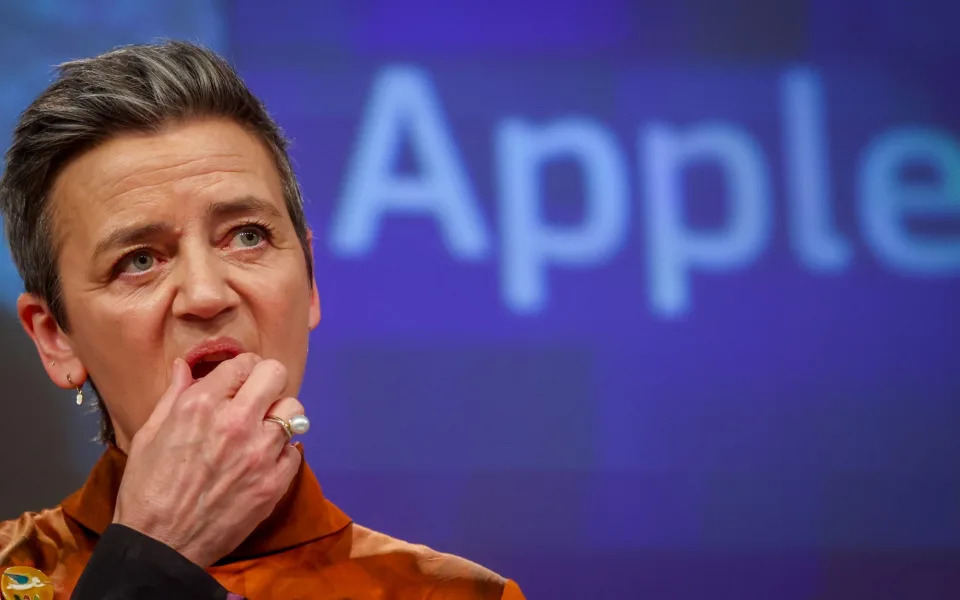

European Commission's competition chief Margrethe Vestager said Apple has 'abused its dominant position' - OLIVIER HOSLET/EPA-EFE/Shutterstock

More than $78bn (£61bn) has been wiped off the value of Apple after it was fined €1.8bn (£1.6bn) by the European Union for breaking the bloc’s competition laws by favouring its own music streaming service over rivals.

The US tech giant’s shares have dropped 2.9pc after it was issued the penalty for raising the price iPhone users pay for music streaming by banning apps like Spotify from promoting cheaper alternatives.

Margrethe Vestager, the European Commission’s competition chief, said Apple had abused a dominant position for a decade, meaning that rivals to Apple Music found it more difficult to compete.


The fine is the first that the EU has imposed on the tech giant. The European Commission said Apple had imposed “anti-steering provisions” that prevented apps such as Spotify from directing users to cheaper subscriptions if users subscribed outside of its app.

The investigation into Apple’s practices was triggered after Spotify made a complaint five years ago.

Apple charges fees of up to 30pc for music subscriptions bought through apps, meaning many streaming companies have offered cheaper alternatives on their website, or stopped offering in-app subscriptions altogether.

Ms Vestager said: “For a decade, Apple abused its dominant position in the market for the distribution of music streaming apps through the App Store. They did so by restricting developers from informing consumers about alternative, cheaper music services available outside of the Apple ecosystem. This is illegal under EU antitrust rules, so today we have fined Apple over €1.8bn.”

Apple said the Commission had failed “to uncover any credible evidence of consumer harm, and ignores the realities of a market that is thriving, competitive and growing fast”.

It said Spotify had “co-ordinated” with the Commission, meeting 65 times over eight years, pointing out that the company is based in Sweden. The company said it would appeal.

Tuesday, November 24, 2020

CRIMINAL CAPPLETALI$M
Apple's security chief charged with bribery


By James Clayton
North America technology reporter

Apple's head of global security has been charged with bribery.

Thomas Moyer is accused of offering bribes in the form of iPads worth $70,000 in order to obtain concealed firearms licenses.

The charges were brought by a California grand jury on Monday. Apple did not immediately respond to requests for comment.

Two police officers from Santa Clara County, California, have also been charged.

County Undersheriff Rick Sung and Sheriff's Captain James Jenson are accused of requesting bribes for concealed firearms licenses.

Mr Moyer is accused of offering bribes to get them.

Under state law, it is a crime to carry a concealed firearm without a concealed weapon license.

Santa Clara County alleges that Mr Sung held back issuing concealed weapons permits to Apple's security team, until Mr Moyer agreed to donate $70,000 worth of iPads to the sheriff's office.

Plan foiled

The charge sheet states that the plan was scuttled at the eleventh hour in August, 2019, when Mr Sung and Mr Moyer learned of a search warrant to seize the police's concealed weapon license records.


The two-year investigation concludes that Mr Sung, aided by Mr Jensen in one instance, would hold back on issuing permits, refusing to release them until the applicants gave something of value.

If found guilty those charged could face prison time.

Santa Clara County District Attorney Jeff Rosen said: "Call this quid pro quo. Call it pay-to-play. Call it give to get. It is illegal and deeply erodes public confidence in the criminal justice system,"

"When high-ranking members of a law enforcement agency are at the heart of a bribery scheme, it tarnishes the badge, the honour, the reputations and - tragically - the effectiveness of all law enforcement agencies."

Related Topics

Apple
California

More on this story


Apple to pay $113m to settle iPhone 'batterygate'

Published5 days ago

Sunday, June 29, 2025

CAPPLETALI$M

Tech Giants Sprint Ahead While Apple Walks on AI

  • Apple's progress in artificial intelligence is described as cautious and incremental, lagging behind rivals such as Google, Microsoft, and Samsung who have aggressively integrated LLMs and generative AI.

  • Siri is highlighted as a central example of Apple's AI struggles, with former employees indicating a preference for incremental changes over a complete rebuild, leading to a slow evolution.

  • The article suggests that Apple's future success depends on its ability to embrace agility and adapt quickly to the rapidly changing AI landscape, rather than maintaining its traditional cautious refinement.

Apple’s position in the rapidly evolving artificial intelligence landscape is increasingly precarious.

While rivals such as Google, Microsoft and even Samsung have surged ahead by integrating large language models (LLMs) and generative AI into their products, Apple’s progress has been notably cautious and incremental.

Commentators and insiders alike question whether Apple is losing the race to harness one of the most critical technology revolutions of the decade.

“I’m massively bearish on it (Apple) long term”, Dan Niles, founder of Niles Investment Management, told the Master Investor podcast, hosted by Wilfred Frost. “They are so far behind on AI, it’s not even funny”.

Climbing a hill, while others sprint

At the centre of Apple’s AI struggle is Siri. Intended to become a conversational assistant powered by large language models (LLMs), its evolution has spluttered.

Former Apple employees describe attempts to integrate AI via “climbing the hill” – incremental changes atop legacy systems – rather than rebuilding from scratch.

As one former exec told the Financial Times: “It was obvious that you were not going to revamp Siri by doing what executives called ‘climbing the hill.’?It’s clear that they stumbled.”

Apple’s annual developer event in early June reflected this caution. Instead of unveiling bold AI advances, the focus shifted to software tweaks and interface updates.

Analysts such as Craig?Moffett warned Apple would “be much more cautious about overpromising and will refrain from showing features that aren’t yet ready for prime time.”

Even Tim?Cook admitted: “It’s just taking a bit longer than we thought… But we are making progress, and we’re extremely excited to get the more personal Siri features out there.”

But this measured tone fell flat against competitors like Google and Microsoft, who have embedded AI more aggressively into search, productivity apps, and hardware.

Performance under scrutiny

Apple’s AI travels at a stately pace in a fast-moving race.

As Niles pointed out, Apple dedicates less than three per cent of revenue to capex and only eight per cent to R&D – well behind peers such as Microsoft (around 12 per cent) and Meta (25 per cent).

Despite commanding a premium market valuation – a high?20s PE compared with broader S&P 500 multiples in the low?20s – Apple’s AI delays and competitive pressures offer little margin for error.

Apple also grapples with external challenges: a 20 per cent drop in its stock this year, regulatory scrutiny of its services division (with gross margins near 74 per cent), and rising tariff risks amid US–China trade tensions.

As Forrester analyst Thomas?Husson noted: “The trade war and uncertainty linked to tariff policy is of much more concern today for Apple’s business than the perception that Apple is lagging behind on AI innovation.”

The Darwinian edge

Niles frames the dilemma through the lens of Darwin.

“The number one thing, especially if you’re a technology investor, but just an investor in general, is what Charles Darwin said… it’s not the strongest of the species that survive, nor the most intelligent, but the one most adaptable to change”, he said.

Apple’s success may now depend on whether it can abandon its perfectionist pace and embrace agility.

As AI reshapes tech at breakneck speed, Apple faces a stark choice – to cling to its legacy model of cautious refinement, or sprint to catch up with rivals rewriting the rules of computing.

By City AM 

Saturday, May 03, 2025

CAPPLETALI$M

Apple expects $900 mn tariff hit as shifts US iPhone supply to India

 AFP
May 1, 2025


Apple chief Tim Cook says most of the iPhones brought into the United States will originate in India as the tech company tries to soften the blow from the US trade war with China - Copyright AFP SONNY TUMBELAKA
Glenn CHAPMAN

Apple on Thursday reported first-quarter profit above expectations but warned that US tariffs could cost the company and was disrupting its supply chain.

Apple expects US tariffs to cost $900 million in the current quarter, even though their impact was “limited” at the start of this year, chief executive Tim Cook said on an earnings call.

Cook said he expected “a majority of iPhones sold in the US will have India as their country of origin,” adding that Apple’s products were exempt from Trump’s most severe reciprocal tariffs for now.

“We are not able to precisely estimate the impact of tariffs, as we are uncertain of potential future actions prior to the end of the quarter,” Cook said. “Assuming the current global tariff rates, policies and applications do not change for the balance of the quarter and no new tariffs are added, we estimate the impact to add $900 million to our costs.”

Tit-for-tat exchanges have seen hefty US levies imposed on China, with Beijing setting retaliatory barriers on US imports.

High-end tech goods such as smartphones, semiconductors and computers received a temporary reprieve from US tariffs.

“Apple proactively built up inventory ahead of anticipated tariff policies,” said Canalys research manager Le Xuan Chiew. “With ongoing fluctuations in reciprocal tariff policies, Apple is likely to further shift US-bound production to India to reduce exposure to future risks.”

While iPhones produced in mainland China still account for the majority of US shipments, production in India ramped up toward the end of the quarter, according to Canalys.

Cook said Vietnam would be the country of origin for almost all iPad, Mac, Apple Watch and AirPod products sold in the US.

China will continue to be where most Apple products are made for sale outside the US, he insisted.

Apple’s revenue of $95.4 billion in the recently ended quarter was driven by iPhone sales, with the company taking in $17 billion in the China market, according to the earnings report. Profit for the quarter was $24.8 billion.

Apple shares slipped more than 3 percent in after-market trading.

“The real story is in Tim Cook’s plans to navigate these unprecedented trade challenges,” said Emarketer analyst Jacob Bourne.

Apple’s plan to shift manufacturing to India “raises pressing questions about execution timeline, capacity limitations, and potentially unavoidable cost increases that will shrink margins, be passed to consumers, or have a mix of consequences,” Bourne added.

Wednesday, April 17, 2024

Apple CEO says that he wants to increase investments in Vietnam

IMPERIALISM; 
THE HIGHEST FORM OF CAPPLETALI$M


Vietnamese Prime Minister Pham Minh Chinh, left, speaks to Apple CEO Tim Cook, right, before their meeting in Hanoi, Vietnam on Tuesday, April 16, 2024. The tech giant CEO is on a visit to Vietnam to promote cooperation and boost investment in the Southeast Asian nation.
 (Duong Van Giang/VNA via AP)


ANIRUDDHA GHOSAL
Tue, Apr 16, 2024,

HANOI, Vietnam (AP) — Apple CEO Tim Cook said Tuesday that he wants to further increase investment in Vietnam a day after the company announced it would spending on suppliers in the Southeast Asian manufacturing hub.

Vietnam has become more important to Apple as the company seeks to diversify its supply chains away from China, where most of its smartphones and tablets are assembled.


The company began looking at moving its production to countries like Vietnam, and more recently India, after shutdowns to fight COVID-19 in China repeatedly disrupted the company's shipments.

Cook made his comments while meeting with Vietnamese Prime Minister Pham Minh Chinh, according to state media outlet Voice of Vietnam. Apple also said that it would increase its spending on suppliers, according to a press release on Monday.

“There is no place like Vietnam, a vibrant and beautiful country," said Cook, according to the press release, adding that the company's annual spending in the country had doubled since 2019.

No details were shared about the plan. Cook arrived in Hanoi on Monday for a two-day visit during which he met students, programmers and content creators.

Apple began operating in Vietnam over a decade ago, and says it is responsible for creating over 200,000 jobs there. Vietnam is also among the top five leading mobile game producers globally.

Apple has 26 suppliers with 28 factories in Vietnam, according to its 2022 list. Most of these located in northern provinces, where they can be easily connected to existing supply chains in southern China. Northern Vietnam has also historically been a hub for making electronics and has cheap, skilled labor.


Apple CEO says company will 'look at' manufacturing in Indonesia

Apple CEO Tim Cook gestures upon the arrival for a meeting with Indonesian President Joko Widodo at palace in Jakarta, Indonesia, Wednesday, April 17, 2024.

2/6

Indonesia Apple
Apple CEO Tim Cook arrives for a meeting with Indonesian President Joko Widodo at the palace in Jakarta, Indonesia, Wednesday, April 17, 2024.(AP Photo/Achmad Ibrahim)
ASSOCIATED PRESS

3/6

Indonesia Apple
Apple CEO Tim Cook ,center, talks to journalist during a joint press conference with Indonesian Minister of Industry Agus Gumiwang Kartasasmita, left, and Indonesian Minister of Communication and Information Technology Budi Arie Setiadi, right, after a meeting with Indonesian President Joko Widodo at the palace in Jakarta, Indonesia, Wednesday, April 17, 2024.(AP Photo/Achmad Ibrahim)
ASSOCIATED PRESS

4/6

Indonesia Apple
Apple CEO Tim Cook walks after a meeting with Indonesian President Joko Widodo at the palace in Jakarta, Indonesia, Wednesday, April 17, 2024.(AP Photo/Achmad Ibrahim)
ASSOCIATED PRESS

5/6

Indonesia Apple
Apple CEO Tim Cook, center, walks with Indonesia’s Minister of industry Agus Gumiwang Kartasasmita, right, and Minister of Communication and Information Technology Budi Arie Setiadi, left, after a meeting with President Joko Widodo at the palace in Jakarta, Indonesia, Wednesday, April 17, 2024.(AP Photo/Achmad Ibrahim)
ASSOCIATED PRESS

Apple CEO Tim Cook, right, walks with Indonesia's Minister of Communication and Information Technology Budi Arie Setiadi, left, after a meeting with President Joko Widodo at the palace in Jakarta, Indonesia, Wednesday, April 17, 2024.
(AP Photo/Achmad Ibrahim)


EDNA TARIGAN and ACHMAD IBRAHIM
Updated Wed, Apr 17, 2024


JAKARTA, Indonesia (AP) — Apple CEO Tim Cook said the company will “look at” manufacturing in Indonesia as he met with Indonesian President Joko Widodo on Wednesday.

“We talked about the president’s desire to see manufacturing in the country, and it’s something that we will look at,” Cook told reporters after the meeting.

Widodo’s administration has worked for years to bring manufacturing to the country to power economic development, while Apple is seeking to diversify its supply chains away from China, where most of its smartphones and tablets are assembled.


The company began moving some production to countries like Vietnam, and more recently India, after shutdowns to fight COVID-19 in China repeatedly disrupted the company’s shipments.

“I think the investment ability in Indonesia is endless. I think that, there is a lot of great places to invest, and we’re investing. We believe in the country,” Cook said.

The previous day, Cook met Vietnamese Prime Minister Pham Minh Chinh in Hanoi, where he said Apple plans to invest more in Vietnam and increase spending on suppliers in the Southeast Asian manufacturing hub.

“Given the slowing Chinese economy as well as the Chinese government’s ongoing efforts to squeeze out foreign companies and replace them with domestic brands, Apple wants alternatives for manufacturing,” said Chris Miller, an associate professor at Tufts University whose work focuses on technology and geopolitics.

“It has already invested more in India and Vietnam, but it is likely looking at other partners in South East Asia to additional manufacturing and assembly operations,” Miller said.

Cook's visit to Indonesia came after Apple announced its fourth Apple Developer Academy in the country, to be located in Bali. The company first launched the program to train app developers in Indonesia in 2018, in the capital Jakarta.

Apple has no manufacturing facilities in Indonesia, but the company says it has invested 1.6 trillion rupiah ($99 million) in its app developer ecosystem in the country.

Widodo's government has sought to leverage the country's reserves of nickel and other raw materials to bring in manufacturing, banning export of raw commodities such as nickel and bauxite to oblige companies to build refineries domestically.

After the meeting with Widodo, Cook also met Indonesia’s president-elect Prabowo Subianto, who is currently defense minister, in Jakarta. He's set to take power in October.

Indonesia’s minister of communication and information, Budi Arie Setiadi, said Wednesday that Microsoft CEO Satya Nadella would visit Indonesia at the end of April. ___

Associated Press writers Victoria Milko in Jakarta and Zen Soo in Hong Kong contributed to this report.

Sunday, June 08, 2025

CAPPLETALI$M

Apple under pressure to shine after AI stumble


By AFP
June 8, 2025


Image: — © AFP
Glenn CHAPMAN

Pressure is on Apple to show it hasn’t lost its magic despite broken promises to ramp up iPhones with generative artificial intelligence (GenAI) as rivals race ahead with the technology.

Apple will showcase plans for its coveted devices and the software powering them at its annual Worldwide Developers Conference (WWDC) kicking off Monday in Silicon Valley.

The event comes a year after the tech titan said a suite of AI features it dubbed “Apple Intelligence” was heading for iPhones, including an improvement of its much criticized Siri voice assistant.

“Apple advertised a lot of features as if they were going to be available, and it just didn’t happen,” noted Emarketer senior analyst Gadjo Sevilla.

Instead, Apple delayed the rollout of the Siri upgrade, with hopes that it will be available in time for the next iPhone release, expected in the fall.

“I don’t think there is going to be that much of a celebratory tone at WWDC,” the analyst told AFP. “It could be more of a way for Apple to recover some credibility by showing where they’re headed.”

Industry insiders will be watching to see whether Apple addresses the AI stumble or focuses on less splashy announcements, including a rumored overhaul of its operating systems for its line of devices.

“The bottom line is Apple seemed to underestimate the AI shift, then over-promised features, and is now racing to catch up,” Gene Munster and Brian Baker of Deepwater Asset Management wrote in a WWDC preview note.

Rumors also include talk that Apple may add GenAI partnerships with Google or Perplexity to an OpenAI alliance announced a year ago.

– ‘Double black eye’ –

Infusing its lineup with AI is only one of Apple’s challenges.

Developers, who build apps and tools to run on the company’s products, may be keen for Apple to loosen its tight control of access to iPhones.

“There’s still a lot of strife between Apple and developers,” Sevilla said. “Taking 30 percent commissions from them and then failing to deliver on promises for new functionality—that’s a double black eye.”

A lawsuit by Fortnite maker Epic Games ended with Apple being ordered to allow outside payment systems to be used at the US App Store, but developers may want more, according to the analyst.

“Apple does need to give an olive branch to the developer community, which has been long-suffering,” Sevilla said. “They can’t seem to thrive within the restrictive guardrails that Apple has been putting up for decades now.”


Apple is expected to lay out its path forward when it comes to artificil intelligence and its closely guarded ‘ecosystem’ of devices and software at its annual Worldwide Developers Conference in Silicon Valley – Copyright AFP Nic Coury

As AI is incorporated into Apple software, the company may need to give developers more ability to sync apps to the platform, according to Creative Strategies analyst Carolina Milanesi.

“Maybe with AI it’s the first time that Apple needs to rethink the open versus closed ecosystem,” Milanesi said.

– Apple on defensive –

Adding to the WWDC buildup is that the legendary designer behind the iPhone, Jony Ive, has joined with ChatGPT maker OpenAI to create a potential rival device for engaging with AI.

“It puts Apple on the defensive because the key designer for your most popular product is saying there is something better than the iPhone,” Sevilla said.

While WWDC has typically been a software-focused event, Apple might unveil new hardware to show it is still innovating, the analyst speculated.

And while unlikely to come up at WWDC, Apple has to deal with tariffs imposed by US President Donald Trump in his trade war with China, a key market for sales growth as well as the place where most iPhones are made.

Trump has also threatened to hit Apple with tariffs if iPhone production wasn’t moved to the US, which analysts say is impossible given the costs and capabilities.

“The whole idea of having an American-made iPhone is a pipe dream; you’d have to rewrite the rules of global economics,” said Sevilla.

One of the things Apple has going for it is that its fans are known for their loyalty and likely to remain faithful regardless of how much time it takes the company to get its AI act together, Milanesi said.

“Do people want a smarter Siri? Hell yeah,” Milanesi said. “But if you are in Apple, you’re in Apple and you’ll continue to buy their stuff.”

Sunday, January 12, 2025

CAPPLETALI$M

Apple wants to keep diversity programs disavowed by other US firms


By AFP
January 12, 2025


Apple has made user privacy a cornerstone of its brand image 
- Copyright GETTY IMAGES NORTH AMERICA/AFP/File SCOTT OLSON

Apple’s board of directors has recommended shareholders vote against a proposal to end the company’s diversity, equity and inclusion (DEI) programs, going against the grain of decisions by other large US corporates.

The National Center for Public Policy Research, a conservative think tank, proposed Apple shareholders consider ending the firm’s DEI program to prevent lawsuits following a 2023 Supreme Court’s ruling against affirmative action in universities.

But the Apple board has recommended voting against the proposal when it meets late this month.

“The proposal is unnecessary as Apple already has a well-established compliance program,” said the board, which includes Tim Cook, the California-based company’s boss.

“The proposal also inappropriately attempts to restrict Apple’s ability to manage its own ordinary business operations, people and teams, and business strategies,” it said, accusing the think-tank of trying to “micromanage” the company.

Apple CEO Tim Cook attended the opening of his company’s newest store in Shanghai, amid growing worries over the iPhone maker’s market share in China
 – Copyright AFP STR, STR

The board said the iPhone maker “is an equal opportunity employer and does not discriminate in recruiting, hiring, training, or promoting on any basis protected by law”.

The proposal will be put to a shareholder vote at Apple’s annual general meeting on February 25.

Following in the footsteps of McDonald’s, Ford, Walmart and a host of others, Meta became the latest US firm to end its DEI programs.

The Friday announcement by Meta which owns Facebook and Instagram, comes amid what it described as “a changing legal and policy landscape”.

President-elect Donald Trump who takes office next week, has been a harsh critic of Meta and its owner Mark Zuckerberg for years, accusing the company of bias against him and threatening to retaliate against the tech billionaire once back in office.

Zuckerberg has been moving aggressively to reconcile with Trump since his election in November, including donating $1 million to his inauguration fund and hiring a Republican as his public affairs chief.

Republicans are also fiercely against DEI programs in corporate America, many of which were established in the aftermath of the Black Lives Matter movement and the nation’s attempt to reckon with longstanding racial disparities.

Read more: https://www.digitaljournal.com/business/apple-wants-to-keep-diversity-programs-disavowed-by-other-us-firms/article#ixzz8xAXerN00

Saturday, November 13, 2021

CAPPLETALI$M

Apple to Pay $30 Million Over Store Workers’ Security Checks


Robert Burnson
Fri, November 12, 2021


(Bloomberg) -- Apple Inc. agreed to pay $29.9 million to employees at its stores who were forced to submit to security bag checks -- off the clock -- when they left work after or during their shifts.Lawyers for the workers asked a federal judge on Friday to approve the settlement, which was reached after a protracted eight-year legal battle.Apple Store employees filed the class-action lawsuit in 2013, claiming the company was violating California law by not paying them for the time it took to check their bags.Apple claimed the bag searches were necessary to make sure workers were not hiding stolen electronic devices in their bags and argued in court that anyone who didn’t like the policy could choose not to bring bags to work.


The lawsuit only covered workers at California’s 52 Apple stores. The class includes 14,683 workers; each will get $1,286 from the settlement, the lawyers said in the court filing.In 2015, a judge granted Apple’s request to toss the lawsuit. But it was revived last year when the Ninth Circuit Court of Appeals ruled that Apple was required to pay employees for the time they spent having their bags checked.

Apple declined to comment on the settlement. The company said in the agreement that it discontinued the check policy in December 2015.The case is Frlekin v. Apple, 13-cv-03451, U.S. District Court, Northern District of California (San Francisco).

Thursday, September 25, 2025

CAPPLETALI$M

Apple presses EU to drop competition law, raises consumer concerns

Apple on Thursday urged the European Union to scrap its Digital Markets Act (DMA), the competition law that came into force last year to curb the power of big tech firms.

 25/09/2025 - RFI

The European Union has imposed new rules on global tech companies. AFP - NIC COURY

The company said the regulation is harming European consumers and weakening the quality of its services.

"The DMA should be repealed while a more appropriate fit for purpose legislative instrument is put in place," Apple said in a formal submission to the European Commission. The statement was filed as part of a public consultation on the law.

EU competition officials say the DMA will make the digital sector in the 27-nation bloc fairer and more open. The legislation targets firms seen as "gatekeepers" with dominant control over online services.

Apple pushes back


Apple has fought the DMA since it was drafted. It argues that the law forces changes that reduce security and limit innovation.

The company, based in Cupertino in California, said it has been forced to remove features from new products released in Europe. Apple said this goes against its mission of giving consumers the most advanced tools possible.

The company also called for the creation of a new independent regulatory agency, separate from the Commission, to enforce the rules if repeal is not possible.


Earphones restricted


Apple gave several examples in its Thursday statement. It said its new wireless earphones, the AirPods Pro 3, had to be released in the EU without the automatic live translation function, one of their headline features. The firm blamed the DMA for the restriction.

Apple also repeated its opposition to opening up its devices to rival app stores and alternative payment systems, which the DMA requires. It argued that these systems do not match the privacy and security standards of its own App Store.

Apple has long relied on a closed ecosystem in which it controls all aspects of its products. It says this model protects users and offers better performance. But EU competition authorities see it as a way of blocking rivals and limiting consumer choice.

Heavy penalties


The Digital Markets Act was adopted in 2022 and took effect in March 2024. It allows the EU to fine companies up to 10 percent of their global turnover, or up to 20 percent for repeat offences.

In April, the European Commission fined Apple €500 million for unfair terms imposed on developers in its App Store. The penalty, which Apple has appealed, was the first handed out under the new law.

Apple also faces a separate EU probe under the Digital Services Act, another flagship law that requires online platforms to protect users from illegal and harmful content.

Wednesday, August 20, 2025

CAPPLETALI$M

UK drops demand for access to Apple user data


By AFP
August 19, 2025


Many tech firms pride themselves on refusing to provide government agencies with access to users' data - Copyright AFP -

Britain has dropped its request for access to Apple users’ encrypted data, which had created friction between London and Washington, US intelligence chief Tulsi Gabbard said Tuesday.

The UK government wanted the tech giant to create a “back door” to let authorities snoop on data uploaded by Apple users if required, for example by law enforcement agencies.

Gabbard said the request “would have enabled access to the protected encrypted data of American citizens and encroached on our civil liberties”.

Many tech platforms pride themselves on being able to guarantee privacy through encryption of messages and other content, and providing access to law enforcement has long been seen as off-limits.

The UK “agreed to drop its mandate” after months of work with US President Donald Trump and Vice President JD Vance, Gabbard posted on X.

The UK interior ministry declined to comment, telling AFP that “We do not comment on operational matters.”

Apple stopped offering its most advanced encryption feature — known as Advanced Data Protection — for British users in February.

ADP ensures that only account holders can view content such as photos and documents stored in the cloud through end-to-end encryption.

Police officials worldwide say encryption can shield criminals, terrorists and pornographers from prosecution even when authorities have a legal warrant for an investigation.

But civil rights and privacy advocates, along with many cybersecurity professionals, praise data encryption as a way to protect against wrongful snooping by authorities as well as hackers.

Apple said earlier this year that it had never built a “back door” or “master key” for any of its products or services, and never would.

Saturday, September 27, 2025

CAPPLETALI$M

Apple asks EU to scrap landmark digital competition law


By AFP
September 25, 2025


Image — © GETTY IMAGES NORTH AMERICA/AFP/File SCOTT OLSON

Apple asked the European Union to scrap its landmark digital competition law on Thursday, arguing that it poses security risks and creates a “worse experience” for consumers.

The US tech giant and the EU have repeatedly locked horns over the bloc’s Digital Markets Act (DMA), which Brussels says seeks to make the digital sector in the 27-nation bloc fairer and more open.

“The DMA should be repealed while a more appropriate fit for purpose legislative instrument is put in place,” Apple said in a formal submission to the European Commission as part of a consultation on the law.

The latest clash came as President Donald Trump sought to pressure the EU over decisions and laws affecting US Big Tech — with key industry figures including Apple chief Tim Cook moving closer to the White House since Trump’s return to power.

“It’s become clear that the DMA is leading to a worse experience for Apple users in the EU,” the tech giant said in a blog post accompanying its submission. “It’s exposing them to new risks, and disrupting the simple, seamless way their Apple products work together.”

Pushing for wholesale reform of the law if it is not repealed, Apple suggested enforcement “should be undertaken by an independent European agency” rather than the commission, the EU’s executive arm and digital watchdog.

The DMA challenges Apple’s closed ecosystem, but Brussels argues that it is necessary to do so to level the playing field for Apple’s rivals and avoid unfair market domination.

The law tells Big Tech firms what they can and cannot do on their platforms. For example, companies must offer choice screens for web browsers and search engines to give users more options.

Violations of the DMA can lead to hefty fines.

Brussels in April slapped a 500-million-euro ($590-million) fine on Apple under the DMA, which the company has appealed.

– Delays for EU users –


Apple says dangers are posed when Europeans can download app marketplaces that rival its App Store.

The giant also cites an increasing number of complaints from users about DMA-related changes but has not provided exact figures.

It argued in its 25-page submission that the EU’s law had forced it to delay new features in the bloc.

For example, Apple has not yet rolled out “live translation” — which allows consumers to choose another language to hear via AirPods in their ears.

The technology was launched this month in the United States but Apple says it must undertake further engineering work to ensure users’ privacy in the EU.

Under the DMA, companies including Apple must make sure their products can work seamlessly with third-party devices such as earphones.

The commission said it was “normal” companies sometimes needed more time to make sure their products were in line with the new law and that it was helping them comply.

DMA enforcement began in March 2024 and the EU’s consultation on the first review of the law ended just before midnight on Wednesday.

Independently from the digital rules, Apple has faced the heat under different EU competition rules. Brussels slapped it with a 1.8-billion-euro fine in March 2024.

EU queries Apple, Google, Microsoft over financial scams


By AFP
September 23, 2025


Image: — © Copyright AFP GREG BAKER


Raziye Akkoc

The European Union on Tuesday demanded Big Tech players including Apple and Google explain what action they are taking against financial scams online, as Brussels seeks to show it is not shying away from enforcing its rules.

The European Commission sent a request for information under the Digital Services Act to the companies, including Microsoft and Booking, “on how they make sure that their services are not being misused by scammers”, an EU spokesman said.

The DSA is the EU’s landmark law demanding Big Tech firms do more to tackle illegal content but it has faced retaliation threats from US President Donald Trump, and censorship claims from the US tech sector.

The EU has vowed it will not back down from enforcing its stringent rules to protect Europeans online.

Tuesday’s request could lead to a probe under the DSA and even fines, but does not itself suggest the law has been broken, nor is it a move towards punishment.

“This is an essential step also to protect users across the EU from certain of these practices, and to make sure that platforms in the EU also play their role,” EU digital affairs spokesman Thomas Regnier told reporters in Brussels.

The request relates to Apple’s App Store, Google Play, online travel agent Booking and Microsoft’s Bing search engine.

The EU fears app stores could be used by scammers to create fake apps posing as legitimate banking providers or fraudsters could publish links to fake websites on search engines.

– Trump threats –

The EU has a bolstered legal armoury with the DSA and its sister law, the Digital Markets Act, which seeks to ensure fair competition online.

Brussels has already launched multiple investigations under the DSA into Meta’s Facebook and Instagram as well as TikTok and X.

But its rules have faced the wrath of Trump — who has shaken up global trade by hitting America’s trading partners with higher tariffs and threatened more levies on those he accuses of targeting US tech companies.

The US State Department, Trump allies and critics including Meta chief Mark Zuckerberg and X owner Elon Musk have called the EU’s rules censorship.

The EU rejects such claims, stressing that whatever is illegal in the real world is also illegal in the online realm.

It has also pushed back at accusations it is targeting American titans, pointing to investigations into China’s big players that face DSA scrutiny including shopping platform AliExpress.

Defenders of the bloc’s tech rules have meanwhile attacked the EU for failing to complete its probe into Musk’s X, which opened in December 2023. X is expected to be hit with a fine but Brussels says technical work in the investigation continues.

EU digital chief Henna Virkkunen told AFP last week that probes into online platforms including X will be completed in the “coming weeks and months”.

She warned more investigations could also be on the way.

“We will probably start new ones because the DSA, of course, it’s a huge legislation,” she said.

Friday, June 13, 2025

CAPPLETALI$M

Foxconn sends 97% of India iPhone exports to U.S. as Apple tackles Trump’s tariffs

By Reuters
June 13, 2025 

An Apple iPhone XR is held at the Steve Jobs Theater after an event to announce new products, in Cupertino, Calif. (AP Photo/Marcio Jose Sanchez, File)

NEW DELHI — Nearly all the iPhones exported by Foxconn from India went to the United States between March and May, customs data showed, far above the 2024 average of 50 per cent and a clear sign of Apple’s efforts to bypass high U.S. tariffs imposed on China.

The numbers, being reported by Reuters for the first time, show Apple has realigned its India exports to almost exclusively serve the U.S. market, when previously the devices were more widely distributed to countries including the Netherlands, the Czech Republic and Britain.

During March-May, Foxconn exported iPhones worth US$3.2 billion from India, with an average 97 per cent shipped to the United States, compared to a 2024 average of 50.3 per cent, according to commercially available customs data seen by Reuters.Latest news & updates on tariffs and the trade war here


India iPhone shipments by Foxconn to the United States in May 2025 were worth nearly US$1 billion, the second-highest ever after the record US$1.3 billion worth of devices shipped in March, the data showed.

Apple declined to comment, while Foxconn did not respond to a Reuters request for comment.

U.S. President Donald Trump on Wednesday said China will face 55 per cent tariffs after the two countries agreed on a plan, subject to both leaders’ approval, to ease levies that had reached triple digits.

India is subject, like most U.S trading partners, to a baseline 10 per cent tariff and is trying to negotiate an agreement to avert a 26 per cent “reciprocal” levy that Trump announced and then paused in April.

Apple’s increased production in India drew a strong rebuke from Trump in May. “We are not interested in you building in India, India can take care of themselves, they are doing very well, we want you to build here,” Trump recalled telling CEO Tim Cook.

In the first five months of this year, Foxconn has already sent iPhones worth US$4.4 billion to the U.S. from India, compared to US$3.7 billion in the whole of 2024.

Apple has been taking steps to speed up production from India to bypass tariffs, which would make phones shipped from China to the U.S. much more expensive. In March, it chartered planes to transport iPhone 13, 14, 16 and 16e models worth roughly US$2 billion to the United States.

Apple has also lobbied Indian airport authorities to cut the time needed to clear customs at Chennai airport in the southern state of Tamil Nadu from 30 hours to six hours, Reuters has reported. The airport is a key hub for iPhone exports.

“We expect made-in-India iPhones to account for 25 per cent to 30 per cent of global iPhone shipments in 2025, as compared to 18 per cent in 2024,” said Prachir Singh, senior analyst at Counterpoint Research.

Tata Electronics, the other smaller Apple iPhone supplier in India, on average shipped nearly 86 per cent of its iPhone production to the U.S. during March and April, customs data showed. Its May data was not available.Latest updates on investing here

The company, part of India’s Tata Group, started exporting iPhones only in July 2024, and only 52 per cent of its shipments went to U.S. during 2024, the data showed.


Tata declined to comment on the numbers.

Indian Prime Minister Narendra Modi has in recent years promoted India as a smartphone manufacturing hub, but high duties on importing mobile phone components compared to many other countries means it is still expensive to produce the devices in India.

Apple has historically sold more than 60 million iPhones in the U.S. each year, with roughly 80 per cent made in China.

---

Reporting by Aditya Kalra and Munsif Vengattil; Editing by Kate Mayberry and Rachna Uppal.

Monday, March 31, 2025

CAPPLETALI$M
France fines Apple 150 million euros over privacy feature

Paris (AFP) – French antitrust authorities handed Apple a 150-million-euro ($162-million) fine on Monday over its app tracking privacy feature, which is also under scrutiny in several other European countries.

Issued on: 31/03/2025 

Apple's privacy feature requires apps to obtain user consent through a pop-up window before tracking their activity across other apps and websites © JUSTIN SULLIVAN / GETTY IMAGES NORTH AMERICA/AFP/File

The watchdog said the way Apple implemented its App Tracking Transparency (ATT) software was "neither necessary nor proportionate to the company's stated goal to protect user data" and also penalised third-party publishers.

In addition to the fine, Apple will have to publish the decision on its website for seven days.

Authorities in Germany, Italy, Romania and Poland have opened similar probes over ATT, which Apple promotes as a privacy safeguard.

"While we are disappointed with today's decision, the French Competition Authority has not required any specific changes to ATT," Apple said in a statement.


The feature, introduced by Apple in 2021, requires apps to obtain user consent through a pop-up window before tracking their activity across other apps and websites.

If they decline, the app loses access to information on that user which enables ad targeting.

Critics have accused Apple of using the system to promote its own advertising services while restricting competitors.
'More control over privacy'

In its decision, France's Competition Authority said the ATT feature leads to an excessive number of consent windows for third-party apps on iPhones and iPads, making the experience more cumbersome.

It also found that Apple's system required users to opt out of ad tracking twice rather than once, "undermining the neutrality of the feature" and causing economic harm to app publishers and ad service providers.

The authority added that Apple's approach disproportionately affects smaller publishers, who rely heavily on third-party data collection to fund their businesses.

Following complaints from advertising industry players who claimed ATT hindered their ability to target users, France's competition watchdog initially declined to impose emergency measures in 2021 but continued its investigation.

Apple said on Monday that ATT "gives users more control of their privacy through a required, clear, and easy-to-understand prompt about one thing: tracking".

"That prompt is consistent for all developers, including Apple, and we have received strong support for this feature from consumers, privacy advocates, and data protection authorities around the world," it said.

© 2025 AFP


Apple heavily condemned in France for its ad targeting system

Paris (AFP) - Apple was fined €150 million by the French Competition Authority on Monday for abuse of a dominant position in the context of targeted advertising on its devices, as similar investigations target the company in other European countries.


Published: 31/03/2025 - 

Apple was fined €150 million by the French Competition Authority on Monday for abuse of a dominant position in the context of advertising targeting on its devices © Philippe HUGUEN / AFP/Archives

The American giant has been sanctioned for the use of its ATT ("App Tracking Transparency") device, presented as an additional protection of users' private data.

The "implementation methods (of this system) are neither necessary nor proportionate to Apple's stated objective of data protection", which penalises third-party publishers, the body stressed on Monday at a press conference.

"While we are disappointed by today's decision, the French Competition Authority has not required specific changes to App Tracking Transparency (ATT)," Apple said in a statement.

The French antitrust authority has indicated that it is up to the American company to comply.

This amount of 150 million euros "seemed appropriate" and "reasonable" to us, explained Benoît Coeuré, the president of the French competition watchdog, which he said represents "a fairly modest sum when you take into account Apple's turnover", which is close to $400 billion in 2024.

Apple will also have to publish a summary of the decision on its website for seven days.
Small publishers penalised

To justify its decision, the Competition Authority notes that this device "leads to a multiplication of consent collection windows, excessively complicating the journey of users of third-party applications" on iPhones and iPads.

In addition, the fact that the user has to refuse advertising tracking on third-party applications twice, instead of once, "undermines the neutrality of the system, causing a certain economic damage to application publishers and advertising service providers".

The regulator believes that the system as it is implemented by Apple "penalizes in particular the smallest publishers" who "depend largely on the collection of third-party data to finance their activity".

Introduced by the American giant in early 2021, the ATT system opens a consent window for the opening of each application.

If a user clicks "no," the app loses access to that person's advertising ID, a unique number that allows them to be tracked online.

This device was suspected of favoring Apple's own services to the detriment of third-party applications.


"Important victory"


"This decision marks an important victory for the 9,000 companies in the media and online advertising ecosystem," several players in the sector, including Alliance Digitale, the Syndicat des Régies Internet and the Union of Media Consulting and Buying Companies, said in a joint statement.

They had referred the matter to the French competition watchdog in 2020 to denounce an obstacle to their targeting capacity, which had initially rejected a request for interim measures in 2021 but had continued the investigation on the merits.

This decision should be observed in Germany, where Apple has been in the crosshairs since June 2022.

The American firm suffered a legal setback in mid-March after the courts confirmed that it had been placed under enhanced surveillance, leaving the group under the threat of measures to regulate its activity.

The competition authorities of Italy, Romania and Poland have also launched similar investigations.

For its part, the European Union reaffirmed in February that it would strongly defend its legislation on digital services targeting American tech giants.

And this, even in the event of retaliatory measures from Washington: President Trump has indicated that he will consider customs duties in response to the "taxes, fines and regulatory constraints on digital services" that would apply to American companies in the EU, and in particular the "tech" giants.

© 2025 AFP

Tuesday, December 15, 2020

UPDATES
#CAPPLETALI$M #WILDCAT STRIKE
Apple probes supplier after workers at Wistron plant in India rampage

An Apple logo hangs above the entrance to the Apple store on 5th Avenue in the Manhattan borough of New York City

By Sankalp Phartiyal and Chandini Monnappa

NEW DELHI/BENGALURU (Reuters) - Apple Inc said on Monday it is investigating whether a Taiwan contractor, Wistron Corp, flouted supplier guidelines at an iPhone manufacturing facility in India, after some workers ransacked the plant in a protest over unpaid wages.

Thousands of contract workers gathered on the grounds of the Wistron site on the outskirts of India's tech hub of Bengaluru on Saturday demanding unpaid wages and better working hours.

As police arrived, the crowd turned violent and video from the scene showed people armed with rods and sticks smashing equipment and vandalizing cars, causing what the company estimated at $60 million in damage.

"We have teams on the ground and have immediately launched a detailed investigation at Wistron's Narasapura facility," Apple said in an email, adding it was dedicated to ensuring everyone in its supply chain was treated with dignity and respect.

Apple said it was sending staff and auditors to the site and was cooperating with police in their investigation.


Wistron, one of Apple's top global suppliers, said in a regulatory filing in Taiwan it "always abides by the law, and fully supports and is cooperating with relevant authorities".

Wistron has been making iPhones in India for nearly four years and its operation has been seen as a success story for Prime Minister Narendra Modi's government that is looking to boost manufacturing.

"The incident hurts the 'Make in India' label," said independent brand consultant Harish Bijoor, referring to the government promotion campaign slogan. "Such events are small scars left on India as a manufacturing facility."

Apple, under the leadership of Tim Cook, has been looking to not only step up its marketing and presence in India - one of the biggest smartphone markets in the world - but also expand its sourcing footprint in the South Asian nation.

A minister for the state of Karnataka, where the factory is located, said the government was talking to all parties and that the labour department was investigating any underpayment of wages and non-clearance of other dues.

The unrest comes as Modi's government is under pressure from protesting farmers opposed to reforms in the agricultural sector, which they say threaten their livelihoods.


MILLIONS IN DAMAGES

Videos taken by employees in the Wistron factory showed men, many wearing masks due to the coronavirus outbreak, destroying security cameras, windows and other equipment.

The crowd smashed four cars, two golf carts, stole laptops and smartphones and destroyed other office equipment, according to a police report filed by Wistron and reviewed by Reuters.

In the complaint, Wistron accused more than 5,000 contract workers and some 2,000 unknown people of destruction of property. It put the losses at 4.38 billion rupees ($60 million).

Police have arrested 149 people over the violence, a senior officer said, while a search was on to identify and arrest more perpetrators as the investigation continues.

Trade union leader M.D. Harigovind said the violence was a direct result of the "brutal exploitation of workers and sweatshop like conditions".


Wistron, whose workers are not unionized, did not respond to questions seeking comment on the allegations, but said in a statement earlier it was "deeply shocked" by the violence it blamed on "unknown persons ... with unclear intentions".

(Reporting by Sankalp Phartiyal in New Delhi, Ben Blanchard in Taipei and Chandini Monnappa in Bengaluru; Writing by Nivedita Bhattacharjee; Editing by Euan Rocha, Arun Koyyur and Stephen Coates)


Originally published as 
SABOTAGE, THE CONSCIOUS WITHDRAWAL OF THE WORKERS' INDUSTRIAL EFFICIENCY, in October, 1916, by the IWW publishing bureau, in Cleveland


Apple supplier Wistron puts India plant damage at up to $7 million

Mon, December 14, 2020,
Men wearing protective face masks walk past broken windows of a facility run by Wistron Corp in Narsapura


TAIPEI (Reuters) - The ransacking of an iPhone manufacturing facility in India caused up to T$200 million ($7.12 million) in damage though production facilities were not as badly hit as reported, its Taiwan-based operator Wistron Corp said on Tuesday.

Thousands of contract workers gathered on the grounds of the Wistron site on the outskirts of India's tech hub of Bengaluru on Saturday demanding unpaid wages and better working hours.

As police arrived, the crowd turned violent and video from the scene showed people armed with rods and sticks smashing equipment and vandalising cars. In a police report seen by Reuters, Wistron estimated damages worth $60 million.


However, in a statement to the Taiwan Stock Exchange on Tuesday, the company said major production facilities and warehouses had not suffered as serious damage as reported by local media, and that it was initially estimating losses at T$100-200 million.

The company is doing its utmost to get the plant back up and running, it said. Wistron shares fell around 2.5% in early Asia trade, underperforming Taiwan's broader stock market.

"The company has cooperated with the relevant authorities and the police investigation and continues to negotiate with the insurance company," Wistron added, without elaborating.

Apple Inc said on Monday it was investigating whether Wistron had flouted supplier guidelines. Apple said it was sending staff and auditors to the site and was cooperating with police in their investigation. Wistron is one of Apple's top global suppliers.

It has been making iPhones in India for nearly four years and its operation has been seen as a success story for Prime Minister Narendra Modi's government that is looking to boost manufacturing.

($1 = 28.1040 Taiwan dollars)

(Reporting by Ben Blanchard; Additional reporting by Twinnie Siu in Hong Kong; Editing by Ana Nicolaci da Costa)


Apple Probes iPhone Supplier After Worker Protests Over Wages, Working Hours Turn Violent In India

Shivdeep Dhaliwal
Sun, December 13, 2020


An Apple Inc (NASDAQ: AAPL) supplier’s factory has been attacked by workers in India who claim they were brutally exploited, the Wall Street Journal reported Sunday.

What Happened: Taiwan-based Wistron Corporation, whose factory near Bengaluru is often showcased by Indian authorities as an example of homegrown manufacturing, saw violence including arson by workers angry over wages and working hours, according to the Journal.

M.D. Harigovind, an official from an Indian union, attributed the agitation to “the brutal exploitation of workers and sweatshop-like conditions.”

Wistron said it was “deeply shocked” by the unrest with a spokesperson reportedly saying “we follow the law and are supporting the authorities with their investigation.”

An Apple spokesperson said the tech giant is “dedicated to ensuring everyone in our supply chain is treated with dignity and respect,” the Journal reported. The Cupertino-based company told the Economic Times that it is probing the allegations against Wistron.

Why It Matters: Last month, Apple put another Taiwanese supplier, Pegatron Corporation, on probation after it discovered cases of labor violations.

In mainland China, Apple employees have alleged that the Tim Cook-led company is complicit in the violation of the country’s labor laws.