“Exterminate the Brutes”: From American Concentration Camps to Contemporary Imperialism
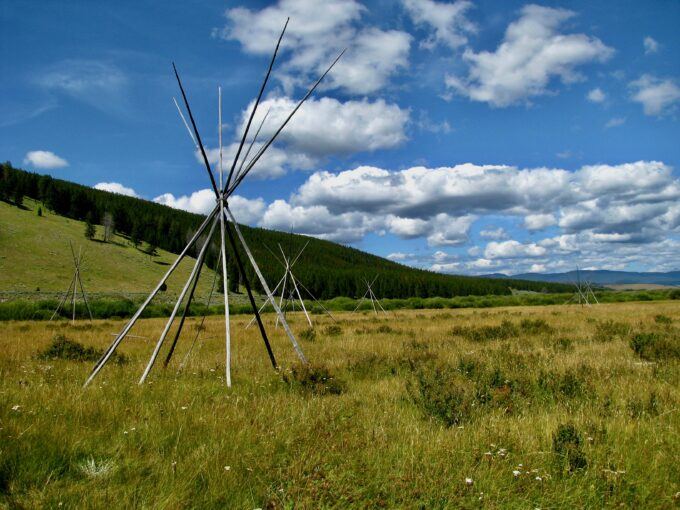
Nez Perce Camp at Big Hole massacre site, Montana. Photo: Jeffrey St. Clair.
”Native Americans will tenaciously defend the legal, political and cultural boundaries of their sovereignty using every means available to American citizens: voting, protesting, petitioning, lobbying, marching and litigating.”
– Paul Rosier, Indigenous Citizens: Native Americans’ Fight for Sovereignty 1776-2025
L. Frank Baum’s The Wizard of Oz boasts a large cast of characters: Munchkins; a tribe of flying jungle monkeys; a Good Witch and a Wicked Witch; a girl named Dorothy, her dog Toto and their companions on the red brick road, as well as a Wizard who turns out to be a fraud. It doesn’t feature any Indians, perhaps because Baum called for the total annihilation of the Indians who lived in and around Kansas, Dorothy’s home state. In editorials published in the Saturday Pioneer, a small town newspaper in December 1890—soon after the U.S. Seventh Cavalry shot and killed several hundred Indians, most of them women and children—Baum wrote, “The Whites by law of conquest, by justice of civilization, are masters of the American continent, and the best safety of the frontier settlements will be secured by the total annihilation of the few remaining Indians.”
Those words appeared in an editorial published after the death on December 15, 1890 of Sitting Bull, the Hunkpapa Lakota warrior who led resistance to American imperialism and colonialism. In a second no less virulent editorial published after the massacre of Indians at Wounded Knee on December 29, 1890, Baum wrote, “our only safety depends upon the total extermination of the Indians. He added, “wipe these untamed and untamable creatures from the face of the earth.”
“Exterminate the Brutes,” Mr. Kurtz exclaims in Joseph Conrad’s novella Heart of Darkness (1899). Colonialists around the world have echoed his sentiments. A 2021 HBO mini-series titled Exterminate the Brutes, inspired in large part by Sven Lindvuist’s book of the same name, traces the history of colonialism and imperialism. (Edward Said once explained to me that “imperialism” was the theory and “colonialism” the practice). Ironically, Mr. Kurtz begins his journey into the heart of darkness wanting to bring light and civilization to the Congolese. Like many colonists he had high ideals.
I had to read about Belgian brutality in the Congo before I learned about American brutality from Massachusetts to California in books like Bury My Heart at Wounded Knee by Dee Brown and Luther Standing Bear’s Land of the Spotted Eagle in which he wrote “Only to the white man was nature a ‘wilderness’ and only to him was the land ‘infected’ with ‘wild’ animals and ‘savage’ people. To us it was tame.” He added, “When the very animals of the forest began fleeing from his approach, then it was that for us the ‘Wild West’ began.” To Dee Brown’s and Luther Standing Bear’s books, I now turned to Paul Rosier’s masterpiece.
No 19th century US writer offered an expose of American genocide that matched Conrad’s exposé of Belgian colonialism. James Fenimore Cooper celebrated the pioneers and the pathfinders and looked forward to “the last of the Mohicans.” John Muir argued that Yosemite was a more beautiful place without the Indians than it was with them, and Teddy Roosevelt wanted national parks for white people on land that once provided a home to Native Americans.
Baum was certainly not the first nor would he be the last white man to call for genocide against the American Indian. In 1783, George Washington wrote, as though fate was at work, “The gradual extension of our Settlements will as certainly cause the Savage as the Wolf to retire; both being beasts of prey though they differ in shape.”
Eleven years later, in 1804, an alarmist Thomas Jefferson echoed the sentiments of Washington: “If ever we are constrained to lift the hatchet against any tribe, we will never lay it down till that tribe is exterminated…In war they will kill some of us; we shall destroy all of them.” Doesn’t Jefferson sound like the current imperial president, Donald Trump, and his Secretary of War, pistol Pete Hegseth, talking about Iran today?
Of course, there were some public figures and writers who denounced the genocide against the Indians, among them author Lewis Mumford and actors Tallulah Bankhead and Marlon Brando who was arrested in 1964 when he supported Indian fishing rights in Washington and later when he dispatched Sacheen Littlefeather to refuse his 1973 Oscar as a way to demonstrated his condemnation of Hollywood’s portrayal of native Americans.
In Indigenous Citizens, his comprehensive new book about Indian struggles for both sovereignty and 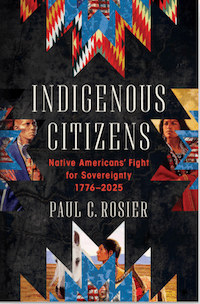 citizenship, Villanova University Professor Paul Rosier offers a telling quotation from novelist Henry Miller who wrote in The Air-Conditioned Nightmare (1945) that the policy of genocide included “poisoning the Indians with alcohol and venereal disease, raping their women and murdering their children” and that it included herding them “into concentration camps.” Miller called it by its right name.
In the 1950s, the Bureau of Indian Affairs (BIA) took Native people from their homes and dispatched them to Chicago, Dallas, Denver, San Francisco and Los Angeles. “Native families were enticed by slick marketing brochures featuring information about vocational training programs” and displaying “photos of tract homes with kitchens full of modern appliances, and a Native family watching a TV set in a modern living room.” On at least one notable occasion that Rosier mentions, BIA agents “loaded people onto trucks after promising employment” in distant cities and took them away. Echoes of the rounding-up of Jews in Germany.
Of course, Hitler learned from the US policy of extermination. His “Final Solution” brought to Germany the vision of Washington, Jefferson, Andrew Jackson and the practice of tens of thousands of settler colonialists and soldiers who invaded Indian territory, stole Indian land and slaughtered the Indians who resisted them by any means necessary in the spirit of guerrilla warriors and global insurgents against empire.
The great value of Rosier’s well-researched, carefully documented tell-it-like-it-is narrative is that it places the history of the American Indian at the heart of American history and connects it to global movements against colonialism and for independence from European imperial powers. Of course, what became known as the continent of North America became a bloody battlefield at the center of world history once European invaders, explorers, questers, soldiers and priests arrived with guns and bibles, horses and sheep, diseases and racism.
Indians used their wits, their savvy sense of diplomacy and their formidable military might to contest the colonizers and force them to sign treaties. But their bows and arrows and their sense of human dignity and their beliefs in inalienable rights were no match for the duplicity and the weapons of the Europeans and the Americans who tore up treaties, pushed Indians further and further West and pursued Manifest Destiny, a cover for what Rosier calls “exterminationist ideology.”
In the chapter titled “No Indians and Dogs Allowed!” Rosier writes, “It is essential to view post-World War II Native American political movements within a global frame.” He adds that “After the war ended, Native people confronted a host of discriminatory actions, including voter suppression, racially restrictive housing covenants, and prohibitions against receiving state and federal benefits.”
Details amplify that story. “Businesses with signs reading ‘No Indians and Dogs Allowed’ dotted the landscape.” “Two white men spent only three months in jail for killing a fifteen-year-old Native girl, by throwing her from a moving car.”
One might say that genocide has been expressed in two forms: one hard with guns and bullets and the other soft, though no less killing with cultural and political weapons meant to rob Indians of their identities, languages and religious practices.
Bumper stickers read, “The only good Indian is a dead Indian,” “Save a deer. Shoot an Indian” and “Too bad Custer Ran Out of Bullets.” During McCarthyism, Indians were excoriated as communist and socialist and more recently as terrorists. Rosier cites the case of a celebrated Korean War veteran who was denied burial in a Sioux City, Iowa cemetery because, as a Native American, his remains were verboten.
Until 2023, the California College of the Law was named after Serranus Clinton Hastings, a lawyer, rancher and the chief justice of the California Supreme Court who led murderous campaigns against Indians in Mendocino County.
Battles have been fought in courtrooms and schools, in Hollywood studios where Indians have been caricatured and at sports stadiums where teams have been called “Redskins” and fans have practiced the “tomahawk chop.” Recent American political figures including Reagan and Schwarzenegger have not been more enlightened than Washington, Jefferson, and Jackson.
California Governor, Schwarzenegger, the billionaire son of an Austrian-born Nazi, complained that Indians “were ripping off” white people when the exact opposite was true. An article titled “Arnold Schwarzenegger Girds for Indian War” quoted him as saying, “It’s time the Indians pay their fair share.” Rosier points out that California Indians with casinos deposited “$350 million in the state’s general fund and helped to eliminate the state’s budget deficit.”
Rosier makes it clear that Indians share a common history, collective struggles and shared goals, though he also writes that “to generalize accurately about the whole spectrum of Indian concerns is impossible.” He points out that Native Americans are Democrats, Republicans, Socialists and apolitical, that they are Quakers, Baptists, Catholics, Protestants and “practitioners of their traditional religions.” He adds that “In 2024, over nine million Native American and Alaska Native citizens of 574 federally recognized Indigenous nations lived on 334 reservations in thirty-five states and in small towns, suburbs and cities in all fifty states.”
I remember a talk by Greg Sarris, an author, a friend, a colleague at Sonoma State University and the chairman of the Federated Indians of Graton Rancheria, a tribe he helped to create. A member of the audience raised his hand, and, when Greg called on him, he asked “What do Indians think of Bill Clinton?” Greg smiled and replied, “I can’t speak for all Indians and not even for all the Indians in my tribe.” He also noted that to be an Indian was a choice and not something determined by blood or DNA. It was a matter of personal cultural identity.
Rosier writes extensively about who is and who isn’t an Indian and how that’s determined today. Indeed, different tribes have adopted different methods; no longer is there an easy road to membership in a tribe. There’s also no one single way to defend Indian culture and identity. ”Native Americans,” Rosier explains, “will tenaciously defend the legal, political and cultural boundaries of their sovereignty using every means available to American citizens: voting, protesting, petitioning, lobbying, marching and litigating.”
One might add that they will occupy islands like Alcatraz, towns like Wounded Knee and reservations like Standing Rock where Indians and their supporters gathered in 2016 and 2017 to protest the construction of the Dakota Access Pipeline. The good news or at least one of them is that between 1990 and 2000, the Indian population increased by over 1 million. No longer can one say that Indians are “retiring,” “invisible” and “vanishing” as though that was a choice they made. Natives are here to stay.
“The world begins at a kitchen table. No matter what, we must eat to live,” the inimitable poet Joy Harjo (Mvskoke/Creek) writes in “Perhaps the World Ends Here,” which seems to honor survival and joy in an impossible world. Harjo adds, “Perhaps the world will end at the kitchen table, while we are laughing and crying, eating of the last sweet bite.”


No comments:
Post a Comment