US Supreme Court rules against ban on ‘conversion therapy’ for LGBTQ minors
8-1 MAJORITY
By AFP
March 31, 2026

The US Supreme Court ruled against a ban on 'conversion therapy' for LGBTQ youth, siding with a Christian therapist who said the law violated her free speech rights - Copyright AFP Alex WROBLEWSKI
The US Supreme Court ruled Tuesday against a Colorado state law banning “conversion therapy” for LGBTQ minors, siding with a Christian therapist who challenged it on the grounds of free speech.
At issue is the constitutionality of a 2019 Colorado law that prohibits licensed practitioners from conducting “conversion therapy” on patients under 18.
Proponents of the treatment claim to change the sexual orientation or gender identity of LGBTQ people.
The therapy has been discredited by major medical organizations, including the American Psychiatric Association and the American Medical Association, and is banned in more than 20 US states and much of Europe.
Research has shown that it is ineffective and even harmful, leading to depression and suicidal thoughts.
But in a 8-1 decision, the court ruled in favor of Kaley Chiles, a licensed mental health counselor who invoked her Christian faith and challenged the law, arguing that it violated her First Amendment right of free speech.
“Colorado’s law addressing conversion therapy does not just ban physical interventions. In cases like this, it censors speech based on viewpoint,” wrote conservative Justice Neil Gorsuch in the decision on behalf of the majority of the Court.
“As applied to Ms. Chiles, Colorado’s law regulates the content of her speech and goes further to prescribe what views she may and may not express, discriminating on the basis of viewpoint,” he argued.
The First Amendment, Gorsuch wrote, is a “shield against any effort to enforce orthodoxy in thought or speech in this country.”
As a result, the Supreme Court sent the case back to the lower courts to review their decisions in light of this ruling.
– ‘Can of worms’ –
Only the liberal Justice Ketanji Brown Jackson expressed dissent, accusing her colleagues of opening “a dangerous can of worms” by undermining states’ ability to regulate medical practices that “risks grave harm to Americans’ health and wellbeing.”
“The Constitution does not pose a barrier to reasonable regulation of harmful medical treatments just because substandard care comes via speech instead of scalpel,” she wrote.
Chiles’ lawyer, James Campbell, of the conservative Alliance Defending Freedom, hailed the ruling in a statement as “a significant win for free speech, common sense, and families desperate to help their children.”
After taking office for his second term in January, President Donald Trump said the US government would only recognize two genders — male and female — and signed an executive order restricting gender transition medical procedures for people under the age of 19.
In June, the Supreme Court voted 6-3 to uphold a Tennessee state law banning hormone therapy, puberty blockers and gender transition surgery for minors.
Conversion therapies are banned, at least partially, in many countries, with the support of health organizations such as the Royal College of Psychiatrists in Great Britain.
The UN has called for a global ban, describing them as discriminatory, humiliating and a violation of individuals’ bodily integrity.
By AFP
March 31, 2026
The US Supreme Court ruled against a ban on 'conversion therapy' for LGBTQ youth, siding with a Christian therapist who said the law violated her free speech rights - Copyright AFP Alex WROBLEWSKI
The US Supreme Court ruled Tuesday against a Colorado state law banning “conversion therapy” for LGBTQ minors, siding with a Christian therapist who challenged it on the grounds of free speech.
At issue is the constitutionality of a 2019 Colorado law that prohibits licensed practitioners from conducting “conversion therapy” on patients under 18.
Proponents of the treatment claim to change the sexual orientation or gender identity of LGBTQ people.
The therapy has been discredited by major medical organizations, including the American Psychiatric Association and the American Medical Association, and is banned in more than 20 US states and much of Europe.
Research has shown that it is ineffective and even harmful, leading to depression and suicidal thoughts.
But in a 8-1 decision, the court ruled in favor of Kaley Chiles, a licensed mental health counselor who invoked her Christian faith and challenged the law, arguing that it violated her First Amendment right of free speech.
“Colorado’s law addressing conversion therapy does not just ban physical interventions. In cases like this, it censors speech based on viewpoint,” wrote conservative Justice Neil Gorsuch in the decision on behalf of the majority of the Court.
“As applied to Ms. Chiles, Colorado’s law regulates the content of her speech and goes further to prescribe what views she may and may not express, discriminating on the basis of viewpoint,” he argued.
The First Amendment, Gorsuch wrote, is a “shield against any effort to enforce orthodoxy in thought or speech in this country.”
As a result, the Supreme Court sent the case back to the lower courts to review their decisions in light of this ruling.
– ‘Can of worms’ –
Only the liberal Justice Ketanji Brown Jackson expressed dissent, accusing her colleagues of opening “a dangerous can of worms” by undermining states’ ability to regulate medical practices that “risks grave harm to Americans’ health and wellbeing.”
“The Constitution does not pose a barrier to reasonable regulation of harmful medical treatments just because substandard care comes via speech instead of scalpel,” she wrote.
Chiles’ lawyer, James Campbell, of the conservative Alliance Defending Freedom, hailed the ruling in a statement as “a significant win for free speech, common sense, and families desperate to help their children.”
After taking office for his second term in January, President Donald Trump said the US government would only recognize two genders — male and female — and signed an executive order restricting gender transition medical procedures for people under the age of 19.
In June, the Supreme Court voted 6-3 to uphold a Tennessee state law banning hormone therapy, puberty blockers and gender transition surgery for minors.
Conversion therapies are banned, at least partially, in many countries, with the support of health organizations such as the Royal College of Psychiatrists in Great Britain.
The UN has called for a global ban, describing them as discriminatory, humiliating and a violation of individuals’ bodily integrity.
Young people are more than twice as likely to attempt suicide if they have been subject to conversion therapy, which LGBTQ+ rights advocates say is “proven to cause lasting psychological harm.”
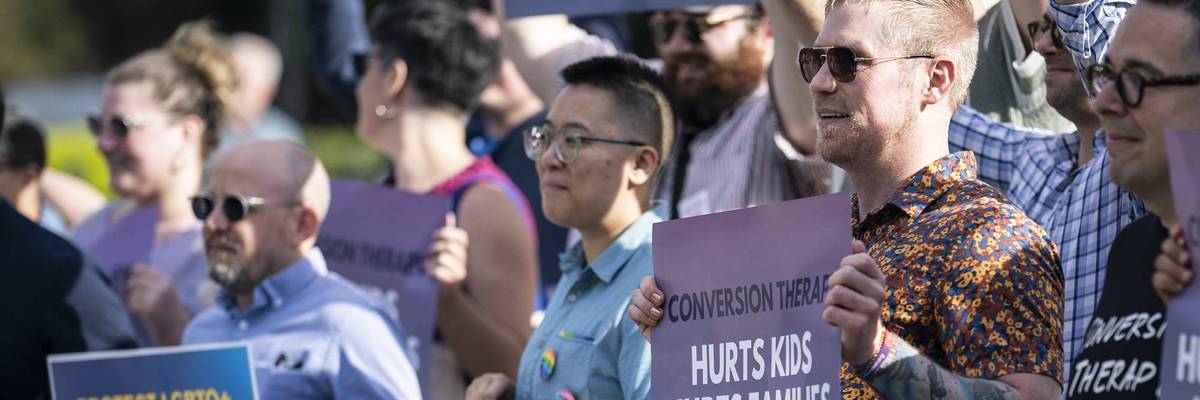
Demonstrators with the Human Rights Campaign stand outside the United States Supreme Court on Capitol Hill on October 7, 2025, in Washington, DC.
(Photo by Jabin Botsford/The Washington Post via Getty Images)
Stephen Prager
Mar 31, 2026
COMMON DREAMS
The US Supreme Court on Tuesday struck down Colorado’s ban on “conversion therapy,” drawing warnings from LGBTQ+ groups that the ruling could expose children in dozens of states to the harmful practice.
Colorado’s law forbade licensed physicians and mental healthcare providers from attempting to “convert” or change a minor’s sexuality, a practice that the American Psychological Association has found to be both ineffective and dangerous, raising rates of depression, anxiety, and suicide in LGBTQ+ youth.
The law defined “conversion therapy” as any treatment that “attempts or purports to change an individual’s sexual orientation or gender identity, including efforts to change behaviors or gender expressions or to eliminate or reduce sexual or romantic attraction or feelings toward individuals of the same sex.”
It allowed exemptions for pastors and religious organizations. It also allowed health professionals to engage in wide-ranging discussions with children about their sexual and gender identities, so long as they did not try to change the child’s orientation.
Nevertheless, on Tuesday, the high court sided 8-1 with Kaley Chiles, a Christian counselor who said she wished to offer talk therapy to children who want to reduce same-sex attraction and argued that the ban on this practice was in violation of her First Amendment rights.
Chiles was backed by the Trump administration, as well as the far-right Alliance Defending Freedom, a Christian nationalist legal group with a long history of seeking to outlaw same-sex conduct.
Most famously, the group argued in support of state laws criminalizing homosexuality in the 2003 Lawrence v. Texas case, and it has since gone on to back many other cases attacking birth control access, same-sex marriage, and transgender equality.
In the majority opinion, the conservative Justice Neil Gorsuch wrote that Colorado’s law “censors speech based on viewpoint” and therefore must be subject to strict scrutiny—the highest form of judicial review, which the court determined it did not pass.
The lone dissenting justice, Ketanji Brown Jackson, argued that Chiles’ treatment was not mere speech, but that it was acting in her capacity “as a licensed healthcare professional,” which formed the crux of Colorado’s defense of the ban.
She argued that the ruling “opens a dangerous can of worms” and “threatens to impair states’ ability to regulate the provision of medical care in any respect.”
“Because the majority plays with fire in this case, I fear that the people of this country will get burned,” Jackson said.
Two liberals, Justices Elena Kagan and Sonia Sotomayor, joined the conservatives in striking the law down. However, they argued in a concurring opinion that a full ban on therapy aimed at changing minors’ sexuality might be more lawful than the one Colorado passed, which included carveouts for specific circumstances.
Kagan also argued that allowing Colorado to outlaw conversion therapy could backfire and give red states the legal framework to also ban counselors from providing affirmative care to LGBTQ+ minors.
LGBTQ+ rights organizations have roundly condemned the court’s decision, which is expected to weaken bans on conversion therapy in the 23 states and the District of Columbia that currently have them.
“Today’s reckless decision means more American kids will suffer,” said Kelley Robinson, the president of the Human Rights Campaign. “The Court has weaponized free speech in order to prioritize anti-LGBTQ+ bias over the safety, health, and well-being of children.”
A 2024 mental health survey by the Trevor Project, an LGBTQ+ advocacy group, found that 13% of LGBTQ+ young people have been either threatened with or subject to conversion therapy—including about 1 in 6 transgender or nonbinary youth.
Previously, the group published peer-reviewed research in the American Journal of Public Health, showing that young people subject to conversion therapy were more than twice as likely to attempt suicide as their peers.
“These efforts, no matter what proponents call them, no matter what any court says, are still proven to cause lasting psychological harm,” said Trevor Project CEO Jaymes Black. “That’s why protections have been enacted in more than 20 states, and are supported by every major medical and mental health association in the country.”
Carl Charles, a senior attorney at Lambda Legal who joined more than a dozen survivors of the practice in a friend of the court brief in support of Colorado’s law, said, “I know firsthand the long-lasting harms of conversion therapy, having been subjected to it when I was 15 years old.”
“This practice did not change my sexual orientation or gender identity,” said Charles, a transgender man. “Instead, it destroyed important relationships and created shame and fear that took time and effort to undo. For many survivors, it is a reverberating life-long harm.”
“LGBTQ+ youth do not need to be changed,” Charles said. “Rather, like all youth, they need to be supported and celebrated for the unique and important people they are becoming.”
Colorado’s Democratic Gov. Jared Polis has said he will seek to pass new legislation that complies with the Supreme Court’s ruling.
“Conversion therapy doesn’t work, can seriously harm youth, and Coloradans should beware before turning over their hard-earned money to a scam,” Polis said. “I am evaluating the US Supreme Court ruling and working to figure out how to better protect LGBTQ youth and free speech in Colorado.”
In other states whose bans could be undermined by the ruling, efforts have already begun to ensure that providers who cause harm to children still face accountability.
In California, which has a similar ban on conversion therapy to Colorado’s, state Sen. Scott Weiner (D-11) introduced a bill proposing a longer statute of limitations and making it easier for LGBTQ+ individuals to bring malpractice claims against medical professionals who subject them to conversion therapy.
Weiner noted that the Supreme Court’s ruling “explicitly states that malpractice claims for conversion therapy are different than bans,” since they require a plaintiff to demonstrate injury caused by their treatment.
“You can’t ‘convert’ someone who’s LGBTQ—full stop—and people who think you can are peddling quackery,” Weiner said. “California will always have the community’s back.”
The 988 Suicide & Crisis Lifeline can be reached by calling or texting 988, or through chat at 988lifeline.org. The Trevor Project, which serves LGBTQ+ youth, can be reached at 1-866-488-7386, by texting “START” to 678-678, or through chat at TheTrevorProject.org. Both offer 24/7, free, and confidential support.


No comments:
Post a Comment