It’s possible that I shall make an ass of myself. But in that case one can always get out of it with a little dialectic. I have, of course, so worded my proposition as to be right either way (K.Marx, Letter to F.Engels on the Indian Mutiny)
Wednesday, April 01, 2026
Researchers investigate the Planetary Health Diet in pregnancy
New study among first to investigate the Planetary Health Diet in pregnancy, just published in the British Journal of Nutrition.
Prof Fionnuala McAuliffe is a Full Professor of Obstetrics and Gynaecology at UCD School of Medicine and the National Maternity Hospital (Dublin, Ireland), Director of UCD Perinatal Research Centre, and a leading Irish expert in perinatal health research.
Following The Planetary Health Diet in pregnancy can meet key nutrient requirements, suggesting that women who eat more sustainably in pregnancy may have higher intakes of several key-pregnancy-related nutrients, including folate, iron, calcium, and dietary fibre.
Due to the environmental impact of food production, there is an urgent need to rethink how and what we eat, and the researchers in this study wanted to explore whether sustainable dietary patterns are feasible in pregnancy.
The Planetary Health Diet is a mostly plant-based diet that aims to optimise human health whilst minimising the environmental impact of food production. The diet differs from that of vegan and vegetarian diets as it emphasises plant-based foods, with reduced intake of animal-based food products such as red and processed meats.
The study, conducted at UCD Perinatal Research Centre, included 678 pregnant women from two Irish cohorts who attended The National Maternity Hospital in Dublin for their pregnancy care. Women completed dietary assessments in the first trimester of pregnancy, and this data was used to calculate Planetary Health Diet Index scores.
The study found that women with higher adherence to the Planetary Health Diet in early pregnancy had daily higher intakes of key nutrients including dietary folate, iron, calcium, and fibre.
Senior author, Full Professor of Obstetrics and Gynaecology at UCD School of Medicine and the National Maternity Hospital, and leading expert in perinatal health research, Prof Fionnuala McAuliffe said: "The findings showed that adhering to a planetary health diet in pregnancy results in better intakes of many important nutrients in pregnancy and, at the same time, supports environmental sustainability."
Pregnancy is a time when nutrition needs to be carefully considered and there is a need for the population as a whole to move toward a more sustainable diet. The researchers conclude from their findings that the Planetary Health Diet in pregnancy meets most, but not all, nutrient requirements.
Although intakes were higher in the Planetary Health Diet Index scores for many nutrients, as for all pregnant women, it is still advised that additional supplements of folate, vitamin D and iodine are taken during pregnancy to meet the additional nutritional needs of Mum and baby.
The study was conducted by researchers at UCD Perinatal Research Centre, The National Maternity Hospital, Technological University Dublin and University College Dublin.
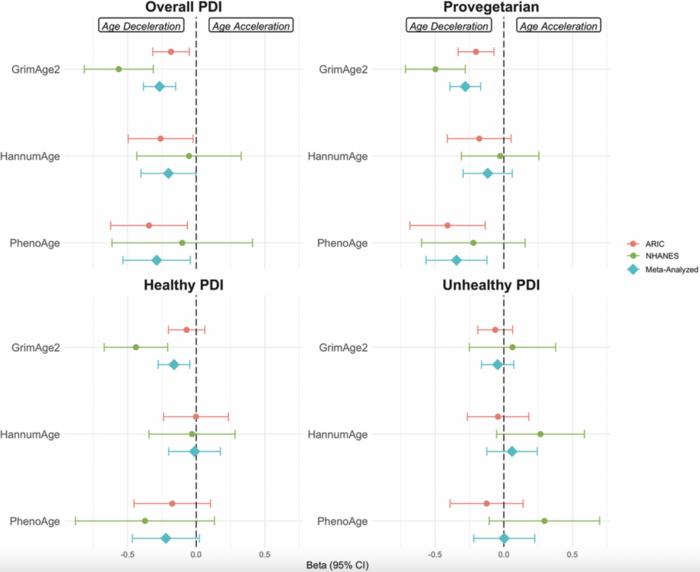
Figure 1.Associations between different types of plant-based diet indices (PDI) and epigenetic aging in the Atherosclerosis Risk in Communities Study (ARIC) and National Health and Nutrition Examination Survey (NHANES). Multivariable linear regression model was adjusted for age, sex, race (in ARIC, we used race-center), total energy intake, education, income (NHANES only), smoking status, physical activity, alcohol intake, and margarine intake (ARIC only). Estimates were meta-analyzed using fixed-effects model. In NHANES, survey-weighted linear regression was used (weighted N= 64,294,854). PDI, plant-based diet index, CI, confidence interval.
Led by first and corresponding author Hyunju Kim from the Department of Epidemiology and the Cardiovascular Health Research Unit, Department of Medicine, University of Washington, the study examined whether four plant-based diet indices — overall PDI, provegetarian diet, healthy PDI, and unhealthy PDI — were associated with DNA methylation-based measures of epigenetic aging. The authors analyzed data from the Atherosclerosis Risk in Communities (ARIC) Study (n = 2,810) and the National Health and Nutrition Examination Survey (NHANES, n = 2,056), and assessed associations with GrimAge2, HannumAge, and PhenoAge.
The researchers found that each standard deviation higher in the overall PDI, provegetarian diet, and healthy PDI was associated with decelerated GrimAge2, while higher overall PDI and provegetarian diet were also associated with decelerated PhenoAge and HannumAge. By contrast, unhealthy PDI was not significantly associated with epigenetic aging. The findings suggest that plant-rich dietary patterns, especially those emphasizing healthier plant foods, may be linked to slower biological aging in largely non-vegetarian populations.
“No significant association was observed for unhealthy PDI and any of the DNA methylation-based aging.”
The authors note that these are observational data and do not establish causality. They call for longitudinal and interventional studies to determine whether sustained adherence to healthy plant-based dietary patterns can directly influence epigenetic aging and related health outcomes over time.


No comments:
Post a Comment