Showing posts sorted by relevance for query FALANGE. Sort by date Show all posts

Monday, April 24, 2023

Fascist sympathizers take to street as Falange founder's body exhumed

Story by By REUTERS • 

Three people were arrested on Monday after police clashed with sympathizers of Jose Antonio Primo de Rivera, founder of Spain's fascist Falange movement that supported the Francoist regime, whose body was exhumed from a mausoleum near Madrid

Supporter of the founder of Spanish fascist Falange party, Jose Antonio Primo de Rivera, gesture outside the San Isidro cemetery, where his remains exhumed from the Franco-era monument known as "The Valley of the Fallen" were transferred, in Madrid, Spain, April 24, 2023© (photo credit: Juan Medina/Reuters)

Spain on Monday dug up the body of Jose Antonio Primo de Rivera, founder of the fascist Falange movement that supported the Francoist regime, and removed it from a mausoleum carved into a mountainside near Madrid as sympathizers gave fascist salutes.

A handful of supporters gathered outside the gates of the complex formerly known as the Valley of the Fallen made the gesture and held up banners saying "Jose Antonio is present" or shouted "Long live Spain" as his hearse drove past.

Police struggled to hold back a larger crowd of about 150 Falange supporters gathered outside the San Isidro cemetery in southern Madrid, where he was to be reburied. They gave the fascist salute and sang the Falangist hymn "Facing the sun."

His exhumation, which follows the 2019 removal of the remains of dictator Francisco Franco, is part of a plan to convert the complex built by Franco, which last year was renamed the Valley of Cuelgamuros, into a memorial to the 500,000 people killed during Spain's 1936-39 civil war.

Presidency Minister Felix Bolanos on Friday hailed the exhumation as another step in giving the valley new symbolism.


Supporters of the founder of Spanish fascist Falange party, Jose Antonio Primo de Rivera, wait to pay tribute outside the San Isidro cemetery, where his remains exhumed from the Franco-era monument known as ''The Valley of the Fallen'' were transferred, in Madrid, Spain, April 24, 2023. (credit: Juan Medina/Reuters)© Provided by The Jerusalem PostSupporters of the founder of Spanish fascist Falange party, Jose Antonio Primo de Rivera, wait to pay tribute outside the San Isidro cemetery, where his remains exhumed from the Franco-era monument known as ''The Valley of the Fallen'' were transferred, in Madrid, Spain, April 24, 2023. (credit: Juan Medina/Reuters)

"No person or ideology that evokes the dictatorship should be honored or extolled there," he said at the time.

The son of dictator Miguel Primo de Rivera, who governed Spain from 1923-1930, Jose Antonio was shot by firing squad in November 1936 by left-wing Republican forces in Alicante.

Exhuming the leader's body

It is the fifth time his body has been buried and the fourth time it has been exhumed.

In 1939, after having lain in two different mass graves in Alicante, his coffin was paraded 500 km (300 miles) from the eastern coastal city to San Lorenzo de El Escorial, a town near Madrid where Spain's royals are buried.

His remains were moved again on the completion of the Valley of the Fallen monument 20 years later and buried under the altar of the basilica, where Franco would join him on his death in 1975.

Franco, a conservative general, and Primo de Rivera, a flamboyant playboy, had little love for each other, according to Franco's biographer Paul Preston.

Franco sabotaged several efforts to organize a rescue or a prisoner swap that would have saved Primo de Rivera's life, Preston wrote in his biography.

His death allowed Franco to eliminate a rival and take control of the Falangists, subsuming them to a broader far-right movement that supported his dictatorship.

The government is carrying out works in the mausoleum to permit access to the crypts where 34,000 people's remains, many of them victims of Franco's regime, are buried
anonymously, allowing families to identify their relatives.


Monday, February 02, 2026

Trump is like this fascist dictator — it isn't Hitler


The Conversation
January 31, 2026 
By Rachelle Wilson Tollemar, Adjunct Professor of Spanish, University of St. Thomas.


Minneapolis residents say they feel besieged under what some are calling a fascist occupation. Thousands of Immigration and Customs Enforcement agents have been swarming a city whose vast majority in 2024 did not vote for Donald Trump — or for a paramilitary roundup of its diverse population.

Tragically, two residents have been killed by federal agents. Consequently, social media is aflame with comparisons of Trump’s immigration enforcers to Hitler’s Gestapo.

While comparisons to Hitler’s fascist regime are becoming common, I’d argue that it may be even more fitting to compare the present moment to a less-remembered but longer-lasting fascist regime: that of Francisco Franco, dictator of Spain from 1936 until his death in 1975.


In 2016, critics warned that Trump’s campaign rhetoric was grounded in textbook fascism, exhibiting signs such as racism, sexism and misogyny, nationalism, propaganda and more. In return, critics were met with intense backlash, accused of being hysterical or overly dramatic.

Now, even normally sober voices are sounding the alarm that America may be falling to fascist rule.

As a scholar of Spanish culture, I, too, see troubling parallels between Franco’s Spain and Trump’s America.

Putting them side by side, I believe, provides insightful tools that are needed to understand the magnitude of what’s at risk today.

Franco’s rise and reign


The Falange party started off as a a small extremist party on the margins of Spanish society, a society deeply troubled with political and economic instability. The party primarily preached a radical nationalism, a highly exclusive way to be and act Spanish. Traditional gender roles, monolingualism and Catholicism rallied people by offering absolutist comfort during uncertain times. Quickly, the Falange grew in power and prevalence until, ultimately, it moved mainstream.

By 1936, the party had garnered enough support from the Catholic Church, the military, and wealthy landowners and businessmen that a sizable amount of the population accepted Gen. Francisco Franco’s coup d'etat: a military crusade of sorts that sought to stop the perceived anarchy of liberals living in godless cities. His slogan, “¡Una, Grande, Libre!,” or “one, great, free,” mobilized people who shared the Falange’s anxieties.

Like the Falange, MAGA, the wing of the Republican Party named after Trump’s slogan “Make America Great Again,” repeatedly vilifies the left, who mostly live in cities, as godless anarchists who live like vermin.

Once in power, the Francoist regime commissioned a secret police force, the Political-Social Brigade — known as the BPS — to “clean up house.” The BPS was charged with suppressing or killing any political, social, cultural or linguistic dissidents.
Weakening resistance

Franco not only weaponized the military but also proverbially enlisted the Catholic Church. He colluded with the clergy to convince parishioners, especially women, of their divine duty to multiply, instill nationalist Catholic values in their children, and thus reproduce ideological replicas of both the state and the church. From the pulpit, homemakers were extolled as “ángeles del hogar” and “heroínas de la patria,” or “angels of the home” and “heroines of the homeland.”

Together, Franco and the church constructed consent for social restrictions, including outlawing or criminalizing abortion, contraception, divorce, work by women and other women’s rights, along with even tolerating uxoricide, or the killing of wives, for their perceived sexual transgressions.

Some scholars contend that the repealing of women’s reproductive rights is the first step away from a fully democratic society. For this reason and more, many are concerned about the U.S. Supreme Court’s recent overturning of Roe v. Wade.

The #tradwife social media trend involves far-right platforms echoing Francoist-style ideologies of submission, restriction, dependence and white male dominance. One of TikTok’s most popular tradwife influencers, for instance, posted that “there is no higher calling than being a wife and a mother for a woman.” She also questioned young women attending college and rebuked, on air, wives who deny their husbands sexual intimacy.


Weakening the economy

Economically, Franco implemented autarkic policies, a system of limited trade designed to isolate Spain and protect it from anti-Spanish influences. He utilized high tariffs, strict quotas, border controls and currency manipulation, effectively impoverishing the nation and vastly enriching himself and his cronies.

These policies flew under the motto “¡Arriba España!,” or “Up Spain.” They nearly immediately triggered more than a decade of suffering known as the “hunger years.” An estimated 200,000 Spaniards died from famine and disease.


Under the slogan “America First” — Trump’s mutable but aggressive tariff regime — the $1 billion or more in personal wealth he’s accumulated while in office, along with his repeated attempts to cut nutrition benefits in blue states and his administration’s anti-vaccine policies may appear to be disconnected. But together, they galvanize an autarkic strategy that threatens to debilitate the country’s health.
Weakening the mind

Franco’s dictatorship systematically purged, exiled and repressed the country’s intellectual class. Many were forced to emigrate. Those who stayed in the country, such as the artist Joan Miró, were forced to bury their messages deeply within symbols and metaphor to evade censorship.

Currently in the U.S., banned books, banned words and phrases, and the slashing of academic and research funding across disciplines are causing the U.S. to experience “brain drain,” an exodus of members of the nation’s highly educated and skilled classes.


Furthermore, Franco conjoined the church, the state and education into one. I am tracking analogous moves in the U.S. The conservative group Turning Point USA has an educational division whose goal is to “reclaim" K-12 curriculum with white Christian nationalism.

Ongoing legislation that mandates public classrooms to display the Ten Commandments similarly violates religious freedom guarantees ratified in the constitution.


Drawing comparisons


Trump has frequently expressed admiration for contemporary dictators and last week stated that “sometimes you need a dictator.”

It is true that his tactics do not perfectly mirror Francoism or any other past fascist regime. But the work of civil rights scholar Michelle Alexander reminds us that systems of control do not disappear. They morph, evolve and adapt to sneak into modern contexts in less detectable ways. I see fascism like this.

Consider some of the recent activities in Minneapolis, and ask how they would be described if they were taking place in any other country.

Unidentified masked individuals in unmarked cars are forcibly entering homes without judicial warrants. These agents are killing, shooting and roughing up people, sometimes while handcuffed. They are tear-gassing peaceful protesters, assaulting and killing legal observers, and throwing flash grenades at bystanders. They are disappearing people of color, including four Native Americans and a toddler as young as 2, shipping them off to detention centers where allegations of abuse, neglect, sexual assault and even homicide are now frequent.

Government officials have spun deceptive narratives, or worse, lied about the administration’s actions.

In the wake of the public and political backlash following the killing of Alex Pretti, Trump signaled he would reduce immigration enforcement operations] in Minneapolis, only to turn around and have Defense Secretary Pete Hegseth authorize the use of an old military base near St. Paul, suggesting potential escalation, not de-escalation. Saying one thing while doing the opposite is a classic fascist trick warned about in history and literature alike.

The world has seen these tactics before. History shows the precedent and then supplies the bad ending. Comparing past Francoism to present Trumpism connects the past to the present and warns us about what could come.


From ‘Moscow gold’ to record reserves: Spain’s gold, then and now

Gold bullion.
Copyright Public Domain Pictures

By Christina Thykjaer
Published on 

The Bank of Spain closed 2025 with gold and currency reserves valued at almost €94 billion, an all-time high driven by astronomical demand for the metal.

At the end of 2025, the Banco de España recorded gold and foreign exchange reserves were valued at nearly €94 billion, the highest figure since comparable statistics became available.

The increase reflects, above all, the rising demand for gold on the international market — recent dips aside — as a safe-haven asset in a year marked by geopolitical and financial uncertainty.

But in Spain, gold is never just an accounting figure. It is also a matter of historical memory. And few expressions are as charged as those referring to so-called “Moscow gold,” one of the most controversial episodes in Spain’s 20th-century economic and political history.

Gold to finance the revolution

Before 1936, Spain’s gold reserves were not exceptional by international standards, but they were sufficient to place the country on the global financial map.

According to historian Magdalena Garrido Caballero, Professor of Contemporary History at the University of Murcia, this gold gave Spain a degree of room for certain international manoeuvres albeit far removed from those of major economic powers.

That margin, however, evaporated with the outbreak of the Spanish Civil War. The diplomatic isolation of the Second Republic, reinforced by the Non-Intervention Committee, left the Republican government with few options for financing the purchase of arms and supplies.

In this extreme context, the Republican government decided to transfer most of the Banco de España’s gold reserves abroad, primarily to the Soviet Union. The aim was clear: to pay for arms, supplies and military assistance to sustain the war effort.

The transfer was real and well documented. In October 1936, some 510 tonnes of gold left the Algameca depot in Cartagena.

It was not an improvised or clandestine operation, but a conscious decision made by the Republic’s legitimate authorities in a context of total war.

Return the gold?

Contemporary historiography has dismantled many of the myths constructed in later decades. Garrido Caballero stresses that the central misconception is the idea that the gold could — or should — have been returned.

Studies by historians such as Ángel Luis Viñas and Pablo Martín Aceña show that the gold was spent during the war, through verified and documented payments, enabling the Republic to resist the military uprising for almost three years.

From this perspective, the “Moscow gold” did not constitute either theft or plunder by the Soviet Union, but a financing operation carried out under exceptional circumstances.

Some of the gold was also sold to France for the same purpose, although this episode never acquired the same symbolic weight.

'Fascist' talking point

After the war, Franco’s regime turned the “Moscow gold” into a powerful propaganda tool.

According to Garrido Caballero, the regime exploited the episode to justify the severity of the post-war period, to reinforce the image of an exploitative Soviet enemy and to delegitimise the Second Republic.

The issue appeared repeatedly in diplomatic reports, the national and international press, and official speeches for decades.

Internationally, however, the matter gained little traction. The United Kingdom viewed it as a bilateral issue between states, while Soviet authorities consistently maintained that there were no outstanding reserves of the gold sent by the Republic.

Where is Spanish gold held today?

Almost 90 years on, the question still resurfaces: where is Spain’s gold?

The answer is much less dramatic than the persistent myth. Spain today holds around 281 tonnes of gold, divided between the Bank of Spain and deposits in the United States, the United Kingdom and Switzerland, according to data from the World Gold Council.

This gold is not tied to the amounts sent to the USSR, but a result of decades of monetary policy, European integration and asset management within the Eurosystem.

From historical trauma to financial asset

The 2025 record does not mean Spain has recovered its lost gold.

Rather, it reflects the rise in the metal’s price on international markets. Today, gold no longer fully backs a national currency or it is not used to finance wars. Instead, it functions as an asset of stability, leverage and confidence in a globalised financial system.

A comparison between 1936 and 2025 reveals a profound shift. During the Civil War, gold was a tangible resource on which a government’s survival depended. This is no longer the case.


Op-Ed 

The Hardest Part of Fighting Fascism Comes After the Fascists Have Fallen

Having lived in Argentina after dictatorship, I know restoring democracy requires far more than just deposing fascists.
January 31, 2026

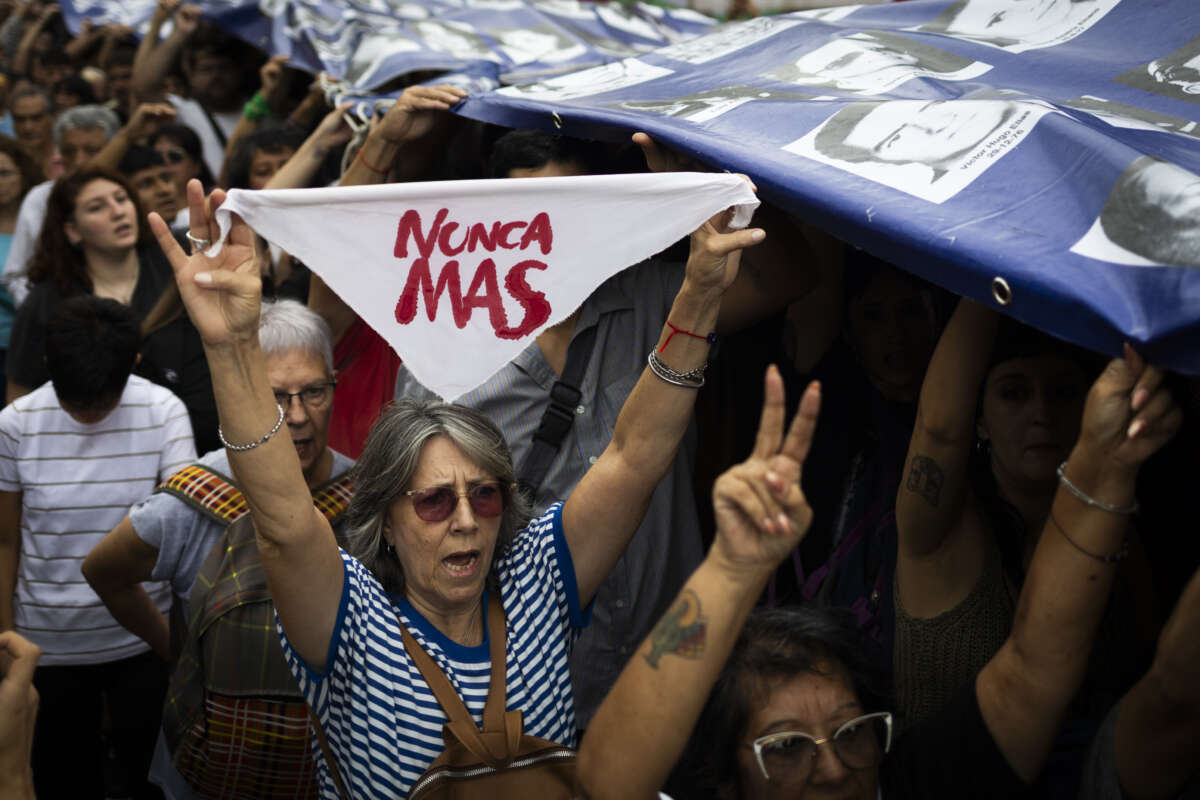
A woman holds a white handkerchief as people carry a banner with pictures of missing people, victims of Argentina's last dictatorship, during a demonstration to mark the 49th anniversary of the 1976 military coup, at Plaza de Mayo square in Buenos Aires, Argentina, on March 24, 2025.
Matias Baglietto / NurPhoto via Getty Images

Ilived in Argentina in the mid-1980s, just after the fall of the brutal military dictatorship that ruled from 1976 to 1983. The country was taking its first, shaky steps back toward democracy. It was a time of great hope, but also of grave uncertainty — because while the generals were gone, the political culture that enabled them remained.

Like most of the nation, I was captivated by the pioneering trials of the military generals that promised to restore justice. But watching the trials, reading the commentary, and witnessing the national response, it became increasingly clear that after a dictatorship collapses, its shadow lingers. Institutions that propped it up may be quick to pivot but slow to reform. And a political culture conditioned to authoritarian rule does not easily snap back.

I see that same danger now in the United States.

Let’s be clear: Fascism isn’t some distant or hypothetical threat — it is already here. Unmarked vans and masked agents snatch students off the streets without due process. Judges and lawyers are intimidated. The most powerful institutions in society — universities, tech firms, law firms, billionaires, legislators — preemptively prostrate themselves to an autocratic leader’s whims, not because they are forced to, but because they calculate that accommodation is safer than resistance. Tens of millions of people are demonized while the military is deployed against civilian populations. These are not warning signs. They are the thing itself.

Of course we must resist. We must speak out, organize, and push back against creeping authoritarianism wherever it appears. But resistance alone is not enough. Post-dictatorship Argentina demonstrates that the harder question comes later: What happens if — and when — authoritarianism is pushed back? What happens after?

Democracy is not just a system of government. It is a way of thinking, of arguing, of living together.

In Argentina, the military junta was defeated, but the nation’s political culture remained deeply scarred. The public had seen generals on trial, but many still struggled to grasp why their crimes mattered. The substance of the prosecution — that to fight terrorism, members of the military became terrorists themselves — was incomprehensible not only to the defendants but also to an alarming number of legislators who had returned to power. Even after convictions, defendants like Jorge Rafael Videla, commander of the first and most ruthless of the three military juntas, proclaimed innocence, maintaining that the proceedings were nothing more than a “trial generated by political motivations.” Ex-president Roberto Eduardo Viola, convicted of responsibility for torture and murder, echoed Videla, adding that “had the military not won [the dirty war] the country would not now be living in democracy. Instead, we would now be a Marxist international dictatorship.”

It was not only these men who needed to face their crimes. Early in the trials, nearly an entire day was spent hearing the defense counsel’s attempt to prove that the daughter of a prominent human rights lawyer might have been a terrorist, and therefore her murder was justified. The claim was not only false; it inverted the very idea of justice. The spectacle continued until the editor of the English-language newspaper that had illegally published the names of the disappeared was called to testify. When a defense attorney asked him how he knew the woman was not a terrorist, the editor replied simply: “Because everyone knows that a person is innocent until proven guilty.”

That moment was electric. It was also sobering. A foundational democratic principle had to be restated aloud, as if newly rediscovered. Years of authoritarian rule had so corroded civic norms that even the presumption of innocence could no longer be assumed as common sense.

A public culture trained to reward cruelty, spectacle, and domination does not revert on its own to one grounded in deliberation and care.

Democracy is not just a system of government. It is a way of thinking, of arguing, of living together. It rests on habits of mind — about truth, responsibility, evidence, dissent, and the limits of power. Once those habits are degraded, they are not easily restored.

Argentina faced a powerful temptation in the years after the trials to move on. The central call of human rights organizations was for “castigo a los culpables” (punishment to the guilty). But conviction of these brutal authoritarian generals would not restore democratic culture. To treat justice as an endpoint — try the guilty, punish them, close the chapter — does not ensure a robust democracy capable of resisting the next aspiring fascist leader. Punishment alone could not repair what had been broken. Fear had reshaped social life and cynicism had replaced trust. Many people had internalized the idea that the right strong leader who didn’t have to deal with interference from independent legislatures or courts might fix the nation’s problems.

The United States now risks a similar fate. Even if authoritarian leadership is removed through elections or legal action, the damage will persist. Institutions that learned to comply will not automatically relearn courage. Citizens who learned that politics is dangerous, rigged, or pointless will not suddenly reengage. A public culture trained to reward cruelty, spectacle, and domination does not revert on its own to one grounded in deliberation and care.

This is why focusing solely on an individual villainous leader misses the deeper problem. Authoritarianism is not just a personality; it is a political project that reshapes institutions and habits alike. When it recedes, what remains are organizations that survived by accommodating power, and citizens unsure of what democracy is for. Without a deliberate effort to rebuild democratic culture, post-authoritarian societies risk becoming democracies in name only. Elections return, but fear and distrust remain. Free speech exists on paper, but silence persists in practice.

Without a deliberate effort to rebuild democratic culture, post-authoritarian societies risk becoming democracies in name only.

In the long aftermath of military rule, Argentine democracy moved unevenly forward, struggling at times to sustain public trust and institutional legitimacy. Fast-forward to today, and the country has entered a new phase of democratic erosion — one in which elections still occur, but many citizens place their faith in an anti-democratic populist who treats democracy as a means rather than a shared project. Javier Milei, elected president in 2023, treats democratic institutions as obstacles rather than aspirations. He governs through permanent crisis rhetoric, stokes division, and routinely questions the legitimacy of political opposition, not merely their policies. In doing so, he undermines the idea that democracy exists to balance interests, protect minorities, or sustain public goods.

In the years following 1983, Argentina did many things right: civilian control of the military; war crimes trials; and memory, truth, and justice initiatives. Milei emerges not despite that history, but partly because of what remained unresolved, what was never fully repaired. Deep distrust of political institutions remained and economic precarity hollowed out solidarity. Milei is not a return to military dictatorship, but he is a symptom of democratic exhaustion — an anti-democratic populist who exploits the failures of democratic culture rather than openly rejecting democracy itself.

If the United States manages to restore democratic governance after this authoritarian moment, it will need far more than new leaders. It will require a massive cultural and educational project — one that re-teaches not only how democracy works, but why it matters. One that confronts institutional complicity rather than glossing over it. And one that restores civility, compassion, and trust.

Schools and universities are among the few public institutions capable of cultivating democratic habits at scale.

Schools and universities will be central to this work. They are among the few public institutions capable of cultivating democratic habits at scale (which is why they are among the first institutions to be attacked by authoritarian regimes). But they, too, will have to reckon with their own failures — with the ways they rewarded obedience over inquiry and collapsed in the face of political pressure. Democratic renewal will demand that education once again be understood not as workforce preparation, but as preparation for shared self-government.

When the military dictatorship in Argentina fell, one could still see in the streets of Buenos Aires the green Ford Falcons which were used to transport many of the desaparecidos to and from clandestine prisons in the countryside. They stood as monuments to tragedy and as metaphors for the remnants of authoritarian rule. Yet, every Thursday afternoon, the Madres de Plaza de Mayo (mothers demanding truth about their sons and daughters who were murdered during the military dictatorship) continue even today to march in front of the Casa Rosada to remind the nation of the fragility of the rule of law.

When the violent power-grabbers who currently lead the U.S. government are held accountable for their abuses, we will breathe a sigh of relief. Accountability is necessary, but it is not sufficient. Justice and fair and free elections matter, but democracy does not survive on procedures alone. It survives when people believe it is worth defending — when they experience it not as an abstract ideal, but as a way of living together that makes dignity, disagreement, and solidarity possible.

That work does not end when autocrats fall. In many ways, it only begins.

This article is licensed under Creative Commons (CC BY-NC-ND 4.0), and you are free to share and republish under the terms of the license.


Joel Westheimer
Joel Westheimer is professor of democracy and education at the University of Ottawa and an education columnist for the Canadian Broadcasting Company. Westheimer is a member of the National Academy of Education and a fellow of the Royal Society of Canada. He can be reached at joelwestheimer@mac.com. Find out more at joelwestheimer.org.


Sunday, June 28, 2020

Trump denies briefing on reported bounties against US troops
By LYNN BERRY and ZEKE MILLER

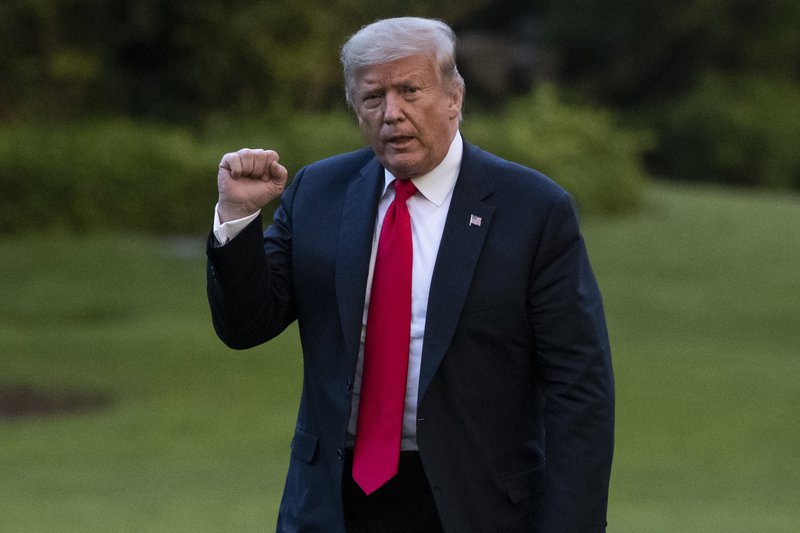
President Donald Trump pumps his fist as he walks on the South Lawn after arriving on Marine One at the White House, Thursday, June 25, 2020, in Washington. Trump is returning from Wisconsin. (AP Photo/Alex Brandon)
THE FASCIST FIST OF FRANCO AND THE FALANGE

WASHINGTON (AP) — President Donald Trump on Sunday denied that he had been briefed on reported U.S. intelligence that a Russian military intelligence unit secretly offered bounties to Taliban-linked militants for killing American troops in Afghanistan, and he appeared to minimize the allegations against Moscow.

American intelligence officials concluded months ago that Russian officials offered rewards for successful attacks on American service-members last year, at a time when the U.S. and Taliban were holding talks to end the long-running war, according to The New York Times.

Trump, in a Sunday morning tweet, said “Nobody briefed or told me” or Vice President Mike Pence or chief of staff Mark Meadows about “the so-called attacks on our troops in Afghanistan by Russians.”

“Everybody is denying it & there have not been many attacks on us,” he said.


The White House had issued a statement Saturday denying that Trump or Pence had been briefed on such intelligence. “This does not speak to the merit of the alleged intelligence but to the inaccuracy of the New York Times story erroneously suggesting that President Trump was briefed on this matter,” press secretary Kayleigh McEnany said.


Trump’s director of national intelligence, John Ratcliffe, also said neither the president nor vice president was “ever briefed on any intelligence alleged” in the Times’ report and he said the White House statement was “accurate.”

Trump’s tweet came a day after presumptive Democratic presidential nominee Joe Biden said that the report, if accurate, was a “truly shocking revelation” about the commander in chief and his failure to protect U.S. troops in Afghanistan and stand up to Russia.

Russia called the report “nonsense.”

“This unsophisticated plant clearly illustrates the low intellectual abilities of the propagandists of American intelligence, who instead of inventing something more plausible have to make up this nonsense,” the Russian Foreign Ministry said.

A Taliban spokesman said the militants “strongly reject this allegation” and are not “indebted to the beneficence of any intelligence organ or foreign country.”

John Bolton, a former national security adviser who was forced out by Trump last September and has now written a tell-all book about his time at the White House, said Sunday that “it it is pretty remarkable the president’s going out of his way to say he hasn’t heard anything about it, one asks, why would he do something like that?”

Bolton told NBC’s “Meet the Press” that he thinks the answer “may be precisely because active Russian aggression like that against the American service members is a very, very serious matter and nothing’s been done about it, if it’s true, for these past four or five months, so it may look like he was negligent. But of course, he can disown everything if nobody ever told him about it.”

The Times, citing unnamed officials familiar with the intelligence, said the findings were presented to Trump and discussed by his National Security Council in late March. Officials developed potential responses, starting with a diplomatic complaint to Russia, but the White House has yet to authorize any step, the report said.

Trump responded to Biden on Twitter, saying “Russia ate his and Obama’s lunch during their time in office”

But it was the Obama administration, along with international allies, that suspended Russia from the Group of Eight after its unilateral annexation of Crimea from Ukraine — a move that drew widespread condemnation.

Biden criticized Trump for “his embarrassing campaign of deference and debasing himself” before Russian leader Vladimir Putin. Trump tweeted that “Nobody’s been tougher” on Russia than his administration.

Trump denies being told about Russian bounties to kill U.S. troops in Afghanistan
WASHINGTON (Reuters) - President Donald Trump on Sunday said he was never briefed about Russian efforts to pay bounties to Taliban-linked militants to kill U.S. troops in Afghanistan, blasting a New York Times report that he had been told about the rewards but had not acted to respond to Moscow.

The White House on Saturday also denied that Trump was briefed on U.S. intelligence regarding the affair but it did not address the merits of the intelligence. The Director of National Intelligence also said Trump and Vice President Mike Pence were not briefed, and called the Times report inaccurate.

“Nobody briefed or told me, @VP Pence, or Chief of Staff @MarkMeadows about the so-called attacks on our troops in Afghanistan by Russians, as reported through an ‘anonymous source’ by the Fake News @nytimes. Everybody is denying it & there have not been many attacks on us,” Trump tweeted, calling on the newspaper to reveal its source.

The Times on Friday reported that U.S. intelligence had concluded that a Russian military intelligence unit linked to assassination attempts in Europe had offered rewards for successful attacks last year on American and coalition soldiers, and that Islamist militants or those associated with them were believed to have collected some bounty money.

Russia’s foreign ministry dismissed the report.

Democrats said the report and Trump’s denial were the latest evidence of the president’s wish to ignore allegations against Russia and accommodate President Vladimir Putin.

“There is something very wrong here. But this must have an answer,” U.S. House of Representatives Speaker Nancy Pelosi told ABC’s “This Week” program.

“You would think, the minute the president heard of it, he would want to know more, instead of denying that he knew anything,” she said, adding that Trump has already given “gifts” to Putin by diminishing U.S. leadership in NATO, reducing U.S. forces in Germany and inviting Russia back into the G8.

Reporting by Susan Heavey and David Morgan; Editing by Alistair Bell

Monday, September 20, 2021

Macron seeks 'new step' towards Algerian Harki fighters

DESPITE THE CRCODILE TEARS THESE WERE REACTIONARY FASCISTS BETRAYED BY THEIR MASTER
NOT UNLIKE THEIR CHRISTIAN COUNTERPARTS 
IN LEBANON AND SPAIN; THE FALANGE


Issued on: 20/09/2021 - 
Hundreds of thousands of Algerian Muslims -- known as Harkis -- served as auxiliaries in the French army during the war for Algerian independence Jean-Marie HURON AFP/File


Paris (AFP)

French President Emmanuel Macron on Monday meets with Algerians who fought for France in their country's war of independence in a fresh attempt to come to grips with a dark chapter in French colonial history.

Hundreds of thousands of Algerian Muslims -- known as Harkis -- served as auxiliaries in the French army in the war that pitted Algerian independence fighters against their French colonial masters from 1954 to 1962.

At the end of the war -- waged on both sides with extreme brutality including widespread torture -- the French government left the Harkis to fend for themselves, despite earlier promises that it would look after them.


Trapped in Algeria, many were massacred as the country's new masters took brutal revenge.

Thousand others were placed in camps in France, often with their families, in degrading and traumatising conditions.

Successive French presidents had already begun owning up to the betrayal of the Algerian Muslim fighters.

Successive French presidents had already begun owning up to the betrayal of the Algerian Muslim fighters Jacques GREVIN INTERCONTINENTALE/AFP/File

Macron's predecessor Francois Hollande in 2016 accepted "the responsibilities of French governments in the abandonment of the Harkis".

But Macron's meeting Monday with 300 people, mostly surviving Harkis and their families, is to mark "a new step" towards a full recognition of France's responsibility for their suffering, his office said.

- 'Task of reparation' -

The meeting comes only days before national Harki day, which has been observed since 2003 -- especially in southern France where many of the surviving fighters settled after the war.

Their political sympathies often lie with the nationalist right whose leader, Marine Le Pen, is the frontrunner among Macron's rivals in France's presidential election next spring.

In a speech Monday, Macron will "start the task of reparation," his office said.

After the war thousands of Harkis were placed in camps in France, often with their families, in degrading and traumatising conditions - AFP/File

"The president believes that the work accomplished over the past 60 years is important but that a new step is necessary in terms of recognising the failures towards the Harkis, but also the failure of the French republic to live up to its own standards," Macron's office said.

The history of the Harkis could not be separated from the history of France, it said.

Authorities have in the past allowed a number of legal procedures to go ahead for the Harkis and their families to claim damages from France.

- 'Hypocrisy' -


But Harki organisations want an official recognition of their treatment to be enshrined in a law by the end of the year, they said in an open letter to Macron.

"We hope that you will be the one to end 60 years of a certain hypocrisy by which the abandoning of the Harkis is recognised in speeches, but not in the law," they said.

The associations also want approved payouts to be increased.

Macron's initiative comes over a year after he tasked historian Benjamin Stora with assessing how France has dealt with its colonial legacy in Algeria.

The report, submitted in January, made a series of recommendations including owning up to the murder of a prominent Algerian independence figure and creating a "memory and truth commission".

Macron has already spoken out on a number of France's unresolved colonial legacies, including nuclear testing in Polynesia, its role in the Rwandan genocide and war crimes in Algeria.

Before the end of his mandate he is expected to attend ceremonies marking the anniversaries of two key events still weighing on French-Algerian relations: the brutal repression of a demonstration of Algerians on October 17, 1961, by Paris police who beat protesters to death or drowned them in the river Seine, and the signing of the Evian accords on March 18, 1962, which ended the war of independence.

© 2021 AFP

Saturday, July 03, 2021

THE CHRISTIAN FALANGE ARE FASCISTS
Pope: Lebanon must remain a ‘land of tolerance, pluralism’

By NICOLE WINFIELD
July 1, 2021

1 of 7
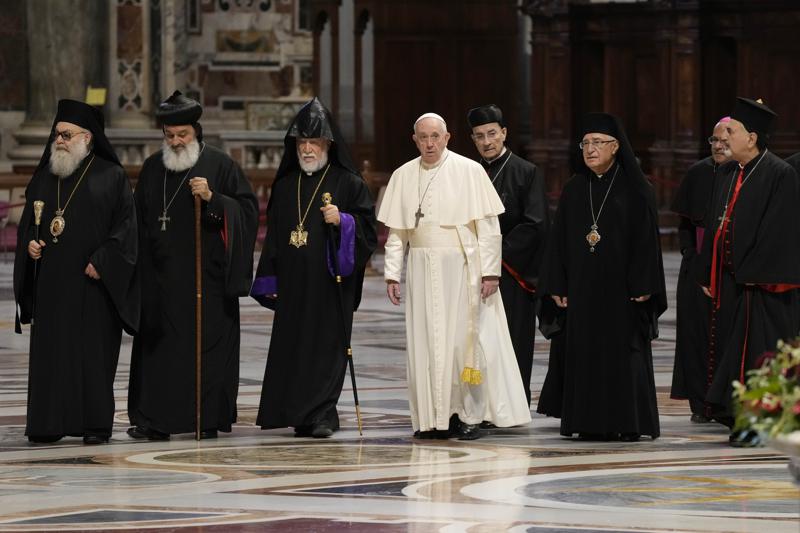
The Patriarch of the Syriac Orthodox Church, Moran Mor Ignatius Aphrem II, second from left, the head of the Catholicosate of the Great House of Cilicia of the Armenian Apostolic Church, Aram I, third from left, Pope Francis, fourth from left, Cardinal Bechara Boutros al-Rahi, firfth from left, Patriarch of Antioch and All the East for the Syriac Catholic Church, Ignatius Youssef III Younan, right, arrive in St. Peter's Basilica to attend a prayer for Lebanon at the Vatican, Thursday, July 1, 2021. (AP Photo/Gregorio Borgia)

ROME (AP) — Pope Francis insisted Thursday that Lebanon must remain a “land of tolerance and pluralism” as he welcomed the country’s Christian patriarchs to the Vatican to pray for an end to the economic and political crisis that has thrown the country into chaos and threatened its Christian community.

Francis presided over an evening prayer service in St. Peter’s Basilica with the leaders of Lebanon’s Christian churches, which featured prayers and hymns in Arabic, Syriac, Armenian and Chaldean. Members of the Lebanese community in Rome and the diplomatic corps filled the pews.

During the service, Francis insisted that Lebanon’s vocation was to be an “oasis of fraternity where different religions and confessions meet, where different communities live together, putting the common good before their individual interests.”

“Lebanon cannot be left prey to the course of events or (to) those who pursue their own unscrupulous interests,” he said. “It is a small yet great country, but even more, it is a universal message of peace and fraternity arising from the Middle East.”

The Mediterranean nation of 6 million, including an estimated 1 million refugees, has the largest percentage of Christians in the Middle East and is the only Arab country with a Christian head of state. Christians make up a third of the population, and the Vatican fears the country’s collapse is particularly dangerous for the continued presence of its Christian community, a bulwark for the church in the Mideast.

Lebanon is going through an unprecedented economic and financial collapse, coupled with an 11-month political deadlock over the formation of a new government. The developments pose the gravest threat to its stability since the end of its civil war three decades ago. It is also trying to recover from the devastating Beirut port explosion last summer — and the coronavirus pandemic.

Francis invited the religious leaders for a day of prayer that began with a silent meditation at the tomb of the Apostle Peter and was followed by closed-door talks about how to help Lebanon emerge from what the World Bank has described as likely to be one of the worst crises the world has witnessed over the past 150 years.

In his final remarks at the ecumenical prayer service, Francis urged political leaders to find solutions and appealed to the international community to help the country recover.

“Stop using Lebanon and the Middle East for outside interests and profits!” he said. “The Lebanese people must be given the opportunity to be the architects of a better future in their land, without undue interference.”

Embattled Prime Minister-designate Saad Hariri, who met with Francis at the Vatican in April, said from Beirut that he hoped the meeting would call on all Lebanese to preserve their coexistence.

“It is no surprise that the pontiff keeps it in his heart through this invite to 10 spiritual leaders with the aim of getting Lebanon through its difficult reality,” he tweeted Thursday, repeating the words of St. John Paul II that “Lebanon is more than a country, it is a message.”

The Vatican’s foreign minister, Archbishop Paul Gallagher, was blunt in explaining the Holy See’s “strong concern about the collapse of the country” during a briefing with journalists last week.

He said Francis had invited the religious leaders to Rome in an acknowledgment that the Christian community had been particularly hard-hit by the crisis, which has sent the well-educated middle classes fleeing power cuts, fuel shortages, soaring prices and now sporadic acts of violence.

The crisis, Gallagher said, “risks destroying the internal balance and Lebanon’s own reality, putting at risk the Christian presence in the Middle East.”

Noting the potential for Lebanon to fall into conflict, he said the country must be helped economically and to keep the peace, saying it “remains the final vanguard of an Arab democracy that welcomes, recognizes and coexists with a plurality of ethnic and religious communities that in other countries aren’t able to live in peace.”

“It must be helped to maintain this unique identity, to ensure a pluralist, tolerant and diversified Middle East,” he said.

Francis has said he hopes to visit Lebanon once a government is formed. Gallagher said if that happens soon, Francis could make a trip early next year.

___

AP correspondent Zeina Karam contributed from Beirut.

Monday, June 12, 2023

Spain begins exhuming civil war victims from Franco basilica
By AFP
June 12, 2023

The vast hillside mausoleum was built after the civil war by Franco's regime -- in part by the forced labour of 20,000 political prisoners - 
Copyright POOL/AFP Ian Vogler

Diego URDANETA

Experts on Monday began exhuming Spanish civil war victims from a huge basilica near Madrid, where the body of former dictator Francisco Franco once lay.

The move comes as Spain gears up for an early general election on July 23 in which Socialist Prime Minister Pedro Sanchez faces an uphill battle.

The team will seek to exhume the remains of 128 victims of the 1936-39 civil war from the complex at the Valley of Cuelgamuros, formerly known as the Valley of the Fallen, the democratic memory ministry said.

The aim is to “recover those bodies and deliver them to their families to give them a dignified burial,” the ministry said in a statement sent to AFP.

“This is not about politics, it is simply a matter of pure humanity.”

A laboratory has been set up in the basilica carved into a mountainside to allow the archeologists, forensic experts and scientific police to do their work.

The remains of some 33,000 people from both sides of the civil war are buried anonymously at the complex, which is topped by a 150-metre (500-foot) stone cross.

Many of the remains were moved to the site 50 kilometres (30 miles) northwest of Madrid from cemeteries and mass graves across the country without their families being informed.

While the site is ostensibly dedicated to the memory of all those killed on both sides of the war, only two graves at the basilica were ever marked: those of Franco and of Jose Antonio Primo de Rivera, founder of Spain’s fascist Falange party.

The government relocated Franco’s remains to a civilian cemetery in 2019, and did the same with those of Primo de Rivera in April.

– ‘Long overdue’ –


Many relatives of those buried there have long campaigned to be able to lay their loved ones to rest near their families under their own names.

“Finally, and perhaps too long overdue, Spanish democracy is providing an answer to these victims,’ government spokeswoman Isabel Rodriguez told public television.

Honouring those who died or suffered violence or repression during the civil war and the Franco dictatorship that followed has been a top priority for Sanchez, who came to power in 2018.

A so-called democratic memory law which came into effect in October 2022 aims to turn the Valley of Cuelgamuros into a place of memory for the dark years of the dictatorship.

It also promotes the search for victims who are buried in mass graves across Spain and annuls the criminal convictions of opponents of the Franco regime.

But the law has been politically divisive, with right-wing parties saying it needlessly dredges up the past.

– Long Franco dictatorship –

Opposition leader Alberto Nunez Feijoo, head of the right-wing Popular Party (PP), has vowed to repeal the law if he comes to power in next month’s election.

Surveys suggest the PP will win the snap polls but will need the support of far-right party Vox to govern.

A prominent NGO that represents victims of the Franco regime, the Association for the Reparation of Historic Memory, welcomed the exhumations.

But it deplored that families concerned “learned of the exhumation from the press and are not there.”

“The Franco family was able to carry the dictator’s body from the Valley of the Fallen on their shoulders,” it added in a tweet.

Franco ruled Spain with an iron fist since the end of the civil war intil his death in 1975, one of Europe’s longest dictatorships.

His regime was notorious for imprisoning, torturing and killing people who spoke out against his rule.

Saturday, February 21, 2026

Francisco Franco: The Fascist Ego


 February 20, 2026

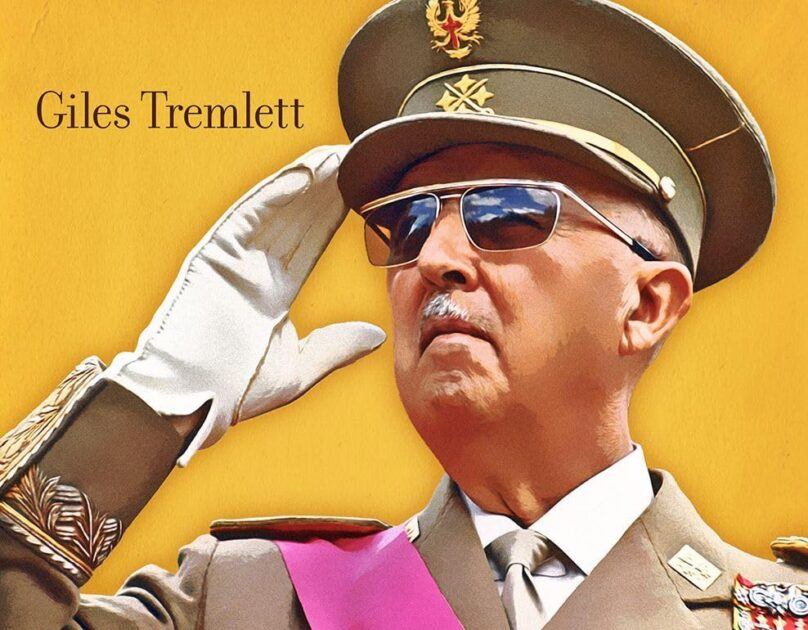
Cover art for the book El Generalísimo: A Biography of Francisco Franco by Giles Tremlett

In 2026, the United States is being ruled by an administration led by a wannabe dictator named Trump. His ego seems to dominate his decisions, while his paranoia encourages him to surround himself with authoritarian individuals eager to prove a strength they have always doubted existed in their persona. Not an intellectual by any measure, Trump’s position in the world of finance and politics is a testimony to the power of ego, cruelty and bombast in the sectors of society he has existed in his entire life. Often compared to Hitler, Mussolini, and other authoritarians familiar to the western media, a recent book titled El Generalísimo: A Biography of Francisco Franco and authored by Giles Tremlett on the life of the Spanish fascist Francisco Franco convinced me that Trump’s closest historical model could well be the man who liked to be called El Generalísimo. A professor of economics, a journalist and historian, Tremlett has provided the public with a comprehensive exploration of El Generalísimo’s life and politics well situated in the history of the historical moments Franco lived, ruled and died.

It’s a story of a man who believed he represented the one true Spain—a Spain that was Catholic and extremely conservative, with anyone not of that makeup fair game for detention and even death as enemies of Spain. This was especially true as regards leftists, anarchists, Catalan, Basque and other separatist groups and liberals. Not only were these people considered enemies of Spain, they were also enemies of Franco; in his mind the two were synonymous. Like other fascist rulers, Franco’s personal idiosyncrasies often frustrated his advisors, occasionally ruining military and political campaigns that would otherwise have succeeded. It’s clear from reading the biography that Franco needed to be in control.

Tremlett discusses Franco’s traits early on in the text, providing the reader with a biography of the man’s youth and family life. His philandering father left the home when Franco was still in school; his mother—already quite religious—turned even more to the Church after her husband’s departure. It is reasonably suggested that this helps explain Franco’s hatred of any type of sexual relationship outside of traditional monogamy in the Catholic tradition. The influence of the Catholic and military education he received (even desired) explains Franco’s fear of and loathing of the arts and politics of Spain’s leftist and liberal classes; a loathing that was publicly quite deep. Like most conservative Catholics then and now, Franco’s moral outrage focused more on sex and sexuality than on war and conquest.

In fact, Franco’s love of military action was deeply influenced by this belief that it was blessed by his God, from his colonial exploits in Morocco to his war on those Spanish people fighting for the Republic and against the fascist Falange. More grotesquely, Franco believed the killing of his Spanish opponents in the civil war were ordained by God and the Catholic Church, which had provided Franco with its approval. One can also assume from reading this biography that the corruption that ran rampant during Franco’s decades-long reign was part of God’s reward for his victory. Despite the corruption of Franco’s government, the author Tremlett makes it a point in stating that Franco was not much of a participant in it if at all. In other words, his moral beliefs forbade him from thieving, but not from killing.

The life told in these pages is of a man who reveled in violence, seeing it as a statement of and a testing of his virility. The history that is the foundation of the text is similarly violent, with the colonial campaigns described at the onset of Franco’s military career echoing throughout the civil war and its eventual dissolution into the bloody madness of World War Two. It is also the biography of a man whose conceit convinced him that his fate was Spain’s fate and that any other concept of Spain was treasonous and had to be neutralized by extermination, if he considered it necessary. The fact of his survival (and of the survival of his rule) is instructive. Once in power, Franco never intended to leave it, except via his death. Previous governmental norms and laws were ignored, overturned or reinterpreted to serve the agenda put forth by Franco. In his mind and the mind of most of his followers, Francisco Franco was not quite of this earth. I could not help but be reminded of the ongoing catastrophe emanating from the White House since January 2025, both in the executive assumptions employed by Trump and his administration and in their plans for the future.

Ron Jacobs is the author of several books, including Daydream Sunset: Sixties Counterculture in the Seventies published by CounterPunch Books. His latest book, titled Nowhere Land: Journeys Through a Broken Nation, is now available. He lives in Vermont. He can be reached at: ronj1955@gmail.com