Showing posts sorted by date for query A-10. Sort by relevance Show all posts

Wednesday, April 22, 2026


Gulf war poses major threat to global fertiliser markets and food security, IFPRI warns

Gulf war poses major threat to global fertiliser markets and food security, IFPRI warns
Gulf war poses major threat to global fertiliser markets and food security, IFPRI warns. / bne IntelliNewsFacebookTwitter


By bnm Gulf bureau April 22, 2026

The ongoing Iran war is disrupting global fertiliser markets with sustained impacts likely on food production, particularly in Africa and South Asia, the International Food Policy Research Institute (IFPRI) said on April 1.

Shipping restrictions in the Strait of Hormuz have already driven sharp increases in fertiliser and energy prices, with the disruption threatening agricultural output if prolonged. Up to 30% of global fertiliser trade passed through the Strait of Hormuz from the Persian Gulf to export markets in 2024, alongside 20% of liquefied natural gas (LNG) supplies and 27% of globally traded oil.

Attacks by both sides in the conflict have damaged production sites and export hubs, including Ras Laffan Industrial City in Qatar, the largest LNG facility in the world, and Iran's Kharg Island oil terminal. Further attacks would reduce supplies further, IFPRI said.

Gulf countries were the single biggest regional exporter of urea and ammonia, both nitrogen-based products, and the second largest regional exporter of diammonium phosphate (DAP) and monoammonium phosphate (MAP) fertilisers between 2023 and 2025. Qatar supplies around 10% of globally traded natural gas, with LNG exports vital for fertiliser production in India, Pakistan, Bangladesh and Turkey.

The Gulf region accounted for 36% of global urea exports from 2023 to 2025, with Iran and Qatar the largest exporters, followed by Saudi Arabia. Iran itself is a major urea producer, with the International Fertiliser Association (IFA) estimating Tehran as the largest urea exporter in the Gulf region despite minimal official export data.

On phosphate, the Gulf region accounts for 26% of DAP and 13% of MAP global exports, with Saudi Arabia the largest producer and exporter. The region also provides close to 50% of globally traded sulphur, a byproduct of oil and gas refining that is critical for phosphate fertiliser production.

European fertiliser producers have requested government support amid steep rises in natural gas prices. US President Donald Trump has issued a 60-day suspension of the Jones Act for fertiliser transportation, offered support for cargo and hull insurance and lifted sanctions on three Belarusian potash producers. The US also suspended sanctions on Russian oil to stem conflict-related price increases.

India has sufficient fertiliser inventory for the Kharif rainy season starting in June, according to the Fertiliser Association of India. The organisation has called on the government to factor raw material price spikes into producer subsidy rates and prioritise fertiliser in natural gas allocation.

African countries are particularly vulnerable, IFPRI warned, given the region's heavy dependence on imports. Fertiliser use in Africa fell 25% in 2022 following the Russian invasion of Ukraine. Low-income countries may find it harder to finance subsidies, given existing fiscal constraints and declining overseas development assistance.

The International Rice Research Institute has warned that if Strait of Hormuz shipping disruptions continue, energy and fertiliser channels could become more consequential short and medium-term risks than initial logistic shocks for Asia's next crop cycle.

Global average yields did not decline following the 2022 fertiliser price spikes, IFPRI noted, as some nutrients remain in soils for multiple years and farmers can shift towards less fertiliser-intensive crops.

A sustained crisis could also increase the use of coal to maintain energy supplies and produce fertiliser, worsening climate change. Chinese fertiliser production already relies on coal for 70% to 80% of ammonia production.

The IFA November 2025 outlook suggested 2026 nitrogen capacity would increase 4% over 2024, with phosphate and potash capacity up 5% each.

"Stabilising fertiliser markets will depend on reducing hostilities and ending the Iran war," IFPRI said.

Paramount’s Purchase of CNN Heralds a New Trump-Friendly Media Empire

Source: FAIR

The Hollywood Reporter (2/27/26) reported Paramount‘s disclosure that funding for its WBD takeover “may include other strategic and financial partners” who go unnamed. The Reporter noted that “previous bids included funding from Middle East sovereign wealth funds, Tencent and Jared Kushner’s Affinity Partners.”

The ultra-wealthy have long leveraged their capital to build sprawling media empires that narrow our public range of debate (FAIR.org6/1/87). But Paramount Skydance‘s winning bid to acquire Warner Bros. Discovery (WBD) marks a major milestone in media monopolization that, if successful, will further expand Trump-allied tech moguls Larry and David Ellison’s burgeoning power over US news and entertainment media.

Even before a winner was announced, the bidding war among ParamountNetflix and Comcast to take over WBD had attracted intense scrutiny, as the acquisition would not only confer lucrative franchises and a huge advantage in the streaming wars, but also control of major media outlets, including CNN, consolidating a greater swath of the media ecosystem under a single owner.

The fallout of the deal was destined to enhance the power of an already-sizable media behemoth, no matter which corporate giant won. On February 27, 2026, after a series of hostile takeover bids by Paramount that disrupted what seemed to be a done deal between Netflix and WBDNetflix abruptly pulled out of the struggle for ownership, stating that it would not be matching Paramount’s higher offer.

The current Paramount offer is valued at $31 per share and, including WBD’s debt load, amounts to a grand total of roughly $111 billion.

Father-and-son moguls

Alex Shephard (New Republic, 10/27/25): “The administration will use its antitrust power to ensure that it gets the owner of Warner Bros. that it wants: the Ellison family.”

Steering this deal, and Paramount’s rapid expansion, are Larry and David Ellison, father-and-son moguls who, in just a single year, have parlayed their tech fortune into a colossal media empire. Larry Ellison, billionaire co-founder of Oracle, has bankrolled Paramount’s ballooning growth, which is overseen by his son David. The pair are notoriously close to Donald Trump, and have already weaponized their newfound media control to shift public discourse to the right (FAIR.org9/9/259/19/2510/9/2511/6/25).

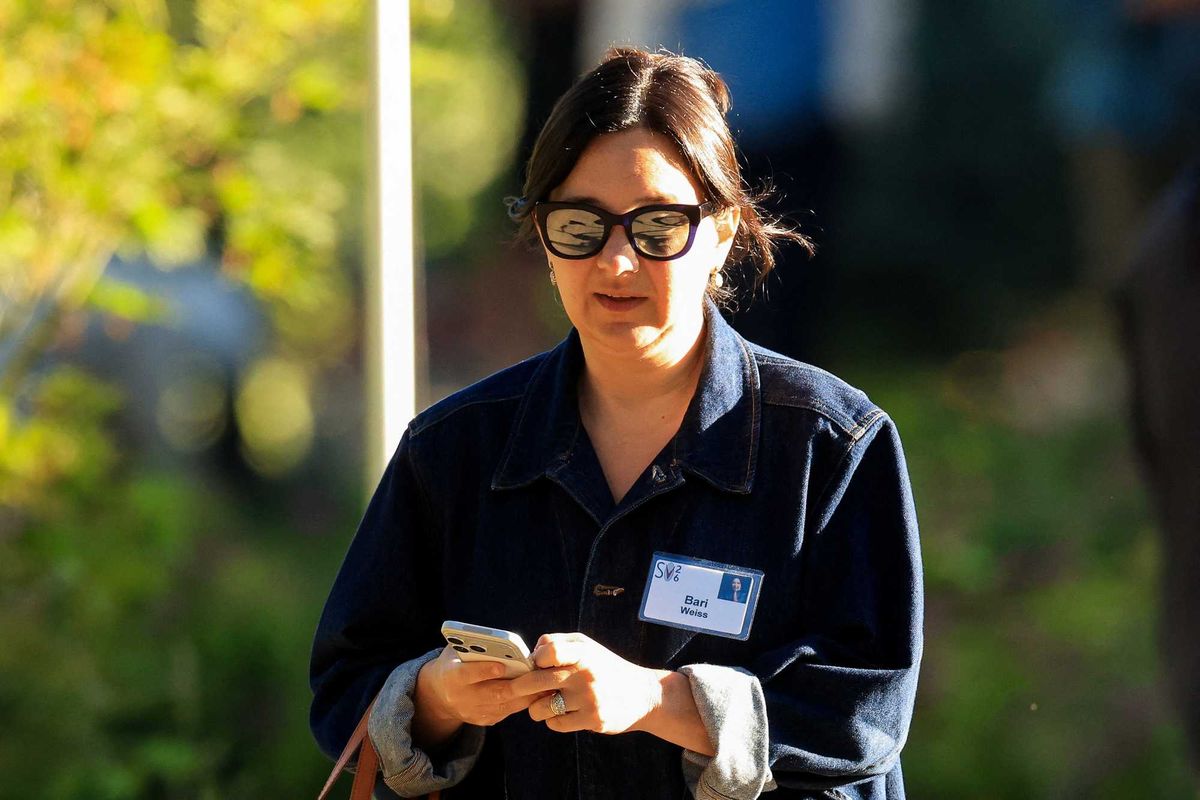
In August 2025, the Ellisons’ Skydance Media acquired Paramount, owner of CBS, and spearheaded a blatant ideological overhaul of the news network (FAIR.org7/24/25). This MAGA-friendly transformation has been aided by Ellison-appointed editor-in-chief Bari Weiss, who had previously made a name for herself as an “anti-woke” crusader and founder of the right-wing media company Free Press. Weiss has been at the forefront of such decisions as canceling the Late Show With Stephen Colbertpulling a 60 Minutes episode that criticized the Trump administration’s mistreatment of Venezuelan migrants, and promoting Tony Dokoupil to primetime anchor, where he promptly gave War Secretary Pete Hegseth an extended and uncritical platform.

Less than six months after the closure of the Paramount deal, in January 2026, Larry Ellison finalized a deal with TikTok, which sold 80% of its US operations to an investor consortium that includes Oracle, and left Ellison with a majority stake in TikTok’s US operations.

Since then, a number of changes have been implemented that reek of censorship and surveillance. For one, TikTok immediately altered its privacy policy to permit more extensive data collection, including tracking user location.

There have also been accusations of content suppression. This became a prominent conversation after the murder of Alex Pretti, as many users reported that they were unable to upload anti-ICE posts and that, if uploaded, their content was receiving unusually low engagement. Researchers found there was a site-wide outage at the time, but they pointed out that because TikTok isn’t transparent with its data or its algorithm, there’s no way to confirm it’s not shadowbanning content (NPR2/4/26)

Now, on the precipice of acquiring WBD, with a targeted completion date of September 30, 2026, the Ellisons are slated to have massively expanded their entertainment, media and tech empire in barely over a year. If the deal moves forward, the family would gain control of a vast portfolio spanning legacy media and Big Tech—including film, news, television, sports and social media—granting them substantial influence over how the world is seen and understood.

Shuffling the media oligarchy

In FAIR’s recent online news ownership study (2/3/26), WBD took the third spot and Paramount/Skydance the 16th. By taking over WBD, the Ellisons would vault into third, just behind Rupert Murdoch’s dynasty.

What does this look like in terms of numbers? According to Pew, 37% of adults in the US use TikTok. Pew notes that “just over half of US adults who use TikTok (55%) say they regularly get news there. That works out to 20% of all US adults,” or about 54 million people. Given TikTok’s expanding reach as a news source, the Ellisons’ ownership of the platform is especially significant.

When factoring in CBS and the additional audience that would accompany an acquisition of CNN, the scope of Ellison-owned media widens even more. As FAIR noted in a recent study (2/3/26), the digital reach alone of these networks is considerable—from December 2024 to November 2025, CBS and CNN attracted 905 million and 4 billion views, respectively. If we use these numbers to project a future in which the Ellisons control CNN, their annual online news view count would be around 5 billion.

The actual broadcast and cable TV viewership of CBS and CNN adds relatively little to the Ellisons’ reach: In a recent week in March, CNN averaged 751,000 total primetime viewers, while the CBS Evening News typically had an audience of 4.3 million in the first quarter of 2026.

While the Ellisons’ rapidly consolidating media dynasty is not unprecedented, these developments have reconfigured the media oligarchy, partially displacing established players and amassing holdings that extend beyond traditional cable and print news into digital and technology media.

Revisiting FAIR’s ranking of digital media owners by site traffic, an Ellison acquisition of WBD would catapult them to the No. 3 spot, driven by CNN’s more than 4 billion annual visits, placing them just behind the No. 1 Ochs-Sulzberger family of the New York Times and the No. 2 Murdoch family.

However, unlike with the Ochs-Sulzbergers, the Ellison media empire would also translate to a strong broadcast and cable news presence, as CNN is regarded as one of the “Big Three” cable news channels, generally trailing only Fox News and Comcast’s MS NOW (formerly MSNBC).

And, although the Murdochs wield considerable power in cable, digital and print news, the Ellison portfolio expands into the social media realm as well. This is notable considering the ever-increasing number of Americans that rely on social media for news. According to Pew, 53% of US adults get news from social media “sometimes” or “often.” Facebook and YouTube are the most popular sites for news, while 20% get news “regularly” from Instagram and TikTok.

While the Ellisons do not lead in social media news ownership—that distinction belongs to Mark Zuckerberg of Meta (which owns Facebook and Instagram) and Larry Page and Sergey Brin of Google (which owns YouTube)—their media empire, like the Murdochs’, ranks prominently across multiple platforms.

Corrupted regulation

The Wall Street Journal (12/8/25) reported that “David Ellison offered assurances to Trump administration officials that if he bought Warner, he’d make sweeping changes to CNN…. Trump has told people close to him that he wants new ownership of CNN as well as changes to CNN programming.”

The Paramount/WBD deal has been unanimously approved by the boards of both companies. The next phase is a WBD shareholders vote, which is scheduled to take place on April 23, 2026, and is expected to move forward without complications.

Reuters (2/27/26) reports that approval in the EU is not anticipated to pose a significant hurdle, given that a combined Paramount/WBD entity would hold less than a 20% market share across European markets.

In the US, the merger would require clearance from both the Department of Justice (DoJ) and the Federal Communications Commission (FCC), which are both controlled by Trump appointees. The anti–public interest antics of FCC chair Brendan Carr are already well-documented by FAIR (2/26/254/2/26CounterSpin4/4/25), and newly appointed Attorney General Todd Blanche appears to have been promoted solely for his unwavering deference to Trump.

DoJ official Omeed Assefi, himself a Trump appointee, has insisted that the transaction would “absolutely not” be fast-tracked for political reasons. Yet this claim has been loudly contradicted by statements from Trump’s inner circle. For instance, Hegseth recently said, “The sooner David Ellison takes over that network [CNN], the better.”

A lawsuit filed against Paramount and assorted executives by a former consultant alleges that the elder Ellison was told by Trump, “Larry, it looks like Netflix is gonna get Warner Bros., but if you really really want it, Larry, I’ll make sure you get it” (Hollywood Reporter3/17/26).

Even if Trump has not explicitly vocalized his preference for an Ellison-owned CNN, it is clear that his personal preference effectively amounts to federal regulatory approval. Put simply, when it comes to antitrust matters, or virtually anything regulatory, pandering to Trump is a prerequisite.

And the Ellisons are not shy about pandering: In early December 2025, while the Netflix deal was still in play, David Ellison met with Trump and DoJ officials in Washington, DC, where he publicly pitched that, if Paramount acquired WBD, he would implement “sweeping changes” at CNN.

As Josh Marshall of Talking Points Memo (12/8/25) observed, shady backdoor dealing and political corruption form the scaffolding of the media oligarchy, a dynamic that reaches new extremes under the Trump regime:

Trump has refashioned antitrust oversight to be little more than a personal veto for the Trump family. Friends can do mergers; foes can’t. Indeed, the indifferent and uncommitted can’t either. You need to get right with the Trump family.

Hope from the states

David Dayen (American Prospect, 2/27/26): “A lifeline exists outside of Trump’s grasp to rethink this looming disaster…. But the state AGs are going to have to act fast.”

While it seems unlikely that federal officials with the power to intervene will do so, there is some cause for optimism at the state level. State governments, particularly state attorneys general, have both the authority and a track record of blocking mergers, even those approved by federal agencies.

Currently leading the charge is California Attorney General Rob Bonta, who, immediately following the news of a potential Paramount/WBD deal, posted on X (2/26/26) that his office would vigorously investigate the merger. California has taken center stage in this fight, due to the outsized impact that such a deal would have on the state’s television and film workforce.

Recent history underscores the validity of these concerns. Just last year, mass layoffs followed the Ellisons’ Skydance/Paramount merger, demonstrating the damage that monopolistic practices wreak on workers.

How effective this resistance will be against the sheer capital and political forces driving the Paramount/WBD deal remains uncertain. As David Dayen explains in the American Prospect (2/27/26), states are well aware of the path forward, and there is historical precedence for them to invoke the Clayton Act to challenge the merger. However, he emphasizes the need to act quickly, noting that states “are in a race against Paramount’s savvy consultants, who are trying to speedrun the deal in a matter of weeks.”


This article was originally published by FAIR; please consider supporting the original publication, and read the original version at the link above.Email

Caitlin Scialla is a freelance writer based in Brooklyn. She is currently interning with Fairness and Accuracy in Reporting (FAIR) and has previously worked with The Progressive magazine.


Source: Prism

She was beginning her spring semester as a second-year law student and paralegal when she received the news: The immigration clinic where she volunteered would have to stop all work, a demand directly from the Trump administration.

The White House issued a stop-work order on Feb. 18, 2025, cutting off aid to federally funded unaccompanied children programs (UCPs) across the U.S. The programs, which provide legal representation to migrant youth who cross the border alone or do not have family in the U.S., were one of the current Trump administration’s first targets.

“I was told to just go home and literally stop working,” recalled the law student Marsha, who is using a pseudonym for fear of retribution.

Days later, on Feb. 23, Immigration and Customs Enforcement (ICE) distributed a memo with a new task for its agents: search for unaccompanied children nationwide and target them for deportation.

This included children such as those Marsha worked with. At the clinic, she assisted them with requesting and receiving court appointments, gaining work authorization, and preparing asylum cases. Some were as old as 18. Others were as young as 3. 

As a result of the funding cuts, according to Marsha, the clinic was forced to deny legal representation to children on a waitlist for more than a year and stop providing legal aid to those it was actively working with.

“It’s completely antithetical to this administration’s stance that everyone should be here legally when you’re gutting the legal infrastructure for that process,” Marsha said.

However, this appeared to be the Trump administration’s strategy: tear down previously established resources as a way to fuel mass deportations, which are then carried out by ICE and Customs and Border Protection (CBP). Agents ripped families apart, caused loved ones to disappear, and rounded up those it claimed were present in the country “illegally”—including U.S. citizens and Native Americans.

In her law school classes, Marsha studied what she was watching in real time: immigrants being treated as national security threats. Then in April 2025, she was enraged to learn that the college she attended, St. John’s University in Queens, New York, signed an agreement with CBP, one of the agencies responsible for immigration enforcement.

“These are the same people [the clinic was] taking to court to convince them that this child who crossed the border alone deserves to stay here, does not deserve to go back to a war-torn country—a country that was destabilized by American policy,” she said.

Prism filed a public records request on Oct. 2, 2025 to obtain a copy of the agreement between St. John’s and CBP. The agency did not provide the records by publication time, in violation of the Freedom of Information Act.  

When the agreement was announced by St. John’s, university leaders said the goal of the collaboration was to create the “Institute for Border Security and Intelligence Studies,” which the university claimed would help CBP “identify intelligence challenges.” The agreement also planned to allow CBP to access the university’s Homeland Security Simulation Lab, where faculty, students, and agencies use virtual reality to simulate scenarios such as terrorist attacks and civil disorder.

Marsha couldn’t have known then that St. John’s would suspend its partnership 10 months later, following widespread pushback from faculty, students, and alumni, as well as reporting by several media outlets, including Prism

But the troubling signs were clear: In the throes of President Donald Trump’s mass deportation campaign, immigration enforcement was becoming embedded within colleges, with little to no community oversight, legal transparency, or guardrails to protect students, faculty, or staff.

Nearly one year has passed since the first agreements between universities and immigration agencies were signed in April 2025. Today, 17 colleges have active agreements, according to a review by Prism. They include three Hispanic-Serving Institutions (HSI) and one Historically Black College and University (HBCU). 

Students and faculty across campuses have overwhelmingly voiced their opposition to the agreements and advocated for the agreements to be terminated, arguing that they create a dangerous environment for anyone who is or perceived to be an immigrant on university campuses nationwide. So far, St. John’s is the only school that has backed out.

A deadly history 

Fresh out of graduate school in 2004, Dohra Ahmad was thrilled to be hired at St. John’s to teach English with a research concentration in anti-colonial movements. As the daughter of an immigrant, the university’s mission statement, one rooted in social justice, spoke to the professor. 

“From the beginning, every part of St. John’s that I interacted with—from my interview, to the faculty orientation, to the mission office—told me that this was a historically immigrant-serving institution,” she said.

During the first Trump administration that began in 2016, Ahmad said St. John’s made efforts to be a safe space for students. The university also appointed its first immigrant, nonwhite, and non-priest president two years prior. During the first wave of anti-immigrant sentiment ushered in by Trump and his supporters, the school’s choice of president felt significant. 

But more recently, she began to wonder if the university was sincere in its social justice mission. The CBP agreement was “a gut punch,” she said. 

As the Trump administration waged war against immigrants in the first half of 2025, St. John’s at first defended the newly formed partnership with CBP. Administrators involved in the partnership insisted that CBP and ICE had different functions, according to a source who is familiar with the conversations among St. John’s leaders.

“When St. John’s first made the deal, they said, ‘Listen, this isn’t ICE, this is actually CBP. They’re doing the work of who gets in at the border and what goods get into the country. That’s different from ICE,’” said the source, who spoke anonymously because they are not authorized to speak publicly. “But not anymore. They’re now an arm of ICE; they’re indistinguishable.”

In recent months alone, countless videos, photographs, and stories from around the country show CBP assisting ICE with enforcement operations. CBP has also helped coordinate some of the largest enforcement operations under the current Trump administration. CBP agents flooded streets in Minneapolis, where some of them shot and killed resident Alex Pretti. And in Chicago, they pulled men, women, and children out of an apartment building during “Operation Midway Blitz.” 

The CBP New York Field Office that St. John’s signed its agreement with directly aided ICE with deportations, Prism has found.

The field office, run by St. John’s alum Francis J. Russo, supported ICE in tracking down immigrants and administering deportation flights. On Instagram, Russo shared photos of agents posing with immigrants in handcuffs. He also participated in a press conference and intelligence symposium with former U.S. Secretary of Homeland Security Kristi Noem, who was ousted after agents killed multiple people across the U.S. under her leadership. 

St. John’s spokesperson Brian Browne did not respond to questions about whether the university was aware of Russo’s connection to Noem. CBP also did not respond to a request for comment.

Ahmad, the English professor, didn’t feel comfortable telling her students not to worry about the university’s partnership with CBP, or trying to reassure them of their safety. In previous semesters, many of her students came from immigrant backgrounds. During class discussions, they shared their families’ stories of migration and navigating the U.S. while being undocumented, she said.

If students shared these details today, she worried, would their classmates report them to CBP?

Ahmad wasn’t alone in her anger over the collaboration. A petition circulated online demanding an end to the university partnership with CBP, collecting more than 1,000 signatures from students, faculty, alumni, and community members. (Disclosure: Julia Luz Betancourt graduated from St. John’s in 2022 and signed the petition demanding the university sever its relationship with CBP.) 

Still, in response to fears that the partnership was a diversion from the university’s social justice mission, Browne characterized them as “illogical” in an interview with Religion News Service. 

“This MOU is no different than countless others that St. John’s pursues with public, private, and non-profit organizations,” he told the St. John’s student newspaper, The Torch. He also claimed to Religious News Service that the partnership would “create a more proficient current and future border security workforce through innovative education and training.”

For students such as Marsha, that was exactly the problem. “It teaches students that their values can be bought at the right price,” she said.

According to an archived article published by the university to announce the partnership, the collaboration stemmed from a conversation between St. John’s associate professor of homeland security Keith Cozine and his former colleague George Pasiakos, assistant director of field operations for the CBP New York Field Office on the 20th anniversary of the Sept. 11 attacks. Cozine is chair of the Homeland Security Department and previously worked for CBP for almost 15 years.

When two planes crashed into the World Trade Center in New York City on the morning of Sep. 11, 2001, Cozine was working at Newark International Airport in New Jersey as an inspector for the Immigration and Naturalization Service (INS), the ICE of its time. While Cozine did not respond to requests for comment regarding his role in the collaboration, Prism obtained his 2010 dissertation for a doctoral program at Rutgers University–Newark, which sheds light on the ways 9/11 shaped his work moving forward. 

He wrote that from the windows of the airport and on the televisions scattered throughout the terminal, he watched in disbelief as New York City’s skyline “changed forever.” 

“I had failed,” he wrote. “As an Immigration Inspector, I was entrusted to protect the citizens of the U.S. from individuals like those terrorists.” 

More broadly, the Sept. 11 attacks also redesigned the U.S.’s approach to national security, leading to the formation of the Department of Homeland Security (DHS), one of the biggest restructurings of the federal government in U.S. history. Each federal immigration agency, including CBP, Border Patrol, and U.S. Citizenship and Immigration Services was reorganized under DHS—and INS dissolved and was reborn as ICE, also overseen by DHS. 

DHS’s initial stated mission was to prevent another terrorist attack from taking place in the U.S. The techniques the agency used largely targeted Muslim immigrants. 

As just one example, in 2003, DHS took over the National Security Entry-Exit Registration System (NSEERS), a so-called counterterrorism program that collected fingerprints, photographs, and other information of male noncitizens ages 16 and older from North Korea and 24 other countries with majority Muslim populations. There is no evidence that NSEERS resulted in any convictions, and many Muslims targeted by the program were deported.

Sept. 11 also changed operations along the U.S.-Mexico border. In the weeks before the attacks, the Bush administration considered a migration accord with Mexico that would have created a pathway to legal status for undocumented immigrants already living and working in the U.S. But after the launch of the “war on terror,” borders and ports of entry were framed as locations susceptible to invasion, leading to “an unprecedented increase in detentions and deportations and unease and confusion within immigrant communities,” according to the American Bar Association.

“The framing of immigration started changing,” Erika Andiola told The Intercept in 2021. Andiola is the chief advocacy officer at the Texas-based Refugee and Immigrant Center for Education and Legal Services. “The entire narrative just became that we were the threat—we were the actual enemy of the nation.”

Increased enforcement in the borderlands pushed migrants into deadlier routes, making the U.S.-Mexico border the “deadliest land route for migrants worldwide on record,” according to the International Organization for Migration. 

Despite this deadly history, St. John’s administrators expressed excitement about the opportunity to offer a career connection to students interested in working for the federal government. CBP, however, focused on the partnership’s potential for intelligence gathering, which is becoming more extreme and invasive under the Trump administration.

St. John’s had connections to the DHS and CBP years before the April 2025 agreement was signed. The university also invited ICE and CBP to a career fair in 2018, sparking backlash from students and faculty, according to reporting in the university’s newspaper.

But sustained pushback from St. John’s professors and students has disrupted the school’s operations with the agency. In February, a dean sent an email that the collaboration was discontinued. The university’s provost, Simon Møller, who signed the agreement, told Gothamist that the partnership was suspended following “mission-focused conversations” with CBP. 

Browne, the university spokesperson, did not respond to a request for comment about why the agreement was terminated.

Ahmad said she is glad the partnership has been suspended, but she does not have faith that future decisions will be made with St. John’s immigrant community in mind.

“Those of us who opposed the partnership had no visibility into either the initial partnership process or the suspension,” she said. 

“Retain control” 

The dissolved partnership between St. John’s and CBP is just one example of how federal immigration agencies are collaborating with universities. A far more common route is ICE’s 287(g) Program, a DHS initiative first included in a law signed by the Clinton administration in 1996 that deputizes local law enforcement to act as immigration agents.

The Obama administration discontinued the program in 2012 after the Department of Justice concluded that police departments engaged in a “pattern and practice” of constitutional violations. However, the program was revamped under the first Trump administration. Now, ICE has signed 1,651 memorandums of agreement for 287(g) programs across the country have entered into the model, with Florida having the highest overall number of agreements with ICE—including the participation of the 17 public universities. 

Florida Gov. Ron DeSantis has exerted unchecked influence on the public university system. On Jan. 27, 2025, he issued a directive for all state and county law enforcement agencies that operate a county jail to enter into ICE’s 287(g) Program, or face suspension. Two hundred eighty-one Florida agencies entered into agreements. 

DeSantis’ directive only applied to sheriff’s departments. However, several university police departments opted to enter into agreements with ICE, granting campus police the authority to interrogate anyone who is believed to be an immigrant about their status, make arrests without a warrant, detain people on campus, and transport them to detention centers. 

What makes these agreements particularly alarming to campus communities is that, as Prism previously reported, university police officers executing immigration enforcement duties under 287(g) work under the direction and supervision of ICE, not the college police departments they are employed by.

The latest school to join the program is the University of South Florida, which finalized its contract on Feb. 10, sparking protests from students.

The agreements fall under the 287(g) program’s Task Force Model. Under the program, law enforcement agencies can receive monetary performance awards of up to $1,000 for each officer trained under 287(g).

Prism spoke with students and faculty at four Florida public universities with 287(g) agreements. They described a pattern of denial, avoidance, and secrecy from their school administrations. Few details are public regarding the agreements, how they will be executed, or which campus officers have been trained to conduct immigration enforcement. 

Tania Cepero Lopez, an associate teaching professor at Florida International University (FIU), said the lack of transparency has taken a toll.

“I was talking to my doctors the other day about the mental health toll that all of this has taken on a lot of us,” she said. “It doesn’t let us focus on the work.”

As the largest HSI in the country, FIU now polices what makes its student body unique: More than 68% of its students identify as Hispanic or Latino, and 7% are nonresident immigrants, according to data from the U.S. Department of Education.

“It’s been frustrating for those of us who saw FIU as a beacon of hope for immigrants,” said Cepero Lopez, who was born in Cuba.

FIU students told Prism that their peers avoid leaving their dorm rooms for anything except attending classes and are otherwise afraid to visit the campus at all.

Ally, an FIU student who is only using her first name for fear of retribution, told Prism that many students no longer feel safe on campus. She is a student organizer with ICEbreakers FIU, a coalition organizing to end the school’s 287(g) agreement and training students how to be legal observers. 

Ally said student safety is not a priority for the university’s 287(g) agreement, adding that the university’s police chief is “a political plant.” Her comment is in reference to a viral video first shared by Florida Rep. Anna Eskamani that shows university Chief of Police Alexander Casas offering “whatever assistance” ICE may need to carry out an “immigration sweep” on campus.  

FIU did not respond to a request for comment.

Students aren’t the only ones pushing back on FIU’s 287(g) agreement

On Aug. 18, 2025, the labor union, United Faculty of Florida (UFF)-FIU, sent a letter to university President Jeanette Nuñez, Casas, and other top administrators requesting their attendance at a town hall to address concerns about the finalized agreement. Also of concern was the Board of Trustees Chair Carlos Duart’s ownership of a company that contracts with GEO Group, the nation’s leading private prison company—and one that contracts with ICE to run detention centers nationwide. The company also helped build the Everglades detention facility known as “Alligator Alcatraz.” 

The administration declined to attend.

“We believe our attendance is unnecessary,” wrote back Barbara Manzano, associate vice president of academic affairs. “As to Chair Duart, his business-related contractual agreements are unrelated to his appointment as a trustee.”

However, the university did eventually respond to a list of questions Cepero Lopez sent on behalf of the union, focused on what permissions ICE agents have on campus. Manzano wrote that ICE may enter public spaces and that classrooms while in session are considered private and therefore, require a judicial warrant. When conducting immigration-related activity, Manzano also wrote that FIU police officers “will inform the faculty member they are authorized to work as an ICE agent.”

FIU isn’t the only Florida university navigating the dangers of a 287(g) agreement or the fallout of DeSantis efforts to reshape public universities. 

Under DeSantis, Florida has been at the forefront of a conservative movement to overhaul public education. In appointing political allies to Florida’s Board of Governors, the governing body of all public institutions, DeSantis controls the politics of individual college boards such as those at FIU, the University of Florida (UF), and Florida A&M University (FAMU).

The result is a jampacked university leadership that seldom represents the most marginalized students on Florida college campuses.

“Students should have a say in who becomes president,” said Mariana Avril Briseno, a student at UF, told Prism. “If the students and larger amount of faculty had a say in how UF is governed, it is likely we wouldn’t have entered the 287(g) agreement.”

UF students have already begun to feel the effects of immigration enforcement targeting their peers. In April 2025, UF student Felipe Zapata Velásquez was deported to Colombia after he was arrested by ICE agents, who said he committed a traffic violation. The following week, UF students protested his deportation and demanded that UF hire an immigration attorney within the Student Legal Services.

“The solidarity shown for Felipe was great. His name was chanted several times. … It was beautiful to see and hear,” Briseno said. “UF is a diverse and multicultural university and should remain as such.”

But in the vision of the conservative presidents running Florida’s public institutions, multiculturalism doesn’t appear to be the goal. Since his appointment in 2025, UF Interim President Donald Landry, who previously worked for the Bush administration, has already restricted speechclaimed diversity, equity, and inclusion efforts have gone “too far”; and vowed to back DeSantis’ approach to Florida’s public education system, saying that a “neutral” university would be conservative.

In the last year alone, DeSantis and his political allies have also pushed for more laws that would make it harder for immigrants to receive or work in higher education, including banning hiring immigrant faculty who are on H1-B visas and placing a cap on the number of international students universities can enroll.

FIU President Jeanette Nuñez was DeSantis’ running mate in 2018 and was the lieutenant governor of Florida until 2025. In an August 2025 interview, Nuñez took no issue with a new regulation barring undocumented students from receiving in-state tuition and claimed that the university’s agreement with ICE simply allowed campus police to “retain control.” 

A part of something greater 

The environment ushered in by DeSantis and the Trump administration means that students at Florida’s only public HBCU are navigating divestment and increasing attacks on their education. 

“FAMU is the forgotten child of Florida,” said Justin Jordan, a third-year broadcast journalism student and president of the school’s Students for a Democratic Society (SDS).

“We do have a small—but I think mighty—population of people who are international students,” he said, noting that the school’s decision to participate in the 287(g) Program is like “spitting in their faces.”

The wave of university 287(g) agreements have sparked activism across Florida campuses. Jordan said FAMU students are getting more involved with SDS’s work to help end the contract. A similar story is unfolding at FIU. 

“People want to be a part of something greater to defend [immigrant] students,” Ally, the FIU student, said. “I can’t say that this is gonna last forever … [but] there’s a lot of power in collective action.”

On March 12, students held a silent disruption at a speaking event between Nuñez and former Major League Baseball player Alex Rodriguez, who was a guest speaker as part of the university’s “Presidential Speak Series.” 

During the event, Ally said students sitting in the first two rows stood up simultaneously to reveal matching shirts, which read: “ICE OFF FIU.” Nuñez looked at the students, then at Rodriguez. According to Ally, she jokingly assured him, “Don’t worry. This isn’t for you.” The student protesters are now under investigation by the university for their participation in the action. 

In a video reviewed by Prism, students later approach Nuñez as she exits the building following the event. She remains turned away from the protesters as they ask her, “Why would you agree to sign the 287(g) agreement?” 

While the university’s agreement remains in place, students told Prism that they hope they can pressure the administration into a full termination, as faculty and students did at St. John’s. 

Moving forward, the plan is to keep organizing until FIU ends its collaboration with ICE. 

“They recognize that we are a force on this campus,” Ally said. “Our group is growing. And as we grow, the administration is weakening.”


This article was originally published by Prism; please consider supporting the original publication, and read the original version at the link above.