Showing posts sorted by date for query AMERICAN CONSPIRACY. Sort by relevance Show all posts

Sunday, May 31, 2026

How to spot a conspiracy theorist in seconds


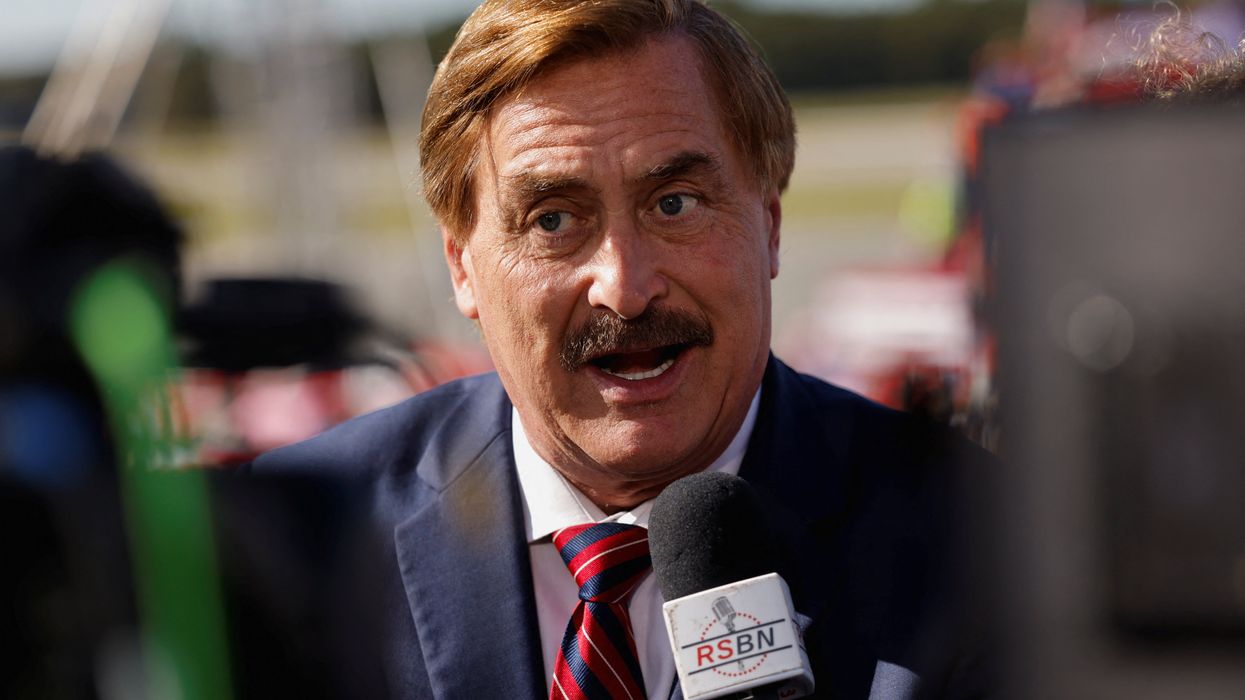
Mike Lindell speaks to the media as he attends Donald Trump's rally in Kinston, North Carolina, U.S., November 3, 2024. REUTERS/Jonathan Drake
May 27, 2026 
ALTERNET

The Internet is full of conspiracy theorists who, knowing the stigma associated with the “conspiracy theorist” label, try to conceal their tendencies by seeming reasonable. Yet a new study reveals a simple tell that these conspiracy theorists have — and it may not be what you think.

“Exploratory linguistic analyses revealed that conspiracism was associated with greater use of conspiracy-related vocabulary (e.g., deception, government), a disproportionate use of sophisticated words, and increased syntactic complexity,” explained the authors of a recent article in the scientific journal PLOS One. “These results suggest that conspiracism may emerge more readily at the lexical level rather than through fully structured narratives. We discuss potential methodological and theoretical factors contributing to these unexpected results, including the roles of context, perceived relevance, motivation, and collective social dynamics. We also consider the possibility that conspiracism may not directly translate into conspiratorial narratives.”

In other words, conspiracy theorists like to gussy up their arguments with ornate language and seemingly-sophisticated forms of analysis, all of which serve to conceal from the public whether their ideas are provably connected to demonstrable facts.

“If so, we recommend comparative research on online vs offline conspiratorial writing to clarify whether conspiracy theories emerge spontaneously from genuine beliefs or are constructed strategically, detached from genuinely held beliefs,” PLOS One concluded.

To learn this, the study authors asked participants to watch an apocalyptic thriller, Leave the World Behind, which is notable for its ambiguous ending. When the nearly 400 study participants were asked to write essays interpreting the movie’s vague information, the scholars — using AI to break down the statistics — found that conspiracy theorists use complex language to make their ideas seem more credible. The use of this language, and the fact that it is consistently untethered to any kind of concrete evidence, is the tell.

“We were surprised that conspiratorial narratives did not emerge as we had predicted,” Alessandro Miani, a researcher in the Department of Psychology at the University of Fribourg in Switzerland and the study’s lead author, told PsyPost's Eric W. Dolan. “We preregistered the hypothesis that people higher in conspiracism would ‘fill the gaps’ of an ambiguous film with conspiratorial interpretations, and we ran two studies with two different conspiracy-belief scales. In both, the expected link between conspiracism and conspiratorial narrative content simply wasn’t there.”

This is not the first study to determine how cognitive processes influence people believing or not believing in conspiracy theories. In February 2024, The Conversation released a breakdown of numerous studies that traced individual thinking styles to one’s propensity to believe in conspiracy theories.

“Research shows that our thinking style can be predictive of susceptibility to conspiracy theories,” The Conversation explained. “The dual processing theory of cognitive style suggests that we have two routes which we can use to process information.”

The Conversation added, “One route is the fast, intuitive route which leans more on personal experiences and gut feelings. The other route is a slower, more analytical route which instead relies on elaborative and detailed processing of information.” Overall “what you tend to see is that people who are not necessarily smarter but who favour the more effortful, analytical thinking style are more resistant to conspiracy beliefs. For example, a British 2014 study found that those who scored highly for questions such as ‘I enjoy problems that require hard thinking’ were less likely to accept conspiracy beliefs.”

The article added, “It also found those who were less likely to engage in effortful thinking styles and more likely to use intuitive thinking showed a higher belief in conspiracy theories.”


ICE Sued Over ‘Civil Rights Catastrophe’ at West Texas Concentration Camp

“The conditions here in this ICE tent camp in a desert are inhumane and cruel,” said one Cameroonian plaintiff in the suit. “No human being should ever have to go through this.”


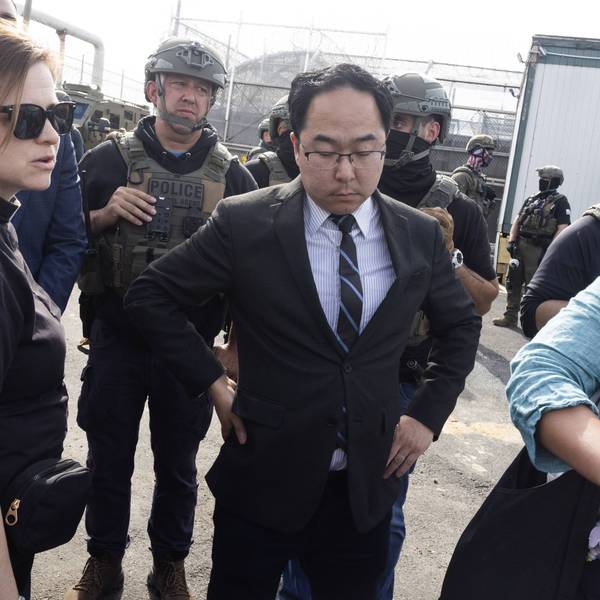
This photo shows a view of US Immigration and Customs Enforcement’s (ICE) Camp East Montana detention center at Ft. Bliss in El Paso, Texas.
Photo by Corrie Boudreaux/El Paso Matter

Brett Wilkins
May 30, 2026
COMMON DREAMS

A group of legal advocacy groups on Friday sued US Immigration and Customs Enforcement and other federal agencies and officials over “inhumane” conditions at the country’s largest concentration camp for immigrants detained during the Trump administration’s mass deportation campaign.

The American Civil Liberties Union, ACLU of Texas, Texas Civil Rights Project, Human Rights Watch, and the law firm Farella Braun + Martel LLP filed suit against ICE, the Department of Homeland Security, Department of Defense, and associated officials, in the US District Court for the Western District of Texas in El Paso


‘What I Witnessed and Experienced Today Was Shameful,‘ Says US Senator Pepper Sprayed by ICE


The lawsuit was filed on behalf of four people seeking to represent a class action for all others held at Camp East Montana, a 60-acre facility located in the Chihuahuan Desert on the grounds of Fort Bliss, an Army base and the site of one of the concentration camps where Japanese Americans and Japanese nationals were imprisoned during World War II. Approximately 2,500 immigrants are being detained there.


The lawsuit documents accounts of what the ACLU called “horrific rights violations” at the facility, including:Severe medical neglect and disease outbreaks, including a months-long measles outbreak that infected at least 14 people;
Violent uses of force by officers against detained immigrants and coercive threats of deportation;
Excessive and arbitrary use of solitary confinement to punish people for requesting basic needs like medical care or hygiene;
Inadequate and rancid food that have caused detained people to lose extreme amounts of weight;
Exposure to dust storms through openings in tent walls that subjects people to respiratory disease; and
Dangerous and unsanitary living conditions in the tent camp, among other rights violations.

“These conditions are longstanding, pervasive, and well-documented, and defendants’ continued inaction in the face of known risks shows their deliberate indifference—not mere negligence—to detainees’ constitutional rights,” the lawsuit states.

At least three detainees have died at Camp East Montana, including Geraldo Lunas Campos, a 55-year-old Cuban who, according to witnesses, died after being handcuffed and placed in a chokehold by guards. The El Paso County Medical Examiner’s Office ruled Lunas Campos’ death a homicide by asphyxia.

Detained immigrants have reported beatings and sexual abuse, medical neglect, hunger and insufficient food, and denial of access to attorneys at the facility.

“The conditions here in this ICE tent camp in a desert are inhumane and cruel. No human being should ever have to go through this,” case plaintiff Gerald Akari Angye said in a statement Friday.

I have already experienced torture in my home country of Cameroon and I never thought I would experience such severely violent treatment by guards here in the United States of America,“ he continued. ”I have been beaten here and even today, I still have a brace on my hands and wrist. I am in pain and I am scared to be here.“

“No one deserves such cruel treatment,” Akari Angye added. “We are all humans and deserve to be treated like it.”

Kyle Virgien, senior staff attorney at the ACLU’s National Prison Project, called Camp East Montana “nothing short of a civil rights catastrophe.”

“Since the day it opened, the facility has repeatedly made headlines for horrific rights violations and even the deaths of three detained people, yet ICE has still evaded accountability for its conduct,” Virgien added. “We’re suing to ensure that no other human being has to endure the inhumane treatment that the Trump administration has inflicted on our clients.”

Another case plaintiff, named in the suit as Navdeep, said, “It feels like we are just political pawns taken from our jobs and families and forced into a temporary tent that is not designed for human life.”

“We could die here, and it feels like no one here would care,” they continued. “With everything happening behind closed doors, I worry the people running this place might cover up the truth about a death or the other injustices that happen here.”

“It’s important for people to know the truth of what is happening here,” Navdeep added. “Being part of this lawsuit is important to me because many people are vulnerable or they become weak because of the conditions here. Even though we come from many different places, we are all human. I want to be a voice for everyone here.”

After receiving “numerous credible reports of torture, killing, and inhumane treatment” of detainees, 35 Democratic Texas state lawmakers earlier this year demand a probe into alleged abuses at Camp East Montana.

Democratic members of US Congress have also sounded the alarm over conditions at Camp East Montana. Rep. Veronica Escobar (D-Texas) has also called out profiteering by the private contractors running the camp.


Amentum Services Inc. took over operations from Acquisition Logistics LLC earlier this year. The latter was never registered to operate in Texas and the former “has a history of health, safety, and other violations of federal law,” according to the consumer advocacy watchdog Public Citizen.

The Trump administration is currently moving forward with a plan to convert industrial warehouses into more ICE concentration camps. The agency has already purchased or contracted for at least 11 warehouses in eight states as part of the $38 billion plan.

While some critics take exception to the concentration camp description, the ICE facilities fit the dictionary definition of the term. The US has a long history of operating concentration camps, with imprisoned peoples ranging from Indigenous tribes during the Trail of Tears and Long Walk to escaped and freed slaves—officially called “contraband” in the Civil War—to Filipinos, Okinawans, and Vietnamese during three different 20th century wars, to Japanese Americans and Japanese nationals during World War II.

“Germany’s concentration camps didn’t start as instruments of mass murder, and neither have ours; both started as facilities for people the government’s leader said were a problem,” talk show host and author Thom Hartmann wrote earlier this year for Common Dreams. “And that’s exactly what ICE is building now. History isn’t whispering its warning: It’s shouting.”


‘By This Logic, Any Protest Could Be a Conspiracy’: Conviction of Spokane ICE Protesters Raises Free Speech Concerns

“We were guinea pigs,” said the father of one of the convicted protesters. “They brought the swamp of Washington, DC, into our area to stop American citizens from exercising our rights that are guaranteed.”


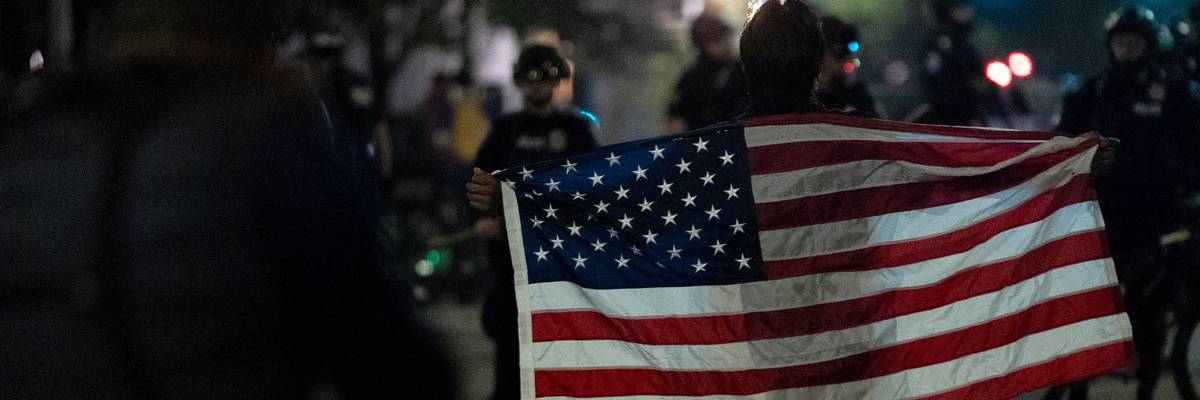
A protestor with an American flag walks towards a police line during a protest against federal immigration arrests, on June 11, 2025 in Seattle, Washington. Protests against ICE raids have spread to cities across the nation after beginning in Los Angeles last weekend.
(Photo by Rio Giancarlo/Getty Images)

Stephen Prager
May 29, 2026
COMMON DREAMS

With the conviction of three anti-ICE protesters in Spokane, Washington on federal “conspiracy” charges Thursday, civil rights advocates and legal experts fear that the Trump administration may have just been handed a powerful tool to criminalize dissent.

Jac Archer, Justice Forral, and Bajun Mavalwalla II, nicknamed the “Spokane 3,” were indicted last year for their actions at a protest in June 2025, where they attempted to physically obstruct ICE agents from transporting two Venezuelan immigrants to an ICE processing facility in Tacoma.

Both of the men reportedly entered the US legally under a humanitarian parole program that had been terminated by the Trump administration, leading advocates to protest their detention.

As Spokesman-Review, a Spokane newspaper, described:
Protesters that day eventually began linking arms around vans and in front of agents’ cars. The event grew chaotic. ICE agents entered a crowd of people standing outside the facility’s parking lot gate and began grabbing people by the necks and arms, pushing them to the ground. Protesters also slashed tires of vans meant to transport the detainees.

But where such activity would usually lead to charges against specific protesters for discrete illegal actions like trespassing, property damage, or other public order offenses, the Department of Justice (DOJ)—as part of a nationwide effort to crack down on protests against ICE—charged nine protesters with “conspiracy to impede or injure officers,” even though no officers were actually injured during the protest.


Legal experts described it as a novel approach that wrapped many people involved in the protest into a single “conspiracy” regardless of whether they committed specific criminal acts.

“Usually if a protest gets out of hand and people are hurt or property is hurt, you see charges based on that,” Mary Fan, a former federal prosecutor and a University of Washington law professor, told The New York Times earlier this month. “They’re not going after people based on specific harm done. They’re stretching conspiracy charges to target protesters and people who organize protests.”

Facing pressure from the federal government to bring the case following a national memo sent from the DOJ to prioritize and publicize cases against ICE agents, then-acting US Attorney for Eastern Washington Richard Barker resigned last year rather than bring charges against the protesters.

He said at the time he was grateful he “never had to sign an indictment or file a brief that [he] didn’t believe in.” His successor, Stephanie Van Marter, however, did sign the order.

Six of the defendants pleaded guilty to the charges to avoid federal prison time. But Archer, Forral, and Mavalwalla chose to fight them, believing the case was part of an unjust attempt to criminalize their right to protest.

After a trial that lasted seven days, a jury found the three defendants guilty of conspiracy. But the defense has argued that the trial was marred by problems that rendered the verdict faulty.

As the Guardian explained:
In February, a federal judge ordered the release of a Venezuelan migrant whose transportation for deportation the protesters sought to block, ruling his arrest violated the constitution.

But the jury, drawn from conservative eastern Washington state, did not hear those facts at trial, thanks to rulings by Judge [Rebecca] Pennell. Pennell, a former federal public defender and appointee of the Democratic president Joe Biden, also ruled the protesters on trial could not use the First Amendment as a defense, though they were allowed to state their reasons for demonstrating.

Instead, the jury watched hours of law enforcement body camera video and heard from a parade of ICE agents... Jeremy Burlingame, an ICE agent who testified, had authored social media posts that called Black politicians “lying ghetto garbage” and transgender people “mentally ill.” He boosted a post showing ICE arresting a pregnant woman at gunpoint that called her a “pregnant invader.”

Federal prosecutors deemed the posts troubling enough to recall Burlingame to impeach him, despite the fact that he was their witness...

But Burlingame’s online posts, the lack of injury to ICE officers, and the absence of evidence showing communication between the three defendants prior to the protest were not enough to sway the jury.

The defendants now face potential sentences of up to six years in prison and a $250,000 fine. However, they are expected to appeal the verdict and have filed a rarely used motion allowing their attorneys to argue that no rational juror could find their clients guilty.

“I question whether justice truly was served by today’s verdict,” Barker told the Spokesman-Review. “This was the first conspiracy prosecution in Eastern Washington history under... a Civil War-era law dusted off to punish members of the Spokane community who stood up for two young men who were unlawfully detained by ICE.”

Video by KREM 2 News/Youtube

Looking beyond the details of the trial itself, many observers questioned the very premise of the DOJ’s prosecution.

Spokane Mayor Lisa Brown said from the start of the trial she believed it was “politically motivated.”

“It was meant to make an example out of people who disagreed with federal immigration policy,” she said.

City council member Sarah Dixit, who said she took part in the protest, said: “Based on the evidence that was shown, I personally didn’t see evidence of what they were accused of. Conspiracy is a charge that feels complicated to prove, and I don’t believe that the government made a strong case for that.”

Others expressed fear for the precedent that had been set. La Rond Baker, the legal director of the Washington ACLU, said the Trump administration “has a demonstrable history of using the Department of Justice to silence and punish its critics.”

The administration has pursued similar sweeping conspiracy charges against other groups of anti-ICE protesters around the country—including in Los Angeles, Broadview, Illinois, and North Texas.

“The verdict was painfully disappointing,” said Archer’s attorney, Carl Oreskovich. “I think it was an extraordinarily aggressive approach to prosecution of protests. And it certainly is going to chill people who want to utilize their First Amendment right to dissent against government actions that they don’t agree with.”

In a comment to The Guardian, Robert Chang, a law professor at the University of California, Irvine School of Law and executive director of its Fred T. Korematsu Center for Law and Equality, said the verdict was “frightening.”

“By this logic, any protest could be a conspiracy,” he said. “The goal posts keep moving.”


Bajun Mavalwalla Sr., a retired US Army intelligence officer who served in Afghanistan, said his son—also a veteran of the same war—and the other two defendants were standing for “the freedoms that separate this country from the dictatorships.”

“People in Spokane and people in Eastern Washington need to understand that we were guinea pigs. That they brought the swamp of Washington, DC, into our area to stop American citizens from exercising our rights that are guaranteed,” the elder Mavalwalla said after his son was convicted.

“It was the whole point of the Constitution, the right to protest, the right to dissent, the right to assemble, all of those things are now in question because of this case,” he said. “My son has taken the brunt of the entire weight of the United States government onto their shoulders.”


Friday, May 29, 2026

Crazy Flows the Don


 May 29, 2026

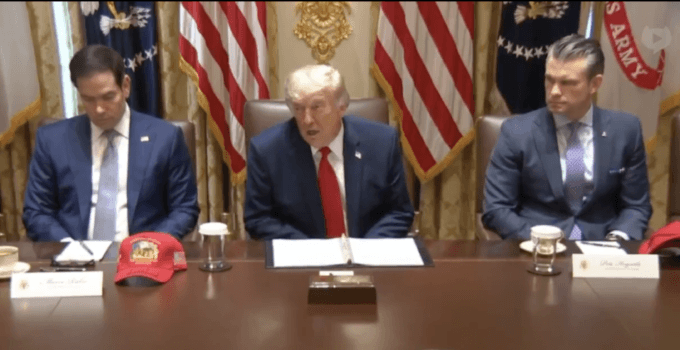
Screengrab from White House video posted to X.

Leaving aside the amen choir in hard-core MAGA circles, is there anyone out there who doesn’t think Donald Trump is bat-shit crazy? How much more evidence is needed before he is gold-chained to the wall of a padded cell?

The midnight tweets of himself as a cartoon action figure are sufficient proof of cognitive disorientation, but at the state level, we have the course of the war in Iran, which, if laid out on a medical chart, would indicate that American foreign policy is being dictated by someone capable of hiding their own Easter eggs.

+++

The war in Iran did not begin after a new Iranian threat or after a congressional resolution; it began as everything does in Trumptopia—with either a billionaire whispering bizarre sweet nothings into Trump’s ear (between DJ sets at Mar-a-Lago) or as a result of a ninety-minute phone call with Vladimir Putin or Benjamin Netanyahu.

It was Netanyahu who dog-whispered Trump into an air campaign over the Persian Gulf, and subsequently, Trump’s reasons for the Iranian war have bounced from regime change and dealing with terrorists to destroying Iran’s nuclear capability to opening the Strait of Hormuz.

Despite waging such a war, you can be sure—given Trump’s addled brain—that he remains clueless about the geography of the Middle East, the alignment of the various coalitions, or the strategic dilemmas now facing the United States as it tries to put the oil genie back in the $2 gallon of gasoline.

As happens with persons suffering from dementia (and there are many forms, as all of us know from our families), Trump’s earlier impulses have become more exaggerated, the further his mind drifts down the rabbit hole. (I bet that on some bad days, he does not remember that there’s even a war going on.)

Trump was always impulsive (sexually and mentally), but now his impulses come with aircraft carriers and cruise missiles.

+++

In the negotiations to end the war in Iran, the only frame of reference in Trump’s mind is some long-ago Manhattan real estate deal where, if you shout loud enough and long enough, you might just end up with the corner lot at a discount price.

At the same time, we know from Trump’s legacy of bankruptcies that, more often than not, his style of negotiation has led him to failure. And that was when he was in his fifties; now in his eighties, with his mind in free fall, for the most part Trump is negotiating with himself.

When Trump first sent family retainers JD Vance, Jared Kushner, and Steve Witkoff to Islamabad to negotiate with the Iranians, he telephoned Vance some 12 times during the talks (in the middle of the night, Washington D.C. time), which I am sure is one reason why those negotiations and those that have followed have never gone anywhere.

Imagine on one hand, having to negotiate with the Iranians, and on the other, get instructions from Trump. In the latest go-round, Trump has sent the draft peace plan to all “concerned parties,” including Israel, an easy way to ensure it fails.

+++

It does not help the American cause (justice and liberty, not what we have now, which is rape and pillage) that the addled Trump cannot keep straight our friends and our enemies.

He somehow thinks that Israel is helping the United States in the Middle East (not simply wagging its own dog), just as he’s in a muddle about Oman (a traditional ally) and the long game of the Saudis (which is to turn Trump into an off-balance sheet asset of its sovereign wealth fund).

In many ways, the president is another Donny (from The Big Lebowski—itself a film about American ineptitude in the Middle East), to whom Walter Sobchak says: “So you have no frame of reference here, Donny. You’re like a child who wanders into the middle of a movie and wants to know…”

All Trump really can keep in focus is who has promised to pay him money, and my guess is that the short list includes Qatar, Israel, Saudi Arabia, and Russia. The rest of the world might just as well be plumbers in Atlantic City who can easily get stiffed on payday.

+++

Without either memory, a frame of reference, core values, or access to history, the demented Trump clings to his “notions” as if they were toys on his nursery floor—something to throw around for a while at the other kids until he gets bored or Daddy’s chauffeur comes to collect him.

Take these examples of how often the president has indulged in changing whims:

—In 2024 Trump ran for the presidency as a Woodrow Wilson Democrat (“He kept us out of war…”) but then once in office behaved like a cross between William McKinley and William Randolph Hearst (“You furnish the pictures, and I’ll furnish the war…”);

—In the Iranian war, Russia’s intelligence agencies helped Iran to target U.S. troops in the field, but then Trump rewarded Putin’s Russia by lifting sanctions on its oil exports and withdrawing American support for Ukraine and NATO;

—In the broader Middle East—because Trump senses a chance for a few golf resorts in Gaza—he has aligned American policies with Israel’s genocide and then, for good measure, made American customers hostage to the fortunes of the OPEC cartel (which, lest we forget, has Trump and his sons in its deep pockets).

+++

None of these positions adds up to a calculated policy, for the simple reason that Trump himself is incapable of coherent thought. Call it frontotemporal dementia, malignant narcissism, or old style psychosis, but whatever Trump has, his mind no longer functions.

He can send out tweets at midnight of himself as Jesus or a Jedi knight; he can march around a parade ground with Putin, Xi, or King Charles; and he can answer a few questions with airplane engines running in the background, but, despite gambling with the future of American civilization by threatening nuclear war in Iran, he cannot discuss Seven Pillars of Wisdom, Mohammad Mosaddegh, or the Treaty of Sèvres and Sykes-Picot.

Trump can neither read nor write (other than his name with a Sharpie), and I suspect that the day after he has met a world leader (take the dance extravaganza in Beijing) he recalls no details of the meeting, and a week later will say to some aide: Why dont we ever have a summit with the Chinese?”

Even more amazing is that Washington D.C. is full of people earning fat salaries to govern the nation, and yet a majority in Congress or on the Supreme Court refuses to act, even when the president spends most of his days and nights barking/tweeting at the moon.

Matthew Stevenson is the author of many books, including Reading the Rails; Appalachia Spring; The Revolution as a Dinner Party (China throughout its turbulent twentieth century); Biking with Bismarck (France during the Franco-Prussian War); and Our Man in Iran. Out not long ago were: Donald Trump’s Circus Maximus and Joe Biden’s Excellent Adventure, about the 2016 and 2020 elections, and The View From Churchill, about the places that shaped the life of the British wartime prime minister. His next books are Playing in Peoria (by bike across the American Mid-West) and Friends of Kind, a literary travel history of World War I.


Donald (Disaster) Trump And the Fight for a Humane Future


 May 29, 2026

Image by charlesdeluvio.

Donald Trump’s America is a scary place in significant part thanks to an unholy alliance of MAGA devotees who don’t believe in science and see intellectuals as public enemy number one, and a gaggle of Silicon Valley militarists who think that they’re the smartest people in the room, if not the universe. Add in White Christian nationalists who abuse religious precepts to sow hatred and division and you have the foundations of the political base that elected Donald Trump (twice!). And worse yet, those groupings are likely to be with us long after our current president has gone off to that great cheeseburger stand in the sky.

Still, it’s worth reflecting on whether such an odd coalition of allies can survive without Donald Trump, or even with a president whose policies have become so harmful and irrational that they’re doing severe human and economic damage even to his most loyal supporters (not to mention the rest of us). And it’s also worth considering whether the pillars of the MAGA movement can manage to stick together in the ever-grimmer Trumpian years to come, not to speak of the post-Trumpian ones, or whether the rest of us can organize a powerful, humane alternative to his politics of hatred and division that could transform this country and the world.

The Know-Nothings Meet the Know-It-Alls

As a start, we have the latter-day “Know Nothings,” a term borrowed from a nineteenth century political movement. It’s not that members of that group literally know nothing. Some of them are quite skilled in their given professions and astute at assessing certain kinds of situations. Some are intelligent but woefully misguided. Trump supporter and former Secretary of Housing and Urban Development Ben Carson, for example, is a brain surgeon.

Members of the anti-science crowd are also often very good at communicating their messages, however wrongheaded or offensive they may be. The problem isn’t that they can’t take in information; it’s that they are distinctly anti-knowledge when it comes to, among other things, separating compelling conspiracy theories from well-documented facts.

The results of their ingrained antagonism toward basic knowledge are profound, making them a threat to public health and democratic practices. After all, we now live in a country where millions of people are against vaccinating their children to prevent potentially deadly diseases and don’t believe that perhaps the gravest threat to continuing life on this planet — climate change — is caused, or even influenced, by human activity or perhaps is even happening at all.

The dangerous delusions of Trump Secretary of Health Robert F. Kennedy, Jr., now have the stamp of government approval and the power of the U. S. government behind them. There is no way to estimate how many people have already fallen sick or even died unnecessarily due to the implementation of his crackpot theories, but the numbers will undoubtedly be significant. The American Public Health Association captured the grim mood of our moment perfectly in an April 2025 press release entitled “Secretary Kennedy and His Policies Are a Danger to the Public Health.”

On a different spiritual plane, tens of millions of Americans believe in the rapture — the notion that they and their kind will be called up to heaven in the end days, while the rest of us will be left behind, presumably to burn in hell (but not a climate-change version of the same). A 2022 Pew poll found that 39% of Americans believe “we are in the end times.” Already! And such a belief, of course, has an impact on how or even whether one wants to devote time and energy to fixing problems here on Earth.

Such an amalgam of opponents of science and skeptics about basic reality bears a distinct resemblance to the “Know Nothing” movement of the nineteenth century that thrived on anti-immigrant sentiments and half-baked conspiracy theories.

The anti-intellectual faction on the right has been propagandized for decades to believe that the biggest obstacle to a better life for them and their families isn’t the predatory corporations hollowing out our economy and manipulating our democracy, but a group of liberal intellectuals clustered on both coasts who allegedly want to replace this country’s bedrock beliefs with a set of “politically correct” prescriptions about how they should live their lives, especially when it comes to DEI or diversity, equity, and inclusion. In such a rendering of reality, that “new class” is seen as sapping the country’s strength and undermining the basic values that would make America great (again!).

The use of that “new class” as a political epithet emerged from the neoconservative movement of the 1960s and 1970s, as Andrew Hartman has explained at his blog on American intellectual history:

“Out of their political repositioning in the late 1960s and 1970s, neoconservatives developed a critical theory (co-opted from anti-Stalinist thinking) about a so-called ‘new class’ of intellectuals, broadly defined to include all professionals tasked with manipulating language — although more narrowly applied to humanists and social scientists. Members of this ‘new class,’ so the theory went, had turned their backs on the society to which they owed their high-ranking status.”

However, the current Trumpian war on DEI should be considered an extension of a longstanding conservative effort to distract Americans from the real sources of their problems by promoting a politics of division and hatred. Mainstream accounts of the drive to eradicate concerns about diversity, equity, and inclusion from public life rarely point out that fighting DEI can fairly be characterized as fighting to make racism, misogyny, and anti-gay and anti-trans discrimination ever more acceptable in the sort of open, unapologetic fashion that prevailed before the modern-day civil rights, women’s rights, and gay rights movements gained strength.

The crusade — and it’s nothing less than that — against DEI needs to be called out for what it is, not treated as some sort of skirmish over language. And rather than DEI programs that stop at raising tough questions about America’s long history of systematic discrimination, what’s needed are programs that truly change people’s lives by creating better-paying jobs and affordable, quality health care for all, regardless of race, gender, class status, or faith. Getting there will, however, require a flowering of faith of another kind — not religious faith, but faith that we can construct an accountable government that serves the public interest, rather than, as in the present age of Donald Trump, the interests of corporations and inhumane ideologues.

Silicon Valley Saviors

In contrast to the “know nothing” faction of the political right in America is the “know it all” faction — Silicon Valley billionaires like Peter Thiel, Alex Karp, Elon Musk, and Palmer Luckey. They view themselves not just as business executives cashing in on the latest trend, but as superior beings who should be running the planet. They promise better living through technology and, as new age militarists, see robotic weapons as the future of warfare. But the idea that such new technologies will inevitably change our lives for the better or protect us from the worst has, at best, a mixed record. It depends, of course, on just who is using such technologies and for what purpose.

In addition to owning companies that create new systems grounded in artificial intelligence and machine learning, the new age militarists are angling to shape our foreign policy, our federal budget, and the future of our democracy. They literally want to become masters of the universe by figuring out how to live forever and promote the colonization of space. They dream of video games in which, as Palmer Luckey put it, “if you die in the game, you die in real life.”

The political reach of the Silicon Valley crowd has grown dramatically in the age of Donald Trump. JD Vance, his vice president, was, of course, groomed and financed by Peter Thiel, the founder of the omnipresent firm Palantir, which provides technology to patrol the border, helps ICE identify suspects, and has provided software to Israel that its leaders have used to step up the pace of bombing in their genocidal war in Gaza. After a stint at one of Thiel’s venture capital firms, Vance won a Senate election in Ohio with major financial backing from him and his allies.

When Trump chose Vance as his running mate, champagne corks popped in Silicon Valley and the money started flowing to help Trump get elected, including up to a quarter of a billion dollars in dark money from Elon Musk. As a result, Silicon Valley now has its man in the executive branch.

Nor is Vance alone. Former employees of tech firms like SpaceX and Anduril are now embedded in key agencies of the federal government, and Secretary of — yes! — War Pete Hegseth has gone all in on integrating AI into U.S. military planning and practice to the delight of the billionaire tech moguls and their hangers-on.

To say that Thiel, Musk, Palmer Luckey, Alex Karp, and their financiers like Marc Andreessen of the venture capital firm Andreessen Horowitz have a high opinion of themselves — and of the potential of the technology their companies produce — would distinctly be an understatement.

Kathryn Boyle of Andreessen Horowitz, a self-appointed chief ideologist and cheerleader for the Silicon Valley tech takeover of America, gave a speech to the conservative American Enterprise Institute in February 2025 that analyst Gil Duran described as an effort to “equate most government actions with communist dictatorships… while positioning tech bros as the ordained saviors of the traditional family.” Boyle’s bread and butter argument — call it a potentially fatal kind of narcissism — was that only the “founders” (yes, they call themselves that!) are serious enough, skilled enough, and endowed by their creator with enough persistence to solve and reverse America’s imperial decline. The rest of us should just get out of the way and let the new techno-gods do their work.

Will Trump’s Patchwork Quilt Come Apart at the Seams?

The Trump coalition is a strange kaleidoscope of confusing views and contradictory cover stories: the know-nothings; the know-it-alls; the false prophets of White Christian nationalism, the billionaires and millionaires, the people who (once upon a time) watched too many episodes of The Apprentice and think Trump is a good businessman; those who want yet another tax break; those men among us who want to control what women do with their bodies, and the (mostly) men who feel liberated because Trump openly and repeatedly makes racist, sexist, anti-gay, and anti-trans statements, legitimizing vocal expressions of prejudice in a way not seen in decades.

Yes, his is a motley crew, but so far they have rallied around the president, no matter the promises he breaks or the harmful policies he jams down all of our throats (policies that could ultimately hit many diehard Trump supporters who aren’t billionaires as hard or harder than they will hit his opponents). Fortunately, there are at least signs that his ability to thrive politically (even as his policies drive America into a ditch) may be fading. His brutal, illogical, illegal, ill-defined war on Iran — complete with genocidal rhetoric about ending an entire civilization — may be the beginning of the end of his grasp of our politics and our psyche.

Unfortunately, he may be as much a symptom of what’s wrong with America as he is a producer of deep damage to the future prospects of democratic governance and human cooperation in this country and on this planet.

Which Way Out?

Any resistance to such know-nothingism and incipient technofascism must start on a human scale. If we are ever going to build a tolerant, welcoming nation that meets the basic needs of its residents, while leaving ample room for scientific inquiry and creative endeavors of all sorts, we need to get off our machines and start talking to — and crucially, listening to — each other.

This is already happening more widely than you might imagine if you’re a prisoner of your news feed. And it’s happening not just in large gatherings like the No Kings rallies, but in local organizing around schools and housing, voter registration and education efforts, and attempts to help communities survive the double-injury of runaway capitalism and the shredding of the social safety net thanks, at least in part, to Donald Trump’s “Big Beautiful Bill” (which is the ugliest, most inhumane piece of legislation in living memory).

We need to fight on at least three fronts — economically, politically, and culturally. Senator Bernie Sanders has shown just how a truly populist economic program could draw support even among diehard MAGA backers, and such a program is a necessity if we are ever to dig our way out of our current predicament.

But economics is hardly the only problem we have. There’s also the reality of racism to contend with, not to speak of a thriving anti-immigrant sensibility, and misogyny, as well as anti-gay and anti-trans discrimination — all deeply embedded in a nation that was founded as a colonial enterprise fueled by slavery and genocide. Such a history has to be transcended by embracing the values and elevating the leadership of the people most impacted by the legacy of America’s repressive past, while building a new culture based on tolerance, respect, and (yes!) love for our fellow human beings.

To be clear (as President Barack Obama would often say), by “transcend” I don’t mean ignore. We must fully acknowledge and seriously commit our society to repairing the crimes embedded in our development as a nation, not to speak of those being committed right now in Donald Trump’s America against so many of us and our planet as well.

And sadly, it’s all too obvious that coming together to save this planet and retain our basic humanity will not be easy. People are messy and, frankly, can be a pain to deal with (yours truly included). We are, however, all we have, and making the effort will matter.

I believe in the saying, attributed to leaders of the Wobblies (the radical union founded in 1905 and known formally as the Industrial Workers of the World), that we must sow the seeds of any new society in the shell of the old one. The way we treat each other in our homes, workplaces, schools, sites of worship, and other public and private spaces will determine whether we can build a better world or are fated to live in a never-endingly Trumpian one. In that context, it’s important not just to speak truth to power, but to begin trying to create alternative sources of power and good ideas aren’t enough for that. (If they were, we would already be living in a far better world.)

Building alternative power and charting a path to such a world will be a distinctly collective undertaking. A handful of charismatic leaders or courageous organizers can’t do it for us. We all need to be leaders since we are all experts (in the sense of knowing our communities and our bits of the world).

There are no guarantees in life, but in this disastrous Trumpian universe of ours, fighting the power should feel far more fulfilling than bending the knee, and if enough of us join that fight, we at least have a shot at building a society and a world worth sustaining for generations to come.

What are we waiting for?

This piece first appeared on TomDispatch.