“The conditions here in this ICE tent camp in a desert are inhumane and cruel,” said one Cameroonian plaintiff in the suit. “No human being should ever have to go through this.”
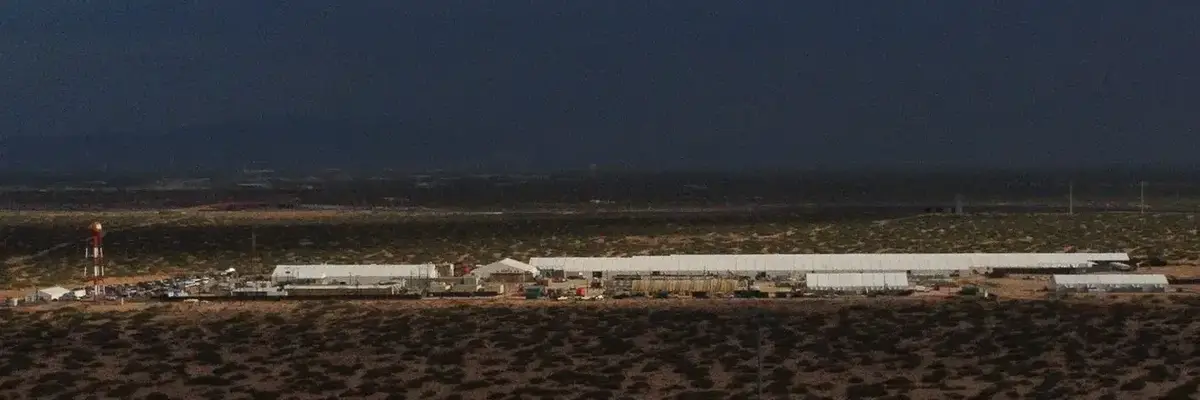
This photo shows a view of US Immigration and Customs Enforcement’s (ICE) Camp East Montana detention center at Ft. Bliss in El Paso, Texas.
Photo by Corrie Boudreaux/El Paso Matter
Brett Wilkins
May 30, 2026
COMMON DREAMS
A group of legal advocacy groups on Friday sued US Immigration and Customs Enforcement and other federal agencies and officials over “inhumane” conditions at the country’s largest concentration camp for immigrants detained during the Trump administration’s mass deportation campaign.
The American Civil Liberties Union, ACLU of Texas, Texas Civil Rights Project, Human Rights Watch, and the law firm Farella Braun + Martel LLP filed suit against ICE, the Department of Homeland Security, Department of Defense, and associated officials, in the US District Court for the Western District of Texas in El Paso
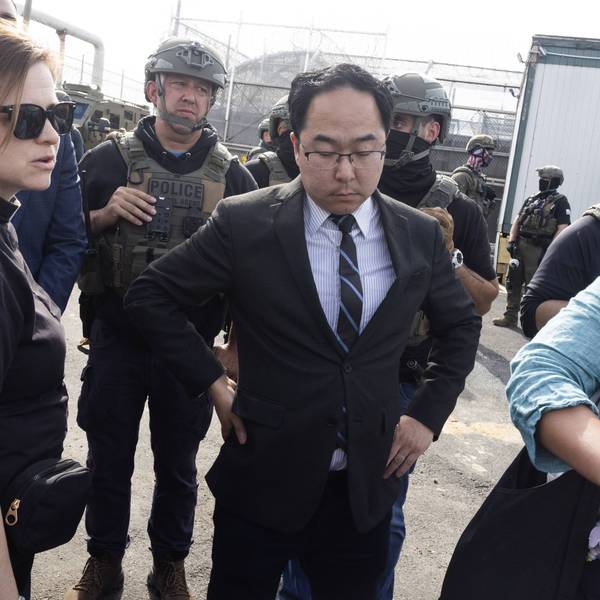
‘What I Witnessed and Experienced Today Was Shameful,‘ Says US Senator Pepper Sprayed by ICE
The lawsuit was filed on behalf of four people seeking to represent a class action for all others held at Camp East Montana, a 60-acre facility located in the Chihuahuan Desert on the grounds of Fort Bliss, an Army base and the site of one of the concentration camps where Japanese Americans and Japanese nationals were imprisoned during World War II. Approximately 2,500 immigrants are being detained there.
May 30, 2026
COMMON DREAMS
A group of legal advocacy groups on Friday sued US Immigration and Customs Enforcement and other federal agencies and officials over “inhumane” conditions at the country’s largest concentration camp for immigrants detained during the Trump administration’s mass deportation campaign.
The American Civil Liberties Union, ACLU of Texas, Texas Civil Rights Project, Human Rights Watch, and the law firm Farella Braun + Martel LLP filed suit against ICE, the Department of Homeland Security, Department of Defense, and associated officials, in the US District Court for the Western District of Texas in El Paso
‘What I Witnessed and Experienced Today Was Shameful,‘ Says US Senator Pepper Sprayed by ICE
The lawsuit was filed on behalf of four people seeking to represent a class action for all others held at Camp East Montana, a 60-acre facility located in the Chihuahuan Desert on the grounds of Fort Bliss, an Army base and the site of one of the concentration camps where Japanese Americans and Japanese nationals were imprisoned during World War II. Approximately 2,500 immigrants are being detained there.
The lawsuit documents accounts of what the ACLU called “horrific rights violations” at the facility, including:Severe medical neglect and disease outbreaks, including a months-long measles outbreak that infected at least 14 people;
Violent uses of force by officers against detained immigrants and coercive threats of deportation;
Excessive and arbitrary use of solitary confinement to punish people for requesting basic needs like medical care or hygiene;
Inadequate and rancid food that have caused detained people to lose extreme amounts of weight;
Exposure to dust storms through openings in tent walls that subjects people to respiratory disease; and
Dangerous and unsanitary living conditions in the tent camp, among other rights violations.
“These conditions are longstanding, pervasive, and well-documented, and defendants’ continued inaction in the face of known risks shows their deliberate indifference—not mere negligence—to detainees’ constitutional rights,” the lawsuit states.
At least three detainees have died at Camp East Montana, including Geraldo Lunas Campos, a 55-year-old Cuban who, according to witnesses, died after being handcuffed and placed in a chokehold by guards. The El Paso County Medical Examiner’s Office ruled Lunas Campos’ death a homicide by asphyxia.
Detained immigrants have reported beatings and sexual abuse, medical neglect, hunger and insufficient food, and denial of access to attorneys at the facility.
“The conditions here in this ICE tent camp in a desert are inhumane and cruel. No human being should ever have to go through this,” case plaintiff Gerald Akari Angye said in a statement Friday.
I have already experienced torture in my home country of Cameroon and I never thought I would experience such severely violent treatment by guards here in the United States of America,“ he continued. ”I have been beaten here and even today, I still have a brace on my hands and wrist. I am in pain and I am scared to be here.“
“No one deserves such cruel treatment,” Akari Angye added. “We are all humans and deserve to be treated like it.”
Kyle Virgien, senior staff attorney at the ACLU’s National Prison Project, called Camp East Montana “nothing short of a civil rights catastrophe.”
“Since the day it opened, the facility has repeatedly made headlines for horrific rights violations and even the deaths of three detained people, yet ICE has still evaded accountability for its conduct,” Virgien added. “We’re suing to ensure that no other human being has to endure the inhumane treatment that the Trump administration has inflicted on our clients.”
Another case plaintiff, named in the suit as Navdeep, said, “It feels like we are just political pawns taken from our jobs and families and forced into a temporary tent that is not designed for human life.”
“We could die here, and it feels like no one here would care,” they continued. “With everything happening behind closed doors, I worry the people running this place might cover up the truth about a death or the other injustices that happen here.”
“It’s important for people to know the truth of what is happening here,” Navdeep added. “Being part of this lawsuit is important to me because many people are vulnerable or they become weak because of the conditions here. Even though we come from many different places, we are all human. I want to be a voice for everyone here.”
After receiving “numerous credible reports of torture, killing, and inhumane treatment” of detainees, 35 Democratic Texas state lawmakers earlier this year demand a probe into alleged abuses at Camp East Montana.
Democratic members of US Congress have also sounded the alarm over conditions at Camp East Montana. Rep. Veronica Escobar (D-Texas) has also called out profiteering by the private contractors running the camp.
Amentum Services Inc. took over operations from Acquisition Logistics LLC earlier this year. The latter was never registered to operate in Texas and the former “has a history of health, safety, and other violations of federal law,” according to the consumer advocacy watchdog Public Citizen.
The Trump administration is currently moving forward with a plan to convert industrial warehouses into more ICE concentration camps. The agency has already purchased or contracted for at least 11 warehouses in eight states as part of the $38 billion plan.
While some critics take exception to the concentration camp description, the ICE facilities fit the dictionary definition of the term. The US has a long history of operating concentration camps, with imprisoned peoples ranging from Indigenous tribes during the Trail of Tears and Long Walk to escaped and freed slaves—officially called “contraband” in the Civil War—to Filipinos, Okinawans, and Vietnamese during three different 20th century wars, to Japanese Americans and Japanese nationals during World War II.
“Germany’s concentration camps didn’t start as instruments of mass murder, and neither have ours; both started as facilities for people the government’s leader said were a problem,” talk show host and author Thom Hartmann wrote earlier this year for Common Dreams. “And that’s exactly what ICE is building now. History isn’t whispering its warning: It’s shouting.”
‘By This Logic, Any Protest Could Be a Conspiracy’: Conviction of Spokane ICE Protesters Raises Free Speech Concerns
“We were guinea pigs,” said the father of one of the convicted protesters. “They brought the swamp of Washington, DC, into our area to stop American citizens from exercising our rights that are guaranteed.”
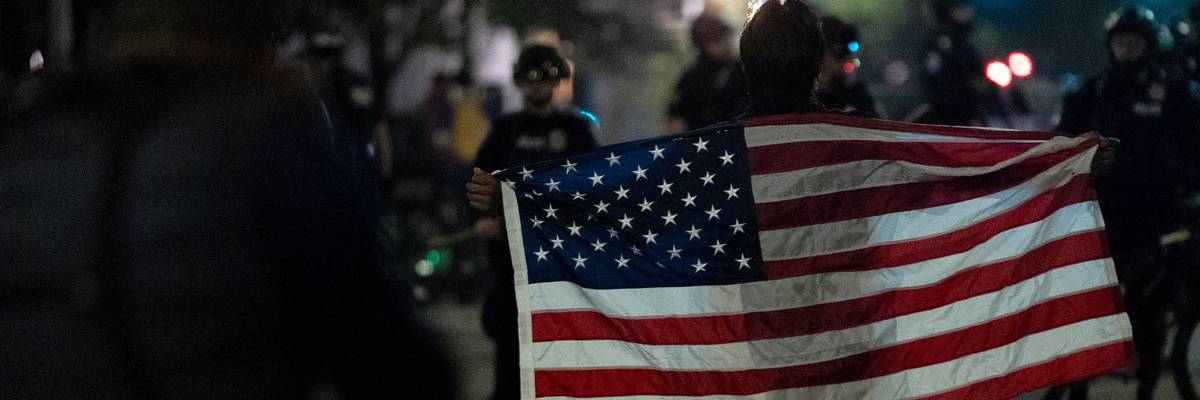
A protestor with an American flag walks towards a police line during a protest against federal immigration arrests, on June 11, 2025 in Seattle, Washington. Protests against ICE raids have spread to cities across the nation after beginning in Los Angeles last weekend.
(Photo by Rio Giancarlo/Getty Images)
Stephen Prager
May 29, 2026
COMMON DREAMS
With the conviction of three anti-ICE protesters in Spokane, Washington on federal “conspiracy” charges Thursday, civil rights advocates and legal experts fear that the Trump administration may have just been handed a powerful tool to criminalize dissent.
Jac Archer, Justice Forral, and Bajun Mavalwalla II, nicknamed the “Spokane 3,” were indicted last year for their actions at a protest in June 2025, where they attempted to physically obstruct ICE agents from transporting two Venezuelan immigrants to an ICE processing facility in Tacoma.
Both of the men reportedly entered the US legally under a humanitarian parole program that had been terminated by the Trump administration, leading advocates to protest their detention.
As Spokesman-Review, a Spokane newspaper, described:
Protesters that day eventually began linking arms around vans and in front of agents’ cars. The event grew chaotic. ICE agents entered a crowd of people standing outside the facility’s parking lot gate and began grabbing people by the necks and arms, pushing them to the ground. Protesters also slashed tires of vans meant to transport the detainees.
But where such activity would usually lead to charges against specific protesters for discrete illegal actions like trespassing, property damage, or other public order offenses, the Department of Justice (DOJ)—as part of a nationwide effort to crack down on protests against ICE—charged nine protesters with “conspiracy to impede or injure officers,” even though no officers were actually injured during the protest.
Legal experts described it as a novel approach that wrapped many people involved in the protest into a single “conspiracy” regardless of whether they committed specific criminal acts.
“Usually if a protest gets out of hand and people are hurt or property is hurt, you see charges based on that,” Mary Fan, a former federal prosecutor and a University of Washington law professor, told The New York Times earlier this month. “They’re not going after people based on specific harm done. They’re stretching conspiracy charges to target protesters and people who organize protests.”
Facing pressure from the federal government to bring the case following a national memo sent from the DOJ to prioritize and publicize cases against ICE agents, then-acting US Attorney for Eastern Washington Richard Barker resigned last year rather than bring charges against the protesters.
He said at the time he was grateful he “never had to sign an indictment or file a brief that [he] didn’t believe in.” His successor, Stephanie Van Marter, however, did sign the order.
Six of the defendants pleaded guilty to the charges to avoid federal prison time. But Archer, Forral, and Mavalwalla chose to fight them, believing the case was part of an unjust attempt to criminalize their right to protest.
After a trial that lasted seven days, a jury found the three defendants guilty of conspiracy. But the defense has argued that the trial was marred by problems that rendered the verdict faulty.
As the Guardian explained:
In February, a federal judge ordered the release of a Venezuelan migrant whose transportation for deportation the protesters sought to block, ruling his arrest violated the constitution.
But the jury, drawn from conservative eastern Washington state, did not hear those facts at trial, thanks to rulings by Judge [Rebecca] Pennell. Pennell, a former federal public defender and appointee of the Democratic president Joe Biden, also ruled the protesters on trial could not use the First Amendment as a defense, though they were allowed to state their reasons for demonstrating.
Instead, the jury watched hours of law enforcement body camera video and heard from a parade of ICE agents... Jeremy Burlingame, an ICE agent who testified, had authored social media posts that called Black politicians “lying ghetto garbage” and transgender people “mentally ill.” He boosted a post showing ICE arresting a pregnant woman at gunpoint that called her a “pregnant invader.”
Federal prosecutors deemed the posts troubling enough to recall Burlingame to impeach him, despite the fact that he was their witness...
But Burlingame’s online posts, the lack of injury to ICE officers, and the absence of evidence showing communication between the three defendants prior to the protest were not enough to sway the jury.
The defendants now face potential sentences of up to six years in prison and a $250,000 fine. However, they are expected to appeal the verdict and have filed a rarely used motion allowing their attorneys to argue that no rational juror could find their clients guilty.
“I question whether justice truly was served by today’s verdict,” Barker told the Spokesman-Review. “This was the first conspiracy prosecution in Eastern Washington history under... a Civil War-era law dusted off to punish members of the Spokane community who stood up for two young men who were unlawfully detained by ICE.”

“We were guinea pigs,” said the father of one of the convicted protesters. “They brought the swamp of Washington, DC, into our area to stop American citizens from exercising our rights that are guaranteed.”
A protestor with an American flag walks towards a police line during a protest against federal immigration arrests, on June 11, 2025 in Seattle, Washington. Protests against ICE raids have spread to cities across the nation after beginning in Los Angeles last weekend.
(Photo by Rio Giancarlo/Getty Images)
Stephen Prager
May 29, 2026
COMMON DREAMS
With the conviction of three anti-ICE protesters in Spokane, Washington on federal “conspiracy” charges Thursday, civil rights advocates and legal experts fear that the Trump administration may have just been handed a powerful tool to criminalize dissent.
Jac Archer, Justice Forral, and Bajun Mavalwalla II, nicknamed the “Spokane 3,” were indicted last year for their actions at a protest in June 2025, where they attempted to physically obstruct ICE agents from transporting two Venezuelan immigrants to an ICE processing facility in Tacoma.
Both of the men reportedly entered the US legally under a humanitarian parole program that had been terminated by the Trump administration, leading advocates to protest their detention.
As Spokesman-Review, a Spokane newspaper, described:
Protesters that day eventually began linking arms around vans and in front of agents’ cars. The event grew chaotic. ICE agents entered a crowd of people standing outside the facility’s parking lot gate and began grabbing people by the necks and arms, pushing them to the ground. Protesters also slashed tires of vans meant to transport the detainees.
But where such activity would usually lead to charges against specific protesters for discrete illegal actions like trespassing, property damage, or other public order offenses, the Department of Justice (DOJ)—as part of a nationwide effort to crack down on protests against ICE—charged nine protesters with “conspiracy to impede or injure officers,” even though no officers were actually injured during the protest.
Legal experts described it as a novel approach that wrapped many people involved in the protest into a single “conspiracy” regardless of whether they committed specific criminal acts.
“Usually if a protest gets out of hand and people are hurt or property is hurt, you see charges based on that,” Mary Fan, a former federal prosecutor and a University of Washington law professor, told The New York Times earlier this month. “They’re not going after people based on specific harm done. They’re stretching conspiracy charges to target protesters and people who organize protests.”
Facing pressure from the federal government to bring the case following a national memo sent from the DOJ to prioritize and publicize cases against ICE agents, then-acting US Attorney for Eastern Washington Richard Barker resigned last year rather than bring charges against the protesters.
He said at the time he was grateful he “never had to sign an indictment or file a brief that [he] didn’t believe in.” His successor, Stephanie Van Marter, however, did sign the order.
Six of the defendants pleaded guilty to the charges to avoid federal prison time. But Archer, Forral, and Mavalwalla chose to fight them, believing the case was part of an unjust attempt to criminalize their right to protest.
After a trial that lasted seven days, a jury found the three defendants guilty of conspiracy. But the defense has argued that the trial was marred by problems that rendered the verdict faulty.
As the Guardian explained:
In February, a federal judge ordered the release of a Venezuelan migrant whose transportation for deportation the protesters sought to block, ruling his arrest violated the constitution.
But the jury, drawn from conservative eastern Washington state, did not hear those facts at trial, thanks to rulings by Judge [Rebecca] Pennell. Pennell, a former federal public defender and appointee of the Democratic president Joe Biden, also ruled the protesters on trial could not use the First Amendment as a defense, though they were allowed to state their reasons for demonstrating.
Instead, the jury watched hours of law enforcement body camera video and heard from a parade of ICE agents... Jeremy Burlingame, an ICE agent who testified, had authored social media posts that called Black politicians “lying ghetto garbage” and transgender people “mentally ill.” He boosted a post showing ICE arresting a pregnant woman at gunpoint that called her a “pregnant invader.”
Federal prosecutors deemed the posts troubling enough to recall Burlingame to impeach him, despite the fact that he was their witness...
But Burlingame’s online posts, the lack of injury to ICE officers, and the absence of evidence showing communication between the three defendants prior to the protest were not enough to sway the jury.
The defendants now face potential sentences of up to six years in prison and a $250,000 fine. However, they are expected to appeal the verdict and have filed a rarely used motion allowing their attorneys to argue that no rational juror could find their clients guilty.
“I question whether justice truly was served by today’s verdict,” Barker told the Spokesman-Review. “This was the first conspiracy prosecution in Eastern Washington history under... a Civil War-era law dusted off to punish members of the Spokane community who stood up for two young men who were unlawfully detained by ICE.”
Video by KREM 2 News/Youtube
Looking beyond the details of the trial itself, many observers questioned the very premise of the DOJ’s prosecution.
Spokane Mayor Lisa Brown said from the start of the trial she believed it was “politically motivated.”
“It was meant to make an example out of people who disagreed with federal immigration policy,” she said.
City council member Sarah Dixit, who said she took part in the protest, said: “Based on the evidence that was shown, I personally didn’t see evidence of what they were accused of. Conspiracy is a charge that feels complicated to prove, and I don’t believe that the government made a strong case for that.”
Others expressed fear for the precedent that had been set. La Rond Baker, the legal director of the Washington ACLU, said the Trump administration “has a demonstrable history of using the Department of Justice to silence and punish its critics.”
The administration has pursued similar sweeping conspiracy charges against other groups of anti-ICE protesters around the country—including in Los Angeles, Broadview, Illinois, and North Texas.
“The verdict was painfully disappointing,” said Archer’s attorney, Carl Oreskovich. “I think it was an extraordinarily aggressive approach to prosecution of protests. And it certainly is going to chill people who want to utilize their First Amendment right to dissent against government actions that they don’t agree with.”
In a comment to The Guardian, Robert Chang, a law professor at the University of California, Irvine School of Law and executive director of its Fred T. Korematsu Center for Law and Equality, said the verdict was “frightening.”
“By this logic, any protest could be a conspiracy,” he said. “The goal posts keep moving.”
Bajun Mavalwalla Sr., a retired US Army intelligence officer who served in Afghanistan, said his son—also a veteran of the same war—and the other two defendants were standing for “the freedoms that separate this country from the dictatorships.”
“People in Spokane and people in Eastern Washington need to understand that we were guinea pigs. That they brought the swamp of Washington, DC, into our area to stop American citizens from exercising our rights that are guaranteed,” the elder Mavalwalla said after his son was convicted.
“It was the whole point of the Constitution, the right to protest, the right to dissent, the right to assemble, all of those things are now in question because of this case,” he said. “My son has taken the brunt of the entire weight of the United States government onto their shoulders.”
Looking beyond the details of the trial itself, many observers questioned the very premise of the DOJ’s prosecution.
Spokane Mayor Lisa Brown said from the start of the trial she believed it was “politically motivated.”
“It was meant to make an example out of people who disagreed with federal immigration policy,” she said.
City council member Sarah Dixit, who said she took part in the protest, said: “Based on the evidence that was shown, I personally didn’t see evidence of what they were accused of. Conspiracy is a charge that feels complicated to prove, and I don’t believe that the government made a strong case for that.”
Others expressed fear for the precedent that had been set. La Rond Baker, the legal director of the Washington ACLU, said the Trump administration “has a demonstrable history of using the Department of Justice to silence and punish its critics.”
The administration has pursued similar sweeping conspiracy charges against other groups of anti-ICE protesters around the country—including in Los Angeles, Broadview, Illinois, and North Texas.
“The verdict was painfully disappointing,” said Archer’s attorney, Carl Oreskovich. “I think it was an extraordinarily aggressive approach to prosecution of protests. And it certainly is going to chill people who want to utilize their First Amendment right to dissent against government actions that they don’t agree with.”
In a comment to The Guardian, Robert Chang, a law professor at the University of California, Irvine School of Law and executive director of its Fred T. Korematsu Center for Law and Equality, said the verdict was “frightening.”
“By this logic, any protest could be a conspiracy,” he said. “The goal posts keep moving.”
Bajun Mavalwalla Sr., a retired US Army intelligence officer who served in Afghanistan, said his son—also a veteran of the same war—and the other two defendants were standing for “the freedoms that separate this country from the dictatorships.”
“People in Spokane and people in Eastern Washington need to understand that we were guinea pigs. That they brought the swamp of Washington, DC, into our area to stop American citizens from exercising our rights that are guaranteed,” the elder Mavalwalla said after his son was convicted.
“It was the whole point of the Constitution, the right to protest, the right to dissent, the right to assemble, all of those things are now in question because of this case,” he said. “My son has taken the brunt of the entire weight of the United States government onto their shoulders.”


No comments:
Post a Comment