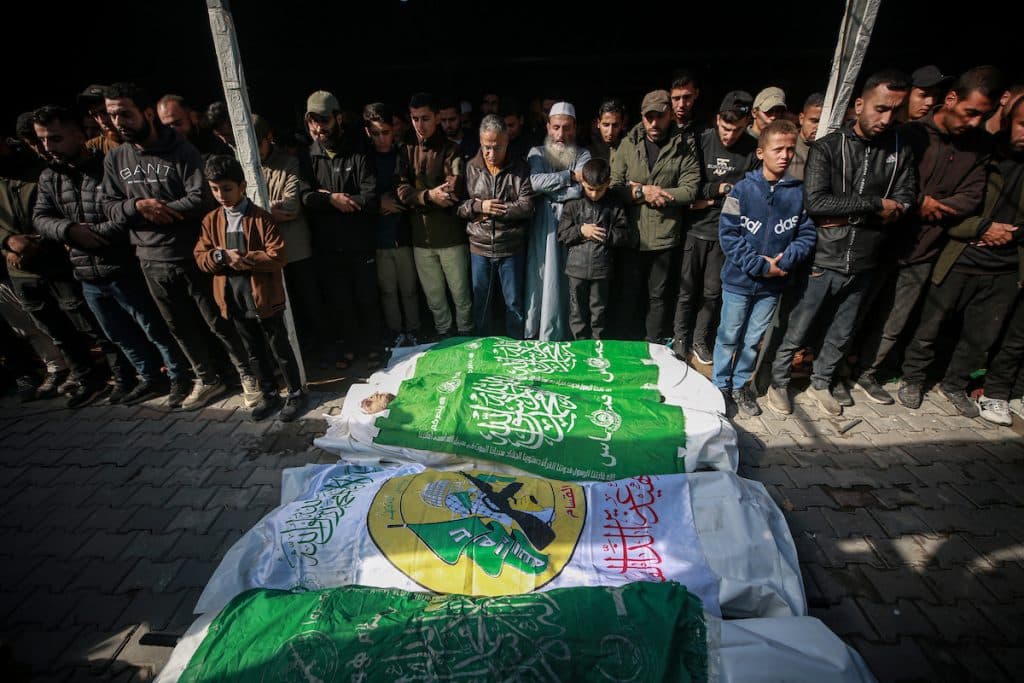
Israeli Military Kills Palestinian Baby and Wounds Parents in West Bank
“The murder of a 7-month-old baby by Israeli forces in the illegally occupied West Bank and an Israeli massacre at a wedding in Gaza are horrific crimes that should shock the conscience of every person,” said a US-based group.
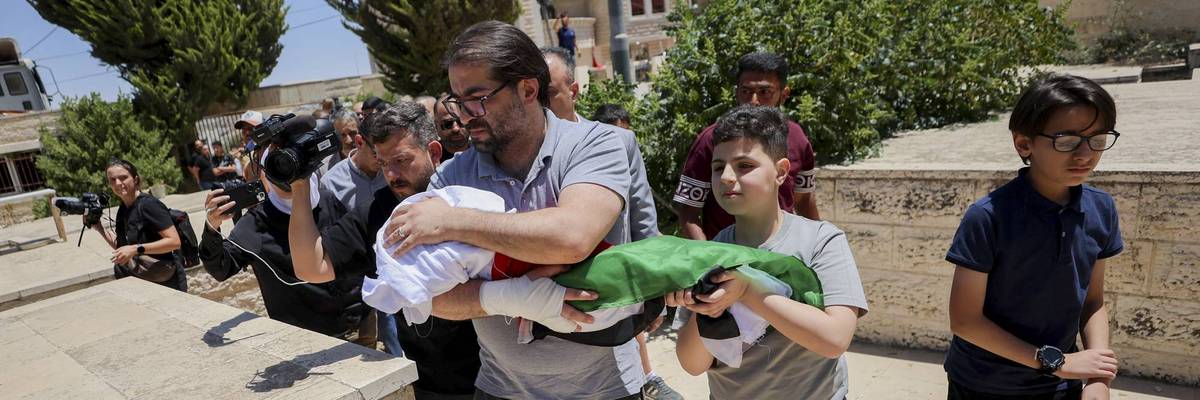
Fahd Abdul Aziz Abu Haikal and his elder son, Kinan, carry the body of his 7-month-old son, Sam, during the funeral in Hebron, in the occupied West Bank, on June 6, 2026.
(Photo by Mosab Shawer/Middle East Images/AFP via Getty Images)
Jessica Corbett
Jun 06, 2026
“The murder of a 7-month-old baby by Israeli forces in the illegally occupied West Bank and an Israeli massacre at a wedding in Gaza are horrific crimes that should shock the conscience of every person,” said a US-based group.
Fahd Abdul Aziz Abu Haikal and his elder son, Kinan, carry the body of his 7-month-old son, Sam, during the funeral in Hebron, in the occupied West Bank, on June 6, 2026.
(Photo by Mosab Shawer/Middle East Images/AFP via Getty Images)
Jessica Corbett
Jun 06, 2026
COMMON DREAMS
Gunfire from at least one Israeli soldier killed a 7-month-old Palestinian boy and injured his parents, who were traveling in their vehicle in the occupied West Bank on Friday, according to the Palestinian Ministry of Health.
The Palestinian National Authority’s WAFA reported that Sam Fahd Abu Haikal lived in Bethlehem with his mother and father, Fahd Abdul Aziz Abu Haikal, a lecturer at Bethlehem University. The family—which also included the baby’s grandmother and 11-year-old sibling—intended to visit Hebron when they were struck by at least one bullet that left both parents with “moderate injuries” and ultimately killed the infant, who “succumbed on Friday evening to critical wounds.”
UNICEF Decries ‘Intolerable’ Israeli Killing of Lebanese, Palestinian Children

‘Burning Entire Families to Death as They Slept’ in Gaza, Israel Kill Count Nears 1,000 Since Ceasefire
As Reuters detailed:
The baby’s grandmother said the family was driving near Checkpoint 17 when they saw Israeli military vehicles and soldiers in the distance and stopped the car. She said shots were then fired toward them, which they initially believed were warning shots.
“One bullet struck my grandson, traversed his face and crossed his head, striking his mother’s cheek where it lodged,” she said, adding that the bullet had also grazed the father’s finger, and that the mother was in hospital.
A spokesperson for the Israel Defense Forces told CBS News that soldiers “perceived a vehicle accelerating toward them” and responded by firing single shots, which injured three Palestinians who were evacuated for medical treatment. The spokesperson added that an initial inquiry “found that those injured were uninvolved civilians,” and that the IDF “expresses deep sorrow for any harm caused to uninvolved individuals.”
Fahd Abdul Aziz Abu Haikal told the Israeli newspaper Haaretz that “the soldier was about 10 meters away from me. He saw me, he saw my wife, and the children. The car windows were not dark, it was daylight, and everything was clear. You can’t say he didn’t see that it was a family.”
The father added that “this case must not be closed without an investigation and without accountability. At least I don’t intend to give up.”
The baby’s death sparked a fresh wave of criticism against the IDF, which is widely accused of committing genocide against Palestinians in the wake of the Hamas-led October 7, 2023 attack on Israel. The Israeli assault on the Gaza Strip has killed over 72,000 people.
Since October 2023, Israeli forces and settlers have also ramped up attacks in the illegally occupied West Bank, killing over 1,000 Palestinians, including at least 240 children, according to the United Nations.
In a Saturday statement, the Council on American-Islamic Relations (CAIR), the largest Muslim civil rights and advocacy organization in the United States, condemned the baby’s killing as well as a deadly Israeli attack on a wedding in Gaza.
“The murder of a 7-month-old baby by Israeli forces in the illegally occupied West Bank and an Israeli massacre at a wedding in Gaza are horrific crimes that should shock the conscience of every person,” CAIR said. “No military force that repeatedly kills children, medical workers, journalists, and civilians—using American taxpayer-supplied weapons—should continue to enjoy impunity or the support of our own government.”
“We call on our government and the international community to stop enabling these atrocities,” the group said, “and to take concrete action to protect Palestinian civilians, end the occupation, and uphold international law.”
This post was updated with a newly available photo and reporting from Haaretz.
Gunfire from at least one Israeli soldier killed a 7-month-old Palestinian boy and injured his parents, who were traveling in their vehicle in the occupied West Bank on Friday, according to the Palestinian Ministry of Health.
The Palestinian National Authority’s WAFA reported that Sam Fahd Abu Haikal lived in Bethlehem with his mother and father, Fahd Abdul Aziz Abu Haikal, a lecturer at Bethlehem University. The family—which also included the baby’s grandmother and 11-year-old sibling—intended to visit Hebron when they were struck by at least one bullet that left both parents with “moderate injuries” and ultimately killed the infant, who “succumbed on Friday evening to critical wounds.”
UNICEF Decries ‘Intolerable’ Israeli Killing of Lebanese, Palestinian Children
‘Burning Entire Families to Death as They Slept’ in Gaza, Israel Kill Count Nears 1,000 Since Ceasefire
As Reuters detailed:
The baby’s grandmother said the family was driving near Checkpoint 17 when they saw Israeli military vehicles and soldiers in the distance and stopped the car. She said shots were then fired toward them, which they initially believed were warning shots.
“One bullet struck my grandson, traversed his face and crossed his head, striking his mother’s cheek where it lodged,” she said, adding that the bullet had also grazed the father’s finger, and that the mother was in hospital.
A spokesperson for the Israel Defense Forces told CBS News that soldiers “perceived a vehicle accelerating toward them” and responded by firing single shots, which injured three Palestinians who were evacuated for medical treatment. The spokesperson added that an initial inquiry “found that those injured were uninvolved civilians,” and that the IDF “expresses deep sorrow for any harm caused to uninvolved individuals.”
Fahd Abdul Aziz Abu Haikal told the Israeli newspaper Haaretz that “the soldier was about 10 meters away from me. He saw me, he saw my wife, and the children. The car windows were not dark, it was daylight, and everything was clear. You can’t say he didn’t see that it was a family.”
The father added that “this case must not be closed without an investigation and without accountability. At least I don’t intend to give up.”
The baby’s death sparked a fresh wave of criticism against the IDF, which is widely accused of committing genocide against Palestinians in the wake of the Hamas-led October 7, 2023 attack on Israel. The Israeli assault on the Gaza Strip has killed over 72,000 people.
Since October 2023, Israeli forces and settlers have also ramped up attacks in the illegally occupied West Bank, killing over 1,000 Palestinians, including at least 240 children, according to the United Nations.
In a Saturday statement, the Council on American-Islamic Relations (CAIR), the largest Muslim civil rights and advocacy organization in the United States, condemned the baby’s killing as well as a deadly Israeli attack on a wedding in Gaza.
“The murder of a 7-month-old baby by Israeli forces in the illegally occupied West Bank and an Israeli massacre at a wedding in Gaza are horrific crimes that should shock the conscience of every person,” CAIR said. “No military force that repeatedly kills children, medical workers, journalists, and civilians—using American taxpayer-supplied weapons—should continue to enjoy impunity or the support of our own government.”
“We call on our government and the international community to stop enabling these atrocities,” the group said, “and to take concrete action to protect Palestinian civilians, end the occupation, and uphold international law.”
This post was updated with a newly available photo and reporting from Haaretz.
Sam Abu Haikal was riding in his parents' car through Hebron when Israeli soldiers opened fire. His mother is in intensive care, and his father, wounded in the hand, buried him alone the next morning. He was only seven months old.
June 6, 2026
MONDOWEISS
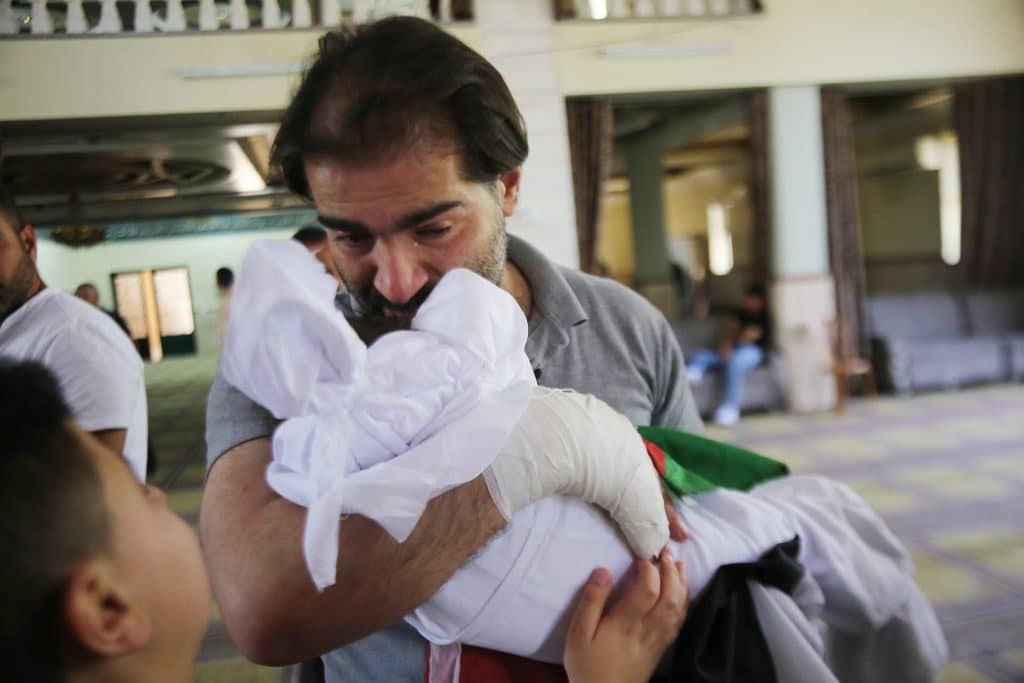 Family members of 7-month-old Sam Fahd Abu Haykal part in the infant’s funeral in the West Bank city of Hebron on June 6, 2026. (Photo: by Mamoun Wazwaz/APA Images)
Sam Abu Haikal was seven months old. On Friday night, Israeli soldiers opened fire on his family’s car in Hebron. He was pulled out of it dead.
The family lives in the Tel Rumeida neighborhood in Hebron’s old city, an area surrounded by Israeli soldiers, checkpoints, and settler outposts, and where Palestinians live under constant harassment and restrictions to their movement.
Since Friday, the Abu Haikal family has been reeling in shock, trying to piece together their loss. Samah Abu Haikal, Sam’s aunt, told Mondoweiss that Sam and his parents — her brother Fahd and his wife Dania — had been returning from a visit to family members in Bethlehem.
“They were very close to Tel Rumeida in an area called Wadi Hariyeh, where the Israeli army doesn’t usually set up checkpoints,” she said. Surprised by the patrol, Fahd stepped on the brakes suddenly, but the soldiers had already raised their rifles. “One of them fired a single bullet that struck the steering wheel and broke into fragments, sending shrapnel into the car,” she added.
The shrapnel struck little Sam in the face, killing him, she detailed.
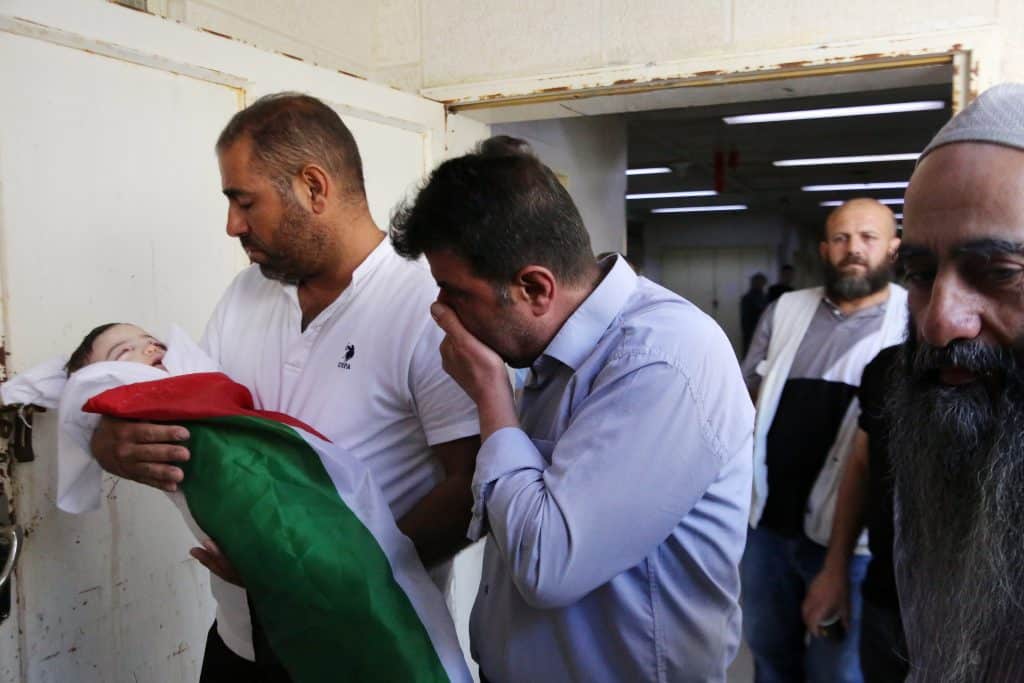
Family members of 7-month-old Sam Fahd Abu Haykal part in the infant’s funeral in the West Bank city of Hebron on June 6, 2026. (Photo: by Mamoun Wazwaz/APA Image)
‘Here, you can be killed with no consequences at all’
Sam’s mother, Dania Salameh, was wounded by another fragment that hit her near the jugular vein, while Fahd was wounded in the hand. “Dania is now in the hospital in intensive care, where she learned that her child had been killed,” Samah continued. “Doctors sedated her, while Fahd went out this morning [Saturday] to bury Sam himself, despite his wounded hand.”
According to Samah, “even though Tel Rumeida is dangerous at all times, this is still a huge shock for the entire family.” In Tel Rumeida, she said, “only residents are permitted entry, and when I go to visit my brother, soldiers often turn me back. And when I am allowed to go in I am scared all the time because of the sheer number of soldiers and settlers everywhere.”
Samah described life in Hebron as having gotten more dangerous over the past year, with Israeli settlers constantly harassing residents and even hurling objects at children. “The situation has become unbearable, and there seems to be very little attention worldwide,” she lamented. “Here, you can just be killed with no consequences at all.”
‘Here, you can be killed with no consequences at all’
Sam’s mother, Dania Salameh, was wounded by another fragment that hit her near the jugular vein, while Fahd was wounded in the hand. “Dania is now in the hospital in intensive care, where she learned that her child had been killed,” Samah continued. “Doctors sedated her, while Fahd went out this morning [Saturday] to bury Sam himself, despite his wounded hand.”
According to Samah, “even though Tel Rumeida is dangerous at all times, this is still a huge shock for the entire family.” In Tel Rumeida, she said, “only residents are permitted entry, and when I go to visit my brother, soldiers often turn me back. And when I am allowed to go in I am scared all the time because of the sheer number of soldiers and settlers everywhere.”
Samah described life in Hebron as having gotten more dangerous over the past year, with Israeli settlers constantly harassing residents and even hurling objects at children. “The situation has become unbearable, and there seems to be very little attention worldwide,” she lamented. “Here, you can just be killed with no consequences at all.”
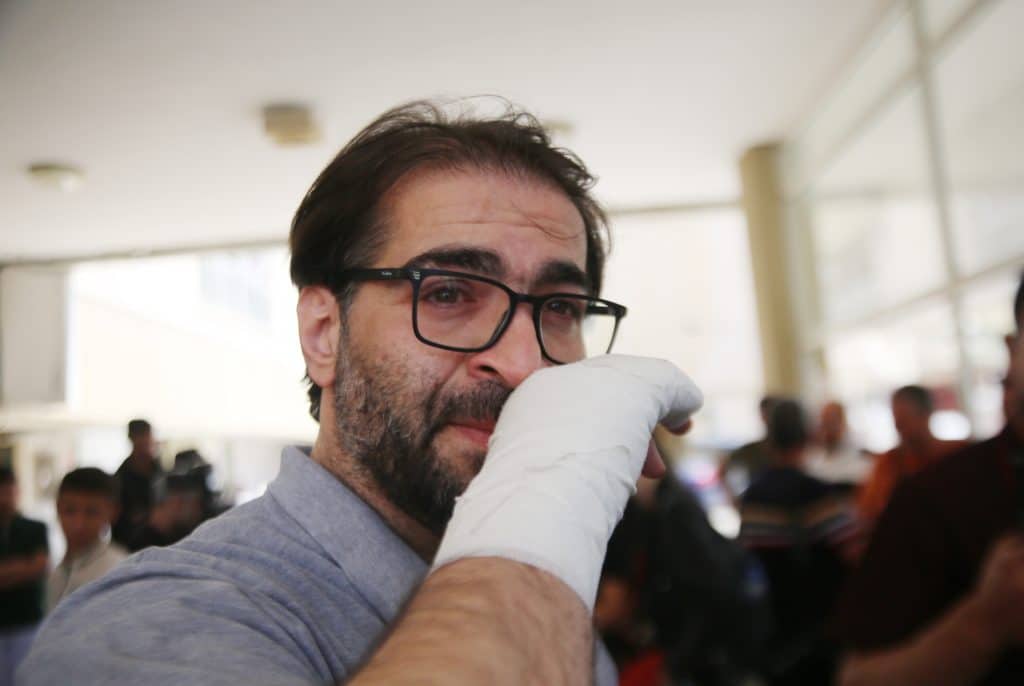
Family members of 7-month-old Sam Fahd Abu Haykal part in the infant’s funeral in the West Bank city of Hebron on June 6, 2026. (Photo: by Mamoun Wazwaz/APA Images)
The Israeli army was quoted by Israeli media as saying that the soldiers “perceived a car accelerating towards them,” acknowledging that the victims were “uninvolved civilians” and that “the incident was under investigation.”‘
This is the second incident of its kind in the West Bank in less than three months, ever since Israeli soldiers opened fire on a car in Tubas last March, killing four members of a Palestinian family, including both parents and two children aged five and seven. The Israeli army also said at the time that it was investigating the incident and had opened a probe. To date, no Israeli soldier has faced any charges.
Sam’s death raises the number of Palestinian children killed by Israeli forces in 2026 to 115. He was the 17th Palestinian child killed this year in the occupied West Bank.
The Israeli army was quoted by Israeli media as saying that the soldiers “perceived a car accelerating towards them,” acknowledging that the victims were “uninvolved civilians” and that “the incident was under investigation.”‘
This is the second incident of its kind in the West Bank in less than three months, ever since Israeli soldiers opened fire on a car in Tubas last March, killing four members of a Palestinian family, including both parents and two children aged five and seven. The Israeli army also said at the time that it was investigating the incident and had opened a probe. To date, no Israeli soldier has faced any charges.
Sam’s death raises the number of Palestinian children killed by Israeli forces in 2026 to 115. He was the 17th Palestinian child killed this year in the occupied West Bank.
Qassam Muaddi
Qassam Muaddi is the Palestine Staff Writer for Mondoweiss. He covers social, political, and cultural developments in Palestine, and has written for several outlets in English and French, including the Catholic Terre Sainte Magazine and other outlets. Follow him on Twitter/X at @QassaMMuaddi.
Qassam Muaddi is the Palestine Staff Writer for Mondoweiss. He covers social, political, and cultural developments in Palestine, and has written for several outlets in English and French, including the Catholic Terre Sainte Magazine and other outlets. Follow him on Twitter/X at @QassaMMuaddi.
Israel kills family sleeping in their apartment in Gaza City
Nora Barrows-Friedman
Nora Barrows-Friedman
5 June 2026
The Electronic Intifada

At Al-Shifa Hospital in Gaza City, mourners grieve over the bodies of nine Palestinians who were killed in simultaneous Israeli airstrikes on four apartment buildings overnight, 4 June. Bilal OsamaAPA images
The following is from the news roundup during the 4 June livestream. Watch the entire episode here.
In Gaza, at least nine people were killed and dozens were injured in a series of Israeli attacks from helicopter gunships during the early morning hours on Thursday.
Israel simultaneously targeted four residential apartments inside the city, according to reporters. Saed Hasballah filmed this footage outside of Al-Shifa Hospital.
Local reports stated that the attack killed five members of the Labad family while they were sleeping in their apartment: two parents and three of their children – Manar, Hassan, Muhammad, Rahaf and Tamim Labad. A 9-year-old girl, Hala, is now the sole survivor of her family.
🚨 Shortly after midnight, Israeli helicopter gunships launched coordinated strikes on residential buildings across Gaza City, killing at least 8–9 Palestinians and wounding several others, according to journalists on the ground.
Five people were reported killed when an… https://t.co/HERRkBqQxu— Drop Site (@DropSiteNews) June 4, 2026Hasballah showed this photograph of some of the many children who were among the injured.
Without prior warning, four apartments in Gaza City were struck, leaving nine victims, including children.
We visited one of these apartments, belonging to the Labad family.
Five family members were killed, and only a nine-year-old girl survived. pic.twitter.com/Vg617BSOkP— Moath Kahlout (@kahlout_moath) June 4, 2026The airstrikes hit homes in the Beach refugee camp, al-Karama, Tel al-Hawa, and Sheikh Radwan neighborhoods of Gaza City. Local reporters say that the targeted buildings were sheltering displaced families, with rescue crews continuing to search the rubble for survivors as intense flames engulfed the buildings.
On Wednesday, Israel drone-bombed the courtyard of a home in the Maghazi refugee camp in central Gaza, killing two Palestinian siblings and wounding four others, according to local reports.
Moments ago, two Palestinian siblings were killed in an Israeli strike that targeted the courtyard of a home in Al-Maghazi refugee camp, central Gaza Strip. pic.twitter.com/ajA2xmQgim— Quds News Network (@QudsNen) June 3, 2026
An israeli terrorist strike in al-Maghazi refugee camp in central Gaza has killed two siblings and injured 4 others.
Names: Saqer and Momen Abu Kareem pic.twitter.com/jcAeZJwf3W— Mosab Abu Toha (@MosabAbuToha) June 3, 2026The Quds News Network posted video of the bodies of Saqer and Momen Abu Kareem being transferred to the morgue by Palestinian emergency response teams.
On Tuesday, Israel carried out a series of attacks in north, central and southern Gaza.
An Israeli drone strike on a tent sheltering forcibly displaced families in Beach refugee camp west of Gaza City injured at least 10 Palestinians, according to the Wafa news agency.
Reporter Salah Ziara captured footage of injured people being driven to the hospital in civilian cars.
The attack came as Israeli artillery shelled areas north of al-Bureij refugee camp in central Gaza, while Israeli forces continued large-scale blasting operations east of Khan Younis in the south, Wafa added.
Also on Tuesday, an Israeli drone strike killed a Palestinian man and injured at least 10 others in a tent shelter in the al-Mawasi area of Khan Younis, according to sources at Nasser Medical Complex.
At least TEN Palestinians have been wounded, including critical wounds, as Israel bombed a TENT in the tent-crowded Al-Mawasi under the auspices of the "CEASEFIRE." pic.twitter.com/fS9xeGFY4L— Ahmed Al-Najjar (@Ahmed_A1Najjar) June 2, 2026And in Deir al-Balah, a Palestinian man was killed and four others were injured in an Israeli attack on a car.
Sources at Al-Aqsa Martyrs Hospital reported to Wafa news agency that 32-year-old Ahmad Khaled Abu Maghseib was killed when the vehicle was struck on the busy Salah al-Din Street in the eastern part of the city.
Israel has bombed a Civilian car and murdered a Palestinian Man and wounded several others in Central Gaza just hours after murdering another Man in Al-Zawaida. pic.twitter.com/KDOgKs40pE— Ahmed Al-Najjar (@Ahmed_A1Najjar) June 2, 2026The hospital sources added that four people were injured, including some in serious condition, and were admitted to emergency departments amid continued pressure on medical teams and shortages of resources.
Reporter Bilal Samak captured video of the elderly father of Ahmad Abu Maghseib collapsing in grief at the hospital, being comforted by loved ones around him.
On Monday, 1 June, a child was injured in an Israeli drone strike on the al-Bureij refugee camp in central Gaza, as Israeli naval vessels fired several shells toward the Gaza City shoreline.
Israel bombed the Gaza seaport on Sunday, where at least two Palestinians were killed and 25 others were wounded, including children.
🎥 “People come here to escape the boredom, to breathe fresh air. Then suddenly a missile falls on them.”
An eyewitness describes the aftermath after Israeli Apache helicopters fired missiles at a gathering of civilians at Gaza Port, killing at least two people and wounding 25… https://t.co/8XrWwNSvFz pic.twitter.com/zfnQmezMRo— Drop Site (@DropSiteNews) May 31, 2026A witness to the massacre, Muhammad Salman, told Al Arabiya TV correspondent and regular guest of The Electronic Intifada livestream Asem al-Nabih that Israeli helicopter gunships fired missiles at the port while families were trying to relax and gather together. There are also displaced families living at the port.
Reporter Salah Ziara filmed a woman standing beside a shelter at the port where people were killed and wounded, blood still spattered on the walls. She admonished the so-called international community, saying, “We don’t want any country boasting, saying we are helping Gaza. We don’t want food, we don’t want anything from you. We want the genocide to stop.”
‼️"We don't want any country boasting, saying we are helping Gaza. We don't want food, we don't want anything from you. We want the genocide to stop," says a Palestinian woman living at Gaza's seaport, her voice breaking after an Israeli occupation airstrike targeted a gathering… pic.twitter.com/5r9VMmtyoN— Translating Falasteen (Palestine) (@translatingpal) May 31, 2026On 30 May, Israel assassinated Dr. Jamal Abu Aoun, the head of the anaesthesia department at Yafa Hospital in Deir al-Balah, in central Gaza.
Breaking: Israel has just killed Dr. Jamal Abu Aoun, Head of the Anesthesiology Department at Yaffa Hospital in Deir al-Balah.
Dr. Abu Aoun, was among Gaza’s dedicated medical professionals serving patients amid the ongoing genocide. pic.twitter.com/N4Xf3XeuaN— Ramy Abdu| رامي عبده (@RamAbdu) May 30, 2026He was killed in an airstrike near the Al-Aqsa Martyrs Hospital in the city.
Reporter Bilal Samak recorded footage of the funeral for Abu Aoun, with his friends, family and colleagues mourning over his body.
Funeral of Palestinian anesthesiologist Jamal Abu Oun who was murdered by an Israeli strike in Central Gaza. pic.twitter.com/qBl3NcPuQi— Ahmed Al-Najjar (@Ahmed_A1Najjar) May 30, 2026The Palestinian Ministry of Health in Gaza stated that as of Thursday, at least 947 Palestinians have been killed and more than 2,900 have been injured since the so-called ceasefire was declared last October.
The ministry said that 119 Palestinians have been killed during the month of May alone, the highest number of people killed every month since the beginning of 2026. Sixteen percent of those killed were children.
Israel depriving children of water, medicine, food
Because of the continued refusal by western powers to stop the genocide, including Israel’s ongoing blockade on Gaza, families are increasingly unable to provide their children with clean water, healthy food and medical care.
Salim Oweis, the communications specialist for the United Nations children’s fund UNICEF, said this week at a press briefing in Geneva that the failure to meet children’s basic needs in Gaza is trapping them in an endless cycle of suffering.
Oweis said that “families across Gaza do not have enough clean water, they are forced to choose between drinking, washing and cooking with what little they have.”
Children, the elderly, workers, those helping the community…everyone needed water. Water is life. Water is needed for survival. Help provide it. https://t.co/naUewmmH9f
Translating Falasteen (@translatingpal) x The Sameer Project continue to provide nearly half a million liters… pic.twitter.com/mxGbb3r7br— The Sameer Project (@sameerproject) May 29, 2026Items needed to sustain water systems and repair damaged water infrastructure, he said, including lubricant oil, water treatment chemicals and spare parts, “are not being allowed in at the scale needed, meaning we cannot repair systems as quickly as needed to reach more children with clean water, and existing systems risk failure due to lack of maintenance and overuse. If we cannot repair systems, then we have to rely solely on water trucking which is much more expensive and doesn’t reach populations as effectively.”
Oweis added that the clearing of solid waste and rubble at the necessary scale is currently impossible because there is no accessible space left to clear it to, directly causing rampant skin, respiratory and gastrointestinal infections and diseases in children.
“No parent should be in a position where they cannot provide their child with the basic needs to keep them healthy,” he said.
“No parent should have to watch as their child writhes in pain from lesions or buckle from weakness because of entirely preventable diarrhoea. That this is happening should be – to everyone – entirely unconscionable.”
Dr. Muneer Alboursh, the director general of the Palestinian health ministry in Gaza, warned this week that more than one million children in Gaza are surviving on roughly six liters of water per day, as water becomes more and more scarce and as Israel continues to prevent the entry of water desalination plants, filters or materials for repair.
🇵🇸 MoH: Gaza Children Surviving on 6 Liters of Water a Day as Summer Arrives
More than one million children in Gaza are surviving on roughly 6 liters of water per day — a fraction of the global norm of hundreds of liters — as infrastructure destruction and the blockade of… https://t.co/zh3HbfjwW3— Drop Site (@DropSiteNews) June 3, 2026Speaking to Al Jazeera Arabic on Tuesday, Alboursh said that medical staff are fearing outbreaks of disease epidemics because of the lack of clean water and Israel’s deliberate incapacitation of the health infrastructure.
“We are talking about no health recovery, in every sense of the word. We are talking about not even rebuilding, reconstruction, as they said, no medicine available, no safe homes, no capacity for treatment,” he said.
In a related post on social media, Alboursh said that Al-Aqsa Martyrs Hospital, which serves a population of over half a million people, has suspended surgical operations “due to the failure of its fourth backup generator.”
If the situation persists at its current pace, he added, “other critical services, such as intensive care and neonatal units, will also cease functioning. We are facing a crisis deliberately manufactured by the occupation, which is blocking the entry of lubricants required for these generators, as well as spare parts and new power generators.”
He added that “there is a severe shortage of medicines and medical supplies – stocks of many essential items have hit zero – and the reality is that this portends a grave and imminent danger. The occupation blocks the entry of medicines, medical supplies, lubricants, and filters, while simultaneously allowing in sweets, chocolates and other non-essential items.”
UNRWA is playing a fundamental role in countering the spread of skin infections caused by rodents and insects in #Gaza.
Our medical teams are treating thousands of the 125,085 reported cases. Our sanitation teams are spraying safe pesticides in areas where huge numbers of… pic.twitter.com/5KWGYpVN6Q— UNRWA (@UNRWA) May 25, 2026“We are currently battling rodent infestations inside our tents, as these pests have begun to compete with us for our meager sustenance, devouring the flour intended to feed our children. By allowing diseases to spread and waste to accumulate – coupled with the complete absence of sanitation services and severe water shortages – the occupation is deliberately facilitating the spread of disease throughout Gaza,” Alboursh warned.
Firefighting services in critical danger
The Civil Defense in Gaza stated this week that amid ongoing Israeli aggression and attacks targeting and setting fire to homes, displacement tents, and civilian vehicles, the fire and rescue services operating with limited resources are facing an unsustainable and dangerous burden.
Three firefighting and rescue vehicles and two ambulances, the Civil Defense said, are out of service due to a critical shortage of spare parts and fire-extinguishing supplies. Furthermore, a substantial portion of their already severely limited fuel reserves has been depleted.
Speaking to the Gaza Herald, Ahmed Radwan, media director for the Civil Defense, said the institution is approaching a critical breaking point.
According to Radwan, nearly 90 percent of civil defense vehicles operating across Gaza have either been destroyed or rendered inoperable during the war.
He added that since the implementation of the ceasefire agreement in October 2025, no new ambulances, rescue vehicles, or emergency equipment have been allowed into the Gaza Strip.
In its press statement, the Civil Defense issued “a grave warning” that rescue and relief operations “regarding fire incidents and rescue missions are at risk of coming to a complete halt. Currently, operations are restricted solely to the most critical emergencies due to these recurring crises.”
The lack of spare parts to repair Civil Defense vehicles, it says, “coupled with the failure to permit the entry of firefighting equipment, rescue gear, and fuel, foreshadows a complete cessation of humanitarian interventions in the coming days. This looming crisis unfolds against the backdrop of escalating Israeli aggression on one hand, and the onset of summer and rising temperatures on the other.”
The Civil Defense called on international organizations to take concrete actions, including prioritizing the provision of essential safety and fire prevention supplies.
Mass arrests, settler attacks
Turning to the occupied West Bank, Israeli soldiers abducted and arrested 35 Palestinians during a series of raids overnight on Tuesday, including four young Palestinian women students of Birzeit University near Ramallah.
The arrests were concentrated in Tulkarm and Nablus, with additional raids reported in Ramallah, Hebron and occupied Jerusalem. The detainees also included several formerly imprisoned Palestinians.
💢 Israeli Forces Arrest Female Students in Pre-Dawn Raid on Birzeit University
Israeli forces arrested four female students from Birzeit University in a pre-dawn raid on the town of Birzeit, north of Ramallah in the occupied West Bank, regional media reported.
The students… https://t.co/mOj39GKwIL pic.twitter.com/AprgJwDFfy— Drop Site (@DropSiteNews) June 2, 2026The four students, Jolan Abu Awad, Natalie Abudayyah, Laila Khalil and Sama Safi, were abducted from their student housing on campus.
The Palestinian Prisoners Society said that their arrests brought the number of Palestinian women currently held in Israeli detention to 89.
In a statement, the Bishop of the Evangelical Lutheran Church in Jordan and the Holy Land, Imad Haddad, denounced Israel’s arrest of Natalie Abudayyeh, who is from the church community, and called for her immediate release.
Statement from Bishop Dr. Imad Haddad on the Israeli Detainment of Natalie Abudayyeh
This morning a beloved youth from our church community, Natalie Abuddayeh, was taken at gunpoint by Israeli forces from her student apartment in Birzeit alongside three other women. We are… pic.twitter.com/5JO51KXfk0— Munther Isaac منذر اسحق (@MuntherIsaac) June 2, 2026In the north, on 31 May, Israeli forces extended a military order that closes off three refugee camps in Jenin and Tulkarm, according to documentation from UNRWA, the United Nations agency for Palestine refugees.
More than 33,000 Palestinians from these camps have been displaced and have not been allowed to return since January 2025, UNRWA said, and this latest extension prolongs their displacement by another two months, until the end of July.
The Wafa news agency reported that Israeli settlers, backed by Israeli soldiers, set fire to Palestinian farmland in Burqa, east of Ramallah, on Wednesday. Similar attacks by settlers were reported in several villages and towns in the southern Nablus governorate, damaging large swaths of agricultural land.
The Good Shepherd Collective posted a video of settlers invading and setting fire to the village of Abu Falah, near Turmusaya, on Tuesday night, “in order to erect a new outpost on lands belonging to the community.”
Last night zionist settlers invaded Abu Falah village, southeast of Turmusayya, in order to erect a new outpost on lands belonging to the community. They also set fire to lands in the village, reporting burning olive trees. pic.twitter.com/xTLVf3gy7s— Good Shepherd Collective (@Shepherds4Good) June 2, 2026Meanwhile, Wafa added, settlers vandalized the sole pipeline supplying water to the Palestinian Bedouin community near Khan al-Ahmar, east of Jerusalem, the latest in an escalation of attacks against the village as Israeli settlers and government officials threaten to destroy the entire community in order to expand one of the largest illegal settlement colony blocs in the occupied West Bank.
Attacks on health care in Lebanon
In Lebanon, more than 40 people were killed and 140 wounded in Israeli strikes on Saturday, 30 May, alone.
🚨 At least 41 people were killed and 140 wounded in Israeli strikes across Lebanon on Saturday
According to Lebanon’s Health Ministry, Israeli attacks have killed at least 3,412 people and wounded 10,269 others since Israel dramatically escalated its assault on March 2.
🎥 An… pic.twitter.com/Dc8FDaRMlU— Drop Site (@DropSiteNews) May 31, 2026According to Lebanon’s health ministry, Israeli attacks have killed more than 3,400 people and wounded nearly 11,000 since Israel’s assaults escalated on 2 March.
The World Health Organization stated that there have been at least 190 attacks on healthcare facilities and personnel in Lebanon over the past three months, and warned that the country’s health system is coming under growing strain.
The WHO said 17 hospitals have been partially damaged, and Israel has killed 128 health workers, including paramedics, and injured 332 others.
Dr. Ghassan Abu Sitta, who is currently working at a hospital in Beirut, posted on social media that he had 20 patients in his Pediatric War Injuries Clinic on Wednesday, for follow-up care.
I had 20 patients in my Pediatric War Injuries Clinic today, for follow-up care.
Of the 20 children, Israel had killed one or both parents of 19 of them.— Ghassan Abu Sitta, Chair of Conflict Medicine AUB (@GhassanAbuSitt1) June 3, 2026“Of the 20 children, Israel had killed one or both parents of 19 of them,” he stated.
As Israeli airstrikes and attacks continued across the south, including on the ancient city of Sour (Tyre), Israel announced a forced displacement order for the entire city of Nabatieh.
On Thursday, our contributor Roqayah Chamseddine reported that there had already been 30 drone strikes, 43 airstrikes and seven cases of artillery shelling on south Lebanon and the Bekaa Valley.
So far today, Israeli attacks on south Lebanon and the Bekaa Valley have included:
30 drone strikes
43 airstrikes
7 cases of artillery shelling https://t.co/uxTP5BUM7k— roqayah chamseddine (@roqchams) June 4, 2026Chamseddine filed this report for The Electronic Intifada on Wednesday evening.
Highlighting reclamation
And finally, as we always do, we wanted to highlight people expressing joy, determination and reclamation across Palestine and around the world.
In Gaza, Hela al-Sousi, the founder of the youth group El-Dowwarjeen, met a young kite maker on the beach and asked him why he flies them.
This video was made in April.
At Al-Shifa Hospital in Gaza City, mourners grieve over the bodies of nine Palestinians who were killed in simultaneous Israeli airstrikes on four apartment buildings overnight, 4 June. Bilal OsamaAPA images
The following is from the news roundup during the 4 June livestream. Watch the entire episode here.
In Gaza, at least nine people were killed and dozens were injured in a series of Israeli attacks from helicopter gunships during the early morning hours on Thursday.
Israel simultaneously targeted four residential apartments inside the city, according to reporters. Saed Hasballah filmed this footage outside of Al-Shifa Hospital.
Local reports stated that the attack killed five members of the Labad family while they were sleeping in their apartment: two parents and three of their children – Manar, Hassan, Muhammad, Rahaf and Tamim Labad. A 9-year-old girl, Hala, is now the sole survivor of her family.
🚨 Shortly after midnight, Israeli helicopter gunships launched coordinated strikes on residential buildings across Gaza City, killing at least 8–9 Palestinians and wounding several others, according to journalists on the ground.
Five people were reported killed when an… https://t.co/HERRkBqQxu— Drop Site (@DropSiteNews) June 4, 2026Hasballah showed this photograph of some of the many children who were among the injured.
Without prior warning, four apartments in Gaza City were struck, leaving nine victims, including children.
We visited one of these apartments, belonging to the Labad family.
Five family members were killed, and only a nine-year-old girl survived. pic.twitter.com/Vg617BSOkP— Moath Kahlout (@kahlout_moath) June 4, 2026The airstrikes hit homes in the Beach refugee camp, al-Karama, Tel al-Hawa, and Sheikh Radwan neighborhoods of Gaza City. Local reporters say that the targeted buildings were sheltering displaced families, with rescue crews continuing to search the rubble for survivors as intense flames engulfed the buildings.
On Wednesday, Israel drone-bombed the courtyard of a home in the Maghazi refugee camp in central Gaza, killing two Palestinian siblings and wounding four others, according to local reports.
Moments ago, two Palestinian siblings were killed in an Israeli strike that targeted the courtyard of a home in Al-Maghazi refugee camp, central Gaza Strip. pic.twitter.com/ajA2xmQgim— Quds News Network (@QudsNen) June 3, 2026
An israeli terrorist strike in al-Maghazi refugee camp in central Gaza has killed two siblings and injured 4 others.
Names: Saqer and Momen Abu Kareem pic.twitter.com/jcAeZJwf3W— Mosab Abu Toha (@MosabAbuToha) June 3, 2026The Quds News Network posted video of the bodies of Saqer and Momen Abu Kareem being transferred to the morgue by Palestinian emergency response teams.
On Tuesday, Israel carried out a series of attacks in north, central and southern Gaza.
An Israeli drone strike on a tent sheltering forcibly displaced families in Beach refugee camp west of Gaza City injured at least 10 Palestinians, according to the Wafa news agency.
Reporter Salah Ziara captured footage of injured people being driven to the hospital in civilian cars.
The attack came as Israeli artillery shelled areas north of al-Bureij refugee camp in central Gaza, while Israeli forces continued large-scale blasting operations east of Khan Younis in the south, Wafa added.
Also on Tuesday, an Israeli drone strike killed a Palestinian man and injured at least 10 others in a tent shelter in the al-Mawasi area of Khan Younis, according to sources at Nasser Medical Complex.
At least TEN Palestinians have been wounded, including critical wounds, as Israel bombed a TENT in the tent-crowded Al-Mawasi under the auspices of the "CEASEFIRE." pic.twitter.com/fS9xeGFY4L— Ahmed Al-Najjar (@Ahmed_A1Najjar) June 2, 2026And in Deir al-Balah, a Palestinian man was killed and four others were injured in an Israeli attack on a car.
Sources at Al-Aqsa Martyrs Hospital reported to Wafa news agency that 32-year-old Ahmad Khaled Abu Maghseib was killed when the vehicle was struck on the busy Salah al-Din Street in the eastern part of the city.
Israel has bombed a Civilian car and murdered a Palestinian Man and wounded several others in Central Gaza just hours after murdering another Man in Al-Zawaida. pic.twitter.com/KDOgKs40pE— Ahmed Al-Najjar (@Ahmed_A1Najjar) June 2, 2026The hospital sources added that four people were injured, including some in serious condition, and were admitted to emergency departments amid continued pressure on medical teams and shortages of resources.
Reporter Bilal Samak captured video of the elderly father of Ahmad Abu Maghseib collapsing in grief at the hospital, being comforted by loved ones around him.
On Monday, 1 June, a child was injured in an Israeli drone strike on the al-Bureij refugee camp in central Gaza, as Israeli naval vessels fired several shells toward the Gaza City shoreline.
Israel bombed the Gaza seaport on Sunday, where at least two Palestinians were killed and 25 others were wounded, including children.
🎥 “People come here to escape the boredom, to breathe fresh air. Then suddenly a missile falls on them.”
An eyewitness describes the aftermath after Israeli Apache helicopters fired missiles at a gathering of civilians at Gaza Port, killing at least two people and wounding 25… https://t.co/8XrWwNSvFz pic.twitter.com/zfnQmezMRo— Drop Site (@DropSiteNews) May 31, 2026A witness to the massacre, Muhammad Salman, told Al Arabiya TV correspondent and regular guest of The Electronic Intifada livestream Asem al-Nabih that Israeli helicopter gunships fired missiles at the port while families were trying to relax and gather together. There are also displaced families living at the port.
Reporter Salah Ziara filmed a woman standing beside a shelter at the port where people were killed and wounded, blood still spattered on the walls. She admonished the so-called international community, saying, “We don’t want any country boasting, saying we are helping Gaza. We don’t want food, we don’t want anything from you. We want the genocide to stop.”
‼️"We don't want any country boasting, saying we are helping Gaza. We don't want food, we don't want anything from you. We want the genocide to stop," says a Palestinian woman living at Gaza's seaport, her voice breaking after an Israeli occupation airstrike targeted a gathering… pic.twitter.com/5r9VMmtyoN— Translating Falasteen (Palestine) (@translatingpal) May 31, 2026On 30 May, Israel assassinated Dr. Jamal Abu Aoun, the head of the anaesthesia department at Yafa Hospital in Deir al-Balah, in central Gaza.
Breaking: Israel has just killed Dr. Jamal Abu Aoun, Head of the Anesthesiology Department at Yaffa Hospital in Deir al-Balah.
Dr. Abu Aoun, was among Gaza’s dedicated medical professionals serving patients amid the ongoing genocide. pic.twitter.com/N4Xf3XeuaN— Ramy Abdu| رامي عبده (@RamAbdu) May 30, 2026He was killed in an airstrike near the Al-Aqsa Martyrs Hospital in the city.
Reporter Bilal Samak recorded footage of the funeral for Abu Aoun, with his friends, family and colleagues mourning over his body.
Funeral of Palestinian anesthesiologist Jamal Abu Oun who was murdered by an Israeli strike in Central Gaza. pic.twitter.com/qBl3NcPuQi— Ahmed Al-Najjar (@Ahmed_A1Najjar) May 30, 2026The Palestinian Ministry of Health in Gaza stated that as of Thursday, at least 947 Palestinians have been killed and more than 2,900 have been injured since the so-called ceasefire was declared last October.
The ministry said that 119 Palestinians have been killed during the month of May alone, the highest number of people killed every month since the beginning of 2026. Sixteen percent of those killed were children.
Israel depriving children of water, medicine, food
Because of the continued refusal by western powers to stop the genocide, including Israel’s ongoing blockade on Gaza, families are increasingly unable to provide their children with clean water, healthy food and medical care.
Salim Oweis, the communications specialist for the United Nations children’s fund UNICEF, said this week at a press briefing in Geneva that the failure to meet children’s basic needs in Gaza is trapping them in an endless cycle of suffering.
Oweis said that “families across Gaza do not have enough clean water, they are forced to choose between drinking, washing and cooking with what little they have.”
Children, the elderly, workers, those helping the community…everyone needed water. Water is life. Water is needed for survival. Help provide it. https://t.co/naUewmmH9f
Translating Falasteen (@translatingpal) x The Sameer Project continue to provide nearly half a million liters… pic.twitter.com/mxGbb3r7br— The Sameer Project (@sameerproject) May 29, 2026Items needed to sustain water systems and repair damaged water infrastructure, he said, including lubricant oil, water treatment chemicals and spare parts, “are not being allowed in at the scale needed, meaning we cannot repair systems as quickly as needed to reach more children with clean water, and existing systems risk failure due to lack of maintenance and overuse. If we cannot repair systems, then we have to rely solely on water trucking which is much more expensive and doesn’t reach populations as effectively.”
Oweis added that the clearing of solid waste and rubble at the necessary scale is currently impossible because there is no accessible space left to clear it to, directly causing rampant skin, respiratory and gastrointestinal infections and diseases in children.
“No parent should be in a position where they cannot provide their child with the basic needs to keep them healthy,” he said.
“No parent should have to watch as their child writhes in pain from lesions or buckle from weakness because of entirely preventable diarrhoea. That this is happening should be – to everyone – entirely unconscionable.”
Dr. Muneer Alboursh, the director general of the Palestinian health ministry in Gaza, warned this week that more than one million children in Gaza are surviving on roughly six liters of water per day, as water becomes more and more scarce and as Israel continues to prevent the entry of water desalination plants, filters or materials for repair.
🇵🇸 MoH: Gaza Children Surviving on 6 Liters of Water a Day as Summer Arrives
More than one million children in Gaza are surviving on roughly 6 liters of water per day — a fraction of the global norm of hundreds of liters — as infrastructure destruction and the blockade of… https://t.co/zh3HbfjwW3— Drop Site (@DropSiteNews) June 3, 2026Speaking to Al Jazeera Arabic on Tuesday, Alboursh said that medical staff are fearing outbreaks of disease epidemics because of the lack of clean water and Israel’s deliberate incapacitation of the health infrastructure.
“We are talking about no health recovery, in every sense of the word. We are talking about not even rebuilding, reconstruction, as they said, no medicine available, no safe homes, no capacity for treatment,” he said.
In a related post on social media, Alboursh said that Al-Aqsa Martyrs Hospital, which serves a population of over half a million people, has suspended surgical operations “due to the failure of its fourth backup generator.”
If the situation persists at its current pace, he added, “other critical services, such as intensive care and neonatal units, will also cease functioning. We are facing a crisis deliberately manufactured by the occupation, which is blocking the entry of lubricants required for these generators, as well as spare parts and new power generators.”
He added that “there is a severe shortage of medicines and medical supplies – stocks of many essential items have hit zero – and the reality is that this portends a grave and imminent danger. The occupation blocks the entry of medicines, medical supplies, lubricants, and filters, while simultaneously allowing in sweets, chocolates and other non-essential items.”
UNRWA is playing a fundamental role in countering the spread of skin infections caused by rodents and insects in #Gaza.
Our medical teams are treating thousands of the 125,085 reported cases. Our sanitation teams are spraying safe pesticides in areas where huge numbers of… pic.twitter.com/5KWGYpVN6Q— UNRWA (@UNRWA) May 25, 2026“We are currently battling rodent infestations inside our tents, as these pests have begun to compete with us for our meager sustenance, devouring the flour intended to feed our children. By allowing diseases to spread and waste to accumulate – coupled with the complete absence of sanitation services and severe water shortages – the occupation is deliberately facilitating the spread of disease throughout Gaza,” Alboursh warned.
Firefighting services in critical danger
The Civil Defense in Gaza stated this week that amid ongoing Israeli aggression and attacks targeting and setting fire to homes, displacement tents, and civilian vehicles, the fire and rescue services operating with limited resources are facing an unsustainable and dangerous burden.
Three firefighting and rescue vehicles and two ambulances, the Civil Defense said, are out of service due to a critical shortage of spare parts and fire-extinguishing supplies. Furthermore, a substantial portion of their already severely limited fuel reserves has been depleted.
Speaking to the Gaza Herald, Ahmed Radwan, media director for the Civil Defense, said the institution is approaching a critical breaking point.
According to Radwan, nearly 90 percent of civil defense vehicles operating across Gaza have either been destroyed or rendered inoperable during the war.
He added that since the implementation of the ceasefire agreement in October 2025, no new ambulances, rescue vehicles, or emergency equipment have been allowed into the Gaza Strip.
In its press statement, the Civil Defense issued “a grave warning” that rescue and relief operations “regarding fire incidents and rescue missions are at risk of coming to a complete halt. Currently, operations are restricted solely to the most critical emergencies due to these recurring crises.”
The lack of spare parts to repair Civil Defense vehicles, it says, “coupled with the failure to permit the entry of firefighting equipment, rescue gear, and fuel, foreshadows a complete cessation of humanitarian interventions in the coming days. This looming crisis unfolds against the backdrop of escalating Israeli aggression on one hand, and the onset of summer and rising temperatures on the other.”
The Civil Defense called on international organizations to take concrete actions, including prioritizing the provision of essential safety and fire prevention supplies.
Mass arrests, settler attacks
Turning to the occupied West Bank, Israeli soldiers abducted and arrested 35 Palestinians during a series of raids overnight on Tuesday, including four young Palestinian women students of Birzeit University near Ramallah.
The arrests were concentrated in Tulkarm and Nablus, with additional raids reported in Ramallah, Hebron and occupied Jerusalem. The detainees also included several formerly imprisoned Palestinians.
💢 Israeli Forces Arrest Female Students in Pre-Dawn Raid on Birzeit University
Israeli forces arrested four female students from Birzeit University in a pre-dawn raid on the town of Birzeit, north of Ramallah in the occupied West Bank, regional media reported.
The students… https://t.co/mOj39GKwIL pic.twitter.com/AprgJwDFfy— Drop Site (@DropSiteNews) June 2, 2026The four students, Jolan Abu Awad, Natalie Abudayyah, Laila Khalil and Sama Safi, were abducted from their student housing on campus.
The Palestinian Prisoners Society said that their arrests brought the number of Palestinian women currently held in Israeli detention to 89.
In a statement, the Bishop of the Evangelical Lutheran Church in Jordan and the Holy Land, Imad Haddad, denounced Israel’s arrest of Natalie Abudayyeh, who is from the church community, and called for her immediate release.
Statement from Bishop Dr. Imad Haddad on the Israeli Detainment of Natalie Abudayyeh
This morning a beloved youth from our church community, Natalie Abuddayeh, was taken at gunpoint by Israeli forces from her student apartment in Birzeit alongside three other women. We are… pic.twitter.com/5JO51KXfk0— Munther Isaac منذر اسحق (@MuntherIsaac) June 2, 2026In the north, on 31 May, Israeli forces extended a military order that closes off three refugee camps in Jenin and Tulkarm, according to documentation from UNRWA, the United Nations agency for Palestine refugees.
More than 33,000 Palestinians from these camps have been displaced and have not been allowed to return since January 2025, UNRWA said, and this latest extension prolongs their displacement by another two months, until the end of July.
The Wafa news agency reported that Israeli settlers, backed by Israeli soldiers, set fire to Palestinian farmland in Burqa, east of Ramallah, on Wednesday. Similar attacks by settlers were reported in several villages and towns in the southern Nablus governorate, damaging large swaths of agricultural land.
The Good Shepherd Collective posted a video of settlers invading and setting fire to the village of Abu Falah, near Turmusaya, on Tuesday night, “in order to erect a new outpost on lands belonging to the community.”
Last night zionist settlers invaded Abu Falah village, southeast of Turmusayya, in order to erect a new outpost on lands belonging to the community. They also set fire to lands in the village, reporting burning olive trees. pic.twitter.com/xTLVf3gy7s— Good Shepherd Collective (@Shepherds4Good) June 2, 2026Meanwhile, Wafa added, settlers vandalized the sole pipeline supplying water to the Palestinian Bedouin community near Khan al-Ahmar, east of Jerusalem, the latest in an escalation of attacks against the village as Israeli settlers and government officials threaten to destroy the entire community in order to expand one of the largest illegal settlement colony blocs in the occupied West Bank.
Attacks on health care in Lebanon
In Lebanon, more than 40 people were killed and 140 wounded in Israeli strikes on Saturday, 30 May, alone.
🚨 At least 41 people were killed and 140 wounded in Israeli strikes across Lebanon on Saturday
According to Lebanon’s Health Ministry, Israeli attacks have killed at least 3,412 people and wounded 10,269 others since Israel dramatically escalated its assault on March 2.
🎥 An… pic.twitter.com/Dc8FDaRMlU— Drop Site (@DropSiteNews) May 31, 2026According to Lebanon’s health ministry, Israeli attacks have killed more than 3,400 people and wounded nearly 11,000 since Israel’s assaults escalated on 2 March.
The World Health Organization stated that there have been at least 190 attacks on healthcare facilities and personnel in Lebanon over the past three months, and warned that the country’s health system is coming under growing strain.
The WHO said 17 hospitals have been partially damaged, and Israel has killed 128 health workers, including paramedics, and injured 332 others.
Dr. Ghassan Abu Sitta, who is currently working at a hospital in Beirut, posted on social media that he had 20 patients in his Pediatric War Injuries Clinic on Wednesday, for follow-up care.
I had 20 patients in my Pediatric War Injuries Clinic today, for follow-up care.
Of the 20 children, Israel had killed one or both parents of 19 of them.— Ghassan Abu Sitta, Chair of Conflict Medicine AUB (@GhassanAbuSitt1) June 3, 2026“Of the 20 children, Israel had killed one or both parents of 19 of them,” he stated.
As Israeli airstrikes and attacks continued across the south, including on the ancient city of Sour (Tyre), Israel announced a forced displacement order for the entire city of Nabatieh.
On Thursday, our contributor Roqayah Chamseddine reported that there had already been 30 drone strikes, 43 airstrikes and seven cases of artillery shelling on south Lebanon and the Bekaa Valley.
So far today, Israeli attacks on south Lebanon and the Bekaa Valley have included:
30 drone strikes
43 airstrikes
7 cases of artillery shelling https://t.co/uxTP5BUM7k— roqayah chamseddine (@roqchams) June 4, 2026Chamseddine filed this report for The Electronic Intifada on Wednesday evening.
Highlighting reclamation
And finally, as we always do, we wanted to highlight people expressing joy, determination and reclamation across Palestine and around the world.
In Gaza, Hela al-Sousi, the founder of the youth group El-Dowwarjeen, met a young kite maker on the beach and asked him why he flies them.
This video was made in April.