Sunday, October 02, 2022

The U.K.'s crisis of confidence was years in the making

Sep 28, 2022

Britain is in a self-inflicted financial crisis that threatens to accelerate the economy's dive into recession — and the country’s new prime minister is coming under intense pressure to blink.

In the week since the government unveiled the biggest tax cuts since 1972 with scant detail of how they will be financed, the pound has crashed to its lowest-ever level against the dollar, the cost of insuring British government debt against the risk of default has soared to the highest since 2016, and the Bank of England has been forced to intervene amid concerns about the nation’s pension funds.

What happens next will determine just how deep the looming recession proves. Central to that question is whether Liz Truss’s three-week old administration can restore its credibility with investors.
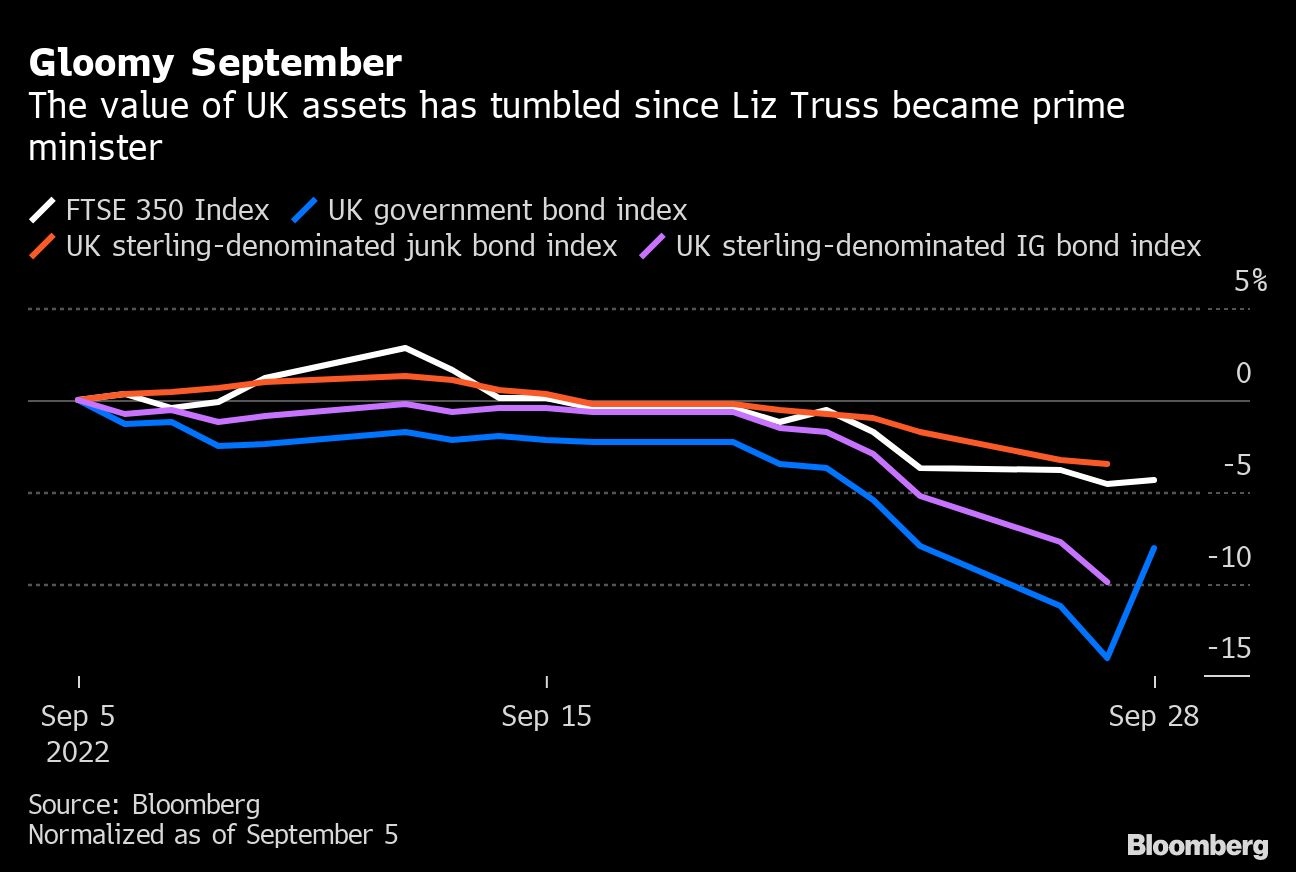
Friday’s mini-budget has become a flashpoint for not just investors’ short-term concerns about unfunded tax cuts at a time when inflation is running close to a four-decade high, or the Bank of England’s failure to contain price growth. It has given sharp focus to their long-held fears about Britain, its current-account deficit, its fractious relationship with its closest trading partner and, above all, a mistrust of what successive politicians promise.

“It’s the latest in a long line of self-imposed economically illiterate decisions,” said Peter Kinsella, global head of FX strategy at Union Bancaire Privee UBP SA in London. “It started with Brexit, and now we’re seeing the latest iteration.”

As markets tumbled, the Bank of England was forced into action to prevent a gilt market crash — and deployed a variant of a policy tool Truss spent recent months criticizing. It promised to buy whatever long-dated gilts were needed to restore order to the market. That set off a rally in long-dated gilts — but increases two risks: that the bank will have to raise rates even further within weeks, and that investors could take fright at whether the BOE is bankrolling the government.
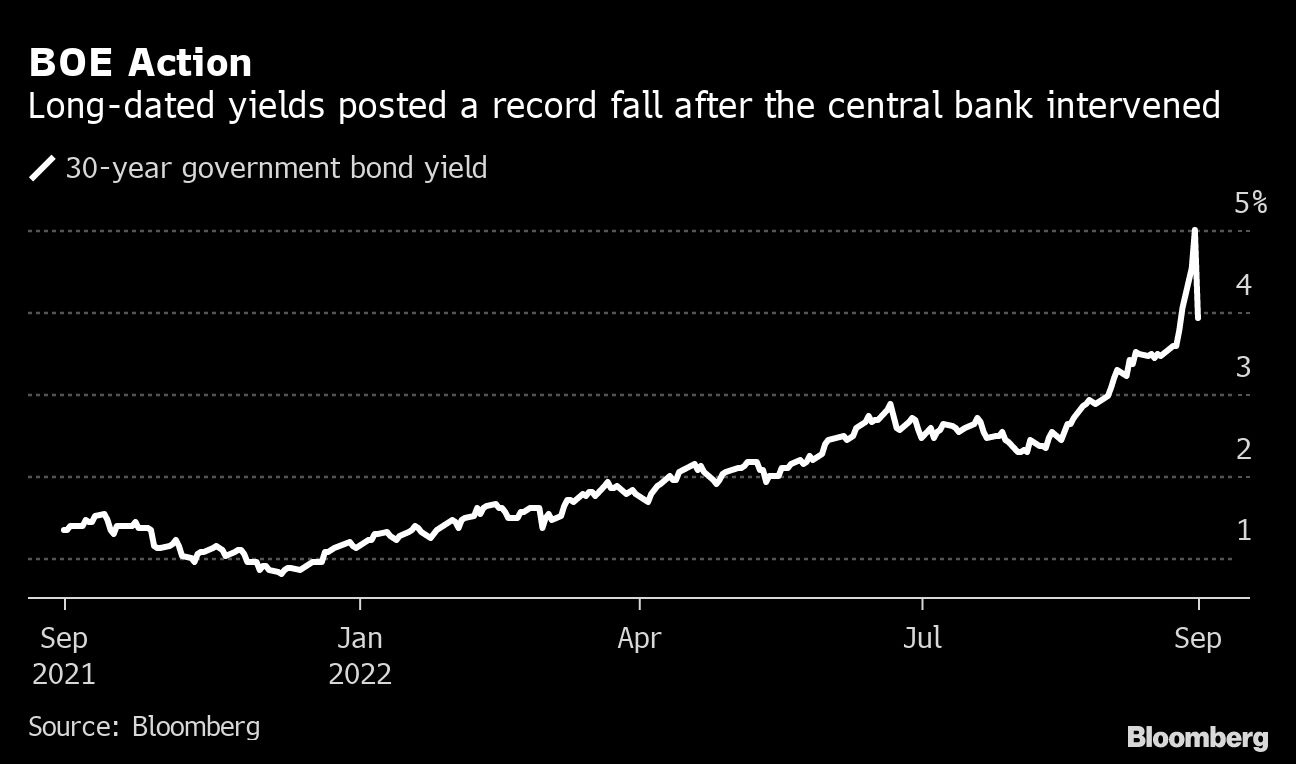
For now, though, the BOE has bought the “government time to fix its credibility,” according to Kallum Pickering, senior economist at Berenberg Bank. How they use that time will be crucial.

Top bankers in the City of London yesterday urged Chancellor of the Exchequer Kwasi Kwarteng to reassure markets before a planned statement on Nov. 23.

The International Monetary Fund, which came to the UK’s rescue in 1976, has already called on the government to reconsider its tax cuts. Famed economists are lining up to warn the UK is displaying the hallmarks of an emerging market. Speaking to the BBC, former Bank of England Governor Mark Carney accused Truss’s government of “undercutting” the nation’s economic institutions.

The prime minister stood by her plans on Thursday, saying economies around the world are facing tough pressures.

“I’m very clear the government has done the right thing,” she told BBC local radio. “This is the right plan.”

The problem for Truss is that she made the tax cuts the centerpiece of her program for government. An about-turn so early into her tenure would be politically fatal: She only won office thanks to the backing of grassroots party members. Most MPs in her own party voted against her, leaving her exposed to a backlash if they sense her policies will lead to defeat.

While Britons wait to see if her gamble on “trickle-down” economics pays off, they face a dramatic increase in borrowing costs — something that could trigger a housing crash and deepen any recession — or a round of swingeing public spending cuts.

“Between Brexit, how far the Bank of England got behind the curve and now these fiscal policies, I think Britain will be remembered for having pursued the worst macroeconomic policies of any major country in a long time,” said former US Treasury Secretary Lawrence Summers, now a professor at Harvard University and paid contributor to Bloomberg Television.

The crisis of confidence had been brewing for years. Dubious claims from the ruling Conservatives — ranging from Brexit’s benefits to parties in Downing Street during lockdown — together with the recent ousting of the Treasury’s top official and the side-lining of the country’s budget watchdog meant investors didn’t believe the Chancellor when he promised to stabilize the public finances.

The markets “aren’t willing to trust the Truss administration’s claims that it will deliver medium-term fiscal sustainability on the basis of its word alone,” said Allan Monks, an economist at JPMorgan Chase & Co. in London. “That reflects a broader distrust in markets about how UK policy making has been evolving — and in our view, that distrust is entirely justified.”

Nothing illustrates it better than the slide in the pound. It’s fallen from a high of more than US$2 in 2007, just before the financial crisis, to US$1.50 at the time of the Brexit referendum, and is now on the brink of parity with the dollar.
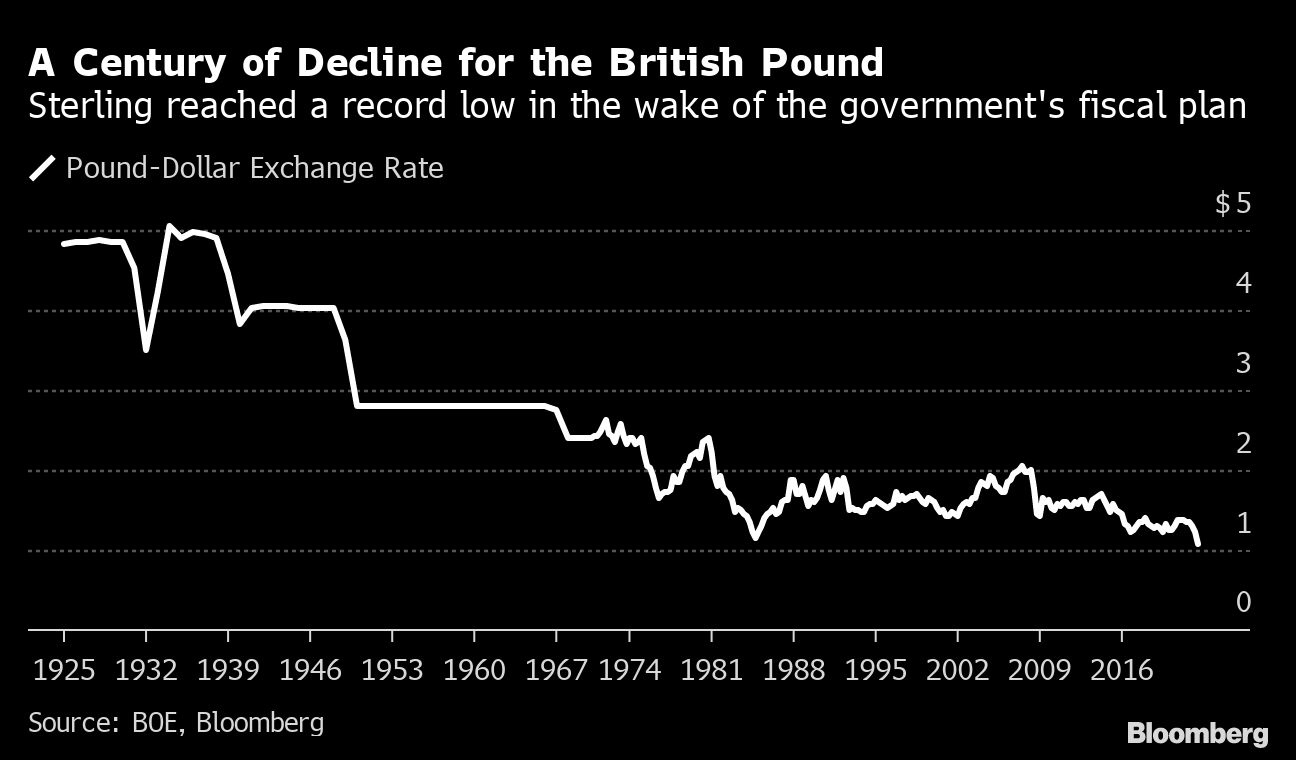
“Because the UK has damaged its once strong credibility with a poorly managed Brexit and persistent threats of a UK-EU trade war, it no longer enjoys the benefit of the doubt,” said Berenberg’s Pickering.

For JPMorgan’s Monks, the doubts set in before the 2016 Brexit referendum, accelerated after the shock result, and culminated in recent attacks on the central bank, the judiciary, and the civil service.

That background of mistrust may have obscured some of the mini-budget’s beneficial reforms. Simon French, chief economist at Panmure Gordon & Co., said the mishandling of the mini-budget was “a shame” because several of the supply-side reforms in areas like planning “have real merit.”
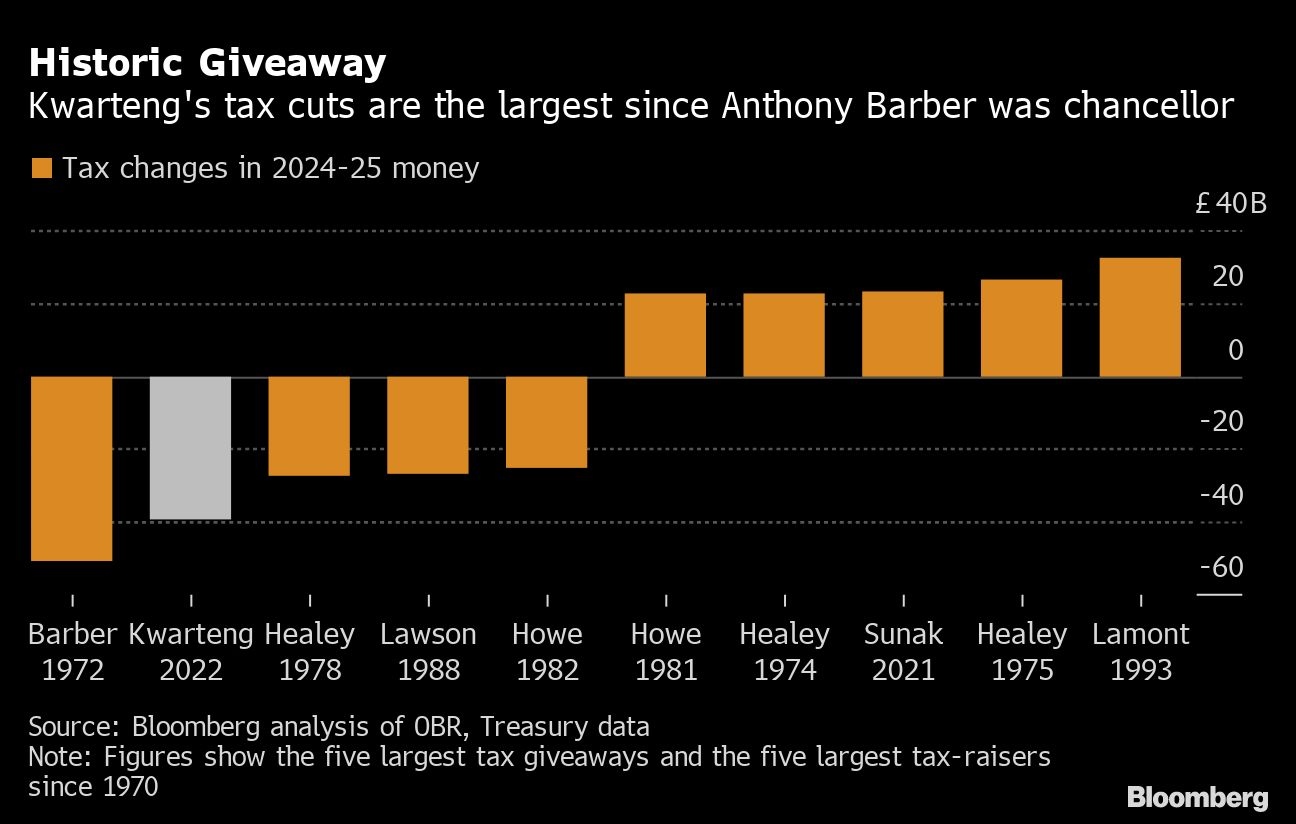
Nevertheless, Friday’s act of fiscal largess — being unfunded — marked a major break from the economic traditions of Truss’s Conservative Party. The government still needs to set out how it will cover the additional borrowing required to fund its £45 billion of tax cuts and further £60 billion-plus for its program to offset the recent surge in energy bills.

Those measures will drive up the country’s budget deficit to 4.5 per cent of gross domestic product in the medium term. That would be enough to put the debt burden on an explosive path, hitting 101 per cent of GDP by 2030, according to Bloomberg Economics.

In the meantime, the Bank of England will come under mounting pressure. The central bank has spent much of the year struggling to raise interest rates fast enough to combat a surge in inflation it failed to predict.

The BOE is now all but guaranteed to respond to the looser fiscal policy with tighter monetary policy. Money market traders are now betting on at least a 150 basis-point rise in interest rates by policymakers' next gathering on Nov. 3. Setting aside the risk of an emergency hike outside of scheduled meetings, that would be a move unprecedented since the bank was granted independence by the government in 1997. Pricing also shows the benchmark rate will almost certainly hit 6 per cent next year.

Companies and homeowners are now bracing for a steep increase in borrowing costs. The biggest British firms already face the highest cost on record to refinance their debt. The Resolution Foundation estimates that the additional increase in rates could add more than £1,000 to the annual cost of a typical £140,000 mortgage. Analysts at Credit Suisse Group AG estimate house prices could “easily” fall by as much as 15 per cent.

The UK, then, faces a grimmer outlook than what Truss promised in her summer campaign to succeed Boris Johnson, when she talked of upending the “business-as-usual economic strategy.” Her own survival in office is even in question. She faces an election in 2024 and one opinion poll this week showed the opposition Labour Party’s lead widening to 17 points, the most ever recorded by YouGov.

It’s not as if Truss wasn’t warned. While campaigning for the premiership over the summer, her opponent, former Chancellor Rishi Sunak, described her tax policies as a “fairy tale.” Economists at Citigroup Inc. even warned her ideas posed “the greatest risk from an economic perspective” to the UK.

One former Tory adviser, who asked not to be identified, was baffled by the decision to announce a mini-budget without a statement from the Office for Budget Responsibility. Not having an OBR forecast looked like a deliberate snub to the markets, he said, a sign that the government didn’t think it needed its sums to add up.

The last week has tested that confidence; the next could stretch it to breaking point.

Top polluters fail to tie CEO pay to carbon-cutting goals

Sep 29, 2022
Daniela Sirtori-Cortina, Bloomberg News


The math of cutting carbon pollution means it will pay for itself: Queen's University prof
Sean Cleary, chair of Institute for Sustainable Finance at Queen’s University, joins BNN Bloomberg and discusses some of his team's research into the need for investment in greenhouse gas reductions. He says that with Canada warming at a rapid pace, spending money to bring down carbon emissions is a cost-effective way of reducing the vastly expensive damage caused by extreme weather events and other climate risks.

t
5:16
We’re putting a tap into the ocean with no carbon emissions: Onek...


7:55
We can surpass the government’s emissions target, but we need sup...


Corporate America’s top emitters are failing to effectively link greenhouse gas reduction targets to CEO pay, a report by a shareholder advocacy group found.

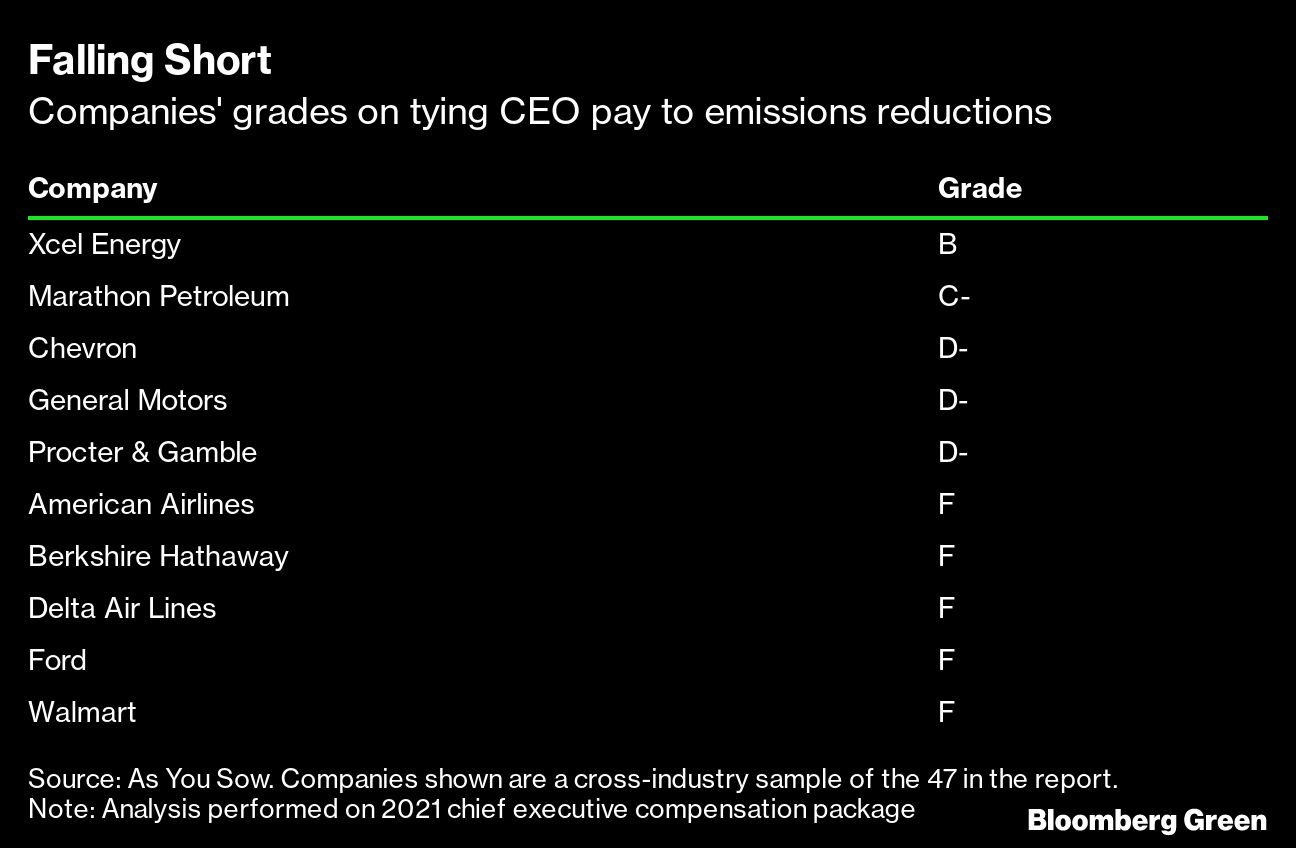
As You Sow analyzed the 2021 chief executive officer compensation packages of 47 US companies included in the Climate Action 100+ initiative, an investor-led program to ensure the world’s largest corporate greenhouse gas emitters curb their footprints. It found that many firms didn’t tie CEO pay to climate metrics, and when they did, it’s wasn’t to a level that would prompt bosses to meaningfully reduce emissions.

Linking environmental goals to compensation is gaining traction as a mechanism to rouse CEOs to action, as the world’s top climate scientists warn that the window to contain global warming is rapidly closing. Almost 70 per cent of S&P 500 companies that have filed 2022 proxy statements included ESG metrics in corporate incentive plans, up from 52 per cent in 2021. But the move won’t be effective if only a sliver of pay is tied to climate progress and the criteria used to assess chief executives is vague, according to As You Sow.

“The CEOs making net zero by 2050 pledges won’t be leading their companies when such pledges come due,” author Melissa Walton wrote in the As You Sow report. That means holding today’s executives accountable for the investments necessary to achieve those goals “is critical,” she wrote.

As You Sow assessed the companies on whether they included a climate metric in the CEO’s 2021 compensation package, giving higher marks for incentives in line with the Paris Agreement’s goal of limiting warming to 1.5°C. It also looked at whether the climate metric was quantitative and the amount of pay tied to it could be measured. Lastly, it analyzed whether the target was included in executives’ long-term incentive plan, which typically includes equity awards paid out over three years and can account for 60 per cent to 70 per cent of CEO pay.

The group then assigned grades based on the results, using a descending scale from A to F. Utility company Xcel Energy Inc. received the highest grade — a B — because it tied performance in reducing emissions to its long-term incentive plan and linked a measurable amount of pay to those goals. Almost 90 per cent of the corporations received D or F grades “for failing to include rigorous quantitative climate-related metrics with measurable payout or long-term incentive components.”

“Generalized linkages are generally insufficient to drive climate progress,” Walton wrote. “The amount of pay tied to most climate metrics was negligible relative to overall compensation.”


A spokesperson for Marathon Petroleum Corp., which got a C-, noted it was the first independent US downstream energy company to establish Scope 1 and 2 emissions intensity reduction targets linked to executive and employee compensation. “We continue to challenge ourselves to lead in sustainable energy by deepening environmental, social and governance commitments to drive long-term benefits for our business and stakeholders,” the spokesperson said.

General Motors Co., which got a D-, said, “We are aligning multiple aspects of the business with our climate goals, not just executive compensation (new this year),” citing a new sustainable finance framework and green bond issuance. A spokesperson also pointed to an announcement from CEO Mary Barra that the company will link a “significant part” of executives’ long-term compensation to meeting its electric vehicle goals.

Procter & Gamble Co. and Walmart Inc. declined to comment. American Airlines Inc., Berkshire Hathaway Inc., Chevron Corp., Delta Air Lines Inc. and Ford Motor Co. didn’t respond to requests for comment.

Multiple companies outlined a goal to “reduce emissions” without specifying the target required to receive a payout, according to the report. Others used vague terms such as “demonstrate leadership” in curbing greenhouse gases, a statement that can’t be quantified, while others touted milestones without having initially set measurable goals. That doesn’t cut it for investors.

“It’s important for companies to make this correlation clear, setting climate targets that convey real, science-based change,” said Simon Fischweicher, North America head of corporations and supply chains at the environmental disclosure nonprofit CDP, which wasn’t involved in the report. “This is particularly the case as investors are increasingly interested in how a company might be managing climate action.”

As You Sow also found that climate metrics were more commonly included in CEOs’ annual bonuses instead of in long-term incentive plans, which likely limits the potential to prompt action because bonuses tend to be a smaller portion of total compensation. And boards have more discretion over bonuses than incentive plans.

The group also took issue with a lack of disclosure in company proxy statements, which makes it harder to tell “performative” statements from effective ties between climate metrics and pay.

Compensation plans should clearly outline climate targets and the threshold required for a payout, according to the report.

“Companies are jumping on this bandwagon at a very alarming rate,” Walton said in an interview. “It needs to be done well.”

Coordination among major central banks 'almost impossible': AIMCo chair

Coordination among the world's largest central banks is nearly impossible, according to the chair of one of Canada’s largest institutional investors, due to each of the three major global economic zones facing different circumstances. 

Amid persistent inflation, the world's central banks have two options, Mark Wiseman, chair of the Alberta Investment Management Corp. (AIMCo), said in a television interview Wednesday.

The first option is to aggressively raise interest rates to control inflation, Wiseman said, which could put an economy into a “very deep and potentially prolonged recession.”

The other option is to accept longer-term inflation above the current two per cent target held by many central banks. However, Wiseman said when inflation is entrenched in an economy it causes “a whole other set of problems.”

“And this talk of coordination is almost impossible because you have the three major blocs, [the] economic blocs in the world, all in a different situation,” Wiseman said. 

The three major economic blocs, North America, Europe and China, all face unique challenges according to Wiseman.

“You've obviously got North America which has an inflationary problem,” he said, adding that the Bank of Canada and U.S. Federal Reserve are likely to continue aggressive interest rate hikes. 

For Europe, in addition to inflation, Wiseman said there are structural problems stemming from the war in Ukraine, including energy issues preventing European central banks from raising interest rates. 

“They've got a problem that they really don't have the levers to pull that that the Bank of Canada [and] the U.S. Fed has,” he said. 

As the Chinese Communist Party’s national congress approaches in mid-October, policymakers will have to stimulate the economy to tackle “flaccid economic growth,” Wiseman said.

“You've got the three major economic zones in the world, all pursuing different paths because they have to, and that's a bad thing. It's a bad thing because it creates disequilibrium in markets, in currency markets and equity markets, and asset pricing generally,” he said. 

Amid economic uncertainty, Wiseman said investors should “hold on tight,” by lowering risk appetites and adjusting portfolios. 

Specifically, Wiseman points to treasuries. 

“Nobody wanted to hold treasuries a couple of years ago because basically, you're making zero. Now you can make at least a nominal return on treasuries, not a real return today, but at least a nominal return on treasuries,” he said. 

Canada's population just got a bit younger thanks to immigration

Sep 28, 2022

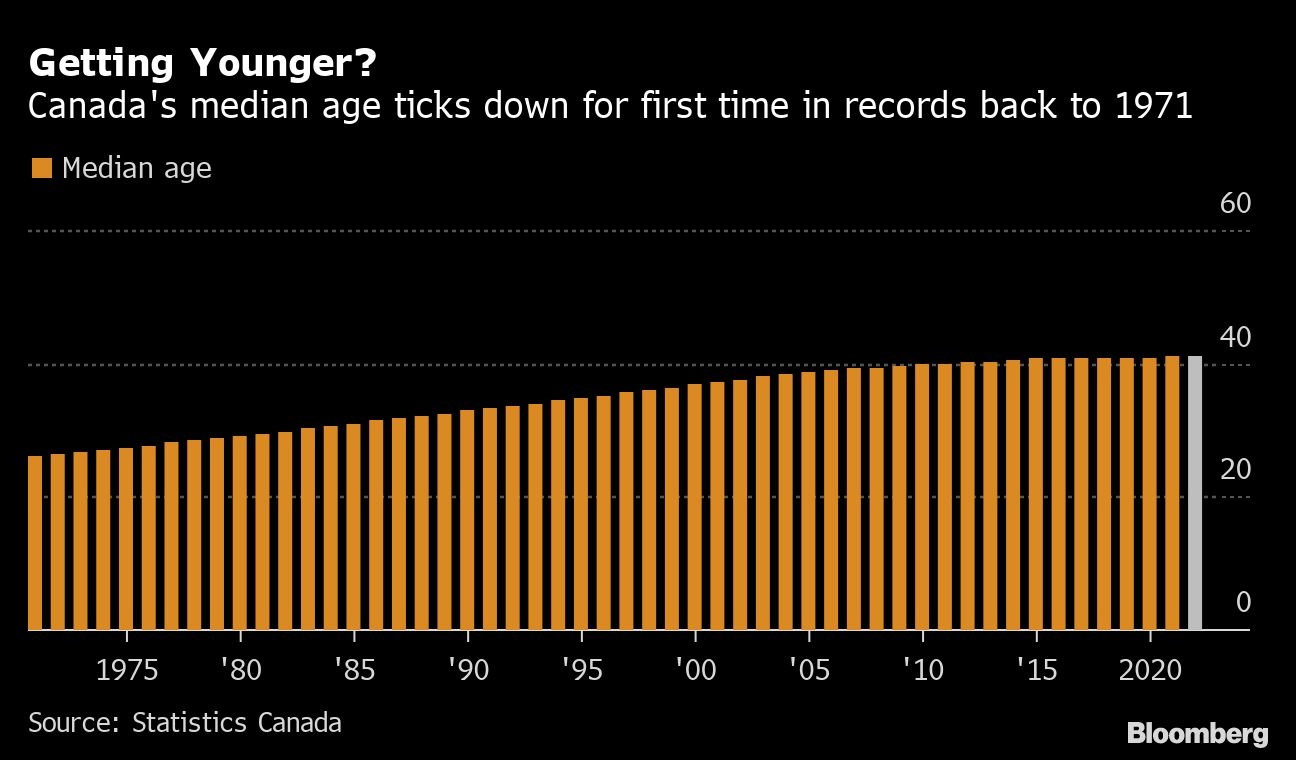
Canada’s population got younger for the first time since 1971, a potential reversal of a demographic trend driven by the government’s open immigration policies. 

The median age of people living in Canada in 2022 edged down to 41, the first decline in more than five decades, according to data released Wednesday by the national statistics agency. The median age had climbed steadily from 26.2 in 1971 to 41.1 last year as the population ages, a trend observed in many advanced economies. 


In recent years, Canada has ramped up its efforts to bring in working-age immigrants to replace workers retiring from the labor force and offset a decline in fertility rates. In the second quarter, the country recorded its fastest pace of population growth since 1957 thanks almost entirely to immigration. 

The median age divides the population into two parts of equal size, and is a key measure for a country’s age distribution. Countries with the world’s youngest median ages of about 15 include Niger, Uganda and Angola, while Monaco, Japan and Germany have some of the highest at around 50 years old.

Bank of Canada vows more transparency after pressure from IMF

The Bank of Canada will begin publishing a minutes-like summary of deliberations by officials after each policy decision in an effort to enhance transparency as it faces one of the most severe tests of its credibility.

The move comes in response to a review by the International Monetary Fund, released on Wednesday, of the central bank’s transparency practices. The Bank of Canada said it will produce summaries roughly two weeks after each policy meeting, starting with the Jan. 25 decision.

“We do expect it to provide a high-level summary of the issues discussed by Governing Council, as well as insight into the key points of focus in their deliberations on economic developments and the risks,” Jeremy Harrison, managing director of the bank’s communications department, said in a statement.

“We also expect it will provide insight into the range of policy options that Governing Council may be considering at any given decision.”

The Bank of Canada has faced criticism in the past for not publishing minutes like the U.S. Federal Reserve, which the IMF said in its report is a practice considered the “golden standard” among inflation targeting central banks. 

The need to bolster the bank’s inflation-fighting credibility, however -- with whatever means -- has taken on added urgency after policymakers failed to foresee the extent and stickiness of the surge in consumer prices, and were late to respond.

As a result, the Bank of Canada is engineering one of its most aggressive tightening cycles ever in a bid to catch up. Officials have rapidly raised the policy rate to 3.25 per cent from the emergency pandemic low of 0.25 per cent it was holding at until March. Markets are pricing in another 50 basis point hike at the October meeting.

Harrison said the summaries won’t attribute comments to any individual members on the council. The Bank of Canada doesn’t make policy through a voting system, so no vote records will be published.

The bank said it has also agreed to enhance transparency around its risk management and audit functions.

“We know that by being transparent, we can help all Canadians understand what we are doing and why, and that’s essential for their trust,” Governor Tiff Macklem said in a news release.

Canopy Growth to sell Tweed, Tokyo Smoke stores to OEGRC and Four20 owner

CANOPY GROWTH CORP (WEED:CT)

3.75 0.07 (1.83%)
As of: 10/02/22 4:07:15 pm
REAL-TIME QUOTE. Prices update every five seconds for TSX-listed stocks
Oct '21Jan '22Apr '22Jul '22Oct '2205101520
Chart Type - 1year
See Full Stock Page »

Canopy Growth Corp. is getting out of the cannabis retail business with two deals to divest its Tweed and Tokyo Smoke stores.

The Smiths Falls, Ont. cannabis company announced Tuesday that it sold all of its stores outside Alberta, as well as the intellectual property for Tokyo Smoke, to OEG Retail Cannabis (OEGRC).

OEGRC is run by the Katz Group, which owns the Edmonton Oilers hockey team and previously had a licensee deal to own and operate all of Canopy's franchised Tokyo Smoke stores in Ontario.

The new deals will see OEGRC, which already owns 64 Tokyo Smoke stores, take control of 23 Tokyo Smoke and Tweed stores across Manitoba, Saskatchewan and Newfoundland and Labrador and force the rebrand of any Tweed stores. 

420 Investments Ltd. will acquire another five stores in Alberta that will be rebranded under its Four20 retail banner.

Canopy did not share the value or financial terms of either deal.

However, it framed the agreements as part of its push to reprioritize the premium segment of cannabis and reduce costs, which the company has been tackling through job cuts and facility closures during the COVID-19 pandemic.

“We are taking the next critical step in advancing Canopy as a leading premium brand-focused CPG cannabis company while furthering the company’s strategy of investing in product innovation and distribution to drive revenue growth in the Canadian recreational market,’’ David Klein, Canopy's chief executive, said in a statement.

The retail segment of the cannabis market that Canopy is exiting has become tough to compete in as the number of pot shops has ballooned, driving competition.

Ontario — Canopy's home province — has 1,333 stores alone, including many that cram Toronto's Queen Street West. The stores hawk the same items from the same province-backed supplier, meaning standing out has never been tougher. 

Cannabis companies in both the retail and production space have also struggled to reach profitability because they keep slashing prices to compete with the illicit market and rival stores.

The average price for cannabis was $11.78 per gram at the start of 2019, shortly after legalization, but fell to $7.50 per gram in 2021, a November report from Deloitte Canada and cannabis research firms Hifyre and BDSA said.

The average price for vape cartridges has similarly fallen by 41 per cent from $32.02 per gram around legalization to $19 per gram a year later.

OEGRC has yet to reveal what pricing strategy it will take on, when it nabs Tokyo Smoke's intellectual property, but chief executive Jürgen Schreiber position the agreement as part of the "advancement" of the cannabis industry.

“OEG Retail Cannabis and Canopy Growth have been partners for many years now and we are committed to a smooth transition for employees and customers of the newly acquired stores as we await final regulatory approval in the coming months,” he added, in a news release.

Staff working at acquired locations will keep their jobs and Canopy will continue to own and operate its Tweed brand of flower, pre-rolls and other products.

The company will also terminate a master licence agreement dating back to 2019 that allowed convenience store giant Alimentation Couche-Tard Inc. to operate a Tweed branded shop in London, Ont.

This report by The Canadian Press was first published Sept. 27, 2022.

Companies in this story: (TSX:WEED, TSX:ATD.B)

CANADA

Labour shortage, pandemic savings to soften blow of short-lived recession: report

Sep 28, 2022

A tight labour market and elevated savings during the pandemic will cushion the impact of a recession on Canadians, says a new report from Deloitte.

Deloitte’s most recent economic outlook report forecasts Canada will enter a short-lived recession by the end of the year.

The report says while rising interest rates will cause a significant economic slowdown, the accumulation of inventories will push the economy into a technical recession.

However, because the job market has been so tight, Deloitte chief economist Craig Alexander said unemployment might not rise as much as it typically would during a recession.

For Canadians, that's what will matter most, he said.

“Nobody eats GDP. From a point of view of Canadians, what really matters is what happens to their jobs and their income,” Alexander said.

According to Deloitte's forecast, the unemployment rate will tick up to six per cent in the third quarter of next year before falling again.

Canada’s unemployment rate was 5.4 per cent in August, up from a record-low of 4.9 per cent.

Alexander said businesses he’s spoken to are still concerned about ongoing labour shortages.

Given the existing hiring challenges, he said employers won't be inclined to lay off workers even if there is an economic downturn so long as it's expected to be temporary.

“If a recession hits, [businesses] are likely to still want to hoard labour because of how difficult it has been to find workers that have the skills that they need,” he said.

While economists are split on whether Canada will enter a recession, an economic slowdown is widely expected because of rising interest rates.

The Bank of Canada has raised its key interest rate five times since March, bringing it to 3.25 per cent. While inflation slowed to 7.0 per cent in August, the central bank is still expected to hike interest rates again in October.

As the Bank of Canada works on bringing the inflation rate down to its two per cent target, higher interest rates will feed into higher borrowing costs, which should slow economic activity.

There have been some early signs that a slowdown is already underway, including falling housing prices and three consecutive months of job losses.

The report from Deloitte says household consumption will fall as the slowdown continues but for households that accumulated savings, their spending won’t be impacted as much

According to Statistics Canada, households saved more than a quarter of their disposable income during the second quarter of 2020. In comparison, the savings rate was just two per cent a year prior.

While the household savings rate has since fallen, it remains elevated compared to pre-pandemic levels.

Households with higher incomes are generally considered to have higher savings rates.

“The inflation environment that we're in right now is absolutely punishing on low-income Canadians. So, there's a very big inequality dimension to [it],” Alexander said.

“But at the middle- and higher-income households, what we're likely seeing is that the cost of living is going up for them, but they can easily afford it and continue spending.”

Scotiabank taps Finning CEO to succeed Brian Porter, surprising Bay Street

Columnist image
Noah Zivitz

Managing Editor, BNN Bloomberg

|Archive

The Bank of Nova Scotia announced Monday that Brian Porter, its president and chief executive officer, is retiring next year — and the choice for his successor caught Bay Street by surprise. 
In a press release, the bank said Porter’s last day in the roles will be Jan. 31, 2023.

He will be succeeded by Scott Thomson, who is currently the president and chief executive officer of Finning International Inc., and a member of Scotia’s board of directors. He isn’t a stranger to the finance industry, having served as a vice-president at Goldman Sachs earlier in his career.

“I was surprised that the Bank of Nova Scotia actually went outside its own executive ranks to choose a new CEO. … I was surprised as well that they had actually gone outside, which shows that the potential CEOs, the people that had been groomed internally to be potential successors, weren't the same quality as they were able to find outside,” said Anish Chopra, a partner and portfolio manager at Toronto-based Portfolio Management Corp. — which owns Scotia shares, in an interview.

Thomson will initially move into Bank of Nova Scotia’s management ranks as president on Dec. 1. Shortly before Scotia’s announcement Monday, Finning announced Thomson’s pending exit, while naming Kevin Parkes, the Vancouver-based heavy equipment-dealer’s chief operating officer, as its next president and CEO.
“Scott is an exceptional leader and a seasoned CEO with a history of delivering results across the Americas and in international markets through a strong focus on operational excellence, talent development, and digital transformation, and a proven track record in effective capital allocation and investments in strategic capabilities,” said Aaron Regent, Bank of Nova Scotia’s chair, in the release.

Porter took the helm as Scotia’s president and chief executive on Nov. 1, 2013, after succeeding Rick Waugh, who led the bank through the global financial crisis. 
Under Porter’s leadership, Scotia made an aggressive push in 2018 to expand its wealth management line of business. In that calendar year, the bank first announced it was buying Jarislowsky Fraser for $950 million; it later acquired MD Financial Management for $2.59 billion in cash, the bulk of which was financed in a share issuance.

While Porter helped to reshape Scotia, the bank has underperformed in the market during his reign.

Through the close of trading Friday, Bank of Nova Scotia’s shares rose 8.9 per cent since Porter became the bank’s CEO. The TSX’s banks industry subgroup (which includes the Big Six, as well as Laurentian Bank of Canada, Canadian Western Bank, Home Capital Group, and the parent company of Equitable Bank) rose 55.2 per cent over that same span. On a total return basis, which includes dividends, Scotia rose 62.5 per cent under Porter, and the banks subgroup more than doubled for investors with a return of 122.6 per cent.

Scotia’s sprawling international banking operations have been a persistent source of concern for Bay Street. Most recently, a slight deterioration in that unit’s profitability in the fiscal third quarter prompted a single-day drop of 5.25 per cent for Scotia’s common shares and a slew of analyst downgrades.

“While the broad strategy is likely to stay intact, we believe the new CEO will look to improve the bank's execution, particularly with [Scotia’s] share price having materially underperformed its Big Six peer group over the past five-year period,” stated Mike Rizvanovic, an analyst at Keefe, Bruyette & Woods, in a note to clients Monday that also called Thomson’s selection “a surprise leadership change.”

Although the investing community was taken aback by the succession, Bank of Nova Scotia’s next chief executive was lauded by one of the country’s best-known business leaders.

“I think they made an excellent choice,” billionaire entrepreneur Jimmy Pattison, the chair and chief executive officer of The Jim Pattison Group, told BNN Bloomberg in a phone interview. “I’ve known him for years. He’s got a lot of good, common sense,” Pattison added. 

Thomson currently serves as a director on The Jim Pattison Group’s board of directors. Pattison first met Thomson when he was serving as a director of Bell Canada, where Thomson previously worked as an executive vice-president.

With a file from Jon Erlichman

BNN Bloomberg is a division of Bell Media, which – like Bell Canada – is owned by BCE Inc.