Sunday, March 26, 2023

Gandhi says disqualification 'politically motivated'

BBC
Sat, March 25, 2023 

Rahul Gandhi speaks to the media in Delhi on Saturday, a day after being disqualified from parliament

The leader of Indian's opposition Congress party Rahul Gandhi has said his disqualification by parliament was politically motivated.

On Friday, India's parliament stripped Mr Gandhi of his MP status a day after he was sentenced to two years in prison in a defamation case.

He was convicted by the court for 2019 comments about PM Narendra Modi's surname at an election rally.

The governing BJP says his expulsion conformed with parliamentary rules.

A 2013 Supreme Court order says that a lawmaker convicted in a crime and sentenced to two or more years in jail stands disqualified from the parliament with immediate effect.

Speaking at a news briefing on Saturday, Mr Gandhi said: "It makes me no difference if I'm disqualified... Disqualify me for life.... I will keep going, I will not stop."

Although India's opposition parties don't always agree on political issues, many of them have supported Mr Gandhi over his disqualification. On Friday, 14 parties approached the Supreme Court, alleging that the federal government was misusing investigative agencies to target BJP's opponents.

Congress president Mallikarjun Kharge alleged that the action against Mr Gandhi was a consequence of his demand for a parliamentary investigation to probe allegations against the Adani Group.

The huge conglomerate was accused of decades of "brazen" stock manipulation and accounting fraud by US-based short-seller Hindenburg Research earlier this year. The Adani Group has denied allegations of financial fraud.

"My job as I see it is to defend the democratic nature of this country," Mr Gandhi said after his disqualification.

"That means defending the institutions of this country, that means defending the voice of the poor people of this country, that means telling the people of this country the truth about people like Mr Adani, who are basically exploiting the relationship they have with the prime minister," he said.

"I was disqualified because Prime Minister Narendra Modi is scared of my next speech on Adani... I can see it in his eyes."

Mr Gandhi's supporters say his disqualification is a sign that India's democratic system is weakening, and more protests against the government are planned in the coming days.

He will not be allowed to take part in national elections due next year, unless his sentence is suspended or he is acquitted in the case.

The ruling Bharatiya Janata Party (BJP), however, said the decision to disqualify Mr Gandhi was in accordance with parliamentary laws, and criticised his party for questioning the verdict.

Federal Labour Minister Bhupender Yadav said Mr Gandhi had insulted members of the caste grouping known as Other Backward Classes (OBC) under which the name "Modi" falls.

"Insulting any surname is not freedom of speech," he said.

But some experts have questioned the severity of Mr Gandhi's sentence.

Joyojeet Pal, an associate professor of information at the University of Michigan, said that it was "highly unusual" for a first-time offender like Mr Gandhi to be given the maximum possible punishment of two years' imprisonment.

"Both low-level politicians and parliamentarians in India are known to engage in extreme speech on social media and in their public meetings. A conviction of this scale, with the consequence of removing the primary challenger to Modi, is practically unheard of," Prof Pal added.

India's Rahul Gandhi says he won't stop asking Modi questions


Rahul Gandhi, a senior leader of India's main opposition Congress party, arrives at the New Delhi airport

Sat, March 25, 2023 
By YP Rajesh

NEW DELHI (Reuters) -Indian opposition leader Rahul Gandhi said on Saturday he had been disqualified from parliament because he has been asking Prime Minister Narendra Modi tough questions about his relationship with Gautam Adani, founder of the Adani conglomerate.

Modi's Hindu nationalist Bharatiya Janata Party responded saying Gandhi had been punished under the law for a defamatory comment he made in 2019 and it had nothing to do with the Adani issue.

Gandhi, a former president of India’s main opposition Congress party who is still its main leader, lost his parliamentary seat on Friday, a day after a court in the western state of Gujarat convicted him in a defamation case and sentenced him to two years in jail.

The court granted him bail and suspended his jail sentence for 30 days, allowing him to appeal.

The defamation case was filed in connection with comments Gandhi made in a speech that many deemed insulting to Modi. Gandhi's party and its allies have criticised the court ruling as politically motivated.

"I have been disqualified because the prime minister is scared of my next speech, he is scared of the next speech that is going to come on Adani,” Gandhi told a news conference at the Congress party headquarters in New Delhi.

"They don’t want that speech to be in parliament, that’s the issue,” Gandhi said in his first public comments since the conviction and disqualification.

Gandhi, 52, the scion of a dynasty that has given India three prime ministers, did not elaborate on why Modi might not like his next speech.

Gandhi's once-dominant Congress controls less than 10% of the elected seats in parliament's lower house and has been decimated by the BJP in two successive general elections, most recently in 2019.

India's next general election is due by mid-2024 and Gandhi has recently been trying to revive the party's fortunes.

"I am not scared of this disqualification ... I will continue to ask the question, 'what is the prime minister’s relationship with Mr Adani?’,” Gandhi said on Saturday.


OPPOSITION QUESTIONS


Modi's rivals say the prime minister and the BJP have longstanding ties with the Adani group, going back nearly two decades when Modi was chief minister of the western state of Gujarat. Gautam Adani is also from Gujarat.

The Congress party has questioned investments made by state-run firms in Adani companies and the handover of the management of six airports to the group in recent years, even though it had no experience in the sector.

The Adani group has denied receiving any special favours from the government and government ministers have dismissed such opposition suggestions as “wild allegations”, saying regulators would look into any wrongdoing.

Congress, and its opposition allies have called for a parliamentary investigation.

"The life of Indian Prime Minister Narendra Modi is an open book of honesty," BJP leader Ravi Shankar Prasad told a news conference called in response to Gandhi's statements on Saturday.

"We don’t have to defend Adani, BJP never defends Adani, but BJP doesn’t target anyone either," Prasad said, accusing Gandhi of habitually lying.

A former federal minister, Prasad listed international business deals the Adani group had signed when a Congress-led coalition government ruled India from 2004 to 2014 and its investments in Indian states ruled by Congress.

"So how is Adani group investing 650 billion rupees ($7.89 billion) in a state ruled by your party," Prasad asked, referring to an announcement by the conglomerate in October that it would invest in the solar power, cement and airport sectors in the western state of Rajasthan, which is ruled by Congress.

Adani's group is trying to rebuild investor confidence after U.S. short-seller Hindenburg Research accused it of stock manipulation and improper use of tax havens - charges the company has denied.

Hindenburg's Jan. 24 report eroded more than $100 billion in the value of the company's shares.

($1 = 82.3340 Indian rupees)

(Reporting by YP RajeshEditing by Robert Birsel and Frances Kerry)
CRIMINAL CAPITALI$M 
Venezuela: 21 officials, businessmen arrested in oil scheme


Venezuelan Attorney General Tarek William Saab arrives for a news conference about corruption cases with the state run oil company, PDVSA, in Caracas, Venezuela, Saturday, March 25, 2023. Venezuela's oil czar, Tareck El Aissami, who announced his resignation on Twitter on Monday, March 20, 2023, pledged to help investigate any allegations involving PDVSA. (AP Photo/Matias Delacroix)


Associated Press
Sat, March 25, 2023 

CARACAS, Venezuela (AP) — Venezuela’s attorney general said Saturday that 21 people, including senior officials in the government of President Nicolás Maduro and business leaders, have been arrested in connection with a corruption scheme involving international oil sales.

Prosecutor Tarek William Saab said the alleged scheme involved selling Venezuelan oil through the country’s cryptocurrency oversight agency in parallel to the state-run Petróleos de Venezuela SA.

The oversight agency allegedly signed contracts for the loading of crude on ships “without any type of administrative control or guarantees,” violating legal regulations, Saab said, without mentioning the amounts involved. Once the oil was marketed, “the corresponding payments were not made” to the state oil company.

The attorney general’s statement comes five days after Venezuela’s once-powerful oil minister, Tareck El Aissami, resigned amid allegations of corruption against some of his closest associates.

El Aissami said he resigned to “accompany and fully support” the investigations. For now, El Aissami, who was one of Maduro’s trusted ministers, is not facing charges.

The U.S. government designated El Aissami a narcotics kingpin in 2017 in connection with activities in his previous positions as interior minister and governor. El Aissami's resignation was announced two days after the Public Ministry appointed five prosecutors to probe the alleged crimes investigated by the National Anti-Corruption Police.

Among the 10 officials arrested, according to the attorney general, are Col. Antonio Pérez Suárez, the vice president of trade and quality supply at PDVSA; Hugbel Roa, the former minister of food; and Joselit Ramírez, the national superintendent of cryptocurrencies.

Also arrested were 11 businessmen, who will be charged with appropriation or diversion of public assets, influence peddling, money laundering and criminal association, Saab said, adding that the crime of treason against the country will be added to public officials’ charges.

Corruption has long been rampant in Venezuela, which sits atop the world’s largest petroleum reserves. But officials are rarely held accountable — a major irritant to citizens, the majority of whom live on $1.90 a day, the international benchmark of extreme poverty.
Spiking violence strains sectarian ties in Iraqi province


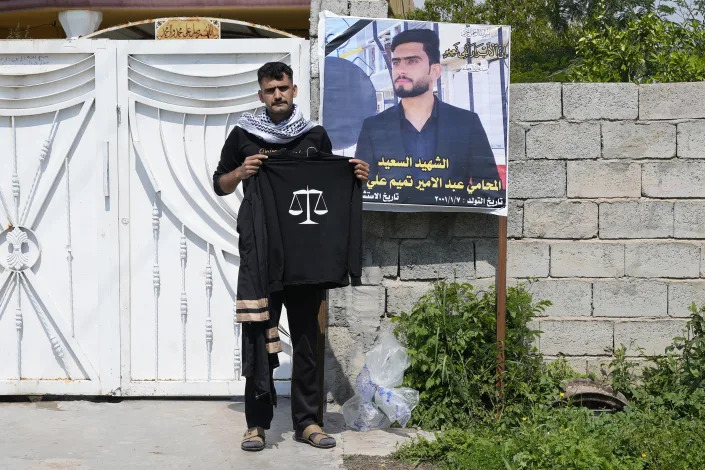
Abdullah Tamim stands next to a poster of his brother Abdel Amir Tamim while holding his brother's graduation robe in Muqdadiyah, Iraq, Wednesday, March 22, 2023. Abdel was killed in a sniper attack earlier this month. It is not known who carried out the attack. Diyala province has seen a spike in killings, some connected to sectarian hatreds but others believed linked to rivalries among Shiite factions.
 (AP Photo/Hadi Mizban)

YASMINE MOSIMANN
Sat, March 25, 2023 

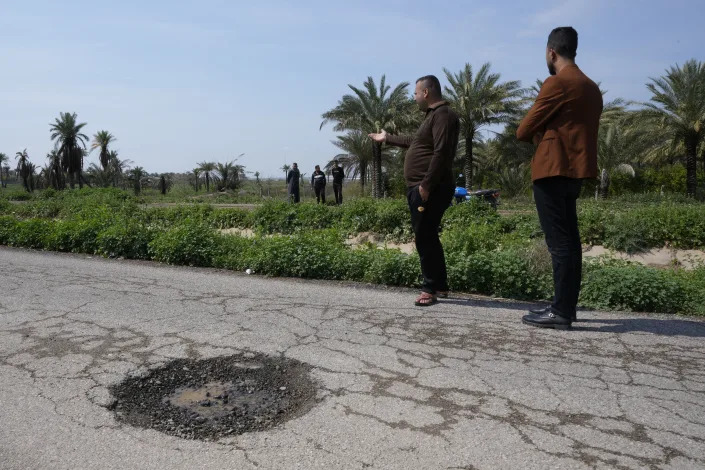
MUQDADIYAH, Iraq (AP) — Hussein Maytham and his family were driving past the palm tree grove near their home after a quiet evening shopping for toys for his younger cousins when their car hit a bomb planted on the moon-lit road.

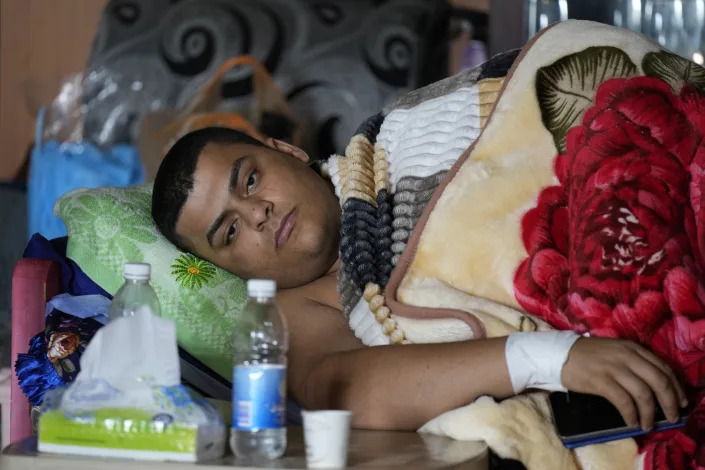
“I only remember the explosion,” Maytham, 16, said weakly from his hospital bed, his pale arms speckled brown by shrapnel. The attack took place earlier this month in the Shiite-majority village of Hazanieh. The force of the blast hurled the teenager out of the vehicle, but his family – his parents, an aunt and three cousins - perished in the fiery carnage. Residents say gunmen hidden nearby in irrigation canals opened fire, killing two others.

This is the latest in a series of attacks witnessed over the last month in the central Iraqi province of Diyala, located north and east of Baghdad. Security officials say at least 19 civilians have been killed by unidentified assailants, including in two targeted attacks.

The violence is pitting communities against each other in the ethnically and religiously diverse province. It also raises questions whether the relative calm and stability that has prevailed in much of Iraq in the years since the defeat of the extremist group Islamic State can be sustained.


Iraq as a whole has moved on from the conditions that enabled the rise of the Islamic State group and the large-scale bloody sectarian violence that erupted after the U.S.-led invasion 20 years ago, according to Mohanad Adnan, a political analyst and partner at the Roya Development Group.

But some parts of the country, including Diyala, remain tense, with occasional waves of violence reopening old wounds. “There are a few villages, especially in Diyala, where they have not overcome what happened in the past,” said Adnan.

Officials, residents, and analysts say at least one instance of violence in Diyala appears to be a sectarian reprisal by Shiites against Sunnis over an IS-claimed attack. But they say other killings were carried out by Shiites against Shiites, as rival militias and their tribal and political allies that control the province struggle over influence and lucrative racketeering networks. Diyala, bordering both Iran and Iraq's autonomous Kurdish region, is a prime conduit for smuggling, including drugs.

The Iranian-backed Badr Organization, a state-sanctioned militia within the Popular Mobilization Forces with a political wing, wrested control of the province from IS in 2015. Since then, it has asserted its dominance over several Shiite political parties and their associated paramilitaries, as well as Sunni groups.

Although most Sunni residents displaced during the war against IS have returned to the province, they say they are often viewed with suspicion by authorities and neighbors due to their perceived affiliation with the extremists. When remnants of the group stage attacks on civilians or security forces, it often prompts a spiral of retaliatory attacks.

In the Sunni village of Jalaylah, nine people, including women and children, were killed in a gruesome attack in late February, two months after they were blamed for allowing an IS attack on a neighboring village, according to security officials.

The attackers moved openly through the area, said villager Awadh al-Azzawi. “They didn’t wear masks. Their faces were clear,” he said.

Residents accuse members of the nearby Shiite village Albu Bali, where IS killed nine in December, of carrying out the attack in revenge. They say the perpetrators belong to local militias using weapons given to them by the state. Security officials affiliated with the armed groups declined to comment.

Banners calling for the blood of the attackers are hoisted on the walls of Jalaylah.

Maytham’s relatives less readily voice their suspicions of who killed their family members, who were Shiite.

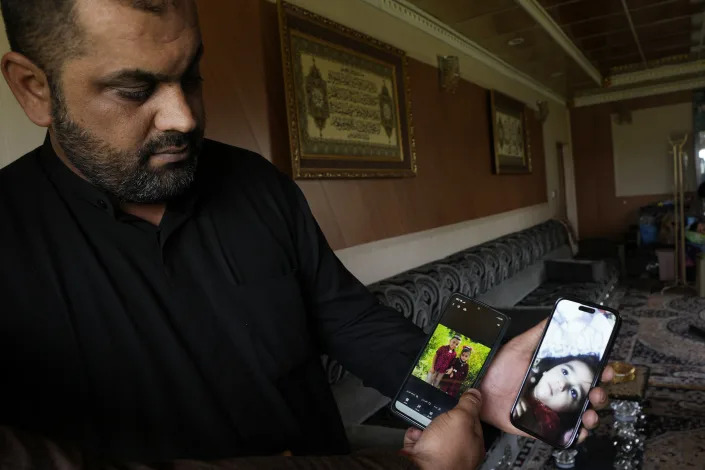
“Only God can be certain who is behind this attack,” said Sheikh Mustaf, the teenager’s grandfather, in his reception hall surrounded by guests offering their condolences for the eight killed in the March 3 attack, only describing the attackers as “terrorists.”

A local leader of the Bani Tamim, one of the most prominent Shiite-majority tribes in Diyala, Sheikh Mustaf has called for calm. But tribe members say their weapons are at the ready if authorities do not bring the assailants to justice.

Prime Minister Mohammed Shia al-Sudani visited Diyala days after the attack, sending military reinforcements to the area. Several have been arrested on terrorism charges and caches of weapons, including mortars, missiles, and ammunition, have been uncovered, according to the security media cell.

“We blame the security forces and the government because they have to secure the area. It’s their responsibility,” said Sheikh Maher, another relative of the deceased and prominent member of the tribe. He blamed “foreign hands” that he said “are trying to return our province back to the days of sectarianism and chaos.”

A provincial security official, speaking to The Associated Press on condition of anonymity because they were not authorized to brief the media, said, “what is happening in Diyala is not only terrorism” – a term generally used for attacks by Sunni militant groups like IS – “but also a struggle for influence between armed factions linked to political blocs.”

Experts say internal rifts are emerging within the Bani Tamim clan, who are split in their support among the competing forces of the Badr Organization, the movement of influential Shiite cleric Muqtada al-Sadr, and the Iranian-affiliated paramilitary group Asaib Ahl Al-Haq.

“There is a struggle within the tribe in order to impose power and to obtain important positions in Diyala, positions in the Diyala government, and security positions,” the official said.

Iraq analyst Tamer Badawi, a doctoral researcher at the University of Kent, said armed groups are also carrying out attacks to destabilize the area and undermine a crackdown launched by the government against smuggling networks that they have operated for years.

“Now, after cracking down on smuggling, crime is increasing, namely murder and kidnapping for the sake of money,” said the security official.

Residents of Diyala say regardless of the cause of the attack, they feel unsafe and blame Iraqi authorities for letting the attacks happen. “This is terrorism. It’s not about tribes, or sectarianism, it’s terrorism,” said Azzawi.
Voting rights effort targets those held in jails across US
 

GARY FIELDS and MICHAEL TARM
Sat, March 25, 2023 

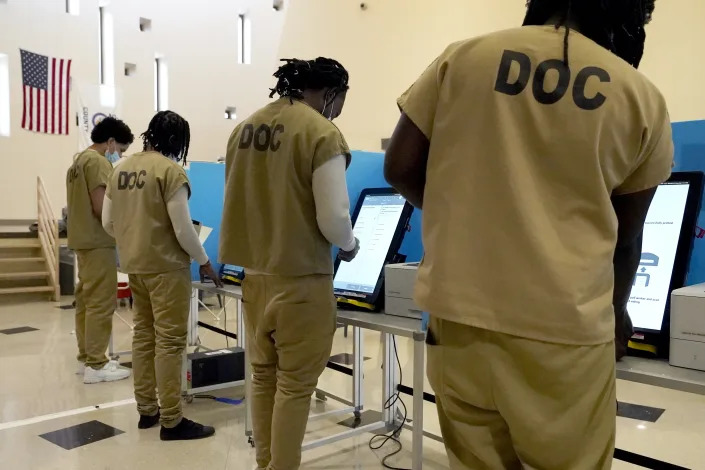
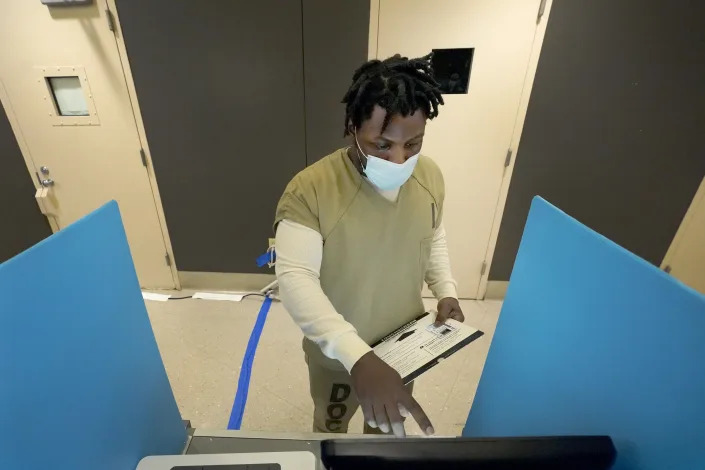
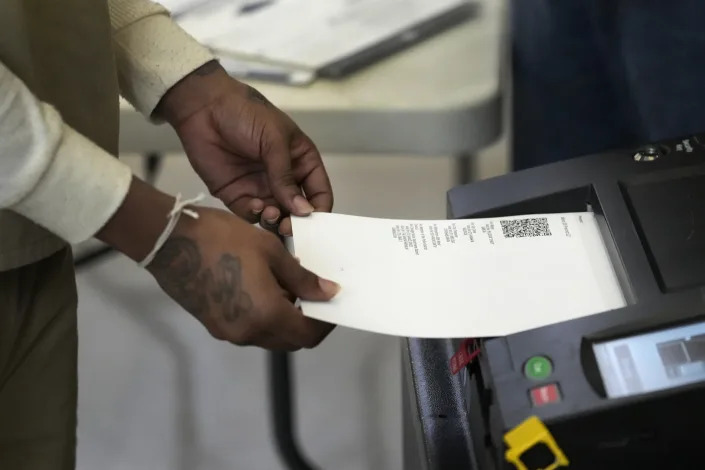
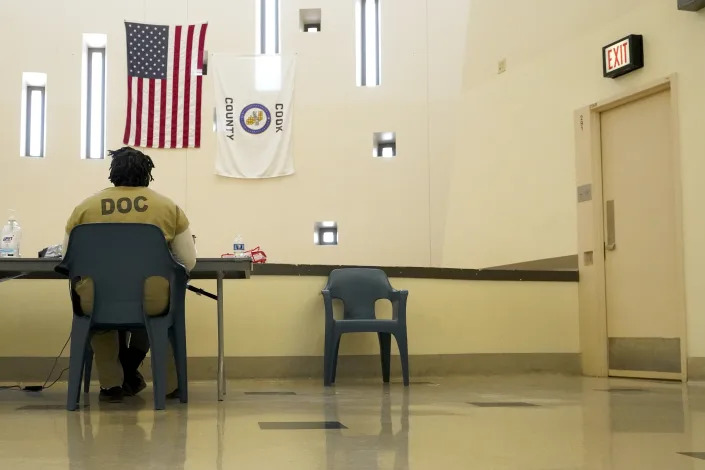
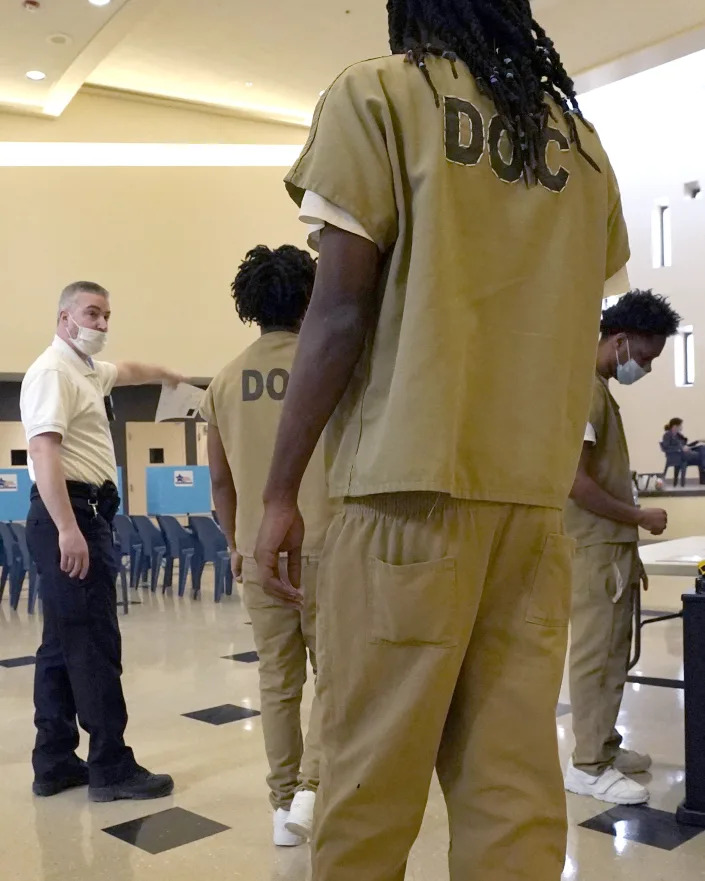
CHICAGO (AP) — The voting precinct could have been any one of hundreds throughout Chicago, except that these voters in the first round of the mayoral election were all wearing the same beige smocks. And the security at this polling place wasn’t intended to keep disrupters and campaigners out, but the voters in.

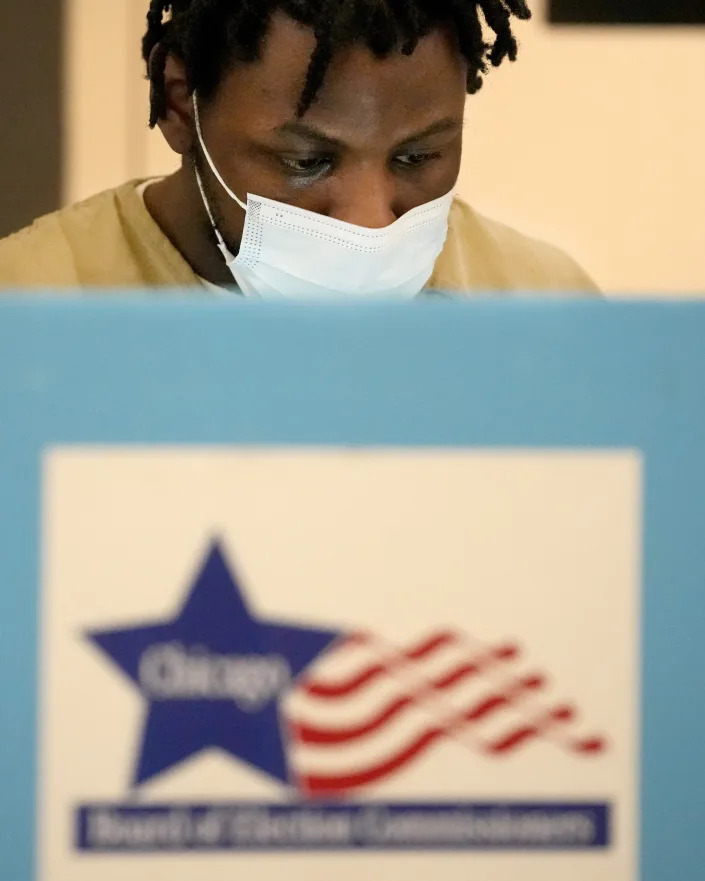
When first-time voter Tykarri Skillon finished studying the list of nine candidates, looking for those who shared his priorities on jobs and affordable housing, he marked his ballot and then was escorted with other voters back to their cells in the Cook County Jail.

The 25-year-old, awaiting trial on a weapons charge, is part of a group not always mentioned in discussions about voting disenfranchisement. People serving sentences for felony convictions lose their right to vote. Detainees awaiting trial or serving misdemeanor sentences do retain that right, but face barriers to exercising it in many parts of the United States.

The Cook County Jail, with more than 5,500 inmates and detainees, is one of the largest such facilities in the nation. It is one of several lockups where voting rights advocates have worked with local election and jail officials to offer voting for those held there. The list includes jails in Denver; Harris County, Texas; Los Angeles County; and the District of Columbia.

Expanding jailhouse voting is one of the latest steps to combine voting rights with criminal justice changes.

“It feels good to have a voice,” Skillon said after casting his ballot during early voting, before the race went to an April 4 runoff. “We’re going home someday, so we should have a voice in our community.”

Candidates he chose from included the current mayor, Democrat Lori Lightfoot. Among the issues that damaged her politically was rising crime. She eventually came in third in the election, bumping her from an April 4 runoff between the two top vote-getters, also Democrats.

The most recent survey from the federal Bureau of Justice Statistics, released last December, showed that 451,400 of the 636,300 people held in jails across the country had not been convicted and thus should retain their right to vote.

Voting rights for pretrial detainees and inmates serving sentences for misdemeanors were upheld in a U.S. Supreme Court decision from 1974, in a case from New York, O'Brien v. Skinner.

Despite that ruling, voting rights advocates say a “de facto disenfranchisement” exists because of mistakes over eligibility and the difficulties that detainees and prisoners face in registering or voting.

In a 2020 report, the Prison Policy Initiative focused on three main reasons: registration is difficult due to issues such as mail-in ballot deadlines and voter ID laws; detention does not meet the criteria for absentee voting in some jurisdictions; and the churn of the jail populations.

At least one state, Tennessee, had a bill introduced this year to address one of the barriers. Being in jail as a pretrial detainee is not one of the reasons considered valid for granting a mail ballot request, said Democratic state Sen. Jeff Yarbro, the bill's sponsor. Yabro, who recently announced he was running for mayor of Nashville, wants that changed.

“Being a full citizen should be the default," he said. "Everybody ought to have the expectation of fully participating in a democracy."

In Harris County, Texas, which includes Houston, about 75% of the nearly 10,000 people held in jail are pretrial. The sheriff's department established a polling place there in 2019, working with the county elections office, and has allowed voting during the past two election cycles. Before that, detainees voted only by mail.

The move started in 2017 with the Houston Justice Coalition and an initiative known as Project Orange that has helped register thousands of detainees and taught them how to navigate the mail ballot process, Nadia Hakim, a spokeswoman for the Harris County Elections Administration, said in an email.

“Previously if detainees wanted to vote, they had to do the legwork,” she said. “They had to know their registration status and make the request for the mail ballot application.”

In-person voting has multiple advantages. The mail ballot application deadline is April 25 for this year's May 6 election. Someone booked after the deadline would not be able to request a mail ballot, Hakim said. With the in-jail polling place, all detainees can vote, as well as members of the staff and public because machines are available in secure and public spaces. In last November's election, 528 people checked in to vote there, including detainees, employees and members of the public, she said.

In California, Los Angeles County Sheriff's Department Capt. Roel Garcia said staff members let pretrial detainees know they can register and vote and hold voter registration drives. Garcia, who oversees the inmate reception center, said the department works with groups such as the League of Women Voters to get information to the detainees about candidates and issues on the ballot.

The department and the Los Angeles County Registrar-Recorder/County Clerk have teamed up on a pilot program since 2020 that allows voting in two jails. There are plans to expand it to all eight county jails in 2024.

Registrar Dean Logan said as many as 11,700 people could be eligible at a given time when the voting goes countywide. He said it could serve as a model for other counties.

“I think the in-person vote centers is something where people are watching to see how that’s going to work and whether or not they have the infrastructure, the equipment and the capacity to offer that,” Logan said.

Cook County Sheriff Tom Dart said in an interview that giving detainees a sense of empowerment and finding ways to get them to rethink their place in the world and to inspire them to change are constant challenges. He said engaging them as elections approach presents an opportunity to accomplish that.

“If you are trying to get inside someone’s head … what better way to do that than to say we want you to be a real decision-maker?" he said. “I’m not saying it is magic fairy dust. … But all (these) things start moving the dial.”

A 2019 state law required that jails take steps to enable voting by detainees who have not been convicted. Smaller jails aren't required to have polling stations but must arrange for absentee ballots.

Dart said the jail helps organize classes overseen by university staff and other organizations to instruct inmates and detainees, before they vote, on everything from the electoral process to the rationale behind judicial elections. Detainees also are able to tune into televised debates between candidates.

“Their election IQ is off the charts,” Dart said. “Participation level, turnout — is higher than it is outside.”

The sheriff's office said about 1,500 inmates and detainees — or roughly 27% of the jail's population — voted during the first round of the Chicago mayoral election.

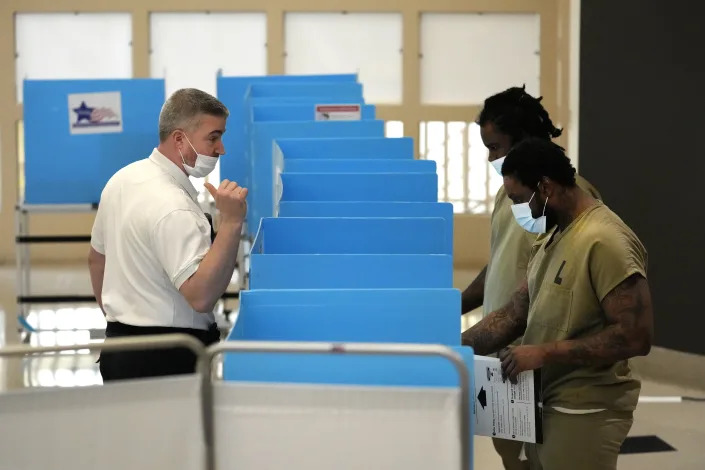
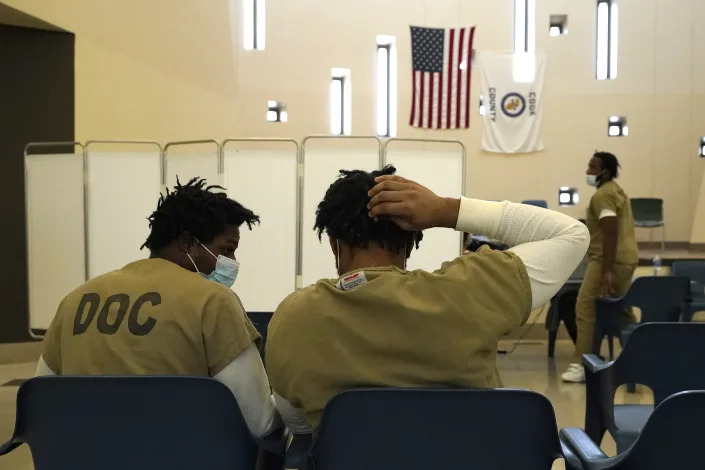
The Chicago Board of Elections brought in several voting booths this year along with a large ballot-collection machine and put them in a section of the jail called “the chapel,” which is normally used for religious services and small concerts.

With just a few guards looking on, half a dozen board of elections staff managed the jail polling stations, first helping with registration.

Among the voters was 20-year-old Tony Simmons, who marked his ballot while a dozen others sat in an adjoining room, waiting their turn. For safety reasons, just four were brought into the polling station at a time.

Simmons, who is awaiting trial on burglary, robbery and other charges in Cook County, said he had seen campaign ads on jail televisions featuring tough-on-crime messages. It didn’t bother him, he said, adding that crimes rates should come down.

Asked what kinds of candidates he voted for, he answered: “Ones who were more lenient” on issues surrounding the law and crime.

First-time voter Skillon, the one awaiting trial on a weapons charge, said he believed what many jaded voters outside the walls don't.

“Your vote matters," he said. "One vote can most definitely make a difference.”

___ Fields reported from Washington.


Tykarri Skillon, an inmate at the Cook County, Ill., jail votes in a local election at the jail's Division 11 Chapel on Saturday, Feb. 18, 2023, in Chicago. (AP Photo/Charles Rex Arbogast)

Associated Press coverage of democracy receives support from the William and Flora Hewlett Foundation. The AP is solely responsible for all content.
Ammonia Security Risks Could Harm Energy Transition Plans

Editor OilPrice.com
Sat, March 25, 2023

With the recent publication of the IPCC report warning of the devastating effects of global warming and the need for action, the push for energy transition away from hydrocarbons faces new challenges. While green hydrogen and green ammonia are being touted as viable substitutes for hydrocarbons in a low-carbon or Net-Zero future, security risks associated with their transportation and storage are being increasingly acknowledged. This poses a potential threat to Europe's green energy strategies, as NGOs and citizens may oppose these plans due to the higher risks involved.

A report by Berenschot, Arcadis, and TNO suggests that more needs to be done to set up the right policy, law, and regulations to mitigate these risks. The report also indicates that the maritime transport of green ammonia is more cost-effective, leading to an influx of this product in European ports, particularly the Port of Rotterdam. However, this also means that the overall transport volumes of ammonia will be exponentially higher, increasing the risks of a potential disaster involving ammonia.

One potential solution to mitigate these risks is the construction of a new pipeline infrastructure or ammonia-crackers, which would require significant investment and time. Until then, conventional transportation will likely remain the main source.

The current legal and policy arrangements or quotas per transportation volume are already showing major constraints, making it crucial for governments and the EU to act quickly. Failure to do so may result in insufficient transportation volumes for high-risk products, causing the expansion of green ammonia projects to hit a brick wall. Similarly, green hydrogen may also face challenges due to its inherent risk profile and higher emission risks when compared to CO2/CH4.

While the push for a green transition away from hydrocarbons is supported by green and environmental activism, this may change if more reports about security risks are published. This could result in increased societal pressure and opposition, especially considering the higher costs and environmental risks associated with green hydrogen. With the potential for increased opposition, it is unclear whether a green transition without hydrocarbons in the long term is feasible.

In summary, while the push for energy transition away from hydrocarbons to green hydrogen and green ammonia continues, the security risks associated with their transportation and storage pose significant challenges. Governments and the EU need to act swiftly to establish the right policy, law, and regulations to mitigate these risks and ensure sufficient transportation volumes for high-risk products. Otherwise, the expansion of green ammonia projects and the adoption of green hydrogen may face significant opposition and challenges.

By Cyril Widdershoven for Oilprice.com
Black holes may be swallowing invisible matter that slows the movement of stars


Robert Lea
Fri, March 24, 2023 

An illustration of a supermassive black hole ringed with a fiery orange accretion disk ending in a thick ring of black dust

For the first time, scientists may have discovered indirect evidence that large amounts of invisible dark matter surround black holes. The discovery, if confirmed, could represent a major breakthrough in dark matter research.

Dark matter makes up around 85% of all matter in the universe, but it is almost completely invisible to astronomers. This is because, unlike the matter that comprises stars, planets and everything else around us, dark matter doesn't interact with light and can't be seen.

Fortunately, dark matter does interact gravitationally, enabling researchers to infer the presence of dark matter by looking at its gravitational effects on ordinary matter "proxies." In the new research, a team of scientists from The Education University of Hong Kong (EdUHK) used stars orbiting black holes in binary systems as these proxies.

Related: What's the biggest black hole in the universe?

The team watched as the orbits of two stars decayed, or slightly slowed, by about 1 millisecond per year while moving around their companion black holes, designated A0620–00 and XTE J1118+480. The team concluded that the slow-down was the result of dark matter surrounding the black holes which generated significant friction and a drag on the stars as they whipped around their high-mass partners.

Using computer simulations of the black hole systems, the team applied a widely held model in cosmology called the dark matter dynamical friction model, which predicts a specific loss of momentum on objects interacting gravitationally with dark matter. The simulations revealed that the observed rates of orbital decay matched the predictions of the friction model. The observed rate of orbital decay is around 50 times greater than the theoretical estimation of about 0.02 milliseconds of orbital decay per year for binary systems lacking dark matter.

"This is the first-ever study to apply the 'dynamical friction model' in an effort to validate and prove the existence of dark matter surrounding black holes," Chan Man Ho, the team leader and an associate professor in the Department of Science and Environmental Studies at EdUHK, said in a statement.

The team's results, published Jan. 30 in The Astrophysical Journal Letters, help to confirm a long-held theory in cosmology that black holes can swallow dark matter that comes close enough to them. This results in the dark matter being redistributed around the black holes, creating a "density spike" in their immediate vicinity that can subtly influence the orbit of surrounding objects.

Related stories

8 ways we know that black holes really do exist

9 ideas about black holes that will blow your mind

The 10 most massive black hole findings from 2022

Chan explained that previous attempts to study dark matter around black holes have relied on the emission of high-energy light in the form of gamma rays, or ripples in space known as gravitational waves. These emissions result from the collision and resulting merger of black holes – a rare event in the universe that can leave astronomers waiting a long time for sufficient data.

This research gives scientists a new way to study dark matter distributed around black holes that may help them to be more proactive in their search. The EdUHK team intends to hunt for similar black hole binary systems to study in the future.

"The study provides an important new direction for future dark matter research," Chan said. "In the Milky Way Galaxy alone, there are at least 18 binary systems akin to our research subjects, which can provide rich information to help unravel the mystery of dark matter."
Scientists Find New Way To Make Hydrogen Directly From Seawater

Editor OilPrice.com
Sun, March 26, 2023 at 9:00 AM MDT·4 min read

RMIT University researchers have developed a cheaper and more energy-efficient way to make hydrogen directly from seawater. In a critical step towards a truly viable green hydrogen industry the new method splits the seawater directly into hydrogen and oxygen. The new process skips the need for desalination and its associated cost, energy consumption and carbon emissions.

The new method has been detailed in a lab-scale study published in the Wiley journal, Small.

Hydrogen has long been touted as a clean future fuel and a potential solution to critical energy challenges, especially for industries that are harder to decarbonise like manufacturing, aviation and shipping.

Almost all the world’s hydrogen currently comes from fossil fuels and its production is responsible for around 830 million metric tons of carbon dioxide a year*, equivalent to the annual emissions of the United Kingdom and Indonesia combined.

But emissions-free ‘green’ hydrogen, made by splitting water, is so expensive that it is largely commercially unviable and accounts for just 1% of total hydrogen production globally.

Lead researcher Dr Nasir Mahmood, a Vice-Chancellor’s Senior Research Fellow at RMIT, said green hydrogen production processes were both costly and relied on fresh or desalinated water.

Mahmood elaborated, “We know hydrogen has immense potential as a clean energy source, particularly for the many industries that can’t easily switch over to be powered by renewables. But to be truly sustainable, the hydrogen we use must be 100% carbon-free across the entire production life cycle and must not cut into the world’s precious freshwater reserves.

“Our method to produce hydrogen straight from seawater is simple, scaleable and far more cost-effective than any green hydrogen approach currently in the market. With further development, we hope this could advance the establishment of a thriving green hydrogen industry in Australia.”

Splitting the difference: a catalyst for seawater

To make green hydrogen, an electrolyser is used to send an electric current through water to split it into its component elements of hydrogen and oxygen.

These electrolysers currently use expensive catalysts and consume a lot of energy and water – it can take about nine liters to make one kilogram of hydrogen. They also have a toxic output: not carbon dioxide, but chlorine.

Mahmood continued, “The biggest hurdle with using seawater is the chlorine, which can be produced as a by-product. If we were to meet the world’s hydrogen needs without solving this issue first, we’d produce 240 million tons per year of chlorine each year – which is three to four times what the world needs in chlorine. There’s no point replacing hydrogen made by fossil fuels with hydrogen production that could be damaging our environment in a different way.”

“Our process not only omits carbon dioxide, but also has no chlorine production,” he added.

The new approach devised by a team in the multidisciplinary Materials for Clean Energy and Environment (MC2E) research group at RMIT uses a special type of catalyst developed to work specifically with seawater.

The study, with PhD candidate Suraj Loomba, focused on producing highly efficient, stable catalysts that can be manufactured cost-effectively.

“Our approach focused on changing the internal chemistry of the catalysts through a simple method, which makes them relatively easy to produce at large-scale so they can be readily synthesized at industrial scales,” noted Loomba.

Mahmood added, “These new catalysts (Nitrogen-Doped Porous Nickel Molybdenum Phosphide) take very little energy to run and could be used at room temperature. While other experimental catalysts have been developed for seawater splitting, they are complex and hard to scale.”

Mahmood explained the technology has the promise to significantly bring down the cost of electrolysers – enough to meet the Australian Government’s goal for green hydrogen production of $2 AU/kilogram, to make it competitive with fossil fuel-sourced hydrogen.

The researchers at RMIT are working with industry partners to develop aspects of this technology. The next stage in the research is the development of a prototype electrolyzer that combines a series of catalysts to produce large quantities of hydrogen.

A provisional patent application has been filed for the new method.

*Source: https://www.iea.org/fuels-and-technologies/hydrogen

***

This looks really good for areas where there is lots of sunshine or wind power with easy access to seawater. That situation just might be competitive to the fossil production sources. There would be quite an impressive investment for the power and the process system. But would it last for the decades needed to drive to good profits is a serious question.

The RMIT group’s work looks like the most successful highly innovative hydrogen production system and process we’ve seen so far. Low temp and relatively low power with seemingly no water prep involved is surely a big step forward.

It will be interesting to see how a “series of catalysts” might impact the production costs.

By Brian Westenhaus via Newenergyandfuel.com
ABOLISH THE DEATH PENALTY
Biden's Justice Dept. keeps hard line in death row cases


This photo provided by Taylor Legal Team shows Rejon Taylor. Taylor hoped the election of Joe Biden, the first U.S. president to campaign on a pledge to end the death penalty, would mean a more sympathetic look at his claims that racial bias and other trial errors landed him on federal death row in Terre Haute, Ind. But two years on, Justice Department attorneys under Biden are fighting the Black man's efforts to reverse his 2008 death sentence for killing a white restaurateur as hard as they did under Donald Trump, who oversaw 13 executions in his presidency's final months. 
(Taylor Legal Team via AP) 

MICHAEL TARM and ALANNA DURKIN RICHER
Sun, March 26, 2023 

CHICAGO (AP) — Rejon Taylor hoped the election of Joe Biden, the first U.S. president to campaign on a pledge to end the death penalty, would mean a more sympathetic look at his claims that racial bias and other trial errors landed him on federal death row in Terre Haute, Indiana.

But two years on, Justice Department attorneys under Biden are fighting the Black man's efforts to reverse his 2008 death sentence for killing a white restaurateur as hard as they did under Donald Trump, who oversaw 13 executions in his presidency's final months.

“Every legal means they have available they’re using to fight us,” said the 38-year-old's lawyer, Kelley Henry. “It’s business as usual.”

Death penalty opponents expected Biden to act within weeks of taking office to fulfill his 2020 campaign promise to end capital punishment on the federal level and to work at ending it in states that still carry out executions. Instead, Biden has taken no steps toward fulfilling that promise.

But it's not just inaction by Biden. An Associated Press review of dozens of legal filings shows Biden’s Justice Department is fighting vigorously in courts to maintain the sentences of death row inmates, even after Attorney General Merrick Garland temporarily paused executions. Lawyers for some of the over 40 death row inmates say they've seen no meaningful changes to the Justice Department's approach under Biden and Trump.

“They’re fighting back as much as they ever have,” said Ruth Friedman, head of the defender unit that oversees federal death row cases. “If you say my client has an intellectual disability, the government ... says, ‘No, he does not.’ If you say ‘I’d like (new evidence),’ they say, ‘You aren’t entitled to it.’”

Administration efforts to uphold death sentences for white supremacist Dylann Roof, who killed nine Black church-goers, and Boston Marathon bomber Dzhokhar Tsarnaev are better known. Lower-profile cases, like Taylor’s, have drawn less scrutiny.

The Justice Department confirmed that since Biden’s inauguration it hasn't agreed with a single claim of racial bias or errors that could lead to the overturning of a federal death sentence.

It's a thorny political issue. While Americans increasingly oppose capital punishment, it is deeply entrenched. And as Biden eyes a 2024 run, it's unlikely he'll make capital punishment a signature issue given his silence on it as president.

In announcing the 2021 moratorium, Garland noted concerns about how capital punishment disproportionately impacts people of color and the “arbitrariness” — or lack of consistency — in its application. He hasn’t authorized a single new death penalty case and has reversed decisions by previous administrations to seek it in 27 cases.

Garland recently decided not to pursue death for Patrick Crusius, who killed nearly two dozen people in a racist attack at a Texas Walmart. His lawyers have said he had “severe, lifelong neurological and mental disabilities.” He could still be sentenced to death under state charges.

Garland also took the death penalty off the table for a man accused in 11 killings as part of a drug trafficking ring.

Defense lawyers say that makes it all the more jarring that Garland’s department is fighting to uphold some death sentences. In one case, Norris Holder was sentenced to death for a two-man bank robbery during which a security guard died, even though prosecutors said Holder may not have fired the fatal shot.

Prosecutors decide before trial whether or not to seek the death penalty, and current death row inmates were all tried under previous administrations. Prosecutors have less leeway after a jury's verdict than before trial.

Court challenges after trials are also often not about whether it was appropriate to pursue the death penalty, but whether there were legal or procedural problems at trial that make the sentence invalid.

“It’s a very different analysis when a conviction has been entered, a jury has spoken," said Nathan Williams, a former Justice Department lawyer who prosecuted Roof. "There has to be a respect for the appellate process and the legal approaches that can be taken."

A Justice Department spokesman said prosecutors “have an obligation to enforce the law, including by defending lawfully obtained jury verdicts on appeal.” The department is working to ensure “fair and even-handed administration of the law in capital-eligible cases," he said.

Inmate lawyers dispute that prosecutors have no choice but to dig in their heels, saying multiple mechanisms have always existed for them to fix past errors.

Justice officials announced this month that they wouldn't pursue death in the resentencing of Alfonso Rodriguez Jr., convicted of killing North Dakota student Dru Sjodin. But that only happened after a judge vacated the original death sentence.

Notably in 2021, the department agreed with lawyers for Wesley Coonce, sentenced to death for killing a fellow inmate in a mental health unit, that lower courts should look again at intellectual disability questions in his case. But the Supreme Court disagreed, declining to hear his case or remand it to lower courts.


Seven federal defendants are still facing possible death sentences.


The first federal death penalty case tried under Biden ended this month. The jury was divided, meaning the life of Sayfullo Saipov, who killed eight people in a terrorist attack on a New York bike path, will be spared. Trump made the decision to seek death and Garland allowed the case to move forward.

Garland's criteria for letting some capital cases proceed isn't clear, though the department often consults victims' families. Some feel strongly that suspected or convicted killers should face death.

Inmate attorneys have asked for all capital cases to get a fresh look. Garland has appeared to take one step in that direction.

The department this year restored written guidance emphasizing that staff can be proactive in fixing egregious errors in capital cases, though none has invoked that option. Garland also re-set processes in which capital defendants can, in certain circumstances, ask the department to consent to their bids for relief.

Taylor was charged with killing restaurant owner Guy Luck in 2003. His lawyers say the 18 year old “discharged his gun in a panic” as Luck tried to grab a gun inside a van in Tennessee.

The prosecution described Taylor to his almost entirely white jury as a “wolf” whom they had an “obligation” to kill. An alternate later said some jurors were determined to get Taylor, recalling: “It was like, here’s this little Black boy. Let’s send him to the chair.”

An appeals court rejected Taylor’s bias claims in 2016, though a dissenting judge said courts must be especially diligent to guard against bias when a defendant is Black and the victim white. She also said Taylor didn't seem to be among the worst of the worst, for whom death sentences are reserved.

Taylor revived the bias claims, though the department hasn't directly addressed them. It has rejected many of his separate claims.

As the 2024 election looms — and with the chance of someone even less sympathetic to their claims entering the Oval Office — death row inmates know the clock is ticking.

“Trump ran out of time during his killing spree,” Taylor told the AP via a prison email system. If elected again, “I don’t think he’d waste any time in continuing where he’d left off.”

___

Richer reported from Boston. Associated Press reporter Colleen Long in Washington contributed.

How Black communities cope with trauma triggered by police brutality

Deion Scott Hawkins, Assistant Professor of Argumentation & Advocacy, Emerson College
Sun, March 26, 2023 

A portrait of Tyre Nichols at the entrance of the church where his funeral was held in Memphis, Tenn., on Feb. 1, 2023. Lucy Garrett/Getty Images

The release of footage showing the brutal beating of Tyre Nichols by Memphis police and protests in Atlanta have renewed public debate on the issues of police brutality and police reform.

For some people, seeing is believing, and the circulation of videos documenting police violence is valued as a tool of accountability.

But for many in the Black community, which studies show is disproportionately affected by police brutality, viewing videos of and having conversations about police violence can have several adverse effects, including psychological distress and trauma.
What is trauma?

The American Psychological Association defines trauma as “any disturbing experience that results in significant fear, helplessness, dissociation, confusion, or other disruptive feelings intense enough to have a long-lasting negative effect on a person’s attitudes, behavior, and other aspects of functioning.”

In her seminal book “Trauma and Recovery: The Aftermath of Violence – From Domestic Abuse to Political Terror,” published in 1992, Dr. Judith Lewis Herman notes that encountering a traumatic event permanently alters one’s perceptions of safety.

To prepare for a threat, these individuals develop intense feelings of fear and anger. These changes in emotional state are usually biological, as shifts in attention, perception and emotion are normal physiological reactions to a perceived threat.

This is known as our “fight or flight response.”

Trauma can manifest itself in various ways. For example, on some occasions, traumatic events are known to lead to feelings of depression and intense sadness and episodes of helplessness.

Additionally, trauma is known to increase one’s state of hypervigilance, or the elevated state of constantly assessing potential threats in the area. This state of elevated alertness often creates anxiety around dying and can have physiological impacts on the body, such as sweating and elevated heart rate.
Police brutality and Black trauma

As a critical scholar and researcher, I use trauma-informed interview techniques to better understand the intersections of police brutality and mental health in the Black community. My research focuses on those most affected, and that research highlights the human experience.

There is always a face behind the statistic.

Thus, my work typically uses critical race theory, as it focuses on the perspectives of marginalized people. For example, my study published in the Journal of Health Communication explored how stories of police brutality are circulated within the Black community and how these stories affect mental health.

Through dozens of interviews, I discovered three key ways in which trauma is triggered by incidents of police brutality that often appear in Black communities.


Valerie Castile stands by a portrait of her son, Philando Castile, on July 6, 2020. Stephen Maturen/Getty Images


Intense sadness, hypervigilance and sense of helplessness


The excerpts below are direct quotations from members of the Black community whom I interviewed as part of a larger research project. This study was conducted in Washington, D.C., in 2018, but its findings are still relevant, as it reveals how police brutality directly fuels trauma in the Black community.

Because of research protections and protocol, pseudonyms are used, and no other identifying information can be published.

1. Intense sadness

When asked about feelings after viewing videos or images of brutality, every interviewee indicated intense sadness as the primary emotion. This sadness often affected how individuals went about their day, especially work-related activities.
Darius

I remember I walked into work, face cut up and people were like, “What’s wrong? What happened?” I told them I had been in a fight. But really, I had been beat up by a police officer who assumed I was someone else. I appreciated them asking me if I was OK, but I wasn’t really comfortable telling them, you know? We had previous conversations that let me know they didn’t really think Black lives mattered. After Philando, I had to take a sick day to recover. That’s how sad I was, man.
Chanelle

Philando Castile. I was rrreealllly sad. Philando was the boiling point. I cracked. I literally had to leave my desk at work and take a break. When I came back, my white co-workers told me I was overreacting because I didn’t know him, which pissed me off. What they don’t get is that Philando could be anyone in my family. It’s not just Philando, it’s that I fear my brothers could be shot in cold blood at any moment. That’s why I was so damn sad.

2. Hypervigilance


Interviewees also discussed their chronic fear of dying at the hands of law enforcement. In turn, this fear prompts a permanent state of hypervigilance or hyperalertness; many members of the Black community constantly feel they are going to die if they encounter a police officer.
Mary

Whenever I see cops, I tense up. One time, cops pulled up to me when I was in a car and my friend looked at me with the straightest face and said, “One of us is about to die.” I was so shocked, and I said, “That’s not funny.” But he was serious. He really thought one of us was going to die.


Each headstone in Minneapolis’ ‘Say Their Names’ cemetery represents a Black American killed by police – deaths that create a ripple effect of pain felt in Black communities nationwide. Jason Armond/Los Angeles Times via Getty Images

Luke

There is not a single time where I can sit in a car and hear a siren or see a cop light flash, that I’m not fearful. I imagine it’s like what soldiers feel when they hear anything that sounds like a bomb. When I hear sirens, I start to look around and hope that someone else is around. Because, if I were to get shot, I would want someone to be able to tell the truth. People are straight up dropping at the hands of police. I never want to be in that situation.

Corey

I’m always scared and alert, honestly. I walk around on campus, and I use my iPad to listen to music. I always have my iPad with me. I’m afraid the police are going to see me holding my iPad and assume it’s something else, and before I have time to explain what it is, I’m afraid I would be shot. I always have my headphones in, too. I replay this terrible scenario in my head over and over again. A cop is yelling at me to stop, but since my headphones are in, I can’t hear him and keep walking. He thinks I am running away and shoots me in my back.

3. Sense of helplessness


Adding to sadness and hyperalertness, many Black Americans also feel they have little control over interactions with police and cannot change the outcome. This is true regardless of their tone, behavior or actions. This is known as helplessness, a known symptom of trauma.

Lena

It’s a sad reality to accept that no matter how you dress, how you talk, a police officer will always judge you and think you’re a threat. I don’t think we have control over if we are going to get beat or not. Black folks could literally read a how-to-survive book and do every step, but cops would still find some reason to make the situation worse. We are always in a Catch-22. If we talk too much, we are talking back. If we talk too little, we are suspicious. I do everything in my power to avoid cops. Listen, someone broke in my house and I refused to call the police. I be damned. Because I think they would have assumed I was the robber and shot me.

Virginia

Every time I see a video, I feel an intense sadness. It feels like you are in the world’s worst … cycle I guess; some kind of sick joke. It’s like, damn, it happened again. Like nothing is ever going to change. Things may look like they are getting better, but then even when they are arrested, the sadness continues.

This article is republished from The Conversation, a nonprofit news site dedicated to sharing ideas from academic experts. 

It was written by: Deion Scott Hawkins, Emerson College.


Read more:

Tyre Nichols’ death underscores the troubled history of specialized police units

Tyre Nichols: U.S. police violence stems from a long history of fighting ‘internal enemies’

Black police officers aren’t colorblind – they’re infected by the same anti-Black bias as American society and police in general

What is mRNA? The messenger molecule that's been in every living cell for billions of years is the key ingredient in some COVID-19 vaccines

Penny Riggs,
 Associate Professor of Functional Genomics and Associate Vice President for Research, Texas A&M University
Sat, March 25, 2023 

MRNA is an important messenger, carrying the instructions for life from DNA to the rest of the cell.
ktsimage/iStock via Getty Images Plus

One surprising star of the coronavirus pandemic response has been the molecule called mRNA. It’s the key ingredient in the Pfizer and Moderna COVID-19 vaccines. But mRNA itself is not a new invention from the lab. It evolved billions of years ago and is naturally found in every cell in your body. Scientists think RNA originated in the earliest life forms, even before DNA existed.

Here’s a crash course in just what mRNA is and the important job it does.
Meet the genetic middleman

You probably know about DNA. It’s the molecule that contains all of your genes spelled out in a four-letter code – A, C, G and T.


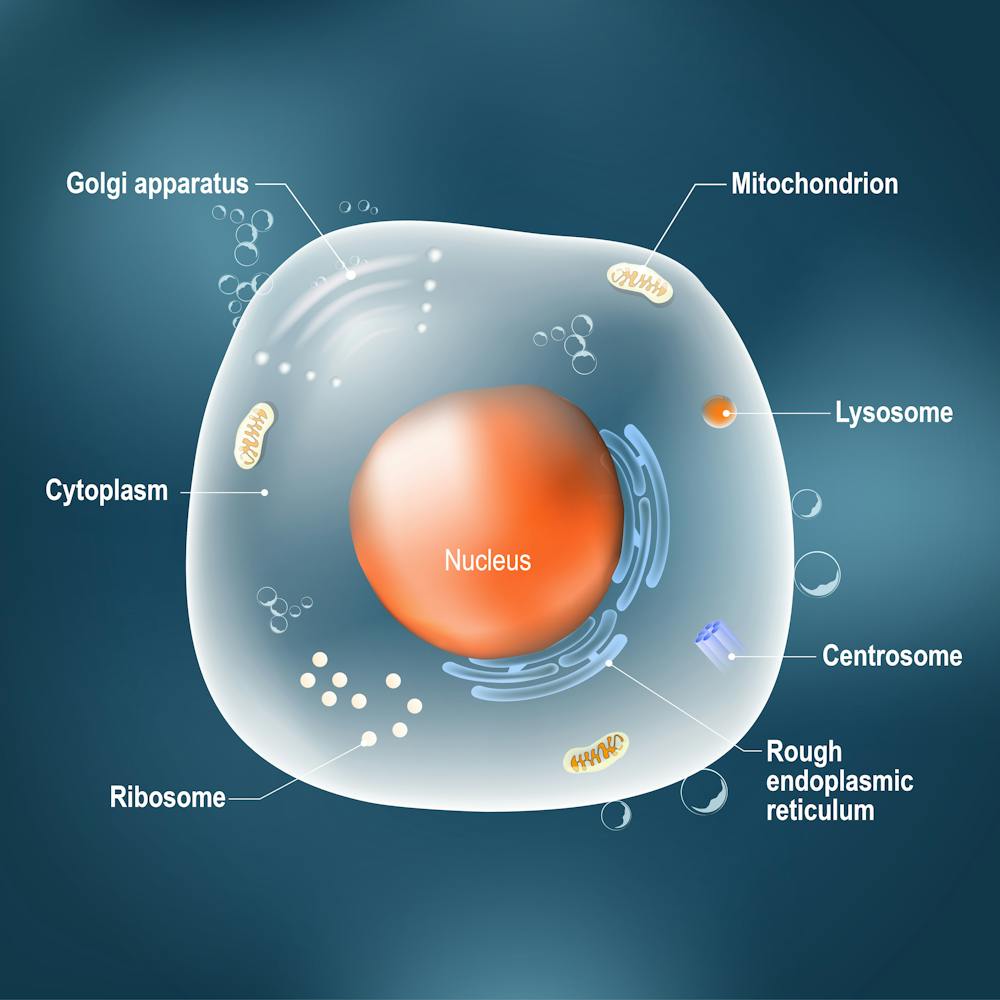
DNA is found inside the cells of every living thing. It’s protected in a part of the cell called the nucleus. The genes are the details in the DNA blueprint for all the physical characteristics that make you uniquely you.


But the information from your genes has to get from the DNA in the nucleus out to the main part of the cell – the cytoplasm – where proteins are assembled. Cells rely on proteins to carry out the many processes necessary for the body to function. That’s where messenger RNA, or mRNA for short, comes in.

Sections of the DNA code are transcribed into shortened messages that are instructions for making proteins. These messages – the mRNA – are transported out to the main part of the cell. Once the mRNA arrives, the cell can produce particular proteins from these instructions.

The double-stranded DNA sequence is transcribed into an mRNA code so the instructions can be translated into proteins. Alkov/iStock via Getty Images Plus

The structure of RNA is similar to DNA but has some important differences. RNA is a single strand of code letters (nucleotides), while DNA is double-stranded. The RNA code contains a U instead of a T – uracil instead of thymine. Both RNA and DNA structures have a backbone made of sugar and phosphate molecules, but RNA’s sugar is ribose and DNA’s is deoxyribose. DNA’s sugar contains one less oxygen atom and this difference is reflected in their names: DNA is the nickname for deoxyribonucleic acid, RNA is ribonucleic acid.

Identical copies of DNA reside in every single cell of an organism, from a lung cell to a muscle cell to a neuron. RNA is produced as needed in response to the dynamic cellular environment and the immediate needs of the body. It’s mRNA’s job to help fire up the cellular machinery to build the proteins, as encoded by the DNA, that are appropriate for that time and place.

The process that converts DNA to mRNA to protein is the foundation for how the cell functions.

[Research into coronavirus and other news from science Subscribe to The Conversation’s science newsletter.]
Programmed to self-destruct

As the intermediary messenger, mRNA is an important safety mechanism in the cell. It prevents invaders from hijacking the cellular machinery to produce foreign proteins because any RNA outside of the cell is instantaneously targeted for destruction by enzymes called RNases. When these enzymes recognize the structure and the U in the RNA code, they erase the message, protecting the cell from false instructions.

The mRNA also gives the cell a way to control the rate of protein production – turning the blueprints “on” or “off” as needed. No cell wants to produce every protein described in your whole genome all at once.

Messenger RNA instructions are timed to self-destruct, like a disappearing text or snapchat message. Structural features of the mRNA – the U in the code, its single-stranded shape, ribose sugar and its specific sequence – ensure that the mRNA has a short half-life. These features combine to enable the message to be “read,” translated into proteins, and then quickly destroyed – within minutes for certain proteins that need to be tightly controlled, or up to a few hours for others.

Once the instructions vanish, protein production stops until the protein factories receive a new message.
Harnessing mRNA for vaccination

All of mRNA’s characteristics made it of great interest to vaccine developers. The goal of a vaccine is to get your immune system to react to a harmless version or part of a germ so when you encounter the real thing you’re ready to fight it off. Researchers found a way to introduce and protect an mRNA message with the code for a portion of the spike protein on the SARS-CoV-2 virus’s surface.

Messenger RNA vaccines get the recipient’s body to produce a viral protein that then stimulates the desired immune response. Trinset/iStock via Getty Images Plus

The vaccine provides just enough mRNA to make just enough of the spike protein for a person’s immune system to generate antibodies that protect them if they are later exposed to the virus. The mRNA in the vaccine is soon destroyed by the cell – just as any other mRNA would be. The mRNA cannot get into the cell nucleus and it cannot affect a person’s DNA.

Although these are new vaccines, the underlying technology was initially developed many years ago and improved incrementally over time. As a result, the vaccines have been well tested for safety. The success of these mRNA vaccines against COVID-19, in terms of safety and efficacy, predicts a bright future for new vaccine therapies that can be quickly tailored to new, emerging threats. Early-stage clinical trials using mRNA vaccines have already been conducted for influenza, Zika, rabies, and cytomegalovirus. Certainly, creative scientists are already considering and developing therapies for other diseases or disorders that might benefit from an approach similar to that used for the vaccines against COVID-19.

This article is republished from The Conversation, a nonprofit news site dedicated to sharing ideas from academic experts. Like this article? 

It was written by: Penny Riggs, Texas A&M University.


Read more:


Coronavirus: A new type of vaccine using RNA could help defeat COVID-19


COVID-19 vaccines were developed in record time – but are these game-changers safe?


Designer proteins that package genetic material could help deliver gene therapy

Penny Riggs has received funding from the United States Department of Agriculture National Institute for Food and Agriculture and the National Science Foundation.