Thursday, January 30, 2025


Statements: On the tenth anniversary of the liberation of Kobani
Published 

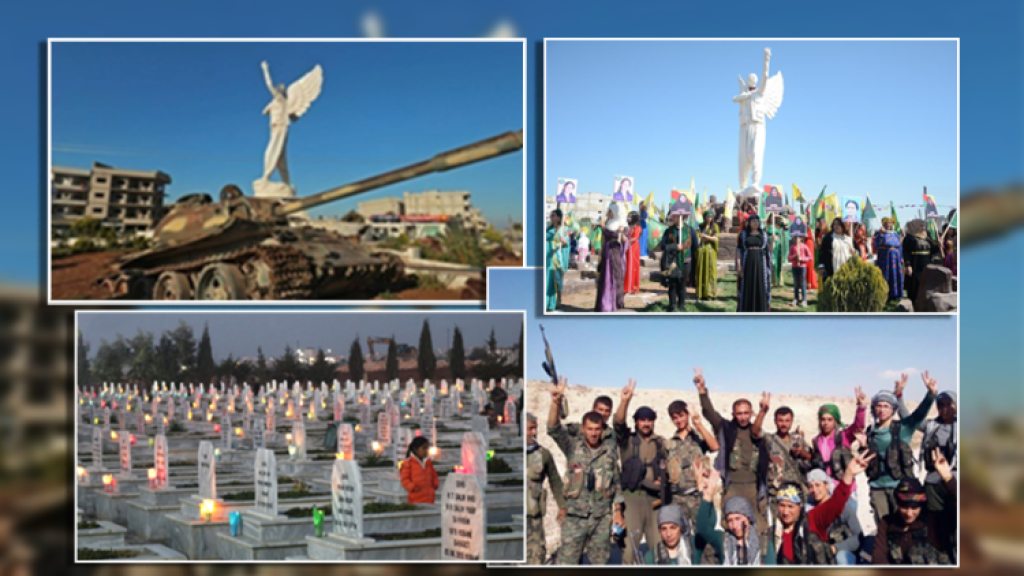
Kobani 10 year anniversary

Below LINKS International Journal of Socialist Renewal is republishing statements by the Syrian Democratic Forces, Autonomous Administration of North and East Syria and People's Defense Units marking the ten year anniversary of the liberation of Kobani


SDF: We will defend Kobani and all our regions in the spirit of the resistance’s victory in 2015

Syrian Democratic Forces (SDF) General Command, January 26

Today, January 26th, marks the tenth anniversary of the victory of the Kobani resistance against the terrorist organization ISIS. On this occasion, we commemorate all our martyrs from the People’s Protection Units (YPG) and the Women’s Protection Units (YPJ), as well as all volunteers from across Kurdistan regions and the globe who joined Kobani the Citadel of Resistance. They displayed extraordinary heroism and self-sacrifice in their struggle against the terrorist organization ISIS.

No doubt that the resistance in Kobani exemplified the unwavering free will and determination to achieve victory against the world’s most powerful terrorist power. Despite facing a brutal siege by this terrorist organization, and despite the immense challenges and resource limitations, the people of Kobani emerged victorious. This victory reaffirmed the profound truth that unwavering determination is the most potent weapon in the face of any obstacle. It demonstrated to the world that the will to resist is the cornerstone of victory, and through this unwavering will, the people of Kobani achieved their historic victory.

The victory in Kobani marked a crucial turning point in the defeat of the terrorist organization ISIS. It signified the beginning of the end of ISIS’s territorial expansion, culminating in their eventual defeat across the entirety of Syrian geography. Had the resistance in Kobani not succeeded, ISIS would have continued to pose a grave and imminent threat to the entire world. It is undeniable that the victory in Kobani was not merely a local triumph but a global victory, as it paved the way for the world to eradicate one of the most dangerous terrorist organizations in human history.

The unwavering will and resolute resistance of the YPG and YPJ fighters in Kobani served as an inspiration for our forces, instilling in them the determination and resolve to liberate the remainder of Syria from ISIS terrorism. Their valiant resistance and ultimate victory formed the bedrock upon which our forces launched successive campaigns to liberate Syrian territories under ISIS control, including their so-called capital, Raqqa, ultimately leading to their final defeat in Al-Baghouz.

The resistance of Kobani and its resounding victory ten years ago paved the way for the establishment of the Syrian Democratic Forces (SDF) and served as a strategic turning point in forging alliances with numerous regional and international forces and entities, most notably the international coalition forces. These forces played a crucial role alongside our own in defeating the terrorist organization, particularly in securing the victory in Kobani, and this effort is highly respected and appreciated by us and by all our people.

Today, on the tenth anniversary of this momentous victory, as we commemorate this cherished triumph alongside the free world, Kobani the Citadel of Resistance faces relentless and brutal attacks by the Turkish occupation and its mercenaries. These attacks are repeated copy of those perpetrated by the terrorist organization ISIS, differing only in name, but the ultimate objective remains the same: to extinguish the flame of freedom in Kobani and silence the voice of its resistance, which once fascinated the world.

On this occasion, we urge all free peoples, states, and human rights and humanitarian organizations to deter the Turkish occupation and its mercenaries and to actively prevent any further aggression against the city of Kobani, which valiantly defeated the terrorist organization ISIS.

Should the Turkish occupation launch any aggression against Kobani, we unequivocally declare that we will engage in a more resolute and determined resistance than that demonstrated against the terrorist organization ISIS in 2014 and 2015. The Syrian Democratic Forces are unwavering in their commitment to protecting Kobani and its people from all forms of attack, regardless of the source. We are prepared to make significant sacrifices to safeguard this vital city.

We extend our heartfelt congratulations to our fighters and our people on this momentous anniversary. Today, we stand more resolute than ever in our determination to protect and defend our territories. We will not hesitate to escalate our resistance against all forms of aggression, regardless of the cost.


AANES: Free will is what creates victory

Democratic Autonomous Administration of North and East Syria, January 26

Today marks ten years since the victory of the Kobani resistance, which led to the end of the most extremist projects in Syria, the region, and even the world. The resistance that emerged as a result of the cohesion of the components of our people demonstrated the truth of the popular will and its strength in combating projects of genocide and liquidation, as the victory in Kobani was a victory for humanity and Syria and the whole world were secured from danger and consequences of extremism.

The resistance of our people in Kobani, as well as the engagement with this resistance by all Kurdistanis and internationalists, has become and proven that free will is what creates victory. We remember this resistance and its martyred heroes, as well as the wounded, and we affirm that the legacy of this resistance is what is victorious today in combating all types of war waged by Turkey, its mercenaries and all those who want to undermine the will of this people.

While we, in the Democratic Autonomous Administration of North and East Syria, stress the necessity of preserving the gains achieved after the Kobani resistance until now, we call for the need to show responsibility by all Syrian national forces and the international community regarding the direct threat to these gains today. In NE Syria in general and at the Tishreen Dam in particular, the continuation of attacks brings with it a real “disaster” in terms of the return of ISIS, as well as its repercussions on the humanitarian aspects and other risks of creating chaos and war without an end.

On this occasion, we assure our free people and public opinion that the Kobani resistance will remain a solid foundation for consolidating and developing the resistance at all levels, as the spirit of this resistance is what grows and continues and achieves victories in the Tishreen Dam, and we will move with this spirit towards achieving the aspirations of our people for democracy and peace, and we will liberate our occupied territories and will expel the occupation, and we will thwart all hegemonic projects, also we will proceed with our patriotic Syrian brothers in building one strong unified Syria, a democratic Syria.


YPG: Kobani demonstrated collective struggle can defeat even the most brutal enemy

People's Defense Units (YPG) General Command, January 26

Today, we solemnly commemorate the 10th anniversary of the liberation of Kobani, a defining moment in the global fight against ISIS. In 2015, after enduring months of relentless and heroic resistance, the forces of the YPG and YPJ, together with our allies and the people of Rojava, achieved a historic victory by expelling ISIS from Kobani. At a time when ISIS cast a dark shadow over the region and the world, spreading terror and launching attacks on multiple countries, the victory in Kobani marked a turning point. It was a defense not only of Rojava but also of Kurdistan, the Middle East, and the world against one of the greatest threats of our time.

Kobani’s liberation was more than a military triumph; it became a profound symbol of resistance, unity, and the enduring spirit of the Kurdish people and the diverse communities of Northeast Syria. The city stood as a front line in the battle between humanity’s aspirations for freedom and dignity and the forces of tyranny and terror. During the siege, ISIS exploited the Turkish border to smuggle fighters and arms, with evidence pointing to Turkey’s complicity in enabling their aggression. Despite these challenges, Kobani became the graveyard of ISIS’s invincibility, demonstrating that solidarity, determination, and the collective struggle of our people could defeat even the most brutal of enemies.

As we celebrate this historic day, we cannot ignore the ongoing threats that echo the challenges of the Kobani siege. The Turkish state’s current attacks on Tishreen and Qaraqozakh continue to destabilize our region, creating conditions that enable the resurgence of ISIS. By targeting civilian areas, infrastructure, and the security of our communities, these aggressions aim to undo the hard-fought gains achieved through the sacrifices of tens of thousands of martyrs. Such actions not only undermine regional stability but also threaten the very principles of justice and humanity that the resistance of Kobani represents. We call upon the international community, all organizations, and nations who once stood with us against ISIS to take a clear and resolute stance against these provocations.

On this anniversary, we honor and remember the martyrs of Kobani, whose sacrifices illuminated the path to victory and inspired a broader struggle for freedom and justice. Their legacy compels us to continue this journey with unwavering resolve, protecting the ideals for which they gave their lives.


Syria: A new model for women or misogynistic regimes?


Published 

Halide Türkoğlu cover pic

Since the fall of the Assad regime in Syria, the future of women in the new Syria remains uncertain. Under Assad’s rule, women were denied rights, imprisoned, and impoverished. Since 2011, they have also become targets of violence by groups opposing the regime.

The potential for an end to chaos and conflict in the new Syria is inherently tied to the form of governance that emerges. Will Hay’at Tahrir al-Sham’s (HTS) interim government evolve into a regime that perpetuates insecurity, discrimination, denial, and genocide? Or will the people of Syria, including women, play an active role in building a new Syria, transforming it into a nation of peace where democratic coexistence ends conflict and violence in the Middle East?

The world is closely monitoring HTS’s policies, but some entrenched patterns remain unchanged from women’s perspectives. The HTS Minister for Women has promised women nothing more than Sharia law. This prospect, far removed from a perspective of women’s liberation, raises concerns about a system that restricts women’s rights, leading to fears that Syria could follow the trajectory of Afghanistan. Women’s organisations fighting for equality and freedom are aware of this risk and are in solidarity with Syrian women, amplifying their voices and struggles.

Women’s active and significant participation in the new Syria is crucial. Women have borne the greatest cost of conflict and war, living through the chaos that has taken lives and disrupted livelihoods. They are best positioned to understand the importance of peace and to construct the means for equal and free coexistence in their country. Policies of male-dominated systems have shown how governance can become a threat to women and broader communities. A constitution written by women would undoubtedly secure peace and democracy in this region.

Since 2011, women in Syria have experienced a feminist and egalitarian system through the women’s revolution in Rojava. Recognising the status of the Autonomous Administration of North and East Syria (AANES) would also mean acknowledging the gains made by women in Syria. This status is a victory for women globally, as the model not only ensures women’s equality and freedom through a social contract but also establishes gender parity and co-leadership models across politics, the economy, social life, healthcare, and security. This has served as an antidote to the violence and discrimination stemming from male dominance and gender inequality in the Middle East.

Beyond their global recognition as women who fought ISIS, the women of Rojava have also built a new life in the Middle East. This life is a democratic model challenging the mindset that institutionalises sexism, nationalism, sectarianism, war, and genocide. Their work in education, social programmes, economic initiatives, self-defence, and women’s organisations — grounded in equality and freedom — has drawn from the historical experiences of women’s movements. Their model of communal life, guided by democratic, socialist, and ecological principles, represents the power of women’s autonomous will and voice. Those who see this model as a threat fear not only women’s gains but also the hope and reality of peaceful coexistence among peoples.

In particular, Turkey’s fear of Kurdish gains in Syria stems from its inability to resolve the Kurdish issue within its borders. This fear drives its search for alternatives to Kurdish governance in Syria, underpinning its entire foreign policy in the region. Civilian deaths have resulted from Turkey’s support of Syrian National Army (SNA) attacks and drone strikes. Women’s rights activists, such as members of the Zenobia Women’s Community, and journalists have been directly targeted and killed. Massacres like those seen during the resistance at the Tishreen Dam reflect similar methods.

The AKP-MHP government in Turkey, which persistently attacks Kurdish achievements in its domestic and foreign policies, continues to commit crimes against humanity through militias and drones against the joint living model of the peoples and women of AANES. Just as it once supported ISIS, it now backs radical Islamist groups in an attempt to destroy the Rojava women’s revolution.

However, recognising the AANES is essential to building a democratic Syria. This requires defending and legally securing equality for women, communities, beliefs, and identities in the governance and construction of Syria. As women fighting for freedom and equality against the AKP government in Turkey, we stand in solidarity with Arab, Alawite, Kurdish, Turkmen, Druze, Circassian, Armenian, and Assyrian women in Syria in their fight for a democratic Syria.

The possibility of ending war in the Middle East, achieving an honourable peace, and enabling equal, free, and communal living is achievable. The Rojava women’s revolution has already built this vision and taught us all. It is now time for nation-states to reconcile with their people, acknowledge this model where women are equal and free, and embrace it as a reference rather than denying it.

*Halide Türkoğlu is a member of parliament for Amed (Diyarbakır). She is currently the spokesperson for the Women’s Assembly of the DEM Party.


New ‘Matchless’ grass variety yields high seed count without need for field burning


Washington State University
Matchless in field 

image: 

WSU turfgrass scientists look over a plot of Matchless Kentucky bluegrass growing at a WSU research farm.

view more 

Credit: Photo courtesy Michael Neff/Washington State University


PULLMAN, Wash. — A new variety of Kentucky bluegrass has been commercially released by researchers at Washington State University.

“Matchless,” developed from another bluegrass variety called “Kenblue,” offers seed growers higher yields without the harmful impacts of burning. It also provides consumers with the option of a more environmentally friendly grass.

For several decades in the 1900s, Kentucky bluegrass growers burned fields to remove stubble after harvest, reduce thatch buildup, prevent disease, and for a number of other benefits. In 1998, Washington state banned the practice due to air quality and safety concerns. Washington produces around 80% of the world’s Kentucky bluegrass seed.

“The ban had a huge impact on an important crop,” said Michael Neff, WSU professor and director of WSU’s turfgrass research program. “The ban didn’t kill the dryland bluegrass seed production industry, but it limited the varieties that could be grown and increased costs for those that could. Matchless adds yield and profit for growers.”

Burning was once widespread in the Pacific Northwest, but now is banned in Washington and Oregon and heavily regulated in Idaho, allowed only under very specific circumstances. Eliminating the practice has environmental benefits that can be marketed to end-users as well.

“Many people care a lot about the environmental impact of the products they use,” said Neff, a professor in WSU's Department of Crop and Soil Sciences. “Matchless can be marketed as a ‘cleaner’ variety. It’s also cheaper than burning.”

Matchless was bred by Neff’s predecessor, former WSU Professor Bill Johnston. Johnston named the variety as a double play on words: No matches are needed to start fires and there’s no match for the yield.

Neff and his lab took the selection Johnston spent years producing and did the required additional years of work to get the plant protected as a new variety. Producing new varieties of Kentucky bluegrass isn’t as simple as traditional plant breeding, where people take pollen from one plant, apply it to the flowers of another, and look at the varying results in future generations.

Due to bluegrass reproduction complications, only a few plants in a large sample of offspring may be different; most are clones. Spotting the differences takes skill and patience.

“As a plant breeder, it’s nice to have a clone of the mom for production because it makes the variety very uniform,” said Jonathan Schnore, a PhD student in Neff’s lab. “But when developing new material, you want genetic recombination, so the offspring have different traits. As a breeder, you’re looking at a field of clones for that one plant that looks different: a needle in a haystack of clones.”

Neff said the challenge is worth the effort. Kentucky bluegrass is very popular for sports fields, golf courses, home lawns, and a variety of other uses.

“It provides a gorgeous, uniform color and feels really great to walk or lie down on,” Neff said. “And it’s very resilient to damage, repairing itself quickly.”

Consumers won’t notice Matchless when buying seed or sod because it looks and performs like other Kentucky bluegrass varieties. Varieties and species are often blended in seed bags purchased at home improvement stores, so consumers mostly don’t see the individual grasses in the bags.

Matchless is owned by WSU and protected in the United States with a Plant Variety Protection Certificate, issued by the USDA. Currently, two companies, Fusion Seed Company and Clearwater Seed Inc., are working to increase their production of Matchless seeds. The goal is to include the variety in future seed mixes.


Japan’s “soft” but not ineffective approach to public health during the COVID-19 pandemic


Researchers from Osaka University found that risk perception and infection prevention behaviors rose during Japan’s COVID-19 state of emergency. After it was lifted, hygienic behaviors persisted, but dread risk perception declined


Osaka University

Fig. 

image: 

Trends in Hygiene Practices and Risk Perceptions by Region During the State of Emergency Period

view more 

Credit: Mei Yamagata, Michio Murakami, and Asako Miura: Effects of political treatments during the COVID-19 pandemic on infection-prevention behavior and risk perception: a panel data analysis of Japan, International Journal of Disaster Risk Reduction, 2025, 105201, doi: https://doi.org/10.1016/j.ijdrr.2025.105201


Osaka, Japan – In contrast to the lockdowns imposed in many countries around the world during the COVID-19 pandemic, the Japanese authorities issued health advisories and counted on citizens to follow them voluntarily. Now, researchers from Japan have investigated how this approach affected public psychology and health-related behaviors during and after the pandemic.

In a study published this month in the International Journal of Disaster Risk Reduction, researchers from Osaka University have revealed the findings of a panel survey conducted in 30 waves between January 2020 and March 2024 examining the impact of Japan’s state of emergency declarations on public behaviors and perceptions.

The Japanese government declared a “state of emergency” during the pandemic. However, the health advisories and restrictions varied regionally, based on the severity of infection levels. “We discovered that despite regional variations in restrictive policies from April 2020, there were no clear regional differences in changes to hygiene behaviors, social activities, or risk perceptions,” notes lead author of the study Mei Yamagata. “This suggests that there were significant spillover effects between the areas targeted for a state of emergency and elsewhere, whether through shared social and informational networks or simply through the media.”

The researchers examined panel data on about 1,200 Japanese citizens throughout the country who were surveyed repeatedly over the course of slightly more than 4 years, starting from the outbreak of the pandemic.

“People’s awareness of the risks associated with COVID increased after a state of emergency was declared in certain regions,” says Michio Murakami, author. “We also saw a significant increase in hygienic behaviors such as mask-wearing and hand-disinfection. Even after the state of emergency was lifted in late May 2020, people tended to continue to follow these hygienic practices for some time.”

In May 2023, the Japanese government officially downgraded the legal status of COVID to the same level as seasonal flu. The study also investigated how this policy change impacted citizens’ attitudes and behaviors.

“We found that the relaxation policy had several noteworthy effects,” comments Asako Miura, senior author. “After it, people became less fearful of catching COVID and were less likely to engage in hygienic behaviors such as mask-wearing. Interestingly, we found that by this stage, people over 42 were less likely than younger people to wear a mask – a phenomenon that may be explained by optimism bias on the part of older people regarding their chances in the event of infection.”

Unfortunately, it seems unlikely that the COVID-19 pandemic is the last global public health emergency we will face, so there would seem to be much to be said for learning from the Japanese experience of managing the pandemic by obtaining the public’s cooperation.

###

The article, “Effects of political treatments during the COVID-19 pandemic on infection-prevention behavior and risk perception: a panel data analysis of Japan,” was published in the International Journal of Disaster Risk Reduction at DOI: https://doi.org/10.1016/j.ijdrr.2025.105201

About Osaka University
Osaka University was founded in 1931 as one of the seven imperial universities of Japan and is now one of Japan’s leading comprehensive universities with a broad disciplinary spectrum. This strength is coupled with a singular drive for innovation that extends throughout the scientific process, from fundamental research to the creation of applied technology with positive economic impacts. Its commitment to innovation has been recognized in Japan and around the world. Now, Osaka University is leveraging its role as a Designated National University Corporation selected by the Ministry of Education, Culture, Sports, Science and Technology to contribute to innovation for human welfare, sustainable development of society, and social transformation.
Website: https://resou.osaka-u.ac.jp/en


New nondestructive method for identifying original batteries using magnetic sensors


University of Tsukuba


Tsukuba, Japan—Lithium-ion batteries (LIBs) are widely used in smartphones, PCs, and electric vehicles, making them indispensable in our daily lives. However, recently, fires and other accidents have occurred in relation to the use of so-called compatible batteries as an alternative to original equipment manufacturer (OEM) batteries. With the widespread use of LIBs, their shapes have become standardized; therefore, distinguishing OEM batteries from the non-original ones based on their appearance has become challenging. Although marks, certification displays, QR codes, IC chips, etc., are used to identify OEM products, they can be copied. Hence, developing identification methods based on electrical characteristics and internal structures is essential.

Researchers at University of Tsukuba previously developed a method for detecting fuel cell failuress using magnetic sensors. In this study, they applied this method and developed a system for identifying LIBs based on the differences in the current path caused by the internal structure of these batteries. This method involves attaching a magnetic sensor to the exterior of an LIB and measuring the magnetic field generated by the current during charging and discharging. This simple method can identify single cells and multiple batteries connected in series.

The researchers will attempt to establish a system for identifying the battery within an actual battery module. Furthermore, they will also seek to develop a system that can identify batteries even in cases of deterioration and identical structures.


Original Paper

Title of original paper:
Evaluation of lithium-ion batteries with different structures using magnetic field measurement for onboard battery identification

Journal:
Green Energy and Intelligent Transportation

DOI:
10.1016/j.geits.2025.100257

Related Link

Institute of Systems and Information Engineering


How group size affects cooperation: Insights from brain science


RIKEN
Group formation 

image: 

A visualization of how groups grow in size and diversity over time.

view more 

Credit: RIKEN


Can bigger groups foster stronger cooperation? New research from the RIKEN Center for Brain Science (CBS), published in Communications Psychology on December 23, challenges conventional wisdom that larger group size reduces cooperation by showing that fluid connections and innate prosocial instincts enable humans to thrive in larger social circles.

Humans are inherently social creatures and heavily rely on teamwork to succeed. This ability to collaborate is deeply rooted in how our brains function. Notably, the size of an animal’s brain often correlates with the size of its social groups. Humans, with our relatively large brains, can form larger and more complex groups than can other animals. Traditionally, however, scientists believed that as groups grow in size, cooperation becomes more difficult. In large groups, losing one connection may not seem significant, and interacting with everyone sufficiently to build trust becomes challenging. Earlier studies reinforced this belief, suggesting that cooperation tends to diminish in larger groups.

A recent study led by Rei Akaishi at RIKEN CBS has turned this assumption on its head, demonstrating that larger groups can actually foster greater cooperation. The researchers conducted an experiment with 83 participants who played the “prisoner’s dilemma” game — a scenario in which players choose between cooperating for mutual benefit or acting selfishly. Group sizes ranged from two to six people, and participants were allowed to leave groups they found undesirable or remove uncooperative members. Throughout the game, participant brain activity was monitored using functional magnetic resonance imaging.

The results were unexpected: people in larger groups cooperated more frequently, with 57% of all decisions being cooperative. The tendency to cooperate increased as group size grew. While group size itself did not directly promote cooperative behavior, it influenced how people managed memory and made decisions during social interactions. Even when participants struggled to clearly recall past interactions, they often defaulted to prosocial behaviors, relying on their general inclinations to trust or cooperate. This suggests that when memory becomes unclear, people prioritize cooperation over caution, enabling smoother group dynamics.

Brain scans offered further insights into the decision-making process. Specific brain regions, such as the fusiform gyrus and precuneus, processed memories of past interactions, while the nucleus accumbens connected these memories to feelings of reward. The prefrontal cortex played a critical role in weighing these memories against personal tendencies, guiding decisions about whether a participant should cooperate with someone who might have previously betrayed them. When memories were less reliable, the brain appeared to naturally encourage cooperation, perhaps as a way to maintain group harmony.

These findings offer a fresh perspective on how humans build trust and interact within groups. Rather than relying solely on stable, long-term relationships. The study highlights the benefits of flexible and fluid social connections for fostering cooperation. This insight is particularly relevant in today’s world, where digital platforms and online communities thrive on dynamic, ever-evolving relationships.

“In practical terms, our findings could help improve teamwork in schools, workplaces, and online environments,” says Akaishi. Allowing people to freely form and adjust connections, rather than adhering to rigid group structures, could lead to better collaboration. For organizations, embracing this natural flexibility in system design may enhance overall group dynamics.

The research also sheds light on how humans evolved to cooperate in large societies. By leveraging memory and adaptability, humans have developed the capacity to work together effectively, even under uncertain circumstances. “We plan to further explore these findings in real-world settings, such as schools or companies, to better understand how factors like culture, leadership, and individual personalities influence group behavior,” says Akaishi. “Our work aims to provide practical strategies for creating more harmonious and productive communities.”