Trump’s Tariffs Will Hurt The World’s Poor The Most – OpEd
Most US media coverage of President Donald Trump’s trade war has focused on how his global tariff regime is likely to impact the US economy and American consumers.
However, it’s the workers in Bangladesh, Cambodia, Ecuador, Guatemala, Lesotho, Vietnam and other poor countries who are likely to be harmed the most by the trade war if it continues after the current pause.
Most economists, regardless of their political affiliation, believe that international trade improves the overall well-being of people in nations that trade with each other.
I am one of more than 1,800 economists who recently signed a letter emphasizing that freedom to trade is associated with higher incomes, faster rates of economic growth and greater economic efficiency—and that tariffs will harm US businesses that use imports in their production.
The US trade deficit isn’t a sign of unfair trade practices—though many such practices undeniably exist—it indicates, instead, that the United States is a good place to invest.
America’s focus on domestic US interests is an understandable response to Trump’s nonsensical claims that his tariffs will usher in a new “golden age” of American greatness. But focusing on the United States ignores the fact that the tariffs can be a matter of life and death for many people in countries with which we trade.
The post-Cold War era of globalized trade and economic growth has witnessed the largest reduction in extreme poverty in the shortest period in human history. The percentage of the global population living in extreme poverty, according to World Bank data, has fallen from nearly 31% in 1990 to 8% today. Tariffs could destroy many of the jobs that have allowed these people to improve and extend their lives.
Vietnam, which is slated to have a 46% tariff placed on its goods at the expiration of the current 90-day pause, is a good case in point. Nike produces half of its shoes in Vietnam, and its 162 supplier factories employ nearly half a million workers. Similarly, Apple’s Vietnamese suppliers employ almost 200,000 workers in their factories.
Jobs such as these contributed to Vietnam’s extreme poverty rate falling from 30% in 2000 to about 2.5% before the onset of the Covid-19 pandemic. Even jobs in Vietnamese apparel factories that have been singled out for protest as so-called “sweatshops” pay an average wage of nearly US$10 a day—more than four times higher than the $2.15 per day the United Nations and World Bank use to demarcate extreme poverty around the world.
Profit margins for these suppliers are not typically more than 5%. A 46% tariff would destroy jobs in these factories and risk returning the workers to much lower wages in the “informal” sector of their economy, where more than 20% of Vietnam’s population still subsists on less than $6.85 per day.
The trade war would be even more disastrous for Bangladesh, which is facing a 37% tariff. Its garment industry employs four million workers and comprises 13% of the country’s entire economy and 80% of its exports.
The growth of Bangladesh’s apparel industry has played a major role in reducing its extreme poverty rate by two-thirds: from more than 30% in 2000 to a little over 10% before the pandemic.
Bangladesh’s population in 2000 was just shy of 135 million. That means some 40 million people were living in extreme poverty at the time. In 2020, with a population that had grown to 166 million, just 17 million were living in such conditions.
Like Vietnam, even working in an apparel factory that’s been singled out as a sweatshop helps workers escape extreme poverty. Protested sweatshops in Bangladesh pay an average of nearly $6 per day. Tariffs that destroy such apparel industry jobs would make the workers’ economic and personal conditions measurably worse.
International trade is truly a win-win. It provides American consumers with a greater variety of goods at cheaper prices and boosts our standard of living.
But the workers in other countries who get jobs that help them escape extreme poverty might be even bigger winners. And they stand to lose the most if President Trump’s global trade war continues.
- This article was also published in Asia Times

Benjamin Powell
Benjamin Powell is Senior Fellow at the Independent Institute, Director of the Free Market Institute at Texas Tech University, and former President of the Association of Private Enterprise Education. Dr. Powell received his Ph.D. in economics from George Mason University and his Bachelor of Science degree in Finance and Economics from the University of Massachusetts at Lowell. He has been Associate Professor of Economics at Suffolk University, Assistant Professor of Economics at San Jose State University, a Fellow with the Mercatus Center's Global Prosperity Initiative, and a Visiting Research Fellow with the American Institute for Economic Research.
Regime Uncertainty And The Trump New Deal – OpEd
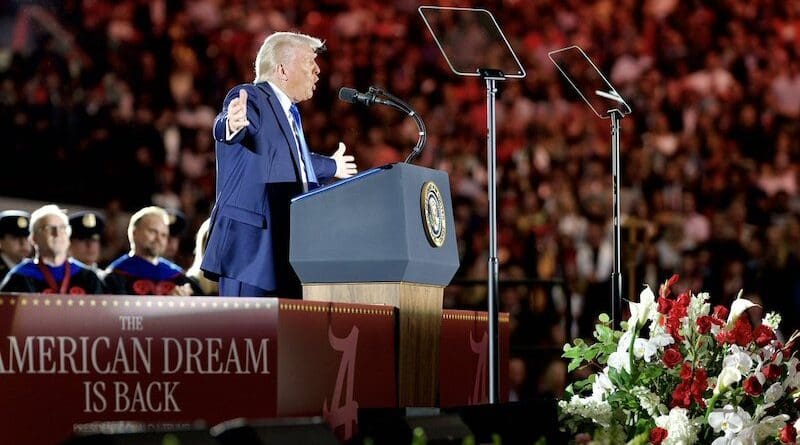
US President Donald Trump. Photo Credit: White House, X
By MISES
By William L. Anderson
As we moved through the fourth month of the Donald Trump presidency, chaos seems to be the situation for the economy. The recent announcement that the GDP had shrunk slightly has spooked the markets, as the up-and-down nature of Trump’s tariff policies has created what Robert Higgs has called “regime uncertainty,” which is bad news for anyone who had hoped that Trump would undo at least some of the economic damage caused by the Joe Biden administration.
Ever since the first Franklin Roosevelt administration launched its “First 100 Days” initiative in 1933, many presidents since then have sought to meet that dubious standard. Given that FDR’s famed 100 Days consisted of unprecedented transferral of power from Congress to the executive branch—with disastrous laws such as the Agricultural Adjustment Act and the National Industrial Recovery Act being passed during that time—the Roosevelt administration spent its time damaging the economy and the nation’s body politic. Nonetheless, the media and other pundits tend to judge an incoming administration by its first 100 days.
By any conventional measurement, Trump’s first 100 days have been tumultuous. This page—as it should—has taken a hard line against the implementation of the new tariffs and there is no backtracking from that criticism, even as many of Trump’s supporters have angrily reacted to the criticism. Furthermore, even Trump has thrown cold water on economic expectations with his recent “two dolls” comments regarding how his tariffs have driven up prices for some goods.
But Trump and his supporters claim that his economic regime of tariffs will have a “pain first, gain later” effect, something we have also dealt with on this page. What Trump has not explained, however, is how his policies will affect the longer-term capital development that any growing economy desperately needs. In fact, the Higgs “regime uncertainty” thesis has something to say about this situation, one that the president and his advisors would do well to heed. (Given the arrogance about economic matters that has come from the Trump White House so far, one doubts anyone there will listen to Higgs or anyone else who disagrees with them).
What Is “Regime Uncertainty” and Why Does It Matter?
In his 1997 paper “Regime Uncertainty,” economist Robert Higgs wrote that the combination of anti-business policies and hostile anti-business rhetoric from the Roosevelt White House during the 1930s contributed to the reluctance of businessmen to make long-term capital investments. Wrote Higgs:
The hypothesis [of “regimeuncertainty”] is a variant of an old idea: the willingness of businesspeople to invest requires a sufficiently healthy state of “business confidence,” and the Second New Deal ravaged the requisite confidence (Krooss 1970, 199–201; Collins 1981, 23–52; Fearon 1987, 209–11; Brinkley 1995, 31–34). Of course, one difficulty with the hypothesis is that business confidence is a vague notion and one for which no conventional empirical measure has been developed. I shall try to narrow the concept somewhat and to show that one can shed empirical light on it by using the findings of systematic opinion surveys and evidence on the behavior of investors in the financial markets.
To narrow the concept of business confidence, I adopt the interpretation that businesspeople may be more or less “uncertain about the regime,” by which I mean, distressed that investors’ private property rights in their capital and the income it yields will be attenuated further by government action.
As Higgs points out, business owners during the 1930s didn’t know what was going to come out of the Roosevelt regime, especially in the second half of the 1930s when the administration firmly stood behind punitive measures against the business community. Higgs writes:
Accepting his party’s nomination for the presidency in 1936, Roosevelt railed against the “economic royalists” allegedly seeking a “new industrial dictatorship” (quoted in Leuchtenburg 1963, 183–84). Privately he opined that “businessmen as a class were stupid, that newspapers were just as bad; nothing would win more votes than to have the press and the business community aligned against him” (Leuchtenburg 1963, 183). Just before the election of 1936, in an address at Madison Square Garden, he fulminated against the magnates of “organized money…[who were] unanimous in their hate for me” and declared, “I welcome their hatred.” To uproarious applause, he threatened: “I should like to have it said of my second Administration that in it these forces met their master” (quoted in Leuchtenburg 1963, 184).
And it was more than just the rhetoric that dampened business investment. Higgs writes that the passage of punishing taxes and empowering of labor union organization of much of the manufacturing sector took its toll:
In the starkest demonstration of their new power, unionists began sit-down strikes, occupying employers’ facilities and refusing either to work or to leave until their demands were met. President Roosevelt declined to use force to eject the sit-down strikers; likewise, many state and local officials would not enforce the law against this willful trespassing on private property. As historian William E. Leuchtenburg (1963) observed, “Property-minded citizens were scared by the seizure of factories, incensed when strikers interfered with the mails, vexed by the intimidation of nonunionists, and alarmed by flying squadrons of workers who marched, or threatened to march, from city to city” (242).
Trump as a New New Dealer
While FDR didn’t spark a trade war, nonetheless his rhetoric and legislative measures—along with his executive orders—shifted the ground for business investment. Many of Trump’s measures since he took office in January are having similar effects, especially in capital development.
As I noted in an earlier article, given the unpredictability of Trump’s behavior in general and his tariff policies in particular, few business owners are going to make the long-term capital investment that would be needed to expand production of manufactured goods here. The reason is that most private business investment is already undertaken in an atmosphere of uncertainty. Writes Peter Klein:
I usually describe my approach here as the “judgment-based view” of entrepreneurship (see Foss and Klein, 2015, for a summary and reflections). The term judgment comes from Knight, who described judgment as decision-making under uncertainty that cannot be modeled or parameterized as a set of formal decision rules. Judgment is midway between the “rational decision-making” of neoclassical economics models and blind luck or random guessing. We sometimes call it intuition, gut feeling, or understanding.
However, many things can change the valuation of factors of production, and government policies such as tariffs, business taxes, or changes in the regulatory regime can create new opportunities for some but also have devastating consequences for other entrepreneurs. When government imposes potentially adverse conditions upon business enterprises, investments that might have been profitable before government acted now will suffer losses and have to abandon their plans.
While “New Deal” is a pejorative term in many business and economic circles, it seems that Trump is trying to push through government initiatives that are creating winners and losers and circumventing free markets. At the same time, his rhetoric has hardly been reassuring business owners and consumers who must bear the brunt of these initiatives, and especially the new (and ruinous) tariffs. Jeff Sommer writes in the New York Times:
Corporate America is stumbling in the dark, and so are investors.
Ford and General Motors executives say they can’t estimate what lies ahead. There’s too much fog even to hazard a guess, so both companies have suspended earnings guidance — signals about future sales and profits — leaving investors to navigate on their own. And the automakers are not the only ones. A broad range of companies, including Delta Air Lines, Southwest Airlines, the footwear company Skechers, UPS and the engine manufacturer Cummins, say they can’t talk confidently about the future.
This situation of uncertainty does not just affect current production decisions but also has an enormous impact upon future capital investment decisions these firms will make. Just as levels of private capital investment fell greatly during the 1930s, the same situation is likely to exist today, as firms are not going to jeopardize their future by investing billions of dollars in new lines of production only to have the president make a shoot-from-the-hip decision that renders the value of an investment to near-zero or even a loss.
Trump is trying to bring about structural changes both in government and in business. His recent executive order affecting the nation’s pharmaceutical industry, for example, can be read in many ways from a veiled threat to lower drug prices to politically-acceptable levels to creating an opening for new capital development. But given Trump’s record in his second administration, these drug firms most likely will pull into a defensive mode for a while to see what Trump actually does in the future, as opposed to making long-range investment plans.
Conclusion
While the US economy is not yet in a recession, Trump’s anti-business rhetoric, his arbitrary decisions, and his imposition of tariffs at ruinous levels are creating uncertainty within the business community. We have not seen this level of business uncertainty in 90 years, going back to the FDR administration.
Should the US economy suffer a recession, a recovery will depend upon new business investment, as firms move away from unprofitable lines of production and find new lines that are more promising. However, if Trump’s regime uncertainty continues, we could find ourselves in an economy that is stagnant and moving nowhere.
- About the author: William L. Anderson is Senior Editor at the Mises Institute and retired professor of economics at Frostburg State University. He earned his MA in economics from Clemson University and his PhD in economics from Auburn University, where he was a Mises Research Fellow. He has been writing about Austrian economics since 1981, when he first was introduced to the Austrian view by the late William H. Peterson.
- Source: This article was published by the Mises Institute

MISES
The Mises Institute, founded in 1982, teaches the scholarship of Austrian economics, freedom, and peace. The liberal intellectual tradition of Ludwig von Mises (1881-1973) and Murray N. Rothbard (1926-1995) guides us. Accordingly, the Mises Institute seeks a profound and radical shift in the intellectual climate: away from statism and toward a private property order. The Mises Institute encourages critical historical research, and stands against political correctness.