Thursday, May 29, 2025


Ballots and Bias: How the Press Framed Venezuela’s Regional and Legislative Elections


by Roger D. Harris / May 28th, 2025

The pro-government alliance achieved a sweeping victory in Venezuela’s May 25 elections, while a fractured opposition suffered losses. Western media distorted the results – spinning low turnout claims, ignoring the role of illegal US sanctions, and offering selective sympathy to elite opposition figures.

Opposition fractures, pro-government consolidates

At stake for the 54 contesting Venezuelan political parties were seats for 285 National Assembly deputies, 24 state governors, and 260 regional legislators.

The pro-government coalition won all but one of the governorships, taking three of the four states previously held by the opposition. The loss of the state of Barinas was particularly symbolic, for this was the birthplace of former President Hugo Chávez, and especially so, because the winner was Adán Chávez, the late president’s older brother.

Likewise, the Chavista alliance swept the National Assembly, securing 253 out of 285 seats. Notable exceptions were the election of opposition leaders Henrique Capriles and Henri Falcón, both of whom are former presidential candidates.

The New York Times reported the same outcomes but spun it as the “results [rather than the vote]…stripped the opposition of some of the last few positions it held,” inferring fraud.

However, this election outcome was not unexpected, as the opposition was not only divided but also had a significant portion opting to boycott the vote. The pro-government forces enjoyed a unified effort, an efficient electoral machine, and grassroots support, especially from the communal movement.

“After 32 elections, amidst blockades, criminal sanctions, fascism and violence,” Venezuelan President Nicolás Maduro affirmed, “today we showed that the Bolivarian Revolution is stronger than ever.”

Opposition self-implodes

The headline from Le Monde spun the voting thus: “Venezuela holds divisive new elections.” Contrary to what the headline suggests, the divisiveness was not the government’s doing, but due to the opposition’s perennial internecine warfare.

While the pro-government Great Patriotic Pole alliance around the ruling Socialist Party (PSUV) “works in unison,” according to opposition leader Henrique Capriles, the electoral opposition is divided into three warring camps. They, in turn, were surrounded by a circular firing squad of the far-right abstentionists, calling for a vote boycott.

The abstentionists were assembled around Maria Corina Machado. She had been pardoned for her involvement in the short-lived 2002 US-backed coup but was subsequently disqualified from running for office for constitutional offenses. Following Washington’s lead, which has not recognized a Venezuelan presidential election as legitimate since 2012, the far-right opposition rejected electoral means for achieving regime change and has even pleaded in effect for US military intervention.

Machado’s faction, which claimed that Edmund González Urrutia won the 2024 presidential election, does not recognize their country’s constitutional authority. Consequently, when summoned by the Venezuelan Supreme Court, they refused to present evidence of their victory, thereby removing any legal basis for their claimed victory to be accepted. Machado maintained that voting only “legitimizes” the government, bitterly calling those participating in the democratic process “scorpions.”

Machado spent the election in self-imposed hiding. She further dug herself into a hole, after urging even harsher punishing US sanctions on her own people, by appearing to support Trump’s sending of Venezuelan migrants to the CECOT torture prison in El Salvador.

El Pais sympathized with her as “driven by the strength of the pain of being a mother who has been separated from her three children.” The WaPo described the middle-aged divorcé from one of the wealthiest families in Venezuela as a “courageous leader” whose “three children are exiled abroad.” In fact, her adult children live comfortably in the US and Colombia.

To this manufactured sympathy for the privileged, Venezuelan-Canadian sociologist Maria Paez Victor asks, “Where are the defenders of the human rights of Venezuelans?” She excoriates the collective West for its selective concern for human rights, emphasizing the neglect of Venezuelans’ rights amid external pressures and US sanctions.

The disputed Essequibo

The headline for The New York Times’s report spun the elections with: “Venezuela is holding an election for another country’s land.” This refers to the elections for governor and legislators in Essequibo (Guayana Esequiba in Spanish), which is, in fact, a disputed land.

For nearly two centuries, Venezuelans have considered that region part of their country, having wrested it from Spanish colonialists in 1835. In the questionable Paris Arbitral Award, with the US representing Venezuela, the Essequibo was handed over to the UK in 1899 (then colonial British Guiana and now the independent nation of Guyana). Ever since, it has been contested territory.

In 1962, Venezuela formally revived its claim at the UN, asserting that the 1899 award was null and void. Not surprisingly, the Times sides with Guyana, or more precisely with what they report as “Exxon Mobil’s multibillion-dollar investments” plus “military ties with the US.”

This first-time vote for political representation in the Essequibo is seen by Venezuelans across their political spectrum as an important step to assert their claim. It follows a referendum in 2023, which affirmed popular support for the Essequibo as part of their national territory. The actual voting was held in the neighboring Bolivar state.

On cue, the western-aligned press criticized the vote on the Essequibo as a “cynical ploy” by the Maduro administration to divert attention from other pressing problems. Meanwhile, they obscure the increasing US military penetration in neighboring Guyana and in the wider region.

Yet even the NYT had to admit: “Claims to the Essequibo region are deeply ingrained among many Venezuelans… [and even] María Corina Machado, the most prominent opposition leader, visited the area by canoe in 2013 to advance Venezuela’s claim.” Venezuelan journalist Jésus Rodríguez Espinoza (pers. comm.) described the vote as “an exercise in national sovereignty.”

Illegal sanctions – the elephant in the room

WaPo opinion piece claims, “that the actual root cause of poverty has been a lack of democracy and freedom,” as if the US and its allies have not imposed sanctions deliberately designed to cripple the Venezuelan economy. These “unilateral coercive measures,” condemned by the UN, are illegal under international law because they constitute collective punishment.

But the fact that Venezuelans had to vote while being subjected to illegal coercion is completely ignored by the corporate press. That is, the existence of sanctions is recognized, but instead of exposing their illegal and coercive essence, the press normalizes them. The story untold by the press is the courage of the Venezuelan people who continue to support their government under such adverse conditions.

Disparaging the election

Washington and its aligned press cannot question the popular sweep for the Socialist Party’s alliance in Venezuela, because it is so obvious. Nonetheless, they disparage the mandate. The chorus of criticism alleges the fraudulent nature of previous elections, although it is a geopolitical reality that Washington considers any popular vote against its designated candidates illegitimate.

For this particular election, these State Department stenographers focused on the supposedly low turnout. In fact, the turnout was typical for a non-presidential election contest and fell within the same percentage range as US midterm elections.

Moreover, the pro-government slate actually garnered more votes than it had in the previous regional elections. The Chavista core of older, working class women remains solid.

When Elvis Amoroso, president of Venezuela’s authority (CNE), qualified the turnout percentages to apply to “active voters,” he meant those in-country. Due to the large number of recent out-migrations, a significant number are registered but cannot vote because they are abroad.

What was notably low was the voting for the highly divided opposition, with major factions calling for a boycott. Further, the opposition had been discredited by revelations that some had received and misused hundreds of millions of dollars from USAID. More than ever, the inept opposition has exposed itself in a negative light to the broad electorate. 

The overwhelming sentiment on the street in Venezuela is for an end to partisan conflict and for continuing the slow economic recovery. Challenges ahead include inflationary winds, a rising unofficial dollar exchange rate, and, above all, the animus of the Trump administration, which is currently in internal debate over whether to try to deal the Bolivarian Revolution a quick or a slow death. Either way, destabilization efforts continue.

To which Socialist Party leader and Interior Minister Diosdado Cabello said: “No one can stop our people. Not sanctions, nor blockades, nor persecution – because when a people decide to be free, no one can stop them.”

Roger D. Harris was an international observer for Venezuela’s 2024 presidential election. He is with the US Peace Council and the Task Force on the AmericasRead other articles by Roger.

Roads to War: The EU’s Security Action for Europe Fund


As the world was readying for the Second World War, the insightful humane Austrian author Stefan Zweig made the following glum observation: “Openly and flagrantly, certain countries express their will to expand and make preparations for war. The politics of rearmament is pursued in broad daylight and at breakneck speed; every day you read in the papers arguments in favour of armaments expansion, the idea that it reduces unemployment and provides a boost to the stock exchange.”

This is not so different from the approval by European Union countries on May 27 of a €150 billion loan program known as the Security Action for Europe (SAFE) borrowing scheme. A press release from the European Council stated that the scheme “will finance urgent and large-scale investments in the European defence technological and industrial base (EDTIB)” with the intention of boosting “production capacity, making sure defence equipment is available when needed, and to address existing capability gaps – ultimately strengthening the EU’s overall defence readiness.”

The statement also makes a central rationale clear: that SAFE will enable continued European support for Ukraine, linking its defence industry to the program. Despite not being an EU member, Kyiv will be able to participate in the scheme. Interestingly enough, the United Kingdom, despite leaving the EU, will also be able to participate via a separate agreement.

Disbursements to interested member states upon demand, considered along national plans “will take the form of competitively priced long-maturity loans, to be repaid by the beneficiary member states.”

The scheme further anticipates the types of weaponry, euphemistically titled “defence products”, that will feature. As outlined by the European Council on March 6, these will comprise two categories: the first covering, amongst others, such products as ammunition and missiles, artillery systems, ground combat capabilities with support systems; the second, air and missile defence systems, maritime surface and underwater capabilities, drones and anti-drone systems and “strategic enablers” including air-to-air refuelling, artificial intelligence and electronic warfare.

The broader militarisation agenda is confirmed by linking SAFE with broader transatlantic engagement and “complementarity with NATO.” It will “strive to enhance interoperability, continue industrial cooperation, and ensure reciprocal access to state-of-the-art technologies with trusted partners.” Significantly, the emphasis is on collaboration: a minimum of three countries must combine when requesting funding for SAFE defence projects.

There seems to be something for everyone: the militarist, the war monger and the merchants of death. Global Finance, a publication dedicated to informing “corporate financial professionals”, was already praising the SAFE proposal in April. “The initiative has the potential to transform the business models of many top European defense groups – like Saab, which has traditionally relied on contracts from the Swedish state to grow its sales.” What a delight it will be for such defence companies to move beyond the constraints on sales imposed by their limiting governments. A veritable European market of death machinery is in the offing.

The fund is intended for one, unambiguous purpose: war. The weasel word “defence” is merely the code, the cipher. Break it, and it spells out aggression and conflict, a hankering for the next great military confrontation. The reason is traditional, historic and irrational: the Oriental despotic eminence arising from the Asian steppes, people supposedly untutored in the niceties of European good manners and democracy. Not that European manners and democracy is in splendid health. A mere glance at some of the candidates suggests decline in institutional credibility and scepticism. But we can always blame the Russians for that, deviously sowing doubt with their disinformation schemes.

The initiative, and its tightening of ties with arming Ukraine, has made such critics as Hungary’s Prime Minister Viktor Orbán sound modestly sensible. “We need to invest in our own armies, but they expect us to fund Ukraine’s – with billions, for years to come,” he declared in a post on X. “We’ve made it clear: Hungary will not pay. Our duty is to protect our own people.”

The approval of the fund by the European Commission has also angered some members of the European Parliament, an institution which has been treated with near contempt by the European Commission. European Parliament Presidente Roberta Metsola warned Commission President Ursula von der Leyen earlier in May to reconsider the use of Article 122 of the EU Treaty, which should be used sparingly in emergencies in speeding up approvals with minimal parliamentary scrutiny. Bypassing Europe’s invigilating lawmakers risked “undermining democratic legitimacy by weakening Parliament’s legislative and scrutiny functions”. The Council’s resort to Article 122 potentially enlivened a process that could see a legal case taken to the European Court of Justice.

The European Parliament’s Legal Affairs Committee (JURI) has also supported a legal opinion repudiating the Commission’s cavalier approach in approving the fund. According to that tartly reasoned view, Article 122 was an inappropriate justification, as the threshold for evoking emergency powers had simply not been met.

Ironically, the rearmament surge is taking place on both sides of the Atlantic, at both the behest of the Trump administration, ever aggrieved by Europe not pulling its military weight, and Moscow, characterised and caricatured as a potential invader, the catalyst for decorating a continent with bristling weaponry. The former continues to play hide and seek with Brussels while still being very much in Europe, be it in terms of permanent garrisons and military assets; the latter remains a convenient excuse to cross the palms of the military industrial establishment with silver. How Zweig would have hated it.


Squabbling Siblings: India, Pakistan and


Operation Sindoor


On April 22, militants from The Resistance Front (TRF), a group accused by Indian authorities of being linked to the Lashkar-e-Taiba terrorist group, slaughtered 26 tourists in the resort town of Pahalgam in the Indian administered portion of Kashmir. This came as a rude shock to the Indian military establishment, which decided that rebellious sentiments in the region had declined. (In March 2025, an assessment concluded that a mere 77 active militants were busying themselves on India’s side of the border.)

The feeling of cooling tensions induced an air of complacency. Groups such as the TRF, along with a fruit salad of insurgent outfits – the Kashmir Tigers, the People’s Anti-Fascist Front, and the United Liberation Front of Kashmir – were all spawned by Prime Minister Narendra Modi’s August 2019 revocation of Article 370 of the Indian Constitution, which granted Kashmir singular autonomy. TRF has been particularly and violently opposed to the resettlement of the Kashmiri pandits, which they see as an effort to alter the region’s demography.

The murderous incident raised the obvious question: Would Modi pay lip service to the 1972 Shimla Agreement, one that divided Kashmir into two zones of administration separated by a Line of Control? (A vital feature of that agreement is an understanding that both powers resolve their disputes without the need for third parties.)

The answers came promptly enough. First came India’s suspension of the vital Indus Water Treaty, a crucial agreement governing the distribution of water from India to Pakistan. Pakistan reciprocated firmly by suspending the Shimla Agreement, expelling Indian military diplomats, halting visa exemptions for Indian citizens, and closing the Wagah border for trade.

Hindu nationalism proved particularly stirred, and Modi duly fed its cravings. On May 7, India commenced Operation Sindoor, involving what were purportedly precision missile attacks on nine militant camps in Pakistan and the Jammu and Kashmir area controlled by Islamabad. The operation itself had a scent of gendered manipulation, named after the vermillion used by married Hindu women to symbolise the durable existence of their husbands. Two female military officers – Colonel Sofiya Qureshi and Wing Commander Vyomika Singh – were tasked with managing the media pack.

The Indian briefings celebrated the accuracy of the strikes on what were said to be the sites of Lashkar-e-Taiba, Jaish-e-Mohammed, and Hizbul Mujahideen. Thirty-one suspected terrorists were said to have perished, though Pakistan insisted that civilians had been killed in this apparent feast of forensic precision. India’s Defence Minister Rajnath Singh would have none of it: Indian forces had only “struck only those who harmed our innocents”.

The next day, it was operations against Pakistan’s air defence systems in Lahore that stole the show. The inevitable Pakistani retaliation followed on May 10, with the Indian return serve against 11 Pakistani air bases. What followed is one version: Pakistan’s military broke into a sweat. A cessation of hostilities was sought and achieved. Armchair pundits on the Indian side celebrated: India had successfully targeted the terrorist cells supported by Pakistan. If one is to read Anubhav Shankar Goswami seriously, Operation Sindoor was a stroke of genius, threatening “the Pakistan Army’s strategic shield against terrorists”.

More accurately, this was a lovely little spilling of blood with weaponry between callow sibling throats, a pattern familiar since 1947. The two countries have fought four full-blown conflicts, two over Kashmir. Along the way, they have made the world a lot safer by acquiring nuclear weapons.

There was something for everyone in this retaliatory and counter-retaliatory feast. India claimed strategic proficiency, keeping censorship on the matter tight. Pakistan could claim some prowess in shooting down five Indian jets, using Chinese weaponry, including the J-10.  With pride and pomp, they could even appoint Pakistani Army chief Asim Munir to the post of Field Marshal, an absurdly ceremonial gesture that gave the impression that the army had restored its tattered pride. It was to be expected that this was ample reward for his, in the words of the government, “strategic leadership and decisive role” in defeating India.

The only ones to be notably ignored in this display of subcontinental machismo were the Kashmiris themselves, who face, in both the Pakistan and Indian administered zones, oppressive anti-terrorism laws, discriminatory practices, and suppression of dissent and free speech.

Ultimately, the bickering children were convinced to end their playground antics. The fact that the overbearing headmaster, the unlikely US President Donald Trump, eventually brought himself to bear on proceedings must have irritated them. After four days of conflict, the US role in defusing matters between the powers became evident. Kashmir, which India has long hoped to keep in museum-like storage, away from the international stage, had been enlivened.  Trump even offered his services to enable New Delhi and Islamabad a chance to reach a more enduring peace. Praise for the president followed, notably from those wishing to see the Kashmir conflict resolved.

In one sense, there seems to be little reason to worry. These are countries seemingly linked to sandpit grievances, scrapping, gouging, and complaining about their lot. Even amidst juvenile spats, they can bicker yet still sign enduring ceasefires. In February 2021, for instance, the militaries of both countries cobbled together a ceasefire which ended four months of cross-border skirmishes. A mere two violations of the agreement (how proud they must have been) was recorded for the rest of the year. In 2022, a solitary incident of violation was noted.

A needlessly florid emphasis was made on the conflict by Indian political scientist Pratap Bhanu Meta.  This was an encounter lacking a “decisive victory and no clear political end”. It merely reinstated “the India-Pakistan hyphenation”. In one sense, this element of hyphenation – the international perception of two subcontinental powers in an eternal, immature squabble – was something India seemed to be marching away from. But Prime Minister Modi, despite his grander visions for India, is a sectarian fanatic. History shows that fanaticism tends to shrink, rather than enlarge, the mind. In that sense, he is in good company with those other uniformed fanatics in uniform.

Binoy Kampmark was a Commonwealth Scholar at Selwyn College, Cambridge. He lectures at RMIT University, Melbourne. Email: bkampmark@gmail.comRead other articles by Binoy.


No One Is Safe Until Everyone Is: Humanity’s Missing Project


Fragmented by nationalism and distracted by power games, humanity stands at a turning point. We face global crises that threaten our survival, yet we remain without a common purpose rooted in solidarity and mutual care. This—our failure to recognize our shared fate—is the true crisis of our time.
Every nation clings to its sovereign right to act in its interest: to strike deals, close borders, and extract value from the global system. This is not new, but it is increasingly dangerous. The Global South strives to reclaim agency from centuries of domination. Africa seeks to shape its future free of outside interference. Asia is lifting millions from poverty through rapid development. Meanwhile, Western powers continue to exert dominance through sanctions, militarization, and economic coercion. Under the banner of a “multipolar world,” the global political order is recycling the same hegemonic logic, just under new names. Both sides of the political divide seem to believe that militarization and bullying are legitimate means to consolidate this fragmentation, all in the name of “security.”
But the realities of our time demand something radically different.
COVID-19 swept across the planet, ignoring borders, languages, and religions. Climate catastrophe looms ever closer. Unchecked corporate power fuels inequality and environmental destruction. These crises do not discriminate, and they cannot be resolved by individual nations alone.
Everything humanity has developed—language, technology, religion, agriculture—has brought us to this moment. We are now confronted with the inescapable truth of our interdependence. We exist together on this Earth. We survive together—or not at all. We have a moral obligation to transform that oneness into a living reality.
The tragedy is that we have no unifying project. No shared aim worthy of our human potential. Despite our vast knowledge and powerful tools, we have failed to answer the simplest question: Why are we here? This is where we must direct our energy.
Instead, we remain trapped in short-term self-interest, both personal and national. We protect our own at the expense of others. But if we want to survive as a species—and not just as competing nations—we must reverse course. We must stop mistaking sovereignty for strength. True strength lies in solidarity.
So what are we here for, as human beings? What could we create together if we aligned our energy with our conscience? What if the measure of sovereignty were not how fiercely we protect our borders, but how deeply we protect human dignity—everywhere?
We possess knowledge, technology, and science beyond anything our ancestors could have imagined. To move forward, we must transcend our “ego-ism,” both personal and national, and begin to imagine another future—one where solidarity, not sovereignty, leads the way.
If we want to survive as a species—and not just as nations—we must urgently ask the only question that matters:
What can we build together?
First published in Pressenza and  available in: Spanish
David Andersson is a French-American journalist, photographer, and author who has lived in New York for over 30 years. He co-directs Pressenza International Press Agency and is the author of The White-West: A Look in the Mirror, a collection of op-eds examining the dynamics of Western identity and its impact on other cultures. Read other articles by David.
German court rejects climate case against energy giant RWE
DW
05/28/2025


Judges have dismissed a climate case brought by a Peruvian farmer against German energy company RWE seeking damages for endangering his home due to melting glaciers.

Saul Luciano Lliuya first filed his lawsuit against RWE a decade ago
Image: Alexander Luna


In a decision that has been 10 years in the making, judges in the western German city of Hamm have thrown out the case of a Peruvian farmer seeking damages from energy giant RWE for the risk of flooding connected to melting glaciers.

Delivering its verdict in the David vs. Goliath case, judges said the damage to Saul Luciano Lliuya's property from a potential glacier flood was not high enough. They ruled out an appeal.

But in a legal first, the court did rule that companies can be held liable for the impact of their emissions.

Speaking after the verdict, Lliuya's lawyer Roda Verheyen said that although the court had not recognized the risk to her client's home, the ruling was a "milestone" that would "give a tailwind to climate lawsuits against fossil fuel companies."

"The judgment that we've just heard means that every community and every person that is affected by climate change today can look at large emitters to take a responsibility, legal responsibility, and it is an immense historic shifting of the dial that's happened today," she told DW.

The environmental NGO Germanwatch, which has supported the plaintiff throughout the long legal proceedings, said the ruling marked "a great success."

"The court's decision, which at first glance sounds like a defeat due to the dismissal of the case, is actually a historic landmark ruling that can be invoked by those affected in many places around the world," the nonprofit said in a statement.

"This is because there are very similar legal requirements in numerous other countries, such as the UK, the Netherlands, the USA and Japan."
A long road of litigation

It's been almost a decade since Saul Luciano Lliuya first filed a lawsuit against the German energy giant, calling on the company to pay its fair share to protect his home in Peru.

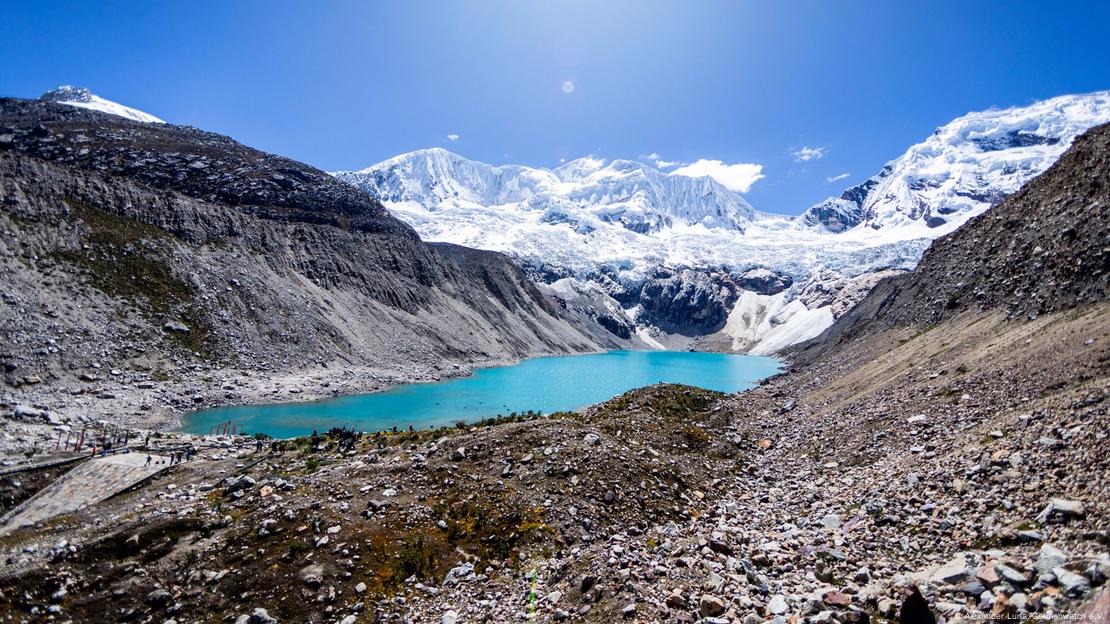
Lliuya's town of Huaraz is located in the west of the country, in a valley below the Palcacocha mountain lake. As greenhouse gas emissions have caused global temperatures to rise, glaciers in the region have been melting.

The amount of water in the lake above Lliuya's home has increased more than fourfold since 2003 alone, leading experts to warn of an increased risk of flooding, with potentially dire consequences for the region. They say if large blocks of ice were to break off the glacier and fall into the lake, it could trigger meter-high flooding in lower-lying urban areas.

As the air temperatures have increased due to the burning of fossil fuels, the lake near Lliuya's home has filled with water from a melting glacier, increasing the risk of flooding
Image: Alexander Luna/Germanwatch e.V.

Lliuya has been suing RWE under a German neighborhood law, which works to protect residents from disturbances resulting from the actions of their neighbors — for example, from tree roots causing damage from an adjacent property. His initial lawsuit was rejected in 2015 by a court in Essen, the western German city where the energy company is headquartered.

But in 2017, a higher court in the nearby city of Hamm granted an appeal. In March this year, judges at that court heard evidence over whether Lliuya's house was really in jeopardy and whether RWE can be held responsible.

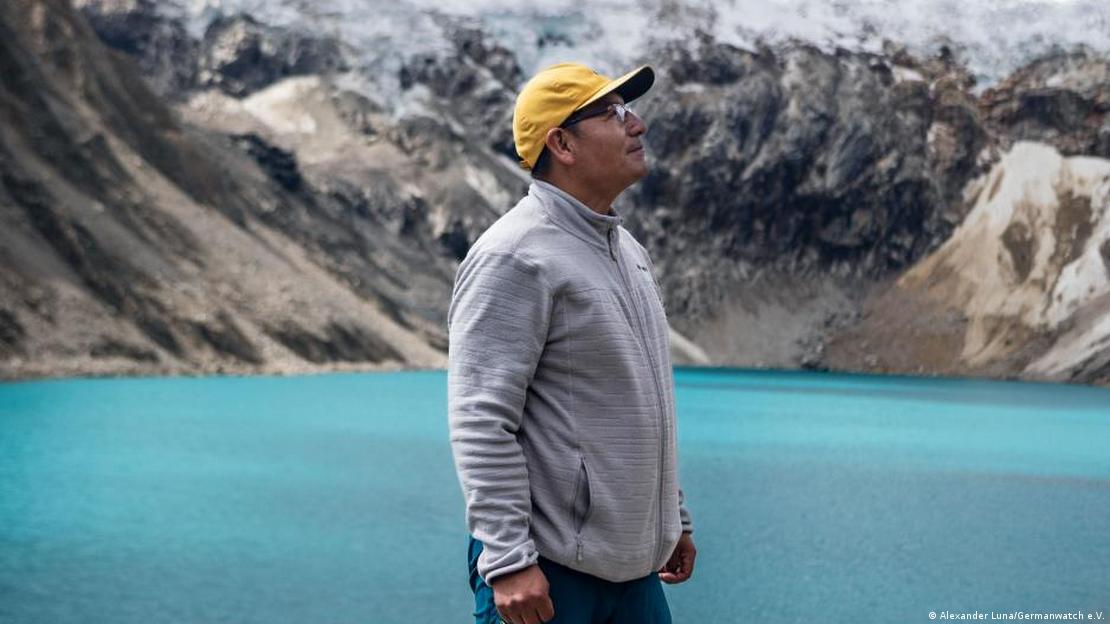
The Peruvian farmer, who earlier this year told DW the case was about "holding those who have caused the damage to account," was calling on RWE to cover a pro rata percentage of the estimated costs to build flood defenses to protect his home from the rising lake water. This would equate to around €17,000 ($19,000).

RWE, which is not active in Peru, said it has always complied with national legal regulations and has repeatedly questioned why it has been singled out.

In a statement after the ruling, the energy giant said it had always considered such civil "climate liability" to be inadmissible under German law. "It would have unforeseeable consequences for Germany as an industrial location, because ultimately claims could be asserted against any German company anywhere in the world for damage caused by climate change."

However, Lliuya's lawyer said her client's problem was not going away.

"The risk from the Palcacocha Glacier Lake and from glacial lakes all over the world actually is still there and the global community and everybody needs to do something about it because we can't just have people living in such danger zones," Verheyen told DW.

Corporate responsibility for global emissions?

As an energy powerhouse with a history of largely using coal to generate electricity, RWE is one of Europe's biggest polluters. A 2023 analysis found the company to be responsible for just under 0.4% of global emissions — more than twice that of Greece.

In ruling the case as admissible in an earlier hearing, experts saw the court as effectively recognizing the transboundary effects of climate change — even if the damage occurs thousands of kilometers away.

"Some of the arguments made in the case are of course transferable, even if not directly applicable in any other jurisdiction," said Petra Minnerop, a professor of international law at Durham University in the UK.

"And this is what we see in litigation generally that litigants have tried to transfer the arguments and also learn from the court outcomes and then provided improved evidence and the adjusted legal argument," she added.

Peruvian farmer Saul Luciano Lliuya took German energy giant RWE to court over rising temperatures that are increasing the risk of flooding near his home
Image: Alexander Luna/Germanwatch 

Could it still set a precedent?

Since the RWE proceedings began, Noah Walker-Crawford, a research fellow at the London-based Grantham Research Institute on Climate Change and the Environment, said around 40 cases have sprung up. They are challenging big companies over their responsibility for climate change in countries such as Belgium, Indonesia and the United States.

"There has been insufficient political progress on climate change over the past decades, especially at an international level and especially in terms of loss and damage, in terms of the devastating impacts that communities are facing around the world, and that's why we're seeing more and more that communities are turning to the courts, really out of desperation," he explained.

Sebastien Duyck, senior attorney with the Center for International Environmental Law, said the judgement shatters the "wall of impunity for major polluters."

He added that "this precedent provides a legal spark to accelerate the pursuit of climate justice. The recognition that a company can, in principle, be held accountable in court for climate harms halfway across the planet will buttress the arguments presented in dozens of pending cases as well as embolden impacted communities to seek justice through the courts."

Edited by: Tamsin Walker

Andes' glaciers shrinking at 'unprecedented' rate

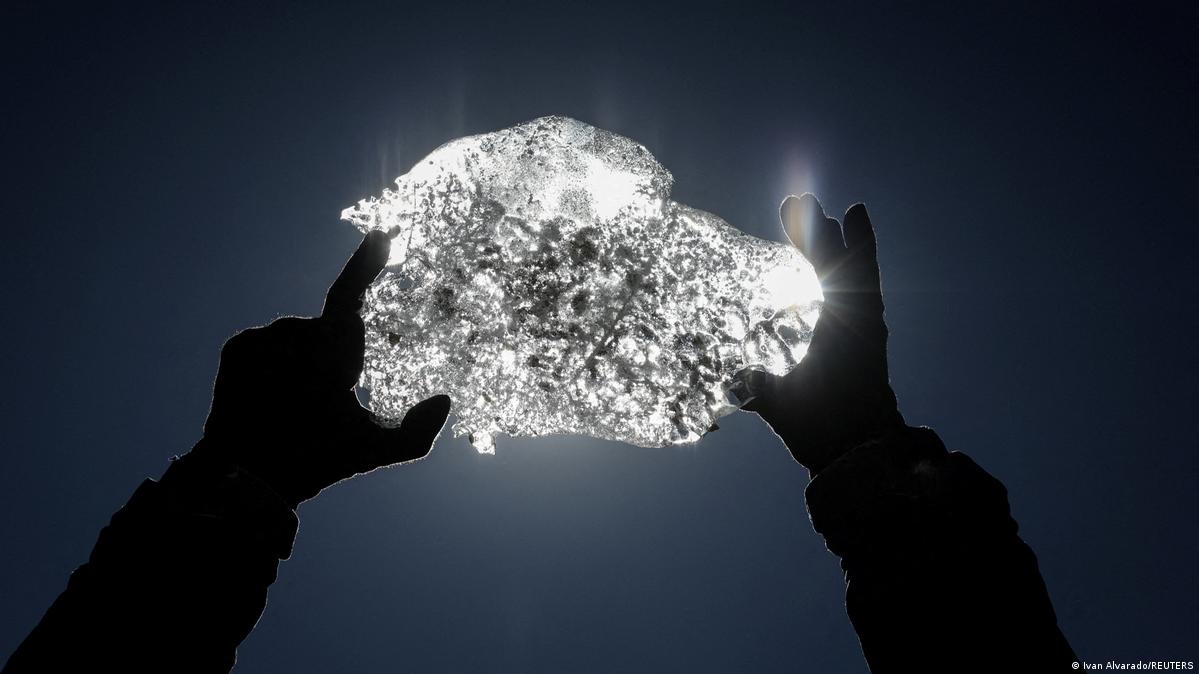
The consequences of climate change are becoming clear in South America's Andes mountain range. Here, glaciers are melting even faster than elsewhere in the world, changing the way of life for millions of people.Image: Ivan Alvarado/REUTERS
Melting majesty

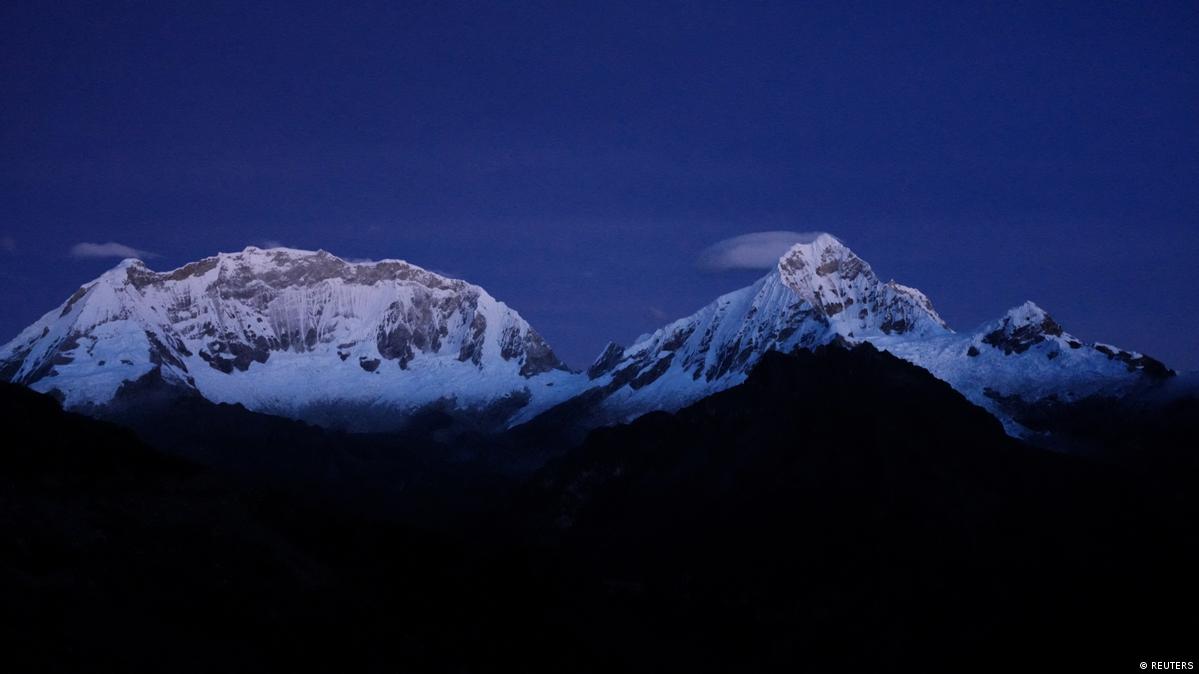
The highest mountains in the Americas can be found in the Cordillera Blanca range in the northern Andes of Peru. But even there, the ice on the peaks, which are up to 6,700 meters (22,000 feet) high, is under threat. Rising temperatures are causing rapid glacier melt and thawing permafrost. This has increased the risk of floods and landslides — and threatens drinking water for millions.Image: REUTERS


High temperatures at high altitude

The glacier on Nevado Pastoruri in the Huascaran National Park is rapidly disappearing. A multinational study has shown that daytime winter surface temperatures in the Andes have risen by 0.5 degrees Celsius (0.9 degrees Fahrenheit) per decade since 2000 at altitudes of 1,000 to 1,500 meters (3,200 to 5,000 feet). The increase above 5,000 meters has been as high as 1.7 degrees Celsius.Image: Angela Ponce/REUTERS


Louise Osborne DW's Chief climate reporter provides expertise on the defining crisis of our time.
THE GRIFT

Is Vietnam courting Trump family with luxury golf course?

DW
05/28/2025

A luxury golf resort owned by the family business of US President Donald Trump has swiftly received preferential treatment from Hanoi. The move comes as Vietnam faces high tariffs from the Trump administration.

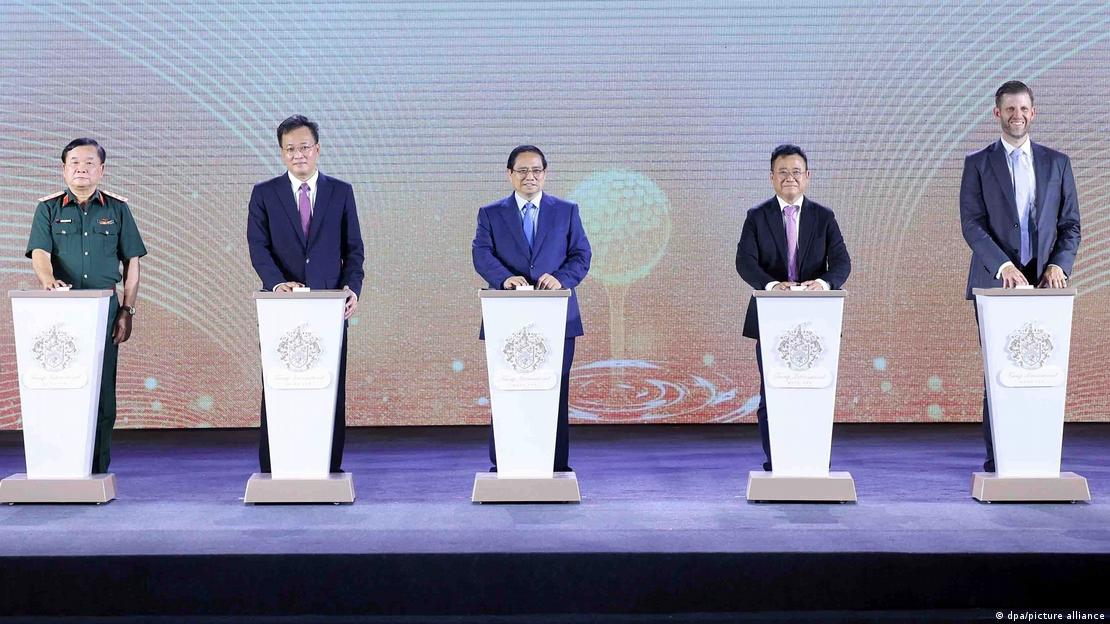
Eric Trump spoke at the groundbreaking ceremony for Trump International Hung Yen, an urban, tourism and golf complex in Hung Yen province
Image: picture alliance / ASSOCIATED PRESS

Ground was broken on May 21 for a $1.5 billion luxury golf resort in northern Vietnam owned by the family business of US President Donald Trump.

Vietnamese Prime Minister Pham Minh Chinh and Eric Trump, executive vice president of the Trump Organization, presided over the ceremony.

Days later, Trump traveled to Ho Chi Minh City, Vietnam's economic powerhouse, to finalize an agreement for a luxury hotel development in an upscale district of the rapidly expanding city.

Reports indicate that the Vietnamese government expedited approvals and potentially violated domestic regulations to favor the Trump Organization.

The deals come as Vietnam faces a 46% tariff threatened by the Trump administration on April 2.

Although these punitive "reciprocal tariffs" have been postponed until July, Vietnam remains under pressure, especially considering its substantial $123 billion (€109 billion) trade surplus with the United States.

Eric Trump (right) and Vietnamese officials attended the groundbreaking ceremony for the Trump International Hung Yen on WednesdayImage: dpa/picture alliance

Vietnam ranks among the most trade-dependent countries globally, with exports to the US alone accounting for approximately 30% of its GDP, according to official data.

"Hanoi understands that for the Trump administration, what is public is private, and the best way to curry favor is to do deals with the Trump family," Zachary Abuza, a professor at the National War College in Washington, told DW.

Relations with Vietnam were positive in the early years of Trump's first term. Former President Nguyen Xuan Phuc was one of the first world leaders to meet Trump at the White House in 2017, and Hanoi was later chosen to host the high-profile but unsuccessful summit between Trump and North Korea's Kim Jong Un in February 2019.

However, Trump's stance shifted drastically later that year when he accused Vietnam of being the "worst abuser" in trade relations with the US, launching investigations into alleged unfair practices. These measures were only reversed after President Joe Biden took office in early 2021.

Vietnam fast-tracks Trump's luxury golf resort


Although officially a private venture, the Vietnamese government significantly facilitated the Trump Organization's golf resort plans.

In mid-March, Prime Minister Pham Minh Chinh met Charles James Boyd Bowman, head of the Trump Organization's projects in Vietnam, and promised to "conduct a thorough review to fast-track the project."

He called on the Trump Organisation to "position Vietnam as a business base and expand its investment footprint in the country," according to Vietnamese media reports.

Vietnam has indeed delivered on its promise, achieving record-breaking speed for regulatory approval, Abuza noted. Typically, projects of this scale take years; this one reached the groundbreaking ceremony within three months of initial filings.

In March, Hanoi also gave permission for SpaceX, owned by Elon Musk, Trump's efficiency czar, to launch its Starlink satellite internet service on a trial basis.

Earlier this week, The New York Times newspaper revealed a letter from Vietnamese officials that explicitly stated that the project required support from senior members of the Vietnamese government because it was "receiving special attention from the Trump administration and President Donald Trump personally."

According to the Times' report, the Vietnamese government has "ignored its own laws" by granting concessions to the Trump Organization that are "more generous than what even the most connected locals receive."

Moreover, the entire project runs counter to the housing master plan of Hung Yen province, where it is located, and potentially the state's environmental and safety regulations.

According to the aforementioned letter by Vietnamese government officials, the groundbreaking event was also brought forward to avoid "missing the window to capitalize on the support of the Donald Trump administration."

Vietnam's strategic hedging

The initial agreement for the golf course was signed last September, two months before Trump won the US presidential election.

"Although the specifics leading up to the deal are not known, one plausible theory is that a real estate project of this scale could not have proceeded without the backing of the Vietnamese government," Hoang Thi Ha, a senior fellow at the ISEAS – Yusof Ishak Institute in Singapore, wrote last month in an article for the institute's Fulcrum analysis website.

She added that state backing "could have been a way for Vietnam to hedge its interests with Trump even before the US presidential election outcome was known."

Moreover, the location of the golf resort is significant. Hung Yen is just outside Hanoi and is the home province of To Lam, the communist party's general secretary.

Nguyen Phu Trong, the powerful general secretary of the Vietnamese Communist Party, died in early 2024. In his place, To Lam, previously the public security minister and Trong's enforcer, quickly consolidated power.

Lam became state president and then party chief, breaking the separation of powers norm of Vietnamese politics and leading some commentators to wonder whether he had dictatorial plans. He later relinquished the presidency.

Since last year, To Lam has purged various ministries and appointed officials or personal friends from Hung Yen province in their place.
'No guarantee that Vietnam will get what it wants'

"There's little doubt that Hanoi has rolled out the red carpet for Trump-affiliated businesses in recent months," Khac Giang Nguyen, a visiting fellow at the ISEAS – Yusof Ishak Institute, told DW.

"It's a calculated, transactional move, with hopes that favorable treatment for Trump's business interests might buy some goodwill in Washington amid the ongoing trade negotiations," he added.

The White House has maintained that Trump's trade discussions are entirely separate from his family's business dealings.

Vietnam has actively sought to mitigate tariff threats, pledging earlier to reduce all duties on US imports and increase purchases of American goods.

"There is no guarantee that Vietnam will get what it wants only by currying favour with Trump. The key factor at work here is whether Vietnam can adequately address Washington's key concerns regarding bilateral trade," Le Hong Hiep, a senior fellow at the ISEAS–Yusof Ishak Institute's Vietnam Studies Program, told DW.

"If Vietnam fails to follow through with its commitment to purchase more American goods and stop the Chinese transshipment fraud, the approval of Trump Organization's project is not going to help," he added.

Edited by: Wesley Rahn

David Hutt Journalist covering Europe-Southeast Asia
Visa application pause 'will be felt in every corner' of US
DW
29/05/2025 


Even a short-term pause on new student visa interview appointments could have major economic consequences and leave many uncertain about pursuing studies or careers in the United States.

International students aspiring to attend one of the world's top universities may be reconsidering after the Trump administration made changes to student visas
Image: Steven Senne/AP/picture alliance


The US State Department has put student visa processing on hold following orders from Secretary of State Marco Rubio — the latest in a series of measures by the Trump administration aimed at tightening immigration screening.

The decision, which requires US diplomatic missions to pause interview appointments for new student and exchange visa applications, comes amid ongoing tensions between the Trump administration and higher-education institutions, in particular Harvard University.

"The Department is conducting a review of existing operations and processes for screening and vetting of student and exchange visitor (F, M, J) visa applicants, and based on that review, plans to issue guidance on expanded social media vetting for all such applicants," said the cable, first reported by Politico.

The State Department's approach is consistent with broader efforts to tighten screening of individuals entering the US.


Since Donald Trump's inauguration in January, the administration has implemented sweeping measures to detain and deport migrants, and to deny entry to some travelers — including tourists — prompting several countries to update their travel advisories.

The move follows efforts by the government to identify and potentially arrest or deport students engaging in university campus activism, particularly protests against Israel's ongoing military campaign in Gaza. Attempts by educational institutions to push back against the Trump administration's measures have been met with grant freezes and funding cuts.

In March, the US government revoked more than 300 visas, with Rubio saying students had engaged in "activities that are counter to our national interest, to our foreign policy."
International students are major economic drivers

More than 1.1 million international students came to the United States in the 2023-24 academic year, with students from India accounting for about 30% of arrivals and those from China around 25%.

But it is also the major financial contribution that students make to the US economy that could potentially be impacted by the pause on interviews.

According to NAFSA, the Association of International Educators, international students injected $43.8 billion (€42.8 billion) into the national economy in 2023-24.

In a statement, NAFSA's executive director and CEO Fanta Aw called the pause "another misguided and deeply troubling attack against international students — adding to a long list that includes arrests, visa revocations, SEVIS [Student and Exchange Visitor Information System] terminations, and threatening their very ability to enroll in certain US institutions."

Previous visa crackdowns left international students concerned employment or education opportunities in the US may no longer be worth the risk.

Michael Clemens, a migration economist at George Mason University, in the US state of Virginia, said even a short-lived pause on student visa applications could have major knock-on effects across the country.

"The pause is tremendously damaging," Clemens told DW. "[It] creates a climate of extreme uncertainty for students considering making the enormous investment to come study in the United States."

"In many states, the ... university system is either the largest employer, such as in the state of Alabama, or one of the largest."

He warned that a decline in international student numbers could undercut the potential for new startup ventures and stifle American innovation.

"Fifteen percent of the high-growth, venture capital-financed startup companies in America — with all of the job creation, investment and technological change they foster — depend on foreign students," he said.

A pause in student visas could also hit local economies hard. Whether providing summer employment or supporting local jobs and small business, Clemens is concerned the wider effort to reduce international student numbers will cripple small-town America.

"The lasting effects of losing America's status — for generations now — as the top destination for the world's talent will be felt in every corner of every rural and urban community in America. They are at the heart of dynamism and economic growth in the United States, and nobody will escape those consequences."

Pause means uncertainty, loss of confidence in US education

Clemens' warning about the lasting impact on America's standing as the top destination for higher education is already being felt.

Rouham Manzoor, who studied in the US, is now the managing director of MACES, an educational consulting firm in Bangladesh that advises prospective students on study options around the world.

"I had a wonderful time there; I consider the US as where I found myself. I have a very strong affinity for US education, I think it's one of the best in the world," Manzoor said. "It's heartbreaking to see this happening."

"Fewer numbers of students are now coming to us and saying, 'Hey, I want to go to the US.' That number has gone down significantly, and with this, definitely many, many more students will shy away from applying to the US," he said.


Others see uncertainty ahead for those deciding where to pursue their careers. Ashish Mailk is one of the millions of international students who benefited from studying in the US, having previously traveled there on a J-1 visa — typically issued to students visiting the US on exchange programs such as fellowships.

Now a fellow at the University of Edinburgh, Malik told DW the move would leave many international students uncertain about what the US could offer them.

"If you think of those who are planning to come for studies or work, their future is at stake," he said.

He added that the broader efforts of the Trump administration to cut back on research grants would also leave international students who rely on visas unsure of their longer-term prospects within the US.

"Many of my peers [and] colleagues aren't sure if their grants will be extended," Malik said.

For Clemens, as a professor working at a US university, he hopes the Trump administration reconsiders its policies before lasting damage is done to international education.

"The enormous trust of international students and top talent from across the world, in the United States, is in the process of being systematically shattered," he said. "Until the US government starts trying to repair that trust, it would be hard for me to, in good conscience, advise students to continue to come to the United States. And that's just indescribably sad for me."


Edited by: Cathrin Schaer


Matthew Ward Agius Journalist reporting on politics, health, history, science, climate and environment.