Wednesday, July 23, 2025


For an ecommunist alternative to degrowth and ‘luxury’ communism
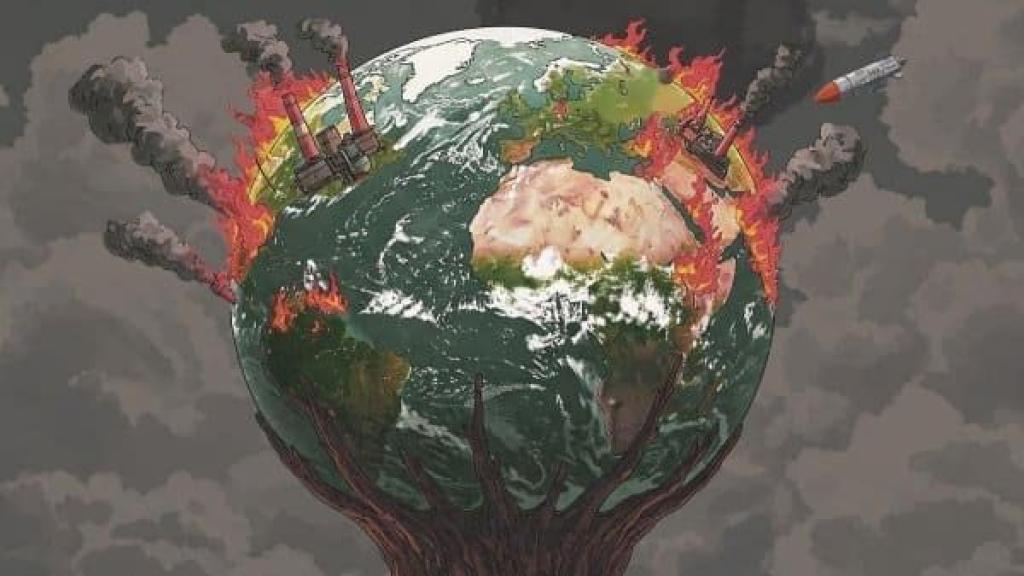


book cover Fiery Red

In his new book, Rojo fuego. Reflexiones comunistas frente a la crisis ecológica (Fiery red: Communist reflections on the ecological crisis), Argentine Marxist Esteban Mercatante takes aim at capitalism as the root cause of the “multidimensional” ecological crisis, while engaging in important dialogues with ecological currents such as degrowth and ecomodernism. Against these, Mercatante argues for an “ecommunist” strategy, focused on labour as the agent of both its own emancipation and the qualitative transformation of society’s relationship with nature, as the only means to avoid disaster. 

With the book only available in Spanish, Federico Fuentes from LINKS International Journal of Socialist Renewal spoke to Mercatante, who is also an editorial board member of Ideas de Izquierda (Left Ideas), to discuss some of the key points raised in his book.

Given the already existing and constantly expanding range of literature on Marxism, ecology and the climate crisis, what made you decide to write your book?

It was precisely because this issue has become such an important focus of contemporary discussions. The ecological crisis today is an intersecting issue, which means that this issue and its impacts must be taken into account across different disciplines.

In this book, I was interested in exploring two things. On the one hand, I wanted to introduce a Marxist perspective — which is not as accessible for Spanish-speakers — into the discussion, particularly here in Argentina where the book was published (it has now also been published in Spain). Most ecomarxist works produced in the past decades, from the early contributions by John Bellamy Foster through to the more recent writings of Kohei Saito and Andreas Malm, have been relatively little discussed. Taking into consideration the dialogue that is occurring between revolutionary left activists and ecologists, I wanted to try to synthesise some of these contemporary contributions that put forward an ecological critique. There are also questions that ecomarxists need to further develop their ideas on, and I wanted to contribute to that too.

On the other hand, I want to look at all the ways in which Karl Marx's critique of political economy can help expose the anti-ecological character of capital accumulation. Part of the book reconstructs the different phases of production and circulation of capital, from capital-labour relations to the formation of a world market based on increasingly accelerated flows of commodities and money. This helps us think through how different ecological problems are generated at each stage of this cycle.

Lastly, there is another key question that Marxism has struggled to address — and which we need to debate — and that is how to link our ecological critique of capital to a revolutionary strategy for transcending capitalism and prefiguring a society that can move beyond capital. This is a major weakness in the otherwise important contributions by Foster, Saito and others. More recent attempts have sought to deal with this challenge, for example Andreas Malm’s call for an “ ecological Leninism”. But, as refreshing as his approach is, his view that the revolutionary seizure of power, as the first step towards transitioning to a socialist society, is not on the agenda today leaves his proposal somewhat floating in the air.

What my book aims to do is contribute to what I believe is a fundamental discussion on how to develop, from an ecological perspective, a revolutionary strategy around a communist vision that both seeks to liberate humanity from exploitation and restore a balanced metabolism between society and nature, which form a differentiated unity.

Environmentalists often focus on climate change, but your book situates this issue within a broader “multidimensional” ecological crisis. Could you elaborate on this?

The idea that we face a multidimensional crisis has been well illustrated by the Stockholm Resilience Centre’s study. It sets out a series of planetary boundaries. One involves greenhouse gases and global warming, but it also looks at biodiversity loss, deforestation and land use changes, ocean acidification, air pollution, and several other boundaries. All up, the SRC sets out nine boundaries and a series of critical thresholds for each that should not be crossed to avoid accelerated deterioration with unforeseeable consequences for a “tolerable” — let alone desirable — human life.

This is what I mean by a multidimensional ecological crisis. It is important to raise this because many of the solutions proposed by green capitalism advocates to deal with ecological problems tend to focus on a single issue — mainly climate change. This generates proposals that, while seeking to fix one issue, end up negatively affecting others. For example, an energy transition requires extracting minerals such as lithium on a large-scale to produce storage batteries. But this leads to more resource extraction, which uses a lot of water and alters ecosystems in dependent countries such as Chile, Bolivia and Argentina.

Why do you say that the cause of this crisis lies in “capitalism’s DNA”?

Capitalist society is characterised by the drive to convert nature into an object that can be valorised. The same occurs with labour power. Dependent on capital, labour is forced to continuously produce as much value as physically possible. The law of value, when extended to nature, implies prioritising the development of techniques that can facilitate extracting the greatest quantity of resources (whether agriculture and livestock, tree plantations for timber, fish farms or minerals) for the lowest price. Nature is “valued” solely in terms of the cost of appropriating it. Meanwhile, certain areas are set aside as “dumping grounds” for waste, which is deemed a “service” capital can exploit.

Under capital’s logic, environmental impacts have historically not been factored into the business equation. In traditional economic theory, they appear as an “externality” — something not intrinsic to business running costs. Capitalist states have sought to “correct” this through environmental governance, with measures including taxes, fines and other mechanisms such as carbon credits. But these do not fundamentally change the relationship between capital and nature, or the negative impacts of various productive activities. They simply make companies pay for polluting by putting a “price” on it, while doing nothing to repair ecosystems.

Capital prioritises short-term profitability, even if that generates burdensome consequences in the medium or long term. Today we are seeing some of these unforeseen consequences from past actions, such as climate change caused by greenhouse gas emissions from preceding centuries. Yet even now, when we know about these consequences, we see oil companies, faced with the prospect of winding up their operations, rushing to extract every last drop of oil, thereby making the consequences even worse. This behaviour — driven by a viewpoint that Saito, borrowing a phrase from Marx, aptly describes as “ after me the deluge” — undermines the prospects of intergenerational sustainability. Sustainability has become a kind of mantra for many companies, but it is mostly pure greenwashing.

The logic of capitalism leads to attempting the “ production of nature”, as geographer Neil Smith put it; that is, a nature entirely mediated by the social, by capital. But attempting this — and Smith somewhat underestimated these limits — is fraught with tensions, because natural metabolic processes are very complex. Capital’s efforts to subsume them generate unpredictable consequences, the impacts of which are proportional to the efforts to dominate nature. This is what Engels had in mind when he spoke of the “revenge” of nature against domination attempts that ignore the limits imposed by nature’s laws and instead seek to “twist” them for profit.

In the book’s introduction, you explain that the environment is very present in state policies and business practices. But, borrowing a phrase from Ajay Singh Chaudhary, you argue what reigns today is “ right-wing climate realism”. What do you mean by this?

Chaudhary correctly points out that a significant section of the ruling class helps ensure climate policies are cosmetic or impotent. Not because it is denialist but because it believes it can survive accelerating deterioration as climate events become ever more recurrent and catastrophic. Chaudhary puts forward the idea of an “ armed lifeboat”, in which those with sufficient resources can — and do — invest in underground bunkers equipped with all the basic necessities, while simultaneously investing in technologies that might one day allow a chosen few to evacuate Earth.

The obvious question is how much of this is feasible and how much is pure science fiction, at least for now. But I am interested in the idea that these sectors see no contradiction in acknowledging the ecological crisis while refusing to promote initiatives that could do something about it. It debunks the idea we so often hear that “ we are all in this together.” When it comes to the ecological crisis, we are not all in this together. That is why the working class and poor must promote our own solutions, because no section of the ruling class — denialist or non-denialist — is going to do that for us.

Has the rising global influence of the far right — we now have far-right presidents in Argentina and the United States — tipped the scale more towards denialism, whether in terms of national policies or in international forums such as the COPs? Related to this, how do you interpret the rise of ecofascist tendencies within this broader far right?

Undoubtedly, as the extreme right grows stronger globally, the voices of denialism, which reject the Paris Agreement and the 2030 Agenda and want to disengage from the COPs, are gaining strength. But divisions and tensions are arising among them, which means things are not so clear cut. Until two months ago [US President Donald] Trump and [tech billionaire] Elon Musk were allies; now they are at loggerheads. The former has always been a denialist, while the latter champions electric automobiles. As a result of this clash, it seems we will have cuts to public funding for electric vehicles and associated technologies. But this could have gone a different way. As we have often seen, the extreme right, with its very strong denialist component, has not necessarily translated its ideas into coherent policies. With each case, we have to look at what different alliances are formed, what concessions have been made to sectors of big capital, etc.

It is important to note that denialist attacks have, in their own way, helped legitimise the stagnant agenda of various multilateral forums. There is an increasing trend among left and progressive sectors to defend them against attacks from the right, and even silence criticisms they once made of the miserliness, impotence and cynicism that pervades these spaces. These forums, along with corporate “ green capitalism”, have gained some legitimacy from being attacked by these denialists. We must be alert to this danger.

The emergence of ecofascisms, though still somewhat incipient, is also important to note. As the consequences of the ecological crisis worsen, we should not be surprised if “emergency measures” take on an evermore overtly ecofascist character. For instance, we can see how the far right tries to draw a link between xenophobia and the view that the climate crisis will lead to future threats of increased immigration waves.

We must be clear that if the working class does not develop an independent, revolutionary political perspective capable of responding to social needs and showing a way out of these crises by tackling the root cause — capitalism — then it is increasingly likely that reactionary solutions will be imposed.

Alongside the growth of ecofascist positions, we are seeing an increasing promotion of apocalyptic visions, particularly among some left sectors who believe that a discourse of environmental catastrophism or collapse will mobilise people. What do you think about this?

This idea of collapse can take different forms.

One is a rehash of the old mechanistic catastrophism that certain anti-capitalist left sectors ascribe to any crisis (whether economic or ecological). Such crises are viewed as objective factors to help compensate for difficulties in the subjective terrain, that is, for building a revolutionary social force. Such currents have appeared throughout the revolutionary movement’s history. It is not surprising that the ecological crisis provides them with some fuel.

Another current believe it is impossible to sustain any type of social organisation that is so dependent on scarce fossil fuels, and therefore resource depletion will inevitably impose reduced social demand. For them, globalisation will become unsustainable and force a return to local, communal spheres. Such thinking is often tied to a certain version of degrowth — not as something desirable, but something that will inevitably be imposed on us.

Lastly, the idea of collapse can also take the form of a kind of generalised common sense or “ structure of feeling”, which is reinforced by the rising recurrence of climate disasters. Out of this has emerged the idea that we have run out of time and are already inexorably heading towards catastrophe. Rather than triggering anti-systemic mobilisations, this leads to paralysing pessimism.

Whether arising as a result of mechanistic thinking or pessimism, collapsism is an obstacle for action. Instead, we must fight against the impending catastrophe.

Some argue that as Global North countries are largely responsible for the crisis they should bear the main responsibility, while Global South countries can use natural resources as they want to develop their economy. What is your view of this complicated issue, often called “ common but differentiated responsibilities” or, in its most radical form, climate justice?

This view contains an important critique of systemic inequalities. This is something formally recognised in international governance, for example when differentiated greenhouse gas emission targets are made on developed and developing countries, respectively. Global climate justice movements have helped bring many of these issues to the fore. Ecological currents have also developed concepts such as unequal ecological exchange and ecological debt.

However, the problem for dependent countries, whose economies remain dependent on the Global North’s, is that “capitalist development” has become a pipe dream, something recent history shows is impossible for them in an imperialist world. In my book El imperialismo en tiempos de desorden mundial (Imperialism in times of world disorder), I look at how the formation of global value chains has condemned dependent countries to a “race to the bottom", in which each strives to offer more flexible labour and environmental regulation and tax incentives to attract investment. The result is that even countries with some success inserting themselves into the many links within existing value chains have not managed to develop their economies in any significant way. Rather, we see increasingly unequal value distribution along these chains, with richer countries taking the lion's share.

That is one issue. The second issue is we must question what development means in times of ecological crisis. It must be clearly stated that non-capitalist perspectives are the only way, first, to break the chains of dependence and plunder, and, second, promote a society that can fully satisfy social needs while maintaining a healthy metabolism between humans and nature. Capitalism cannot do this.

You write that “different currents within critical ecology and ecosocialism give very different answers to what should be the central coordinates guiding the organisation of post-capitalist societies.” What are these main currents?

Broadly speaking, these currents today tend to be polarised between proponents of degrowth and advocates of an anti-capitalist or ecomodernist accelerationism.

The main target of degrowth — as its name suggests — is economic growth, which is identified as the main cause of the ecological crisis in its multiple dimensions. Significant space is dedicated to the “ ideology” of growth in most of these writings. Many degrowth texts spend time explaining how gross domestic product (GDP) growth became an incontrovertible measure of economic success, and how all economic policies since the 1930s are based on stimulating continuous growth. Degrowthers argue that you cannot put an equal sign between GDP growth — or more specifically GDP per capita — and wellbeing. They say, beyond a certain point, higher GDP per capita does not equate to an equivalent improvement in people’s lives.

It is worth keeping in mind that these authors write from, and think about, their situation in rich countries. Their argument that what we face today is over-consumption, and that resource extraction far exceeds the planet’s capacity to replenish what is extracted, makes sense when we talk about developed countries. They raise concepts such as the “ imperial mode of living”, which says rich societies live beyond sustainable limits, and do so at the expense of the rest of the planet from which they extract resources and offload the costs of environmental impacts.

This raises an interesting issue by inserting imperialism into the ecological question. But, at the same time, it contains several problems. For instance, discussion tends to end up going down the path of questioning consumption rather than production itself, which, beyond any intentions, slightly blurs the systemic root of the problem. Also, the working classes in rich countries end up being viewed as participants in this “imperial mode of living” — or, at least, are not explicitly excluded. This is despite multiple indicators showing a marked deterioration in their living standards in recent decades, due to privatisation and global economic restructuring. This is not clearly incorporated into degrowth perspectives.

This does not mean the burden of responsibility should be equally shared. Inequality is a very important aspect of these views: the idea that the ultra-rich — with their planes, yachts and mansions — share overwhelming responsibility for creating such a large ecological footprint. Moreover, questioning the notion of economic growth as an end in itself, as degrowthers do, is important. Productivist ideas have gained a foothold even among some anti-capitalist sectors, despite being a dead end. So, such warnings are valuable.

But there are big weaknesses in degrowth perspectives in terms of developing consistent alternatives. They say there must be qualitative changes in how things are produced, but struggle to come up with concrete measures. The quantitative emphasis — reducing the scale of production and consumption — is the only thing they clearly articulate.

The common denominator between different visions of degrowth is a vague, and often ambiguous, anti-capitalist stance. Questioning economic growth as an end in itself means opposing a basic aspect of capitalism, because there is no continuous capital accumulation of value if there is no concomitant rise in resource extraction. But it is much more difficult to translate this negative idea into a positive alternative.

There are also differences among exponents of degrowth on the alternative. Some authors, such as Serge Latouche, are directly hostile to the idea of socialism, given the past experiences of the former bureaucratised workers' states, and accuse all Marxists of being productivist. Others argue that a steady-state capitalist economy (in which some sustained measures avoid growth while guaranteeing reproduction at a stable rate) may be possible, and that therefore degrowth and capitalism are not inherently antagonistic. There are also those with more anti-capitalist views, such Jason Hickel or Kohei Saito, the latter of which explicitly advocates for degrowth communism.

Notwithstanding these nuances, what characterises all these visions is their focus on a kind of minimum or immediate program, which may vary a little but is basically conceived as demands on the state. They include some interesting issues we can agree on — such as reducing the working day — but are not combined with a transitional perspective, or something resembling a strategy to transcend capitalism.

Standing opposed to these positions — in an almost mirror-like fashion — is ecomodernism. From this perspective, the answer to the ecological crisis lies in accelerating technological development. Its central diagnosis is that, under capitalism, innovation is unable to fulfil its full potential, as it gets harder to translate it into profitable business models that justify investments. Aaron Bastani’s book Fully Automated Luxury Communism is a prime example. In Bastani's view, freeing technological development from the constraints imposed by capitalist relations of production would make it possible to fully automate production processes.

In this sense, ecomodernism is opposed to reducing metabolism. On the contrary, they argue the need to continue pursuing growth, and perhaps even growing faster, in order to come up with innovations that can solve environmental problems. The problems capitalism generates are simply reduced to a lack of planning. Ecomodernism envisions forms of consumption intrinsic to this mode of production continuing beyond capitalism, thus contributing to their naturalisation and dehistoricisation. Technology is also fetishised. It tends to be given an aura of neutrality, when in fact all new developments and innovations are shaped by class relations.

For ecomodernists, there is almost no limit to the so-called decoupling of the economy from the environment — that is, ensuring the least possible impact in terms of resource extraction and waste production. The expansion of what Bastani defines as “fully automated luxury communism” can therefore apparently occur without encountering any sustainability problems. They base this on the claim that this has been occurring for a long time under capitalism in the more developed countries.

The problem is that, despite undeniable efficiency gains in terms of material impacts, statistics on so-called decoupling mostly leave out the fact that, due to changes in the global division of labour, such countries depend much more on material processes occurring outside their borders; namely, industrial processes in developing countries that are controlled by multinationals based in imperialist countries. What we have is less decoupling than the offshoring of production processes to third countries, through which environmental impacts are “outsourced”. Once we take this “offshoring” into account when looking at ecological footprints, the scale of decoupling is largely reduced, if it does not disappear altogether.

Putting faith in an automated luxury communism based on such weak assumptions can only lead to ruin. Precisely because they do not want to put all their eggs in one basket, they often hedge their bets, saying that if we cannot achieve enough decoupling, then the answer lies in space mining (the extraction of metals from asteroids) and using outer space as a dumping ground for the trash accumulating in increasingly unsustainable ways across much of the planet.

Lastly, ecomodernists think more in terms of eliminating labour than transforming it. Dave Beech views this current as essentially anti-work. This shows itself in the absence of the working class as a subject with any role to play in its emancipation or establishing a different social metabolism. They hope that the system’s contractions, worsened by the kind of accelerationism they propose, will produce a post-capitalism that enables planning, along with the “democratisation” and extension of the consumption patterns of the rich to the rest of society.

Given these patterns cannot be made universal within the finite limits of the planet, it is not surprising they have to conjure up intergalactic solutions to environmental challenges. What we are left with are proposals such as Bastani’s, that offer a (luxury) “communist” variant of the kind of space ravings of Elon Musk or Jeff Bezos.

Against these currents, you argue the case for an “ecommunist” perspective? What is ecommunism? Why and how does it differ from ecosocialism?

The term ecomunismo comes from the title of Ariel Petruccelli’s latest book, which was published in Spanish almost at the same time as mine. I adopted the term because it foregrounds the central issue that ecological Marxism or ecosocialism must emphasise. Instead of debating whether “solutions” will come from technology or reducing metabolisms, we need to organise the needed social forces to attack the foci of ecological destruction: capitalism and the relations of production this exploitative social order engenders.

For many critical ecologists, including even some ecosocialists, the relations of production are a kind of “black box”; a terrain left unexplored or only tangentially mentioned. They miss the centrality of ending alienated relations between the great producing class — the waged labour force — and the means of production. Ecomodernists and degrowers both talk about reducing the working day, albeit for different reasons and motivated by different logics, but what is missing from both is the protagonism of labour — exploited by capital — as an agent in its own emancipation and in the qualitative transformation of society’s relationship with nature.

Ending the monopoly of private ownership over the means of production implies expanding workers’ democracy — the democracy of those who produce and also consume a great part of what is produced — into a sphere currently dominated by capital. Under capitalism, production-consumption is a differentiated unity mediated by the process of exchange, in which social need can only be expressed as a financially-sound demand (and can only appear as the choice of one or another commodity that capitalists have previously decided to produce and sell). As such, only by socialising the means of production can we re-establish a genuine unity of both processes, in which production is based on satisfying social needs — the first step towards any kind of planning. This is a key aspect that can help us break free from the polarised debate between “more” or “less” that has dominated discussions among ecosocialists.

Rationally mastering society's metabolism with nature by collectively deciding what to produce (based on which social needs should be prioritised) does not mean we can avoid difficult decisions around capitalism’s legacy of environmental destruction. But rather than these decisions being made by the private power of capital — backed by governments whose central function is reproducing capitalist relations of production — it will be the producing class as a whole, having regained control over the means of production, which will work out proposals to settle these questions. They will do so while ensuring that three different objectives are met: fully satisfying fundamental social needs; democratising production; and seeking to establish a rational metabolism with nature. Moreover, “expropriating the expropriators” will allow us to recover a broader notion of wealth, which breaks with the idea that abundance must translate into the kind of limitless consumerism that capitalism has promoted to sell ever increasing numbers of commodities.

Post-capitalist ecomodernist mirages envision the end of labour through automation, where machines, the ultimate embodiment of capital, appear as divine incarnations, but nothing is said about how, what and who will decide what is produced. In contrast, communism, as we understand it, has at its heart the transformation of labour and its relationship with nature. This is the cornerstone for recovering all the potential denied to labour by the alienated relations imposed on it by capital and, at the same time, for ending the abstraction of nature. These are the preconditions for moving from the realm of necessity to the realm of freedom, which presupposes a balanced social metabolism.

I am not proposing any magic bullet for dealing with the dangerous ecological crisis that capital will leave behind for any society emerging from its abolition. Achieving new relations of production based on collective decision-making will not mean being able to fix overnight the ecological disaster capitalism has produced. The more sober proposal I am making is that there is no need to delude ourselves with the techno-optimistic prometheanism of “fully automated luxury communism”, or resign ourselves to the hardships advocated by degrowthers. On the contrary, achieving a society based on the democratic deliberations of all workers and communities, and on planned social production through socialisation of the means of production in the hands of a minority of exploiters, can create the conditions to allow us to meet the twin objectives of (re)establishing a balanced social metabolism while fully satisfying social needs.

 

Call for 1st International Antifascist Conference


[Editor’s note: An leader of the Socialism and Liberty Party (PSOL) will be speaking at Ecosocialism 2025, September 5-7, Naarm/Melbourne, Australia. For more information on the conference visit ecosocialism.org.au.]

First published on conference website.

We are in the midst of an intense struggle over the direction of society. The Brazilian people endured the tragedy of the Bolsonaro government, drawing lessons about the genocidal and authoritarian nature of its project. Through intense social and political mobilization, we were able to defeat it at the ballot box. However, Bolsonarism still maintains a significant presence in society and within institutional spheres. This, however, is not a uniquely Brazilian problem — it affects the rights of the working classes across the world, especially in the so-called “Western world.” The far right governs or stands as the main political alternative in much of Europe. They govern the planet’s largest military power. They govern or pressure governments that claim to be democratic and popular, as well as liberal governments of all types.

Brazilian organizations operating in the southern region of the country had convened the 1st International Antifascist Conference, initially planned for May 2024. However, at that time, the state of Rio Grande do Sul experienced the worst flood in its history — a direct consequence of climate change that affected millions of people. At the time, hundreds of people representing causes and struggles from 31 countries across 6 continents had responded to the call. Given the gravity of the situation, it was a difficult but absolutely necessary decision to cancel the event, so that all efforts could be directed toward rebuilding the devastated cities. Now, the time has come to resume the call for the Conference, maintaining the same principles that guided the original invitation.

The rise of the far right, alongside the emergence of openly fascist organizations, coincides with the first assessments of the traumatic experiences represented by the genocidal governments of Jair Bolsonaro in Brazil and Donald Trump in the United States. In addition, the genocide in Gaza persists — denied by the imperialist nations, but condemned unanimously by the so-called “Global South” and by organizations awaiting the outcome of the case brought before the International Criminal Court. In neighboring Argentina, Javier Milei is waging a war against the working class, the popular sectors, and the youth, working to dismantle historic social and democratic rights. In Porto Alegre, a city with deep democratic traditions and aspirations, we seek to build a space of unity between forces with social presence and political relevance — both electorally and in broader ideological and political terms —, prioritizing the fight against the far right on multiple fronts, based on political unity while respecting differences.

The analysis of these historical experiences reveals the resilience of democratic and progressive forces. However, the scale and coordination of fascist and far-right forces continue to grow, resonating with sectors invested in deepening the most recent dynamics of capitalism, particularly those driven by the interests of global financial capital. This is directly connected to the international coordination of neofascist and far-right movements, which are organizing to compete on a global scale for their project.

Led by the Socialism and Liberty Party (PSOL), the Workers’ Party (PT), and the Communist Party of Brazil (PCdoB) in the state of Rio Grande do Sul, we call on international antifascist forces to open a dialogue capable of confronting the destruction being carried out by ultraliberal conservatism — placing unity in the streets against the far right as our top priority. Porto Alegre was the epicenter of popular resistance that defeated a coup d’état in 1961. At the beginning of this century, it hosted the World Social Forum, gathering diverse expressions of the left and social movements. Hundreds of thousands took part in this collective process to build another possible world.

Beyond differing perspectives on that experience, we now seek to take a step forward — a necessary one. The mobilizations and mass social struggles against the far right are the other side of today’s international reality. Hundreds of thousands are taking to the streets in Germany against the neo-Nazi party; across five continents against the genocide of the Palestinian people; and in Argentina, in massive resistance by workers and popular sectors against the Milei government. The first general strike of the year, in January, sparked a massive national mobilization that went far beyond the trade unions that organized it. Workers, neighborhoods, assemblies, cultural groups, independent media, youth, and the broader left joined together in a true united front to defeat Javier Milei.

It is in the spirit of these struggles that we aim to coordinate and come together from March 26 to 29, 2026, in Porto Alegre, to organize and debate how to build a movement — both in the streets and across multiple spaces — capable of confronting far-right and fascist expressions. We aim to open the way for solidarity among struggling peoples and for the defense of social and economic rights, democratic freedoms, the environment, science, and the arts – and against all forms of exploitation, xenophobia, and oppression.

We call on all organizations, individuals, movements and political actors who wish to take part to join us in this political space and initiative by endorsing this call.

Antifascist greetings,

PSOL, PT, PCdoB

Brazil: A major political change


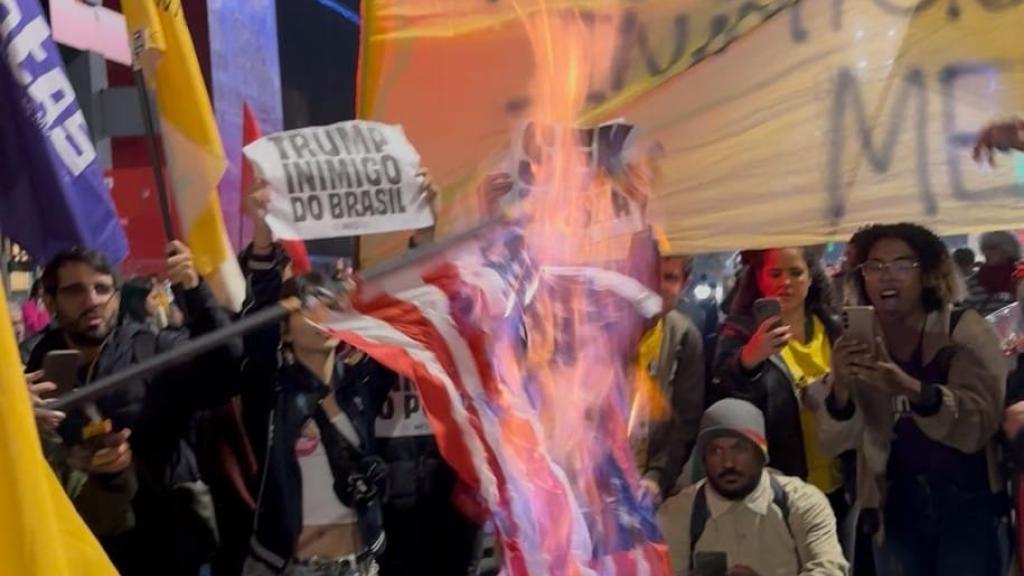
Burning US flag in Brazil protest

[Editor’s note: An leader of the Socialism and Liberty Party (PSOL) will be speaking at Ecosocialism 2025, September 5-7, Naarm/Melbourne, Australia. For more information on the conference visit ecosocialism.org.au.]

First published at Revista Movimento

Brazil’s political landscape has undergone a significant shift in the past two weeks, marking a qualitative change in national political dynamics. What began as a crisis triggered by the majority of Congress taking a right-wing opposition stance, demanding that President Lula da Silva respond more forcefully with popular policy, escalated sharply after the incident with US President Donald Trump and retaliatory tariff war directly attacked Brazilian sovereignty.

Our caucus within the Socialism and Freedom Party (PSOL), the Socialist Left Movement (MES), has quickly responded to the changing situation. We took to the streets on July 10 and participated in joint actions at every rally and demonstration aligned with this agenda, against Congress and the enemies of the Brazilian people: the far right, Trump, and the domestic coup-plotters. At the 60th UNE (Brazilian National Student Union) Congress in Goiânia, the youth group Juntos continued this fight, promoting solidarity with Palestine, ecosocialism, and an end to university budget cuts driven by the fiscal framework.

In light of these new developments, beyond our firm commitment, we want to discuss the new coordinates and tasks arising from this major political change in Brazil, which is, however, a reflection of the international situation, where resistance to Trump and his dictates is growing.

Trump vs. the Brazilian people

On July 9, Trump sent a letter to Lula announcing a 50% tariff increase on Brazilian products. He framed this as retaliation for what he called persecution of former president Jair Bolsonaro and even issued threats against Brazil’s Supreme Court. This came just days after the BRICS summit held in Rio de Janeiro and was justified with the false claim that the US has a trade deficit with Brazil.

This assault on national sovereignty, which beyond targeting Brazilian institutions, threatened to collapse key sectors of industry, had immediate repercussions.

First, it sparked a wave of anti-imperialist sentiment not seen since the early-2000s protests against the FTAA (Free Trade Area of the Americas). In recent years, the far right had opportunistically claimed the mantle of patriotism, but this episode makes it harder for them to sustain that narrative.

It had been years since we saw US flags burned in protests, as in the July 10 demonstration.

Second, the tariffs hit a large swath of Brazil’s national bourgeoisie, from citrus growers and agribusiness to the coffee, steel, and aerospace sectors. The indignation was reflected in the editorials of the bourgeois press, especially those aligned with the São Paulo business elite, such as Folha and Estadão.

Finally, Bolsonaro and his allies became visibly politically isolated. Whether in the stance taken toward the government, where, albeit belatedly, Davi Alcolumbre and Hugo Motta (Senate and Deputies Chamber Presidents, respectively) closed ranks with Lula, or in the direct attacks on Bolsonaro — as Estadão did.

Tarcísio (Governor of São Paulo State) also suffered political damage. After clumsily defending Bolsonaro, he lost ground. One Estadão editorial made clear that a segment of the business class expects the São Paulo governor to prioritize his state’s economic interests. As a result, some centrist factions that were drifting away from Lula in favor of Tarcísio have now pulled back and are in wait-and-see mode.

As if that weren’t enough, Trump has continued his attacks, mocking street vendors on 25 de Março and even Brazil’s PIX payment system, giving Lula’s government ammunition. What was once a liability for Lula, the PIX crisis (negative repercussions generated by the government’s decision to monitor financial transactions with the aim of identifying tax evasion and other irregularities, with allegations that the government was planning to tax Pix), is now a problem for Trump and the Bolsonaro camp.

Government regains its footing

Trump acted like a “mad firefighter”, one who pours gasoline instead of water to put out fires. The federal government seized the moment, expanding on earlier gestures such as advocating for taxing the ultra-rich.

With a broader field of action, Lula capitalized on his opponents’ weakness on three fronts: he continued to rally political struggle against Trump through social media and allied social movements, tapping into the energy of the new conjuncture; politically, he took the right step in considering a diplomatic application of the reciprocity law; and on the business front, he is working to rebuild ties with sectors of the business elite that oppose Trump’s tariff hikes. Lula’s emerging new pact may moderate the polarization around taxing the rich and allow him to lower the intensity of grassroots mobilizations.

The outcome has been striking. Lula has regained his footing and is rising in popularity while his main rivals are losing ground. According to a Quaest poll, Lula now leads in all projected scenarios. The same poll found that 72% of Brazilians blame Trump for the tariffs on Brazilian goods.

It’s the so-called “popular agenda” that’s driving Lula’s rebound, as he gains in the polls and sees his opponents struggling, with Jair Bolsonaro ejected from the race, Eduardo Bolsonaro isolated and at risk of arrest, leaving Tarcísio erratic and on the defensive.

Lula also struck a deal with Arthur Lira (former Deputies Chamber President) to advance a bill exempting lower-income earners from income tax. Though the plan’s progressive structure is still insufficient, it’s a notable departure from Finance Minister Haddad’s previous stance. On the IOF (tax on financial transactions) issue, Supreme Court Justice Alexandre de Moraes mediated a compromise, prompting a retaliatory “bombshell” bill from Congress. Vice President Alckmin is now negotiating a way forward before the tariffs go into effect on August 1, but the outcome remains uncertain.

An agenda gaining strength

This political moment calls for action. There’s now a real opportunity to launch a mass campaign to tax billionaires and revive anti-imperialist sentiment at a time when wide segments of the population, across all social classes, are becoming politicized.

Defending national sovereignty means defending the country’s interests, defeating the tariff war, and helping build an international movement against Trump. This fight must involve mobilizations that are democratic and inclusive, such as the August 11 Student Day rallies, where major organizations are preparing protests. The Metalworkers’ Union of São José dos Campos has already held a major demonstration in front of Embraer. Congresswoman Fernanda Melchionna has introduced a bill — dubbed the “Sovereignty Bill” — to toughen economic reciprocity laws.

We must strike back against imperialism by taxing U.S. corporations, pushing for patent waivers, regulating profit remittances abroad, and taking other steps toward centralizing foreign trade.

To fuel the mass movement, workers must have confidence in their own power. Key demands like ending the 6-day workweek (6×1) need to be unified in a national day of strikes and mobilization. We must also participate in the people’s referendum scheduled for September.

Veto it, Lula!

Still, in the midst of all this, agribusiness quietly pushed through the “Devastation Bill” late at night. In a country set to host COP30, we’re now witnessing the worst environmental setback in decades.

This only underscores the regressive nature of agribusiness, which depends on a primary-export model that breeds subservience, exploitation, and environmental degradation. That’s why the anti-capitalist and independent left, represented within PSOL, must continue to assert its own agenda and values.

Lula was right to listen to public opinion and veto the bill that would have increased the number of federal deputies. Now he must do the same again: Veto the Devastation Bill, Lula!

A new political phase is underway. It’s a showdown between imperialism, its local agents, coup-plotting sellouts, and the Brazilian people as a whole. Only through grassroots mobilization can we build the strength to defeat Brazil’s enemies.

Israel Dutra is a sociologist, Secretary of Social Movements for PSOL, a member of the party’s National Leadership, and an activist with the Socialist Left Movement (MES/PSOL).


Solidarity with Venezuela: The real issue is demonization, not criticism of Maduro


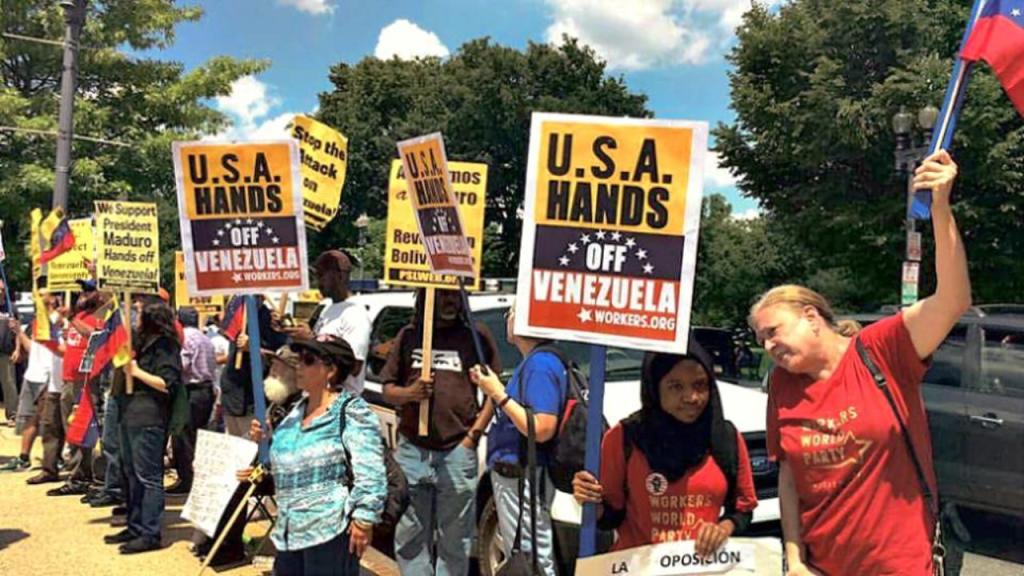
Protest in solidarity with Maduro

One important debate on the left over the past century has centred on assessing governments committed to socialism that, when confronted with imperialist aggression, veer from their original course.1 Cases in point include: the Soviet Union under Josef Stalin and after 1953, Cuba under Fidel Castro, Vietnam following the death of Ho Chi Minh, China under Mao Zedong and Venezuela under President Nicolás Maduro.2

The exchanges on the pages of LINKS International Journal of Socialist Renewal between Gabriel HetlandEmiliano Teran MantovaniPedro Eusse and myself over the Maduro government must be seen in this wider historical context. In his latest rejoinder, Hetland does a good job summarising areas of agreement and differences between us, making any further recap unnecessary. This article will only examine four gaps.

Prioritising anti-US imperialism

First, the left worldwide needs to centre its attention on the struggle against US imperialism, and quite possibly characterise it as the number one priority today. Consider the US’s omnipotent role in combating progressive movements around the world, the devastation it has unleashed in Gaza and across the Middle East, and its military budget that fuels arms races and heightens the risk of a nuclear confrontation.

Just one example is its construction of the Golden Dome missile defence system and the Pentagon’s program for the mass production of drones. The aim is to force China to keep pace militarily, thereby straining its economy. The Ronald Reagan administration pursued the same strategy in the 1980s, which the right credits with hastening the collapse of the Soviet Union.

Mao’s dictum on the importance of determining the principal contradiction at any given moment — defined as imperialism during the Japanese occupation of China — is applicable to Venezuela. Its economy is dependent on petroleum to the extent that it is hard to imagine any leftist government escaping the devastating impact of US-imposed sanctions.

Considering Washington’s relentless regime-change actions, US imperialism must be seen as the principal contradiction confronting Venezuela. Yet in his discussion of what he calls “the most important criterion by far” for evaluating the Maduro government, Hetland indicates — at least implicitly — that he does not share this view on the imperative to prioritise the struggle against US imperialism.

Venezuela and Cuba are the front line of defence against US imperialism in Latin America. What is at stake is the prospect of total subjugation — hinted at by US President Donald Trump and his neocon supporters when they invoke the Monroe Doctrine, viewed as essential to safeguarding US national security.

Moreover, US intervention has given rise to failed states and prolonged civil wars in countries such as Haiti, Libya, Iraq and Afghanistan. Whether this depiction is relevant to the debate over the Maduro government is a valid question, which merits inclusion in the discussion.

Maduro’s progressive aspects

Second, nowhere in the two articles by Hetland is there any discussion of what I identify as the Maduro government’s positive or progressive aspects (foreign policycommunescommunity participation). His only comment along these lines is: “Maduro’s foreign policy continues to exhibit traces of anti-imperialism, but even this is highly limited.” Hetland, however, offers no explanation as to why he considers it “highly limited.”

The failure to address these issues is a fundamental shortcoming because my articles in LINKS do not deny important downsides of the Maduro government, but address the negative consequences and inaccuracies of demonising Maduro. My basic argument against HetlandTeran and Eusse (writing on behalf of the the Partido Comunista de VenezuelaCommunist Party of Venezuela, PCV3) is that demonising Maduro is counterproductive, as it undermines the work of the Venezuelan solidarity movement in opposing sanctions. 

The issue at stake is not mistaken policies but demonisation. Recognising important positive aspects runs counter to the demonisation that permeates their articles in LINKS. Following from the premise that anti-imperialism needs to be prioritised, the largely progressive nature of Venezuela’s foreign policy has to be brought into the picture in a major way.

The details matter, especially when they go beyond mere rhetoric. Examples include Venezuela’s solidarity toward Cuba in the form of shipments of much-needed oil on generous terms, despite the logistical difficulties imposed by US sanctions.

Furthermore, in the context of Latin America’s increasing political polarisation, Venezuela has been in the forefront of clashes with right-wing governments, including those of Argentina’s Javier Milei, Brazil’s Jair Bolsonaro, Ecuador’s Daniel Noboa and Panama’s José Raúl Mulino.

Moreover, Maduro’s actions have stood in solidarity with Venezuelan immigrants, at the same time as he has lashed out at Washington’s inhumane policies toward them. Also significant is the Maduro government hosting the World Congress against Fascism last year, which drew 500 activists from 95 countries, and vehemently defending the Palestinian cause.

Grey areas

Third, open debate, transparency and the free flow of information are the first things that get sacrificed when a nation is in a wartime-like situation. Such an environment has been thrust on Venezuela since 2014-15, with the four months of regime change street actions (known as the “guarimba”) and Barack Obama’s executive order declaring the nation a threat to US national security.

The resultant “ grey areas” pose a dilemma for analysts lacking inside information and complicate the task of reaching well-founded conclusions. Numerous examples can be cited. One is the cash transactions for oil on the high seas (known as “cash and carry”) to avoid secondary sanctions against buyers and shipping companies, a practice conducive to corruption.

Another is the strengthening of the military faction within Chavismo (which dates back to the start of the Chávez presidency, if not earlier) as a result of Washington’s open calls on military officers to overthrow the government. The unity of the two main longstanding currents within Chavismo, led by Maduro and former military lieutenant Diosdado Cabello, was a sine qua non for the survival of the Maduro government from the outset.4 This reality may have limited Maduro’s options.

The existence of grey areas does not rule out possible condemnation in absolute terms of a president of a given nation. They do, however, underscore the need to recognise that Maduro’s Venezuela represents an extreme case of a nation facing imperialist aggression, and to give serious consideration to the resultant challenges.

The existence of important grey areas also suggests that a nuanced analysis regarding the complexity of the Venezuelan case is more appropriate than the black and white one put forward by those who demonise Maduro.

Solidarity movement

Fourth, in the section in his second article under the subheading “Solidarity,” Hetland notes that the anti-Iraq war movement stopped short of defending the Saddam Hussein regime. He concludes that, by the same logic, there is no reason why the Venezuelan solidarity movement needs to highlight anything positive about the Maduro government.

The example of the Iraq War, however, is compelling precisely because it demonstrates the opposite. Hussein’s reprehensible image contributed to the disappointing mobilisation capacity (after an initial spurt) of the anti-war movement — in sharp contrast to the huge protests against the Vietnam War in the 1960s. One reason (although undoubtedly not the main one) was that large numbers of those who protested in the ’60s were inspired by the tremendous prestige that Ho Chi Minh enjoyed at the time.

Moreover, one of the most important and effective activities of the Cuban and Venezuelan solidarity movements has been organising trips to these countries (as the anti-Vietnam war movement also famously undertook.) One may ask: would an organisation that demonises the Maduro government be likely to sponsor delegations of activists and sympathisers to Venezuela?

Finally, Hetland’s comparison between the Iraq War and the international sanctions against Venezuela falls short, since anti-war movements (as in the case of Iraq) and solidarity movements (as with Venezuela) focus on different issues, as discussed in my previous rejoinder. The effectiveness of international solidarity movements, more than the anti-war movement, largely hinges on the positive image of the government that is being targeted by imperialism.

Anti-imperialism and socialist governments

In closing, I would like to bring into the discussion Domenico Losurdo’s Western Marxism: How it Died, How it can be Reborn,5 which recently has been the source of considerable debate on the left. Losurdo contends that historically much of the left (those he calls “Western Marxists”) has failed to grasp the anti-imperialist nature of socialist governments.

Elsewhere, I have criticised Losurdo for casting too wide a net in placing individual leftists in the pejorative category of “Western Marxism”. On the positive side, however, Losurdo’s book skillfully articulates what the experience of socialist governments have clearly demonstrated over the last century: socialist construction in Global South countries, in a world in which capitalism is hegemonic and imperialism predominates, is a far more complex process than the struggle to achieve state power. Even more so, in the case of Venezuela, which has been singled out by Washington for special attack, a fact that has been thoroughly documented.6

Losurdo contends that only leftist purists deny the role played by private capital in socialist transition. None of the four articles in this debate recognise the complexity involved in the economic transformation of a nation committed to socialism, such as Venezuela, and specifically the thorny issue of tactical allies with the private sector, which beyond doubt open the door to corruption.

Hetland notes that Chávez (and Maduro) “was unable to overcome Venezuela’s longstanding hyper dependence on oil,” while Eusse asserts that the Chavista government left the “rentier” model intact. While both statements are accurate, the authors fail to outline a viable alternative economic strategy, taking into consideration current circumstances. Indeed, there are no ready-made blueprints or panaceas to deal with the types of challenges the Maduro government has faced on the economic front since 2015, when Washington escalated its war on Venezuela and options became limited.

Any realistic analysis that offers solutions to the pressing economic problems confronting post-2015 Venezuela will inevitably be at odds with black and white thinking that demonises Maduro and equates his government with the right-wing opposition.

  • 1

    I would like to thank Leonardo Flores and Lucas Koerner for their critical comments on this article as well as the previous one posted by LINKS.

  • 2

    On what basis do I assert that Maduro is committed to socialism? Maduro’s personal and political trajectory is relevant. His background is not that of a social democrat-type politician. Born into a leftist family, Maduro was an activist and member of radical left parties in his youth, before joining the Chavista movement in the 1990s. For six years he served as foreign minister under former president Hugo Chávez, who few would deny was a socialist. Maduro heads the Partido Socialista Unido de Venezuela (United Socialist Party of Venezuela, PSUV), which officially adheres to scientific socialism and Marxism. 

  • 3

    With regard to the PCV’s critique of, and split with, the Maduro government in 2020, I have argued elsewhere that both sides committed errors that contributed to the falling out. I would like to add that throughout my career as a writer and analyst, I have written extensively on the PCV’s history (beginning with my PhD dissertation) and have highlighted its heroic struggles. In the process, I interviewed, got to know, and developed great admiration for numerous PCV historical leaders. Ellner, “Objective Conditions in Venezuela: Maduro’s Defensive Strategy and Contradictions among the People.” Science & Society (July 2023), p. 401-402. 

  • 4

    When Chávez died in 2013, there was considerable speculation that Maduro and Cabello would come into conflict over control of the Chavista movement. Maduro, who in the early years of the Chávez presidency headed the Chavista labour movement fraction in the National Assembly, was associated with worker demands and leftist ideology, unlike Cabello. Ellner and Fred Rosen, “Chavismo at the crossroads: Hardliners, moderates and a regime under attack.” NACLA: Report on the Americas (May-June, 2002), pp. 9-11.

  • 5

    Losurdo, Western Marxism: How it Died, How it can be Reborn (New York: Monthly Review
    Press, 2024).

  • 6

    Joe Emersberger and Justin Podur, Extraordinary Threat: The U.S. Empire, the Media, and Twenty Years of Coup Attempts in Venezuela (New York: Monthly Review Press, 2021), pp. 21-23; Ellner, “Objective Conditions in Venezuela…,” pp. 396-399


Rep. Randy Fine Tells Palestinians To ‘Starve Away’ as Babies Die of Malnutrition Under Israeli Blockade in Gaza

On Tuesday, Rep. Randy Fine (R-FL) said on X that Palestinians in Gaza should “starve away” while also claiming the reports of people dying of hunger due to the US-backed Israeli blockade are a “lie.”

Fine made the comments in response to the news that 15 Palestinians, including four children, died of starvation over 24 hours.

“Release the hostages. Until then, starve away,” Fine wrote on X from his official Congress account. “(This is all a lie anyway. It amazes me that the media continues to regurgitate Muslim terror propaganda.)”

President Trump and Randy Fine (photo via Fine’s X account)

The reports of starvation deaths from Gaza’s Health Ministry are corroborated by photos and interviews with family members of those who died. Among the dead on Tuesday was six-week-old Yousef al-Safadi, who lost his life due to the lack of baby formula.

Fine recently joined the House after winning a special election to replace Mike Waltz, President Trump’s former national security advisor, who has been nominated to be the US ambassador to the UN. Trump endorsed Fine despite his history of calling for violence against Palestinians.

Later on Tuesday, news broke that Fine was being added to the House Foreign Affairs Committee, which is headed by Rep. Brian Mast (R-FL), who previously volunteered with the Israeli military and once wore his IDF uniform while at work on Capitol Hill.


Dave DeCamp is the news editor of Antiwar.com, follow him on Twitter @decampdave.


Latin Patriarch of Jerusalem Says the Church ‘Will Never Abandon’ the People of Gaza

Cardinal Pizzaballa and Greek Orthodox Patriarch Theophilos III held a joint press conference after visiting Gaza

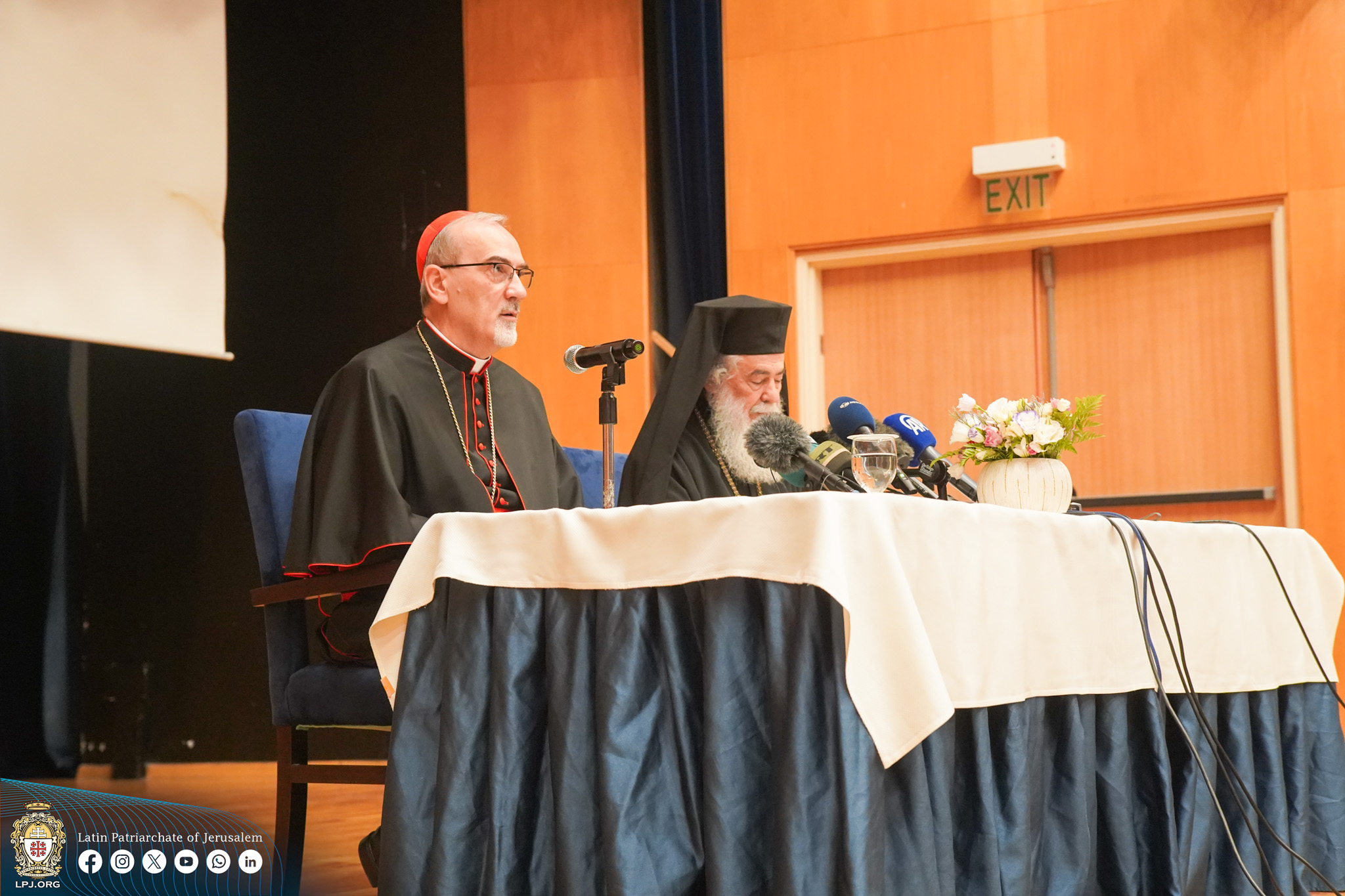
Cardinal Pierbattista Pizzaballa, the Latin Patriarch of Jerusalem, held a joint press conference on Tuesday with Greek Orthodox Patriarch Theophilos III after the two Christian leaders visited Gaza following the Israeli tank shelling of the Holy Family Church in Gaza City, which killed three Christians.

In an opening statement, Pizzaballa said the “Church, the entire Christian community, will never abandon” the people of Gaza. “Christ is not absent from Gaza. He is there — crucified in the wounded, buried under rubble and yet present in every act of mercy, every candle in the darkness, every hand extended to the suffering,” he said.

Pizzaballa emphasized that the visit to Gaza and the Church’s efforts were not only for the small Christian community, but also for the broader Palestinian population. “Our hospitals, shelters, schools, parishes — St. Porphyrius, the Holy Family, the Al-Ahli Arab Hospital, Caritas — are places of encounter and sharing for all: Christians, Muslims, believers, doubters, refugees, children,” he said.

Cardinal Pizzaballa (left) and Patriarch Theophilos III (right) during their joint press conference in Jerusalem on July 22, 2025 (photo via the Latin Patriarchate of Jerusalem)

In his statement, Theophilos said that he and Pizzaballa entered Gaza “as servants of the suffering Body of Christ, walking among the wounded, the bereaved, the displaced, and the faithful whose dignity remains unbroken despite their agony.”

Theophilos said that he witnessed “both profound grief and unyielding hope” during his time in Gaza. “To the international community, we say: silence in the face of suffering is a betrayal of conscience. To the children of Gaza, we affirm: the Church remains beside you. And to all those who wield power, we echo the Lord’s command: ‘Blessed are the peacemakers, for they shall be called children of God,'” he added.

Both patriarchs called for peace and a ceasefire in Gaza. “It is time to end this nonsense, end the war and put the common good of people as the top priority,” Pizzaballa said. “We pray — and call — for the release of all those deprived of freedom, for the return of the missing, the hostages and for the healing of long-suffering families on all sides.”

They also recounted the suffering they saw in Gaza due to the lack of food, and their press conference came as starvation deaths due to the Israeli blockade are dramatically increasing. “Humanitarian aid is not only necessary — it is a matter of life and death. Refusing it is not a delay, but a sentence. Every hour without food, water, medicine and shelter causes deep harm,” Pizzaballa said.

Pizzaballa and Theophilos also pointed to recent comments from Pope Leo XIV, who said on Sunday that the “barbarity” in Gaza must come to an end.


Dave DeCamp is the news editor of Antiwar.com, follow him on Twitter @decampdave.