Wednesday, July 23, 2025


Australia: Fighting AUKUS in Wollongong
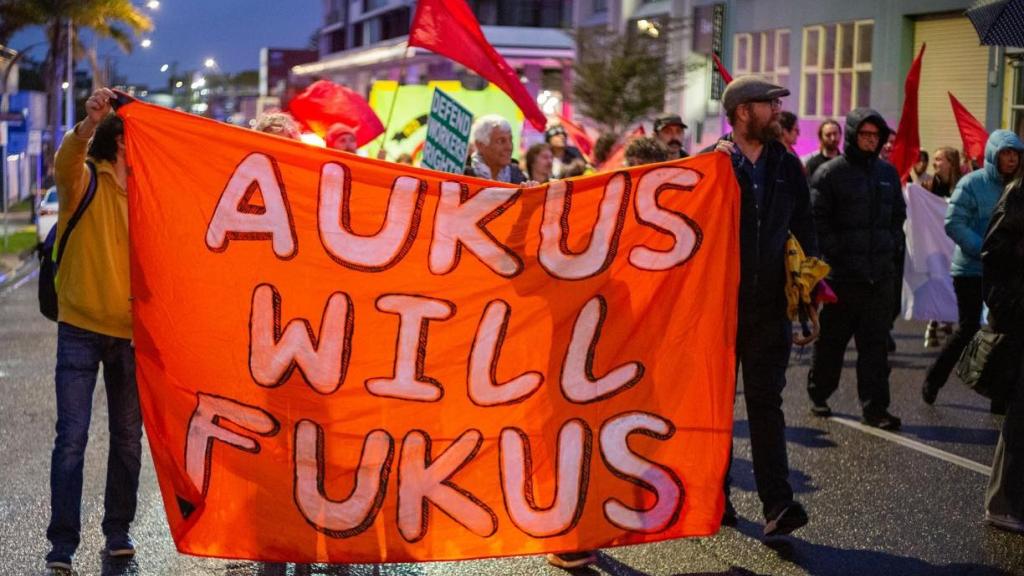

Wollongong May Day

In March 2023 former prime minister Scott Morrison identified Port Kembla, Newcastle and Brisbane as three sites short-listed for a future east coast base for Australia’s promised AUKUS nuclear-powered submarines.

Located in the City of Wollongong, Port Kembla is a major industrial centre south of Sydney, and the third largest industrial port in Australia’s largest state. It has long been a hotbed of social movement and industrial militancy. It was in Port Kembla that wharfies famously refused to load the tramp steamer Dalfram in 1938, when they learned that its cargo of pig iron was bound for Japan, and its occupation of China. Australian pig iron, the wharfies saw, was being used in the massacre of Nanking and would soon be raining down on Australia as “bombs and bullets”. The dispute escalated nationally and earned then attorney-general (and future prime minister) Robert Menzies the enduring nickname “Pig Iron Bob”.

There has been significant social, cultural and economic change in Wollongong in the nearly 90 years since the pig iron dispute. Today, a worker in Wollongong is more likely to work in health care and social assistance (17.3%) or education and training (11.2%), than in manufacturing (5.7%) or on the waterfront (transport, postal and warehousing, 4.5%). But the example set by Port Kembla waterside workers remains a living tradition.

Shortly after Morrison short-listed Port Kembla, Socialist Alternative activists at the University of Wollongong called a rally against the submarines in the city mall. It was attended by a cross-section of the community and addressed by students, local Greens city councillors, union leaders and community members. After the rally, Wollongong Against War and Nukes (WAWAN) formed and began organising an ongoing campaign to stop the submarines. Support was broad-based, coming from Greens and Labor members (including some councillors), left union officials and others.

The campaign escalated in 2023 following leaks to the media suggesting Port Kembla had firmed as the preferred location for an east coast base. The first WAWAN protest of the year was held outside the Defence Industry Conference, organised by local business peak body Business Illawarra to drum up arms-related business for local engineering and manufacturing concerns. The rally clarified the relationship between the nuclear base and the broader project of military industrialisation in Wollongong, both of which have the support of the Labor Party leadership. However, while visiting Wollongong for the defence industry conference, Labor Assistant Defence Minister Matt Thistlethwaite announced that any decision on an east coast submarine base would be delayed until at least the end of the decade.

The Defence Industry Conference was followed by the historic 2023 May Day March for Peace, Jobs and Justice at Port Kembla, when thousands of community members, unionists, socialists and peace activists from Wollongong, Sydney, Canberra and further afield marched in opposition to the base. WAWAN’ analysis was that Labor, having received a clear message from its union affiliates and local branch members that siting a base in Port Kembla would be contested, chose the path of least resistance by delaying a painful decision that would affect it in key seats in the Illawarra, while retaining its broader commitment to AUKUS. Having won a temporary reprieve, WAWAN shifted its focus to building long-term resistance to the militarisation of the city.

The huge escalation of Israel’s genocidal war against the Palestinians in October 2023 shifted the focus of anti-war organising in Wollongong. Solidarity with Palestinians brought different social layers into the anti-war movement, including more young people, students and members of local migrant communities with kinship and cultural ties to Palestine and the Middle East. Wollongong Friends of Palestine was established to coordinate solidarity action. Weekly marches held by the group in central Wollongong were well attended and although numbers have dropped off somewhat as the war drags on, continue on a fortnightly basis.

For WAWAN, organising against Israel’s genocide while maintaining local opposition to the subs meant rethinking and repositioning its work. In March 2024, when a second regional Defence Industry Conference was held in Shellharbour, WAWAN cooperated with Wollongong Friends of Palestine to protest the event. WAWAN highlighted the relationship between the desires of local business leaders and politicians to convert Wollongong’s industrial base for military industrial purposes and the war on Gaza by demanding an end to arms exports from the Illawarra to the Israeli Defence Force.

This demand emerged from a campaign of direct action initiated by local people who discovered that local steel manufacturer Bisalloy was producing armour steel for Israeli military contractor Elbit Systems. The company is also contracted to provide hull steel for the AUKUS submarine project. The campaign began when small groups of individuals occupied the facility and locked-on to equipment in late 2023 and early 2024. Since May 2024, there has been a series of rolling community pickets of Bisalloy’s Unanderra factory, the sixth of which took place in May this year. The first picket also coincided with the establishment of a long-running series of encampments and protests at the University of Wollongong. Remarkably, the pickets at Bisalloy have yet to suffer a single arrest and have successfully disrupted operations at the factory, with the company directing workers to stay home for the day shift on at least three occasions.

War as industrial policy

The Bisalloy blockades have been particularly important not only because of their militancy but because they contest the industrial policy that lies at the heart of the AUKUS pact. Speaking at the Lowy Institute a few days after Morrison first announced AUKUS in March 2022, then Opposition leader Anthony Albanese not only pledged Labor’s support for the deal but outlined three pillars of Labor’s national security policy: territorial defence, sovereignty, and “promoting Australia’s economic and social stability, with sustainable growth, secure employment, and a unified community.” Albanese linked AUKUS to Labor’s Future Made in Australia Plan, promising to insulate Australia from an increasingly chaotic world by developing a sovereign manufacturing capability. In the 2024 federal budget, Labor’s support for Australian manufacturing was dominated by defence-related spending, including AUKUS submarines and other heavy infrastructure.

Back of the envelope calculations show that the AUKUS plan will cost $18 million per job created. But in a climate of global instability, the appeal of militarist nationalism has seen even the Greens jump on the national security bandwagon, with Greens NSW Senator David Shoebridge jettisoning the party’s longstanding opposition to militarism in favour of developing a “sovereign capacity” to manufacture deadly missiles and drones. Of course, this turn to a populist “independent” and “sovereign” defence policy is not only an affront to internationalism and a distraction from necessary cross-border cooperation on climate change, it is absurd in a world where defence manufacturing projects involve globally integrated supply chains.

In Wollongong, the prospect of war as industrial policy has profound implications for the future of its industrial base. Back in 2009, the South Coast Labour Council (SCLC) commissioned a report that led to the formation of the Green Jobs Illawarra strategy. This green new deal policy suggested a positive way forward for the region, with the potential to preserve manufacturing jobs while building on the region’s strengths in research and innovation to address the threat of climate change. By contrast, the submarine base and associated defence industries exploit growing geopolitical tensions, fanned by Australia’s China threat industry, with its ties to US arms dealers.

Liberal Party figures in Wollongong, including NSW Right figure Concetta Fierravanti-Wells, have pushed the idea of Port Kembla becoming a naval facility since well before the AUKUS announcement. In 2015 the Illawarra office of Regional Development Australia released a report extolling the virtues of relocating Australia’s Fleet Base East from Garden Island in Sydney to Port Kembla. The same coalition of local interests have lent their support to the submarine base proposal. Many local business interests, such as those associated with steel manufacturing, have hedged their bets, lending support to both initiatives.

The two possible futures for Wollongong became starkly visible in 2023, when a significant element of the Green Jobs strategy was set to come to fruition. The federal government held a public consultation on a proposed offshore wind zone for the Illawarra. The proposal enjoyed strong support from Green Jobs Illawarra partners. However, a Trump-style anti-wind farm campaign appeared as if from nowhere, organised by a core of activists (including some with connections to the anti-lockdown and COVID denial movement) and National and Liberal Party figures.

The campaign spread spurious claims about environmental harms, including a fake article claiming to be from a peer-reviewed journal linking offshore wind to whale deaths. It attracted many residents, some with genuine concerns about the impacts offshore wind might have on ocean ecosystems, and others concerned about their million-dollar views. In October 2023, opponents held a large rally against the proposal with speakers including candidates from the Shooters, Fishers and Farmers Party and Pauline Hanson’s One Nation, as well as local surfers.

The Good for the Gong campaign, led by local environmentalists, including some with ties to the Greens and Labor, has sought to defend offshore wind. Unfortunately, despite weathering the storms of neoliberalism better than most parts of Australia, the trade union movement in Wollongong has never recovered from the devastation of the Accord period, when union officials agreed to police industrial militancy on behalf of Labor and the employers, leading to a huge decline in workplace democracy and grassroots union membership.

In the context of vastly weaker unions, Green Jobs remains largely the preserve of the union leadership and class-conscious union members within older, established sectors of the working class, together with the technically trained professional, scientific and engineering workforce, which has grown in size and significance since the 1990s (including in and around the University of Wollongong). Wollongong’s population has also grown, with significant in-migration from Sydney. These more recent arrivals lack ties to the established working-class institutions that still dominate local governance.

Good for the Gong has organised primarily online and lacks open democratic structures that could enable grassroots participation. Its proximity to Wollongong’s Labor and Green establishment has not generated the populist passions of the anti-wind movement. At the same time, the anti-wind movement has not proved to be enduring. Its ragtag organisation has little grounding in local institutions and lacks deep roots in the proletariat. Like Good for the Gong, it is a largely online phenomenon, but without local institutional support has been kept alive by shady figures with ties to conservative political parties with few members in Wollongong.

The consultation process eventually culminated in the declaration of an offshore wind area, but the only commercial proponent still interested in building the infrastructure, BlueFloat Energy, asked that its application for a feasibility license be suspended in February following then Opposition leader Peter Dutton’s threats to cancel offshore wind projects if elected. The episode has been an object lesson in the instability of institutions in the current period, where populist insurgency can threaten long-made plans but lacks the organisational ability to propose concrete alternatives.

Whither Wollongong?

With Trump’s on-again, off-again tariffs threatening Port Kembla steel and the potential of a renewables manufacturing hub neutered (at least temporarily), there is a high risk that participation in a US-dominated arms industry will be presented as the only choice for sustaining Port Kembla’s manufacturing future. The wedge politics around nuclear that Dutton pursued during the federal election campaign amounted to little more than a culture war at the national scale. Nevertheless, together with Labor’s ongoing commitment to militarism, opposition to renewables may serve to derail alternative paths of economic development long enough to allow military industrialisation to gather speed.

Reflecting on the pig iron dispute of 1938 is instructive here. The power of the working class to resist Australian and Japanese militarism emerged out of a bitter struggle against unemployment and the ruthless exploitation of workers in the coal mines, on the waterfront, and in the steelworks. Working class activists were prepared to defy industrial laws, and risked starvation and eviction, for the cause of peace.

The SCLC remains stronger than many comparable regional union bodies and has maintained a principled commitment to peace. While unions in Wollongong are a shadow of their former self, their commitment to keeping Wollongong free of nuclear submarines and developing peaceful, sustainable industries is important. Their influence has been particularly significant locally, given Labor dominates local power structures at municipal, state and federal levels, in some of the safest Labor seats in the country. But while unions and Labor members may be a threat to local MPs worried about their seats, there are few signs of willingness or ability to mobilise large-scale action on the job in defiance of industrial laws as the waterside workers did in 1938. The main exception to this remains the Maritime Union of Australia (MUA).

On Dalfram Day 2024, a now annual event when local unions hold a commemoration beside a sculpture commissioned to commemorate the Pig Iron Dispute near Port Kembla harbour, a community picket was held at Bisalloy. The SCLC has opposed the Gaza war and sought legal advice for local workers concerned about their potential complicity in war crimes, but has not issued any official endorsement of the community pickets nor mobilised an official presence.

As hundreds of local people gathered at dawn outside the factory gates, a full-page advertisement funded by the SCLC appeared in the Illawarra Mercury, drawing links between the Dalfram dispute, Bisalloy, and the AUKUS submarines. Up on the headland by the harbour, SCLC and MUA officials, the Labor Lord Mayor of Wollongong, the Consul-General of China, and members of the Australian Chinese community gathered to remember a time when wharfies defied their employer and their government in the cause of international solidarity. Nearby, however, few of the workers who stood outside the gates of Bisalloy were from these traditional sectors. Rather, they represented the precarious, largely non-unionised multitude that is the class today.

The Bisalloy dispute shows that it is possible to organise militant direct action without the direct involvement of the unions, and in doing so to evade the industrial laws that have undermined union power. WAWAN has sought to work across the contradictions that exist between established working-class institutions and the precarious multitude. Its small core of activists weave together personal and organisational links to both traditional and new social movements.

When unions and anti-war activists brought thousands to the streets on May Day in 2023, in what remains the largest anti-AUKUS protest to take place in Australia, it showed that our strategy works. Nevertheless, the challenges are significant. The Labor Party’s commitment to AUKUS has proved unwavering, despite internal dissent, and the Greens recent embrace of “sovereign” arms manufacturing suggests just how limited a challenge they represent to Australian Laborism.

The anti-windfarm campaign showed how a fragmented and intensely atomised proletariat could be manipulated to support right-wing populism. Nevertheless, solidarity with Palestinians has broadened Wollongong’s anti-militarist movement beyond the more traditional red-green alliance upon which WAWAN and the earlier Green Jobs coalition were built. The Bisalloy blockades demonstrate the living potential of the social movement militancy that is needed to reconstitute a powerful anti-war movement in the coming struggles.

Alexander Brown is a Wollongong Against War and Nukes activist.


From US hegemony to a ‘war of all against all’: Boris Kagarlitsky on Trump’s first 100 days


Boris on Trump

First published in Russian at Spichka and Rabkor. Translation and introduction by Dmitry Pozhidaev for LINKS International Journal of Socialist Renewal.

This article is based on a series of letters sent by Boris Kagarlitsky from a Russian penal colony, where he is serving a 5-year prison sentence on politically motivated charges for his outspoken opposition to the war in Ukraine and the policies of the Russian government. Despite the severe restrictions imposed on political prisoners, Boris has continued to write and analyse global developments, including Donald Trump’s return to the White House.

The letters, sent in fragments over the course of several weeks, starting in early May, were compiled and edited into a single article by Spichka1 and Rabkor.2 The resulting text — written without internet access and under conditions of censorship — offers a sharp and often ironic reflection on the political and systemic dynamics behind Trump’s return to power. It was prepared and published in Russian jointly by Spichka and Rabkor after being sent back to Boris for revision and approval.


Trump’s trump cards

After his first 100 days in office, Trump registered the lowest presidential approval rating in US history since such measurements began. The number of dissatisfied citizens surged, while voter support dwindled. But the president and his inner circle remained undeterred, insisting that the US people would eventually recognise the accomplishments of his administration. To many observers, the situation appeared to be a triumph of arrogance and incompetence. Yet, even if one accepts such assessments, a fundamental question arises.

How did such incompetent people come to lead the world’s greatest power?

In reality, it was Trump’s opponents who paved his way to power. For at least a decade and a half, starting with the 2008–10 economic crisis, when the flaws of neoliberal capitalism became fully exposed, US ruling circles (and to some extent Europe’s as well) invested enormous effort in preventing the emergence of any constructive alternative to the existing system. All political forces, particularly those on the left that were pushing for overdue and necessary reforms, were systematically marginalised or else corrupted and co-opted in exchange for abandoning any serious struggle for power.

One must admit that Bernie Sanders3 and his supporters in the US resigned themselves to this situation and essentially started playing to lose, as if engaged in a game where defeat was the condition for participation. As a result, the only remaining alternative consisted of irresponsible, incompetent and uncooperative figures characterised as “loudmouths who could never actually come to power.” At first, this was so obvious that no one took their shouting seriously. Even Trump’s first presidency between 2016-20 failed to teach the establishment any lessons. What happened was not viewed as a systemic threat but a random glitch, one successfully corrected without serious consequences.4 After all, in 2020, Trump lost the election and left the White House, having fulfilled virtually none of his promises.

Meanwhile, the situation continued to evolve, and not in the establishment’s favour. Regardless of what TV commentators, experts, intellectuals and political consultants had to say, the system’s internal contradictions revealed themselves, and unresolved problems kept accumulating, laying the groundwork for a new crisis, this time a political one.

Problems piled up, but no one solved them. Hence, a new political crisis

In 2024, the Democrats lost the election not because Trump’s ideas had become more convincing, but because the liberal establishment had worn out even its own supporters. At the last moment, realising the threat, the establishment tried to mobilise voters by scaring them with the horrors that would follow a Trump victory. But by then, the public’s disgust and contempt for the old political class, combined with the demoralisation of the moderate middle, had outweighed even the fear of a Trumpist experiment. The voters who could have stopped Trump simply did not show up. Some even voted Republican out of spite — after all, with Trump, at least things would be entertaining.

And the fun began.

The sociology of Trumpism

Trump’s first hundred days in office were marked by a surprising urgency, as the new administration, without much deliberation, immediately laid all its cards on the table. This rapid-fire assault brought not so much significant change as it did sheer chaos. But an obvious question arises:

Why is Trump in such a hurry? And more importantly — where is he rushing to?

Imposing tariffs on uninhabited islands or firing thousands of civil servants based on formal criteria without evaluating their actual performance — one could chalk all this up to administrative incompetence. Or blame it on the president’s impulsiveness and emotional instability. But the reasons go much deeper.

Like any populist coalition, Trump’s electorate is highly heterogeneous, uniting social groups with diverging (and at times, contradictory) interests. Such a coalition can function as long as it remains in opposition; its cohesion held together by shared protest against the existing power structure, even if the sources of discontent differ greatly from group to group. But once in power, and faced with the task of making real policy decisions, it becomes clear that some parts of the movement benefit from those decisions, while others not so much, and many more actually end up worse off.

Whatever Trump may say about reviving US industry, his working-class supporters are more likely to face a new wave of inflation than new job opportunities — further impoverishing already struggling households.

The Trumpist bloc is bound to unravel

Such disintegration is inevitable even if certain aspects of Trump’s policies “work” in the short term.5 Which is why it is crucial for him to push through major, irreversible changes as quickly as possible — while his supporters remain united and his opponents are still disoriented, demoralised and lacking a coherent agenda that might appeal to parts of his base.

The problem is that the urgency to act has forced Trump to simultaneously pursue what should have been done sequentially. For instance, his conflict with Western Europe escalated even before the war in Ukraine could be resolved (a task that, in any case, cannot be accomplished without European cooperation). The crackdown on immigration and the assault on social and cultural norms established in defence of women and middle-class minorities also began at the same time, triggering a cascade of scandals. In this context, a clash with the judiciary, though ultimately inevitable, occurred prematurely and tactically misfired. This was followed by confrontations with Mexico and Canada. The result is administrative chaos, wherein the president and his team repeatedly find themselves retreating, delaying implementation, and rescheduling their initiatives.6

Trump has created a new incentive for opposition mobilisation

By attempting a political blitzkrieg, Trump laid all his cards on the table far too early — cards that he might have kept as trumps in the future. Rather than exploiting the demoralisation and passivity of his opponents, he inadvertently gave them a new reason to organise.

Mass protests against the deportation of undocumented immigrants, starting in Los Angeles and sweeping across all major and many smaller US cities on June 14, 2025, demonstrated the enormous potential of a renewed opposition.7 Of course, these protests did not and could not bring about immediate political change, but they clearly show that a mass constituency is emerging across the country, one that is ready to unite and take action. The question is: who will organise these people, and how will they be guided into a serious political struggle?

The chaos Trump unleashed alienates the wavering, but consolidates his core base

Still, it is too early to declare his policies a failure. The chaos and fights stirred by Trump actions may repel undecided voters but, at an emotional level, they might also reinforce the cohesion of his core base. More importantly, the elitism and social deafness of the liberal opposition make it nearly impossible for many disillusioned Trump voters, especially working-class ones, to cross over, even if they come to feel betrayed by his policies.

Such a new political mobilisation would require not just a strong left-wing movement, but one that has freed itself from the ideological chains of political correctness and is prepared to act not as an ally of liberalism, but as an independent political force with its own face and agenda. So far, no such movement has emerged. But the US left still has time to reflect on the lessons of its defeats in 2016, 2020 and 2024.

The political economy of Trumpism

When I used the term Trumpism in one of my earlier articles, some of my colleagues questioned its accuracy. Dmitry Pozhidaev,8 for example, remarked that “anything ending in ‘-ism’ implies a relatively coherent and consistent system — something that cannot be said of Trump or his administration.” And indeed, when we look at the electorate of the current US president, we see a glaring contradiction between the interests and expectations of Rust Belt9 workers on the one hand, and billionaire “technocrats” such as Elon Musk on the other.

However, if we examine Trump’s decisions from the standpoint of political economy, we find actions that are in fact quite logical and consistent — at least in terms of the interests of US capital, or more precisely, the segment of it facing declining profitability and shrinking markets. “In that sense,” Pozhidaev concedes, “Trump’s policies may well deserve the ‘-ism’ suffix (though I suspect Trump himself is unaware of this).”

Trump seeks to forcibly correct the global economic imbalances that built up over the past thirty years

In short, Trumpism represents a policy of coercive redistribution of the disproportions in global capitalism that have accumulated over the past three decades and led to the Great Recession of 2007–09. At that time, the crisis was simply “drenched in money” without eliminating its structural causes. As a result, the imbalances continued to grow, and the system continued to malfunction. We are now confronted with the prospect of a new crisis, potentially even more severe.

But since Trump and his team hold conservative views, they also do not propose any structural changes involving the redistribution of resources, authority or power between the private and public sectors, or between labour and capital.

This time, it is not income and benefits being redistributed, but costs and losses

Essentially, the idea is to force other countries to shoulder the main burden of the crisis, thereby relieving the US of it. How that burden is distributed among classes and sectors in other countries is of no concern to Trump. But even within the US, the industrial working class that voted Republican in 2024 is unlikely to gain much: rising prices will not be offset by proportional job growth. British economist Michael Roberts10 has calculated that even in the best-case scenario, Trump’s policy would only raise the share of industrial employment in the US from 8% to 9%.

As Pozhidaev puts it, “Trump’s tariff policy lacks a developmental logic — it is not targeted at strategic sectors, nor is it backed by investments in innovation or infrastructure. Many of the tariffs apply to goods the US no longer produces — and has no intention of producing.” Hazbi Budunov11 writes much the same: “Trump has tariffs, but no industrial policy.” So, the much-touted revival of the Rust Belt is unlikely to materialise.

Worse still, if Trump does try to use additional resources to strengthen traditional labour-intensive industries, he will trigger a capital shift within the US economy. As Pozhidaev notes, this would occur “at the expense of capital invested in high-tech and financial sectors.” It is clear that Trump is unlikely to take this route, and if he does, he will not pursue it consistently. In any case, such a choice would expose the critical contradiction at the heart of the Trumpist coalition. Most likely, the outcome will be limited to benefits for a few “privileged” firms, while tensions rise among the various groups that supported Trump in 2024. The federal budget might come out ahead, and the US trade deficit could narrow somewhat, but this will only aggravate another contradiction embedded in Trump’s strategy.

What will happen to the dollar?

While lamenting the huge US trade deficit, Trump’s supporters tend to overlook the fact that, in return, the US supplies the global market with its most important and genuinely indispensable export: the world’s reserve currency.

Dollars are far from being mere “green pieces of paper,” as domestic “patriotic economists” such as Mikhail Khazin12 would have us believe. On the contrary, dollars function not only as a means of payment for goods and services purchased by US citizens, but also as a global medium of exchange. For trade between Argentina and Peru, or between Vietnam and Laos, dollars are just as essential as they are for shipping goods from Mexico to the United States.

Through the US trade deficit, the world receives the steady flow of liquidity that the the global system needs to function

Of course, in the 1940s and ’50s, when the US ran a trade surplus, the situation was somewhat different. Back then, the US had to inject dollars into the global economy directly, through aid programs (such as the Marshall Plan), subsidies, military-political agreements and loans, some of which had to be written off later. In that sense, the current setup is arguably “fairer,” at least in that the US now receives actual goods and services in exchange for its dollars.

If Trump’s plan succeeds and the flow of dollars dries up due to the elimination of the trade deficit, the global economy will face a severe liquidity shortage. Multiple scenarios could follow — from the dollar being replaced as the world’s reserve currency to a global crisis that would make not only the 2007–09 Great Recession but even the 1929–32 crash look like child’s play. In any case, the much-anticipated “collapse of the dollar system” long dreamed of by Russian patriots would indeed occur, but it would not just harm Americans. Everyone would suffer. And Russia, as a raw materials exporter, would be among the hardest hit. In fact, some of the consequences for the Russian economy are already becoming visible through declining oil prices, triggered by the economic instability set in motion by Trump.

Trump is dismantling US hegemony — not to replace it with a fairer world order, but to impose US dominance by force

And it is not just that Trump is simultaneously trying to strengthen the US’ trade position while destabilising its currency. Behind this lies an even deeper issue. Trump is in effect dismantling the system of US hegemony, but not in order to replace it with a more equitable and balanced world order. On the contrary, his goal is to replace it with a system of US domination through force: compelling other countries not just to trade resources and goods, but to hand them over to the most powerful predator.

The alternative to US hegemony is a ‘war of all against all’

The system of hegemony entails not only significant benefits for the US, but also numerous obligations and burdens placed on the US state and society. This is precisely the burden Trump seeks to shed in order to “Make America Great Again.” Unfortunately, in today’s global conditions, the alternative to hegemony is not a fairer world order but chaos, what is often for some reason called a “multipolar world” in Russia, but is in fact a “war of all against all”. In a world of chaos, the larger predators simply devour the weaker ones — and even they are not immune from being devoured or at least seriously bitten. It is clear that economic chaos inevitably leads to war. And these would not be the so-called “managed” conflicts fantasised about by conspiracy theorists.

In reality, the collapse of the global economy is not part of Trump’s plan. That is why his new administration in Washington will need to construct at least some system of alliances. But that effort is not going too well either.

Trump’s geopolitics

If we were to briefly summarise the transformation brought about in the global system by Trump’s victory, it would be this: the United States, under Trump, has effectively abandoned its role as global hegemon, not to establish a more democratic and rule-based order, but to replace hegemony with direct, hard domination.

From Trump’s perspective, the burden the US bears to maintain balance and functionality in the world-system is “unfair.” As a result, a unified, rules-based international order is being replaced by a patchwork of bilateral deals, each negotiated ad hoc, without regard for the interests of other parties, and based purely on the balance of power at the given moment. This approach flows logically from Trump’s worldview but, of course, the issue goes far beyond the personality of the 47th president of the United States.

The crisis of US hegemony has been unfolding for a long time, corresponding to the decline of the US share in the global economy. At the same time, the US elite’s inclination toward coercive solutions has steadily grown. And yet now a decisive turning point has arrived. Acknowledging the crisis of hegemony, Trump does not attempt to repair or reform the system. Instead, he proposes to discard the global social contract entirely and return, at a new level, to a “war of all against all”, in which the US, as the largest predator, can extract unilateral gains.

Trump’s approach destabilises the world order

The problem is that this approach inevitably destabilises the global order and creates new risks, including for US interests. Worse still, it raises the possibility that previously hostile actors will begin to unite against a common enemy, which, in this case, would be Trump’s America. One foreseeable consequence is closer ties between Western Europe and China, as both are victims of Trump’s trade wars.

It is safe to assume that the Trump administration is well aware of the risks associated with such a scenario. This is precisely where Russia becomes strategically important. Washington’s policy shift toward rapprochement with Moscow, clearly signaled by the 47th president, is often explained in terms of Trump’s personal sympathies for Vladimir Putin (and, more broadly, for political regimes unburdened by legal, moral or institutional constraints). Even if that is true, there are far more important factors at play.

Russia has the potential to become a bridge between China and Europe, which is exactly what Trump wants to prevent

On the contrary, a Russia that is alienated from Western Europe and reoriented away from China toward the US becomes an ideal partner. A corresponding deal can be struck, one that accommodates Moscow’s ambitions. The only obstacle is that to implement such a scenario, the military conflict in Ukraine would need to end, lifting US obligations and freeing Russia from its growing dependence on China, a trend that has inevitably intensified since 2022.

Trump’s approach involved making demonstrative concessions to Moscow while simultaneously working to exclude Britain and the European Union from the peace process, and blocking any role for China. In essence, both Russia and Ukraine would become hostages of Trump’s America, which alone (outside any legal or institutional framework) would serve as the guarantor against renewed conflict. A full-fledged peace settlement would not be necessary. On the contrary, freezing an unresolved conflict would make both parties dependent on the mediator, who, in turn, would demand a hefty price for its services.

Above all, this price would take the form of access to mineral resources. From the first version of the draft agreement proposed by Trump to Ukraine, it was clear the Trump administration was less concerned with giving US companies access to raw materials (such as rare earth metals) than with ensuring that China and Western Europe did not gain access to them. The project had a distinctly colonial character, and it is no surprise that, even in a weakened state, the [Volodymyr] Zelensky administration in Kyiv initially tried to delay the signing, provoking a scandal in the White House, and eventually secured a modified version of the agreement.

Overall, Trump’s efforts on the Ukraine front turned out to be surprisingly unsuccessful

At the outset, the US president clearly expected not just a swift ceasefire but a rapid realignment of alliances, turning the Kremlin into a de facto partner against Europe and, if possible, against China. But after several months, nothing had moved forward.

Despite the highly favourable terms of the deal offered by the US, and the Kremlin’s evident willingness to respond positively to US initiatives, the plan fell apart for one simple reason: within the Russian elite itself, there was no consensus — neither on how to respond to the new situation nor on what to do with Russian society and its mounting problems after the war. As a result, negotiations did begin, but they went nowhere. The Kremlin’s chosen tactic of endless delays effectively sabotaged Trump’s plan. The fact that this sabotage was likely unintentional did not change the outcome.

The Kremlin rejected Trump’s proposal and began stalling negotiations

This approach proved fatal for both sides. Trump’s entire strategy hinged on achieving irreversible results as quickly as possible before any of his potential opponents, either domestic or international, had a chance to regroup. Prolonging the process inevitably undermined that goal.

Resistance to Trumpism was also growing on the economic front. This forced the US administration to make a series of compromises, postponing the introduction of prohibitive tariffs and initiating negotiations with the European Union and China. In itself, this was far from a disaster, especially since Trump’s team was initially prepared to bargain. But in the context of mounting political tensions at home — and the beginning of a drift away from the scandal-ridden administration by parts of the Republican Party — it became increasingly urgent for Trump to deliver some kind of result.

Negotiations with Iran were more successful than with Russia

The final hope for a foreign policy breakthrough came from talks with Iran. These progressed slightly better than those with Russia. But even here, delays caused by indecision in Tehran proved fatal. This time, the spoiler was Israeli Prime Minister Benjamin Netanyahu, who had a clear interest in escalating the conflict.

Once again, foreign policy became hostage to domestic politics. By launching military action against Iran, Netanyahu left Trump with no choice but to either join in or admit defeat. Predictably, Trump chose military escalation over acknowledging failure. In doing so, he not only fell in line behind his junior partner, but effectively brought US foreign policy back into alignment with the trajectory set by previous administrations, including on the Russia–Ukraine conflict.

Regardless of the 47th president’s intentions, no radical ‘realignment of alliances’ has taken place

What happened reveals the fundamental ineffectiveness of Trump’s original approach, which sought to reduce foreign policy to a series of bilateral deals. The problem is that international relations are, by definition, multilateral, and domestic political factors can complicate matters significantly if they are not taken into account.

If Trumpist foreign policy has so far failed to produce the sweeping results expected by the new US administration, it is still too early to declare it a failure. Neither the US nor the global economy have collapsed, though the fallout from the spring trade war surge is already being felt and will continue to be. For all his strategic stubbornness, Trump has shown tactical flexibility, and that has helped stabilise the situation for now.

We are entering a phase of “war of position,” to use [Antonio] Gramsci’s term. But that does not mean there will not be new “flare-ups.” On the contrary, they are inevitable. The only question is how the forces opposed to Trumpism will respond.

The beginning of the end or the end of the beginning?

When attempting to summarise the results of Trump’s first months in office, one is struck by the discrepancy between the scale of unfolding events and their actual consequences to date. Not only have the dramatic tariffs and other threats against neighbours and partners not been implemented, but the president’s domestic policy initiatives have also been repeatedly blocked by the US judiciary. Trump’s attempt to attack Harvard University (his idea being that it is a leftist stronghold) ended with a court overturning his order to ban the admission of foreign students. His attempt to revoke birthright citizenship for children of undocumented immigrants born in the US has been struck down across multiple states as unconstitutional.

Trump’s political initiatives brought him into sharp conflict with the judiciary

To be fair, this conflict was anticipated and planned in advance by the president’s team. After all, the final authority lies with the Supreme Court, where conservatives hold the majority — and three justices were appointed by Trump during his first term. But the question remains: in a moment of systemic confrontation, will they choose ideology or the institutional interest of the judiciary?

At first glance, one might say all this points to failure. But in reality, things are more complicated.

Given my current circumstances, I have to rely on colleagues who (unlike me) still have access to the media and internet for information and ongoing analysis. And it is here that an unexpected remote debate has taken shape. While the economists I have already quoted tend to agree with each other in their sceptical assessments, emphasising that at least Trump’s initiatives have not brought down the US or global markets (something many feared, and some even hoped for), political analysts are far less unanimous. Turning to my colleagues and comrades Grigory Yudin13 and Alexey Sakhnin14 for insight, I received two completely opposing views.

While Sakhnin emphasises that Trump has failed to deliver on any of the promises he made for his first 100 days, Yudin counters: “Frankly, I do not see any failure — so far, everything is going according to Trump’s plan.”

Trump has not achieved his publicly stated goals, but not all of his goals were public

By dragging out unfolding processes, clashing with the judiciary, and undermining the foundations of US democracy, Trump is imposing a new logic, forcing both allies and opponents to accept that the “war of all against all” has already begun. In fact, when we describe Trump’s “failures,” we risk falling into the same trap as critics of the Yeltsin–Gaidar reforms in 1990s Russia. Back then, we also demonstrated that none of the reformers’ publicly stated goals had been achieved, at least not by the end of the decade. But the point is that those stated goals were secondary compared to the real, unstated one: to redistribute power and property, creating a new elite (into which parts of the old nomenklatura would be integrated).

Similarly, we must now recognise that the precise figures and percentages Trump cites in relation to tariffs are not especially important. They are often pulled from thin air — or left to artificial intelligence. What is proceeding in earnest is the dismantling of institutions.

Bilateral deals instead of common rules — that is the new world order logic

In Trump’s view, it does not much matter what exact deals are struck in negotiations with the EU, China, Iran or Russia. What matters is that everyone — whether willingly and enthusiastically (as with the Russian elite), or reluctantly and under duress (as with the EU and China) — is forced to accept a new logic: private bilateral deals in place of universal rules and norms. In essence, this is just the “war of all against all”, conducted by commercial means. The problem is that the logic of politics and the logic of business differ radically. And as we have seen in the cases of Ukraine and Iran, even a willingness to reach an agreement does not guarantee that a deal will be struck or that it will satisfy the parties involved.

It is too early to declare Trump successful, but everything is going according to his plan

Thus, I would hesitate to declare Trump successful at this stage. It is probably accurate to say that things are still proceeding according to his plan — his plan, though not his timetable. The fact that the US president has not managed to realise any of his major objectives within the first 3–4 months of his term does not mean he is giving up or that those objectives cannot still be achieved later. Delay does not mean abandonment. And the 90-day pause only signals that, once better prepared, the administration plans to relaunch its offensive. Still, as mentioned earlier, Trump’s haste was not accidental.

The Trumpist blitzkrieg was premised on the need to radically push through his agenda before his opponents had time to organise and consolidate, and before inevitable fractures emerged within his own ranks. The first part of the plan has been more or less successful: opponents of Trumpism remain divided and — more importantly — ineffective. But the second part has gone far worse: the breakdown of the Trumpist coalition began even earlier than expected.

The Trumpist coalition began to fracture sooner than anticipated: Musk clashed with Trump as early as June

The public spat between Trump and Musk, which erupted in June 2025, could of course be portrayed as a clash of two egocentric, erratic and authoritarian personalities (such a conflict was, after all, inevitable and baked in from the start). But behind it lies a much deeper contradiction.

The coalition that brought Trump to power was, from the outset, fragmented and heterogeneous — socially, culturally, and even in terms of business interests. Conflicts among leading figures are now widening the cracks in an already unstable structure. New actors are being drawn into the fray. On one side, segments of big capital are growing disillusioned, both with Trump’s excessive radicalism and with the lack of tangible results. For instance, Apple, the flagship of the high-tech sector, has no desire to relocate all its production to the US, while Boeing is already suffering from China’s pivot toward European Airbus planes. On the other side, the conservative judges Trump has counted on are increasingly forced to choose between the institutional interests of the judiciary and their own ideology, leading to fractures even within their ranks.

Ahead of the 2026 midterms, Republican lawmakers will have to choose between loyalty to their voters or to the president

Republican members of Congress, already thinking about the 2026 midterm elections, are beginning to question whether loyalty to the president could soon become a serious liability. Working-class families in the Rust Belt are worried about rising inflation and still see no sign of the promised new jobs. The unrest sparked by anti-immigrant measures in Southern California gives Trump another excuse to blame everything on “the left,” but it also raises the question of federal intervention in state affairs, which may cause tension among Republican governors, and so on.

It is still unclear just how serious the consequences of these internal cracks will be for Trumpism in the near term. Especially since, contrary to the president’s claims, the left has yet to emerge (either in the US or abroad) as the logically necessary alternative seemingly called for by the course of events. But it can no longer be denied that the erosion of the Trumpist coalition is already a political fact. The problems will continue to mount, and each new development threatens to turn into an unexpected challenge for the White House.

The main casualty of right-wing populism has been the liberal establishment

As for the rest of the world, left to fend for itself, even within the “war of all against all” framework, it not only suffers from uncertainty, but also opens (or may open) new possibilities. This will take time, especially since the global momentum of right-wing populism still lingers (just look at the recent election results in Poland). But the fact that the main casualty of this populist wave has been the liberal establishment gives the left some grounds for hope.

Still, turning that hope into political reality will require a deeper reckoning with the failures of the past two decades, when the left not only lost the initiative but also gave up its autonomy, becoming little more than an appendage to the same old mainstream liberals.

To conclude, let us recall the words of Winston Churchill, spoken after the Battle of Stalingrad.

‘This is not the end. It is not even the beginning of the end. But it is, perhaps, the end of the beginning’

We have entered a new era. And while the positive agenda of Trumpism remains, fortunately, far from realisation, its destructive impact has already been substantial. The task now is to ensure that Trumpism does not become the only alternative to a dying neoliberal order.
 

  • 1

    Spichka is an independent Marxist media platform that amplifies anti-authoritarian and leftist voices, particularly those silenced by state repression.

  • 2

    Rabkor (short for Workers’ Correspondent) is a long-standing left-wing publication focused on class analysis, labour struggles, and critical political commentary. Before his arrest, Kagarlitsky served as Rabkor’s editor-in-chief.

  • 3

    Bernie Sanders is a US democratic socialist and independent senator from Wisconsin. He participated in the Democratic Party primaries to become the party’s presidential nominee in 2016 and 2020. After losing the primaries, he called on his supporters to back the nominated candidates — Hillary Clinton and Joe Biden, respectively.

  • 4

    Kagarlitsky analysed the ideological and political crisis of the Western left and its failure to formulate a credible alternative to neoliberal capitalism and populism in his books Between Class and Discourse: Left Intellectuals in Defense of Capitalism (2022, Routledge) and The Long Retreat: Strategies to Reverse the Decline of the Left (2024, Pluto Press). 

  • 5

    We can already see the Trumpist bloc beginning to unravel, as illustrated by the conflict between Elon Musk and Trump.

  • 6

    For example, Trump has postponed the introduction of tariffs for a second time. They were originally scheduled to take effect in April, but he delayed them by 90 days. Now he has pushed the deadline back again—to August 1. Reuters, July 7, 2025, https://www.reuters.com/business/trump-signs-executive-order-extending-tariff-deadline-august-1-2025-07-07/ 

  • 7

    “Millions turn out nationwide for ‘No Kings’ protests against Trump administration,” PBS, June 20, 2025, https://www.pbs.org/newshour/classroom/daily-news-lessons/2025/06/millions-turn-out-nationwide-for-no-kings-protests-against-trump-administration 

  • 8

    Dmitry Pozhidaev is a development economist who runs his own blog, Elusive Development. The quotes were taken from Kagarlitsky’s personal correspondence with him.

  • 9

    The Rust Belt is a region spanning parts of the US Midwest and East Coast. By the 1970s, it was a hub of industrial development, but as manufacturing jobs were relocated elsewhere, the region began to fall into decline.

  • 10

    Michael Roberts is a British economist and Marxist. He has written books on the crisis of contemporary capitalism, including The Great Recession – A Marxist View (2009), The Long Depression (2016), and others. He also runs his own blog.

  • 11

    Hazbi Budunov is an economist who runs the Telegram channel Politeconomics.

  • 12

    Mikhail Khazin is an economist and statistician. A supporter of Eurasianism, he hosts his own program on the patriotic Russian state-run station Radio Sputnik.

  • 13

    Grigory Yudin is a sociologist and holds a PhD in philosophy. Since February 2022, he has participated in anti-war protests. In 2024, he was designated a “foreign agent” by the Russian government.

  • 14

    Alexey Sakhnin holds a PhD in history and is one of the co-founders of the Left Front. Due to persecution following the Bolotnaya Square protests, he left Russia but returned in 2019 after the case was closed due to the statute of limitations. He currently holds an anti-war position.