Saturday, August 30, 2025


Column: LME storage capacity falls as politics upend metal flows
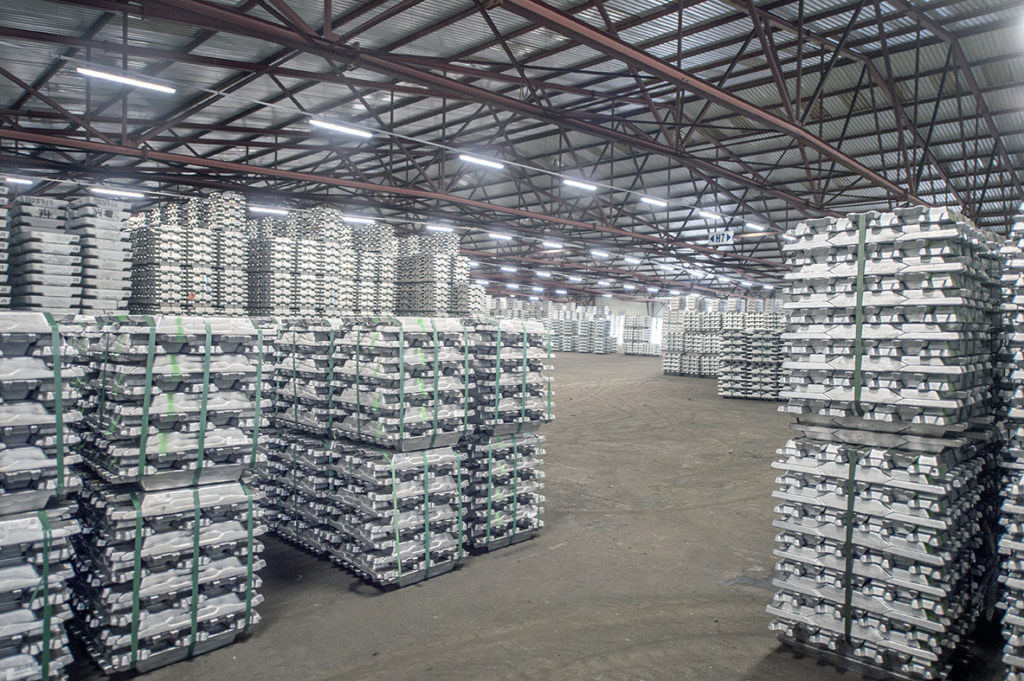

LME warehouse. Credit: Steinweg Group

The London Metal Exchange’s (LME) global warehousing capacity shrank by 4.25% over the first half of 2025 despite the opening of new delivery locations in Hong Kong and the Saudi Arabian port of Jeddah.

Total registered storage space of 3.2 million square meters is now at its lowest level since the exchange started publishing its quarterly updates in 2016.

The shrinkage is down to sliding exchange inventory. Total stocks, including off-warrant stocks, fell by 541,000 metric tons over the first half of 2025 and closed June at a 20-month low of 1.62 million tons.

Low stocks should be a bullish signal for base metal prices but it’s one that is currently distorted by geopolitical turbulence.

LME warehouse capacity and quarterly change

Diverted metal

Aluminum has for many years been the mainstay of the LME warehousing business. The global production base of 65 million tons is a lot larger than any of the other LME metals and smelters have historically been slow to respond to drops in demand because of the costs of idling capacity.

Surplus metal has in the past gravitated to the market of last resort. There were over three million tons of aluminum in LME storage as recently as 2021. Combined on- and off-warrant stocks now total just 717,000 tons.

Is this a sign of a market in supply deficit? It’s difficult to say because the April 2024 ban on new deliveries of Russian metal has deprived the market of one of its biggest physical liquidity providers.

Ever more Russian metal is flowing eastwards to China in response to US, UK and European sanctions. China’s imports of Russian aluminum surged by 80% year-on-year to 1.1 million tons in January-June.

This year’s hike in US import tariffs has further disrupted global flows of the light metal, leaving little available for LME storage despite lucrative warehouse deals.

It’s telling that ISTIM UK Ltd, the LME warehouse operator at the centre of several big aluminum stock plays in Port Klang, has cut its presence in the Malaysian city from 22 to 13 units over the last twelve months.

Despite other operators stepping into the gap, total storage capacity at Port Klang declined by 15% over the first six months of the year.

Copper clear-out

Copper bulls got very excited when LME stocks were raided in the second quarter but the near depletion of exchange inventory had nothing to do with demand and everything to do with US President Donald Trump.

Trump’s announcement he was launching an investigation into copper imports on national security grounds in February opened up an unprecedented arbitrage between the US duty-paid price traded on the CME and the international price traded in London.

LME warehouses were stripped as inventory was shipped to the United States. US imports of refined copper surged to 724,000 tons between March and June, equivalent to 80% of the country’s import demand last year.

CME registered copper stocks are at a 21-year high of 247,210 tons, while LME inventory of 155,000 tons is still down by 43% on the start of 2025 despite some replenishment from Chinese smelters.

The tariff threat turned out to be unfounded but caused a massive redistribution of inventory without making much change to the global exchange stocks picture.

Changes in LME warehouse units by location

Singapore churn

LME zinc stocks have also been cleared out over the last couple of months. Registered tonnage has fallen by 72% since the start of the year and at 65,525 tons is the lowest it’s been since May 2023.

Yet time-spreads remain curiously relaxed, the benchmark cash-to-three-months period still trading in small contango.

The market’s apparent lack of concern reflects a recent history of zinc stocks churn at Singapore. The city has been the focal point for LME deliveries of both zinc and lead and currently accounts for 99% and 97% of all registered inventory respectively.

It’s thus no surprise that LME warehouse operators have opened more units in Singapore than anywhere else over the last 12 months.

The number of listed warehouses in the city has increased by nine to 38, outstripping the eight new listings in Hong Kong and the four in Jeddah after the ports opened for LME business in January and July respectively.

The current conundrum is that the lead is still there, although still churning judging by last week’s spate of cancellations, but the zinc has gone missing.

For now.

The rising count of LME storage units in Singapore suggests warehouse operators are betting there’s still a lot of zinc around for potential LME delivery.

Waiting for metal

Sanctions and tariffs have combined to reduce metal flows to the LME with trickle-down impact on the exchange’s physical storage function.

The good news for LME warehouse companies is that disruption can open new opportunities. Hong Kong warehouses started receiving copper almost as soon as they opened thanks to Chinese smelters delivering metal into a market that was tight after the CME arbitrage trade.

The less good news is that Russia, a major aluminum, copper and zinc producer, is increasingly turning to the Chinese market.

The growing trade between the two countries may not be easily reversed, even in the unlikely event that sanctions are lifted.

LME storage capacity has fallen by over a quarter since the start of the decade, when over four million tons of metal were being stored.

Neither stocks nor storage seem likely to grow back to those levels any time soon, given the potential for politics to further fracture what was once a highly globalized physical metals market.

(The opinions expressed here are those of the author, Andy Home, a columnist for Reuters.)

(Editing by Louise Heavens)


Sibanye Stillwater narrows loss on restructuring, US production credits

Credit: Sibanye-Stillwater

Sibanye Stillwater reported a narrower first-half loss on Thursday, as production credits at its US palladium business and the restructuring of its South African mines partly offset big writedowns at its US and Finnish operations.

The Johannesburg-based miner posted a loss of $211 million, for the six months to June 30, down from a $372 million loss the year before, when it booked a $407 million impairment on its US operations after cutting its forecast for palladium prices.

Under the Inflation Reduction Act enacted in 2022, the US offers credits as an incentive for the domestic production of critical minerals, including palladium.

“The positive financial outcomes from solid operational management and decisive restructuring were amplified by the incorporation of Section 45X credits in terms of the Inflation Reduction Act,” Sibanye said in a statement.

Sibanye said a total $285 million of combined estimated credits from the 2023 financial year had been recognized, boosting profitability for the first half of 2025. Cash payments are expected in 2026, it added.

However, the company said the production credits would be phased out from 2031 and terminated in 2034 under US President Donald Trump’s signature spending law. That prompted Sibanye to book another 3.8 billion rand impairment of its US business due to the expected decrease in future cash flows.

Sibanye on July 31 petitioned the US to impose a tariff on Russian palladium imports to support the long-term viability of US supplies. Russia’s Nornickel is the world’s largest palladium producer with a 40% share of global mined output.

A final decision on the petition is expected within 13 months.

“The preliminary duties and determinations are expected in the next three to five months,” Charles Carter, Sibanye’s chief regional officer for the Americas, said during a results call.

US imports of palladium from Russia jumped 35% from 2022 to 2024, and increased by another 50% in the first quarter of 2025, Carter added.

Sibanye also wrote down 5.4 billion rand from the value of its Keliber lithium project in Finland, citing a decrease in the long-term price forecast for the battery mineral.

It also took a 461 million rand impairment on its Zimbabwean joint venture Mimosa after the introduction of a 5% beneficiation tax on platinum in January, CFO Charl Keyter told analysts.

($1 = 17.5632 rand)

(By Nelson Banya; Editing by Louise Heavens and Mark Potter)


Codelco-SQM lithium deal to close before Boric’s 2026 exit, minister says


Chilean president Gabriel Boric. (Image by Casa de América, Flickr.)

Chile’s newly appointed Economy Minister Alvaro Garcia expects state-run copper producer Codelco and local miner SQM to finalize a major lithium partnership deal before the current administration leaves office in 2026, he said in an interview.

Some presidential contenders have said they would review the deal or scrap it altogether if it does not come through before President Gabriel Boric leaves office, putting pressure on his administration to finalize the key pillar of its vow to boost the state’s role in lithium production.

“This is our immediate objective. We expect it will be completed before the end of the administration,” said Garcia, who was tapped last week in a cabinet reshuffle that made his predecessor Nicolas Grau finance minister.

Codelco and Santiago-based SQM initially expected the joint venture to go into effect in early 2025, but final steps have taken longer than expected.

The deal requires approval from various antitrust regulators due to SQM’s presence in global markets. SQM expects regulatory approval from China in September or October.

The partnership is slated to give Codelco, the world’s largest copper producer, majority control of SQM’s lithium production in the Atacama salt flat.

Garcia said he also expects new lithium operating contracts, including one for global miner Rio Tinto’s partnership with state-run Enami, to be granted in September.

He added that Chinese automaker BYD and steel group Tsingshan remain interested in projects in Chile after both scrapped plans for lithium processing plants there, but did not have further details.

“Companies have said they remain interested,” he said.


Speed up investment

Garcia also expects a long-awaited law to streamline development permits to go into effect in the coming days. Congress passed the law in July, but the administration is awaiting court review due to challenges from legislators.

“Our information tells us that the court has already agreed,” Garcia said. “The most important thing left to do is to define how the regulations will be implemented.”

A second bill aimed at quickening the environmental assessment system – the longest part of Chile’s permitting process – has been delayed in Congress.

Garcia gave no updated timeline for the law, but said the first bill, which addresses so-called sector permits, already will help investment.

“The process will be even more streamlined, but what has been achieved in the area of sector permits already greatly expedites projects,” Garcia said.

(By Fabian Andres Cambero; Editing by Alexander Villegas and Richard Chang


Baosteel expects China’s steel exports to stay above 100Mt in 2025

Stock image.

China’s biggest listed steelmaker Baoshan Iron & Steel Co expects the country’s total steel exports to stay above 100 million metric tons in 2025, it said on Friday, while monitoring potential curbs on national steel output.

The company, known as Baosteel, is a subsidiary of the state-owned China Baowu Steel Group, the world’s largest steelmaker by output.

Steel exports will likely fall in the fourth quarter from the current high level, curbed by potentially higher export prices, new tax regulations and tariff barriers, Baosteel chairman Jixin Zou said at the company’s first-half results briefing on Friday.

China’s steel exports in the first seven months climbed 11.4% to hit a record high despite trade barriers being thrown up. Baosteel exported 4.83 million tons of steel in the same period, versus a total of 6.07 million tons in 2024.

“Currently, our monthly exports are still increasing, so we already have the capability of exporting 10 million tons of steel annually,” said Baosteel general manager Baojun Liu.

The company is targeting the capacity to export 15 million tons and 20 million tons of steel in 2026 and 2028 respectively, Liu said.

Additionally, Baosteel said it would closely monitor measures to cut steel output and the development of “anti-involution” policies in China to address perceived overcapacity in industry.

China’s top leadership pledged in July to crack down on a deflationary price war, sparking expectations of a nationwide supply reform in sectors plagued by overcapacity including coal and steel, which sent prices higher.

China will push to cut steel output between 2025 and 2026 as it tackles overcapacity that has hit prices and fed a worldwide protectionist backlash, Reuters reported.

Baosteel reported on Wednesday a 7.4% annual increase in first-half net profit despite soft domestic demand and lower steel prices.

(By Amy Lv and Lewis Jackson; Editing by Clarence Fernandez and Jan Harvey)


Lynas Rare Earths to raise $488 million after China shock

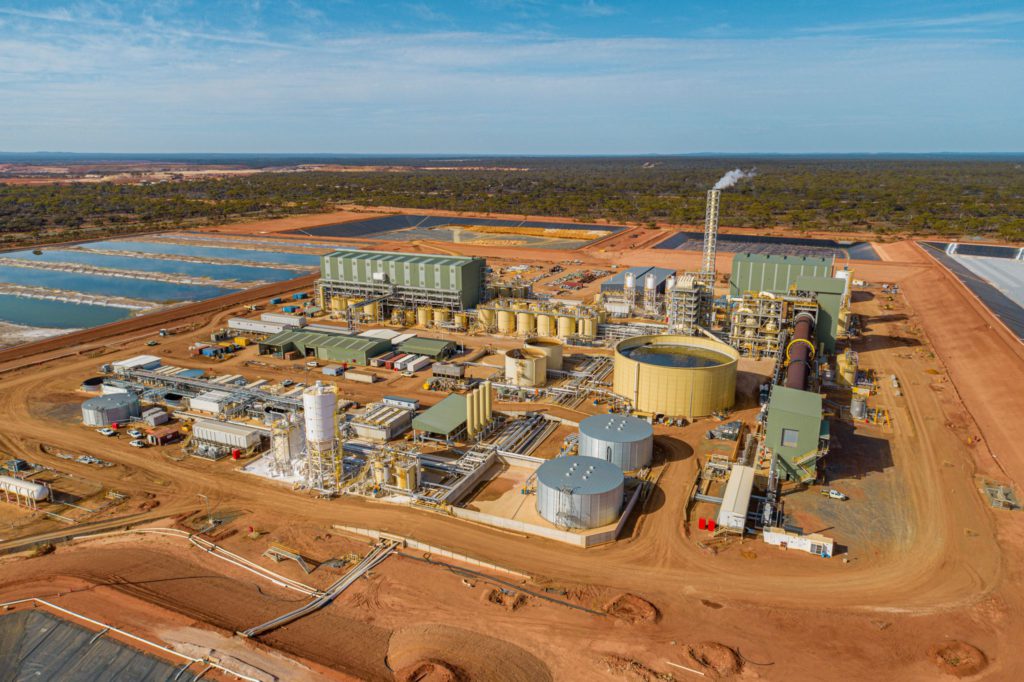
Lynas’ processing facility in Kalgoorlie. Credit: Lynas Rare Earths Ltd.

Australia’s Lynas Rare Earths Ltd., one of the few suppliers of the critical minerals outside China, unveiled a A$750 million ($488 million) share sale to fund its expansion as western firms respond to Beijing’s supply shock earlier this year.

The company — backed by Australia’s richest person, Gina Rinehart — will use the funds to streamline existing operations, modify an Australian mine and expand Malaysian processing plants. Lynas also wants partnerships with downstream metal or magnet projects, in the US or elsewhere.

The global rare earths industry is in the midst of upheaval after China launched export controls in April, weaponizing its grip on production to fight US President Donald Trump’s trade onslaught. There’s now a push to further develop supply chains that don’t run through China.

“We need to take this opportunity where the market is really evolving rapidly,” chief executive officer Amanda Lacaze said on a conference call with investors Thursday. Billionaire shareholder Rinehart “often exhorts us to maintain our focus on developing the industry outside China because of the importance globally for industry and governments,” she added.

Rinehart’s privately held Hancock Prospecting Ltd. currently has a 8.2% stake in Lynas, making it the second-largest shareholder. She has also amassed holdings in US-backed MP Materials Corp., Arafura Rare Earths Ltd. and Brazilian Rare Earths Ltd., along with several lithium producers.

Lynas plans to issue shares at A$13.25 apiece, representing a 10% discount to the last traded price on Aug. 27. In addition to this fully underwritten placement, there will also be a non-underwritten share offering to raise up to a further A$75 million, it said.

The miner’s stock has more than doubled this year, and closed Wednesday at A$14.73 a share before a trading halt on Thursday.

But the announcement and investor briefing also pointed to challenges facing Lynas in a new era for the rare earths industry. The US Department of Defense agreed to a landmark deal last month backing supplier MP Materials, casting doubt over Lynas’ own Seadrift project in Texas, and the level of government support Lynas can expect.

“There is significant uncertainty that the Seadrift plant will proceed as has been conceived previously,” Lacaze said on the call. There is an existing rare earths supply chain outside China, Lacaze said, and “it’s important that policy development is done in such a way that continues to protect that, because development of new plants can be long and uncertain.”

Supply hub

The Australian firm outlined a strategy up to 2030 that focuses on producing more “heavy” rare earths — the type targeted by Chinese export controls — rather than adding to total capacity in Australia and Malaysia. It also envisages participation in downstream joint ventures or other partnerships to produce metals or rare earth magnets. Malaysia could potentially become a supply hub for “all” parts of the supply chain, Lacaze said.

Lynas is in discussions with the US, Japanese and Australian governments about the possibility of agreeing to guaranteed floor prices for rare earths sales, Lacaze said. Minimum prices were part of the Pentagon’s deal with MP Materials, as part of bid to guarantee supply viability over the long term, regardless of Chinese actions.

The absence of state participation in the placement, or agreements on floor pricing, could be perceived “as a signal that government support is not forthcoming immediately,” Citigroup Inc. said in a note. That may reinforce the view sentiment has peaked, and near-term valuations could be vulnerable to a reset, it said.

China produces more than 90% of the world’s rare earth magnets, the vital industrial components used in electric vehicles, dishwashers and fighter jets. Supplies from the Asian powerhouse have recovered somewhat since the slump, with shipments jumping in July to their highest since January.

The Perth-based company on Thursday posted A$8 million in net income for the year to June 30, below the A$23.5 million analyst consensus.

(By Martin Ritchie and Justina T. Lee)


Vale, Brazil fail to reach deal for railway concessions renegotiation

Railroad transporting iron ore from Vale’s Carajás complex in Brazil. Image courtesy of Vale.

Vale said on Thursday that it has not reached a consensus with the Brazilian government and local land transport agency ANTT for the renegotiation of two railway concession contracts within a previously established deadline.

In a securities filing, Vale said the contracts for the Carajas and Vitoria-a-Minas railway concessions, which in 2020 had been extended until 2057, remain in effect.

(By Andre Romani; Editing by Leslie Adler)


Arctic town seeks Swedish state help with relocation due to mine

Bird view of wooden church in Kiruna. Stock image.

Sweden’s Arctic municipality of Kiruna called for government help to relocate a third of its residents to allow the expansion of the world’s largest underground iron ore mine.

Kiruna has won fame for being moved in its entirety — a process started in 2004 — to accommodate the growth of the state-owned LKAB’s mine. In updated forecasts on Thursday, LKAB said it now expected 2,700 more homes and 6,000 more people, a third of the town’s population, to be directly affected by its expansion plans over the coming decade.

“I call on the Swedish government to contact Kiruna municipality as quickly as possible,” municipal leader Mats Taaveniku told a news conference earlier on Friday. “We can’t manage without help from the state and the government in this situation,” he said.

In 2022, a new retail area was opened 3 kilometers (1.9 miles) from Kiruna’s previous center, and earlier this month, the town’s historic church was wheeled to a new site. The company said Thursday that relocation “must start now to secure operations until and beyond 2035.”

Sweden’s Minister for Energy, Business and Industry Ebba Busch said in a separate statement on Friday the government had contacted the municipality and understood the challenges it was facing, including how to “prioritize between different national interests.” LKAB “has been clear that it will take part in the compensation,” she said.

She added that it was positive that LKAB continues to make large investments in Kiruna’s home county of Norrbotten as this would help secure jobs and a supply of raw materials which did not rely “on dangerous states.”

(By Charlie Duxbury)


A critical moment: The importance of restoring domestic tungsten production in the US

AI-generated stock image by FarisZul.

When you picture an American jet fighter on a critical mission or the latest electric vehicle (EV) rolling off a factory line, you may not realize that several of the key materials that drive these technologies, including tungsten, come from halfway across the world.

Although tungsten is a critical mineral prized for its unmatched density, high melting point and hardness, the US has gone more than ten years without producing a single ounce domestically, relying instead on foreign suppliers to fuel innovation.

This gap creates US national defense implications and leaves high-tech manufacturing industries vulnerable to disruptions in the supply chain at any time and underscores the urgent need to secure a reliable supply at home.

To further understand the stakes and why the current US supply gap is so concerning, let’s examine how tungsten is produced and who controls it worldwide.

Current state of tungsten supply

Today, the global tungsten market is overwhelmingly dominated by China, which produces roughly 80 to 90% of the world’s supply. Other countries contribute only small fractions, leaving the US highly dependent on foreign sources for this critical mineral.

Historically, the US once had a modest tungsten industry, peaking during the mid-20th century when domestic mines supplied defense and industrial needs. Over time, however, production declined due to competition from cheaper imports, high extraction costs and dwindling reserves, eventually reaching zero over a decade ago.

This absence of domestic supply has left the US vulnerable to shifts in global markets, trade disputes and geopolitical tensions. In other words, relying almost entirely on foreign producers, particularly one nation with outsized control, significantly decreases our ability to respond quickly and independently in moments of crisis.

National security implications

Therefore, restoring a domestic supply of tungsten is about more than just mining a mineral—it’s a matter of national security, industrial resilience and economic strength.


The US reliance on foreign tungsten leaves defense programs, from aircraft to armor-piercing munitions and advanced weapon systems, vulnerable to export restrictions, tariffs and geopolitical tensions. A secure domestic supply would ensure uninterrupted access for critical defense applications, reducing vulnerabilities in military supply chains and safeguarding the operational readiness of US forces.

At the same time, tungsten powers high-tech industries such as semiconductors, electronics and EVs, making reliable access essential for innovation and growth. It also plays a key role in emerging technologies, including fusion energy research, which could shape the future of sustainable power.

Bringing tungsten production home would provide a stable foundation for defense, empower industries to develop new technologies without supply chain uncertainty, create high-skilled jobs and strengthen regional economies.

In short, restoring domestic tungsten supply would transform a vulnerability into a competitive advantage for both national security and technological leadership, making it something the country can no longer afford to ignore.

Restoring domestic supply

Restoring domestic tungsten supply will require a coordinated effort across government, industry and research institutions. Identifying and developing untapped domestic deposits is the first step, followed by investing in modern mining and processing facilities capable of producing high-purity tungsten for both defense and industrial applications.

Industries from aerospace and defense to electronics, semiconductors and EVs all depend on tungsten, and even short-term shortages could stall innovation, delay production timelines and drive up costs across these critical sectors, underscoring the urgency of building a stable domestic supply.

Public-private partnerships and targeted incentives could encourage companies to take on the upfront costs of extraction and refinement, while research into more efficient and environmentally responsible methods could make domestic production economically sustainable in the long term.

Strategic stockpiling and supply chain planning would further ensure that critical industries and military programs maintain uninterrupted access, even during global disruptions. Together, these measures could establish a resilient supply chain that strengthens both economic growth and technological competitiveness.

Conclusion

As we see it, restoring domestic tungsten supply is crucial. Securing reliable access would strengthen national defense, reduce reliance on foreign sources, and empower industries from aerospace to electronics, semiconductors and EVs to innovate without the constant risk of supply disruptions.

A stable domestic supply would create high-tech jobs, bolster regional economies, and provide the US with a strategic advantage in both security and technology. It would also mitigate risks associated with overreliance on foreign suppliers, particularly China, ensuring that critical materials remain accessible even amid global uncertainties.

Although the challenges are real, the opportunity is clear: by investing in domestic tungsten production, the US can transform a long-standing vulnerability into a foundation for resilience, innovation and global leadership.


* Brodie Sutherland is CEO of Patriot Critical Minerals Corp., and a geologist with over a decade of experience leading mineral exploration across 20+ countries.

Brodie Sutherland, CEO, Patriot Critical Minerals CorpSubmitted image.