Monday, September 01, 2025

Pacifist Japan struggles to boost troops as China anxiety grows


By AFP
August 30, 2025


Tokyo is shifting its defence resources to southwestern regions such as Okinawa as tensions with China rise - Copyright AFP Philip FONG

Hiroshi HIYAMA

Sporting dark face paint and clutching a gun, teenage soldier-in-training Takuma Hiyane crawls across a field on Japan’s Okinawa, the front line of the nation’s defence as anxiety grows over China’s territorial ambitions.

As the world marks the 80th anniversary of World War II, Japan — which has been officially pacifist since its defeat — is trying to lure more talent into its armed forces.

Tokyo began upping its military spending in 2023 and aims to make it two percent of its gross domestic product by the end of the 2027 fiscal year, but has come under pressure from Washington to boost it even further.

Japan fears that China could attempt a forceful takeover of Taiwan — the self-governed island it claims — potentially triggering a conflict with Washington that could drag in Tokyo as well.

But it has been hard to convince enough young Japanese to enlist.

Hiyane, a 19-year-old former high school badminton player who signed up after his graduation in March, was swayed by the idea of helping victims of natural disasters, he said.

“I thought this was a job that I could contribute to my country and be proud of, so I decided to join,” he told AFP, carefully dodging questions on the sensitive topic of national defence.

Tokyo wants a beefed-up military in southwestern regions such as Okinawa, home to some 70 percent of US military facilities in Japan and seen as strategically important for monitoring China, the Taiwan Strait and the Korean peninsula.

In 2023, the Japan Self-Defense Forces (SDF) aimed to hire almost 20,000 people, but recruited just half that number, according to the defence ministry.

Dangerous duties, low pay and a young retirement age of around 56 are off-putting for young Japanese, officials and experts say.

Japan’s low birth rate, shrinking population and tight labour market are also complicating recruitment, leaving around 10 percent of the force’s 250,000 positions unfilled.

– Better conditions –

On Okinawa, Hiyane and his fellow trainees braved scorching heat to stage a line formation, before dashing forward to capture a mock enemy fort.

“I find training here very physical and hard, but I am used to it in a way since I played sports at school,” he said.

“I find it more exhausting and nerve-racking when I have to shoot guns.”

Prime Minister Shigeru Ishiba said in June that increasing SDF numbers was “a top priority” given Japan’s worsening security environment.

Kazuyuki Shioiri, who helps manage an infantry regiment in Okinawa where Hiyane trains, said increased defence expenditure was gradually making troops’ lives better through various upgrades including air conditioning, cleaner bathrooms and more privacy in dormitories.

“We have been able to improve conditions,” he said.

Before the extra funds, Japanese troops had complained that they lacked bullets and basic supplies.

They used to strip old tanks and jets for parts to repair newer equipment, the defence ministry said.

But it’s not simply “muscular troops with high combat capabilities” that the force wants, said Toshiyuki Asou, an SDF recruiter on Okinawa.

“We are looking for a wide range of personnel now as national security involves everything from cybersecurity, space defence, electromagnetic warfare, and of course intelligence work,” he added.

– Reluctant to fight –


Despite the government’s defence push, Japanese citizens have traditionally kept their distance from the subject, with some still carrying bitter memories of the nation’s militarist past.

Japan’s constitution, which was drafted by the US after World War II and enjoys wide public support, bans Tokyo from using force and does not recognise the SDF as a formal military.

While the troops are highly respected, the public have loudly opposed any attempt to amend the constitution to grant them that status.

In a Gallup International survey released last year, only nine percent of Japanese respondents said they would fight for the country if there was a war, while 50 percent said they would not.


That compares with greater willingness in some other countries, with 46 percent of South Koreans, 41 percent of Americans and 34 percent of Canadians saying they would fight.

Ryoichi Oriki, the former head of the Joint Staff of the SDF, said during a recent press briefing that he wished for “greater understanding among the public about the reality of national defence”.

In the field, new recruits said they were excited about launching their military careers despite the geopolitical turbulence.

“I have learned the spirit and skills of Self-Defense Force personnel,” said Hiyane, who is about to complete his initial training. “I feel I have grown.”
Indonesian islanders taking Swiss concrete giant to court over climate


By AFP
August 31, 2025


Residents of the tiny Indonesian island of Pari want Swiss cement giant Holcim to pay for what they say is its share of the climate change that threatens their home - Copyright AFP William WEST

Nina LARSON

Residents of the tiny Indonesian island of Pari, threatened with disappearance by rising sea levels driven by climate change, have come to Switzerland to demand compensation from cement giant Holcim.

The case is part of a wider international movement seeking to assign responsibility to major companies for the climate damage hurting the livelihoods of millions of people, especially in the Global South.

More than two years after four residents of Pari filed suit against the world’s largest cement firm, two of them have travelled to Switzerland to take part in a preliminary hearing in the landmark case.

The hearing to determine whether or not the court will consider the complaint will take place on Wednesday in Zug, where the firm is headquartered.

Holcim insists it is “deeply committed to taking action on climate”, but maintains that “the question of who is allowed to emit how much CO2” should be “a matter for the legislature and not a question for a civil court”.

Environmentalists say cement production is responsible for around eight percent of global CO2 emissions, and allege that Holcim figures among the 100 largest CO2 emitters among all companies worldwide.

The company thus bears significant responsibility for climate-related loss and damages, the suit maintains, in a case that could be a milestone for plaintiffs from developing countries who take on industrial giants.

– ‘Inspirational’ –


“I hope the case will become inspirational… for climate victims” around the world, plaintiff Asmania told reporters in the Swiss city of Lausanne ahead of the hearing, speaking through a translator.

Environmentalists have said most of the 42-hectare (104-acre) island of Pari could be underwater by 2050 due to rising sea levels.

The islanders say saltwater floods have in recent years surged in scale and frequency, battering homes and damaging livelihoods.

Asmania, a 42-year-old mother-of-three, who like many Indonesians goes by one name, has already lost her seaweed farm due to flooding, which has also ravished her fish farm, sweeping in dirt and oil that kill off the babies.

This year, she began with 500 small fry, “and there are only nine left”, she said, adding that income “is zero”.

– ‘Biggest threat’ –

Another plaintiff, 54-year-old mechanic and beach manager Arif Pujianto, also said climate impacts were taking a dire toll.

“The climate crisis is the biggest threat to my life,” he said through a translator.

He described how severe flooding of Star Beach had shrunk the pristine stretch of sand by nine metres since 2021, driving away tourists vital for his income.

At the same time, tidal floods now regularly reach his bamboo house, rotting the walls and contaminating his well, forcing him to purchase drinking water for his family at a high price.

The small workshop where he repairs motorcycles and diesel engines has also been repeatedly flooded, rusting his equipment, he said.

If the Swiss court refuses to take the case, Arif said he feared he would lose his beach, his island and even his life.

– A first –

Environmental litigation against governments and fossil fuel firms seen as responsible for the greatest CO2 emissions has surged in recent years, but the case marks the first such action against a major cement company.

It is also the first filed by Indonesians against a foreign company for climate-related damage, and the first instance of a Swiss company being sued for its alleged role in such damage.

The four plaintiffs in the case are seeking 3,600 Swiss francs ($4,500) each from Holcim for damages and protection measures such as planting mangroves and constructing breakwater barriers.

Swiss Church Aid (HEKS), an NGO helping the islanders, stressed that the amount was only equivalent to 0.42 percent of the actual costs — in line with estimates that Holcim is responsible for 0.42 percent of global industrial CO2 emissions since 1750.

In addition, the plaintiffs are demanding a 43-percent reduction in Holcim’s greenhouse gas emissions by 2030 and a 69-percent reduction by 2040, with HEKS saying this was in line with the Paris Climate Agreement’s goal of limiting global warming to 1.5 degrees Celsius, compared to the pre-industrial era.
Japan, South Korea had hottest summer on record in 2025

– ‘All man-made’ –


By AFP
September 1, 2025


A woman with an umbrella walks in the scorching sun in Tokyo on September 1
 - Copyright AFP Philip FONG


Alice PHILIPSON with KANG Jin-kyu in Seoul

Japan and South Korea sweltered this year through the hottest summers since records began, their weather agencies said Monday.

Temperatures the world over have soared in recent years as climate change creates ever more erratic weather patterns.

Japan’s average temperature between June and August “was 2.36C above the standard value, which marked the hottest summer since records began in 1898”, according to the Japan Meteorological Agency (JMA).

“It was the third consecutive summer of record-level high temperatures,” the JMA added.

During that same period in South Korea, the average temperature was 25.7C, “the highest since data collection began in 1973”, the Korea Meteorological Administration said in a press release.

The previous record over the same period was 25.6C, set just last year.

In Japan the scorching heat left some 84,521 people hospitalised nationwide from May 1 to August 24 this year, up slightly from 83,414 during the same period last year, according to the Fire and Disaster Management Agency.

– ‘All man-made’ –

In Tokyo, avid runner Masao Nakano, 80, told AFP he pines for the old days when he could just “step outside, sprinkle water in the street and feel the cool air”.

Nakano says he survived the sizzling summer by working out at a gym and jogging to prepare for a marathon.

“This is crazy. It’s all man-made, right? All the air-cons and power generation”, he said.

Japan’s beloved cherry trees are blooming earlier due to the warmer climate, or sometimes not fully blossoming because autumns and winters are not cold enough to trigger flowering, experts say.

The famous snowcap of Mount Fuji was absent for the longest recorded period last year, not appearing until early November, compared with the average of early October.

In South Korea, the country is grappling with a prolonged drought that has hit the eastern coastal city of Gangneung.

A state of national disaster has been declared in the city of 200,000 after weeks without rain — with water levels at the Obong reservoir, the city’s main source of piped water, falling below 15 percent.

The dry spell has forced authorities to implement water restrictions, including shutting off 75 percent of household meters.

Heatwaves are becoming more intense and frequent worldwide because of human-caused climate change, scientists say.

But the speed of temperature increases across the world is not uniform.

Of the continents, Europe has seen the fastest warming per decade since 1990, followed closely by Asia, according to global data from the US National Oceanic and Atmospheric Administration (NOAA).

The United Nations warned last month that rising global temperatures are having an ever-worsening impact on the health of workers, and was also hitting productivity, which they say dropped by two to three percent for every degree above 20C.

burs-aph-kjk/fox
US judge blocks Trump from expanding rapid deportation process


By AFP
August 30, 2025


(L/R) US President President Donald Trump, Florida Governor Ron DeSantis, and Secretary of Homeland Security Kristi Noem visit a migrant detention center, dubbed "Alligator Alcatraz," in Ochopee, Florida on July 1, 2025 - Copyright AFP ANDREW CABALLERO-REYNOLDS

A US judge on Friday blocked the Trump administration from massively expanding a procedure that allows authorities to swiftly deport migrants without a court hearing, in a blow for the president’s mass deportation plans.

The process, which is called “expedited removal,” had previously been used to rapidly deport migrants detained near the Mexican border if they had entered the US in the previous two weeks.

However since January, the administration of Donald Trump has expanded the use of the procedure across the whole country — and applied it to migrants who have been in the US for up to two years.


US District Judge Jia Cobb blocked this expanded use of the procedure, saying it could lead to people being “erroneously” deported without due process, including the chance to prove they have been in the US for more than two years.

“Unlike the group of people who have traditionally been subject to expedited removal — those detained at or near the border shortly after crossing — the group of people the Government is now subjecting to expedited removal have long since entered our country,” Cobb wrote in a 48-page opinion published late Friday.

“In defending this skimpy process, the Government makes a truly startling argument: that those who entered the country illegally are entitled to no process under the Fifth Amendment, but instead must accept whatever grace Congress affords them,” she added.

“Were that right, not only noncitizens, but everyone would be at risk.”

The ruling by Cobb, who was appointed by former president Joe Biden, was in a case brought by Make The Road New York, a rights group supporting migrants.

The judge emphasized that the court was not casting “doubt on the constitutionality of the expedited removal statute, nor on its longstanding application at the border.”

Trump campaigned to return to the White House vowing to deport millions of undocumented migrants.

But his mass deportation program has been restricted by numerous court rulings, notably on the grounds that those targeted should be able to assert their due process rights.

Cobb also quoted the Constitution, which guarantees that “no person shall be removed from the United States without opportunity, at some time, to be heard.”
THE WORST OF THE WORST
Trump Just Tried to Illegally Deport 600+ Guatemalan Kids on Holiday Weekend

"It is a dark and dangerous moment for this country when our government chooses to target orphaned 10-year-olds and denies them their most basic legal right to present their case before an immigration judge," a lawyer said.


Migrants deported from the United States in a military plane arrive at La Aurora International Airport in Guatemala City, Guatemala on January 30, 2025.
(Photo by Josue Decavele/Anadolu via Getty Images)

Jessica Corbett
Aug 31, 2025
COMMON DREAMS

In an effort reminiscent of US President Donald Trump using the Alien Enemies Act to send hundreds of migrants to a Salvadoran prison, his administration just tried to deport more than 600 unaccompanied children to Guatemala over Labor Day weekend—though for now, a federal judge's order appears to have halted the plan, unlike last time.

CNN exclusively reported Friday morning that the Trump administration was "moving to repatriate hundreds of Guatemalan children" who arrived in the United States alone and were placed in the custody of the Office of Refugee Resettlement. Subsequent reporting confirmed plans to deport the kids, who are ages 10-17.

Fearing their imminent removal after the administration reportedly reached an agreement with the Guatemalan government, the National Immigration Law Center (NILC) launched a class action lawsuit around 1:00 am Sunday, seeking an emergency order that was granted just hours later by a federal judge in Washington, D.C.

"Plaintiffs have active proceedings before immigration courts across the country, yet defendants plan to remove them in violation of the Trafficking Victims Protection Reauthorization Act of 2008, the Immigration and Nationality Act, and the Constitution," NILC's complaint explains.


Efrén C. Olivares, vice president of litigation and legal strategy at the NILC, said that "it is a dark and dangerous moment for this country when our government chooses to target orphaned 10-year-olds and denies them their most basic legal right to present their case before an immigration judge."

"The Constitution and federal laws provide robust protections to unaccompanied minors specifically because of the unique risks they face," Olivares noted. "We are determined to use every legal tool at our disposal to force the administration to respect the law and not send any child to danger."

Politico's Kyle Cheney and Josh Gerstein reported on the judge's moves:
U.S. District Judge Sparkle Sooknanan issued the order just after 4:00 am Sunday, finding that the "exigent circumstances" described in the lawsuit warranted immediate action "to maintain the status quo until a hearing can be set."

The judge, a Biden appointee, initially scheduled a virtual hearing on the matter for 3:00 pm Sunday, but later moved up the hearing to 12:30 pm after being notified that some minors covered by the suit were "in the process of being removed from the United States."

Sharing updates from the hearing on social media, Cheney reported that Sooknanan took a five-minute recess so that US Department of Justice attorney Drew Ensign could ensure that the details of her order reached the Trump administration—which is pursuing mass deportations. Ensign confirmed to the judge that while it's possible one plane took off and then returned, all the children are still in the United States.

Following the judge's intervention, NILC's Olivares said in a statement that "in the dead of night on a holiday weekend, the Trump administration ripped vulnerable, frightened children from their beds and attempted to return them to danger in Guatemala."

"We are heartened the court prevented this injustice from occurring before hundreds of children suffered irreparable harm," he added. "We are determined to continue fighting to protect the interest of our plaintiffs and all class members until the effort is enjoined permanently."


'Stop lying, you ghoul': Internet erupts over Stephen Miller's claim on child deportations

Robert Davis
August 31, 2025 
RAW STORY


White House deputy chief of staff for policy Stephen Miller attends the annual White House Easter Egg Roll with his family, including his wife, Katie Miller, left, on the South Lawn of the White House in Washington, D.C., U.S., April 21, 2025. REUTERS/Leah Millis

The internet erupted on Sunday after President Donald Trump's immigration advisor attempted to smear a judge for refusing to deport hundreds of children in the middle of the night.

Stephen Miller, the White House deputy chief of staff, wrote on X that U.S. District Judge Sparkle Sooknanan of the District of Columbia was "refusing" to allow hundreds of Guatemalan children to be reunited with their parents. His comments came after Judge Sooknanan issued an order prohibiting the Trump administration from deporting the children.

"The minors have all self-reported that their parents are back home in Guatemala," Miller wrote in a post on X. "But a Democrat judge is refusing to let them reunify with their parents."

Lawyers and legal analysts shredded Miller's claims on social media.

"Stop lying, you ghoul," Timothy Bellman, a Democrat in West Virginia, posted on X.

"Stephen Miller's rant is pure garbage, total fake news from Trump's anti-immigrant goon!" activist Mike Young posted on X. "Judge Sooknanan blocks hasty deports of 700 unaccompanied kids for just two weeks to confirm safe homes, upholding laws you ignore! Your boss separated thousands in 2018, crying wolf now? We defend children from bullies like you, not exploit them."

"Stephen Miller is a liar," immigration lawyer Aaron Reichlin-Melnick posted on X. "Here is a sworn declaration from one of the children saying that their mother is dead and that they left because they suffered abuse and neglect at the hands of their family, including their surviving father. The child wants to stay and seek protection."

"This is devoid of factual or legal relevance," Kyle Cheney, Politico's senior legal affairs reporter, posted on X. "Lawyers for the children say some were fleeing abusive situations, and say the deportation effort was undertaken abruptly overnight and without legally required notice or protections to ensure safety. Whether their parents are in Guatemala + whether admin complied with law are distinct questions for court to resolve."


Experts stunned by Trump’s ‘unprecedented’ plan to deport hundreds of unaccompanied kids

Daniel Hampton
August 29, 2025 
RAW STORY


(Screengrab via CNN)

A CNN reporter said experts are stunned by an "unprecedented" Trump administration move to take steps to send hundreds of Guatemalan children back to their home country after they arrived in the United States alone.

CNN correspondent Priscilla Alvarez joined "News Central" and told co-host Brianna Keilar that it's an "unprecedented move."

"Every expert official that I've talked to can't recall ever seeing something like this — which is the U.S. government working in coordination with the Guatemalan government to send back hundreds of children that are in U.S. government custody," Alvarez said.

She noted that the "reason that this is so unprecedented and unheard of" is that U.S. law provides numerous protections for children who arrive at the U.S.-Mexico border alone, meaning they don't have a parent or legal guardian. They are then placed into the care of the Health and Human Services Department. Officials then try to find a family sponsor in the United States, such as a parent, sister, aunt, or relative. Once the child is placed, they typically then learn if they have legal protections in immigration proceedings.


Watch the clip below or at this link.

"So here's where things get different. This is a plan by the administration to send back more than 600 children that they have identified — that are in government custody — to Guatemala. They are expected to not have a parent in the United States and some family in Guatemala," said Alvarez.

While supporters of the plan may say the children are being returned to a parent, Alvarez notes that in many cases, the children are fleeing "bad conditions at home" — sometimes because of a parent.

"That could be because of a parent — those they are fleeing their family there — or it could be because their family can't protect them from what is happening in-country," she said. "It is no small thing for a child to come to the U.S. southern border on their own. And we are talking here about a range of ages from 0 to 17."

Trump's administration is internally calling the deportations "repatriations," meaning they're not involuntary removals. However, advocates have said the children likely don't understand what is actually happening for them to be returned.


SO LONG JUAN AND MARIA

DEPORTEE; PLANE WRECK AT LOS GATOS


‘Fueling sexism’: AI ‘bikini interview’ videos flood internet


By AFP
September 1, 2025


AI slop is blurring the distinction between truth and fabrication, experts say - Copyright AFP Oliver Contreras

Anuj Chopra with Sumit Dubey in New Delhi and Michelle Fitzpatrick in Frankfurt

The videos are strikingly lifelike, featuring bikini-clad women conducting street interviews and eliciting lewd comments — but they are entirely fake, generated by AI tools increasingly used to flood social media with sexist content.

Such AI slop — mass-produced content created by cheap artificial intelligence tools that turn simple text prompts into hyper-realistic visuals — is frequently drowning out authentic posts and blurring the line between fiction and reality.

The trend has spawned a cottage industry of AI influencers churning out large volumes of sexualized clips with minimal effort, often driven by platform incentive programs that financially reward viral content.

Hordes of AI clips, laden with locker-room humor, purport to show scantily clad female interviewers on the streets of India or the United Kingdom — sparking concern about the harm such synthetic content may pose to women.

AFP’s fact-checkers traced hundreds of such videos on Instagram, many in Hindi, that purportedly show male interviewees casually delivering misogynistic punchlines and sexualized remarks — sometimes even grabbing the women — while crowds of men gawk or laugh in the background.

Many videos racked up tens of millions of views — and some further monetized that traction by promoting an adult chat app to “make new female friends.”

The fabricated clips were so lifelike that some users in the comments questioned whether the featured women were real.

A sample of these videos analyzed by the US cybersecurity firm GetReal Security showed they were created using Google’s Veo 3 AI generator, known for hyper-realistic visuals.

– ‘Gendered harm’ –

“Misogyny that usually stayed hidden in locker room chats and groups is now being dressed up as AI visuals,” Nirali Bhatia, an India-based cyber psychologist, told AFP.

“This is part of AI-mediated gendered harm,” she said, adding that the trend was “fueling sexism.”

The trend offers a window into an internet landscape now increasingly swamped with AI-generated memes, videos and images that are competing for attention with — and increasingly eclipsing — authentic content.

“AI slop and any type of unlabeled AI-generated content slowly chips away at the little trust that remains in visual content,” GetReal Security’s Emmanuelle Saliba told AFP.

The most viral misogynistic content often relies on shock value — including Instagram and TikTok clips that Wired magazine said were generated using Veo 3 and portray Black women as big-footed primates.

Videos on one popular TikTok account mockingly list what so-called gold-digging “girls gone wild” would do for money.

Women are also fodder for distressing AI-driven clickbait, with AFP’s fact-checkers tracking viral videos of a fake marine trainer named “Jessica Radcliffe” being fatally attacked by an orca during a live show at a water park.

The fabricated footage rapidly spread across platforms including TikTok, Facebook and X, sparking global outrage from users who believed the woman was real.

– ‘Unreal’ –

Last year, Alexios Mantzarlis, director of the Security, Trust, and Safety Initiative at Cornell Tech, found 900 Instagram accounts of likely AI-generated “models” — predominantly female and typically scantily clothed.

These thirst traps cumulatively amassed 13 million followers and posted more than 200,000 images, typically monetizing their reach by redirecting their audiences to commercial content-sharing platforms.

With AI fakery proliferating online, “the numbers now are undoubtedly much larger,” Mantzarlis told AFP.

“Expect more nonsense content leveraging body standards that are not just unrealistic but literally unreal,” he added.

Financially incentivized slop is becoming increasingly challenging to police as content creators — including students and stay-at-home parents around the world — turn to AI video production as gig work.

Many creators on YouTube and TikTok offer paid courses on how to monetize viral AI-generated material on platforms, many of which have reduced their reliance on human fact-checkers and scaled back content moderation.

Some platforms have sought to crack down on accounts promoting slop, with YouTube recently saying that creators of “inauthentic” and “mass produced” content would be ineligible for monetization.

“AI doesn’t invent misogyny — it just reflects and amplifies what’s already there,” AI consultant Divyendra Jadoun told AFP.

“If audiences reward this kind of content with millions of likes, the algorithms and AI creators will keep producing it. The bigger fight isn’t just technological — it’s social and cultural.”

burs-ac/st

New wave: Sea power turned into energy at Los Angeles port


By AFP
August 31, 2025


Sea change: the floaters convert the power of waves into an electrical current - Copyright AFP Patrick T. Fallon


Romain FONSEGRIVES

Floating blue paddles dance on the waves that lap a dock in the Port of Los Angeles, silently converting the power of the sea into useable electricity.

This innovative installation may hold one of the keys to accelerating a transition away from fossil fuels that scientists say is necessary if the world is to avoid the worst effects of climate change.

“The project is very simple and easy,” Inna Braverman, co-founder of Israeli start-up Eco Wave Power, told AFP.

Looking a little like piano keys, the floaters rise and fall with each wave.

They are connected to hydraulic pistons that push a biodegradable fluid through pipes to a container filled with accumulators, which resemble large red scuba tanks.

When the pressure is released, it spins a turbine that generates electrical current.

If this pilot project convinces the California authorities, Braverman hopes to cover the entire 13-kilometer (eight-mile) breakwater protecting the port with hundreds of floaters that together would produce enough electricity to power 60,000 US homes.

Supporters of the technology say wave energy is an endlessly renewable and always reliable source of power.

Unlike solar power, which produces nothing at night, or wind power, which depends on the weather, the sea is always in motion.

And there is a lot of it.

– Tough tech –

The waves off the American West Coast could theoretically power 130 million homes — or supply around a third of the electricity used every year in the United States, according to the US Department of Energy.

However wave energy remains the poor relation of other, better-known renewables, and has not been successfully commercialized at a large-enough scale.

The history of the sector is full of company shipwrecks and projects sunk by the brutality of the high seas. Developing devices robust enough to withstand the fury of the waves, while transmitting electricity via underwater cables to the shore, has proven to be an impossible task so far.

“Ninety-nine percent of competitors chose to install in the middle of the ocean, where it’s super expensive, where it’s breaking down all the time, so they can’t really make projects work,” Braverman said.

With her retractable dock-mounted device, the entrepreneur believes she has found the answer.

“When the waves are too high for the system to handle, the floaters just rise to the upward position until the storm passes, so you have no damage.”

The design appeals to Krish Thiagarajan Sharman, a professor of mechanical engineering at the University of Massachusetts Amherst.

“The Achilles heel of wave energy is in the costs of maintenance and inspection,” he told AFP.

“So having a device close to shore, where you can walk on a breakwater and then inspect the device, makes a lot of sense.”

Sharman, who is not affiliated with the project and whose laboratory is testing various wave energy equipment, said projects tend to be suited to smaller-scale demands, like powering remote islands.

“This eight-mile breakwater, that’s not a common thing. It’s a rare opportunity, a rare location where such a long wavefront is available for producing power,” he said.

– AI power demand –

Braverman’s Eco Wave Power is already thinking ahead, having identified dozens more sites in the United States that could be suitable for similar projects.

The project predates Donald Trump’s administration, but even before the political environment in Washington turned against renewables, the company was already looking beyond the US.

In Israel, up to 100 homes in the port of Jaffa have been powered by waves since December.

By 2026, 1,000 homes in Porto, Portugal should be online, with installations also planned in Taiwan and India.

Braverman dreams of 20-megawatt projects, a critical capacity needed to offer electricity at rates that can compete with wind power.

And, she said, the installations will not harm the local wildlife.

“There’s zero environmental impact. We connect to existent man-made structures, which already disturb the environment.”

Promises like this resonate in California, where the Energy Commission highlighted in a recent report the potential of wave energy to help the state achieve carbon neutrality by 2045.

“The amount of energy that we’re consuming is only increasing with the age of AI and data centers,” said Jenny Krusoe, founder of AltaSea, an organization that helped fund the project.

“So the faster we can move this technology and have it down the coastline, the better for California.”
The US Supreme Court Asks Why It Shouldn’t Gut the Voting Rights Act

We may well see the elimination of the 11 Black-majority districts — all Democratic — in GOP-controlled Southern states.

August 29, 2025

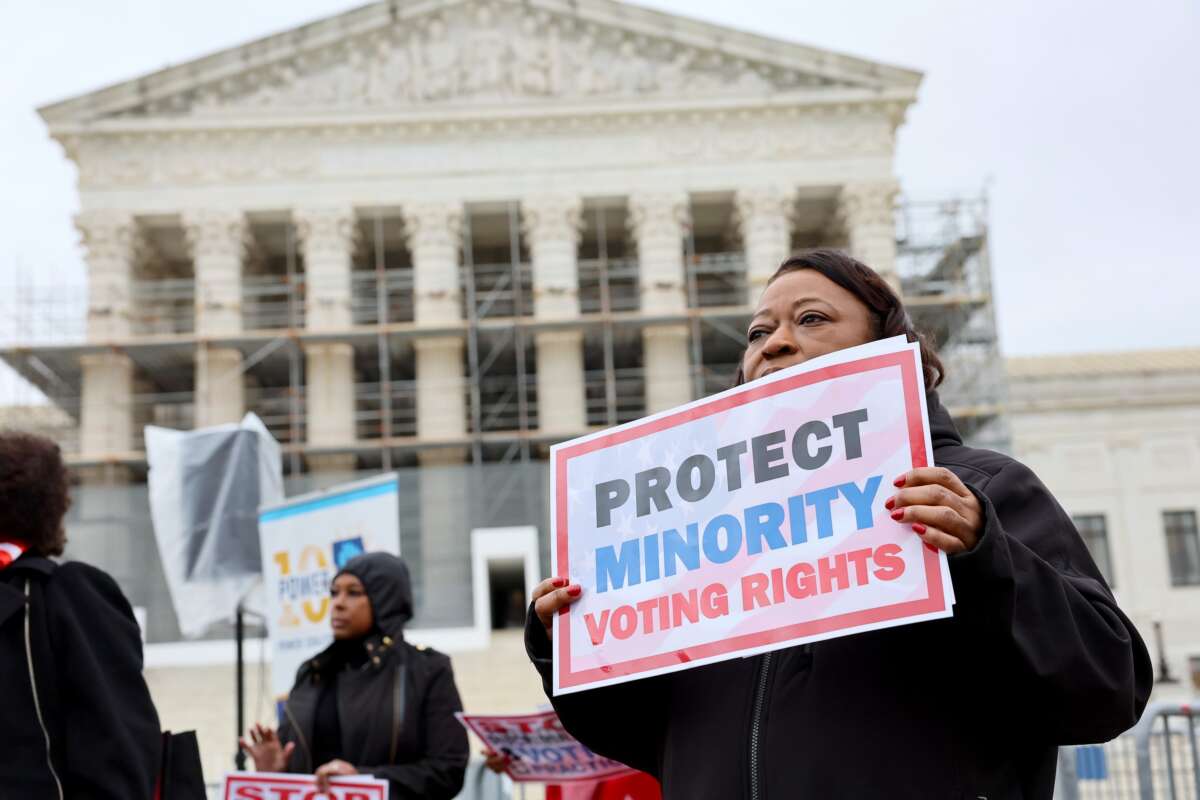
Black Louisiana voters and civil rights advocates call on the Supreme Court to uphold a fair and representative congressional map in Louisiana v. Callais at the Supreme Court of the United States on March 24, 2025, in Washington, D.C.
Jemal Countess / Getty Images for Legal Defense Fund

In what may prove to be the most consequential redistricting case to come before the Supreme Court, Louisiana is urging the court to gut the main provision of the Voting Rights Act of 1965 (VRA) and ban any consideration of race in redistricting. Louisiana filed its brief after the high court on August 1 asked the parties whether compliance with Section 2 of the (VRA) violates the Constitution’s 14th or 15th Amendments. By framing that question, the court may be signaling its intention to eviscerate the VRA.

Louisiana v. Callais reached the Supreme Court after a coalition of civil rights organizations and Black voters sought to reinstate a map that the state legislature had adopted in 2024. The map, which established a second majority-Black congressional district in the state, had been drawn in response to a 2022 U.S. district court ruling. In that case, the court ruled that a prior map, drawn in 2020, likely violated Section 2 because it included only one majority-Black district out of the state’s six congressional districts. The coalition had argued that the old map diluted the votes of Black residents, who constitute about one-third of the population of Louisiana.

The Fifth U.S. Circuit Court of Appeals had affirmed the district court’s ruling that the old map probably violated Section 2, and the appellate court ordered Louisiana to adopt a new map by January 15, 2024. The Louisiana Legislature complied and drew a map with a second majority-Black district.

A group of self-described “non-African American” voters then filed a federal legal challenge to the 2024 map, alleging that it was an unconstitutional racial gerrymander because it separated voters primarily on the basis of race. A three-judge panel of the U.S. district court agreed with them, but the Supreme Court stayed the district court’s ruling and allowed the 2024 map to be used in the 2024 elections while it considered the merits of the case.

In March 2025, the high court heard arguments but didn’t make a decision, instead delaying a ruling on the merits until the following term this fall. In its June 27 order, the court said it would “issue an order scheduling argument and specifying any additional questions to be addressed in supplemental briefing.”

Related Story

The Voting Rights Act Dodged a Bullet — for Now
Five House seats may well shift to Democrats in the wake of “Allen v. Milligan.”
By Marjorie Cohn , Truthout June 12, 2023


That more specific order came on August 1, when the court directed the parties to brief the question of the constitutionality of Section 2 of the VRA. Reargument is scheduled for October 15.

In its brief filed on August 27, Louisiana asked the Supreme Court to overrule its 1986 decision that set forth the legal test used to determine when a congressional map dilutes the voting power of minorities and thus violates Section 2. Relying on the case that ended race-based affirmative action in higher education, Louisiana argued for a “color blind” Constitution — a euphemism for allowing racial discrimination to continue.
VRA Section 2 Forbids the Government From Denying the Right to Vote Based on Race

The 14th Amendment’s Equal Protection Clause prohibits the government from treating people differently without a compelling or rational basis.

The 15th Amendment forbids the government from abridging or denying the right to vote “on account of race, color, or previous condition of servitude.”

Section 2 of the Voting Rights Act was enacted to enforce the 15th Amendment. It prohibits any voting qualification or prerequisite to voting, or practice or procedure that “results in a denial or abridgment of the right of any citizen of the United States to vote on account of race.” That happens when voters of color “have less opportunity than other members of the electorate to participate in the political process and to elect representatives of their choice.”

In its August 1 order, the Supreme Court directed the parties to file briefs addressing a question raised across three pages in the brief from the “non-African American” voters: “Whether the State’s intentional creation of a second majority-minority congressional district violates the Fourteenth or Fifteenth Amendments to the U. S. Constitution.”

The voters wrote in that brief: “Section 2 is no longer constitutional in Louisiana because the voter data from Louisiana … shows that Black voters in Louisiana today have an equal opportunity to participate in the political process and elect representatives of their choice.” The brief goes on to say: “Section 2 imposes burdens on constitutional redistricting laws that cannot be justified by Black Louisianans’ needs.” Finally, the brief contends:


Section 2 is abused to set racial quotas and elevate some groups over others. Such practices violate “the twin commands of the Equal Protection Clause that race may never be used as a ‘negative’ and that it may not operate as a stereotype.”

By zeroing in on those three pages, the high court appears amenable to deciding that Section 2 violates the 14th or 15th Amendment.
Fifth Circuit Court of Appeals Sides With Black Louisiana Voters

The district court had held a seven-day trial in late 2023, where data analysis was presented, and expert witnesses and Black voters throughout Louisiana testified about the discriminatory effect of the 2022 congressional map.

On August 14, 2025, the Fifth Circuit Court of Appeals affirmed the district court ruling that the 2022 map violated Section 2 of the VRA. The appellate court held that the old map diluted the voting power of Black voters by unfairly dividing communities into districts, in order to reduce their voting power and thereby deny them an equal opportunity to elect candidates of their choosing. The Fifth Circuit — which is considered the most conservative federal appeals court in the country — rejected the assertions that the 2024 map violated the 14th or 15th Amendment.

When it takes up the merits of the case next term, the Supreme Court will review the Fifth Circuit’s opinion.

What Will the Supremes Do?

The question before the court is whether the 2024 map with the additional Black-majority district will be used in 2026 and subsequent elections. If the high court strikes down the 2024 map, it will create a presumption of illegal racial gerrymandering when map drawers craft majority-minority districts — districts in which people of color are the majority of voters — effectively destroying Section 2 of the VRA.

If the high court finds Section 2 unconstitutional, we may well see the elimination of the 11 Black-majority districts — all Democratic — in Republican-controlled Southern states.

In 2013, Chief Justice John Roberts wrote the opinion in Shelby County v. Holder, gutting Section 5 of the VRA, which had required federal preclearance before changes to election rules could go into effect in jurisdictions with a history of discriminatory voting practices.

But in Shelby, Roberts provided assurances that Section 2 of the VRA would still be available to protect voting rights.

Two years ago, the Supreme Court struck down a racist congressional district map in the 5-4 decision of Allen v. Milligan. Although Brett Kavanaugh joined Roberts in voting with the three liberal members of the court in that case, Kavanaugh asked the Solicitor General during the March argument in Louisiana v. Callais whether the VRA’s requirement of race-conscious drawing of majority-minority districts can still be a constitutional remedy for voting discrimination. Kavanaugh noted that “the Court’s long said, that race-based remedial action must have a logical end point, must be limited in time, must be a temporary matter. Of course, in school desegregation and university admissions.” In Milligan, Kavanaugh flagged the question of an expiration date for Section 2, but he noted that Alabama had not raised the issue.

The Voting Rights Act, one of the greatest victories of the Civil Rights Movement, has been targeted by the right since its enactment in 1965. Roberts noted in Shelby that “largely because of the Voting Rights Act, voting tests were abolished, disparities in voter registration and turnout due to race were erased, and African-Americans attained political office in record numbers.”

But, as Ruth Bader Ginsburg wrote in her Shelby dissent, “Throwing out preclearance when it has worked and is continuing to work to stop discriminatory changes is like throwing away your umbrella in a rainstorm because you are not getting wet.”

By the end of June 2026, we should learn whether Kavanaugh and Roberts think that discrimination has ceased enough to warrant throwing away the VRA’s Section 2 umbrella.


This article is licensed under Creative Commons (CC BY-NC-ND 4.0), and you are free to share and republish under the terms of the license.


Marjorie Cohn is professor emerita at Thomas Jefferson School of Law, dean of the People’s Academy of International Law and past president of the National Lawyers Guild. She sits on the national advisory boards of Veterans For Peace and Assange Defense, and is a member of the bureau of the International Association of Democratic Lawyers and the U.S. representative to the continental advisory council of the Association of American Jurists. Her books include Drones and Targeted Killing: Legal, Moral and Geopolitical Issues
.
FEMA Employees Speak Out After Attacks on Workers Warning of Looming Disaster

“The danger posed to our collective communities … is very real,” said one employee who signed a public letter.
August 30, 2025
A Federal Emergency Management Agency (FEMA) sign is displayed at the entrances to their headquarters on June 13, 2025, in Washington, D.C.Kevin Carter / Getty Images

Nearly 200 employees of the Federal Emergency Management Agency (FEMA) signed an extraordinary letter sent to Congress on August 25, denouncing the current administration’s erosion of their work and warning that it risks the occurrence of another Hurricane Katrina-sized disaster. More than 30 provided their names; the rest signed anonymously.

Named the Katrina Declaration, the letter was one of the most powerful written so far by beleaguered federal employees attempting to salvage their agencies from a predatory administration seemingly intent on bulldozing basic government functions. They have followed up on this by asking people around the country to join them in their protest by endorsing the letter.

“I knew that if I didn’t sign this letter I would feel as though I was failing in my duty to protect the public I swore an oath to serve; that I would feel complicit in the false narratives this administration has been working so hard to drive about their intentions with FEMA when I’ve seen only evidence to the contrary,” one of the signatories told me. Like most of those who spoke to me, she requested anonymity, fearing retribution from the Trump administration. “In the end, I knew that more people would die if I did not help raise the alarm. So I did. And I am. And I will continue to do so.”

The authors didn’t pull punches, arguing that the administration is violating the Post-Katrina Emergency Management Reform Act, which Congress passed in 2006 to improve FEMA’s performance after the agency’s dismal failures following the devastation the hurricane wrought upon New Orleans twenty years ago this week. The Trumpified Department of Homeland Security (DHS), the parent department to FEMA, is slashing funding to vital FEMA services. And the department is insisting that all grants in excess of $100,000 be personally approved by DHS Secretary Kristi Noem — a choice that has created a huge backlog in contracts.

Due to the new influx in red tape, residents of states facing the aftermath of natural disasters, such as Texas, which faced devastating floods in July; and North Carolina, which suffered huge storm-related losses earlier this year, have already faced huge delays in receiving assistance from FEMA. Contractors who run phone help lines and other vital services connecting the public to the agency have been mothballed and specialists have been taken off their regular jobs to help staff these cratering phone systems. Throughout the year, the department has systematically placed obstacles in the way of disaster preparedness and risk-mitigation programs around the country. And it has blocked all climate change-related disaster preparation and mitigation work, as well as analysis of future risks generated by climate change, despite the overwhelming evidence indicating climate change is real and is accelerating.

Related Story

FEMA Suspends Staff Who Warned Trump Cuts Risk Another Katrina-Level Disaster
The administration is illegally retaliating against federal employees for whistleblowing, one advocate said. By Elizabeth Weill-Greenberg , Truthout  August 27, 2025


“Our shared commitment to our country, our oaths of office, and our mission of helping people before, during, and after disasters compel us to warn Congress and the American people of the cascading effects of decisions made by the current administration,” the FEMA signatories explained in their letter. “We the undersigned — current and former FEMA workers — have come together to sound the alarm to our administrators, the US Congress, and the American people so that we can continue to lawfully uphold our individual oaths of office and serve our country as our mission dictates.”

“I desperately want it [the letter] to make a difference,” Katherine Landers told Truthout. A geospatial risk analyst, Landers helps generate the census tract-level National Risk Index — used by home-owners, businesses, town planners and insurance companies to estimate potential environmental hazards facing neighborhoods throughout the country. “I don’t want this to be in vain,” Landers said.

Landers was motivated to sign the letter by a growing sense of horror at how vulnerable the administration was leaving the general public to disasters, due to the cuts and the bureaucratic requirements they were imposing on FEMA staff. In particular, she was stunned by the war on science. And she, along with her colleagues, was outraged at how chaotic the response was to the deadly floods in Texas this summer — and by the fact that the contractors who ought to have been helping flood victims apply for relief funds and other services weren’t able to work because Noem hadn’t approved their contracts.

In December 2024, Landers and her colleagues released a Future Risk Index, based on years of climate change research from FEMA and other government science agencies. The index analyzed how risks from a slew of natural hazards would shift over the coming years as climate change accelerated, and also identified which communities would be left most vulnerable. In February 2025, in the wake of Trump’s executive orders clamping down on climate change research and anything that could be seen as bolstering diversity, equity, and inclusion, FEMA was forced to remove the index — taking offline not only the climate change research but also the analysis of how differing socio-economic conditions would create disparate impacts across different communities in the face of a warming planet. Landers and her colleagues were also sent a long list of climate change-related words that they were no longer allowed to keep up on their website. “The executive orders are forcing us to turn a blind eye to where the best science is,” Landers said. “It’s forcing us to turn our heads and completely ignore the science. It’s scary. Our hands are tied right now.”

Days after the letter was released, the more than 30 staff who had gone public with their names, Landers among them, were summarily placed on administrative leave, locked out of their government email accounts, and ordered not to work and not to enter the FEMA offices.

Truthout spoke to three other signatories who asked to remain anonymous given the continued blowback to the letter. “It was very sudden,” one said. “I was at work and we all received emails that we were placed on administrative leave.” She continued, “We’re in a state of purgatory. We can’t do our jobs but we’re also not free to do anything else. That’s very unusual.”

But the suspensions haven’t succeeded in stopping the growing chorus of outrage at the administration’s gutting of the agency. One signatory talked about the massive brain drain that FEMA is experiencing as employees are fired, quit, or take early retirement — upwards of thirty percent of the permanent full-time staff have been lost since Trump’s inauguration — leading to a broad loss of institutional knowledge.

Another, who works on FEMA’s mitigation strategies, likened the agency to the hub of a wheel, helping to coordinate disaster preparation, mitigation and response strategies with community groups, residents, and local governments around the country. “Without the hub,” she explained, “your spokes don’t fit in; your wheel can’t turn.” She said some employees are so down-in-the-dumps because of the cuts that they are getting ill and taking sick days, while others are so demoralized that they are even taking leave without pay, finding it too stressful to work in such a toxic environment.

A third talked about the extraordinary levels of burnout, and the rock-bottom morale plaguing employees. She expressed her fear that the government is so under-prepared as hurricane season gets underway that it will almost certainly cost lives.

There is a sense among FEMA employees that the country is perched on an abyss, and that at some point a major disaster will occur that a denuded agency cannot even begin to address. “The public is currently staring down the barrel of a gun held by the administration as it plays Russian Roulette, with natural disasters serving as the bullet. It may not be the next pull of the trigger — or tomorrow — but the outcome is inevitable unless meaningful, lasting change, as outlined in the Katrina Declaration, is implemented and with haste,” one of the signatories explained. “And this isn’t just hyperbole for the sake of it; the danger posed to our collective communities, especially those on the coast, in tornado alley, or in areas prone to fire and flooding, is very real.”


This article is licensed under Creative Commons (CC BY-NC-ND 4.0), and you are free to share and republish under the terms of the license.

Sasha Abramsky is a freelance journalist and a part-time lecturer at the University of California at Davis. His work has appeared in numerous publications, including The Nation, The Atlantic Monthly, New York Magazine, The Village Voice and Rolling Stone. He also writes a weekly political column. Originally from England, with a bachelor’s in politics, philosophy and economics from Oxford University and a master’s degree from the Columbia University Graduate School of Journalism, he now lives in Sacramento, California.
INTERVIEW

Leftist Vermont Rep Tanya Vyhovsky Toured Ukraine. Here’s What She Learned.


A Ukrainian American DSA politician shares eyewitness thoughts on efforts to build solidarity with the Ukrainian left.
August 28, 2025

Children sit on the pavement outside a residential building after a Russian ballistic missile struck a bank building in the city center on August 28, 2025, in Kyiv, Ukraine.
Pierre Crom / Getty Images


Did you know that Truthout is a nonprofit and independently funded by readers like you? If you value what we do, please support our work with a donation.

Wednesday night, Russia staged its largest attack on Ukraine since President Donald Trump started the so-called peace process. Moscow launched 598 drones and 31 missiles on targets in Ukraine. Most of them were shot down, but many others still evaded Ukraine’s air defense systems, hitting over 20 locations in the capital, Kyiv, and severely damaging a building next to the European Union mission.

That came on the heels of a Russian missile strike on a U.S.-run factory in the country. Thus, despite the recent two summits that Trump called to reach a peace deal, Russia is in fact escalating its war on Ukraine.

In Alaska, Trump met with Russian President Vladimir Putin, who has an arrest warrant on his head from the International Criminal Court. In Washington, he met with Ukrainian President Volodymyr Zelenskyy along with several European heads of state. Trump has promised to orchestrate another meeting between Putin and Zelenskyy, something that now seems highly unlikely, as Ukraine opposes the imperialist conditions Russia expects from any settlement — annexation of land and a veto for Moscow on any security guarantees against future Russian attacks

Trump wanted to cut a deal with Putin for the partition of Ukraine. He hoped that would ensure U.S. corporations opportunities to plunder Ukraine’s mineral reserves and profit from the neoliberal reconstruction of the country. Likely above all he wanted a settlement so that he could turn Washington’s attention to its main imperial rival, China.

Trump and Putin planned to bully Zelenskyy into accepting “land swaps,” essentially agreeing to Russia’s illegal conquest of a whole swathe of Ukraine in return for peace. But the Ukrainian President is legally barred by the country’s constitution from surrendering sovereign land.

Related Story

“Sappers” Are Working to Demine Ukrainian Fields at Great Personal Risk
Humanitarian volunteers are doing perilous work to remove land mines that Russian soldiers left behind in 2022. By Theia Chatelle , Truthout July 15, 2025


Moreover, 70 percent of Ukrainians oppose any such land for peace deal. They know such a compromise would likely doom people under occupation to brutal oppression and that Putin will at best pause his war only to start it again to achieve his stated goal of subordinating Ukraine in Russia’s imperialist sphere of influence.

During this charade of a peace process, Putin actually escalated the war with increased missile strikes and drone attacks with the aim of annexing more land. In the midst of Putin’s escalation, Vermont State Senator Tanya Vyhovsky was in Ukraine on a speaking tour to build solidarity with the country’s progressive movement.

Vyhovsky is a Ukrainian American, clinical social worker, and a member of Vermont’s Progressive Party and the Democratic Socialists of America. In this exclusive interview, which has been lightly edited for clarity and concision, she speaks with Truthout about conditions in Ukraine, its progressive forces, and why the U.S. left should rally to support the country’s struggle for self-determination.

Ashley Smith: You were in Ukraine on a speaking tour to build solidarity with the Ukrainian resistance to Russia’s invasion and occupation of the country. What were conditions like?

Tanya Vyhovsky: I met with the broad progressive movement, including unions, political parties, leftist NGOs, and student unions. It was a powerful experience to connect to the people fighting for real leftist social change in Ukraine amid a full-scale invasion.

The war’s impact really depends on where you are in the country. In the capital, Kyiv, I saw many buildings that had been bombed — apartment buildings, factories, and small businesses. These were generally outside of the city center. But it’s not as bad as in other cities. The indirect impact of the war, though, is everywhere.

For example, you can’t visit the parliament, the Rada, because it is protected by razor wire and military patrols in order to keep the government safe and functioning. All the cities’ fountains have been turned off to save money. All the statues are sandbagged and wrapped, and in certain districts, the lower windows are sandbags. So, at first glance, Kyiv may not seem like a war zone, but if you look just beneath the surface, you see the signs of the war.

In Kryvyi Rih, which is closer to the front line, the war is in your face. The Russian forces bombed one of the city’s parks in April. There is a memorial there for the 19 people, including nine children, who were killed when the Russian military targeted the park with cluster munitions. I couldn’t stay in the city’s hotels because they have been bombed by Russia. Schools have been relocated to bomb shelters.

Dnipro was functioning much as usual, except that the windows all have sandbags and there are above-ground bomb shelters on nearly every corner. Three hours after I left the city, they suffered multiple ballistic missile attacks.

In Lviv, it feels for the most part like there isn’t a war. The statues are netted, people casually mention a church statue whose head fell off during a bombing, and there were occasional air raid sirens. But the curfew is very loosely adhered to. When I was there, there hadn’t been a Russian attack in six weeks. But the day after I left, there was a massive missile attack that killed people. So, despite differences, everywhere I felt like I was in a country under siege.

I spoke to many soldiers about what it’s been like for the past nearly four years. People say they’re tired but not broken and that they are not willing to give up. The vast majority of Ukrainians — from citizens to soldiers — oppose Trump’s attempt to cut a deal with Putin for the partition of their country. If that deal were struck, many service members told me there would have been a revolt among the troops.

While I was not able to go to cities on the front, I did speak to a lot of people particularly in Lviv that had been internally displaced from Zaporizhzhia, Kharkiv, and Kherson. They’ve had to try and rebuild their lives in Lviv and other cities where they’ve found refuge. They described the horrors of living under constant bombardment, especially for their kids, and felt like they had no choice but to flee.

These internally displaced people have put a strain on housing and the cost of living in the cities where they resettled. But everyone I spoke with said it was the duty of all Ukrainians to ensure that internally displaced people are welcomed, cared for, and protected.

While you were in Ukraine, President Trump held his two summits, first in Alaska and then in Washington. What were the various responses to these summits from Ukrainians?

While I was there, I watched all the coverage of Trump’s summit in Alaska with Putin. Because of my travel dates, I was only able to watch parts of Zelenskyy’s summit in D.C. Frankly, neither I nor any Ukrainian I spoke with think that Putin or Trump are looking for peace. The plan they’re putting forward is unacceptable on its face.

A lot of Ukrainians did not watch the summit and did not expect it to yield any results. Russia is making demands that Ukraine can in no way agree to. It is demanding that Ukraine give up sovereignty and accept occupation. Trump has positioned the U.S. as a middleman but with clear sympathies with Russia. The Ukrainians rightfully demand sovereignty and the return of all their land. So, with such diametrically opposed positions, it’s hard for Ukrainians to take this so-called peace process seriously.

Ukrainians often asked my advice on what Ukraine should do. That’s a question that I have no right to answer. Here in the U.S., I don’t face air raids, fighting on the front, and occupation. Only Ukrainians can decide what to do. But I can say, based on Ukraine’s history and the geopolitical situation in Eastern Europe and globally, that if Ukraine accepts a “deal” that includes occupation and further annexation of land, it will not end this war and lead to lasting peace.

Such a deal will simply pause Russian aggression until Putin has time to regroup and come back for more Ukrainian land. This is, of course, what happened after Russia’s first invasion in 2014. Putin took Crimea and sections of Donbas, bided his time, cut a deal, and then launched the war again in 2022.

Any deal will banish people in annexed areas to brutal Russian oppression. Currently, Ukrainians suffer terrible oppression under occupation. They certainly have not found peace and safety. The stories from Crimea are horrific. I really worry that an occupation will lead to full-scale genocide as it has in Palestine after 75 years of occupation.

Finally, I worry about the implications for democracy and sovereignty if Putin’s aggression is rewarded.

People in the U.S. know little about Ukraine’s progressive forces. What kinds of groups did you meet with? What were their main struggles, and how do they combine those with support for the liberation struggle?

There is a surprisingly vibrant and diverse progressive movement. I met with the federated unions, which are run by the state, as well as with the independent trade unions, which are much more politically active. I talked with members of the student unions (both federated and independent). I visited NGOs that are doing a variety of different work supporting civil society, supporting the armed forces, and supporting veterans.

I also met with a new grassroots political party, as well as with leaders of the feminist movement, young LGBTQ activists, and small groups of volunteers making food and mats for the military. They are all organizing around their issues and demands. They all voiced demands for better working conditions, higher wages, fair taxation, and expanded rights and access to reproductive health care, as well as for a more representative government. These are the same challenges we as working people face in the United States.

But, astonishingly, Ukraine is not as neoliberalized as the U.S.

Ukrainians have universal health care, strong public schools, and affordable if not always free university education. They are actually concerned that the West will condition its support for Ukraine with a pledge to enact a neoliberal reconstruction of the country with the usual requirements of privatization, deregulation, and austerity.

The Ukrainian left was critical of the status quo and critical of the government. But they know that their fight for expanded democratic rights and better social programs, wages and benefits cannot be separated from the struggle to defend the country. In fact, they contend that the more those issues are addressed, the more united the country will be in fighting to preserve its independence.

Recently, Zelensky passed a bill that undermined the independence of the government’s anti-corruption agency. But after popular protest, he reversed course. Various forces you met with played a major role in organizing the protests. What is the significance of these protests?

I met with many of the leaders and participants in these protests. While they are of course thankful that this catastrophic law was halted, they all feel that these anti-corruption agencies need to be strengthened, not just returned to the status quo.

We should recognize that these protests occurred under martial law. They were illegal. But unlike in Russia, where they would have been met with brutal repression, they were allowed to happen, and they scored a victory. That shows the vibrancy of Ukraine’s democratic freedoms even amid this war, something that Russian conquest — as we know from the occupied territories — would eradicate.

People are very critical of Zelensky and his neoliberal policies. But there was also a recognition that the war is a major obstacle to addressing these issues. At this point, they said, there is also no major left party that has representatives in parliament or grassroots power to advance their demands. But people are trying to build such a party to ensure that their country does not become a carbon copy of the United States. They want social and economic justice for all in a free and sovereign Ukraine.

As a Vermont State Senator, you are one of DSA’s prominent elected officials. While the left has uniformly supported Palestine’s struggle for self-determination, it has not extended the same solidarity to Ukraine’s struggle. Why?

I think the answer to this is complicated and the result of a flawed way of approaching the question of Ukraine and its struggle for self-determination. Some on the left believe that anything the United States is involved in must be bad and therefore because the U.S. has supported Ukraine they should oppose such support.

This is a form of American exceptionalism in reverse — the idea that everything the U.S. supports must be reactionary. This leads some on the left to oppose not just the U.S. but also Ukraine’s struggle for self-determination and, in some cases, even to support Russian imperialism. Others simply know little about the history of Ukraine’s resistance, including left-wing resistance to Russian imperialism. So, there is not the same kind of knee-jerk sympathy with Ukraine as there rightly is with Palestine.

There are also those who oppose all funding of any war. They hold the naive belief that if Ukraine just stops fighting it will bring about peace. That’s obviously not the case. If Ukrainians didn’t resist, Russia would simply conquer the country and impose dictatorial colonial rule. The truth is that if Russia stops fighting, there will be peace, but if Ukraine stops, there will be no Ukraine.

Finally, there is a subset of the left that mistakenly thinks that Russia is not an imperialist power but a progressive force standing up to the U.S. In reality, Putin heads a neoliberal, capitalist dictatorship. So, people on the left have various justifications for not supporting Ukraine’s struggle against occupation, genocide, and imperialism, but they are all wrong.

In your meetings with Ukraine’s progressive forces, what message did they want conveyed to the U.S. left? What do they want us to advocate here?

The Ukrainian left wants the U.S. left to know that they exist, that they are strong and united, and that they cannot fight for leftist values and ideals under Russian occupation. They told me so many stories from the long history of Ukraine’s struggle for freedom and justice all the way up to today. They implored me to ask the U.S. leftists to open their minds and hearts to their fight for collective liberation in Ukraine.

We should actually follow the example of the Ukrainian left that just organized a demonstration against Israel’s manufactured famine in Gaza at the memorial of the Holodomor, the famine Stalin imposed on Ukraine. The international left should follow the words of the chant, “from Ukraine to Palestine, occupation is crime.”

Finally, with Trump collaborating with Putin on plans to partition the country so he can turn his attention to Washington’s imperial rivalry with China, what can people here in the U.S. do to materially support Ukraine’s people?

There are many opportunities for people to provide desperately needed material support. They can donate to the Ukraine Solidarity Network’s fund drive to support the Ukrainian Nurses Union, Be Like We Are, to purchase essential life-saving equipment to treat their patients.

But the list is really endless. People can donate to campaigns that make freeze-dried emergency food for soldiers at the front and tarps to protect soldiers. The independent unions need money to rebuild houses and provide more care to wounded veterans. The teachers need help to renovate their bomb shelter schools, and the feminists need funding for comprehensive reproductive rights education.

There really isn’t any part of civil society or the military in Ukraine that would not benefit from material support. But, most importantly of all, all people of conscience must stand with Ukraine and support its struggle for self-determination. Their struggle is our struggle — one for peace, justice, and equality.


This article is licensed under Creative Commons (CC BY-NC-ND 4.0), and you are free to share and republish under the terms of the license.

Ashley Smith  is a socialist writer and activist in Burlington, Vermont. He has written in numerous publications including Truthout, The International Socialist Review, Socialist Worker, ZNet, Jacobin, New Politics, and many other online and print publications. He is currently working on a book for Haymarket Books entitled Socialism and Anti-Imperialism.