Picnic on a Receding Glacier
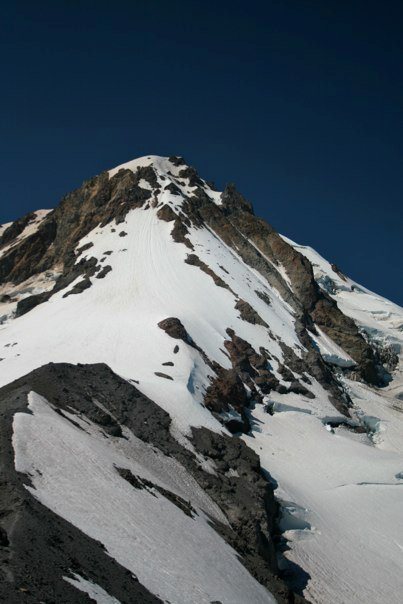
Eliot Glacier in retreat, from Cooper’s Spur on the eastern flank of Mt. Hood. Photo: Jeffrey St. Clair.
Instrument records and long-term observations show that Alpine glaciers have been retreating and thinning significantly since the end of the Little Ice Age from approximately 1300 to 1850.
Hold that thought.
Now imagine someone bringing sandwiches.
Not metaphorical ones—actual ones, wrapped in that lovely wax paper, tucked into a backpack beside crampons and thermos flasks. Someone will have packed strawberries. Someone else, a small bottle of wine for those who drink, and mountain water for those who don’t, in a bottle to be refilled again and again.
By late morning, the light will be hard and precise. The surface—what remains of it—will not be the smooth, mythic white people expect, but a kind of broken grey: meltwater channels, soot, wind-scored ridges.
It will creak sometimes, like a door remembering with nostalgia that time when it used to open.
Little will be left of many of the glaciers now, retreating not just in metres per year but in staircases. A sign will mark where one stood in 1990. Another in 1950. The past will be arranged vertically, like something you can descend through.
The picnickers—if that is the word—arrive in clusters. A family from Lyon. Students from Berlin. A couple who came here once on their honeymoon and have returned to see it again.
“Before it changes forever,” the couple might say, and then stop, as if the sentence had already expired.
They all spread blankets on rock, not ice, because the ice is no longer reliable.
A scientist is there too, measuring what she calls ablation. This is the reduction in volume of the glacial ice through melting and evaporation. She drills into it, sets a marked pole. Each week, she returns to see how much more has been revealed.
She writes the number down. She does not linger. There is a discipline to looking without talking.
If she was ever asked why she comes in person instead of relying on satellite data, she would likely gesture outwards—to the fractured expanse, the improbable blue in the deeper crevasses.
“You cannot understand scale,” she might say, “unless you stand inside it.”
A man opens the wine.
It is not permitted. It is not unusual. The cork comes free with a soft, polite sound—another small release into the thin air. Paper cups follow. Someone laughs too loudly. The sound travels.
Below them, meltwater runs in narrow, urgent streams, cutting temporary paths through the ice. By tomorrow, they will have rearranged themselves yet again. Nothing here keeps its shape for long.
Children step closer first.
They crouch where rock gives way to ice, testing it with their weight. A parent calls out—“Careful! Not too close!”—but the warning feels abstract. The glacier looks solid enough. It has always looked solid enough.
In 1850, it reached far into the valley, threatening farms and homes. People prayed for it to stop advancing.
Now they come to watch it leave.
The direction of fear has somehow been reversed. The instinct—to gather, to witness—has not.
There is a blue that appears where ice is dense enough to absorb every wavelength of light except the shortest.
Not the blue of the sky or of water. It is deeper than that. It is internal. As if the glacier were lit from within by something slow and ancient.
A student tries to photograph it and fails.
“It never looks right,” they say, scrolling through images that have flattened it into something ordinary. “It’s more…”
They don’t finish.
Nearby, someone finally unwraps the strawberries. The red is uncomplicated. Immediate. They are eaten quickly, before they warm.
This one glacier presently loses several metres of thickness each year.
This is measured. Cross-checked. Published. The numbers grow with a clarity that resists metaphor.
And still, people come. They lay out their blankets.
Not in denial of the data, but in its presence.
As if beauty—especially when it becomes precarious—requires witness.

No comments:
Post a Comment