It’s possible that I shall make an ass of myself. But in that case one can always get out of it with a little dialectic. I have, of course, so worded my proposition as to be right either way (K.Marx, Letter to F.Engels on the Indian Mutiny)
Friday, September 05, 2025
Two Ferry Crewmembers Stand Trial for Fatal Collision off Jersey
Two crewmembers of the ferry Commodore Goodwill are standing trial for the deaths of three fishermen in connection with the sinking of a fishing vessel off Jersey, UK in late 2022.
On the morning of December 8, 2022, the Condor-operated ferry Commodore Goodwill was under way about four nautical miles off the coast of Jersey, making about 19 knots. The vessel was behind schedule and had put on extra turns to catch up; the weather was clear and surface conditions were calm. UK officer Lewis Peter Carr was standing watch, and Ukrainian seafarer Artur Sevash-Zade was on lookout duty.
At about 0535, the Commodore Goodwill hit the small fishing vessel L'Ecume II, sinking it instantly. Skipper Michael Michieli and his two deckhands, Philipinne nationals Jervis Baligat and Larry Simyunn, were killed.
Prosecutors allege that there were ample advance warnings of an impending collision, and that Carr and Sevash-Zade were negligent in their duties. Both men face three counts of manslaughter for the fatal accident.
On the morning of the collision, Sevash-Zade departed the bridge for breakfast without a relief, prosecutors allege - a violation of company rules - and the L'Ecume II was visible on radar while he was in the ship's mess. After he returned, 13 minutes before the casualty, Goodwill altered course to starboard seven degrees, putting the two vessels on a collision course; the master's standing orders were to maintain a minimum one-nautical-mile closest point of approach, but the ordered course would bring them into much closer proximity, the prosecutors alleged.
Goodwill took action to avoid collision when in extremis, but it was too late. The helm was left in autopilot until after collision, and the watchstanders did not pull back on the throttle, prosecutors said.
"[This was] not a freak accident, it was purely the consequence of human error and negligence," Crown Advocate Matthew Maletroit told the court.
China Unveils Large Shipboard Laser System for "Maritime Attack"
People's Armed Police Propaganda Bureau / state media
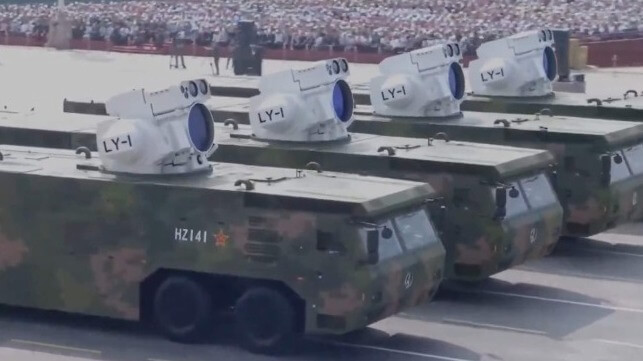
China's military has unveiled a previously-unseen laser weapons system at its massive parade in Beijing. The new LY-1 laser is designed for shipboard applications, but for the reveal, it was fielded in a truck-mounted mobile version.
The LY-1 is the latest in a series of laser weapons that China's PLA Navy has been developing since the late 2010s. Laser weapons have advantages, particularly against high-volume threats like drone aircraft and drone boats, but they also pose significant technical challenges: they must be able to track on target long enough to heat up and burn a hole in an incoming drone or missile, and the length of time required goes up if the power delivered goes down. Atmospheric conditions like fog and smoke can interfere with a laser beam, reducing impact on the target.
The LY-1's power and range were not disclosed, but the announcer for the parade described the device as "strongly capable of precision disruption and persistent strike." In the West, shipboard laser weapons are discussed in the context of point defense against drones and missiles; by contrast, the official description advertised the LY-1 as a device capable of "maritime attack" applications, indicating an offensive capability is contemplated.
Global Times, a state media outlet, said that the LY-1 can also be used for damaging optical sensors - a low-end application for a shipboard laser. "On ships, the LY-1 has sufficient space for power units, meaning that it could have higher power, enabling it to be capable of intercepting not only attacks from unmanned equipment, but also anti-ship missiles, with very low cost for each interception," Global Times wrote.
Zhao Dashuai, a social media commentator for the People's Armed Police Propaganda Bureau, connected LY-1's development to U.S. Navy weapons systems. "Capable of shooting down missiles, this makes subsonic antiship missiles obsolete," Zhao wrote. "Looking at you LRASM, Harpoon and NSM [Lockheed's Long Range Anti-Ship Missile, Boeing's Harpoon and Kongsberg's Naval Strike Missile]."
At the parade, the PLA also displayed the Hurricane 3000, a massive microwave array for disabling drones' electronics mid-flight. Not just a jammer, the array is powerful enough to cause internal damage to electronic circuits, like putting a smartphone in a microwave oven. China North Industries Group Corporation claims that it has a range of three kilometers, and it is truck-mounted for road-mobile deployment (or mounting on an open weather deck).
The U.S. Army has a comparable system with a more compact form factor and somewhat less range, the Leonidas Generation II. The U.S. Navy tested an earlier version of this system against small craft targets, and found it effective in disabling electronically-controlled motors - a useful technology for defeating swarms of unmanned drone boats.
Leidos Develops Autonomous Commando Landing Craft for UK
Leidos, the IT and defense tech company behind the Sea Hunter drone boat, has come up with an autonomous commando team delivery craft for the Royal Navy - a new and unusual application of naval autonomous technology. The program's goal is to deliver a series of 24 "medium surface insertion craft" that can deploy special forces, lightweight vehicles and "medium combat loads."
Leidos was historically known as a government IT contractor, but its work with the Navy has allowed it to build up expertise in maritime autonomy, and that's a big part of the firm's focus going forward. "We're not world renowned as an autonomous naval vessel builder. That's because we don't build ships. But everything around it, and everything that enables those commercial shipyards to become government shipyards, we have," CEO Thomas Bell told DefenseOne last month.
Originally developed for long-distance oceanic navigation for patrol, submarine-tracking and surface warfare missions, Leidos' autonomy technology can be found aboard the ACTUV / Sea Hunter and the crewboat-based Ghost Fleet Overlord prototype series. The private company currently holds an operation and management contract for the Navy's Ghost Fleet vessels, plus a $250 million five-year contract for unmanned ISR system R&D.
Leidos announced Thursday that it has now developed an autonomous landing craft for delivering British commando teams to shore, capable of long range and high speeds (above 40 knots). An illustration released with the announcement shows that it will have a stern ramp for disembarking troops; enough space and deadweight for carrying light tactical vehicles; and a sloped tumblehome hull, typically selected for reduced radar signature.
The vessel was designed by Leidos Naval Architects (Gibbs & Cox), the Royal Navy, and the UK Commando Force. It will be fitted out for AI and vessel autonomy, making it one of the larger operationally-deployed autonomous vessels in military service (though it is still not a pure unmanned design, like the Saildrone or NOMARS).
Glamox Provides Advanced Helicopter Landing Systems for Royal Navy Warships
HMS Trent completes successful sea trials of an advanced lighting system that guides helicopter pilots in rough seas and night operations
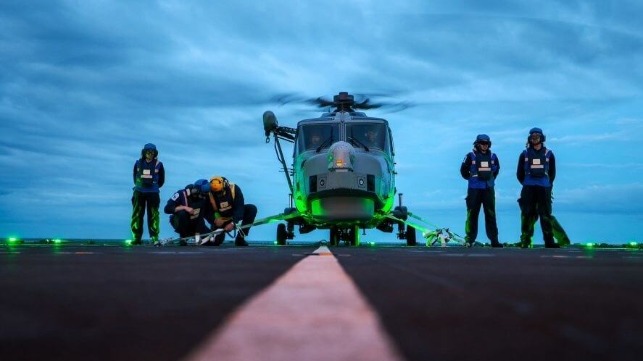
Glamox, a world leader in lighting, has enhanced the capabilities of the Royal Navy’s Offshore Patrol Vessels, HMS Trent and HMS Spey, to land helicopters on a moving deck in challenging weather and during night conditions. HMS Trent was the first vessel to be equipped with the advanced Helicopter Visual Landing Aid System (HVLAS), which underwent rigorous testing off the English south coast in July, involving three days of day and night landings from a Wildcat helicopter. HMS Spey is the next in line to be fitted with the system. Additionally, Glamox supplied both vessels with military-grade Night Vision Imaging System navigation lights.
The HVLAS is a comprehensive flight deck-based lighting system that provides pilots with visual cues and information during approach and landing. It includes a stabilised horizon bar that shows pilots the position of the horizon, regardless of the roll and pitch of the vessel. A glide path indicator assists pilots in judging approach angles using a three-colour light beam to show the correct path or whether the helicopter is too high or too low. Additional deck-edge lighting and focused LED beam lines provide accurate positional cues for pilots operating in low-visibility conditions or using night vision goggles. See the video.
The lighting system includes controls to dim or adjust the lighting intensity for improved visibility. This means that the ship can support covert missions, operating in near-dark conditions, and the lighting can be tuned to meet the operational requirements of helicopters from other forces.
“The fact that we now have the ability to control our lights in such a different manner will mean that the ability for partner nations to land helicopters will be significantly easier,” said Lieutenant Harry Jukes, HMS Trent’s Weapon Engineer Officer, interviewed by the British Forces Broadcast Service.
Following HMS Trent’s refit in Malta and the successful validation of the system at sea, the vessel is expected to be deployed to the Caribbean, where it can support various missions from counter-narcotics to humanitarian aid. The HVLAS for HMS Spey will be fitted in Singapore during its scheduled maintenance period. The Royal Navy has a further three Batch 2 River Class Offshore Patrol Vessels that could benefit from the system.
“This is the first time that Royal Navy Ships have had an HVLAS retrofit, and we are delighted with the results. The new technology greatly extends the capabilities of the Offshore Patrol Vessels to conduct helicopter operations at night and in bad weather conditions,” said Ronny Orvik, head of Glamox’s Defence & Security business. “Furthermore, this major update underscores the value of the Defence Equipment & Support arm of the UK’s Ministry of Defence in keeping its ships at the forefront of advanced technology.”
The products and services herein described in this press release are not endorsed by The Maritime Executive.
Northern Sea Route
Russia: First NSR International Boxship Route to Start as Box Volume Grows
Containership on an earlier voyage being aided by an icebreaker (Rosatom)
Russian officials are again highlighting the growth of shipping and specifically containership along the Northern Sea Route. In just 10 days, they expect the first containership following an international route to European ports will start an NSR transit, while data shows a slight increase in traffic so far this year along the Arctic shipping route.
The Liberian-flagged containership Istanbul Bridge (66,781 dwt / 4,950 TEU) is completing an eastbound transit, and then Rosatom reports says IAA Port News that the vessel will depart September 15 westbound. For the first time, it will follow a route coming from China with intermediary stops at Felixstowe, Rotterdam, and Hamburg, before proceeding to St. Petersburg.
Speaking at the Eastern Economic Forum, IAA reports Rosatom executives highlighted that container vessel traffic is growing on the NSR coming from international ships. They report that last year 14 containerships made the transit, twice as many as in 2023, and they projected more than 20 transits this year. All vessels making the NSR transit have to obtain permits from Rosatom.
The forecast is consistent with a mid-season analysis of vessel transits on the NSR released by the Center for High North Logistics. They analyzed AIS data and reported that transits during the first half of the season showed a slight increase, reaching 52 as of the end of August versus 45 last year, with 17 completed, 10 nearing completion, and 12 within the NSR area. An additional 13 ships have commenced sailings scheduled to transit the NSR.
The data analysis shows a nearly equal split between east and west transits, but tankers are laden traveling east and returning westward most likely in ballast. Tankers continue to make up the largest number of vessels using the NSR (13), plus two LNG tanker voyages,
Bulk carriers and containerships are so far tied with 10 voyages for each segment. However, they said only three of the eastbound bulkers were traveling with cargo. They, however, assume that the vast majority of the containerships are carrying cargo. The main cargo flow continues to be from Russia to China.
The analysis notes that September and October, and into November, will be an active period for the NSR. They also highlighted that ice has remained present on portions of the route, with residual ice still being observed in the eastern part of the East Siberian Sea.
The final data for the NSR is not scheduled to be released till the end of the year. Russia has been highlighting strong growth and progress toward the objective of year-round transits and reaching the goals set by Vladimir Putin, but it is unclear how accurate the data is and how close they are toward achieving ambitious goals for Arctic route shipping.
Portuguese Navy Searches Container Ship After Report of Armed Boarding
Containership Odysseus reported boarders overnight off the Portuguese coast (Portuguese Navy)
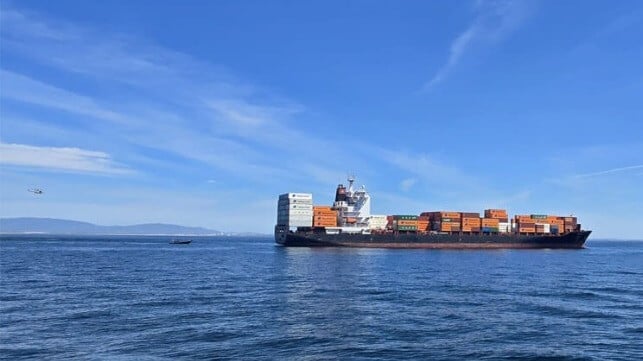
The Portuguese Navy confirmed earlier media reports that an operation is underway off the coast after a containership requested assistance. The vessel said there were boarders aboard, and unconfirmed media reports said at least two crewmembers had been locked in the engine room.
The vessel, Odysseus (39,420 dwt), is managed by Cosmoship of Greece and was underway last night, September 3, from Virgo to Malga. The alert requesting assistance went out around 2300 local time while the vessel was off the Algarve coast near the city of Lagos, Portugal.
Built in 2006, the vessel has a capacity for 2,824 TEU. It is registered in Liberia.
The Navy reports the containership diverted to a position approximately six nautical miles off the coast, and that a team from the Navy and National Maritime Authority boarded the vessel. The media reports are that both patrol boats and a helicopter were involved in the operation.
The Navy reports that the vessel is diverting to the port of Sines for further inspection. The media said that the two crewmembers were released from the engine room and that an initial search did not locate the boarders.
Speculation is that it was a drug cartel that boarded the ship. Portugal’s Correio da Manhã tabloid is saying that there were two individuals armed and wearing hoods spotted on the ship. They are thought to have fled before the authorities arrived to assist the vessel.
Land-Based Tests Underway for Seawing Automated Kite System
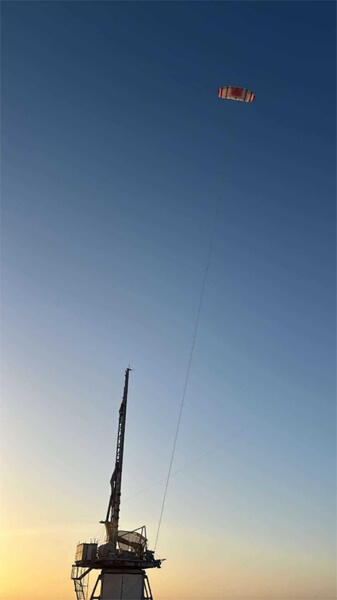
Testing is proceeding with the company saying Seawing can produce a comparatively larger amount of thrust that other wind systems (K Line)
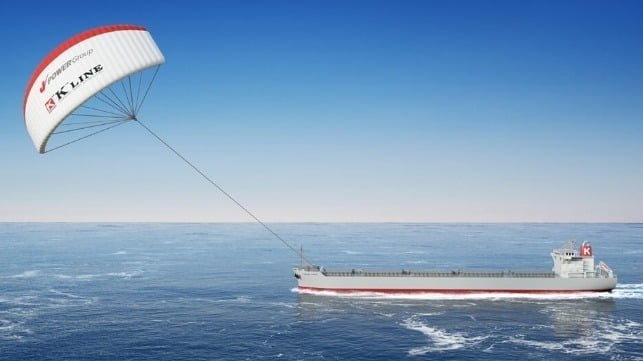
Japan’s Kawasaki Kisen Kaisha (“K” LINE) reports its subsidiary Oceanic wing completed the first phase of land-based testing for the Seawing kite system. The company is continuing to pursue the commercialization of the concept as a more productive means of wind-assisted propulsion.
They acknowledged that while there are several wind-assisted propulsion systems (WAPS) that are under development, they said Seawing is differentiated from the other WAPS by its ability to generate a comparatively large amount of thrust, which is achieved using high-altitude wind. Seawing harnesses natural wind power and can be installed on any type of vessel, including existing vessels. The system is automated and deploys the kite on a tether system placed near the bow.
There have been previous tests of kite systems conducted in France. A series of validation tests was undertaken in 2023 using a RoRo sailing for Airbus.
In the latest tests, completed in June, Oceanicwing verified the tensile strength and performance of the Seawing system using a 300 m2 kite at a land test site.
Confirming that the results of these tests were good, “K” Line says phase two of its development commenced in July. In phase two, Oceanicwing plans to increase the size of the kite and verify the tensile strength, reliability, operability, and safety of the Seawing system at the land test site.
They continue to work toward testing on a large bulk carrier owned and operated by “K” LINE. The goal is to complete the tests within approximately two years and move toward the practical application of Seawing. They expect that Seawing will reduce fuel consumption by more than 10 percent. The actual energy-saving effects they note depend on ship type, speed, route, and season, and in certain combinations of these factors, fuel consumption may be reduced by significantly more.
Report: Korean Steel Giant POSCO is Exploring Acquiring Control of HMM
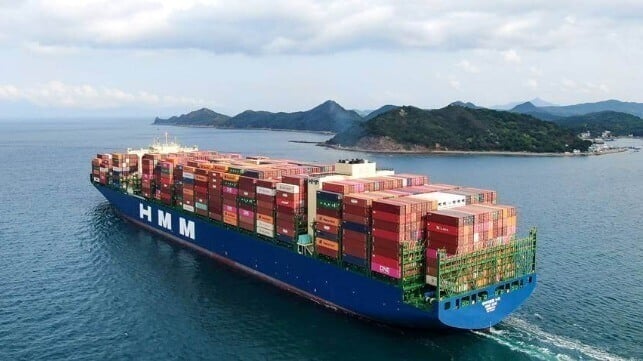
Reports indicate that new potential buyers are emerging for the government stake in HMM (HMM file photo)
Speculation is being renewed over the ownership fate of Korean shipping company HMM, a year and a half after the deal to sell the company collapsed. In an exclusive report, The Korean Economic Daily writes that steel giant POSCO is drawing up detailed plans to buy control of the shipping company.
The Korean Economic Daily reports that POSCO, which had previously been speculated as a potential suitor, has changed its strategy and now is interested in re-entering the shipping sector after deciding not to participate in the government auction in 2023 for control of HMM. POSCO was invested in Hanjin but sold the company in 1995. It reports that POSCO is searching for new growth strategies as it is facing a slowdown and the impact of U.S. tariffs on its steel business and batteries.
A controlling stake in HMM has been held by two Korean banks, the Korea Development Bank and the Korea Ocean Business Corporation, since the 2016 government-led rescue of Hyundai Merchant Marine. The two government entities collectively hold over 70 percent of stock in HMM, but have been talking of privatizing the shipping company to redeploy taxpayer monies to other investments to grow Korean business.
KDB, which owns an approximately 36 percent stake in HMM, is believed to be the leader in the privatization effort. The banks selected Harim as the preferred bidder last time, but the negotiations reportedly broke down in 2024 over a demand that the banks retain a say in the management of the HMM after the privatization. KDB is believed to be exploring starting a new round of bidding.
The Korean Economic Daily reports POSCO’s strategy is targeting acquiring the shares from KDB in a private deal. KOBC, which also holds approximately 36 percent, is believed to have decided to continue to hold its position, and the strategy calls for co-managing HMM between POSCO and KOBC.
Korean law requires that if the HMM is to be sold, it must be in a public auction. The newspaper reports that HD Hyundai Heavy Industries and Hanjin might be bidders if there were a new auction. Harim is also believed to still be interested in the business. The POSCO strategy, however, could avoid a public auction.
HMM has reported that it is pursuing a strategy to diversify its business, which is currently larger in container shipping. It attempted to buy SK Shipping to expand its dry bulk shipping. It is now reported to be pursuing individual vessel purchases of bulkers and tankers as well as building new containerships. It is also ordered car carriers, which will be operated under charter to Hyundai-Glovis, and four multi-purpose cargo vessels.
Hanwha Sells $1B Worth of Stock in Hanwha Ocean to Fund U.S. Projects
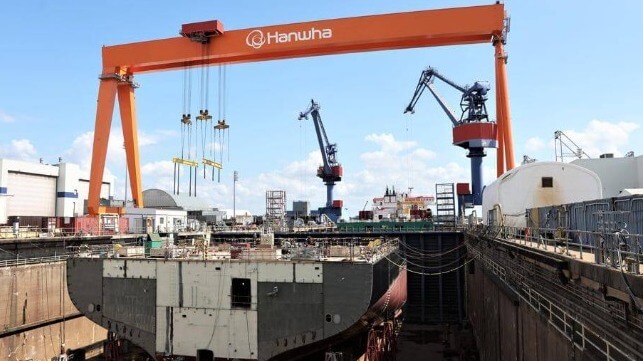
A holding company in South Korea's Hanwha Group has sold about $1 billion worth of shares in shipbuilder Hanwha Ocean, and it plans to reinvest the proceeds in its new U.S. projects.
Hanwha Impact Partners has sold its entire remaining stake in Hanwha Ocean - about 13 million shares, equal to about four percent of the company - to institutional buyers in a block sale. The holding company started out with a nine percent stake in 2023, the year Hanwha bought the shipbuilder, according to Yonhap. Hanwha Group retains 42 percent of Hanwha Ocean, along with management rights.
The share sale is well-timed: Hanwha Ocean's stock has risen by 250 percent since last year. Hanwha Ocean share prices fell by five percent after the announcement Thursday.
Hanwha owns Hanwha Philly Shipyard, formerly held by Norwegian conglomerate Aker, and it has pledged to spend $5 billion on enlarging the American yard's capacity, taking it from one ship delivery per year today to 20 ships per year by the 2030s. Philly's yard - valued at $100 million at the time of its sale last year - will be upgraded with improved basic infrastructure, as well as South Korean innovations like robotic welding technology. This is one of the first major commitments under the $150 billion program that South Korea's government calls "Make American Shipbuilding Great Again," or MASGA.
Hanwha is also buying two LNG carriers that will be built jointly in Korea and the U.S., then flagged into the United States registry. The project will be an opportunity to transfer Korean LNG shipbuilding techniques and technology to Philly, Hanwha says. In addition, it has ordered a series of 10 MR chemical tankers from Philly, which it says is the biggest commercial order by value ever placed at an American yard.
Hanwha Group said that the share sale will help fund these initiatives, and a company official also told Yonhap that "the goal is also to improve the financial structure by repaying debt."
After Six Years, CSSC Completes its Megamerger With CSIC
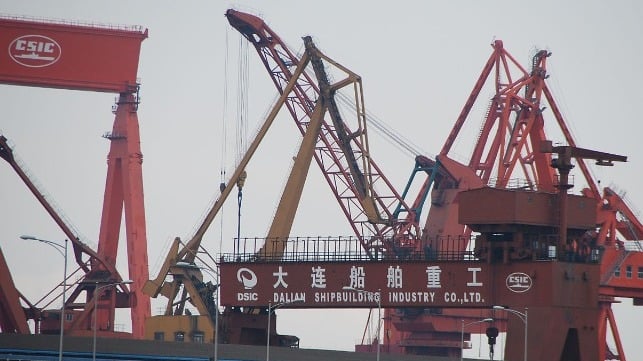
After years of preparation, the megamerger of Chinese shipbuilding giants CSSC and CSIC has finally been completed. Though the two enterprises have both been under CSSC's control since 2019, they retained their independent stock listings - until Thursday, when an exchange filing completed the integration of CSIC into CSSC.
At the market close on Thursday, CSIC shareholders received 0.13 shares of CSSC for every share they owned. CSIC's stock will be delisted from the Shanghai Exchange on Friday. After that point, it will be dissolved as a legal entity, and all of its assets and obligations will be assumed by CSSC. The company's hope is that it will be able to better integrate its shipyard assembly operations, improve its purchasing power, achieve as-yet-unrealized synergies from the union of the two companies, and "regulate competition within the same industry."d
As a group, CSSC and CSIC were already the world's largest shipbuilding conglomerate. Now with a unified brand, the merger confirms CSSC as the biggest shipbuilder by assets, revenue and order backlog. In 2024, CSSC-operated yards built more tonnage than the entire production of the U.S. shipbuilding industry since 1945.
The merger is a reunion, and it brings CSSC back full circle to its former might. The giant state enterprise spun off CSIC as a separate entity in 1999, and gave it control of government yards in northern China. CSIC came back under CSSC's ownership in 2019, but it retained its brand, management structure and support departments. In September 2024, CSSC announced long-expected plans to re-merge the two firms fully into a single entity.
The full integration will have implications for Chinese defense procurement. CSIC handles a large share of the PLA Navy's surface fleet construction contracts, and unification with CSSC is expected to help streamline warship production.
Europe hopes to join competitive AI race with supercomputer Jupiter
With the launch of supercomputer Jupiter, the biggest artificial intelligence machine in Europe, on Friday, the continent hopes to join the AI training models race after lagging behind the US and China.
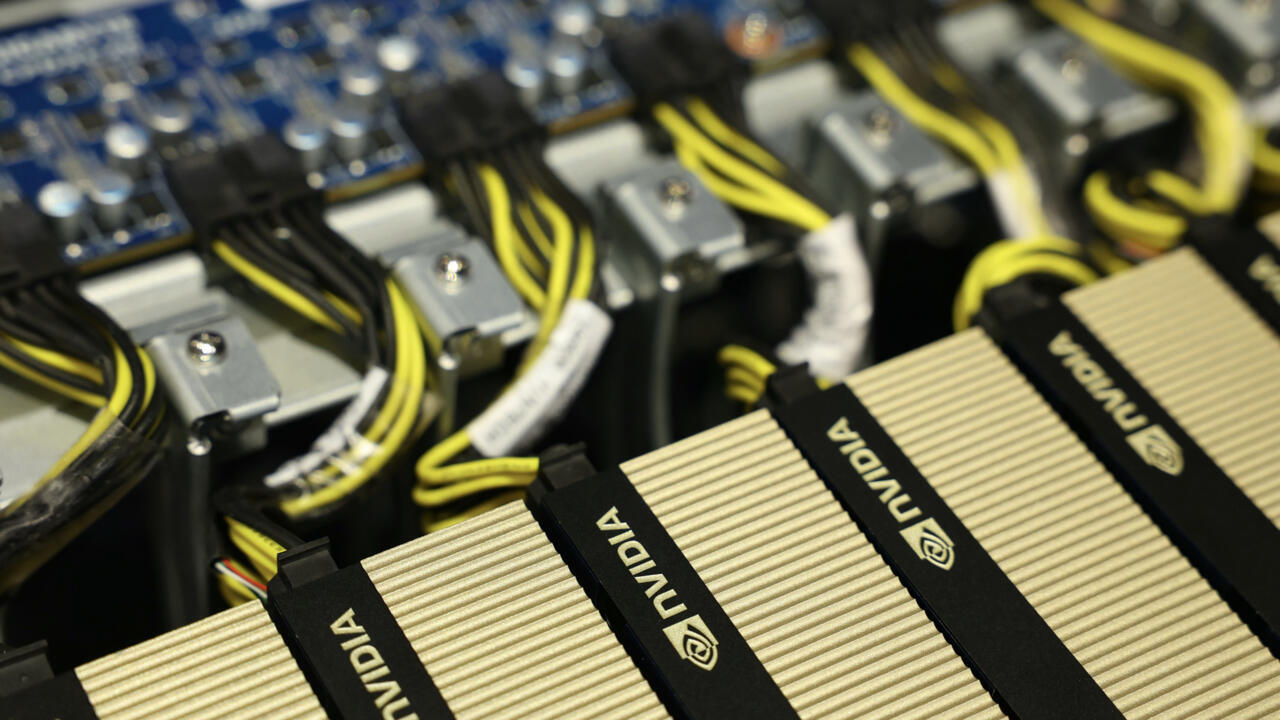
Jupiter is housed in a centre covering some 3,600 metres (38,000 square feet) – about half the size of a football pitch – containing racks of processors, and packed with about 24,000 Nvidia chips, which are favoured by the AI industry
Europe's fastest supercomputer Jupiter is set to be inaugurated Friday in Germany with its operators hoping it can help the continent in everything from climate research to catching up in the artificial intelligence race.
Here is all you need to know about the system, which boasts the power of around one million smartphones. What is the Jupiter supercomputer?
Based at Juelich Supercomputing Centre in western Germany, it is Europe's first "exascale" supercomputer – meaning it will be able to perform at least one quintillion (or one billion billion) calculations per second. The United States already has three such computers, all operated by the Department of Energy.
Jupiter is housed in a centre covering some 3,600 metres (38,000 square feet) – about half the size of a football pitch – containing racks of processors, and packed with about 24,000 Nvidia chips, which are favoured by the AI industry.
Half the 500 million euros ($580 million) to develop and run the system over the next few years comes from the European Union and the rest from Germany.
Its vast computing power can be accessed by researchers across numerous fields as well as companies for purposes such as training AI models.
"Jupiter is a leap forward in the performance of computing in Europe," Thomas Lippert, head of the Juelich centre, told AFP, adding that it was 20 times more powerful than any other computer in Germany.
How can it help Europe in the AI race?
Lippert said Jupiter is the first supercomputer that could be considered internationally competitive for training AI models in Europe, which has lagged behind the US and China in the sector.
According to a Stanford University report released earlier this year, US-based institutions produced 40 "notable" AI models – meaning those regarded as particularly influential – in 2024, compared to 15 for China and just three for Europe.
"It is the biggest artificial intelligence machine in Europe," Emmanuel Le Roux, head of advanced computing at Eviden, a subsidiary of French tech giant Atos, told AFP.
A consortium consisting of Eviden and German group ParTec built Jupiter.
Jose Maria Cela, senior researcher at the Barcelona Supercomputing Center, said the new system was "very significant" for efforts to train AI models in Europe.
"The larger the computer, the better the model that you develop with artificial intelligence," he told AFP.
Large language models (LLMs) are trained on vast amounts of text and used in generative AI chatbots such as OpenAI's ChatGPT and Google's Gemini.
Nevertheless with Jupiter packed full of Nvidia chips, it is still heavily reliant on US tech.
The dominance of the US tech sector has become a source of growing concern as US-Europe relations have soured.
What else can the computer be used for?
Jupiter has a wide range of other potential uses beyond training AI models.
Researchers want to use it to create more detailed, long-term climate forecasts that they hope can more accurately predict the likelihood of extreme weather events such as heatwaves.
Le Roux said that current models can simulate climate change over the next decade.
"With Jupiter, scientists believe they will be able to forecast up to at least 30 years, and in some models, perhaps even up to 100 years," he added.
Others hope to simulate processes in the brain more realistically, research that could be useful in areas such as developing drugs to combat diseases like Alzheimer's.
It can also be used for research related to the energy transition, for instance by simulating air flows around wind turbines to optimise their design. Does Jupiter consume a lot of energy?
Yes, Jupiter will require on average around 11 megawatts of power, according to estimates – equivalent to the energy used to power thousands of homes or a small industrial plant.
But its operators insist that Jupiter is the most energy-efficient among the fastest computer systems in the world.
It uses the latest, most energy-efficient hardware, has water-cooling systems and the waste heat that it generates will be used to heat nearby buildings, according to the Juelich centre.
(FRANCE 24 with AFP)
China to impose temporary duties on EU pork over 'dumping'
Beijing (AFP) – China said Friday it would impose temporary anti-dumping duties on European Union pork imports, delivering another blow to shaky ties between the economic powerhouses.
Issued on: 05/09/2025 - FRANCE24
Chinese authorities launched the probe into European pork imports last year during scrutiny by Brussels of Beijing's state subsidies for the domestic electric vehicle industry
Beijing and Brussels have navigated a challenging relationship in recent years, complicated greatly by Russia's 2022 invasion of Ukraine.
Chinese authorities launched the probe into European pork imports last year during scrutiny by Brussels of Beijing's state subsidies for the domestic electric vehicle industry.
The investigation has "preliminarily determined that imports of relevant pork and pig by-products originating in the European Union are being dumped", a statement from China's commerce ministry said.
Authorities have decided to implement "provisional anti-dumping measures in the form of deposits", it added.
The import duties range from 15.6 percent to 62.4 percent and will enter into force on September 10, the statement continued.
The provisional measures are still subject to the commerce ministry investigation, which had already been extended until December.
China -- the world's leading consumer of pork -- imported 4.3 billion yuan ($604.3 million) in pork products from major European producer Spain alone last year, according to official Chinese customs data. Testy relations
Beijing's move comes on the heels of a diplomatic blitz that saw President Xi Jinping meet face-to-face with several prominent adversaries of Western governments, including Russia's Vladimir Putin and North Korea's Kim Jong Un.
Top EU diplomat Kaja Kallas on Wednesday criticised the three leaders' joint appearance at a parade marking the 80th anniversary of the end of World War II as "a direct challenge to the international system built on rules".
The statement by Kallas drew choice words from a spokesman for China's foreign ministry, who said Thursday that "remarks made by a certain EU official are full of ideological bias".
Much to the chagrin of EU leaders, Beijing has never denounced Russia's war nor called for it to withdraw its troops.
Many of Ukraine's allies believe that China has provided support to Moscow, repeatedly calling on Beijing to exert pressure on Putin to end the war.
China insists it is a neutral party, regularly calling for an end to the fighting while also accusing Western countries of prolonging the conflict by arming Ukraine.
Earlier on Friday, Beijing's foreign ministry said it "strongly opposes" calls by US President Donald Trump for European leaders to put economic pressure on China over the war in Ukraine.
Recent years have seen entrenched political disagreements between Beijing and Brussels threaten their strong economic relationship.
The current trade spat erupted last summer when the European Union moved towards imposing hefty tariffs on EVs imported from China, arguing that Beijing's subsidies were unfairly undercutting European competitors.
Beijing denied that claim and announced what were widely seen as retaliatory probes into imported European pork, brandy and dairy products.
Western troops in Ukraine would be ‘legitimate’ target for Russia, Putin warns
Any Western troops deployed to Ukraine would be a "legitimate" target for Moscow's army, Russian President Vladimir Putin warned on Friday, a day after 26 countries pledged to deploy protective troops on Ukrainian soil if a ceasefire is reached.
Russian President Vladimir Putin warned on Friday that any Western troops deployed to Ukraine would be a "legitimate" target for Moscow's army, a day after Kyiv's Western allies said they had committed to a troop presence in the event of a peace deal.
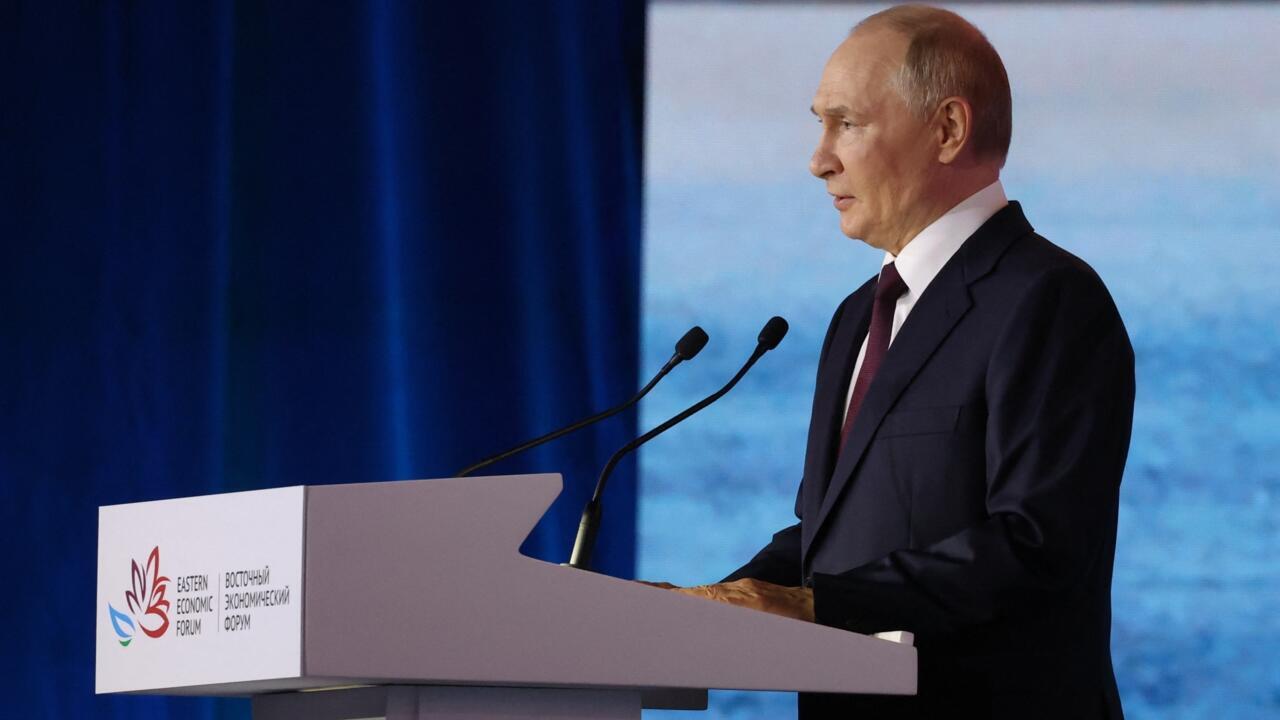
"If some troops appear there, especially now during the fighting, we proceed from the premise that they will be legitimate targets," Putin said at an economic forum in the far east city of Vladivostok.
He added that the deployment of a Western force was not conducive to long-term peace.
Putin's comments came the morning after more than two dozen countries pledged to join a "reassurance" force to deploy in the wartorn country after any eventual peace deal with Moscow.
A force to deter Russia from again attacking its neighbour is a key pillar of the security backstop a coalition of mainly European countries want to offer to Ukraine if the war ends via a peace deal or a ceasefire.
The extent of any US involvement remains uncertain, even after European leaders spoke to President Donald Trump via video conference following the Paris summit at which the "coalition of the willing" pledged its force.
France's President Emmanuel Macron (R) and Ukraine's President Volodymyr Zelensky arrive to chair the Coalition of the Willing Summit, at The Elysee presidential Palace in Paris, on September 4, 2025.
The meeting represented a new push led by Macron to show that Europe can act independently of the United States after Trump launched direct talks with Russian President Vladimir Putin.
The United States was represented by Trump's special envoy Steve Witkoff, who also met with Zelensky separately.
Trump said after his call with European leaders that he would speak to Putin soon, with Peskov confirming Friday that such a call could be organised swiftly. 'First concrete step'
Europe has been under pressure to step up its response over three and a half years after Russia launched its full-scale invasion in February 2022.
"We have today 26 countries who have formally committed – some others have not yet taken a position – to deploy as a 'reassurance force' troops in Ukraine, or be present on the ground, in the sea, or in the air," Macron told reporters, standing alongside Zelensky.
Zelensky hailed the move: "I think that today, for the first time in a long time, this is the first such serious concrete step."
The troops would not be deployed "on the front line" but aim to "prevent any new major aggression", the French president said.
Macron added that another major pillar was a "regeneration" of the Ukrainian army so that it can "not just resist a new attack but dissuade Russia from a new aggression".
Macron said the United States was being "very clear" about its willingness to participate in security guarantees for Ukraine.
There are also divisions within the coalition, with German Chancellor Friedrich Merz urging more pressure but remaining cautious about the scope of involvement.
"Germany will decide on military involvement at the appropriate time once the framework conditions have been clarified," a German government spokesman said after the summit.
Taking a similar line, Italy's Prime Minister Giorgia Meloni reiterated that her country will not send troops to Ukraine, but could help monitor any potential peace deal.
There is also growing concern that Putin is not interested in a peace accord, with alarm intensifying after his high-profile visit to China this week. 'Play for time'
Frustration has been building in the West over what leaders say is Putin's unwillingness to strike a deal to end the conflict.
Zelensky said the call with Trump discussed sanctions on Russia and protecting Ukraine's airspace.
"We discussed different options, and the most important is using strong measures, particularly economic ones, to force an end to the war," Zelensky said on social media.
The White House said it urged European countries to stop purchasing Russian oil "that is funding the war".
A Russian rocket attack Thursday on northern Ukraine killed two people from the Danish Refugee Council who were clearing mines in an area previously occupied by Moscow's forces, the local Ukrainian governor said.
Macron warned that if Russia continued refusing a peace deal, then "additional sanctions" would be agreed in coordination with the United States.
He accused Russia of "doing nothing other than try to play for time" and intensifying attacks against civilians.
The gathering followed Putin's high-profile trips to China and the United States, where he met with Trump in Alaska last month.
Speaking Wednesday in Beijing, where he attended a massive military parade alongside Chinese President Xi Jinping, Putin hailed his forces' progress in Ukraine, adding that Russian troops were advancing on "all fronts".
(FRANCE 24 with AFP)
Afghanistan earthquake death toll tops 2,200, rescue efforts 'still ongoing'
The death toll from the devastating earthquake that struck eastern Afghanistan over the weekend has risen to more than 2,200, officials said Thursday. The deadliest quake to hit the country in decades has also stymied the emergency response as the cash-strapped country contends with overlapping humanitarian disasters.
An Afghan man looks for his belongings amidst the rubble of his collapsed house after a deadly magnitude 6 earthquake that struck Afghanistan on Sunday, at Lulam village, in Nurgal district, Kunar province, Afghanistan, September 3, 2025.
The death toll from the powerful earthquake that struck eastern Afghanistan at the weekend rose sharply to more than 2,200 on Thursday, according to a new toll, making it the deadliest in decades to hit the country.
The vast majority of those killed in the magnitude-6.0 earthquake that jolted the mountainous region bordering Pakistan late Sunday were in Kunar province, where 2,205 people died and 3,640 were injured, according to a Taliban government toll.
Another 12 people were killed and hundreds injured in the neighbouring provinces of Nangarhar and Laghman.
"Hundreds of bodies have been recovered from destroyed houses during search and rescue operations," deputy government spokesman Hamdullah Fitrat wrote on X on Thursday, announcing the new toll, adding that "rescue efforts are still ongoing".
Limited access to the hardest hit areas of mountainous Kunar province has delayed rescue and relief efforts, with rockfalls from repeated aftershocks obstructing already precarious roads etched onto the side of cliffs.
Various countries have flown in aid, but hundreds of villagers in the hard-hit Nurgal district were still stranded in the open air, squeezing multiple families under pieces of tarp pulled from the rubble and unsure of where they would get a morsel to eat.
A fight broke out over food when some finally reached the field in Mazar Dara where hundreds of people were camped out, little aid having reached them.
"Yesterday, some people brought some food, everyone flooded on them, people are starving, we haven't had anything to eat for a long time," Zahir Khan Safi, 48, told AFP. 'Every hour counts'
Poor infrastructure in the impoverished country, still fragile from four decades of war, has also stymied the emergency response.
The World Health Organization warned that local healthcare services were "under immense strain", with shortages of trauma supplies, medicines and staff.
The agency has appealed for $4 million to deliver lifesaving health interventions and expand mobile health services and supply distribution.
"Every hour counts," said WHO emergency team lead in Afghanistan Jamshed Tanoli. "Hospitals are struggling, families are grieving and survivors have lost everything."
The loss of US foreign aid to the country in January this year has exacerbated the rapid depletion of emergency stockpiles and logistical resources.
NGOs and the UN have warned that the earthquake creates a crisis within a crisis, with cash-strapped Afghanistan already contending with overlapping humanitarian disasters.
Filippo Grandi, head of the UN's refugee agency, said the quake had "affected more than 500,000 people" in eastern Afghanistan.
The country is contending with endemic poverty, severe drought, and the influx of millions of Afghans forced back to the country by neighbours Pakistan and Iran since the Taliban's 2021 takeover.
Even as Afghanistan reeled from its latest disaster, Pakistan began a new push to expel Afghans, with more than 6,300 people crossing the Torkham border point in quake-hit Nangarhar province on Tuesday.