Saturday, February 21, 2026

AI and the economy: A losing bet for working people
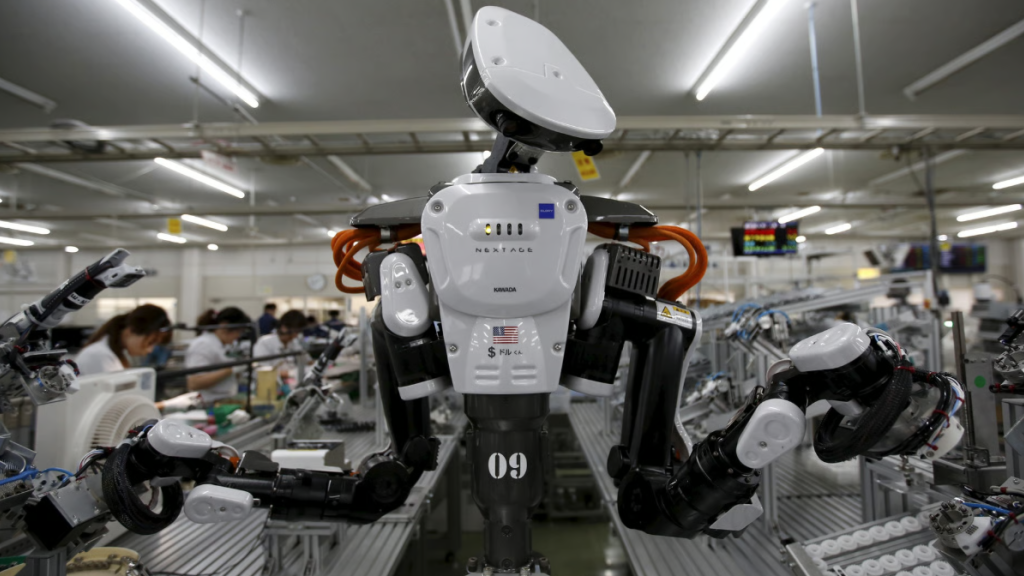

Ai robot in production line

First published at Reports from the Economic Front.

Tech billionaires and the Trump administration, with the apparent support of most of the capitalist class, are betting big on artificial intelligence (AI). In fact, AI investments have become the primary driver of US economic growth.

But this is a losing bet for us. The AI boom is not sustainable. And because it is delivering little of value, unbalancing our economy, intensifying our ecological crisis, and threatening the quality and responsiveness of our social institutions, the longer it goes on the greater the harm done and the more difficult will be the task of economic and social renewal.

The AI boom

Many people believe that artificial intelligence is an ethereal technology, “living” in the clouds. In reality, AI systems are firmly rooted. They need electricity for training and operation, water for cooling, and racks of servers with chips built using hard to acquire minerals, all of which must be housed and accessed in gigantic data centers.

It is the massive spending on these data centers and their associated equipment and software that is most responsible for the US economy’s current growth. The economist Jason Furman estimated that US GDP growth in the first half of 2025 was almost entirely due to these AI-related investments. Excluding them, GDP growth, on an annualized basis, would have been minimal, only 0.1 percent. OECD researchers held a more pessimistic view, believing that without that spending the US would have been in outright recession.

Yearly AI-related capital spending by the biggest tech companies — Google, Amazon, Meta, and Microsoft — rose from $150 billion in 2022 to $360 billion in 2025. And they collectively plan to spend a substantially greater amount, $650 billion, in 2026. Bloomberg reports that “The companies’ estimates for [2026] are expected either near or to surpass their budgets for the past three years combined.” To put that spending in perspective: “the largest US-based automakers, construction equipment manufacturers, railroads, defense contractors, wireless carriers, parcel delivery outfits, along with Exxon Mobil Corp., Intel Corp., Walmart Inc. and the spun-off progeny of General Electric — 21 companies — are projected to spend a combined $180 billion in 2026.”

These four tech companies are not the only ones investing in data centers. xAI, which was merged with SpaceX in 2026, completed a massive data center in 2025 with another still under construction. Oracle has recently become a major supplier of cloud services and, according to Larry Ellison, its CEO, the company aims to build “more cloud infrastructure data centers than all its infrastructure competitors combined.” In 2025, it signed a $300 billion contract with OpenAI to provide five years of computing services.

AI’s growth supporting effects are also felt through another channel — the stock market. The November 2022 launch of the AI chatbot ChatGPT sparked an explosive growth in the value of a group of tech stocks known as the “Magnificent 7” — NVIDIA, Microsoft, Alphabet, Apple, Meta, Tesla and Amazon. These stocks currently account for close to 40 percent of the value of the S&P 500 and are responsible for approximately 80 percent of the market’s overall rise in 2025. They generated an average return of 27.5 percent in 2025, compared with 7 percent for the rest of the S&P 500, producing a sizeable market capitalization weighted gain of 17.5 percent.

In line with the class nature of the US economy, the wealthiest 10 percent of Americans, owners of close to 90 percent of the stock market, were the chief beneficiaries of this market showing. The wealth effect, where a rise in asset values encourages an increase in consumption, then played its part. The consumption share of the top 20 percent of earners soared over 2025, reaching 60 percent of total US consumption by the end of the year.

The celebration of AI as economic savior distracts from the fact that it is a very specific type of AI, known as generative artificial intelligence, that is largely responsible for the boom. Artificial intelligence technologies are typically divided into two main groups, machine learning and generative AI. Machine learning models use algorithms to identify patterns, make decisions, and improve their performance through experience. They do not generate new content. Generative AI models, which are trained on large data sets, can produce human-like text and respond to and manipulate audio and image inputs. The best known are ChatGPT (OpenAI), Gemini (Google), Claude (Anthropic), Grok (xAI), Copilot (Microsoft), and Llama (Meta).

The owners of these generative AI systems are locked in intense competition, with each hoping to secure market dominance and the resulting monopoly profits. But that is only the short-term goal. They also appear to believe that further development of their respective AI systems will produce a higher level Artificial General Intelligence (AGI), a superintelligence that will lead to, in the words of Mark Zuckerberg (Meta’s CEO), the “creation and discovery of new things that aren’t imaginable today.” Sam Altman (OpenAI’s CEO) believes that a soon to be created AGI will provide a solution to global warming, enable us to colonize space, and live forever with our minds uploaded to computers. Elon Musk (xAI’s CEO) believes that AI-powered robots will soon make work optional and money irrelevant.

The race to achieve market dominance, and eventually AGI, pushes these companies to continually offer new models that are said to be faster, more reliable, and more powerful. And it is this competitive upgrading that is propelling data center construction and the economy’s growth. The reason is that existing data centers cannot easily be retrofitted to accommodate the needs of the new models, which require a greater number of larger server racks, each with more numerous energy hungry powerful chips, and more complex energy and cooling systems.

Trouble ahead

Despite all the excitement and confident assertions that generative AI is a revolutionary technology capable of transforming the US economy for the better, the AI boom is likely near exhaustion. That is because these advanced AI systems suffer from serious and unescapable flaws and limitations that make them incapable of serving as a bridge to anything resembling AGI and too unreliable and expensive (if priced to cover cost) to win widespread adoption by sufficient numbers of individuals or businesses.

Despite the use of the term intelligence, these systems do not think or reason. They operate by probabilistically selecting words or images based on pattern recognition developed from training on massive data sets built largely from material scrapped from the web. As a consequence, they periodically make nonsensical connections, leading them to produce factually inaccurate responses. This proclivity to “hallucinate” makes them untrustworthy, as the many lawyers, doctors, journalists, coders, students, and business owners who have relied on them have discovered. And because these systems are trained on largely unfiltered material from the web, they can also produce output that replicates the hateful and discriminatory material found there, making their use unacceptable in a variety of social, educational, and employment settings.

The companies developing these systems generally downplay the seriousness of these and other related problems, claiming they will be overcome with better and larger data sets, more sophisticated algorithms, and greater computational power. However, new human created material in sufficient quantity for additional training has proven difficult to obtain because AI generated material now dominates the web. While some developers claim that this “synthetic data” is just as useful as human generated material, studies have found that its use leads not just to a loss of accuracy but to a structural degradation of how reality is represented or, in the words of tech researchers, “model collapse.” As for the problem of hallucinations, even OpenAI employed researchers have concluded that “large language models will always produce hallucinations due to fundamental mathematical constraints that cannot be solved through better engineering.”

Not surprisingly then, businesses employing AI have found productivity gains difficult to realize. An MIT Media Lab study, reported on by Forbes, concluded that “AI pilot failure is officially the norm — 95 percent of corporate AI initiatives show zero return.” A survey of more than 1,000 enterprises across North America and Europe found that 42 percent had abandoned most of their AI initiatives in 2025, up from 17 percent in 2024.

The upshot? None of the major generative AI systems are profitable or on the road to profitability. OpenAI’s ChatGPT is the most widely used system. Yet, as tech commentator Ed Zitron points out, the company lost $5 billion in 2024 and will likely lose upwards of $8 billion in 2025.

An article in The Conversation, a nonprofit news organization, offers some insights into why:

Free [generative AI] services, and cheap subscription services like ChatGPT and Gemini, cost a lot of money to run. OpenAI CEO Sam Altman has been candid about how much money his firm spends, once quipping that every time users say “please” or “thank you” to ChatGPT, it costs the firm millions. Exactly how much OpenAI loses per chat is anyone’s guess, but Altman has also said even paid pro accounts lose money because of the high computing costs that come with each query.

Some analysts estimate OpenAI might run out of cash by mid-2027 without new funding. OpenAI itself forecasts a loss of $14 billion in 2026 and expects to continue to make huge losses totaling $44 billion until 2029.

Things are not much better for Meta, Amazon, Microsoft, Google, and Tesla, which have their own AI systems and also build and operate their own data centers. Collectively, these firms spent more than $560 billion on AI related capital expenditures over the years 2023-2025, all to generate combined earnings, not profits, of only $35 billion.

Despite model shortcomings and profit challenges, the major AI players remain determined to press ahead. But with planned spending far outstripping revenue, they can do so only if they are able to obtain the required funds from debt and venture capital markets. And the amounts needed are sizeable. For example, OpenAI has signed deals committing it to spend some $1.4 trillion dollars over the next five years, including $500 billion to purchase chips from NVIDIA, $300 billion for computing services from Oracle, $22 billion for computing services from CoreWeave, and an unknown amount to Broadcom to help it develop and deploy racks of its own designed chips. Oracle, for its part, is planning to raise some $50 billion in 2026 through a combination of debt and equity sales to finance its construction activity.

Even the largest data center builders are finding it necessary to tap debt markets. As Bloomberg explains:

More than $3 trillion. That’s the ­staggering price tag to build the data centers needed to prepare for the artificial intelligence boom. Not even the world’s biggest technology companies—not Amazon.com, not Microsoft or Meta Platforms—are prepared to foot the bill with only their own cash.

So where will the money come from? Debt markets.

Which ones? All of them.

Blue-chip bonds, junk debt, private credit and complex asset-backed pools of loans. “The numbers are like nothing any of us who have been in this business for 25 years have seen,” says Matt McQueen, who oversees global credit, securitized products and municipal banking and markets at Bank of America Corp. “You have to turn over all avenues to make this work.”

For the moment it appears that lenders and investors are willing to back the AI bet. But with AI developers unable to produce a dependable, cost-effective, and broadly useful product, company revenue projections are bound to disappoint and there will come a time when lenders and investors will simply refuse to throw good money after bad. When that moment arrives, the AI boom is finished.

OpenAI may be the most vulnerable to such a financial squeeze. As noted above, it has signed a number of agreements to purchase services from other companies. However, at the rate it is burning through money, it may not be long before its financing needs outgrow what lenders and investors will find acceptable. If they pull back, OpenAI will be forced to retrench, slashing employment and investment, with negative consequences for its stock price, development program, and the companies counting on its business. Oracle is one of those companies. It borrowed heavily to finance its data center construction counting on OpenAI for most of its future revenue. Without that revenue, Oracle’s own financial situation will quickly deteriorate. Both OpenAI and Oracle are major customers of NVIDIA, so their difficulties will affect its bottom line. And on it goes.

A growing number of investment analysts are starting to take this danger seriously. NPR reports that “Morgan Stanley analysts estimate that Big Tech companies will dish out about $3 trillion on AI infrastructure through 2028, with their own cash flows covering only half of that,” leading one analyst to say: ‘If the market for artificial intelligence were even to steady in its growth, pretty quickly we will have over-built capacity, and the debt will be worthless, and the financial institutions will lose money.’”

In early February 2026, these concerns led, as Bloomberg describes:

to a series of punishing [stock market] selloffs, wiping more than $1 trillion from the market values of big tech companies. . . . [This] marks a major break from the sentiment of the last few years, when speculation that AI would set off a transformative productivity boom kept pushing stock prices higher. . . . But the pile of money the tech giants are throwing at AI is getting so big that there’s increasing skepticism about whether it can continue.

In fact, there are signs that even tech players are growing worried. OpenAI was encouraged to pursue its spending plans because NVIDIA had agreed to make a $100 billion investment in the company. However, only months later, NVIDIA walked back that commitment, with Jensen Huang, the company’s CEO, claiming that the deal was nonbinding. Bloomberg cites reports that Huang has privately voiced concerns about OpenAI’s business strategy and standing relative to its competitors.

The problem, of course, is not a matter of competition. Rather it is that these generative AI systems cannot deliver what they promise. Surveys may show significant business and public use, but paying customers are few and far between. While OpenAI claims more than 500 million weekly users, only 15.5 million are paying subscribers, which as Zitron notes, “is an absolutely putrid conversion rate.” And this still beats Google, whose latest Gemini model is now getting rave reviews. As Zitron explains, “When you look at the actual business lines, the revenues are pathetic, with Google’s Gemini Enterprise only having eight million paying subscribers…which could mean everything from “paying $17 to $30 a month for a Google workspace with Gemini account” to “has used the Gemini Enterprise API.”

The way forward

The AI boom will end. But it would be a mistake for us to just wait for that to happen. It could take years and every year it continues we pay a price. The massive investment in generative AI and its data center infrastructure is drawing funds away from areas of greater social importance, leaving our economy ever more unbalanced and incapable of responding to our needs.

The hyperscale data centers are themselves enormously harmful. They disrupt communities, displace needed agricultural land, siphon off tax revenue needed to fund social services, push up electricity prices, stress local energy systems and water resources, and contribute to global warming. Encouragingly, community groups and environmental organizations are finding new and effective ways to resist the construction of new data centers and, in some cases, block the operation of existing ones.

AI developers are also aggressively working to embed generative AI systems into as many aspects of our lives as fast as possible. They appear to recognize the growing popular distrust and disapproval of their systems and no longer count on their “organic adoption” by consumers, social institutions, or government agencies. Rather, as the writer Matt Seybold so well puts it, “They have moved on to a new dream of forced adoption mandated by government and managerial coercion.” We can already see signs of their efforts in our schools, health institutions, newsrooms, film studios, and social media, although resistance, especially from unions, is growing.

The end of the AI boom doesn’t mean that tech companies will abandon their efforts to profit from required use of generative AI systems or that our economy will automatically generate a new center of economic vitality. That means we need to deepen our own organizing efforts, with a focus on building a more coordinated and stronger fight for a technology policy and economy that serves majority interests.



 

No Public Funds for Secular or Religious


Charter Schools


Charter schools are private entities. They are businesses first and foremost, not schools. Calling them “public” does not make them public in any way, shape, or form. They also remain private in character whether they are considered secular or religious, or non-profit or for-profit.

As private organizations, charter schools have no valid claim to public funds. Thus, for example, to assert that a secular charter school can receive public funds but a religious charter school cannot is to promote confusion.

The main reason charter schools are labelled “public” is to fool the gullible and to justify funneling billions of dollars a year from under-funded traditional public schools to privately-operated charter schools.

Last year, on May 22, 2025, the Supreme Court of the United States (SCOTUS) delivered a 4-4 split ruling on the landmark case of St. Isidore of Seville Catholic Virtual Charter School v. Drummond, which originated in Oklahoma. The split decision left intact the lower court’s decision (in Oklahoma) that blocked the establishment of the online K-12 religious charter school. Conservative Justice Amy Coney Barrett recused herself from the case due to her connection to forces promoting the creation of St. Isidore of Seville Catholic Virtual Charter School. In all likelihood, she will now preside over similar cases, probably swinging the vote in favor of permitting publicly-funded religious charter schools. A full bench bodes well for sectarian forces.

In recent weeks, the news has been filled with reports of new attempts to establish religious charter schools in different states, including, most notably, a Jewish online charter school in Oklahoma. To no one’s surprise, The Journal Record reported on February 11, 2026, that, “An Oklahoma state board on Monday rejected a proposal to open a Jewish charter school, likely restarting a legal fight over public funding of religious education.” Many religious and secular forces have opposed the creation of such a school as well. The case is expected to reach the SCOTUS.

According to EdWeek, the online religious charter school “projects opening in the fall of 2026 with 500 students and state funding of $2.6 million, growing to 1,500 students and funding of $8.3 million by 2030.” This means a loss of $11 million for traditional public schools. The real figure is likely higher.

The core issue in such cases is determining whether charter schools are public or private entities. If they are public, then a certain logic follows. If they are private, a different logic follows. It is thus key to sort out this fundamental issue.

It is important to recognize and grasp that, unlike public schools, charter schools are created by unelected private persons, cannot levy taxes, avoid many laws and regulations, treat teachers as “at-will” employees, are mostly deunionized, and routinely cherry-pick students. These are just some of the major differences between public schools and charter schools.

To be sure, unlike public schools, charter schools are not state actors. They are not political subdivisions of the state. Nor are they considered government agencies or natural components of state public education systems. They are simply not set up like that under state laws. Charter schools, importantly, are not created by the State even though they may be delegated certain functions by the State. Creation and delegation are not synonymous.

To further elaborate, charter schools are performance-based contracts entered into by two distinct parties: a private organization and the government (or government-sanctioned entity). Naturally, partnering with the government is not the same as being part of the government. This is an important distinction in State Action Doctrine. Charter schools are not an arm of the government like traditional public schools are. They are not acting on behalf of a governmental body. Nor do they act with the same authority as the government. Interestingly, the appearance of the word “charter” before “school” is one of the many ways charter schools are distinguished from traditional public schools.

Precisely because they are private entities, various provisions of the U.S. Constitution do not apply to charter schools. Many private actions are not subject to constitutional scrutiny under State Action Doctrine. Certain constitutional standards do not apply to acts of private persons or entities. Constitutional standards apply mainly to the States and their subdivisions (like cities, counties, and school districts). Thus, as deregulated private actors, charter schools are generally not subject to liability under 42 U.S.C. § 1983,[4] while traditional public schools are.

As in last year’s landmark case of St. Isidore of Seville Catholic Virtual Charter School v. Drummond, the SCOTUS will likely promote confusion about the “publicness”/”privateness” of charter schools. But in the final analysis, the main principle guiding such matters is: no public funds for private entities.

Shawgi Tell (PhD) is author of the book Charter School Report Card. He can be reached at stell5@naz.eduRead other articles by Shawgi.

Australia as Zionist-Occupied Territory


 February 20, 2026


Photograph Source: מעין שרון – CC BY 2.5

Australia has always been susceptible to the Zionist siren song.

H. V. Evatt was a brilliant lawyer and High Court of Australia judge (at 36, the youngest appointee ever). He was also joint Foreign Affairs Minister and Attorney-General in successive Labor governments, 1941-49. However, Evatt moonlighted as Chair of the UN Special Committee on Palestine in 1947. In that capacity, through crude partisan means (while claiming otherwise), he legitimized the preposterous Resolution 181 (II) of November 1947 for the partition of Palestine – that Resolution itself the product of corrupt threats to voting members. Caroline Graham, sometime journalist and academic, has re-told the Evatt story. Graham cites Evatt’s contemporary – equally reputable lawyer, Pakistani delegate Muhammad Zafrulla Khan – who took umbrage at Evatt’s blocking of a submission of the partition plan to the recently empowered International Court of Justice. For Khan, this was “a confession that the General Assembly is determined to make recommendations in a certain direction, not because these recommendations are in accord with principles of international fairness and justice.” Yet Evatt is feted for his significant role in using UN auspices to legitimize the state of Israel then being forged by terrorist means.

Another ‘bonding’ of Australia to Israel was in the attraction of elements of the Australian union movement for Histadrut. Histadrut was not and is not a conventional peak union federation. The British anti-Zionist Tony Greenstein has succinctly captured (2009) the historical character and role of Histadrut. Formed in 1920, it was the economic and industrial center of the Zionist enterprise in Mandatory Palestine, bonded with the Haganah militia and the Jewish Agency as political wing, and subsequently a cornerstone of the economy of the apartheid Israeli state. Some Greenstein quotes: ‘a great colonizing agency’; ‘From its inception it excluded Arab labor and thus rejected worker solidarity in favor of national exclusivism’; ‘actively collaborating with the South African state’. After 1970, Histadrut allied with the military to institutionalize the exploitation of Palestine workers from the Occupied Territories, with Palestinian workers forced to financially contribute to their own exploitation without benefits. Australia might be in the antipodes but how could its union leaders be so ill-informed on Histadrut’s character?
If larger-than-life Labor Prime Minister Bob Hawke (1983-91) was a loyal friend of the US, he became fanatically pro-Israel. Raised in a fundamentalist Christian household envisaging Israel as end times eschatology, Hawke early was close friends in the labour movement with left-wing Zionist Jews working to aid Jewish refugees. Personal friendships drew him closer to the mainstream Zionist lobby from which he became a front man for its cause, oblivious to the contemporaneous slaughter of Palestinians and destruction of their livelihoods.

During the 1970s, Hawke was omnipresent – contemporaneously President of the Australian Council of Trade Unions (ACTU) and President of the Australian Labor Party (and Australian go-between at the ILO), Hawke was enraptured by Histadrut’s multi-pronged activities and sought to replicate elements by the formation of multiple joint business ventures between the ACTU and Jewish businessmen and even with Histadrut directly.

Hawke made innumerable trips to Israel, becoming honorary ambassador and feted, not least for his intercession in the Soviet Union (through a Russian unionist counterpart) for the right of Soviet Jewry to emigrate. He was constantly attempting to overturn the ‘balanced’ (or, rarely, pro-Palestinian) stance of his ACTU and Labor Party peers. Finally, after being elected to Parliament in 1979 and becoming Party leader in 1982, elected as Labor Prime Minister in March 1983 he puts his pro-Israel stamp on the government itself.

In November 1975, The UN General Assembly passed Resolution 3379 (dependent on the USSR, Soviet satellites, Arab states and non-aligned nations), determining that ‘Zionism is a form of racism and racial discrimination’ – which it is. Chaim Herzog, Israel’s UN Ambassador (1975-78), father of a certain Isaac Herzog, was apoplectic. On 23 October 1986, Hawke moved a motion in Parliament to rescind Resolution 3379, then taken up globally by opposing forces. (Resolution 3379 was rescinded belatedly in 1991, after the collapse of the USSR.) The move was reinforced in Australia when, in November 1986, Hawke invited and entertained the same Chaim Herzog, becomes Israeli President (1983-93). This was a successful PR stunt. Only in his dotage did Hawke step back partially from his pathological devotion.

(From L-R) Former Australian treasurer Wayne Swan [Labor], chair of the Zionist Federation of Australia (ZFA) Jeremy Liebler, former Australian prime minister John Howard [Liberal], Prime Minister Benjamin Netanyahu, former Australian foreign minister Alexander Downer [Liberal], former Australian communications minister Stephen Conroy [Labor], former Australian defense minister Brendan Nelson [Liberal], Ginette Searle ZFA Executive and Australian Ambassador Chris Cannan meet in the Prime Minister’s Office in Jerusalem on October 28, 2019. (Amos Ben Gershom/PMO) [A bipartisan tugging of the forelock, visit organized by the Zionist Federation of Australia]

Australian subordination to the US and Israel comes more or less as a joint package (told to me by a Labor MP). This mentality is effectively bipartisan, not least after the CIA-led Buckingham Palace-endorsed 1975 Whitlam Labor government coup. Labor MPs now permanently watch their backs and confront head-on the perennial pressure of the in-your-face Zionist lobby.

Julia Gillard, pro-Israel Labor Prime Minister (2010-13) employed US expatriate Bruce Wolpe as her sometime chief of staff where he also doubled as her direct liaison with Zionist Jewish community leaders (vide Bob Carr’s 2014 Diary of a Foreign Minister).

Representative of the Australian Liberal Party’s toadyism was then Foreign Minister (and lawyer) Julie Bishop’s visit to Israel in January 2014 during which she expressed to find no illegality in Israel’s increasing settlement population in the Occupied Territories, defying the transparency of international law. Liberal Prime Minister Scott Morrison (2018-22, possibly the most irresponsible and incompetent Australian Prime Minister ever) cynically followed President Trump’s lead in promising to move the Australian embassy to Jerusalem (calling it ‘West Jerusalem’, but Israel considered it a positive move), before being forced to retract on the idea.

Australia’s voting record in the United Nations with respect to Israel has been abysmal, generally tied in with the other colony Canada and a handful of Pacific Island satellite statelets. James O’Neill again elaborates (December 2020).

In office from May 2022, the Labor Party’s Anthony Albanese and his Foreign Minister Penny Wong did nothing after Israel began the mass murder and demolition of Gaza after the Hamas massacre of October 7, 2023. ‘Israel has a right to defend itself’ – well, as an apartheid state long committed to ethnic cleansing, no it doesn’t. ‘We support a two-state solution’. Given that the words are not accompanied by appropriate action, Labor de facto supports the ongoing ethnic cleansing (now genocide in Gaza) of apartheid Israel.

In January 2024, the Labor government (as with some other countries) suspended aid commitments to the UNRWA on Israeli claims that the UNRWA was infested with Hamas operatives. Israeli authorities lie as a matter of principle, but Australian authorities have yet to twig to it. Then in March 2024 (and in the other lapdog countries), UNRWA funding resumed without these diligent countries admitting that they had been conned.

Israel has long disdained the presence of UNRWA on Gazan soil, giving a semblance of sustenance against the relentless Israeli depredations. Then in January 2026, the Israelis dismantled UNRWA premises in East Jerusalem. UN rapporteur Francesca Albanese decried the act. Anthony Albanese (definitely no relation) looked elsewhere.

In December 2024 the Albanese government, atypically, put its head above the parapet and voted with over 150 countries (this time with the equally unreliable Canada, the UK and New Zealand on board – so that’s all right then) on two resolutions: for an ‘immediate, unconditional and permanent ceasefire’ in Gaza and in support of the work of the UNRWA (in which Israel is rightly accused .of ‘a campaign of misinformation’). However, the Australian representative maintained its puppy dog sanctimonious mentality in regretting that the first resolution did not include a condemnation of the ‘terrorist’ actions of the ‘terrorist’ group that is Hamas. For this rare show of ‘courage’, the government was criticised by the Executive Council of Australian Jewry (ECAJ), one of Israel’s prime local fifth columns, and the shameless Coalition Opposition. Mass murderer Netanyahu soon chimed in to blame Labor’s vote on a subsequent firebombing of the orthodox Adass Israel synagogue in Melbourne.

In September 2025, the Albanese government acquired another smidgeon of courage in voting at the UN to recognise the ‘independent and sovereign state of Palestine’. Merely a smidgeon, as Australia would have been out on a limb if it had not followed fellow waverers France, Canada and the UK belatedly on a more principled path. Mass Murderer Netanyahu responded immediately, claiming that the vote was a product of the government catering to electoral considerations (i.e. Muslim voters), that there will never be a ‘terrorist state’ on Israel’s borders (Israel has yet to define them as they are ever-expandable) and that settlements expansion will continue apace. Netanyahu shows the world who’s boss.

Comes the 14 December 2025 Bondi massacre and Albanese has fallen back into line. New South Wales State Labor Premier Chris Minns never left it. Both Minns and Albanese have ditched any self-respect by wearing kippahs at Jewish gatherings.

Meanwhile ECAJ’s co-CEO Alex Rychin (I see no genocide) decides to invite Israeli President Isaac Herzog to Australia. Albanese readily succumbs, legitimizes the outrage, and instructs the Governor-General Sam Mostyn to formalize the invitation. Mostyn should have declined, counselled Albanese against this rash move guaranteed to generate disruption and left Albanese to handle the evident anomaly.

Herzog duly arrives in Australia and readily confirms the foresight of his detractors. He spends the proverbial two minutes sympathizing with Bondi victim families and survivors. The bulk of the time he spends deflecting responsibility from Israel for the rise of ‘antisemitism’ and criticizing protestors for attempting to ‘delegitimise’ Israel. The delegitimization of Israel has been well handled by Israel’s leaders since its establishment through terrorism in May 1948.

Shockingly, Herzog was taken to the Jewish Moriah College in Sydney’s Eastern suburbs where he was paraded amongst ranks of vulnerable children. This is the same school where children seemingly went hysterical at the visit in February 2017 of mass murderer Benjamin Netanyahu. Then Prime Minister Malcolm Turnbull (and his wife) basked in the limelight of Netanyahu’s presence in Turnbull’s own electorate where resides Sydney’s most substantial Jewish population. Herzog’s father Chaim pulled a comparable stunt in visiting Melbourne’s Mount Scopus college in 1986.

Some commentators muddy the waters by claiming that Herzog is ‘merely’ the titular head of the Israeli state and bears no responsibility for the actions of successive Israeli governments which might ‘possibly’ be on the nose. Herzog is an integral and defiant component of the Israeli killing and ethnic cleansing machine. Protestors at the 10 February Sydney Town Hall demonstration against the Herzog visit chanted “From the river to the sea, Herzog to the ICC.” Quite.

The ongoing official tolerance of apartheid Israel in Australia is grotesque, obscene. The Albanese government expels the Iranian ambassador on the basis of Mossad ‘intelligence’ (Iran’s IRGC supposedly being behind several ‘antisemitic’ acts) yet refrains from closing down the Israeli embassy. Materiel for Israel’s war machine (especially parts for Israel’s F-35 contingent) continue to be exported from Australia.

The once student radical Anthony Albanese has led his government and the Labor Party into total capitulation. At the Sydney anti-Herzog protest, Greens Party Senator Mehreen Faruqi claimed that “never even in my wildest nightmares would I have thought that we would reach this level of depravity and immorality”. Quite again.

Gareth Evans, sometime Labor Foreign Minister (1988-96) and would-be international player, describes Australia as a middle power. No, Australia is a non-power, by the long-term auto-immiseration of its potential capacities.

Rather, Australia is a vassal state. There is no indication that this status is going to be transcended in the near future.

Evan Jones is a retired political economist from the University of Sydney. He can be reached at:evan.jones@sydney.edu.au


How Australia’s Tobacco Excise Produced Crime

Prohibitive Puffing


The cutting of pleasures, the trimming of delights and telling people how they can enjoy life, is the sort of thing that will be tolerated, up to a point. Otherwise liberal countries do suffer moral convulsions, be it about sex, drug taking, smoking and boozing. Regulations and laws are inevitably passed, much of it tolerated. But instead of addressing the vice in question, invigilating rule makers and bureaucratic needlers often end up creating something worse. That’s when questions start being asked.

The demon tobacco is particularly relevant here. While tobacco companies deserve their satanic reputations for ruining health, knowingly denying medical science and encouraging addiction, governments and state authorities have also capitalised. The smoker, in effect, has become a unique exploited species, derided by the moralists for taking to the puff and polluting sacred air, seduced into addiction, and having the wallet raided by the severe excises levied upon the product.

The relentless battle against tobacco consumption has had a curious turn of late in a country which counts itself one of the most successful in restricting it. Over five decades ago, the Marlboro Man vanished from Australian billboards and was nowhere to be seen on television. An aggressive health campaign, accompanied by images of graphic savagery and brutal steep rises in the tobacco excise, accounted for a decline in consumption. (From 2013, the Commonwealth legislated 12.5% annual increases, followed by further rises in the excise.)

In recent years, however, a few problems have emerged. In 2025, the revenue model that the Commonwealth had relied upon was no longer providing expected returns. Legal cigarette and tobacco sales had fallen by 29% in the year through to September. The Australian Tax Office, in calculations made for 2023-24, estimated a net loss of A$3 billion.

Economist John Quiggin explains this decline with admirable clarity: “The short answer is that, over the past decade or so, the tobacco excise has been steadily increased to the point where there are big profits to be made from dodging the tax.” The Australian Financial Review, with a dash of cynicism, also noted that the unquestionable harm caused by smoking had “given successive governments social license to ratchet up taxes on tobacco products for decades while enjoying the accompanying budget bonanza.”

paper by the conservative Centre for Independent Studies published in November last year argues that a misalignment of priorities has emerged in the policy of taxing tobacco consumption. The Commonwealth, in the main, had been “rewarded for over-taxing while states and local communities bear the health, policing, and insurance costs of the disorder that results.”

Punishing excises have, effectively, encouraged smokers to shop elsewhere. The number of tobacconists and innocuous convenience stores have proliferated, profiting from under-the-counter sales of untaxed tobacco with plain packaging and illegal vapes. The variation of price between a legal pack of 20 cigarettes (about A$50) and one available at such stores (say A$16), should make policy makers blush. The onus has fallen to the States to try to punish infringements, something they have been doing with a certain degree of leniency. To this can be added a throbbing surge in violent crime, thriving criminal syndicates and, if any concession to abject failure was needed, an increase in smoking rates.

In the face of such a collapse in policy, government wiseacres and health advocates remain stubborn to any change on taxing tobacco. Terry Selvin, chief executive of the Public Health Association, sees no reason why the tobacco lobby should be placated, placing the stress, as all fundamentalists on controlling behaviour do, on stiffer regulations. “I think it’s perfectly legitimate for the current excise rate to remain at its current level to allow time for proper enforcement to be put [in] place.” The Australian treasurer Jim Chalmers and the federal health minister, Mark Butler, have both refused to lower the excise. This is despite Butler’s admission in September last year about instances of “violence and arson taking place as rival gangs try to take control of what is a very high-revenue market for them.”

The prohibitive nature of the tobacco excise in Australia has created a state of affairs uncannily similar to the banning of liquor for sale and distribution between 1920 and 1933 in the United States. Initiated by the passage of the Eighteenth Amendment and the Volstead Act, Prohibition was the fruit of frightful earnestness and fanaticism, progressive hope and aspirational absurdity. “The American people have said that they do not want any liquor sold, and they have said it emphatically by passing almost unanimously the constitutional amendment,” declared House of Representatives Judiciary Chairman Andrew Volstead. Instead of discouraging the consumption of liquor, it created an industry of illicit, often dangerous consumption, producing such criminally enterprising types as Al Capone, encouraging the bootlegging antics of Joseph Kennedy Sr, father of the 35th President of the United States, and gave birth to The Great Gatsby, Scott Fitzgerald’s near perfect, sublime novel of debauched sensibilities and ruined dreams. From then on, America became a nation of habitual lawbreakers.

The effect of Prohibition was inimitably captured by the Republic’s most acerbic critic on the subject. “None of the great boons and usufructs that were to follow the passage of the Eighteenth Amendment has come to pass,” thundered H. L. Mencken in 1925. “There is not less drunkenness in the Republic, but more. There is not less crime, but more. There is not less insanity, but more. The cost of government is not smaller, but vastly greater. Respect for law has not increased, but diminished.”

The Australian model of prohibitive sale of tobacco, accompanied by a zealous public health campaign, initially diminished consumption. The tide has turned. Government greed and monomania set in. The continuing increase of the tobacco excise has encouraged a tobacco black market run by savvy syndicates waging turf wars over distribution. In response, both the bureaucracy of ineffective law enforcement and the number of smokers has increased. Even the generally dull New South Wales Premier Chris Minns had to grimly muse that “this would be the only tax in the world where it’s doubled but the rate of revenue collection has halved. Something is obviously happening here.” The obvious trend, however, is often the least observed in Canberra.

Binoy Kampmark was a Commonwealth Scholar at Selwyn College, Cambridge. He lectures at RMIT University, Melbourne. Email: bkampmark@gmail.comRead other articles by Binoy.