Sunday, April 12, 2026


Russia Retaliates Attacking Izmail Port in Ukraine

fire at warehouse in Izmail, Ukraine
An overnight Russian attack damaged warehouses and a ship at the port of Izmail on the Danube (USPA)

Published Apr 8, 2026 2:50 PM by The Maritime Executive


Ukraine’s seaport authority and local government officials announced a new attack on the Danube port of Izmail. Unconfirmed reports said the port was attacked in retaliation for the earlier attack by Ukraine on a cargo ship in the Sea of Azov that killed three crewmembers, while other reports said Izmail was being used to offload military equipment.

The officials said Russia continues to deliberately attack the ports, logistics facilities, and infrastructure. The latest attack came with drones that were reported to have struck warehouses, resulting in a fire that was extinguished by the emergency services. 

The reports also said that a vessel docked in the port was damaged and possibly had a fire. It was reported, however, to have remained afloat.

Ukraine’s largest port on the Danube, Izmail, played a critical role early in the war when the Odesa region was blockaded. Since Ukraine reported the Odesa ports with the grain channel, Izmail has reportedly been used mostly to receive military cargoes, including explosives and fuel, that are brought in on the Danube. One report said the vessel that was targeted overnight was offloading military supplies from NATO.

Russia’s Defense Ministry also reported that it conducted an aerial bombardment of a drone storage site.  It claimed to have destroyed the facility without providing a specific location.

It was the latest in a series of renewed attacks on Ukrainian port facilities. The regional administrator for Odesa, Oleg Kiper, also reported an attack south of the Odesa region overnight. He also said that port infrastructure and a warehouse were partially destroyed.

“The enemy continues to deliberately strike at logistics and port infrastructure. Tonight, Russia attacked the Odesa region with strike drones. In Izmail, as a result of the hits, port infrastructure facilities of one of the enterprises were damaged,” said the Ministry for Communities and Territories Development.

It was the second recent strike on the Izmail district. Additional reports said Russia had also attacked the port of Vylkove, which is further inland on the Danube.

Ukrainian defense forces reported that Russia launched a total of 176 drones overnight. They claimed to have shot down or suppressed 146 of the drones.


France Targets Shadow Tankers with Stiffer Penalties for False Flag

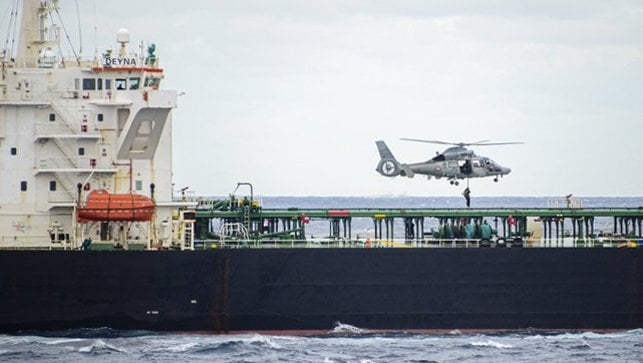
French troops boarding tanker
French forces boarding a suspected false flag tanker in the Western Mediterranean (Emmanuel Macron)

Published Apr 9, 2026 4:55 PM by The Maritime Executive


France is reported to be pursuing legislation to stiffen the penalties for vessels flying false flags or failing to comply with the instructions of the authorities. It comes after France has detained three shadow fleet tankers in the past seven months in an effort to crack down on violations of the sanctions on the Russian oil industry.

The French news agency Agence France-Presse (AFP) reported on Wednesday that it had seen draft legislation that calls for the tightening of the penalties against ships suspected of operating under a false flag. According to the report, the fines would be doubled to €300,000 ($350,000) and could result in up to two years in prison. If the lives of the individuals boarding the vessel are placed in danger, the new legislation would increase the fines to €700,000 ($818,000) and a prison sentence of up to seven years. 

In addition to increasing the penalties, the law also clarifies responsibility. It extends the definition to any person “who exercises power of control or management” over the vessel’s operations, AFP reports.

This appears to be a direct outgrowth of the incident in September 2025 when France moved to stop a notorious shadow fleet tanker, which at the time was using the name Boracay. Reports said the captain refused to obey orders and initially tried to block the boarding of the vessel by French troops. Ultimately, they were able to stop the ship and direct it into territorial waters, where it was held for several days.

The master of the Boracay, a Chinese citizen, was arrested and ordered to stand trial in February 2026. He was sentenced in absentia to one year in prison, and an arrest warrant was issued.

French President Emmanuel Macron has spoken out about the need to intervene to curtail the shadow tanker fleet. He said stopping the vessels even for a few days would disrupt the economics, and is reported to have been advocating that the European Union become more active in its efforts to enforce regulations on the shadow fleet.

In January 2026, France detained another shadow fleet tanker, the Grinch, but later released it with a fine. Two months later, it again stopped a tanker, the Deyna, in the Mediterranean. This tanker, which reported it was sailing under the flag of Mozambique, shows that it is still in the Fos Sur Mer anchorage three weeks after it was detained.

AFP reports the legislation is currently being reviewed by the French Parliament.  It is expected to come up for debate and then a vote for adoption on July 14.

Estonia and Germany were leaders in the efforts, having challenged and detained tankers last year. Sweden has also recently acted, stopping two vessels last month that it suspected were operating under false flags. Both remain under detention until they can provide proof of legitimate registries and insurance, and one was also found to have deficiencies during a Port State inspection. Sweden also briefly held a tanker suspected of causing an oil spill in the Baltic but released it, saying it could not confirm the details and citing the limitations of international treaties.

Belgium, also with France’s assistance, recently detained a product tanker that it believed was operating under a false flag, but released it with a fine. The United Kingdom recently said it completed its legal review and has threatened, but so far has not acted, to seize tankers transiting the English Channel sailing under a false flag.


Baltimore Fireboats Respond to Sinking Towboat

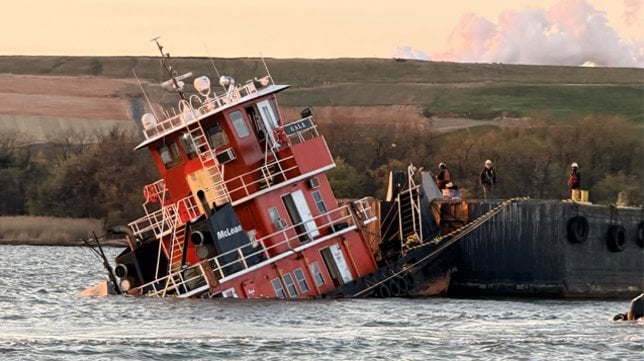
sinking towboat and brge
Baltimore rescue teams responded to a mayday call from the towboat (BCFD)

Published Apr 8, 2026 1:03 PM by The Maritime Executive


The Baltimore City Fireboat Station is reporting that it received a mayday call from a tug operating south of the city in the Curtis Bay/Curtis Creek region. The vessel reported it was taking on water.

The vessel is being identified as the Gale (145 gross tons) towboat, and from the pictures, it appears to have been moving a fuel barge. The vessel, built in 1980, has been owned by a Maryland-based company, McLean Contracting, since 2020. It is 65.5 feet (20 meters) in length.

It is unclear how many people were aboard this morning, but the report says they have all been rescued. There were no reports of injuries.


The towboat is reported to have struck an object in Curtis Creek and began taking on water. Fire Rescue Boat 1 and Marine 1 (acting as Fire Rescue Boat 2) quickly responded to the scene. 

The Gale appears to have remained partially above water, tied to the barge.  Another tug remains in the area while a rescue operation can be organized.


Maryland Reaches Settlement in Principle with Owner/Operator of Dali

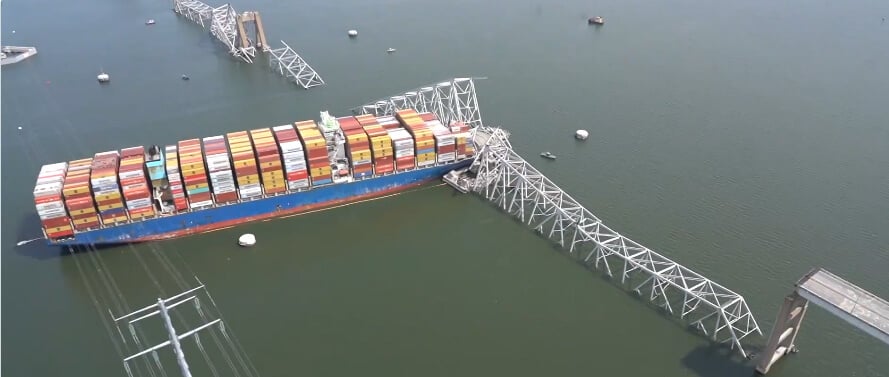
Dali containership bridge Baltimore
Dali hit the bridge on March 26, 2024 (Maryland National Guard)

Published Apr 9, 2026 2:37 PM by The Maritime Executive


The State of Maryland announced that it has reached a settlement in principle with the owners and operators of the containership Dali for the 2024 destruction of the Francis Scott Key Bridge. Details of the settlement were not announced, with the state saying terms were being finalized but that it resolves a significant portion of its claims, specifically against Grace Ocean and Synergy Marine.

Maryland had filed in U.S. District Court alleging that the disaster was the result of “negligence, mismanagement, and the reckless operation of a vessel that was not seaworthy and should never have left port.” The Attorney General’s office was making claims on behalf of the Maryland Transportation Authority (MDTA), the Maryland Port Administration (MPA), and the Maryland Department of the Environment (MDE), for the destruction of the bridge, harm to the Patapsco River and the surrounding environment, lost revenue, and the economic losses sustained by Maryland and its residents.

“The Dali’s crash into the Key Bridge disrupted the Port of Baltimore, devastated livelihoods, and sent economic shockwaves across our state that are still being felt today,” said Attorney General Anthony Brown. “Our work is not finished, but this settlement is an important step toward making Maryland whole.”

While the settlement in principle will resolve the claims against Grace Ocean and Synergy Marine, the attorney general’s office highlighted that it does not resolve any claims the state may have against HD Hyundai, the builder of the Dali.

It marks a key step in the case, as Judge James Bredar has pushed all parties to be ready for a June 1 start of the bench trial. In the first phase, Judge Bredar will hear the arguments by the owner and operator to limit its liability, citing a 175-year-old law. If upheld, they would be able to limit the liability to the value of the ship and its cargo, approximately $44 million. The second portion of the trial would consider the individual claims.

While Maryland has settled, the civil case also includes the city of Baltimore, the families of the six victims of the bridge collapse (a road work team), and many businesses that claimed financial injury in the aftermath of the collapse.

Grace Ocean, Synergy, and their insurance companies have already settled claims made by the U.S. Coast Guard and the federal government for the cost of the cleanup and recovery operations. The companies settled a $102 million claim with the U.S. Justice Department in October 2024. At the time, the companies said the settlement was not indicative of any liability, which they expressly reject for the incident that led to the collapse of the Francis Scott Key Bridge.

Earlier this month, it was revealed that the insurance company that underwrote the coverage of the bridge for Maryland had settled with Grace Ocean and Synergy Marine. It agreed to pay the companies $350 million, the same amount that it had previously paid the state as the maximum coverage for the bridge.

During the most recent status meeting at the court, the judge acknowledged there could be additional settlement agreements announced in the coming weeks, but admonished all parties to be ready for the trial date. He said the schedule had to be the top priority.
During the trial, the defendants are expected to draw from the evidence collected by the National Transportation Safety Board, U.S. Coast Guard, and other investigators. They cannot use the NTSB conclusions but have access to the information that formed the NTSB report, as well as the hundreds of hours of depositions, including from crewmembers who have been detained in Baltimore pending the trial.

Maryland continues to assert that the efforts to replace the bridge are now moving forward, although cost estimates have soared to more than $5 billion. The replacement is expected to be completed by 2030.


Oil Spill While Bunkering Containership Disrupts Port of Antwerp

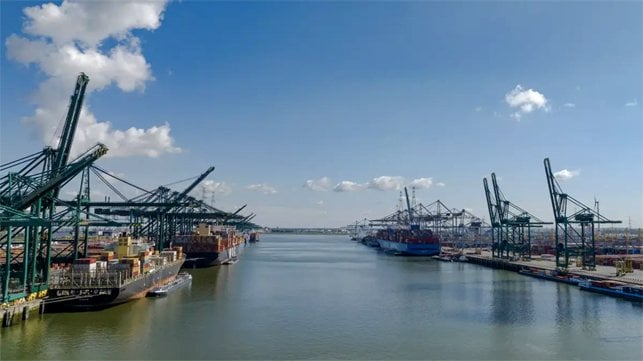
containerships Port of Antwerp
Several containerships are being held as the cleanup begins after the oil spill at the Port of Antwerp (Port of Antwerp-Bruges)

Published Apr 10, 2026 2:20 PM by The Maritime Executive


The Port of Antwerp, one of the busiest ports in northern Europe, reported that shipping operations have been disrupted after an oil spill was detected overnight while a vessel was bunkering. While the authority was able to resume traffic on the Scheldt River later in the day on Friday, port operations, including the container terminal, remain suspended.

The leak happened during the nighttime hours but, according to local media reports, was not detected until this morning, when the port activated its response operations. Some reports are saying the leak happened while the Liberian-registered MSC Denmark VI (5,762 TEU) was bunkering. Local media is saying they detected a crack in the hull, possibly a rust spot, and the hole has now been corrected, but the leak occurred. It is unclear how much fuel leaked into the water, but the spill was reportedly affecting locks three kilometers (nearly two miles) downstream from the port.

Operations at the Zandvliet and Berendrecht locks were suspended due to the slick, and the Scheldt was closed beyond buoy 80. The spill was also impacting the Deurganck Dock and Europaterminal. 

The port authority was conducting an aerial survey and working to contain the spill. It said the priority was preventing further spread and that it would be monitoring sensitive areas around the port.

The containerships MSC Denmark VMSC Monterey V, and MSC Sara Elena were all in the vicinity of the spill, as well as several inland cargo ships. Across the slip, the CMA CGM ParanaguaMSC Anna Maria, and MSC Anshika VI were also berthed. 

The Scheldt was reopened on Friday afternoon while specialized vessels were engaged in the cleanup around the terminal. The port said it was trying to minimize the disruption, but no timing was available for when operations at Duerganck Dock would resume.

There was a similar incident in the same slip at the port in June 2024. Port officials at the time said they expected it would take several days to recover the oil and then to wash down the hulls of the vessels and the walls of the berth, before operations could resume.

Antwerp is Europe’s second busiest port, and the Duerganck is home to the single largest container terminal in Europe, operated by PSA. Owned jointly by PSA and MSC’s TIL, the terminal has nine berths and over 12,000 feet of quay. It was relocated nearly a decade ago to this location and expanded to have an annual throughput capacity of 9 million TEU.


Pakistan Navy Responds to Distress Call from Burning Chinese Bulker

bulker fire
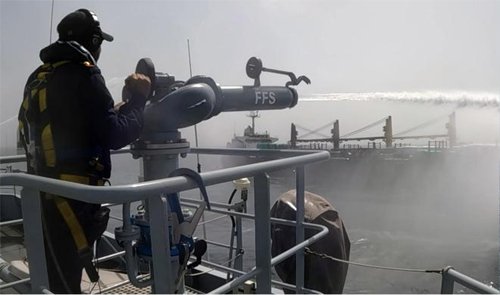
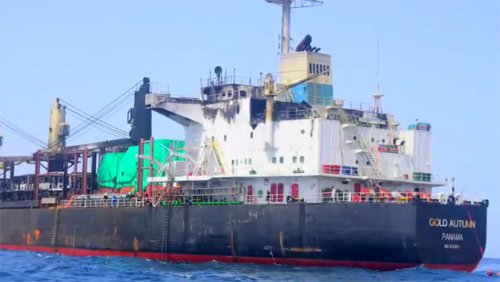
Crew was rescued from the bulker burning 200 nm off the coast of Pakistan (Photos courtesy of Pakistan Navy)

Published Apr 10, 2026 2:43 PM by The Maritime Executive


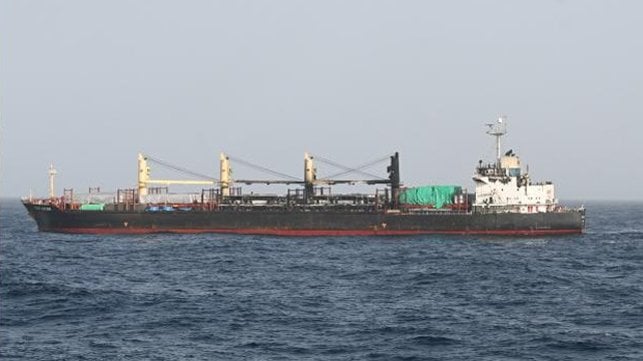
The Pakistan Navy vessel PNS Hunain responded to a distress call from a bulker. The vessel was reported to be on fire approximately 200 nautical miles off the coast of Pakistan.

The ship, the Gold Autumn (46,500 dwt), is a bulker built in 2001 and owned by Chinese interests. According to its AIS signal, it was sailing to Sohar, Oman, when the fire began.

The ship is 190 meters (623 feet). According to the reports, there was a crew of 18 aboard, including from China, Bangladesh, Myanmar, Vietnam, and Indonesia. All the crew was safely evacuated and have now been taken to Karachi, Pakistan.


The Maritime Rescue and Coordination Center in Pakistan received the distress call from the vessel and coordinated the search and rescue operation. When the PNS Hunain reached the vessel, it assisted in the firefighting and conducted a damage assessment after the fire was extinguished. Medical assistance was also provided to the crew.

Few details were released, but the pictures showed the bridge and upper decks of the deckhouse burnt out. There was also fire damage forward around the cargo hatches. It is unclear how the fire started.


Australia Bans Chinese-Owned Bulker for Unpaid Crew Wages

Chinese owned bulker docked in Australia
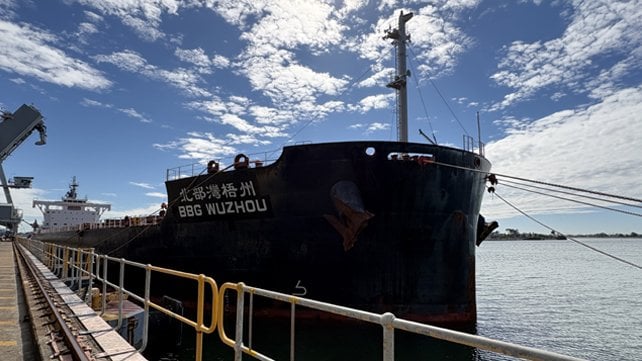
Australian authorities banned a second bulker in a little over a month on unpaid wages and crew welfare violations (AMSA)

Published Apr 9, 2026 5:55 PM by The Maritime Executive


The Australian Maritime Safety Authority, well-known for its strict enforcement actions, announced it has issued a six-month ban against a Chinese-owned bulker for unpaid crew wages and other violations. It is the second ban the authority has issued in a little over a month, with it saying it should serve as a reminder to employers of their obligations under the Maritime Labour Convention.

The Liberia-flagged bulker BBG Wuzhou (81,895 dwt) recently arrived in the port of Newcastle, where AMSA reports it conducted a comprehensive inspection. Built in 2016, the vessel is owned and managed by companies in China.

AMSA reports it found that the crew had not been paid for seven months, with unpaid wages totaling nearly A$69,000 (US$49,000). In addition, AMSA says it identified multiple issues, including insufficient food and not providing free drinking water. It also reports the ship was detained for unseaworthiness and “being substandard.”

The bulker departed Newcastle on April 7 bound for Singapore. After its departure, AMSA issued a six-month ban from entering or using any Australian ports or waters. It remains in effect until October 4.

“Australia has zero tolerance for such conduct. It is unlawful, unethical, and a clear breach of our laws and values,” said Greg Witherall, AMSA Acting Executive Director Operations. “Vessel bans are costly, with some operators facing losses of millions of dollars by being denied access to Australian ports.”

AMSA highlighted the actions, saying they should serve as a clear warning to maritime employers to meet their obligations. It emphasized that the MLC requires timely payment of wages, safe accommodations, adequate rest, and access to support. It said that a failure to meet minimum standards for seafarers’ living and working conditions “may result in serious consequences.”

This was the second ban issued in 2026, after an action against another Chinese-owned bulker, Ocean Bright, on March 8. It was also cited for more than US$32,000 in unpaid wages to eight members of the crew and banned for six months.


Op-Ed: UK Naval Shrinkage Taints London Defence Conference

Royal Navy
UK Royal Navy tracking Russian ships in the English Channel (RN)

Published Apr 10, 2026 5:49 PM by The Maritime Executive


Attempts to develop the annual London Defence Conference as an annual geopolitical event rivalling the Munich Security Conference are facing difficulties as the conference gets underway.

A tour of the Gulf by the British Prime Minister, and a press conference by the British Defence Secretary this week, were intended to soothe concerns. But instead, both have emphasized the weakness of the UK’s defense posture and have failed to paper over the cracks.

Sir Kier Starmer, the British Prime Minister, spent much of his tour of the Gulf States emphasizing the seriousness of the current crisis in the Gulf and the need “to step up” and enhance defense capabilities. But he has not announced any additional expenditure. Indeed, whilst nominal increases were announced some time ago, taking defense expenditure from 2.3 to 2.6 percent of GDP between 2024 and 2027, this has been achieved by including allocations for the naval nuclear deterrent, and those for the intelligence and security services, under the defense budget. 

This means, according to the Institute for Fiscal Studies, that spending on the armed forces in real terms has decreased this year rather than increased. The Prime Minister has accepted that the defense budget should make up 3.5 percent of GDP by 2035, but has made no program commitment to start the necessary additional funding necessary to achieve this goal. The 2.6 percent of GDP spent on defense is programmed not to rise between 2027 and 2029, and the Defence Investment Plan to implement the recently completed fundamental defense review remains unfunded. Illustrating the switch in priorities from defense to welfare spending, in 1987–88, defense made up 3.5 percent, and spending on the National Health Service was 4.0 percent of GDP. If UK defense spending gets back to 3.5 percent in 2035, by then the health budget is projected to be 9.2 percent of GDP.

The lack of investment in defense equipment over the past ten years is not, of course, the current government’s fault, but the Starmer government is suffering the consequences. Although now deploying some ground-based air defense systems, the UK has not been able to offer immediate assistance to Gulf states in the form of offshore air defense destroyers, nor mine clearance capability, notwithstanding defense agreements in place. Neither has the UK honored its responsibilities in recent weeks to the Republic of Cyprus under the 1960 Treaty of Guarantee, whereas the other two guarantors, Greece and Turkey, have both done so. Nor has it come to the aid of Oman, a very close ally, in whose waters mines and have been laid and ships attacked, whose ports have suffered drone attacks, and who now faces losing control to Iran over its territorial waters in the Strait of Hormuz – through which it sought to guarantee freedom of passage to ships of all nations.

But aside from an inhibiting lack of equipment, without which the Royal Navy could perhaps have played a more active role, in all these instances, there also appears to be a lack of resolve. Whereas the Nordic nations have found cause to intercept dark fleet tankers in the Baltic, on the basis of suspected breaches in health, labor, environment, and registration issues, the UK’s Attorney General is content that the UK instead provides the dark fleet with escorts and free passage through the English Channel rather than arrest them. The Royal Navy has also looked on whilst Russian Navy GUGI submarines linger over underwater cables, the Defence Secretary implying that watching the Russians as they work acts as a deterrent. In reality, the Russians were probably not seeking merely to locate or damage the cables, but to covertly plant unobtrusive tapping devices alongside the cables, as was done during Operation Ivy Bells. 

There is nothing more detrimental to deterrence, and no greater signal of weakness, than talking up prowess and capability which simply does not, nor is even planned to exist. Meanwhile, the defense industry in the UK wonders what it will take to finally see funding allocated to the Defence Investment Plan.

The opinions expressed herein are the author's and not necessarily those of The Maritime Executive


Royal Navy Tracks Russian Warships for Ten Days in UK Waters

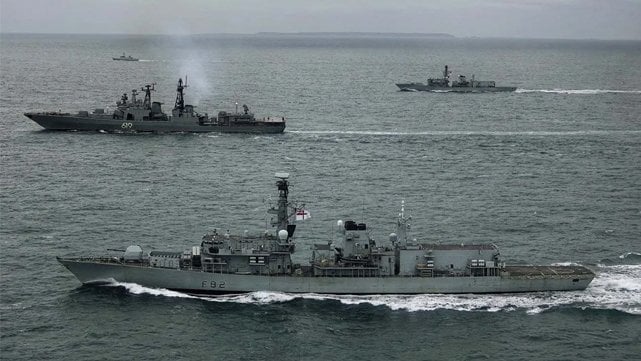
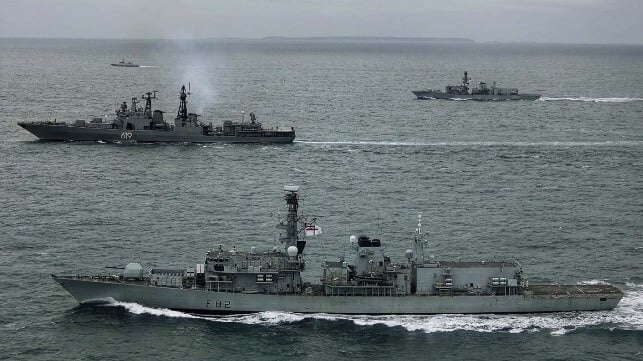
Two Type 23 frigates closely follow the Russian frigate Severomorsk (center left, smoking) (Royal Navy)
Two Type 23 frigates closely shadow the Russian frigate Severomorsk (center left, smoking) (Royal Navy)

Published Apr 10, 2026 12:16 AM by The Maritime Executive


Four Royal Navy ships recently got under way to track the movements of Russian convoys through the English Channel and the North Sea, a higher-than-usual operational tempo for Russian activity in UK home waters. The patrols follow recent news of a suspected Russian spy submarine operation in British waters, which the UK believes to have been targeted at subsea fiber-optic cables. 

From March 29 through April 7, patrol ship HMS Mersey got under way three different times to track Russian Navy assets, including the frigate Admiral Grigorovich, the tank landing ship Aleksandr Shabalin and the attack sub Krasnodar, a Kilo-class diesel-electric submarine. 

Meanwhile, the Type 23 frigate HMS Somerset accompanied the Russian destroyer Severomorsk and the fleet oiler Kama as they passed by Brittany and through the Channel. Frigate HMS St. Albans joined this mission, then Somerset departed for an extended submarine-tracking patrol in the North Atlantic. 

"Our ability to provide a presence to monitor the Russian activity in UK water is no small feat especially with such an increase in activity over the last few months," said HMS Mersey XO Lt. George Hage in a statement. "We are very proud to be part of the Royal Navy’s commitment to the maritime security of the United Kingdom."

The Royal Navy's fleet is under pressure from crew shortages, underinvestment and aging platforms. The venerable Type 23 frigate class is the backbone of the surface fleet, and was commissioned in the 1990s and early 2000s; it has historically provided much of the lifting near UK home waters, but itis rapidly aging out of service. Seven remain in commission with the Royal Navy, down from the original order of 16; the survivors have completed a life-extension refit, and hull corrosion repairs are said to have factored into the extensive work for preservation. 


HM Coastguard and RNLI Coordinate Medevac After Cargo Ship Fire

medevac
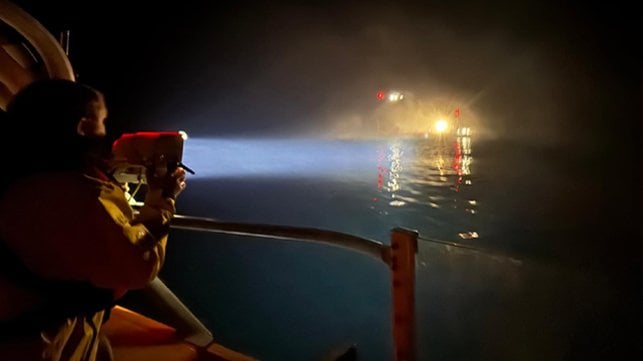
HM Coastguard organized the medevac while the Salcombe RNLI stood by to provide assistance (Salcombe RNLI)

Published Apr 10, 2026 6:15 PM by The Maritime Executive


A crew from HM Coastguard led the medevac of an injured seafarer from a cargo ship in the English Channel on April 8. The RNLI at Salcombe also dispatched an all-weather lifeboat at 2200 and stood by during the rescue and until a tug secured the disabled vessel.

A small cargo ship, RDJ Waalstroom (2,650 dwt), issues a mayday call while transiting the English Channel near Portsmouth, England. The Dutch-owned ship, which was built in 2003, reported an engine room fire. It is 90 meters (295 feet) in length and was operating with a crew of six. The ship is registered in Antigua and Barbuda and had been bound for Balboa, Spain.

The vessel reported that the crew had evacuated the engine space and was using a fire suppression system. However, one of the crewmembers had been injured and was requiring immediate medical attention. The vessel was reported to be drifting approximately 40 miles south of Salcombe.

The Salcombe ALB stood by while the Coastguard rescue helicopter lowered a paramedic to the deck. They determined to remove the individual and airlift the crewmember to a hospital in Portsmouth.

A Dutch warship also responded to the call and was standing by to provide assistance. However, the HM Coastguard reports the cargo ship had drifted into French waters, and at about 0100 coordination was transferred to the French authorities. 

A rescue tug reached the vessel, which still had five of its crew aboard. The plan was to tow it to a port in France.


UK Appoints Salvage Company to Remove Masts from Famous WWII Wreck

WWII Liberty Ship
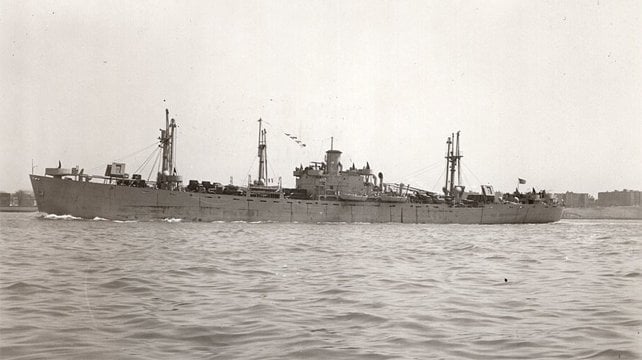
SS Richard Montgomery was one of more than 4,700 Liberty Ships, but she sank laded with explosives on the UK coast (US Archives public domain photo)

Published Apr 10, 2026 8:03 PM by The Maritime Executive


After six years of planning and annual surveys of the wreck site, the UK confirmed that it has selected a salvage company to remove the masts of the SS Richard Montgomery, a World War II Liberty ship that wrecked in the Thames Estuary in 1944. The wreck site became a popular tourist attraction, although all that is visible are the tops of three masts, but because the ship is still laden with explosives, people are warned to keep their distance.

The UK’s Department for Transport (DfT) officially has oversight of the wreck and confirmed to the BBC that it has appointed a leading salvage company to undertake the delicate job. The Telegraph newspaper reports that Resolve Salvage was selected, and the DfT confirmed that it expects to finalize the contract soon. The Telegraph says the work is expected to run for nearly a year until March 2027.

The Richard Montgomery was one of more than 2,700 WWII-built Liberty ships, a standardized design that the U.S. created at the start of the war and mass-produced to meet the needs for cargo and troops. The 10,000 dwt vessels were approximately 440 feet in length (135 meters), and, while known as a maritime workhorse, also earned some more dubious reputations due to their rapid construction. The average build time was brought down to just over 40 days, and in a 1942 publicity effort, one was built in under five days. At its peak, U.S. shipyards were turning out more than three Liberty ships a week.

The Richard Montgomery was commissioned in 1943. Her fateful voyage began in August 1944 when she was loaded with nearly 7,000 tons of munitions. Upon her arrival in the UK, she was assigned an anchorage in the shallow Thames Estuary near the Sheerness Middle Sands. She was waiting for a convoy to proceed to Cherbourg, but on August 20, 1944, during a storm, she dragged anchor and grounded. 


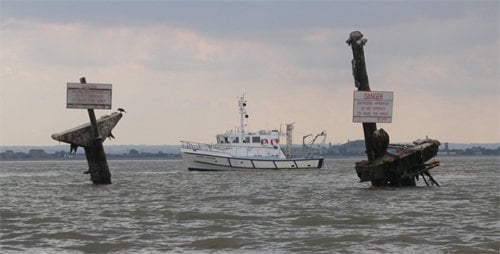
The masts are above the water level regardless of the tide (MCA)


A salvage effort ensued, and by most estimates, at least half of the munitions were salvaged by September 25, 1944. However, the ship broke her back, and as the water rose, the efforts had to be abandoned. The recent UK surveys have estimated that there are approximately 1,400 tons of explosives contained within the forward holds.

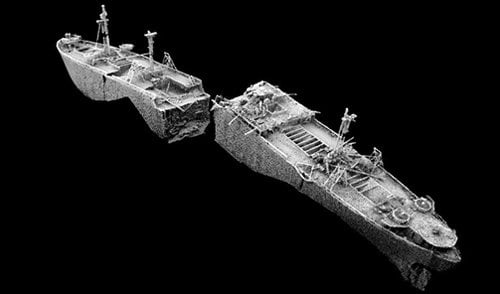
The ship is sitting on the bottom in two pieces. Two of three forward masts protrude from the water, attached to the ship near the holds containing the munitions. They are visible at all tide conditions, and long-ago warning signs were posted to stay away. The wreck, however, is just about 1.5 miles off the coast.

The DfT had started an effort in 2020 to remove the masts, but it had stalled out. Surveys, however, raise a concern as the hull continues to deteriorate, the masts are increasingly in danger of toppling over. One concern is that they could displace or even cause an explosion of some of the munitions still onboard. More sensationalist media reports also speculate that terrorists could attempt to explode the mutations. 


Rendering of the wreck based on multibeam and laser data from the 2013 survey report (MCA)


The BBC is now reporting that the removal has become a local sensation and political issue, with a petition being raised demanding that the masts be placed on permanent display in the local area near the wreck site. The DfT told the BBC it was aware of the calls to preserve the masts but said it was too early to determine what would happen to them once they were removed from the wreck.

The UK continues its monitoring and annual surveys of the wreck. Overall, they report it is stable. The condition, however, is too decayed to consider removing more of the ship, especially because of the concern about the munitions that remain onboard.