Monday, April 27, 2026


BHP adopts new Chinese iron ore price index in deal to end dispute


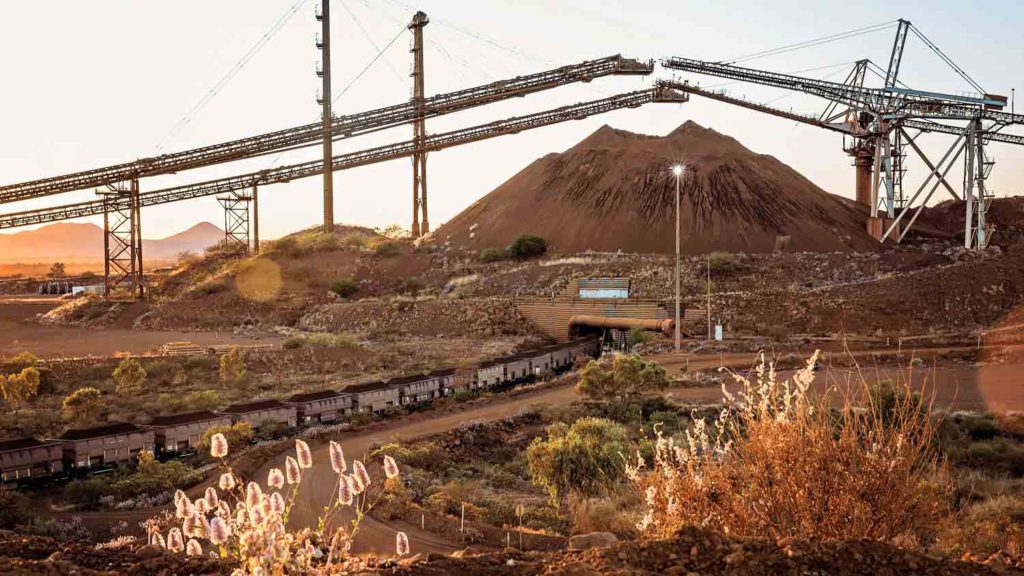
Yandi operations. Credit: BHP.

BHP Group agreed to use an additional Chinese iron ore price index for one of its flagship products as part of a deal with China to end a months-long dispute, three sources with knowledge of the matter said.

BHP, the world’s third-largest iron ore supplier, said on Wednesday that it had concluded negotiations on a new sales contract with China Mineral Resources Group (CMRG), ending the dispute stemming from bans on the procurement of the key steel-making ingredient from BHP.

Neither BHP nor CMRG – the Chinese state iron ore buyer – gave details of the agreement.

The new contract will last until the end of BHP’s 2027 financial year, according to an investor who said they were informed by the mining group’s executives.

Settlement for BHP’s Jimblebar fines, a medium-grade iron ore, will be based on a weighted average of four indices including the equivalent US dollar value of China’s COREX 61% iron ore portside index, which will carry a weight of 26%, two of the three sources said.

All the sources requested anonymity due to the sensitivity of the matter.

BHP declined to comment.

CMRG did not immediately respond to a Reuters request for comment.

Other indices for settling Jimblebar fines include the Argus 61% seaborne index, Mysteel 61% seaborne and the converted dollar value of the Mysteel 61% portside index.

Second miner to adopt index

Previously, BHP settled Jimblebar contracts with Chinese clients using either a fixed price or a combination of Argus and Mysteel seaborne indices.

The Beijing Iron Ore Trading Centre Corp, or COREX, launched its iron ore portside index last September in a push to gain a role in pricing iron ore imports, worth $123 billion in 2025.

BHP is the second Australian miner to adopt the COREX index following Hancock Prospecting, two of the sources said. China lifted a partial ban on iron ore procurement from Hancock last September, Reuters reported. It did not give a reason.

Hancock did not immediately respond to a request for comment.

Global miners and traders have been cautious about using COREX because of its relatively short data history and the fact that it is based on portside transactions rather than the seaborne market used in other indices, industry insiders said.

As part of the deal, BHP will offer a 1.8% rebate per iron ore vessel on term contracts, on top of a freight-linked discount for certain large ships, one of the sources said.

(By Reuters staff and Melanie Burton; Editing by Tony Munroe and Emelia Sithole-Matarise)


Anglo American draws three bidders for coal sale


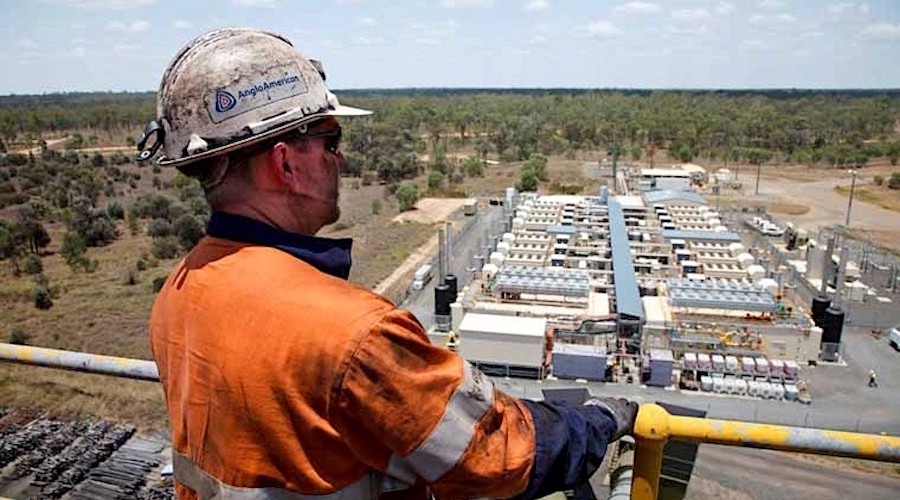
Power station at the Moranbah North metallurgical coal mine. (Image courtesy of Anglo American.)

Anglo American (LON: AAL) is said to have at least three potential buyers for its Australian steelmaking coal business after a $3.8 billion sale to Peabody Energy (NYSE: BTU) collapsed following a mine fire.

Stanmore Resources (ASX: SMR), Mitsubishi Corp., and Indonesia’s BUMA Internasional are among at least three bidders circling the Queensland-based assets, with a deal potentially emerging in the coming months, according to Bloomberg News. Goldman Sachs and Morgan Stanley are running the process, the news outlet’s sources said.

The sale’s collapse last year dealt a setback to Anglo’s broader plan to divest non-core assets after BHP’s (ASX: BHP) failed takeover bid, and a successful deal now would help revive that strategy while potentially reshaping the global steelmaking coal market.

Peabody walked away from the agreement after a fire at the Moranbah North mine, which it said accounted for roughly half the deal’s value. The incident followed another blaze in 2024 at the Grosvenor mine, Anglo’s second-largest metallurgical coal operation, which remains offline even as Moranbah North has resumed production.

Eyes on Asia

For bidders, acquiring the portfolio would either cement or elevate their standing among the world’s top suppliers of steelmaking coal to Asian markets, currently dominated by the BHP Mitsubishi Alliance and Glencore (LON: GLEN). Buma Internasional already has exposure to the assets, having agreed to acquire a 51% stake in the Dawson project from Peabody contingent on the original deal’s completion.

Stanmore, backed by Indonesia’s Widjaja family through Golden Energy and Resources, may face financing pressure if it proceeds, as its market capitalization sits below A$2 billion, potentially less than the transaction value.

Anglo has already spun off its platinum division into Valterra Platinum (JSE: VAL) and continues to seek a buyer for its struggling De Beers, which is part of a sweeping portfolio overhaul as it advances the takeover of Canada’s Teck Resources (TSX: TECK.A TECK.B)(NYSE: TECK).


FRACKING BY ANY OTHER NAME

Quaise moves closer to building world’s first superhot geothermal power plant


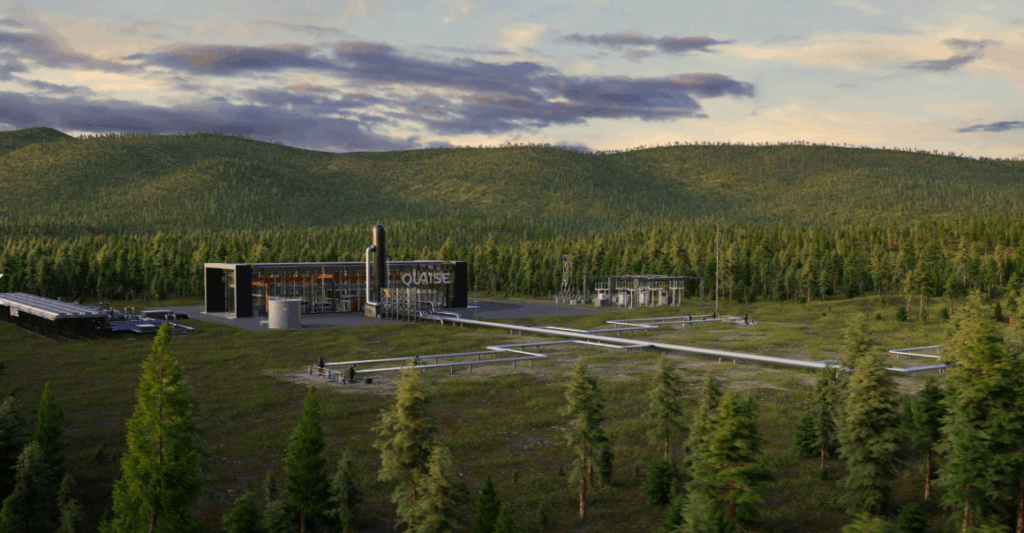
Image: Quaise Energy

Quaise Energy, a startup out of MIT, said it is on track to build the world’s first power plant using superhot geothermal energy: that obtained by tapping into rock with temperatures greater than 300°C (572°F).

The first phase of the company’s complex, Project Obsidian, is currently under construction in Oregon.

A study presented at the 2026 Stanford Geothermal Workshop has validated the company’s belief that its first plant could produce at least 50 megawatts (MW) of clean, renewable electricity, Quaise said. That energy, produced from only a handful of wells, would be available 24/7, it added.

Subsequent expansions at the same location are expected to bring even more energy, and the second phase targets 250 MW.

“Our goal is to build out to a gigawatt in the area,” Quaise CEO Carlos Araque said in a news release.

“We believe our breakthrough drilling technology could ultimately make gigawatt-scale geothermal plants viable across the globe, including in regions where geothermal has never been possible before,” Araque said.

Because Project Obsidian is the first of its kind, there are many unknowns, such as the geochemistry of the rock it will tap into. Daniel Dichter, a senior mechanical engineer at Quaise, is first author of a paper exploring these unknowns that he presented at Stanford earlier this year.

“Most of our analysis, which is based on several models, was dedicated to trying to understand some of these uncertainties,” Dichter said.

Quaise also supports research at Oregon State University aimed at doing the same thing by recreating extreme underground conditions in the lab.

“This analysis validates our long-held hypothesis that higher subsurface temperatures entail substantial improvements in power production,” Dichter said. “It shows us that we can get to a capacity of 50 megawatts of power with this system.”

“If these first wells work the way we think they will, they will be on par with exceptionally productive oil and gas wells in terms of equivalent power output,” he said.

The confirmation well is expected to be in operation later this year, and the first phase of the complex is expected to be operational by 2030.


Eramet plans Indonesia mine halt in May as it awaits permit revision


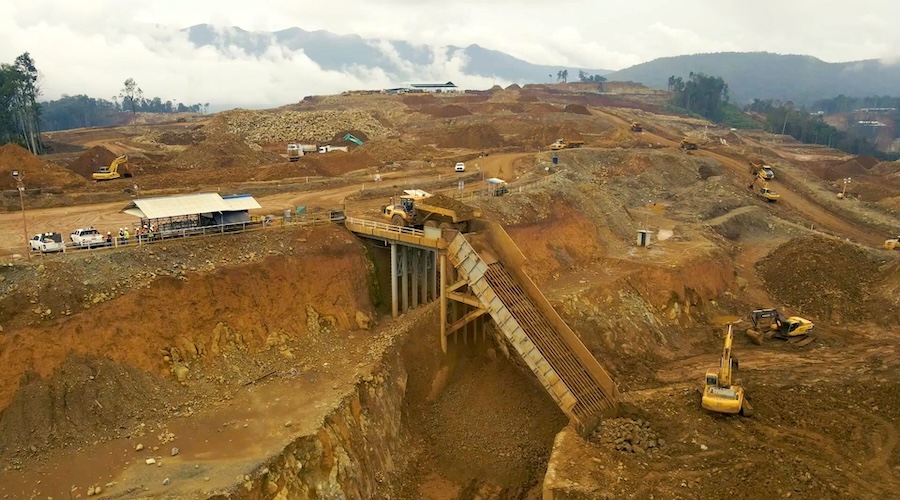
Weda Bay Nickel mine. (Image courtesy of PT Weda Bay Nickel.)

Eramet is planning to halt production at its nickel mine in Indonesia next month while it waits to see if it will obtain an additional volume allowance from the authorities, the French mining group said on Thursday.

Eramet’s nickel mining joint venture in Indonesia received an initial production allowance of 12 million wet metric tons for this year, down from the 32 million it initially received for 2025, as part of steps by Indonesia to regulate more closely mining supply.

In a first-quarter sales statement, Eramet said it will use up its allowance of 12 million wet metric tons of nickel ore by mid-May, with its Weda Bay mine preparing to go on care and maintenance next month.

Its joint venture PT Weda Bay Nickel is submitting a request for an upward permit revision, it said.

Within the initial allowance, the 9 million wet metric tons for external nickel ore sale were used up by mid-April, with the remainder of production dedicated to the joint venture’s adjacent nickel processing plant, it added.

(By Gus Trompiz; Editing by Lincoln Feast)


Vale Indonesia signs $750 million loan deal with global lenders

Credit: Vale Indonesia

Nickel miner PT Vale Indonesia on Thursday signed a loan deal of $750 million with a number of global lenders to help finance its expansion.

Vale signed the loan agreement with a number of banks including Singapore’s United Overseas Bank (UOB), DBS Bank and Japan’s Mizuho Bank, among others, said Bernardus Irmanto, Vale Indonesia CEO.

The loan is “very critical” to help finance development of Vale’s projects in Bahodopi, Pomalaa and Sorowako, Irmanto said.

The financing is structured as sustainability-linked credit, among the first for a mining company in Asia, said UOB Indonesia chief executive Hendra Gunawan. The deal also includes a $250 million green-shoe option, he added.

(By Fransiska Nangoy; Editing by Keith Weir)

Column: Gulf aluminum disruption ripples up to alumina market

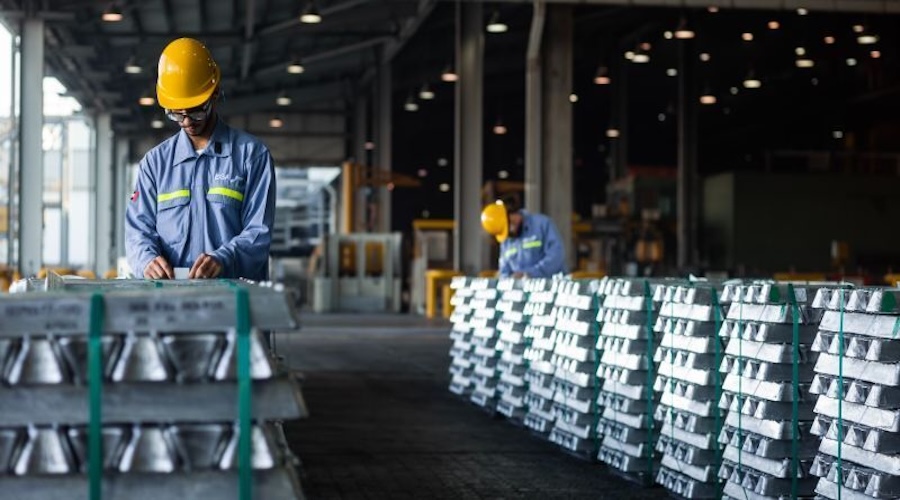
Emirates Global Aluminium is the world’s largest ‘premium aluminum’ producer. Credit: Emirates Global Aluminium | LinkedIn

(The opinions expressed here are those of Andy Home, a columnist for Reuters.)

The Iran war has focused the aluminum market on what is not coming out of the Strait of Hormuz. But there is an equally significant problem: what is not going in.

Gulf aluminum smelters are highly ​dependent on imports of alumina, the intermediate product between bauxite and metal, to maintain operations.

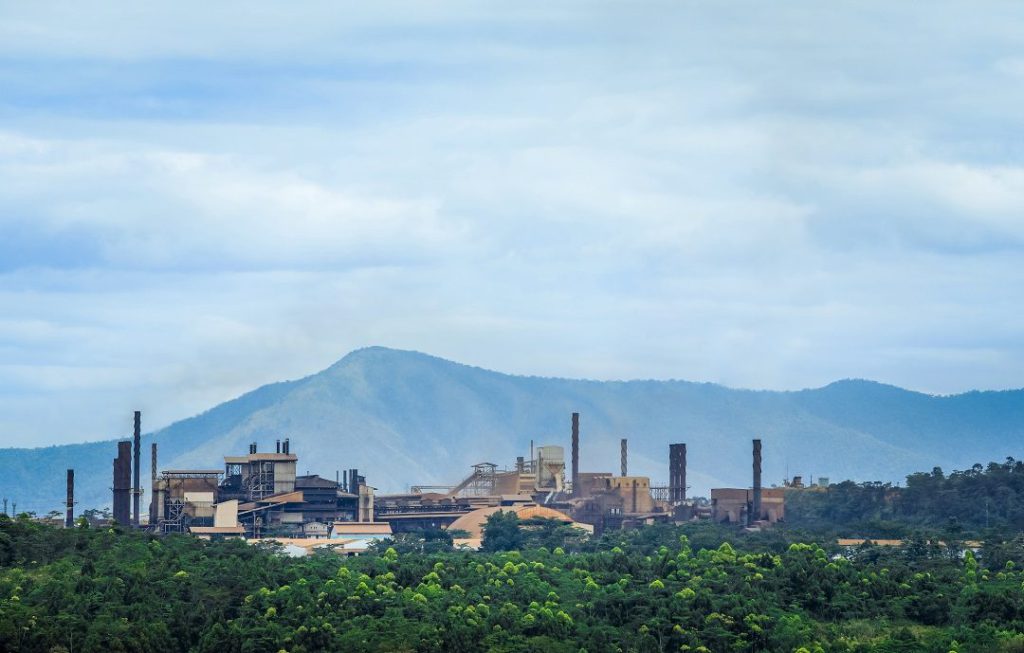
The region has six smelters but only two alumina refineries. One of ‌them, Emirates Global Aluminium’s (EGA) Al Taweelah plant, has been damaged by Iranian missiles. The smelter at the site is out of action for the same reason and other smelters are running at reduced capacity.

The first-round impact of this disruption is further price pressure on an already soggy alumina market as shipments are redirected away from the Gulf.

The second-round effect could be further cuts in Gulf metal production as smelters ​run low on raw-material stocks.

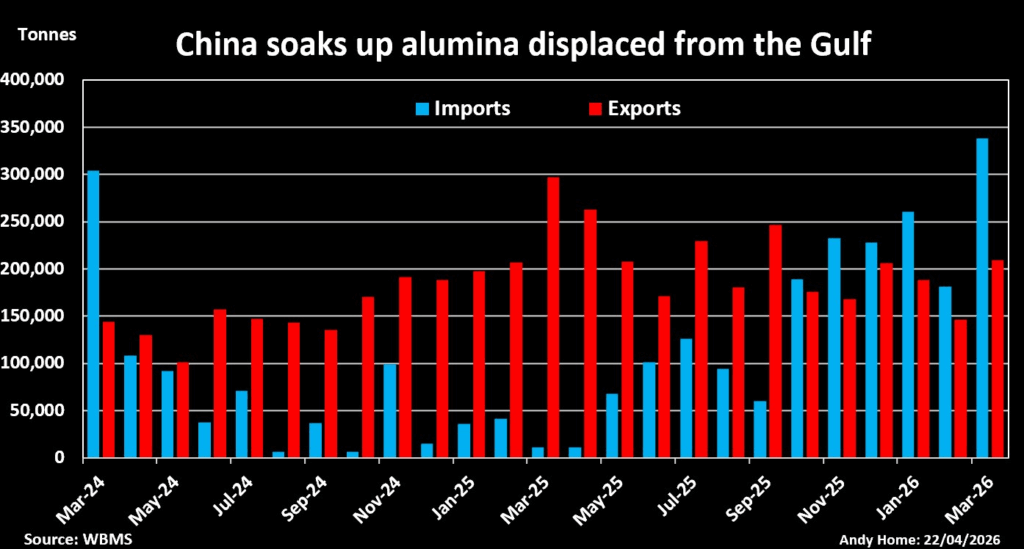
The only winner here is China, which is soaking up the displaced alumina.

Under pressure

The alumina market was under pressure even before ​the outbreak of the Iran war.

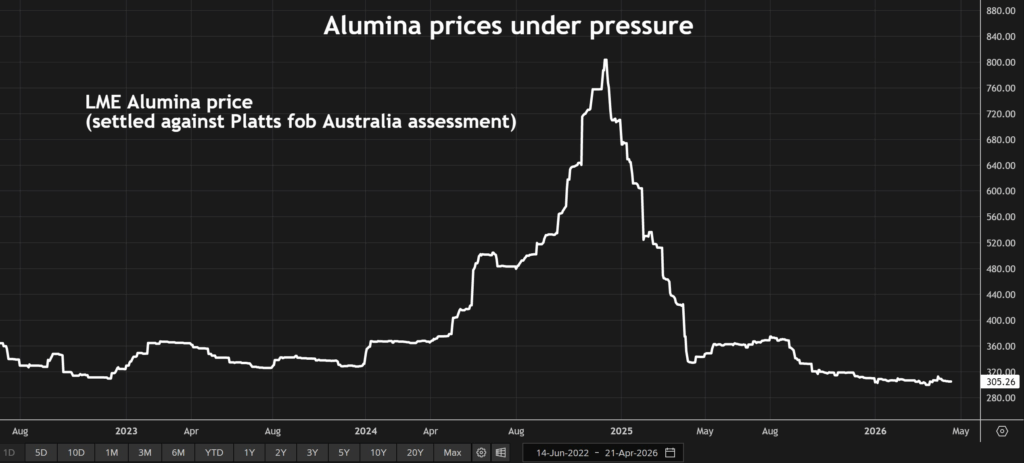
The London Metal Exchange (LME) price , which settles against S&P Global Platts’ assessment of the Australian fob price, ⁠has been hovering around the $300 per metric ton level since the start of the year.

That is a far cry from the frenzied rally of 2024, when prices surged to ​above $800 on a series of supply hits.

The market has since shifted to oversupply, thanks to continued expansion of production capacity in China and Indonesia.

Macquarie Bank assessed the global surplus ​at 2.54 million tons last year and in December was forecasting another surplus of 1.26 million tons in 2026.

The bank has just upped its 2026 oversupply estimate to 2.2 million tons as Gulf-bound shipments are redirected into the seaborne market.

How long the Strait remains closed to shipping will determine everything.

Input risks

The longer it takes the Strait to reopen, the greater the risk of further smelter cuts to those already ​announced by Qatar producer Qatalum, and Aluminium Bahrain.

The only fully integrated Gulf producer is Saudi Arabia’s Ma’aden, which operates its own bauxite mine feeding the Ras Al Khair alumina refinery.

Ma’aden produces more ​alumina than its smelter consumes and has been arranging emergency supplies to others, according to consultancy Wood Mackenzie.

Alumina is not the only headache for Gulf operators.

Coal tar pitch, which is used ‌to manufacture ⁠the carbon anodes used in the smelting process, could be an even bigger logistical problem, according to AZ Global Consulting.

While other carbon inputs such as calcined coke and petroleum coke can be “diverted, stockpiled, re-bagged, trucked, or re-routed with relative flexibility … liquid pitch requires heated storage, heated silos, and heated trucks to keep it molten from loading point to discharge point,” it said.

Such facilities are not widely available and not easily improvised. “Pitch may prove to be the hardest logistics problem in the carbon chain if disruption continues,” ​AZ Global said.

China wins

China is the prime ​beneficiary of the disruption in the ⁠alumina segment of the processing chain.

It imported 338,315 tons of alumina in March, the largest monthly tally since January 2024, according to the World Bureau of Metal Statistics, which collects data from official customs figures.

AZ Global expects imports to remain robust ​in the months ahead on the back of an open import arbitrage between domestic and international prices.

With the Gulf crisis also sending ​aluminum prices to four-year ⁠highs, China’s smelters are enjoying strong margins.

Western production fell by an annualized 312,000 tons in March due to curtailments in the Gulf, while Chinese production rose by 88,000 tons, according to the International Aluminium Institute.

China’s share of global production inched up to a record 60.2% last month, and that ratio is likely to carry on creeping higher as the Iran war takes ⁠a growing ​toll on Gulf smelters.

(Editing by Marguerita Choy)


US aluminum industry showing resilience in face of war’s disruption, association says

Stock image.

The US aluminum industry is facing real challenges due to the war in the Middle East, trade tariffs and high prices, but is showing resilience and ability to adapt, officials from the Aluminum Association said on Thursday.

“We are hearing from our members that their supply chains are adjusting in real time,” Chuck Johnson, president of the association that represents US aluminum production and jobs, said on a call with reporters. The impact on supply chains could be “more profound” as the conflict drags on, he added.

The Gulf accounted for around 22% of US primary and alloyed aluminum imports in 2025, but two of the region’s smelters have been targeted by Iran and others have been unable to ship metal via their usual channels due to the closure of the Strait of Hormuz.

“There is metal coming in from other smelters and other countries,” said Kelly Thomas, the association’s vice chair, without providing specifics. “The good news is that it is a global industry and there is material available. It’s just a matter of getting it to the United States.”

Domestic aluminum recycling capacity that the US has invested in is starting to come online, which will be able to replace some imported metal, said Duncan Pitchford, president of Norsk Hydro’s US unit.

US aluminum demand in 2025 was flat on 2024, according to the association’s preliminary numbers, Johnson said. “We … presume that there may be some demand destruction from direct tariff effects, but also from the uncertainty in the market. But we have not confirmed that to date,” he added.

The Trump administration last year imposed a 50% tariff on imports of aluminum into the US, and this month made some adjustments. “This closed a critical loophole that previously allowed unfairly traded aluminum to enter the US market through the downstream goods,” Johnson said.

(By Tom Daly; Editing by Paul Simao)

Aluminum faces ‘black swan’ supply shock, Mercuria says

Stock image.

The global aluminum market is experiencing a “black swan” event as disruptions due to the Middle East war trigger a supply shock that will lead to major shortages this year, according to the top metals analyst at commodity trader Mercuria.

The region accounts for about 7 million metric tons of annual aluminum smelting capacity, or roughly 9% of the estimated global supply this year. Aluminum is a key material for the transport, construction and packaging industries.

“The scale of the supply shock we’re seeing in the aluminum market is probably the largest single supply shock a base metals market has suffered in the post-2000 era,” Nick Snowdon, head of metals and mining research at Mercuria, said on the sidelines of the Financial Times Commodities Global Summit in Lausanne, Switzerland.

“We are already in a ‘black swan’ event. No one could have foreseen something on this scale,” he told Reuters.

Concerns about supplies due to disruptions stemming from the US-Israeli war with Iran fuelled a rally on the London Metal Exchange, pushing aluminum prices to a four-year high at $3,672 a ton on April 16.

Mercuria estimates the market will face, at a minimum, a deficit of roughly 2 million tons between now and the end of the year. Snowdon said this estimate may prove conservative, as it assumes a near-term improvement in alumina flows via the Strait of Hormuz will enable some smelters to restart production this quarter.

“That shortfall compares with about 1.5 million tons of visible inventory and just over 3 million tons of total global stock, including non-visible units, leaving the market with limited buffers,” Snowdon said.

A larger deficit is possible if the conflict is extended and flows of alumina – a feedstock for aluminum production – to the Gulf are limited, he added.

Middle East aluminum cannot easily be replaced. In China, the world’s top producer, there is an annual output limit of 45 million tons, while the US and Europe have little idled capacity that could return.

Snowdon said the US and Europe were particularly exposed to the supply shock because of low stocks.

Of the 3.4 million tons of primary and alloyed aluminum that the US imported last year, the Middle East accounted for nearly 22%, according to Trade Data Monitor, an information provider.

Europe imported around 1.2 million tons, or 18.5%, of its primary and alloyed aluminum from the Middle East last year, according to TDM.

Premiums paid on top of the LME price for physical metal also have surged, hitting a record $1.14 per lb or $2,521.50 per ton in the US and a nearly four-year high of $599 per ton in Europe early in April.

(By Pratima Desai, Tom Daly and Polina Devitt; Editing by Paul Simao)


Enbridge $2.9B BC natural gas pipeline expansion gets federal approval

Staff Writer | April 24, 2026 |


Oil & gas pipelines. AI-generated stock image.

Enbridge (TSX, NYSE: ENB) announced Friday that the Canadian Government has approved the Sunrise Expansion Program, a C$4 billion ($2.9 billion) natural gas expansion of Enbridge’s Westcoast pipeline system in British Columbia.


Sunrise Expansion is designed to add approximately 300 million cubic feet per day of natural gas transportation capacity to the southern portion of the Westcoast pipeline system, the company stated.

Once in service, the added natural gas transportation capacity is expected to strengthen energy security and affordability by supporting access to natural gas during periods of peak demand, it added.

Natural gas transported on the Westcoast system is used to heat homes, hospitals, businesses and schools. It also supports electric power generation, industrial activity across BC and global LNG exports.

Expected to contribute more than C$3 billion to Canada’s economy, the project will involve the hiring of approximately 2,500 workers during construction, including workers from local communities and Indigenous groups. To date, more than C$52 million has been spent on the hiring and procuring of services from Indigenous businesses, Enbridge said.

“The multi-billion dollar Sunrise Expansion program is a shovel-ready, critical natural gas infrastructure project that supports the advancement of Canada’s energy superpower ambitions,” Enbridge CEO Greg Ebel said in a news release.

The project will include the construction of new pipeline segments along the existing system, additional natural gas compression, and upgrades and modifications to existing facilities.

“Our commitment to Canadians was to get projects approved and built — and with today’s approval of the Sunrise Expansion program, we’re doing just that. This project will enable us to heat more homes, businesses, hospitals, and schools, while bolstering British Columbian industry, including for LNG, and creating thousands of jobs,” Minister of Energy and Natural Resources Tim Hodgson said.

“It is proof that, in partnership with industry and Indigenous partners, we can strengthen energy security and price stability and create new international trade opportunities, while meeting rigorous environmental and safety standards,” Hodgson added.

Construction is scheduled to begin in July 2026, with a targeted in-service date in late 2028.

Federal decision on remote road could unlock Ontario Ring of Fire access

Aerial view of lake in Ring of Fire, Ontario. Stock image.

The Impact Assessment Agency of Canada has launched a comprehensive review of the proposed Webequie Supply Road project, a 107-km all-season highway that would connect the Webequie Airport to the McFaulds Lake area in northern Ontario’s mineral-rich Ring of Fire region.

The agency now invites Indigenous communities and the public to examine and comment on its draft impact assessment report, which details potential environmental consequences and outlines crucial mitigation strategies for this infrastructure project.

The proposed road represents a critical piece of transportation infrastructure that mining industry experts consider essential for unlocking one of Canada’s most promising mineral regions.

The Ring of Fire area contains substantial deposits of chromite, nickel, copper and platinum group metals, resources that industry analysts estimate could generate billions in economic activity. However, the remote location has presented significant logistical challenges for mining development.

The Canadian Institute of Mining, Metallurgy and Petroleum has identified inadequate transportation infrastructure as a core barrier to resource development in northern regions, due to the higher capital and operating costs to accommodate remote locations.

Ontario and federal analyses demonstrate that all-season road access decrease mining operation cost while improving worker safety and reducing environmental impacts from frequent helicopter flights. The Webequie Supply Road would provide year-round access to an area that currently relies on expensive seasonal winter ice roads and aircraft transportation.

The federal assessment examines potential environmental impacts within federal jurisdiction and proposes specific mitigation measures and monitoring programs to address identified concerns. The agency also seeks public input on potential legally binding conditions imposed on the project developer.

To date, Indigenous communities have expressed both support for economic opportunities and concerns about environmental protection. The Webequie First Nation, which initiated the road proposal, views the project as essential infrastructure for community development and resource revenue sharing. However, others have raised questions about impacts on traditional hunting grounds and waterways.

The public comment period is now underway and closes on May 22, 2026. All submitted comments will become part of the permanent project record and will be published online.

More information is here.


China discusses reopening border trade, cooperation in mining with Myanmar


Muang Long village in the golden triangle, Luang Namtha, North Laos. Stock image.

China and Myanmar discussed the resumption of border trade and cooperation in energy and mining during a visit to Naypyidaw on Saturday by Chinese Foreign Minister Wang Yi, according to a statement by the office of Myanmar President Min Aung Hlaing.

“We believe Myanmar will become a country with long-term development under your leadership,” Wang was quoted as saying in the statement, after a meeting with the 69-year-old former military chief. The two sides also discussed improving cooperation in agriculture and technology, and in cracking down on online scams.


Wang is in Myanmar until Sunday as part of a visit that also takes in Thailand and Cambodia. It follows a separate visit to Myanmar by Thailand’s Foreign Minister Sihasak Phuangketkeow, who offered backing for Myanmar’s bid to normalize ties with Asean. The bloc has banned Min Aung Hlaing from key summits since he ousted Aung San Suu Kyi’s civilian government in 2021.

Myanmar has been struggling with a weakened economy and an ongoing civil war since the 2021 military coup. The former junta leader Min Aung Hlaing was sworn in as president earlier this month after a widely-criticized election which was held in military-controlled areas only. Earlier this week, the regime imposed martial law in 60 out of 330 townships where ethnic armed groups are active.


Opinion: Can Kyrgyzstan’s mining reset work?


Silvercorp Metals is developing the Tulkubash and Kyzyltash gold projects in Kyrgyzstan. Credit: Silvercorp Metals

As 2025 ebbed away, a high-level government delegation from Kyrgyzstan met with mining investors in a non-descript meeting room in London to discuss a delicate new initiative: a reset between Kyrgyzstan and Western capital.

Barely five years after wresting control of the Kumtor gold asset from a North American operator, the same powers that championed the nationalization are now using surging demand for critical minerals as an opportunity to bring Western investors back into Kyrgyzstan. This bold strategy will test how far, and how quickly, trust can be rebuilt in an era of rising resource nationalism.

Trust is thin on the ground for both sides. The Kumtor saga saw the Kyrgyz government take control of the country’s largest gold mine from Canadian miner Centerra Gold, which had become the face of foreign mining capital after entering the country during the post-Soviet murk of the 1990s. The affair raised profound concern among investors around respect for property rights and political risk in Kyrgyzstan.

But it also brought to the fore unwelcome allegations of possible corruption in high places, ecological destruction and resource-stripping, leading many Kyrgyz to take a dim view of foreign mining investment. Any reset must therefore be politically defensible in Bishkek, the capital, while simultaneously convincing outside investors that contracts will be honoured and disputes resolved without arbitrary political intervention.

Sellable at home

Mining is a make-it-or-break-it issue in Kyrgyzstan’s politics. The 2005 Tulip Revolution saw then-President Askar Akayev overthrown, in no small part due to the perception that he was selling off Kyrgyzstan’s mineral wealth for the enrichment of his family and foreign mining corporations.

Incumbent president Sadyr Japarov, by contrast, made his name in 2013 leading a campaign of civil unrest that pushed for the nationalization of Kumtor and ultimately carried him to the presidency in the 2020 revolution.

As a president whose nationalist movement was built on opposing Western mining investments, Japarov will be keen to avoid two things in particular.

The first is doing anything that brings back memories of Kumtor. For projects actively backed by the state, that appears to mean no gold, no environmental disasters and no Canadians.  The mining reset accordingly emphasizes ESG standards heavily and targets investments in critical minerals projects, primarily by UK and European investors.

That’s not to say Canadian investments in gold are entirely off limits. In January of this year, Silvercorp Metals of Canada paid $160 million to acquire a 70% interest in the Tulkubash and Kyzyltash gold projects from UK-based Chaarat Gold. This deal, however, was not actively marketed by Bishkek, and involved swapping one foreign investor for another rather than bringing a new Western partner into a state-backed project.

The second potential pitfall is any perception that the government is once again handing control over Kyrgyzstan’s mineral wealth to foreigners without delivering real and lasting benefits at home. That concern is evident in the government’s decision to retain a 30% free-carried interest in the Silvercorp Metals investment.

It also likely explains why the state-backed assets offered to Western investors are minority stakes, mostly in polymetallic deposits with moderate mine lives. These involve complex metallurgy that Western expertise can unlock, but leave ultimate control in Kyrgyz hands and provide offramps in the medium term should public sentiment sour.

In practice, however, such offramps are unlikely to be needed: a move away from the Chinese capital (and, more to the point, the Chinese labour) that dominates projects in Kyrgyzstan is likely to prove popular politically.

On the first criterion then, the reset seems well engineered to garner domestic political support or, at the very least, not to generate opposition.

Credible abroad

What reassures Kyrgyz voters and politicians is of secondary importance for investors looking to re-enter the country. They will instead focus on political cover, investment suitability and legal protections.

The political signalling around the reset is its strongest point. In March 2026, the Foreign Ministers of five Central Asian nations, Kyrgyzstan included, travelled to London for talks with the UK government, with mining at the top of the agenda. There is a clear convergence of interests.

The UK is seeking to secure supplies of critical minerals and counter Russian influence in Central Asia, while the countries of the region hope to develop their mineral wealth for the benefit of their citizens and avoid over-dependence on their powerful neighbours to the north and east.

The projects on offer are also well selected. Rather than proposing copper or bulk commodity mega-projects, Kyrgyzstan leads with a portfolio of small-to-medium-size projects. The smaller ones, in particular, could be developed quickly and present only moderate capex requirements. These present good opportunities for Western investors thinking about dipping their toes back into the water.

Legal protection, however, is where the reset looks weakest. While investor briefing materials refer to discussions about adopting English common-law protections and establishing independent arbitration mechanisms, no new investor protections are yet in place. That leaves investors to fall back on existing bilateral investment treaty protections, where they exist. EU investors can rely on a modern treaty dating from 2024, while UK investors must dust off the 1994 treaty. Canadian investors, as Centerra discovered, have no investment treaty protection at all.

Legal risk alone is unlikely to derail the reset. It will, however, shape the kinds of investors Kyrgyzstan can attract and the terms on which they are willing to commit capital.

Niche appeal

The initiative has been carefully calibrated to navigate Kyrgyzstan’s volatile domestic politics. Focusing on critical minerals and diplomatic signalling is also a sensible strategy to woo back Western investors. However, the reset is unlikely to attract significant mainstream capital immediately given Kyrgyzstan’s recent history.

What it may do is open the door to a first wave of risk-tolerant equity, most likely from specialist mining investors.

This will not come cheap. Investors who understand the risks will discount Kyrgyzstan’s assets heavily. But if Bishkek is willing to accept that price and if the early projects are licensed, operated and exited without political interference, the country can rebuild its reputation as an international mining jurisdiction and pave the way for large-scale mainstream investment.


Matthew Fisher is General Counsel at La Mancha, an investment fund started by Egypt’s Sawiris family with about $3 billion in assets under management across emerging-market mining projects, with a particular focus on gold.

War squeezes global mining as diesel and acid supplies tighten

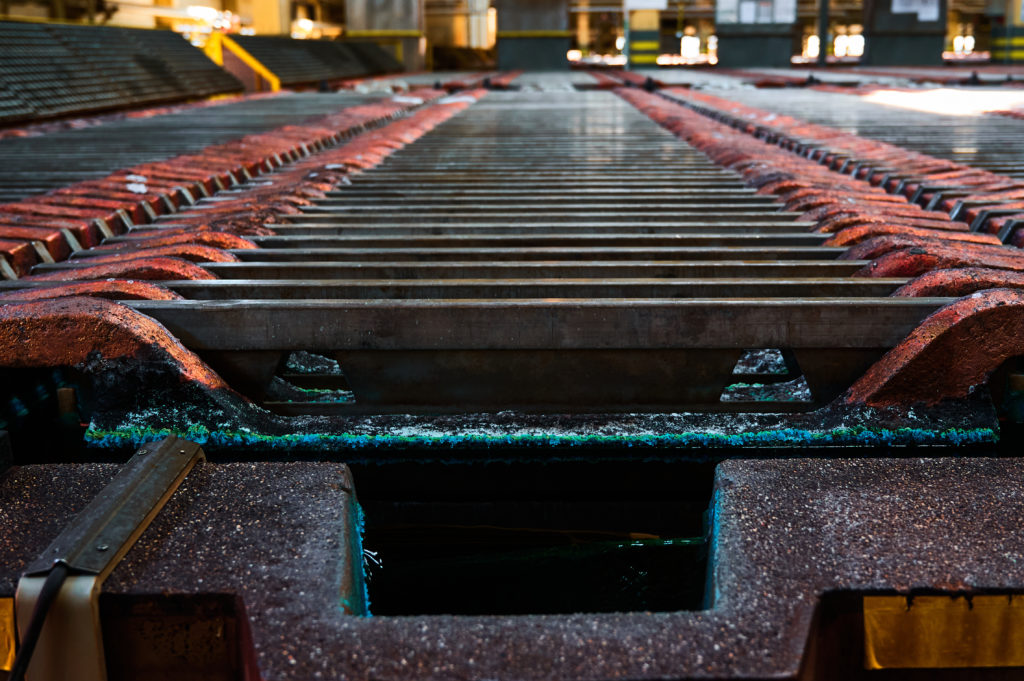
Process of copper refinement in large electrolysis bathtub. Stock image.

From the Australian outback to Ethiopia and the Democratic Republic of Congo, the global mining industry is beginning to feel the effects of disruption caused by the war in Iran.

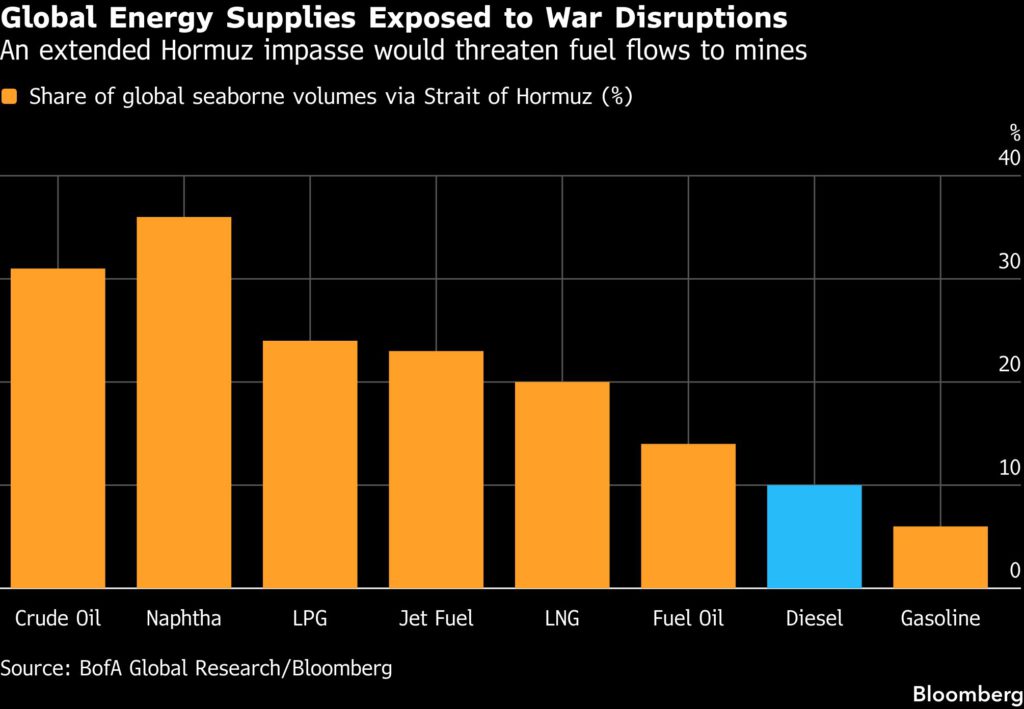
War-driven snarl-ups are starting to ripple through supply chains, squeezing access to key mining inputs while driving up costs to produce some of the world’s most sought-after metals. The biggest impacts are from diesel, the main fuel powering heavy equipment at mine sites, as well as sulfur, used in processing about a sixth of the world’s copper.

“The supply chain is breaking down,” Ivanhoe Mines Ltd. founder and co-chairman Robert Friedland told a conference in Switzerland Tuesday, warning that war’s impact on mining has barely started.

So far, there hasn’t been a significant impact on global metals output because big mining companies have been able to secure supplies and absorb higher costs. But smaller producers from Africa to Australia are starting to feel the pain as the conflict drags on. The longer the war continues, the greater the risks to an industry already strained by mining outages and project delays at a time of accelerating demand for critical minerals.

The Middle East accounts for about half the world’s seaborne sulfur and at least 10% of shipped diesel, according to data compiled by Goldman Sachs Group and Bank of America. Sulfur — and by extension, sulfuric acid — are vital inputs for a type of processing known as SX-EW, which accounts for 17% of copper supply, according to Goldman.

If war-related upheavals intensify, it could start eroding the 23 million tons of copper mined per year in a more meaningful way and drive up already elevated metal prices even more. Futures on the London Metal Exchange are more than 40% higher than a year ago, and in January touched a record high above $14,500 a ton.

Congo — the world’s No. 2 copper producer and biggest supplier of cobalt, a battery metal — is particularly exposed because most of its sulfur comes from the Middle East and its output is unusually reliant on SX-EW plants. SX-EW uses acid to leach copper and cobalt out of certain types of ore, without needing smelters that actually generate acid as a byproduct.

Securing new sulfur supply could take almost two months while inventories at some facilities cover only a month, according to a person with knowledge of the situation. Some smaller cobalt and copper operators are slowing output amid difficulties getting affordable sulfur and spiking diesel costs, said the person.

Local sulfur prices have surged to about $1,200 a ton, about double from before the Iran war, according to pricing agency Argus. Some local buyers said smaller parcels even reached $1,400 a ton as copper plants are eager to stock up.

If supply chain delays extend through June, Goldman analysts estimate the Central African nation could curtail about 125,000 tons of output this year.

In Zambia, a combination of disrupted supply from local smelters and the Middle East war means “sulfuric acid is a worry,” said Jonathan Morley-Kirk, finance director at Jubilee Metals Group Plc. The copper company has explored pooling purchases with other operators, he said on a recent earnings call.

Mining executives may offer a clearer read on disruption threats in the coming weeks as companies report quarterly results.

Adding to the Middle East’s sulfur disruptions, China has signaled plans to halt exports from May of acid produced as a byproduct of copper and zinc smelting. Beijing’s curbs could remove about 1.5 million tons of acid through December, or roughly a tenth of the seaborne market, according to Goldman.

That poses a particular challenge for Chile, which sourced about 30% of its acid from China last year. If restrictions hold through year-end, as much as 200,000 tons of acid-dependent metal output would be put at risk in the top copper-producing nation — or about 1% of global supply, Goldman analysts wrote in an April 21 note.

To be sure, Chilean copper giant Codelco produces most of the acid it consumes and locked in prices before the war, though it is closely monitoring suppliers’ ability to deliver, chief commercial officer Braim Chiple said. US copper producer Freeport-McMoRan Inc. is similarly hedged, though chief executive officer Kathleen Quirk said in an interview that acid supply is “on the list of things to worry about.”

While sulfur markets are tightening, traders say buyers are still able to secure alternative cargoes.

“The sulfur is there for those who can pay the price,” Graeme Train, Trafigura’s global head of metals and minerals analysis, said Monday at the FT Commodities Global Summit.

Some nickel producers in Indonesia have sourced sulfur from Central Asia and Canada, albeit at sharply higher prices, said a person familiar with the situation.

China’s Zhejiang Huayou Cobalt Co. said it doesn’t rule out cutting output if sulfur supply remains tight. The company, which uses sulfur at some of its Indonesian nickel plants, was “caught off guard” after prices surged, chairman Chen Xuehua said on a Monday earnings call.

In Australia, Lynas Rare Earths Ltd. is confident it can get enough sulfuric acid for its domestic processing plants and Malaysian refinery, but the big effect is prices, CEO Amanda Lacaze said on a Monday investor briefing. “We expect that sulfuric acid alongside some other transport cost increases, etc., will make it a little more challenging for us in terms of costs” this quarter.

Diesel disruptions are also pushing up mining costs, particularly for open-pit operations in copper, coal, iron ore and hard-rock lithium. Major producers such as Codelco and Antofagasta Plc estimate the impact at about a 5% increase in production costs — manageable given strong margins.

The bigger risk in some regions is physical availability. Congo again stands out, as copper-cobalt mines rely on imported diesel hauled across long, complex supply routes.

“This fragmented and logistics-intensive supply chain makes diesel availability particularly constrained and costly in mining regions,” BofA analysts wrote in an April 17 note. “Fuel availability in the DRC is not merely a cost variable, but a critical operational constraint.”

Global fuel upheavals tightened diesel availability in Ethiopia, according to Akobo Minerals AB, prompting the Oslo-listed firm to temporarily scale back operations at its Segele project.

In Australia, diesel shortages have already affected some smaller miners, while major producers remain largely insulated: Rio Tinto Group said in its latest production report that operational impacts have been limited, though rising fuel prices are lifting costs.

Fuel constraints forced iron ore producer Fenix Resources Ltd. to curtail activity, reducing non-essential mining and haulage at its Western Australia operations, the company said last month. There are reports of difficulties in booking Indonesian coal shipments after June because of concerns over securing diesel supplies.

Some of the world’s largest mining companies, with operations from Southeast Asia to Latin America, are starting to warn investors of rising costs tied to the Middle East conflict.

Teck Resources Ltd. warned of higher fuel costs for its flagship Chilean copper mines Thursday in its earnings report. While the Vancouver-based company said it didn’t see a significant risk to fuel supply disruption, “there could be an amplified impact on costs at our Chilean operation due to the requirement for diesel imports.”

Freeport, which operates the massive Grasberg copper mine in Indonesia, lifted its 2026 cost estimates in part because prices for diesel and sulfuric acid have been highly volatile with significant regional dislocation.

The chairman of Chile’s state-owned Codelco, Maximo Pacheco, said the war’s impacts have become an unexpected headwind for the industry.

“Nobody expected this to happen,” he said in an interview. “Producing copper today is more and more difficult.”

Copper king Chile faces acid supply crunch as China exports dry up


Lomas Bayas copper mine in Chile. (Image courtesy of Glencore.)

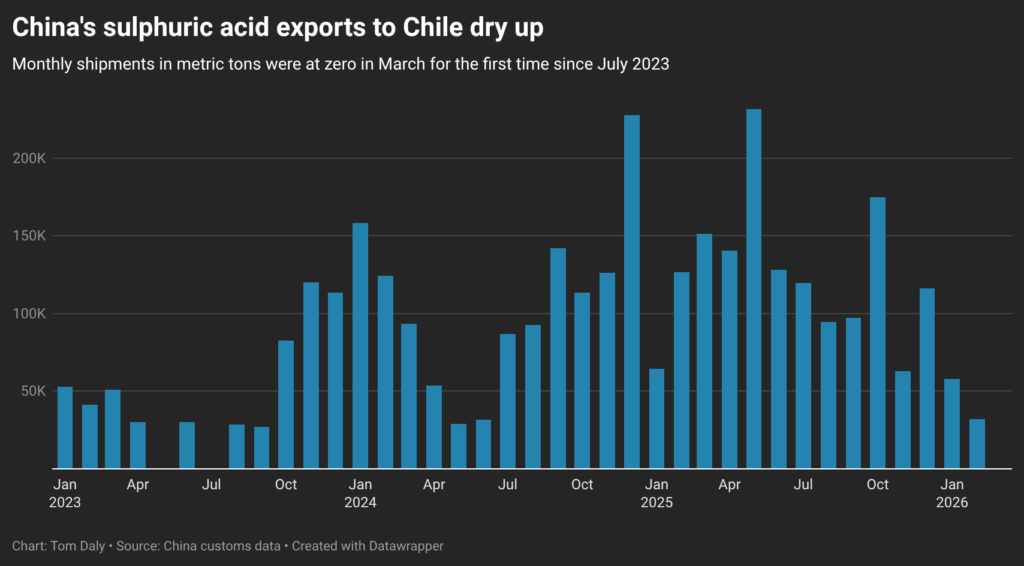
China’s exports of sulphuric acid to Chile dwindled to zero in March, Chinese customs data show, leaving the world’s top copper producing nation facing a squeeze on supplies of the chemical used to make around half of its refined metal.

The war in the Middle East has caused a sulphur supply crunch, and China is reportedly planning to ban sulphuric acid exports from May to ensure its domestic market – notably the fertilizer industry – does not face a shortage.

But shipments to Chile, which was China’s biggest overseas acid market in 2025 and took almost one-third of its exports, have already dried up, with no acid departing for the South American country last month for the first time since July 2023.

In comparison, China exported 31,870 metric tons of acid to Chile in February 2026 and 151,268 tons in March 2025.

Sulphuric acid is a byproduct of smelting copper ore. But it is also used to produce refined copper via another process known as leaching.

Since Chile does not produce enough acid of its own, it depends on imports, 37% of which come from China, according to HSBC. It thus partly relies on Chinese smelters that purchase its ore to send back the acid for leaching so it can make more metal.

But relations between mining companies and China’s smelters have been strained recently as tight ore supplies have meant treatment charges – the fees paid to process ore – have been heavily in the miners’ favour.

Copper output at risk

“If sulphur supply tightens, acid availability becomes more constrained and expensive,” Alexis Urbani, a sulphuric acid trader with Incotrade Chile, told Reuters.

“That can directly impact cathode production, especially for operations relying on secondary sulphides or lower-grade ores, where acid consumption is higher.”

Morgan Stanley said in a note this month that Chile’s 1.1 million tons of annual leached copper production could be at risk from a Chinese acid export ban. That is over half Chile’s refined copper output of about 2 million tons and one-fifth of its total copper contained production of 5.5 million tons.

“Any impact on output may take time to emerge, however, as leaching is a relatively slow process,” the bank said, estimating that imports from China account for 20% of acid supply for Chilean copper leaching.

China’s overall sulphuric acid exports held steady month-on-month at 143,381 tons in March, with shipments to the Philippines, India and Indonesia all rising sharply.

Chile is particularly vulnerable to supply fluctuations, Bold Baatar – chief commercial officer at Rio Tinto, co-owner of the country’s giant Escondida mine – told a conference on Wednesday.

“The most exposed country is Chile in terms of need for sulphuric acid imports, because that’s where the highest amount of leached copper is,” he said.

(By Tom Daly, Divya Rajagopal, Amy Lv and Polina Devitt; Editing by Joe Bavier)