Friday, May 08, 2026

Fuel Prices Have Spiked More in ‘Energy Independent’ US Than in Nations That Have Moved Away From Oil and Gas

“The only real energy independence from the Middle East is renewables,” said one policy expert.
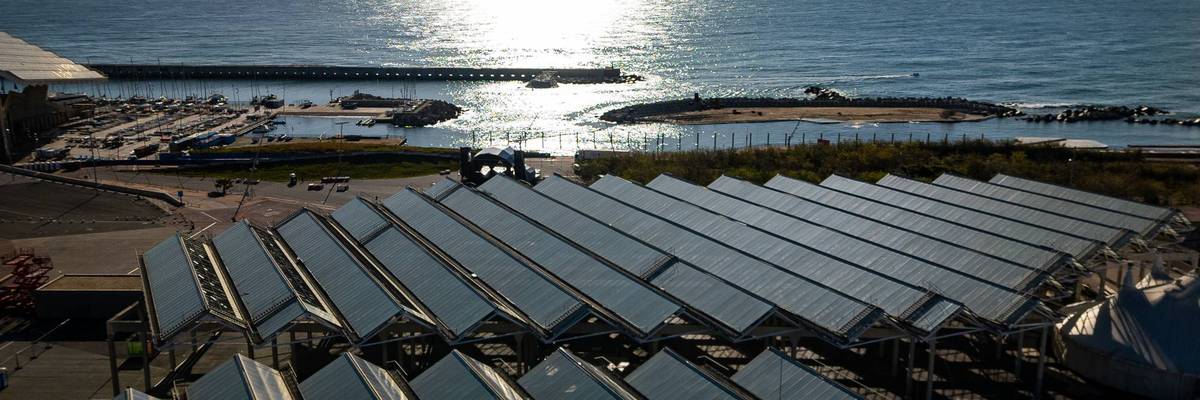


Solar panels are seen in the city port in Barcelona, Spain on March 27, 2026.
(Photo by Davide Bonaldo/SOPA Images/LightRocket via Getty Images)

Stephen Prager
May 05, 2026
COMMON DREAMS

Average gas prices in the United States are quickly climbing toward $5 per gallon this week as US President Donald Trump’s war with Iran shows little sign of resolution.

Where average prices were about $2.98 the day before the war’s launch, they had shot up to $4.48 as of Tuesday, according to AAA’s gas price tracker, as Iran’s restriction of ships traveling through the Strait of Hormuz has squeezed global oil shipping and the shipping of other fuel sources like liquefied natural gas (LNG), causing global price hikes.

And while Trump has touted America’s supposed “energy independence” as an ace in the hole, achieved by ratcheting up fossil fuel production while canceling solar and wind power projects, data shows that the US has been hit harder by the price shocks than any other major economy in the world, with those that have embraced renewable energy being especially resilient.


Although the US leads the world in oil production by a large margin, data from JP Morgan Commodities research, analyzed Friday by MarketWatch, showed that between February 23 and April 27, the US experienced about a 42% increase in gas prices, the fifth-highest in the world.

“The spike in US gasoline prices over the past two months has outpaced everywhere except Southeast Asia, the region most dependent on oil from the Persian Gulf,” explained Yahoo Finance geopolitics reporter Jake Conley.

Rebecca Babin, senior energy trader and managing director at CIBC Private Wealth, explained to MarketWatch last week that while increased fuel production gives the US a “buffer,” oil is a global market and “it doesn’t operate in a vacuum.” She said, “Global tightness and domestic bottlenecks still show up in gasoline prices.”

Meanwhile, some of the countries that have best survived the price hikes include France and Spain, which derive large shares of their power from nuclear energy and renewables, respectively.

Craig Hanson and Jessica Isaacs, a pair of researchers at the World Resources Institute, explained last month that while a mix of factors is at play, countries less reliant on fossil fuels generally “find themselves in a better position to withstand the current crisis.”

“Every country has homegrown access to at least two clean energy resources—the sun shines, and the wind blows just about everywhere at some point,” they said. “The same cannot be said of oil and gas, where production is concentrated in a small number of countries and exposed to geopolitical disruption.”

“Renewable resources like wind, solar, and geothermal have zero fuel costs, and the fuel cost of nuclear power is quite low. Again, the same cannot be said of fossil fuels, which have costs set by volatile global markets,” they added. “These two advantages are why some of the world’s clean energy frontrunners are faring better than other countries amidst the Iranian energy crisis.”

As Reuters reported in late April, the contrast between Europe’s biggest gas guzzlers and green energy adopters is particularly stark.

While Albania has kept energy prices in check and even lowered them compared to last year by using its large system of hydroelectric dams, which supply much of its power, countries like Germany and Italy, which still rely heavily on gas, have seen electricity prices spike.

Hanson and Isaacs noted that while clean energy investments have helped soften the blow of global price shocks, the effects are not the same across the board. While price hikes for the electricity used to power factories, homes, and cars have been blunted by the availability of alternative energy sources, others, like heat—which are more reliant on natural gas—have still been affected.

Still, though, they said the crisis has shown that in addition to environmental sustainability, “clean energy systems’ greatest benefits today might actually be price stability and domestic energy resilience.”

While Trump has continued his efforts to choke off any federal investment in renewable energy and double down on oil and gas production, other nations have taken the war’s price hikes as a sign to further accelerate their transition away from fossil fuels.

Germany and several other European Union members, for example, have announced expedited timelines to expand offshore wind and solar investments, explicitly citing the volatility in oil markets caused by the war.

Stephen Wertheim, a senior fellow in the American Statecraft Program at the Carnegie Endowment for International Peace, said the energy price shocks showed that “the only real energy independence from the Middle East is renewables.”
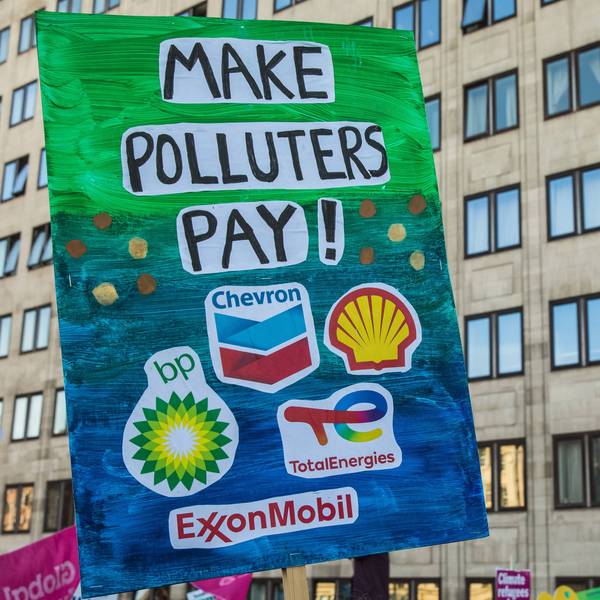
Trump DOJ Sues Minnesota in ‘Desperate Effort to Shield’ Big Oil From Climate Case

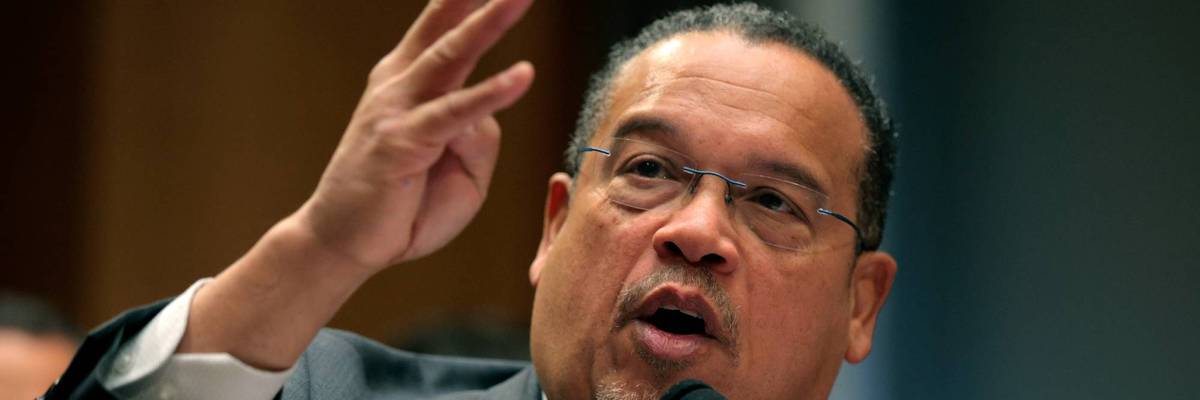
“The American people deserve a Department of Justice that fights for us, and it’s a tremendous shame that Trump’s DOJ would rather sell us out to Big Oil,” said Minnesota Attorney General Keith Ellison.


Minnesota Attorney General Keith Ellison testifies before the Senate Homeland Security and Governmental Affairs Committee on February 12, 2026 in Washington, DC.
(Photo by Chip Somodevilla/Getty Images)

Jessica Corbett
May 04, 2026
COMMON DREAMS

Just weeks after the Minnesota Supreme Court allowed the state’s climate deception lawsuit against the fossil fuel industry to move into discovery, President Donald Trump’s Department of Justice took action in federal court on Monday to block the case.

Minnesota Attorney General Keith Ellison first sued the American Petroleum Institute, ExxonMobil, Koch Industries, and its subsidiary Flint Hills Resources in state court for orchestrating and executing a “campaign of deception” regarding the fossil fuel-driven climate emergency “with disturbing success” in 2020.


The industry has been fighting to kill the case since then, and the DOJ on Monday filed a complaint in the District of Minnesota against both the state and Ellison. In a related statement, Associate Attorney General Stanley Woodward declared that “President Trump promised to unleash American energy dominance, and Minnesota officials cannot undermine his directive by mandating that their woke climate preferences become the uniform policy of our nation.”

“Minnesota’s attempt to impose a national regulation on global greenhouse gas emissions not only is preempted by federal law, but also undermines affordable and reliable American energy, weakening the national and economic security of the United States,” Woodward continued, summarizing the argument made in the new federal filing.

While the fossil fuel entities targeted by Minnesota welcomed the Trump DOJ’s intervention, Ellison made clear that he was undeterred.

“In 2020, I sued Big Oil for lying to Minnesotans about the true causes of climate change, then sticking us with the bill for the harms it is causing,” Ellison said. “Six years later, we are still waiting to go to trial because Big Oil has pulled every procedural trick in the book to delay facing the consequences of their unlawful actions.”

“This frivolous and meritless lawsuit is just their latest attempt to hide from accountability, and I will move to have it dismissed immediately,” he pledged. “The American people deserve a Department of Justice that fights for us, and it’s a tremendous shame that Trump’s DOJ would rather sell us out to Big Oil.”

Richard Wiles, president of the Center for Climate Integrity, which supports cases against polluters, also ripped the federal filing.

“This is a desperate effort to shield the architects of Big Oil’s decadeslong climate deception from facing accountability,” said Wiles. “Big Oil and the Trump administration are clearly terrified that Minnesota’s lawsuit will reveal exactly how these defendants defrauded the public about the dangers of fossil fuels. Federal courts dismissed the Trump administration’s last two attempts to stop states from taking Big Oil companies to court. This naked political intimidation tactic should meet the same fate.”

Trump was backed by Big Oil during the 2024 election and campaigned on a promise to “drill, baby, drill.” Since returning to office, he’s aimed to serve industry interests in a range of ways, including last year’s executive order directing the US attorney general to protect “American energy from state overreach.”

The Justice Department noted in its Monday statement that last year, its Environment and Natural Resources Division “filed complaints against Hawaii, Michigan, New York, and Vermont to stop those states’ unconstitutional climate actions.”

Dozens of state and local governments have filed cases similar to Ellison’s in Minnesota. The US Supreme Court is preparing to hear arguments related to one from Colorado that dates back to 2018: Suncor Energy Inc. v. County Commissioners of Boulder County.

Meanwhile, Trump and Big Oil’s allies in Congress are also working to protect polluters. Last month, Sen. Ted Cruz (R-Texas) introduced a bill that, if passed, would “prohibit liability against those engaged in the mining, extraction, production, refinement, transportation, distribution, marketing, manufacture, or sale of energy for damages or injunctive or other relief from the use of their products, and for other purposes.”

Wiles noted at the time that “Big Oil companies have raked in massive profits at the pump while lying to the American people about the catastrophic harm of their products, and now they want to deny Americans their rightful day in court and stick taxpayers with the bill for the mess they made.”

“If fossil fuel companies have done nothing wrong,” he asked, “why do they need immunity?”
Evacuation Must Start Now as Climate-Driven Rising Gulf Slowly Drowns New Orleans: Study

“Coastal Louisiana has evidently already crossed the point of no return,” says new research.


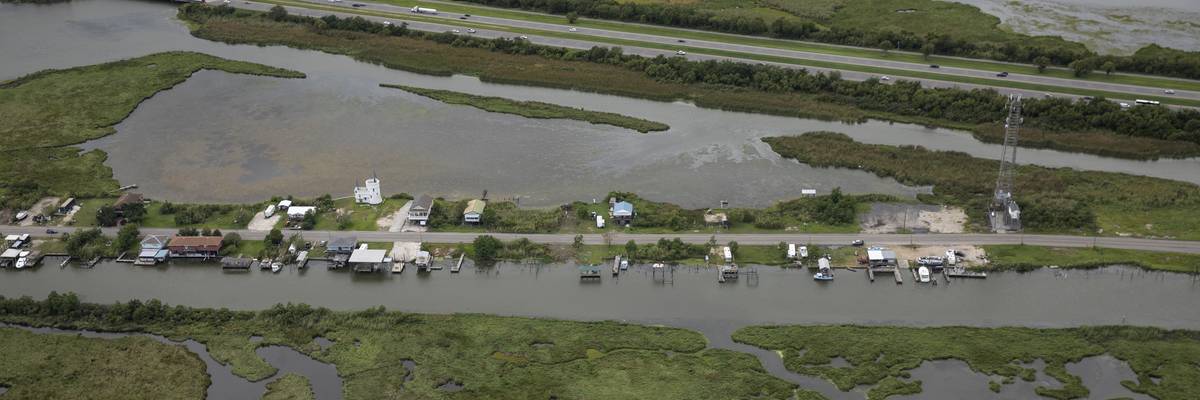
Homes in New Orleans are surrounded by rising waters on August 23, 2019 amid the worsening climate emergency.

(Photo by Drew Angerer/Getty Images)


Brett Wilkins
May 04, 2026
COMMON DREAMS

A study published Monday warns that New Orleans must immediately begin planning and gradually implementing its permanent evacuation to avert a dangerously rushed exodus later, because it has passed a “point of no return” as climate-driven sea-level rise slowly swallows the storied city.

“With global temperatures poised to exceed the 1.5°C Paris Agreement threshold—a level that triggered substantial ice sheet collapse during the Last Interglacial—low-elevation coastal zones face sea-level commitments far beyond current planning horizons,” says the study, which was published by the journal Nature Sustainability.

“With this geological frame of reference, we examine the impact of sea-level rise on what may be the most physically vulnerable coastal zone in the world using prehistoric and contemporary patterns of human mobility,” the publication continues. “We highlight the positive aspects of the recently commenced out-migration in this region and argue that the fate of communities landwards of this coastal zone will be decided in the next few decades.”

“While climate mitigation should remain the first step to prevent the worst outcomes, coastal Louisiana has evidently already crossed the point of no return,” the paper adds.

That’s because rising waters are slowly eroding Louisiana’s coast, including New Orleans, which “may well be surrounded by the Gulf of Mexico before the end of this century,” according to the study’s authors.

“Louisiana is a canary in the coal mine. It is one of the rare places where we’re already clearly seeing climate-motivated depopulation combined with other social and economic factors,” said Yale School of the Environment professor and study co-author Brianna Castro.

The authors argued that by acknowledging the inevitability of New Orleans’ underwater future, government and residents can avert a fraught rushed retreat by planning and executing a managed multigenerational relocation and set an example for other threatened coastal communities.

According to one widely cited study published a decade ago, around 13 million Americans living in coastal areas could be forced to relocate to higher ground by the end of the century due climate-driven sea-level rise, with the Gulf Coast and Florida expected lose the most livable land. Globally, hundreds of millions of people are expected to be displaced by 2100 due to rising seas.

After Hurricane Katrina—which inundated the city and killed nearly 1,000 people in the New Orleans metro area—billions of dollars were spent fortifying the city’s levee system, which failed catastrophically during the 2005 storm. However, experts warn that in the long term, levees won’t be able to stop the rising waters any longer.

That’s why the study’s authors said officials must begin the city’s orderly depopulation as soon as possible.

“What kind of retreat do you want?” asked Castro. “Do you want to incentivize it and then people go naturally for jobs, housing, and lifestyle amenities—or do you want people to wait and then have to leave abruptly in crisis?”


‘I Don’t Hate the Americans’: Latest Lego Video Promotes Empathy Between People of US and Iran

‘Love for the people, but the system must cease... From Tehran to DC, we’re screaming for peace.”


A still from the latest video which seeks to forge solidarity between all the people suffering from the war against launched by the US and Israel against Iran.

(Photo: Screenshot/via social media)

Jon Queally
May 02, 2026
COMMON DREAMS

The creative team behind many of the viral sensations featuring Lego characters and storytelling critical of the war launched by US-Israeli forces against Iran two months ago, posted a new video on Saturday that seeks to forge solidarity between everyday Iranians and Americans suffering from the conflict, and who desperately want to see the fighting brought to an end.

“The Iranian AI Lego team has another video out,” said Trita Parsi, executive vice president at the Institute for Responsible Statecraft, a DC think tank focused on US foreign policy. “The music, lyrics, and imagery are all designed to appeal to disillusioned Americans.”


Iran Says YouTube Is Trying to ‘Suppress the Truth’ By Banning AI Lego-Style Videos Mocking US-Israeli War

With the video—featuring dramatic scenes from daily life in both Iran and the United States under the shadow of war—the makers behind it, said Parsi, “are doubling down on building bridges between Americans and Iranians while depicting the US government and ‘system’ as the real enemy.”

Touching on themes of shared empathy between people and a political system in the US that insulates the people in power, like US President Donald Trump and lawmakers in Congress, from the will of the voters, the chorus of the song states, “Same sun rising, but we’re living in hell; While the leaders are ringing the funeral bell.”

‘Love for the people, but the system must cease,“ the chorus continues, ”From Tehran to DC, we’re screaming for peace.“


The lack of peace, the music video argues, is not a reflection of what the American people want but comes from the leaders of the country, motivated by profits, wealth, and geopolitical power.

Your politicians are puppets, strings pulled by their greed,
Selling weapons to anyone, ignoring the need.
They sit in ivory towers, completely out of touch,
Making billions on bombs while the world suffers so much.
They point fingers at us; call us the axis of bad
While they fund the worst violence that the world ever had.

While the imagery shows Iranians suffering in food lines and terrified by US and Israeli bombs being dropped on cities, the message from the Iranian production team behind the video is that the people of Iran do not blame the people of America for the bad behavior of their government.

It’s not you, America. It’s the ones who lead you.
Listen to my heart...

I don’t hate the Americans who are living in fear,
To the working class people trying to make ends meet
To the students protesting, marching out on the street,
We are one and the same, just trying to survive,
Just trying to keep our cultures and our families alive.

I see you standing for justice, fighting the system of hate.
It’s your corrupt politicians that are sealing our fate.
I say love to the citizens from coast to coast,
You’re victims of the same machine that hurts us the most.

So I wrote this track to try to bridge the divide,
To lay down the weapons, to swallow the pride.
We don’t need another missile, no more tactical strikes.
We need conversations on what the future looks like.

My purpose is peace. Let the hostility cease.
Let the eagles and lions finally sit at the feast
From the Persian Gulf straight to the American Shore.
Let our generation be the one that finishes war.
Put the guns in the dirt. Let the healing begin
Because if we keep shooting, then nobody will win.

The “peace” the song concludes, is not for the benefit of “the leaders” waging the war, but for “the innocent souls” harmed by war and the “next in line” in future generations.

The new video on Saturday builds on a previous video from earlier in the week that represented a pivot away from simply ridiculing Trump and slamming the Israelis for their aggression by focusing more on trying to reach the American people who oppose the war and are also being harmed by it.


The earlier video released Thursday, noted Drop Site News, invokes “the 1953 CIA-backed coup against Prime Minister Mohammad Mosaddegh,” and “references the human cost of sanctions,” and “draws a parallel between Iranian and American working people”—all to break through possible barriers of understanding between civilians in the US and those living under the scourge of war in Iran.

“They want us to hate, they want a wall made of glass,” the song says. “But we’re both just the victims of a ruling class.”


‘The World Is Proud of You, Guido’: American Peace Activist Honored in Iranian Lego Video

“Your dignity stands taller than the place you stood, and it will live forever in our memory.”


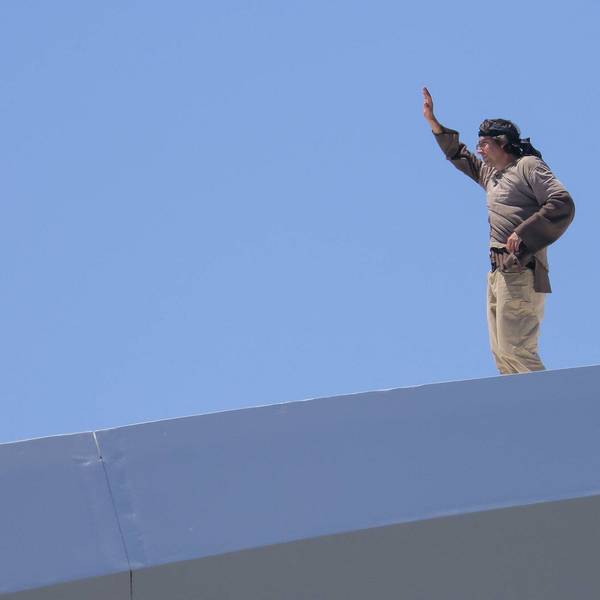
A still from a video produced by Explosive Media depicting peace activist Guido Reichstadter atop the Frederick Douglass Memorial Bridge, which he climbed to protest the war against Iran launched by US President Donald Trump.
(Photo: Screengrab/Explosive Media)


Common Dreams Staff
May 02, 2026

Explosive Media, one of the independent outfits generating the viral videos about the war in Iran, created a short piece on Saturday to honor the American father of two who climbed atop a bridge in the Washington, DC this weekend to demand an end to the conflict.

“In honor of Guido Reichstadter, the man who climbed the Frederick Douglass Memorial Bridge to make his voice of protest heard,” the group said in a post alongside the video short. “Your dignity stands taller than the place you stood, and it will live forever in our memory.”

As Common Dreams reported, Reichstadter climbed the bridge wearing a t-shirt that simply read “End War” beginning on Friday afternoon, remained in protest overnight, and told one reporter he intends to remain “for a few days at least.”

In honor of Guido Reichstadter,
the man who climbed the Frederick Douglass Memorial Bridge to make his voice of protest heard.

Your dignity stands taller than the place you stood,
and it will live forever in our memory. 🫡🏔️ pic.twitter.com/WANYzS7kIh
— Explosive Media (@ExplosiveMediaa) May 2, 2026

Reichstadter said he climbed the 168-foot-tall bridge “because the government of the United States is engaged in acts of mass murder in my name. And I refuse to be complicit in that.”

“The world is proud of you, Guido,” Explosive Media said in a separate post on social media. “Soon, side by side, we will celebrate peace and victory together.”


‘I Refuse to Be Complicit’: Man Scales 168-Foot Bridge in DC Demanding End to Iran War

“I’m at the top of this bridge,” says Guido Reichstadter, “because the government of the United States is engaged in acts of mass murder in my name.”


Guido Reichstadter scaled the Frederick Douglass Memorial Bridge in Washington, DC on Friday, May 1, 2026 in order to protest the Iran War started by the President Donald Trump just over two months ago.
(Photo: bystander video/screenshot/via Al-Jazeera)


Jon Queally
May 02, 2026
COMMON DREAMS

Forty-five-year-old social justice activist named Guido Reichstadter, on Saturday morning, was still perched atop the Frederick Douglass Memorial Bridge in Washington, DC, after first scaling the structure Friday afternoon in protest against President Donald Trump’s disastrous war against Iran, now in its third month, and the rapid and unregulated spread of artificial intelligence technology.

As Reichstadter, who described himself as the father of two children with master’s degrees in both math and physics, said in a video posted to social media on Friday: “Hi, my name is Guido Reichstadter, and I’m currently occupying the top of the Frederick Douglass memorial bridge in Washington, DC.”


‘A Beautiful Act of Profound Civil Disobedience’: Guido’s Bridge Protest Against Iran War Hits Day Five

“I’m calling on the people of the United States,” he continued, “to bring an immediate end to the Trump regime’s illegal war on Iran and the removal of the regime’s power through mass nonviolent direct action and non-cooperation.”

“I woke up on February 28th, and I found that hundreds of school children had been blown apart. I think there are many millions of Americans who reject the war in principle, but whose actions have not yet been sufficient to bring it to an end.”

In a separate video, he explained he was at the top of the bridge, which rises approximately 168 feet above the Anacostia River at its highest point, “because the government of the United States is engaged in acts of mass murder in my name. And I refuse to be complicit in that.”

While bridge traffic in both directions was closed at times on Friday and overnight, the bridge is reportedly open to traffic Saturday morning, though with some lane restrictions, as law enforcement said a “barricade situation” with the protester continued.

Reichstadter, who has staged high-profile protests in the past, spoke to Al-Jazeera via video stream on Friday to explain his actions and call for an end to the war that he says—and tens of millions of other Americans agree, according to polling—is a colossal failure by the Trump administration.


“I mean, it’s an atrocity, right?” he said when asked what motivated him. “I woke up on February 28th, and I found that hundreds of school children had been blown apart. I think there are many millions of Americans who reject the war in principle, but whose actions have not yet been sufficient to bring it to an end.”

Democratic members of Congress, both in the US House and Senate, have now brought several War Powers Resolutions to the floor in an effort to end the US attack on Iran, which now includes a naval blockade of the country, but Republican majorities in both chambers, backing Trump, have thwarted those efforts.


Poll after poll, meanwhile, shows that Reichstadter is completely correct in stating that millions of people “reject the war,” but still the war continues even after a 60-day deadline, according to the War Powers Act of 1973, which says the president must either end military operations or get the explicit approval of Congress, which came and went on Friday.

On Friday, a video showed Reichstadter wearing a t-shirt that read “NO WAR” and unfurling a large black banner along the side of the bridge’s central arch as part of the protest.

Before scaling the bridge, Reichstadter also spoke with journalist Ford Fisher to explain his motivations and what he hoped to accomplish with his one-person direct action:


- YouTubewww.youtube.com

Reichstatder stayed on the bridge overnight, even as fireworks exploded overhead from a nearby Major League Baseball game.


In his statement concerning AI, Reichstadter said he wanted to “urgently warn the people of the US and the world of the imminent danger we are in of crossing a point of no return towards the development of artificial intelligence, which poses the risk of catastrophic harm to humanity, including human extinction.”

“I call on the governments of the world to take immediate action to end this danger by permanently banning the development of artificial general intelligence and machine super intelligence,” he said. “I also call on the people of the world to exert all possible influence through nonviolent action to compel their governments to end this danger with all possible speed.”


Iran Wants to Know If Anyone Told Kids in Trump’s Oval Office About Minab Massacre

“Has anyone told these children that that bloodthirsty man killed more than 200 students just a few days ago?”


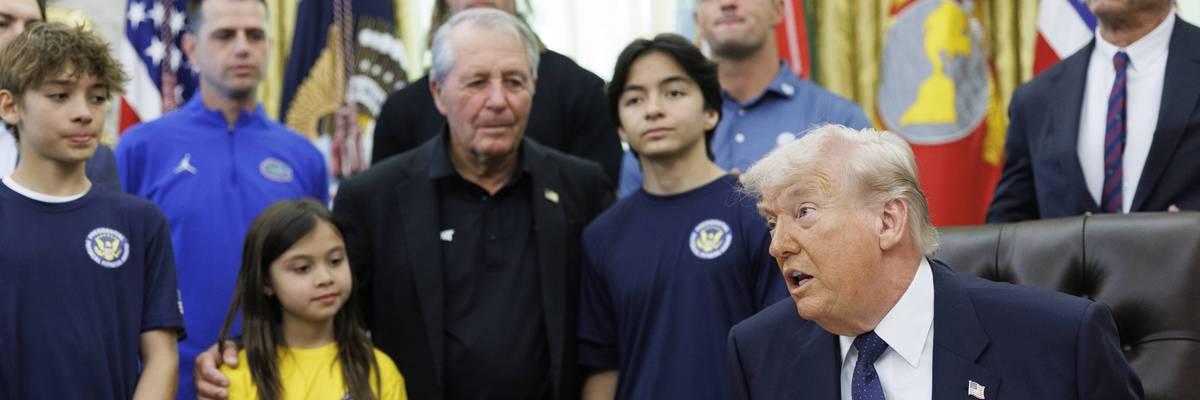
President Donald Trump speaks before signing a proclamation inside the Oval Office at The White House in Washington, on May 5, 2026. The memorandum is set to restore the Presidential Fitness Test Award, a competitive school-based fitness program last seen under the Obama administration.
(Photo by Tom Brenner for The Washington Post via Getty Images/Pool)

Jon Queally
May 06, 2026
COMMON DREAMS


The day after US President Donald Trump told young children in the Oval Office about the blowing up of strategic targets in Iran and described the graphic killing of Iranian protesters who were shot in the head by alleged snipers, a social media account with Iran’s foreign service on Wednesday inquired whether anyone had thought to mention the scores of students who were murdered earlier this year when US forces bombed a school in the city of Minab.

“Has anyone told these children that that bloodthirsty man killed more than 200 students just a few days ago?” asked the Embassy of the Islamic Republic of Iran in South Africa.


New Evidence Bolsters Claim That US Lied About Another Iran Airstrike Massacre


While the number of students killed in the Minab massacre—which took place on the very first day of US bombing—was put at “more than 100” by Amnesty International in a March report, the Iranian government has said 60 or more college students have been killed by US and Israeli forces during airstrikes on universities and research facilities since the attack ordered by Trump began on February 28.

Trump, during his remarks to the children and other gathered in the White House to mark a new physical fitness initiative by the White House, called the Iranians “sick people” who he absurdly claimed would have destroyed the entire Middle East, including Israel, with a nuclear weapon—which they don’t have—“within two weeks” if the US had not attacked when they did.


Trump, with no sense of irony, told the children, “we’re not going to let lunatics have a nuclear weapon.” The optics of Trump’s comments were not only seized by the Iranians to make a point about how the US military has conducted itself under his command.

“Trump unironically tells kids in America that Iran is full of ‘sick people’ who would’ve nuked them,” said journalist Fiorella Isabella, “as the entire world with a half a brain reminds him that the very first thing he and his Zionist ghouls did was order a double tap-strike on 180 school children in Minab.”
A Seriously Unwell Trump Is Losing Iran War for All the World to See

What makes the US president so pathetic is also what makes this moment in history so incredibly dangerous.


A Lego-style animated video posted by the Iranian company Explosive Media mocks US President Donald Trump and Israeli Prime Minister Benjamin Netanyahu on March 7, 2026.
(Image: Screenshot / Explosive Media)

Robert Reich
May 07, 2026
Inequality Media


We are witnessing what happens to a person who is consumed with the need to dominate but cannot.

Iran is unlikely to give in. It can withstand the economic pressure of a blockade better than Trump can withstand the political pressure that comes with rising gas prices (now nearly $4.50 a gallon, on average), soon followed by rising food prices.

His looming failure in Iran is not just a serious geopolitical defeat for the United States; it’s a personal crisis for Trump.

Those rising prices coupled with an increasingly unpopular war have increased the likelihood that Democrats will take back control of the House and even possibly the Senate in the upcoming midterms.

Here again, not just a political defeat for the Republican Party but a personal crisis for Trump.

His ego cannot accept a humiliating loss, as we saw after the 2020 election. His need to bully, dominate, and gain submission is so hardwired inside his insecure head that the defeats he’s now facing — to Iran and to Democrats — are already setting off explosions.

He’s posting more wildly than ever — attacking, insulting, ridiculing, threatening.

On Sunday, Trump posted that Democrats had “RIGGED the 2020 Presidential Election. GET TOUGH REPUBLICANS—THEY’RE COMING, AND THEY’RE COMING FAST! They’re no good for our Country, they almost destroyed it, and we don’t want to let that happen again!” He demanded that Republicans “approve all of the necessary Safeguards we need for Elections to protect the American Public during the upcoming Midterms.”

More of his posts are bizarre AI-generated paeans to himself, his godlike powers, his wished-for physique, and his self-image of omnipotence. On Friday night, he posted an AI-image of himself, JD Vance, Marco Rubio, and Doug Burgum, all shirtless and with young physiques, standing in the reflecting pool in front of the Lincoln Memorial, along with an unidentifiable woman in a bikini. Minutes later he posted an image of House Minority Leader Hakeem Jeffries holding a baseball bat, with a caption calling Jeffries “low IQ,” “a THUG,” and “a danger to our Country.” On Tuesday, he posted AI-images of Joe Biden on one knee with the caption “COWARDS KNEEL,” Barack Obama with the caption “TRAITORS BOW,” and himself with his fist raised and the caption “LEADERS LEAD.”

His mouth — never in control — is now in diarrheic mode. He’s even back to attacking the pope, accusing him of “endangering a lot of Catholics and a lot of people,” adding, “but I guess if it’s up to the pope, he thinks it’s just fine for Iran to have a nuclear weapon.”

His thin-skinned vindictiveness is beyond anything we’ve seen before, which is saying a lot. Last week, after German chancellor Friedrich Merz said the U.S. was “being humiliated by the Iranian leadership,” Trump repeatedly attacked and ridiculed Merz. The Defense Department then said it was pulling 5,000 troops out of Germany, and Trump said he was increasing tariffs on European cars and trucks to 25 percent (from 15 percent).

He’s becoming ever more obsessed with monuments to himself — his ballroom, his arch, his so-called “garden of heroes,” his Trump-embossed passports, his image on 24-karat gold commemorative coins, and his name plastered or etched all over Washington. His plans for self-monuments are becoming larger by the day, more grotesque, more grandiose, and more expensive. Senate Republicans just proposed $1 billion more for Trump’s ballroom, which, recall, was supposed to “cost taxpayers nothing.”

He has even directed the Treasury to announce that his own signature — yes, the same one that appears in a book of birthday greetings for Jeffrey Epstein — will replace the Treasurer’s on all new U.S. paper currency. This will be the first time in American history that a sitting president’s name will appear on circulating cash money.

His thirst for vengeance is exploding, too. Last week the Department of Justice launched another criminal case against former director of the FBI James Comey (whose earlier indictment was quashed by the courts) for posting a picture of seashells spelling out “86 47” on Instagram a year ago. Trump is also insisting that the Justice Department restart its criminal investigation of Jerome Powell and double-down against former Joint Chiefs of Staff Chair Mark Milley and others he considers “enemies.”

Facing the two monumental failures of Iran and control over Congress, Trump is fanatically seeking other ways to assert dominance. On Tuesday, his Education Department announced a civil rights investigation into Smith College over enrolling transgender students. Expect more of this.

Regardless of what happens in Iran, he’ll claim victory. That will be difficult to do convincingly when gas prices remain over $4 a gallon, but he’ll undoubtedly try.

What if Democrats win control of one or both chambers of Congress in the midterms and he claims they lost or cheated? The nation barely survived the last time Trump’s fragile ego faced a major loss.

We’ll also have to cope with Trump as a lame-duck president who can no longer dominate and gain submission as he did before. Will he try to remain president beyond his second term to avoid this?

The man is unwell. Seriously unwell. Lame-duck presidents fade away, but injured dictators can be dangerous.

Bragging of Wartime Iran Blockade, Trump Admits ‘We’re Like Pirates’

“We took over the cargo. We took over the oil. It’s a very profitable business,” said the American president, of seizing ships many thousands of miles away from US waters. No mention of what the war of choice against Iran is costing the US taxpayer.


In this handout photo provided by US Central Command, US forces patrol the Arabian Sea near M/V Touska on April 20, 2026, after firing upon the Iranian-flagged vessel that the US accused of attempting to violate the US naval blockade of Iranian ports near the Strait of Hormuz.
(Photo: Handout by the US Navy via Getty Images)

Jon Queally
May 02, 2026
COMMON DREAMS


President Donald Trump on Friday night openly bragged about the US military acting “like pirates” in the world’s oceans as he described recent activities of the US Navy incapacitating vessels at sea and then taking their cargo.

“We took over the cargo. We took over the oil. It’s a very profitable business,” Trump said with a smile as the friendly crowd at the Forum Club in Palm Beach, Florida, cheered him on.

“We’re sort of like pirates, but we’re not playing games,” Trump added before calling the Iranian “bullies” who had to be confronted.


“The only good thing about Trump—only thing!—is that he sometimes says what we all know to be true,” said journalist Mehdi Hassan, “but don’t expect an American president to say, admit, out loud.”

In a social media post, the Iranian Embassy in New Zealand said: “No need to confess, President, the whole world already knows you. By the way, those who, with performative noise, constantly talk about ‘international law’ and ‘freedom of navigation’… don’t want to condemn piracy now?”

“The only good thing about Trump—only thing!—is that he sometimes says what we all know to be true, but don’t expect an American president to say, admit, out loud.”

While using the US military to seize the contents of ships may be profitable to somebody, it’s not entirely clear who that might be.

So far, the estimate for what Trump’s war of choice against Iran over the last two months has cost US taxpayers in the immediate term ranges from $25 billion, which is what the Pentagon itself said this week, to upwards of $100 billion. Over the long term, including the increased cost of gas and groceries due to the economic disruption and the care of veterans involved in the war, the costs of the war—which remains historically unpopular among the US public—could exceed $1 trillion.

Mark P. Nevitt, a retired US military lawyer and now an associate professor at Emory University School of Law, argues that the series of maritime blockades imposed by Trump on Iran has created a “legally surreal moment” in the ongoing conflict.

“The United States is simultaneously observing a ceasefire with Iran while enforcing a naval blockade—a belligerent wartime operation that has no legal basis in peacetime,” explained Nevitt in a column for Justice Security on Friday. “Normally, the imposition of a naval blockade ends a ceasefire, because a blockade is itself a belligerent act.”

While there are established legal frameworks for naval blockades during wartime, legal scholars have asserted from the outset of the war—when the US and Israel launched unprovoked bombings of Iran on Feb. 28—that the war itself is illegal under international law.

While the existence of the blockade, an overt act of war, means the US and Iran remain in active military conflict, Trump himself and the Pentagon made the untenable claim this week that because a tentative ceasefire is in place, the US is not engaged in war—thereby trying to sidestep a 60-day threshold under the War Powers Act of 1973 which mandates the president either get permission from Congress to continue the war or end military operations completely.

As Nevitt puts it, “the United States is neither fully at war nor fully at peace according to its own logic.”

In his assessment, which makes distinctions between maritime law under normal circumstances versus laws of war and blockades during active military conflict, Nevitt said the Pentagon’s position that it can enforce a total blockade of ships coming or going from Iranian ports by interdicting or boarding “sanctioned vessels of any flag state anywhere in the world is remarkably broad and lacks a sound legal basis in international law.”


Leaked CIA Analysis Shows Trump and Hegseth ‘Lied Through Their Teeth’ About Iran War, Says Murphy

White House officials “just straight up fabricated shit,” said the Democratic senator from Connecticut.


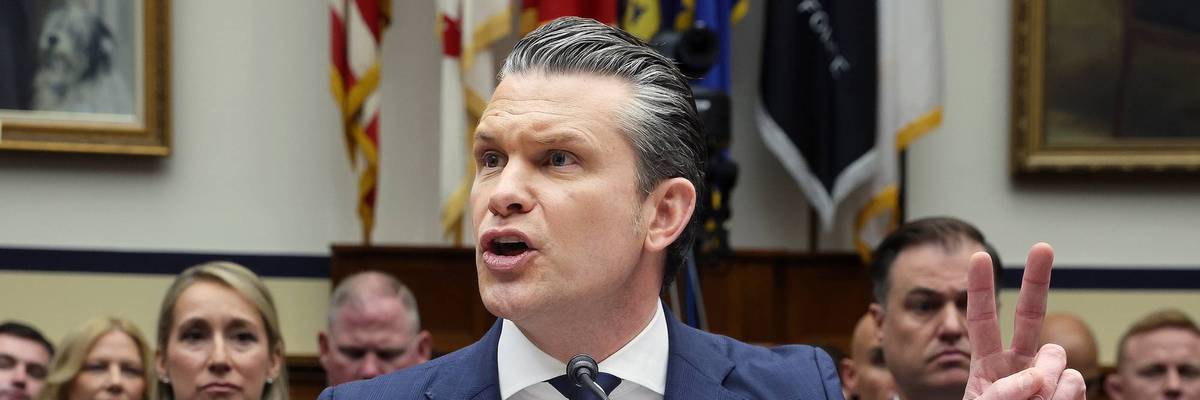
US Secretary of Defense Pete Hegseth testifies before the House Armed Services Committee on April 29, 2026 in Washington, DC.
(Photo by Kevin Dietsch/Getty Images)

Jessica Corbett
May 07, 2026
COMMON DREAMS

Just hours before the Trump administration conducted what it claimed were “self-defense strikes” against “Iranian military facilities,” The Washington Post reported Thursday that the Central Intelligence Agency concluded that “Iran can survive the US naval blockade for at least three to four months before facing more severe economic hardship.”

Citing four unnamed officials familiar with the analysis, the newspaper highlighted that “the CIA analysis might even be underestimating Iran’s economic resilience if Tehran is able to smuggle oil via overland routes.”

Militarily, “Iran retains about 75% of its prewar inventories of mobile launchers and about 70% of its prewar stockpiles of missiles,” the Post added. “There is evidence that the regime has been able to recover and reopen almost all of its underground storage facilities, repair some damaged missiles, and even assemble some new missiles that were nearly complete when the war began.”


Drop Site News’ Murtaza Hussain responded that if this assessment along with a previous one from the Center for Strategic and International Studies about “remaining US munitions and interceptor capacity are even approximately correct, it goes a long way to explaining why Trump seems so eager to end the war whereas the Iranians have either dug in or escalated their negotiating positions. The missile math of continuing the conflict would be much more favorable to the Iranians, especially if the war continued for a significant time.”

“Prior to the war, interceptor capacity compared to the size of the Iranian missile stockpile seemed like the most rationally incontrovertible reason to avoid fighting such a conflict, even for people who found it politically desirable,” he added. “This also might explain why the US and Israel pivoted towards the end to threatening countervalue strikes against civilian targets if attempts to destroy the underground missile cities by air were ineffective.”

The Post’s reporting came one month into a fragile ceasefire and starkly contrasts the recent framing of conditions in Iran from President Donald Trump and others in his administration, including Defense Secretary Pete Hesgeth.

Sen. Chris Murphy (D-Conn.) responded to the Post’s reporting by quoting Hegseth, who said in March that “never before has a modern, capable military, which Iran used to have, been so quickly destroyed and made combat ineffective.”

Murphy declared: “They lied through their teeth. Just straight up fabricated shit.”


Still, White House spokesperson Anna Kelly stuck to the administration’s framing in a Thursday statement to the Post.

“During Operation Epic Fury, Iran was crushed militarily,” Kelly said. “Now, they are being strangled economically by Operation Economic Fury and losing $500 million per day thanks to the United States military’s successful blockade of Iranian ports. The Iranian regime knows full well their current reality is not sustainable, and President Trump holds all the cards as negotiators work to make a deal.”

Meanwhile, some experts were unsurprised that the CIA privately delivered a “sober” assessment contradicting the administration’s public commentary on the conflict—which it now claims is no longer an active “war,” seemingly to dodge a key congressional deadline.

“Nice to know that a confidential CIA analysis is confirming what close observers of the Iranian economy have been saying publicly for weeks! Intelligent policymakers rely on intelligence. But Trump jeopardized diplomacy by instigating a blockade that was never going to work,” said Esfandyar Batmanghelidj, an adjunct professor at Johns Hopkins University’s School of Advanced International Studies in Europe and founder of the think tank Bourse & Bazaar Foundation.

Sharing the reporting on social media, Jennifer Kavanagh, a senior fellow and director of military analysis at the think tank Defense Priorities, wrote: “As I argued a week into the U.S. blockade, Iran can hold out for months without economic collapse. The costs for the US and the world are increasingly unsustainable, however.”

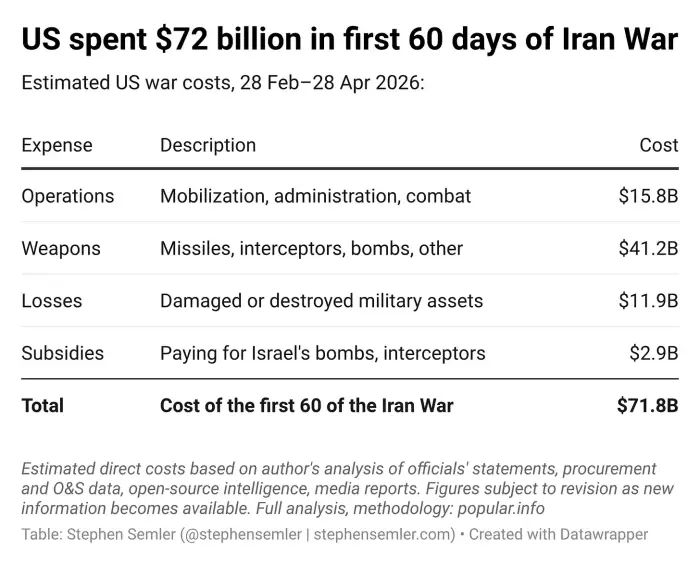
Earlier this week, Stephen Semler, a senior fellow at the Center for International Policy, estimated that the US government spent $71.8 billion on the Iran War during its first 60 days, an average of $1.2 billion daily. The International Monetary Fund warned last month that the conflict could cause a global recession.

Last Friday, Trump responded to the War Powers Act’s 60-day deadline by claiming to Congress that his war—which already violated US and international law—had been “terminated.” The White House said at the time that no fire had been exchanged since April 7, when a ceasefire deal was reached just hours after the president issued a genocidal threat against the Iranian people.

However, on Thursday evening, United States Central Command announced that Iran “launched multiple missiles, drones, and small boats” at American warships. CENTCOM added that it “eliminated inbound threats and targeted Iranian military facilities responsible for attacking US forces, including missile and drone launch sites; command and control locations; and intelligence, surveillance, and reconnaissance nodes.”


Trump’s Iran War Will Cost US Families $1,753 Extra at the Pump This Year: Analysis

“Instead of swindling taxpayers to pay for his gilded ballroom and finding new ways to give CEO billionaires tax breaks, Trump should focus on ending his war on Iran,” said Sen. Ed Markey.


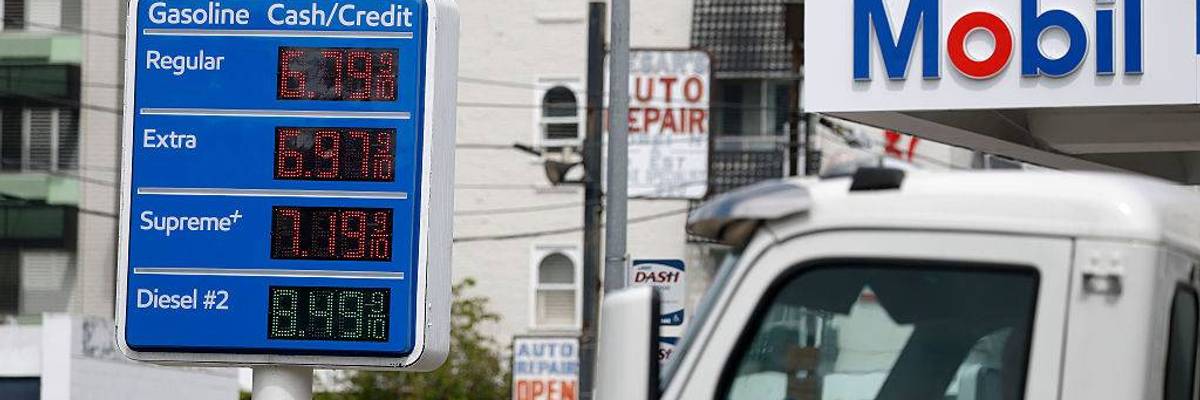
Gas prices at more than $6 a gallon are displayed at a Mobil station on May 4, 2026 in Los Angeles, California.
(Photo by Justin Sullivan/Getty Images)

Brad Reed
May 07, 2026
COMMON DREAMS

An updated analysis released Thursday finds that President Donald Trump’s illegal war with Iran will cost Americans significant money at the gas pump this year.

The report, released by the office of Sen. Ed Markey (D-Mass.), projects that if gas prices remain at their current level of over $4.50 per gallon, it will cost a US drivers an extra $73.06 per month—or $876 per year—to fill up their cars compared to what they were paying before Trump attacked Iran in late February.

For a family with two cars, this would mean forking over an extra $1,753 for gas this year.


The analysis also notes this projection is “likely an underestimate” since “many analysts predict gasoline prices will rise higher without a permanent end to the war.”

The report highlights how Trump’s Iran war is likely to bolster Big Oil’s profits, which had been steadily declining since 2022, when they exploded in the wake of Russia’s invasion of Ukraine.

Climate and renewable energy organizations have repeatedly called on the US Congress to pass a windfall tax on Big Oil profits for the duration of the war, which they said could be used to provide relief to consumers and invest in clean energy infrastructure.

In a statement accompanying the report, Markey blasted Trump for both the Iran war and his broader economic mismanagement.

“American small businesses and families cannot afford Trump’s crushing bump at the pump—all thanks to the President’s illegal war on Iran,” said Markey, the top Democrat on the Senate Small Business Committee. “Americans have to figure out how to make ends meet while Trump slashes affordable healthcare, dismantles clean energy networks, and doubles down on his tariff taxes.”

“Instead of swindling taxpayers to pay for his gilded ballroom and finding new ways to give CEO billionaires tax breaks,” Markey added, “Trump should focus on ending his war on Iran and ending the pain on Main Street.”

Expert Puts True Cost of Trump’s Iran War at $72 Billion—Nearly 3 Times Higher Than Pentagon Said


“The $25 billion war cost given by Pentagon Secretary Hegseth and acting Comptroller Hurst before Congress was a lie. It was a denial of the Iran war’s spiraling costs.”


Acting Pentagon Comptroller Jules Hurst and Pentagon Secretary Pete Hegseth testify during a Senate hearing on April 30, 2026.
(Photo by Graeme Sloan/Getty Images)

Jake Johnson
May 06, 2026
COMMON DREAMS

The Pentagon’s official estimate of the direct financial cost of the US war on Iran is a nearly threefold undercount of the actual price tag of the war, according to an expert analysis published Wednesday.

Stephen Semler, a senior fellow at the Center for International Policy, produced the new cost estimate for the Popular Information newsletter. Accounting for armament use, troop deployments, and other factors, Semler estimated that the US government spent $71.8 billion on the Iran war over the course of 60 days—an average of $1.2 billion per day.


“Like the estimates from Pentagon leadership and unnamed officials, this figure refers only to direct war costs—near-term expenses for military operations, munitions, and the like—and not indirect costs, which include broader economic impacts, interest on the national debt, and longer-term expenses like veterans’ care,” explained Semler, who argued that the Pentagon’s $25 billion cost estimate suffers from “incomplete accounting of damaged or destroyed military assets, the exclusion of costs outside the department (including billions of dollars in State Department-funded military aid to Israel), and a flawed method for tracking munition expenditures.”


Semler, who detailed his methodology in a separate post, accused top Pentagon officials of attempting to deliberately mislead lawmakers and the American public about the true cost of the war, which is historically unpopular.

“The $25 billion war cost given by Pentagon Secretary [Pete] Hegseth and acting Comptroller [Jules] Hurst before Congress was a lie,” Semler wrote Wednesday. “It was a denial of the Iran war’s spiraling costs, one of several foreseen consequences of the Trump administration’s decision to go to war. The closing of the Strait of Hormuz is another predictable consequence.”

Semler’s analysis was released days after unnamed Trump administration officials told CBS News that they believe the actual US cost of the Iran war is roughly double the estimate offered under oath by Pentagon leaders.

“US officials familiar with internal assessments suggested the war’s price tag is closer to $50 billion so far,” CBS News reported. “Much of the gap is accounted for by munitions that have been used and need to be replaced. For instance, the Pentagon has lost 24 MQ-9 Reaper drones—sophisticated unmanned aircraft that can cost $30 million or more apiece—underscoring how quickly the financial toll has mounted. Taken together, the higher estimate reflects not only the tempo of operations but also the often unseen costs of attrition, as material lost in the field reshapes the ledger.”

Ongoing efforts to calculate the costs of US-Israeli war—which has killed thousands, displaced millions, sent global energy markets into chaos, and sparked fears of a worldwide food crisis—come as Trump continues to threaten Iran with an even more aggressive bombing campaign, which would send the conflict’s price tag soaring further.

In a Truth Social post early Wednesday, Trump said that if Iran doesn’t agree to US terms to end the war, “the bombing starts, and it will be, sadly, at a much higher level and intensity than it was before.”
Trump Rebuked for Bypassing Congress With $8.6 Billion Weapons Sale to Israel and Gulf Allies


“The vaults are open and the arms trade is thriving before the war and after it,” said one Nobel Peace Prize laureate.


Common Dreams Staff
May 03, 2026

As the US voting public continues to express its discontent over the disastrous war of choice against Iran that US President Donald Trump launched just over two months ago, fresh criticism followed after weekend reporting revealed the administration skirted congressional review to approve an $8.6 billion weapons deal with the United Arab Emirates and other allies in the Middle East.

Announced Friday night quietly by the US State Department, as the New York Times reports, the “sales would entail the transfer of rockets to Israel, Qatar, and the United Arab Emirates and air-defense equipment to Qatar and Kuwait.”


According to the Times:
Under the terms of the deal with Qatar, the Gulf country would pay more than $4 billion for American-made Patriot missile interceptors — global stockpiles of which have dwindled during the war with Iran.

Israel, the Emirates and Qatar would receive an Advanced Precision Kill Weapon System, which fires laser-guided rockets. Kuwait also purchased an advanced aerial defense system for about $2.5 billion.

Secretary of State Marco Rubio expedited the deals under an emergency provision allowing the “immediate sale” of the weapons, the State Department said, bypassing standard congressional review and prompting criticism from Democratic lawmakers. This is the third time the second Trump administration has invoked an emergency authorization during the Iran war to bypass Congress on arms sales.

“No comment,” said Mohamed ElBaradei, a Nobel Peace Prize winner and the former head of the International Atomic Energy Agency (IAEA), in an eye-rolling response to the news on social media.

After a commenter suggested that “America opened the door to war for [the countries taking part in the sale] so they would open their treasuries and the Israeli-American arms trade would boom after a slump,” ElBaradei seemed to agree.

“The vaults are open, and the arms trade is thriving before the war and after it,” he said.

Kenneth Roth, former executive director of Human Rights Watch and now a visiting professor at Princeton University, said: “Trump is bypassing Congress to fast-track arms sales to the United Arab Emirates, apparently without receiving any promise that the UAE would stop arming the genocidal Rapid Support Forces (RSF) in Sudan.”

The RSF has been accused of atrocities in the ongoing Sudanese civil war, and the backing it has received from the US, with the UAE as its closely allied proxy, has been the source of outrage and criticism.