White House lashes out at ‘sick’ Star Wars actor Mark Hamill for AI post of dead Donald Trump
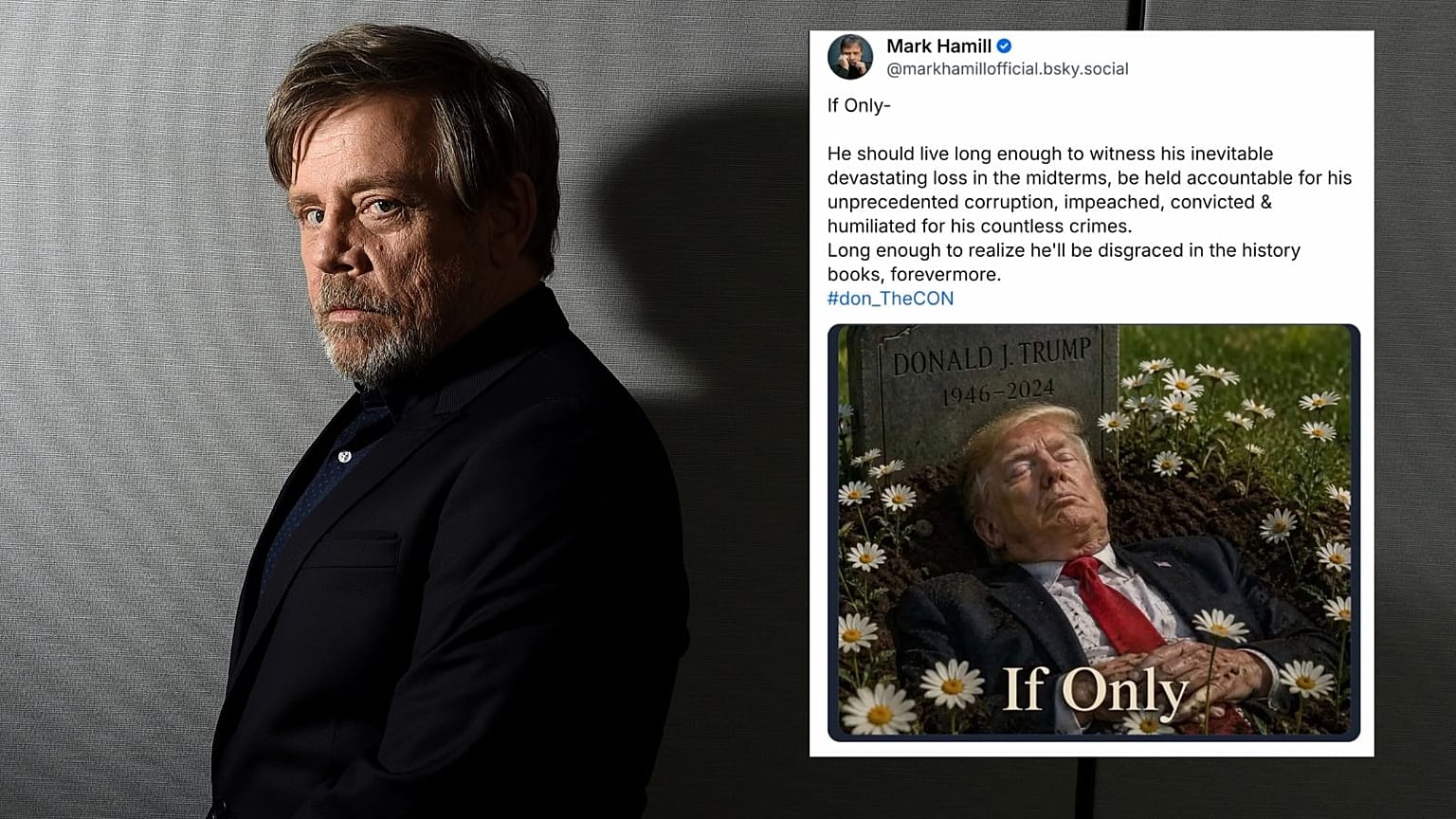
The White House has called Mark Hamill a “sick individual” after the Star Wars actor posted an image of Donald Trump in a grave on social media.
The Trump administration has lashed out at Star Wars actor Mark Hamill for posting an image on social media of Trump dead in a grave.
The White House claims that the image and rhetoric inspire security threats.
“Mark Hamill is one sick individual,” the White House wrote in a post on X. “These Radical Left lunatics just can’t help themselves. This kind of rhetoric is exactly what has inspired three assassination attempts in two years against our President.”
The Luke Skywalker actor posted what appeared to be an AI image of Trump on Bluesky, featuring the president in an open grave. The image included the caption “If Only” and a headstone showing his date of death as 2024.
“If Only - He should live long enough to witness his inevitable devastating loss in the midterms, be held accountable for his unprecedented corruption, impeached, convicted & humiliated for his countless crimes,” Hamill wrote in an accompanying post. “Long enough to realize he'll be disgraced in the history books, forevermore. #don_TheCON.”
Hamill deleted the image and issued further clarification: “Accurate Edit for Clarity: ‘He should live long enough to... be held accountable for his... crimes,’” Hamill wrote on Bluesky. “Actually, I was wishing him the opposite of dead, but apologize if you found the image inappropriate.”
The image comes after a man was charged with the attempted assassination of Trump in a shooting at the White House Correspondent’s Association dinner last month.
Days after the shooting, Melania Trump demanded that talk show host Jimmy Kimmel be fired, as the comedian joked days prior to the incident that the first lady had a "glow like an expectant widow".
Kimmel responded to criticism of his joke by saying it was merely a reference to the couple's age difference.
Melania Trump’s comments massively backfired online, with many accusing her of hypocrisy and pointing out a massive double standard, as Trump frequently lashes out with violent rhetoric and images aimed at his opponents.
Recently, during the course of the Iran war, he posted an image of himself holding a machine gun and threatened that a “whole civilization will die” unless Tehran agrees to his demands.
Last year, he shared an AI-generated video of himself bombing No Kings protestors and an AI image riffing on the war film Apocalypse Now.
Elsewhere, and Star Wars related, Trump posted another unsual image on May 4 – Star Wars day.
The White House shared an image of Trump as the Mandalorian (with Grogu in tow, looking like he wants to be anywhere else). Trump holds an American flag in one hand (which notably has only 11 red and white stripes as opposed to 13) and is pictured without the Mandalorian helmet on his head (a big no-no in the Mandalorian code, if Trump knew anything about the cultural references he was riffing on).
"In a galaxy that demands strength - America stands ready," the White House wrote. "This is the way. May the 4th be with you."
The post was met with backlash, with Star Wars fans blasting Trump.
"This has caused a major disturbance in the force today. Yikes," someone wrote online, while another said: "Please tell me there will be a lawsuit."
This wasn’t the first time the White House shared Star Wars-inspired imagery of Trump. Last year, they posted an image of a distressingly muscular Trump holding a red lightsaber.
"Happy May the 4th to all, including the Radical Left Lunatics who are fighting so hard to bring Sith Lords, Murderers, Drug Lords, Dangerous Prisoners, & well known MS-13 Gang Members, back into our Galaxy. You’re not the Rebellion - you’re the Empire," the caption read.
Once more, Trump and his administration failed to fully grasp the cultural implications of the image, as red is the chosen colour of the villainous Sith Lords. Star Wars creator George Lucas once said regarding lightsaber colours: “Good guys are green and blue, bad guys are red.”
Hardly rocket science.
As one X user pointed out: “The lack of self awareness and hypocrisy by calling the left ‘the empire’ while showing Trump with a Sith lightsaber.”
Blonde, fervent and fake: Can AI-generated
Trump fans boost him in the midterms?
Clad in swimsuits or sometimes military fatigues, the mostly blonde women lavish praise on US President Donald Trump and vilify his rivals. But these Trump fans are AI-generated, flooding tech platforms with fervent but fake political messaging ahead of the November US midterm elections.
Issued on: 10/05/2026
By: FRANCE 24

Hyper-realistic AI avatars parroting Donald Trump slogans like "America First" and echoing MAGA talking points on immigration are increasingly present on the American political scene, underscoring how new technologies can be used to energise and manipulate voters.
"Where are all my MAGA friends at? If you voted for Trump, say it loud in the comments and you've got yourself a new follower from Texas," an AI-generated woman sporting a red MAGA hat declares on TikTok.
"Trump is the future of America," reads text overlaid on another AI-generated TikTok video depicting a teenage girl on a beach, a US flag fluttering in the background.
In an Instagram clip set to the Village People's "YMCA", an avatar portraying a "MAGA patriot" says she "came out of the closet as a Trump supporter".
It's not clear who is behind the AI accounts and whether they are part of a coordinated influence operation ahead of the November elections that will determine whether Republicans maintain control of Congress.
Trump began really embracing AI-generated images last year, including pushing unfounded corruption allegations against California's Democratic Governor Gavin Newsom and a blatantly racist post, later deleted, depicting former president Barack Obama and first lady Michelle Obama as apes.
'Shape public opinion'
US media have detected hundreds of AI-generated pro-Trump influencers in recent months – young men and women depicted in military fatigues or dressed as immigration agents – commenting on hot-button political issues including abortion and the Iran conflict.
The Governance and Responsible AI Lab (GRAIL) at Purdue University has also tracked numerous such accounts across TikTok, Instagram and Facebook.
"The growing wave of political AI influencers amid the 2026 elections is a glimpse into a future where hyper-targeted AI content can be used to shape public opinion," Andrew Yoon of CivAI, a nonprofit focused on AI's capabilities and dangers, told AFP.
Such content is "increasingly difficult to detect, especially when made by sophisticated operators", Yoon said.
As AI technology becomes more and more sophisticated, online manipulation using phony influencers could "become even more personalised and difficult to control", he added.
One AI influencer on Instagram – featuring a lifelike female soldier posing alongside Trump – amassed nearly a million followers before she was revealed to be AI and the account was suspended.
Referring to the synthetic soldier, Justine Moore, an AI-focused partner at Silicon Valley investor Andreessen Horowitz, wrote on X: "I'm genuinely floored by how many dudes are following influencers that are clearly AI."
These pro-Trump influencers slap lifelike human faces on disinformation – pairing them with realistic voices and talking points and thus creating the illusion of a legitimate political movement.
Political themes, financial motives
Disinformation typically surges around elections, propelled by automated bots, trolls and phony accounts that amplify false narratives and push them into mainstream political discourse.
The potential for manipulation is multiplying with AI. And few regulations exist to stop it.
Researchers warn that AI deepfakes – which have already been used to target global leaders including French President Emmanuel Macron and Ukraine's President Volodymyr Zelensky – can influence voter turnout and distort geopolitical events.
While promoting Trump, some AI influencers also appear focused on boosting engagement, attracting followers and promoting commercial products.
The bio of one pro-Trump AI influencer on Instagram directed users to a website selling MAGA-themed artwork priced at up to $500.
"Many of them are driven by commercialisation goals, using politics as a means rather than an end," Daniel Schiff, an assistant professor at Purdue University and co-director of GRAIL, told AFP.
As election season approaches, Schiff said he expects a rise in AI-generated messaging. Despite the political themes, he says "financial profit" will likely be the primary goal behind generating digital influencers.
(FRANCE 24 with AFP)