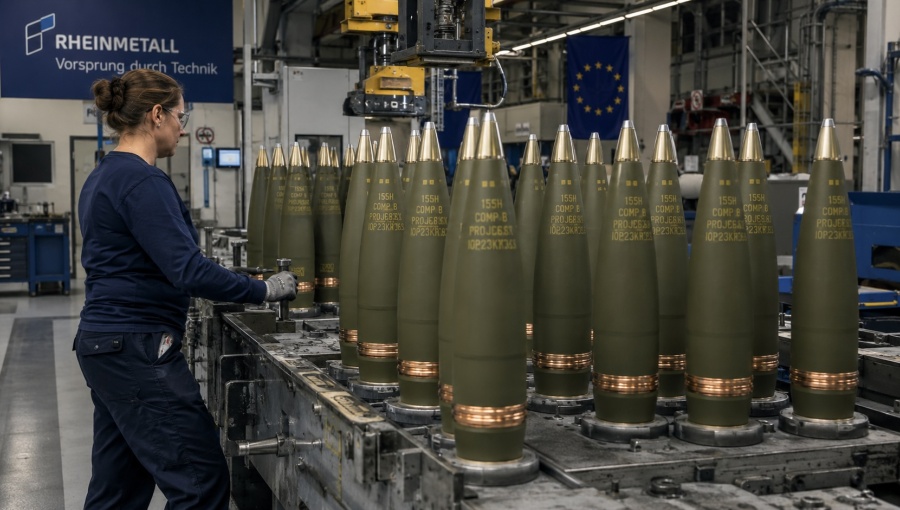
Europe's most ambitious attempt to coordinate its own defence — the €800bn ReArm programme launched with considerable fanfare in early 2025 — is being quietly undermined by the very governments that approved it. Member states are ignoring reporting requirements, protecting national defence industries and blocking collabourative purchasing, even as a convergence of crises makes pan-European coordination more urgent than at any point since the Cold War.
The scale of the coordination failure has been laid bare in a written reply from Defence Commissioner Andrius Kubilius to a European Parliament question. Only 12 of the EU's 27 member states submitted data on joint procurement to the European Defence Agency — the body tasked with fostering security cooperation among member countries, Politico reports. Without the data from the majority of member states, Kubilius warned, it is "impossible" to properly assess how many countries are actually collabourating or whether the EU's broader defence strategy is working at all.
The failure of basic information-sharing exposes a deeper dysfunction that will also undermine the new drive to create a Euro Nato that is no longer dependent on the US for Continental security. The European Defence Industrial Strategy — approved in 2024 as the bloc's first systematic effort to improve defence readiness by 2035 — sets a non-binding goal to buy at least 40% of defence equipment collabouratively by 2030. In 2022, collabourative procurement stood at 18%. In 2007, the EDA set a non-binding 35% benchmark. Nearly two decades later, Europe has moved in the wrong direction. And since the reporting requirements carry no penalties, Brussels has no mechanism to compel compliance beyond public embarrassment.
Beyond the immediate problems with modernising the defence sector, the member states ability to pay for the modernisation is also under pressure thanks to the increasingly dysfunctional European economy. Another 12 out of 27 member states have now breached the EU’s Excessive Deficit threshold of 3% of GDP and need to introduce austerity measures to. Get government spending back under control or face penalties.
As IntelliNews reported, the combination of crises has exposed fiscal fragility around the world, with Europe amongst the countries with the least fiscal space to expand borrowing to meet its mounting defence, competitive and energy transformation bills.
In addition to the €800bn ReArm programme, the EU is now on the hook of helping Ukraine raise €100bn a year to pay for its war, it needs to invest some €600bn into power sector infrastructure to complete the green transformation, and the Draghi report recommended spending €800bn a year over the next four years to close the competitive gap with the US and China that has opened up after decades of underinvestment. As IntelliNews reported, increasingly Europe can’t afford to take over the burden of supporting Ukraine and since taking over responsibly has failed to offset the end of US military aid.
The national interest problem
The European defence market has long been fragmented. Each member state jealously guards its own defence industries and funnels contracts toward them — a practice that creates costly duplication, with countries fielding many different varieties of jets, tanks and other systems that cannot easily interoperate. That fragmentation is precisely what ReArm was designed to address. Instead, it is reproducing the same national-interest dynamics at a larger scale.
For example, a fundamental argument has broken out amongst members, where French President Emmanuel Macron is insisting that the EU buy only European-made weapons, whereas other states want to continue to source US-made weapons.
The tension has erupted most visibly in Poland, where nationalist President Karol Nawrocki vetoed legislation implementing Warsaw's €43.7bn SAFE (Security Action for Europe) loan out of fear that the funds could benefit German companies. Pro-EU Prime Minister Donald Tusk has insisted that 89% of the cash will remain in Poland — a guarantee that, as Brussels has noted, directly contradicts the common procurement objective the loan was designed to support.
"This distrust is one of the major blocking elements to move towards a genuine and highly necessary European Defence Union," Wouter Beke, a Belgian MEP from the European People's Party who sits on the Parliament's Defence and Security Committee, said, cited by Politico.
One possible response would be to make data sharing a condition of access to EU defence funding — a link that the Commission has so far declined to make, and one that would "almost certainly spark strong national resistance," as Politico noted.
The legal architecture of the European Defence Industrial Strategy reflects this political reality. It is "just a communication with no legal teeth" — a recognition that defence remains a national competence.
The Commission itself acknowledges that "defence industrial readiness can only be achieved if the Member States' continued increase of defence spending is enabled to actually prioritise collaborative investments." Getting member states to actually do so is another matter.
The weapons pipeline crisis
The internal dysfunction of Europe's rearmament effort would be costly at any time. It is arriving simultaneously with a collapse of the weapons pipeline from the US to Ukraine — making the failure of EU coordination directly consequential for the front line.
Several sources told the Financial Times that the US has informed the UK, Poland, Lithuania and Estonia that there will be long delays to contracted arms deliveries, with two sources also mentioning possible delays to Asia. Five sources familiar with the matter told Reuters that the delays would affect several European countries, including in the Baltic and Nordic regions, as the war in Iran continues to deplete weapons stockpiles. Some of the weapons in question were purchased by European countries under the Foreign Military Sales programme but have not yet been delivered, although they have already been paid for.
The mechanism designed to address this gap is the Prioritised Ukraine Requirements List — PURL — a programme under which Nato countries purchase American weapons from US stocks for onward transfer to Ukraine, effectively forcing Europeans to finance the supplies at their own expense. The situation has worsened due to the escalation in the Middle East, with the uncertainty surrounding deliveries of missiles for Patriot systems described as particularly critical. Although Washington has provided guarantees for weapons that have already been paid for, the prospects for new packages remain unclear and the order book backlog at most of the US’ top arms makers means delivery delays could run into years.
In early April, Trump threatened to stop weapons supplies to Ukraine under PURL entirely unless European allies joined the operation to reopen the Strait of Hormuz. The Washington Post reported that the Pentagon was considering redirecting military aid intended for Ukraine to the Middle East, as the Iran war is depleting some of the US armed forces' most critical munitions.
The most concerning shortfall for Ukraine will be munitions for HIMARS missile systems — used to hit enemy positions and facilities behind the front line — and NASAMS, used to eliminate aerial threats such as drones and missiles. Ukraine is already running low on air defence as Russia continues to launch wave after wave of attacks on civilians and infrastructure.
According to Foreign Policy, one European diplomat involved in the PURL initiative bluntly stated that the US administration considers Ukraine as a state that will not last even one or two days without external assistance.
The gap nobody is filling
The convergence of these two failures — Europe's inability to coordinate its own arms purchasing and the US's redirection of weapons toward the Middle East — has created a gap that neither Brussels nor Washington is currently in a position to fill.
The EU is backing its coordination push with cash. The €1.5bn European Defence Industry Programme allocates €240mn for joint procurement; the €150bn Security Action for Europe loans-for-weapons scheme also encourages countries to team up. But money alone cannot overcome the structural reluctance of governments to cede procurement decisions to supranational bodies. The Poland example demonstrates that even governments that are formally pro-EU will defend national industrial interests over European ones when the moment of decision arrives.
Europe's defence market fragmentation means the continent collectively produces a bewildering array of incompatible systems, despite the Nato membership production guidelines, struggles to produce ammunition at the volumes required for a sustained high-intensity conflict, and has no single procurement entity capable of placing the kind of orders that would allow manufacturers to invest in expanded capacity. That is the problem ReArm was designed to solve. The data from Brussels suggests it is not solving it.

No comments:
Post a Comment