Sunday, June 21, 2026

For preservers of lynching history in the US, Juneteenth is a religious reckoning

(RNS) — The Equal Justice Initiative’s Bryan Stevenson says confronting America’s lynching history is a matter of faith that demands truth-telling and repentance — especially on America’s most recently recognized national holiday.


The Rev. Marcus A.L. Freeman III, center, leads a Communion service at the historic Wesley United Methodist Church, Sunday, June 7, 2026, in Austin, Texas. (Video screen grab)


Chloe Landen
June 18, 2026 
RNS

AUSTIN, Texas (RNS) — In 2016, 89-year-old Opal Lee walked from Fort Worth, Texas, to Washington, D.C., in hopes of establishing Juneteenth as a national holiday. Partly due to her efforts, it became one in 2021.

Juneteenth commemorates June 19, 1865, when the nation’s last enslaved people in Texas learned of their freedom. The news arrived over two years after Abraham Lincoln’s Emancipation Proclamation.

But for “the grandmother of Juneteenth,” the holiday carries a grief more personal than for most living today. When she was 12 years old, her family moved into a predominantly white neighborhood in Fort Worth. Shortly after, on June 19, 1939, a mob of over 500 white residents burned the family’s home down.

“It’s just another iteration of a lynching, in a way,” said the Rev. Marcus A.L. Freeman III, senior pastor of the historic Wesley United Methodist Church in Austin. “To just take everything you work for and just burn it down.”
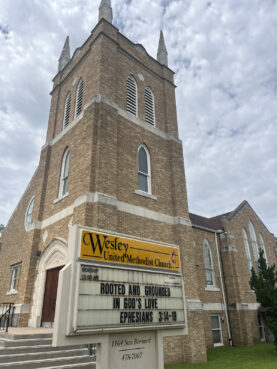


Wesley United Methodist Church in Austin, Texas. (RNS photo/Chloe Landen)

Founded in 1865 by newly freed people, Wesley is one of Austin’s oldest Black institutions. It’s also home to the city’s only lynching marker, which serves to document the history of lynching in America for current and future generations.

Installed in December 2017, the marker is one of over 80 such plaques erected across the nation by the Equal Justice Initiative’s Community Remembrance Project, which began placing the markers to help communities face the violent truths of their past. EJI also constructed the country’s first lynching memorial, the National Memorial for Peace and Justice, in Montgomery, Alabama.

Bryan Stevenson, EJI’s executive director, told RNS that Juneteenth is a time to celebrate emancipation but also to acknowledge continued harm. Despite the positive development in recognizing Juneteenth nationally, “Black people in this country were subjected to another century of torture violence.”


For Stevenson, the work is a matter of faith. Drawing on his own religious community, Stevenson told RNS that people cannot claim to want “heaven and redemption and salvation” but be unprepared to acknowledge, repent or confess to anything. The fact that very few people can name a single Black lynching victim, he added, reveals how much work remains.

Several of EJI’s lynching markers are placed on or near church properties. The Community Remembrance Project erects markers at locations where lynchings occurred, which in some cases have been churches. Yet in instances where very little is known about a lynching, the EJI has asked local Black churches to house the markers.

Black churches served as vital protective spaces for Southerners terrorized by lynchings near and far — which has made them appropriate homes for lynching history, Stevenson said.

That was the case for the marker at Wesley in Austin.

The plaque commemorates a triple lynching in August 1894 after a white child’s death while in the care of a Black female domestic laborer. Without evidence or investigation, the woman and two Black men presumed to be accomplices were quickly arrested. A white mob then abducted the three from jail, took them to a neighboring city, tied them to stakes and shot them to death. No one was ever charged with their killings. The few surviving records suggest the victims were innocent.
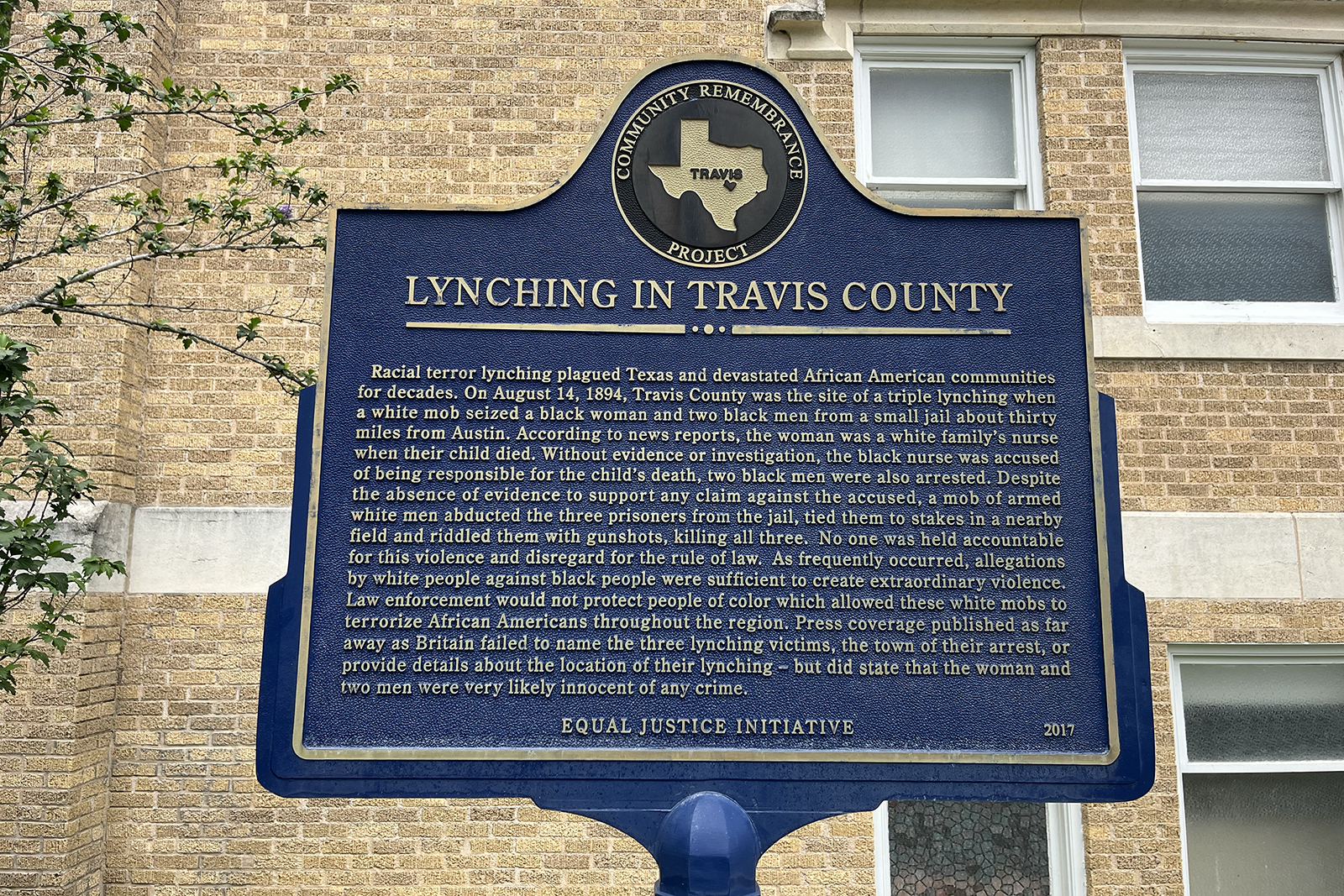

A lynching marker from the Equal Justice Initiative’s Community Remembrance Project on the property of Wesley United Methodist Church in Austin, Texas. (RNS photo/Chloe Landen)

Their tragic story was not unique. From the late 19th to the mid-20th century, Texas was a leader in mob violence. The Tuskegee Institute recorded 493 lynching victims in Texas between 1882 and 1968 — 352 of whom were Black. Nationally, the same archive documented 4,743 people killed by lynching during that period — 3,445 of them Black. But many lynchings went unreported, and the actual statistics are believed to be far higher.

Like the three individuals commemorated by Wesley’s marker, many lynching victims were held in jails, often on false charges or scant evidence, when white mobs came for them. Law enforcement routinely served as willing accomplices and sometimes participated in lynchings.

In some cases, lynchings were communal spectacles that drew thousands and generated a tourist economy. The 1893 lynching of Henry Smith in Paris, Texas, was attended by at least 10,000 white men, women and children. Bound to a 10-foot-tall scaffold bearing the word “JUSTICE,” Smith was tortured for nearly an hour before his body, still alive, was set aflame. Smith’s bones, pieces of his clothing and photographs of his death became fiercely sought-after souvenirs.

No white person was ever convicted of lynching a Black American. And mob members did not conceal their identities when posing beside corpses they had lynched.


Several historians of religion have interpreted lynching as a form of Southern religious practice. Lynch mobs frequently conceived of their violence as divinely ordained justice and were known to praise God amid killings. The ritualized elements of lynching, including forced confessions, drawn-out physical torture and the exchange of relics in a post-lynching marketplace, bear unmistakable resemblances to religious ceremony.
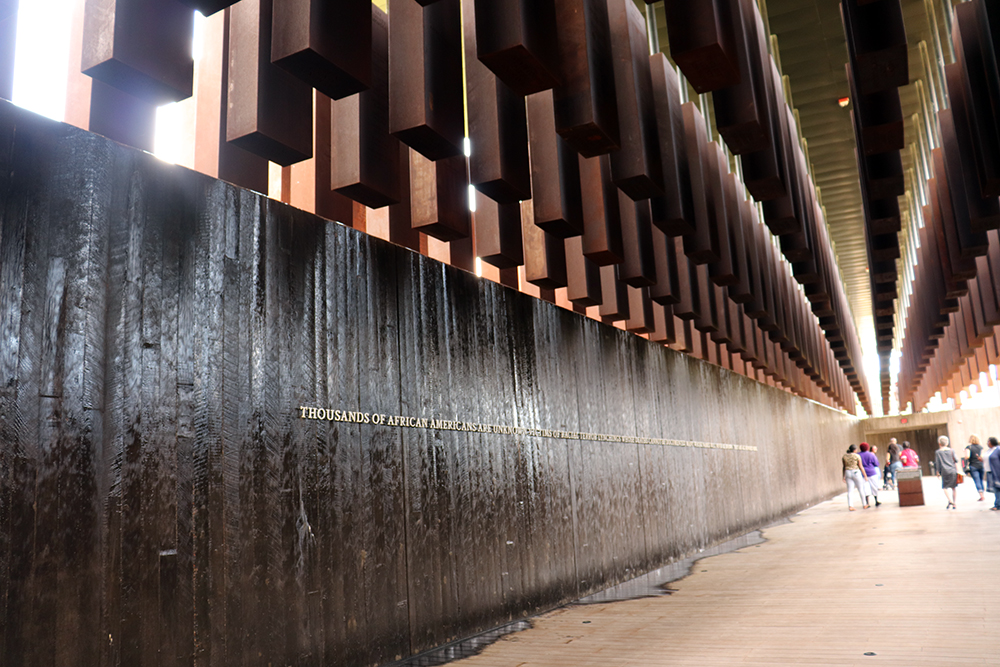


Columns memorializing lynching victims at the National Memorial for Peace and Justice in Montgomery, Ala. (RNS photo/Adelle M. Banks)

And justifying it all were powerful mythologies of Black criminality, none more enduring than the myth of the “Black rapist.” Though accusations of sexual assault were mostly false — and though rape in the South has historically manifested as a crime with Black women as the primary victims — the defense that lynching was necessary for the protection of white women outlived all others.

These myths about Black criminality and inferiority trace their roots to enslavement, Stevenson said, allowing some to “feel moral and decent and Christian” as they sold human beings and then lynched them decades later.

With this context, placing a lynching marker at a Black church carries theological weight, functioning as a counternarrative on sacred ground. For Wesley’s church historian Arlene L. Youngblood, the symbolism is direct. “When you put daylight on something that’s ugly, something that’s shameful,” she told RNS, “Satan has to run.”

According to Youngblood, Wesley was the only Black church in Austin that agreed to take the EJI’s marker. “Even though it’s a sad circumstance,” Youngblood said it was an honor to be asked. And it took courage for Wesley’s reverend at the time, Sylvester Chase, to say yes, she added.
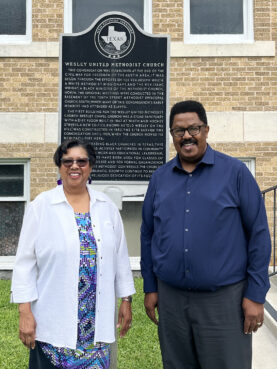

Church historian Arlene L. Youngblood, left, and senior pastor the Rev. Marcus A.L. Freeman III at Wesley United Methodist Church in Austin, Texas. (RNS photo/Chloe Landen)

“It was a public acknowledgment (that) something has happened to us,” Youngblood said.

Since then, Freeman, the current senior pastor, has observed that the marker engenders a discerning “reverence” in those who walk by it, sometimes so totalizing that they don’t turn their heads as he passes behind them. “It’s amazing to watch,” he said.

Freeman sees those moments as an extension of what he calls Wesley’s “ministry of presence” and “ministry of information.” The church has a long educational history rooted in the traditions of the Black church and the theological commitments of the United Methodist denomination. The lynching marker, in his view, is fully consistent with Wesley’s tradition.

“If we don’t learn our history,” Freeman said, “we’re likely to repeat it.”

“And it’s still happening — that’s the killer,” Youngblood added.

For many Black Americans, the history of lynching has never felt distant. Instances of racial terror were not isolated events but part and parcel of systemic racism and white supremacy. Lynchings’ expansive violence reshaped the American landscape, leaving thousands dead and fueling the Great Migration of more than 6 million Southern Black refugees to the North and West, in addition to contributing to the continued disenfranchisement of African Americans.

As EJI research has shown, communities where lynchings occurred are areas that remain disproportionately poor and highly incarcerated. The Center for Justice Research has similarly demonstrated that states’ lynching rates predict current poverty levels, which in turn emerge as the strongest predictor of incarceration. The national incarceration rate of Black Americans is six times the rate of white Americans. Black people are also disproportionately sentenced to death, particularly when the crime involves white victims.

Notably, the first piece of anti-lynching legislation to be signed into law was the 2022 Emmett Till Antilynching Act, which made lynching a federal hate crime. The victory came decades after several failed attempts in the early to mid-20th century.

Stevenson and Youngblood join countless others who understand the police killings of George Floyd, Breonna Taylor, Michael Brown, Trayvon Martin, Ahmaud Arbery and far too many more as modern-day lynchings.

“They were victims of these presumptions of dangerousness and guilt because of their color,” Stevenson said, adding these presumptions are themselves an enduring legacy of slavery’s “great evil” — the false narrative “that somehow Black people aren’t as good as white people or less human, less evolved, less decent.”

“We are not yet free of that narrative,” Stevenson said. “The work remains.”
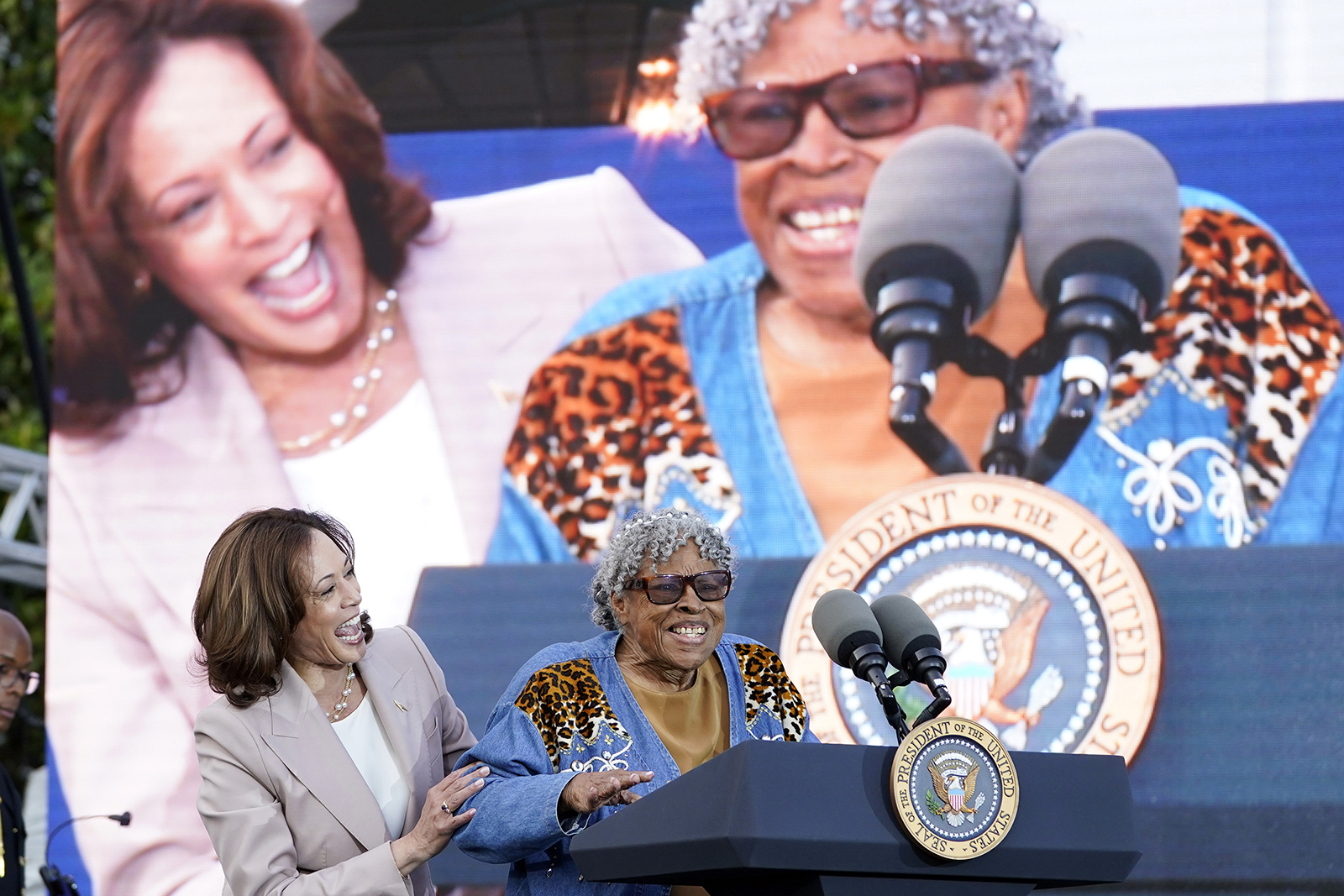

Vice President Kamala Harris welcomes Opal Lee to the stage during a Juneteenth concert on the South Lawn of the White House in Washington, June 13, 2023. Lee is considered the grandmother of Juneteenth. (AP Photo/Susan Walsh)

Stevenson envisions America’s 250th birthday, like Juneteenth, as an opportunity to celebrate but also to acknowledge persisting challenges and commit to overcoming them. The effort of installing lynching markers that draw people of diverse racial backgrounds together “to talk about these tragic incidents of the past and to commit to a healthier future” is, he said, “a microcosm of what the whole nation must do.”

Those at Wesley who shepherd Austin’s only lynching marker are similarly sitting with the full weight of that paradox. Youngblood cited a lack of affordable housing, widespread homelessness, the school-to-prison pipeline that disproportionately affects Black youth, deep cuts to the Supplemental Nutrition Assistance Program and ongoing redistricting and gerrymandering as reasons for grief, not celebration.

“This is the best country in the world,” Youngblood said. “But right now, this is not a pretty year to celebrate America.”

Freeman has found inspiration from Opal Lee herself. In a recent Texas Co-op Power article, Lee, now nearly 100 years old, laughed off the idea of retirement. “People who are old can’t sit in a rocking chair and wait for the Lord to come and get them,” she said. “There’s still plenty of work to be done.”

“The struggle continues, as we say,” Freeman concurred.


In Richmond, churches retrace the path of the enslaved to confront their own history

RICHMOND, Va. (RNS) — Just as the country prepares to celebrate the 250th anniversary of the Declaration of Independence — and Juneteenth — Virginia Episcopalians are trying to reckon with the role of their city and their denomination in slavery as a founding reality of the United States.

Fiona André
June 18, 2026
RNS

RICHMOND, Va. (RNS) – From 1830 to 1860, tens of thousands of enslaved people disembarked ships at Richmond’s Manchester Docks, an entry point into a bondage system that built Virginia’s wealth and shaped the city’s history. Shackled together, the enslaved people trudged along a muddy trail connecting the docks to the city’s auction house, where they were sold and bought as property.

Today, the path, known as the “slave trail,” is part of a citywide walking tour exploring Richmond’s role as a major hub of the domestic slave trade.

As about 20 Virginians marched in line, in silence, over the muddy trail on Saturday (June 13) — some clinging to one another to understand the experience of enslaved people who walked the trail in chains — a gospel singer performed the African American spiritual “Wade in the Water” alongside them.

Walking silently, Renee Munford, who is Black, said she felt her ancestors. The 65-year-old wondered what they thought as they walked, whether they were afraid, confused or both. At some point, she cried.

“Every time I looked out at the water, all I could see was people coming in on ships and disembarking, and just in a frenzy, so my heart bled for that,” she said.

The silent walk was the first part of a historical and spiritual pilgrimage through Richmond led by two local Episcopal churches. The gathering, called “Walking With the Enslaved: The Church’s Role in Slavery Pilgrimage,” seeks to cover the city’s racial history from the steps of Virginia’s state Capitol to a notorious 19th-century slave jail to Richmond’s first African church.


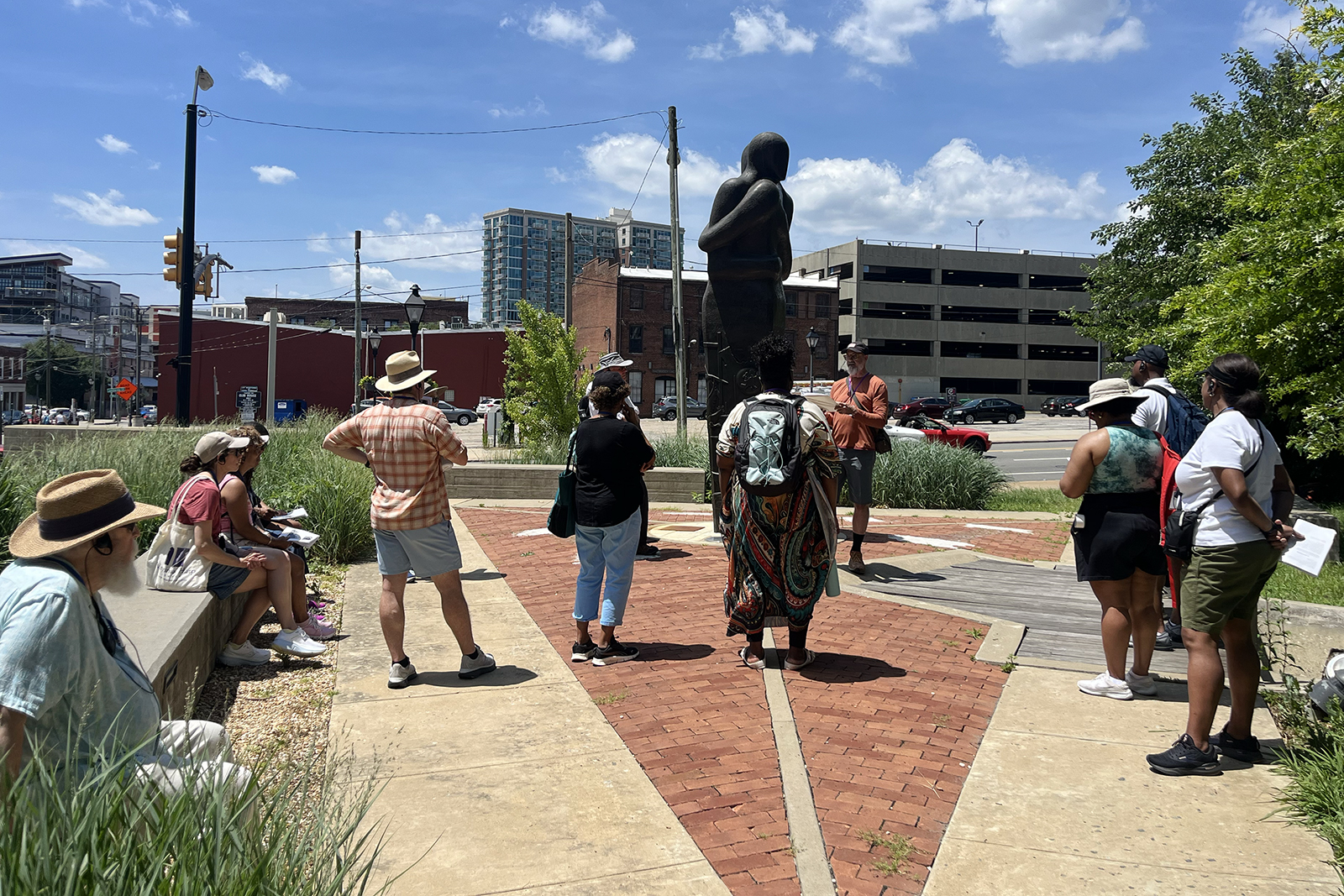
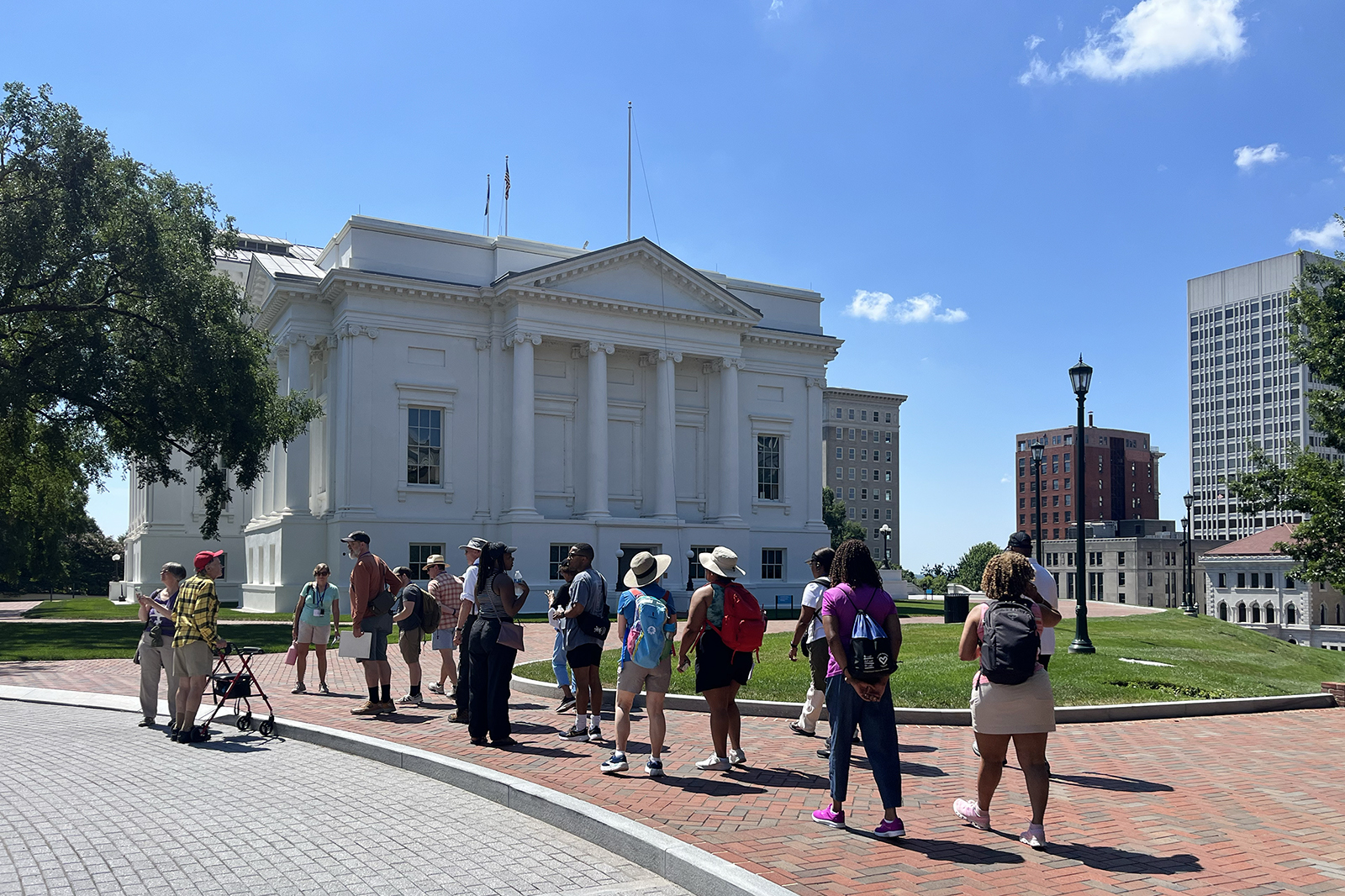
Participants in a slavery pilgrimage visit State Capitol square, Saturday, June 13, 2026, in Richmond, Va. (RNS photo/Fiona André) TOP PHOTO: Docent Glyn Hughes, center right, speaks to a group at the Richmond Slavery Reconciliation Statue, Saturday, June 13, 2026, in Richmond, Va. (RNS photo/Fiona André)

The daylong retreat grew out of a partnership between St. Paul’s Episcopal Church, Virginia’s largest Episcopal parish that was once attended by Confederate army Gen. Robert E. Lee and Confederate President Jefferson Davis, and St. Philip’s Episcopal Church, one of the South’s oldest Black Episcopal churches, founded in 1861 by enslaved and freed Richmonders. The two congregations designed the experience centered on stories of enslaved people and enslavers, prayer and African American spirituals, which they hope will make for a transformative and eye-opening encounter for all who take part.

Just as the country prepares to celebrate the 250th anniversary of the Declaration of Independence — and Juneteenth, the commemoration of when enslaved people of Galveston got news of their liberation on June 19, 1865 — these Episcopalians are trying to reckon with the role of their city and their denomination in slavery as a founding reality of the United States. The churches’ collaboration reflects both the Episcopal Church’s racial reconciliation focus, announced in 2016, by then-Presiding Bishop Michael Curry — the first African American to lead the denomination nationally — and a broader citywide effort to confront the city’s slave-trading past.

St. Paul’s and St. Philip’s, both of whose histories were shaped by Richmond’s role as a major slave-trading center and the capital of the Confederacy, are hoping to translate these efforts into personal transformation.

Before they embarked on the pilgrimage, the group gathered for an introduction session at St. Philip’s. Nikki Fernandes, one of the tour’s docents, reminded them of the day’s spiritual goal. “We hope you leave this pilgrimage with something, and that the Holy Spirit will guide what that something is,” said Fernandes, a Virginia native and a Ph.D. candidate at the University of Pittsburgh.

Walking through these historic sites is more likely to transform people and help the history solidify in their minds than something less immersive, said Jerry Gilbert, one of the pilgrimage’s co-chairs and a vestry member at St. Paul’s. “That may be what people would call the ancestors talking to you, or the place talking to you. … But I think it really happens because I’ve felt it happen,” Gilbert told RNS in an April interview.
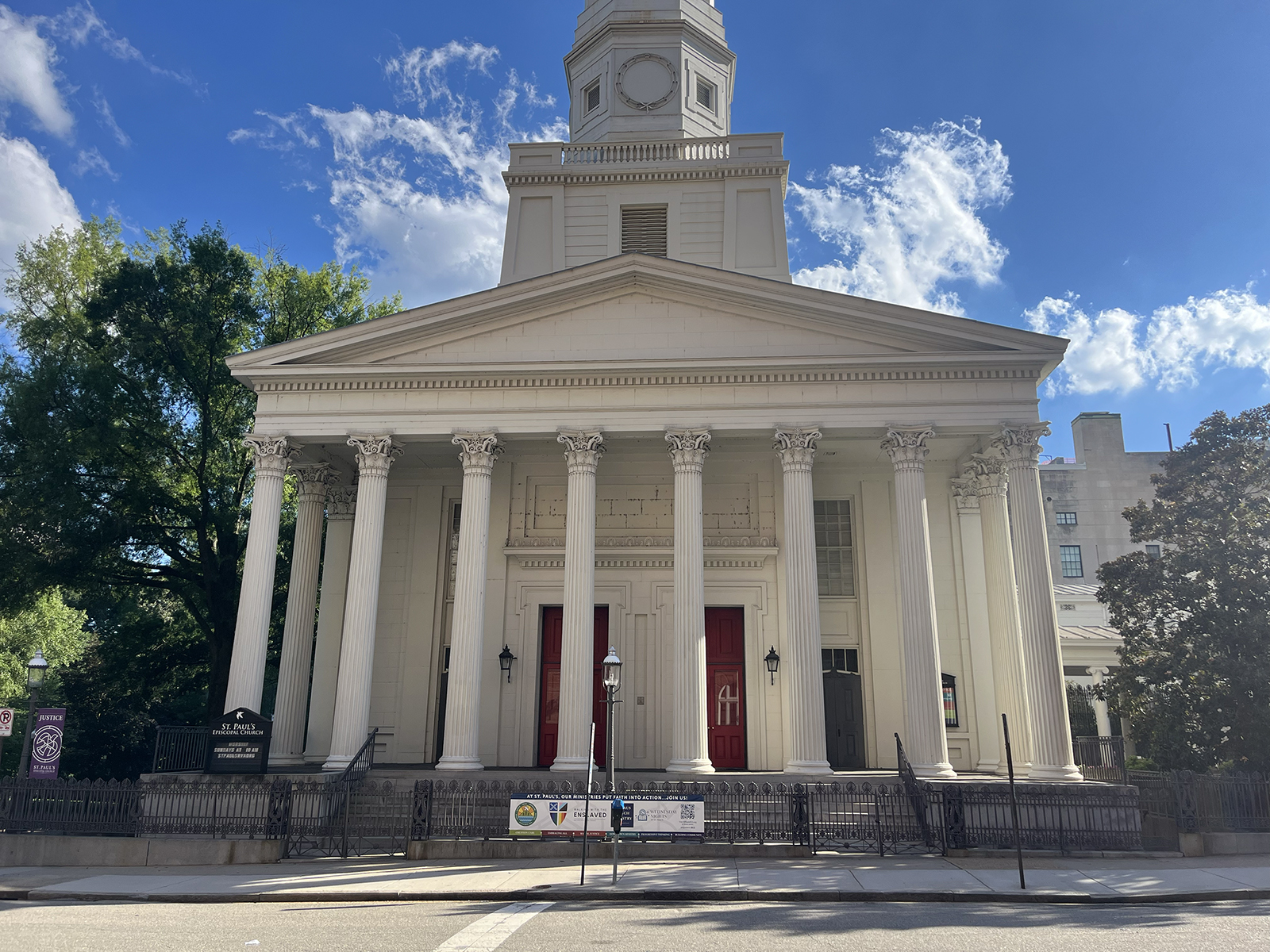


St. Paul’s Episcopal Church, Saturday, June 13, 2026, in Richmond, Va. (RNS photo/Fiona André)

Many participants had heard about the pilgrimage through the churches. The project started at St. Paul’s and took off after the congregation reached out to St. Philip’s to collaborate. Gilbert said the church needed a “nonwhite majority” partner to improve the walks.

“We knew that sometimes white privilege is very blind to seeing all of the aspects of a situation when race is involved,” he said.

St. Paul’s, perched on Richmond Hill near the Virginia Capitol, traces its roots to Monumental Church, established in 1814 by prominent Richmonders — “nearly all” enslavers, according to the church’s website. During a tour stop on Richmond Hill, Glyn Hughes, another docent, stressed that the freedom ideals that fueled America’s founding collided with Virginia’s reliance on slave trading and its leaders’ affiliation with Episcopal and Presbyterian churches.

In front of the state Capitol, which once held church services for Presbyterians and Episcopalians but also served as the Confederate States Congress during the Civil War, Hughes invited participants to “think about how they were mingling Christian values to their ideals.”
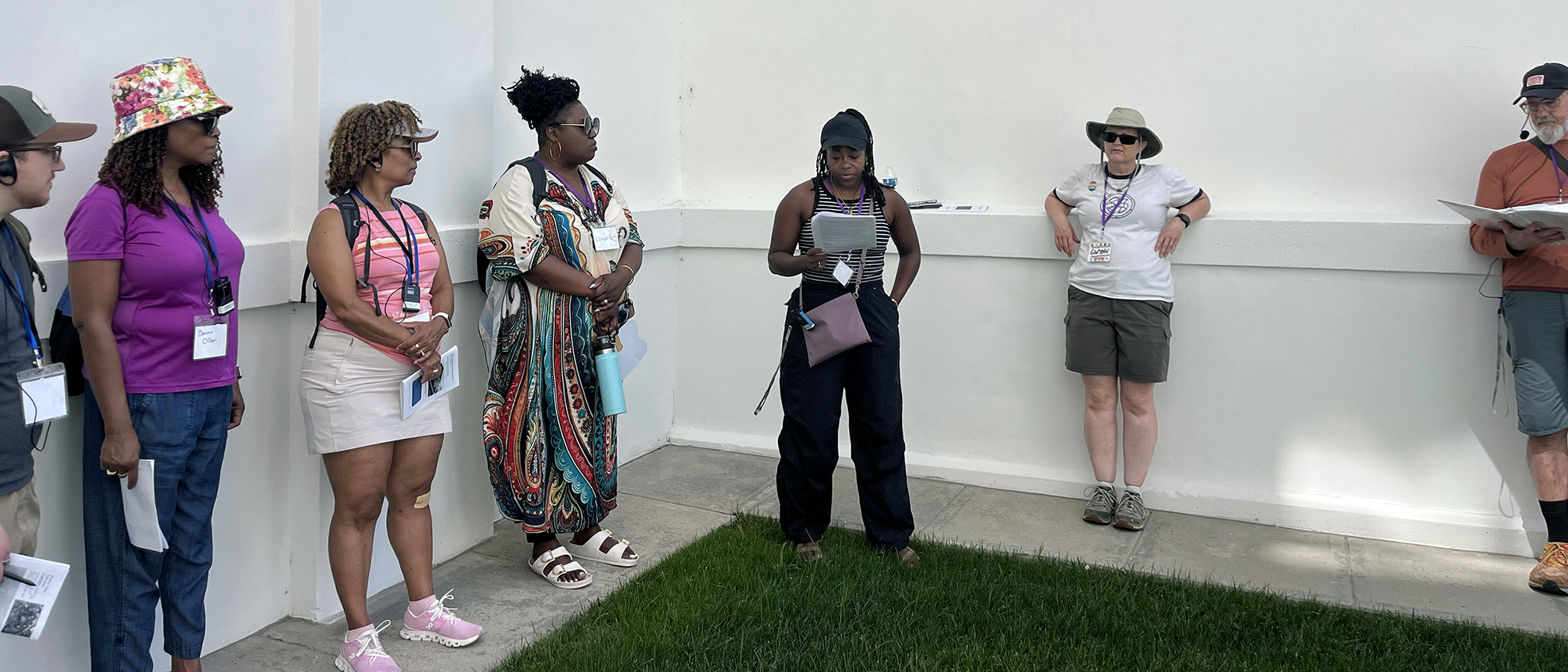

Docent Nikki Fernandes, center, addresses a slavery pilgrimage group on Saturday, June 13, 2026, in Richmond, Va. (RNS photo/Fiona André)

After the 2015 killing of nine Black worshippers at Mother Emanuel AME Church in Charleston, South Carolina, St. Paul’s started examining its own racist past. Five years later, the church removed Confederate symbols from the sanctuary, shedding the most visible reminders of its support for the Confederacy and cutting off its embrace of Lost Cause ideology after the Civil War.

St. Philip’s, nestled in Richmond’s North Side, has served as a refuge for Black Richmonders through the Civil War, the Jim Crow era and today. Despite its prominence for the city’s Black Episcopalians, the church didn’t gain full representation at the diocesan convention until 1937.

The churches’ partnership has been “transformational,” said Crystal Green, a co-chair of the project and a member of St. Philip’s. “It’s part of a healing process that is 400 years in the making, so it’s transformed our lives, our worship styles, and it’s also built a lifetime of friendships.”

Beginning at the “slave trail” shapes participants’ experience of the pilgrimage’s nine remaining stops, organizers noted. The recovered stories of Black Richmonders also ensure participants center the perspectives of enslaved people during the pilgrimage.

At the fifth stop, the First African Baptist Church, Fernandes recounted the story of Henry “Box” Brown, a member of the congregation born into slavery on a Louisa County plantation. In 1849, Brown escaped by shipping himself to Philadelphia in a wooden box to reach freedom in the North.

Four years after promising $10M for racial reparations, Virginia’s Episcopalians have little to show

The tour cultivates a sense of sacredness through prayers, silent reflections and songs. The pilgrimage’s opening prayer, which invites participants to “leave the familiar, the comforting, the known” to find a deeper sense of God, is echoed through the Bible verses associated with each stop. A preacher-style call and response ritual in front of each site also reinforces the pilgrimage’s spiritual dimension.
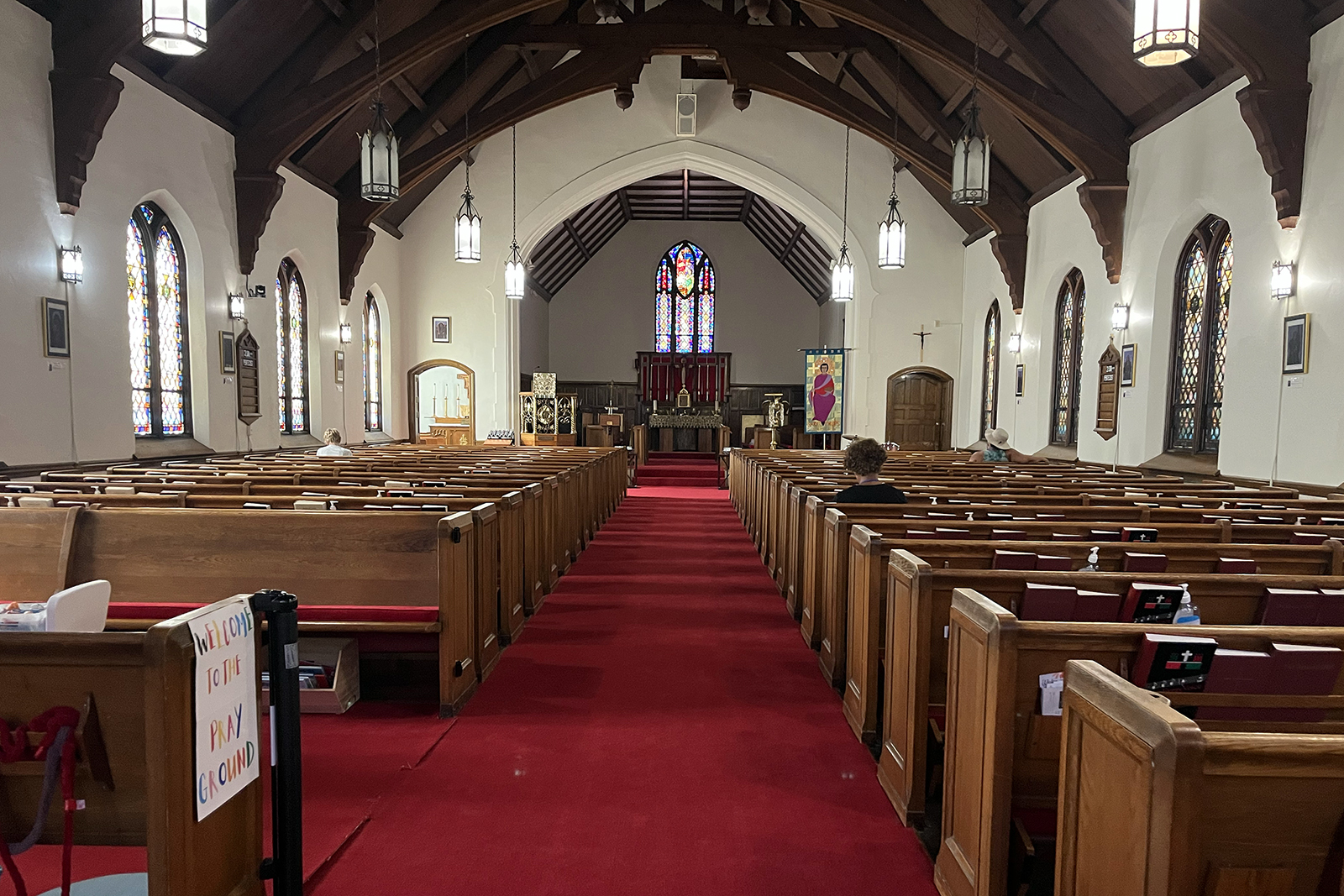

Participants in a slavery pilgrimage take some quiet time in St. Philip’s Episcopal Church, Saturday, June 13, 2026, in Richmond, Va. (RNS photo/Fiona André)

“God of love who traces our journeys,” Hughes said as the group approached each stop. “Enlighten the eyes of our hearts,” participants replied in unison.

The spirituals — including “Amazing Grace,” a hymn that predates the United States, and Thomas Dorsey’s 1930s classic “Take My Hand, Precious Lord” — also help set the pilgrimage’s solemn tone. For Shauntae Lilly, the gospel singer who accompanies the group, the songs are a tribute to the enslaved.

“My voice provides the voice of the journey,” said the 43-year-old singer. “ … Sometimes stories are easier felt than heard.”

Lilly, who grew up attending both Southern Baptist and Black Episcopal churches, said years of observing and listening to church choirs compensate for her lack of classical training. Like some Black participants, Lilly said she feels the presence of her ancestors during her performances.

“I feel as if the good Lord uses my voice to do that,” she said.

The pilgrimage’s last stops — the Shockoe Bottom African Burial Ground, the sunken slave jail of Shockoe Bottom and its dried-up reconciliation fountain — sit under the shadow of Interstate 95. Built in 1958, the highway severed Sixth Mount Zion Baptist Church, a 150-year-old Black Baptist congregation and the pilgrimage’s final stop, from Jackson Ward, Richmond’s historical Black neighborhood.
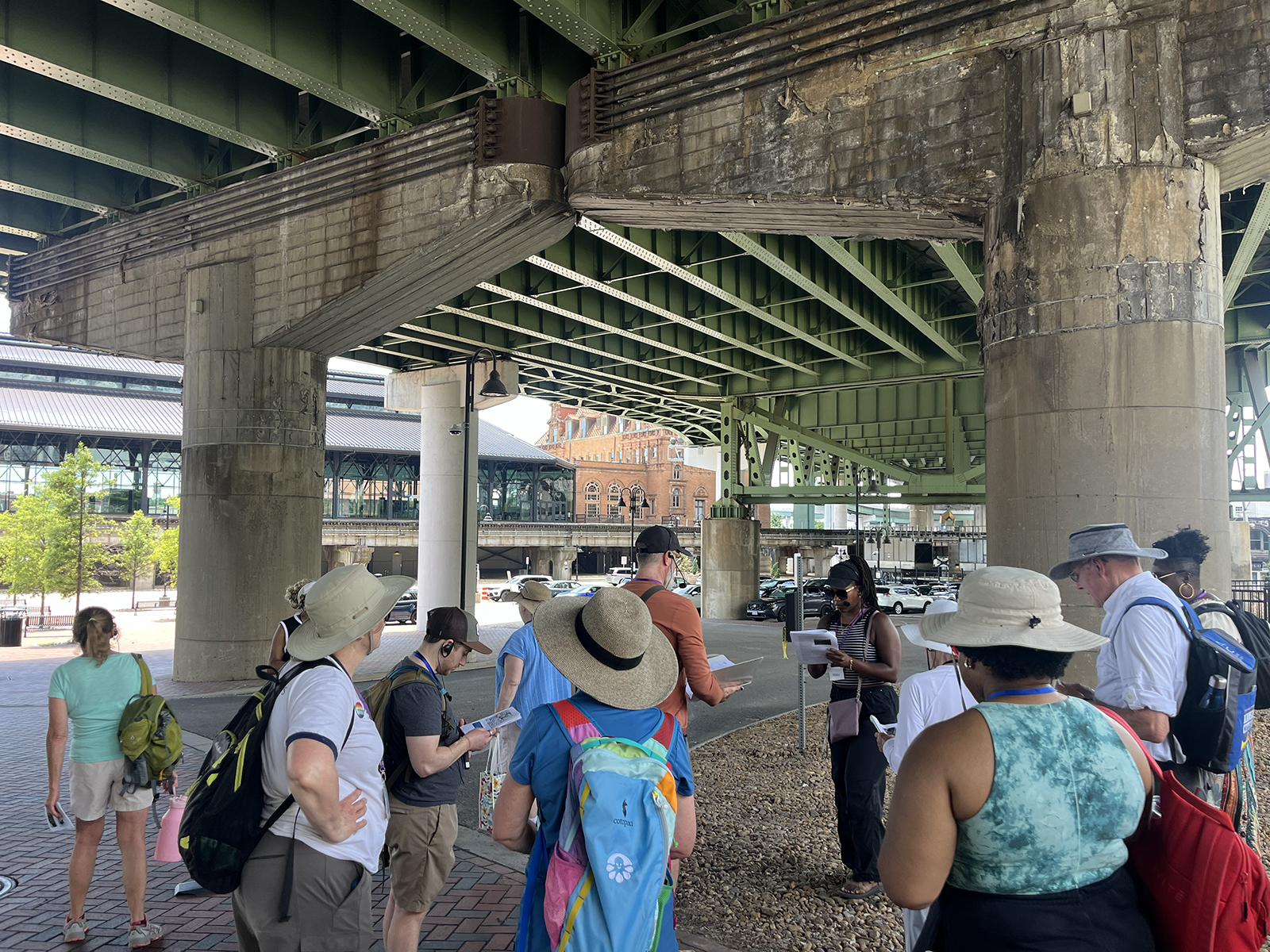

Participants in a slavery pilgrimage stop under Interstate 95, Saturday, June 13, 2026, on the way to Shockoe Bottom African Burial Ground in Richmond, Va. (RNS photo/Fiona André)

To Hughes, the interstate’s path through Jackson Ward is an example of “infrastructural violence” and a reminder of continued harm inflicted on Black Richmonders, he told participants on the bus ride back to St. Philip’s.

After lunch at St. Philip’s, participants scattered across the sanctuary and garden for a period of silent reflection. Guided by a Gospel of Matthew verse quoting the Prophet Isaiah about people who “listen, but never understand … look, but never perceive,” participants then shared their emotions, frustrations and awakenings. Equipped with a form inquiring about how they felt, what they thought and what value they carried as they completed the walk, the group embarked on an hourlong discussion on the pilgrimage.

As she sat on a bench by herself in St. Philip’s garden after the walk, Monica Melton, an educator who has lived in Richmond for 20 years, said she was thinking about how to get more involved.

Ever since the U.S. Supreme Court ruled against a Louisiana congressional map that included two Black-majority districts, thereby hollowing out a key provision of the 1965 Voting Rights Act, Melton said she has been concerned about Black voters’ political power in the South.

“I was really thinking less, maybe about the experience throughout the day, but like ‘where is my voice?’ like my political voice,” she said.

The personal stories of the enslaved, which she called the “most powerful piece,” also changed how she plans to approach discussions on racial history with her students.

Her husband, the Rev. Brent Melton, has also been impacted by the enslaved people’s stories. When the couple, who are white, got home on Saturday, Brent Melton modified the sermon he had prepared for the next-day service to mention the pilgrimage.

As he told the parishioners of Richmond’s Grace & Holy Trinity Church that the “work of the Kingdom coming near” requires building communities, Brent Melton noted how the pilgrimage created community by pushing participants to convene with strangers.

“It was kind of like doing the stations of the cross, we had a simple liturgy, the story slowly unfolded, we even had music with a cantor,” he said. “Before we met in our small group, we were asked to do the most hated thing: do not sit with anyone you know. It was a God experience of movement with strangers. We were in the action of bringing God’s kingdom near.”

As she stepped into St. Philip’s that morning, Munford said, she felt weary of the experience ahead. Time invested in multiple racial reconciliation efforts that ultimately stalled had left her skeptical. “It made me kind of bitter towards the whole reconciliation thing,” she said. But seeing white Virginians willing to face this history gave her hope.

“All I could think is, you’ve got these white people that are interested enough to take out time on their Saturday and go through this process with us,” she said.



Five things resettlement orgs want you to know this World Refugee Day

(RNS) — As the U.S. welcomes individuals from all over the globe to celebrate the world’s game, most refugees remain largely shut out. On this World Refugee Day, faith-based resettlement organizations say caring for the stranger is a spiritual concern.


Pastor Jennifer Castle joins others outside the U.S. District Court after a federal judge blocked President Donald Trump’s effort to halt the nation’s refugee admissions system, Feb. 25, 2025, in Seattle. (AP Photo/Ryan Sun)


David Katibah
June 18, 2026 

(RNS) — 5.4 million people became refugees in 2025. With the global total eclipsing more than 35 million refugees — not including the 69 million internally displaced persons — resettlement remains a vital lifeline for the most vulnerable communities.

For more than four decades, the U.S. has been on the front lines of that process. But in 2025, the U.S. only resettled 11,500 refugees, a sharp drop from the more than 100,000 in 2024. In 2026, the number so far is less than 6,000 — all of them from South Africa.

As the U.S. welcomes individuals from all over the globe to celebrate the world’s game, most refugees remain largely shut out.

This Saturday (June 20) is World Refugee Day, celebrated by the U.N. since 2001. In light of ongoing changes to U.S. immigration and refugee policy, we asked faith-based resettlement organizatio
ns what communities of faith should know about current U.S. refugee policy.

The U.S. refugee program has been devastated in recent years.


Matthew Soerens. (Photo courtesy of World Relief)

The U.S. Refugee Admissions Program, a bipartisan effort established in the wake of the fall of Saigon, has all but been gutted. Some of the most vulnerable communities in the world are now barred from seeking entry into the United States.

But many Christians are not aware, said some of the major faith-based refugee resettlement agencies.

“The average person in the average church I go to has no idea that the refugee resettlement program has been shut down,” Matthew Soerens, vice president of advocacy and policy for World Relief, told Religion News Service.

The change in policy has meant these agencies have had to make major staffing and programming adjustments. Some of them have had to survive the termination of significant U.S. grant funding. But more importantly, they say, the change has felt like an abandonment of these needy communities.
RELATED: After refugee aid cuts, faith groups help Afghan women connect through sewing

During the first Trump administration, the number of refugees admitted to the U.S. was cut drastically, leading resettlement agencies to cut staff and reduce programs. Those programs were rebuilt during the Biden administration, only to be shut down again when Trump returned to office.

In fiscal 2026 (which began Oct. 1, 2025), the vast majority of refugees who have been resettled are white Afrikaners, a minority community from South Africa. Persecuted Christians and other religious minorities, who have historically been a priority for the USRAP — such as through the Lautenberg Program — are no longer given special consideration.

“We’re unfortunately quite confident that zero Christian refugees from countries where Christians are known to face persecution will come to the United States as refugees this year, down from more than 29,000 two years ago,” said Soerens.


Deputy Secretary of State Christopher Landau greets Afrikaner refugees from South Africa, May 12, 2025, at Dulles International Airport in Dulles, Va. (AP Photo/Julia Demaree Nikhinson)

Despite the restrictions by the current administration, most Protestant pastors prefer a much wider net for refugee admissions. Only 18% of pastors in a 2026 poll run by Lifeway identified Afrikaners as a priority for refugee resettlement.

On the other hand, 70% of pastors identified those who have fled persecution and have family members already in the U.S. as a priority.
Families have been separated, and more families are at risk of separation.

Many of the individuals who come to the U.S. are hoping to chart a path for their families, said Matt Misterek, director of communications at Lutheran Community Services Northwest, one of the plaintiffs in an ongoing case against the U.S. government’s refugee restrictions.

“When individuals come, they’re often almost always here to put their front foot forward with the hope that in fact they’re going to be able to reunite with their families in the United States,” said Misterek.

Family reunification is considered a priority by Congress, especially uniting children with their families that are already stateside. Yet while exceptions to the ban are being made for South African refugees, the same is not true for these children.

One such child is a 9-year-old boy from the Democratic Republic of the Congo. He’s been stuck alone in Burundi, even though his parents and siblings are already in the U.S.

“These actions are discriminatory, cruel and arbitrary,” said Mevlüde Akay Alp, senior litigation attorney for IRAP and lead attorney in the case against the selective application of the refugee ban. The boy’s family is a new plaintiff in an amended complaint put forth by IRAP.

Other policies put in place by the Trump administration in November have made reunification much more difficult. They included a freeze on all asylum applications and a pause on immigration applications for individuals from a list of 39 countries.

The result? Millions of people whose cases were in process were left in limbo.

As of last week, a judge determined the policies were “arbitrary and capricious” and forced U.S. Citizenship and Immigration Services to restart processing applications. Milagro Sique is the CEO of Dorcas International Institute of Rhode Island, the primary plaintiff in the case that led to this ruling. She told RNS the ruling means folks can finally escape this limbo.

“It gives them some clarity, so that (they) the petitioner can make a meaningful decision on their lives,” Sique said.

For many, however, the pause on refugee resettlement means there is still no pathway for their families to join them.
Some refugees already in the U.S. could be in jeopardy.

As part of a crackdown, U.S. Immigration and Customs Enforcement has arrested some refugees already legally in the country and detained them for questioning. A federal judge has ordered the Trump administration to pause these detentions.

But refugees remain at risk of a “revetting” process, which could result in revocation of their permanent status.


Leliz Bonilla Castro, left, and her sister Xochina Michelle Castro, refugees from Honduras, participate in an English class for refugees, April 11, 2024, in Columbia, S.C. (AP Photo/Erik Verduzco)

For HIAS, the world’s oldest refugee resettlement agency, restrictions on immigration are something it has weathered in the past, particularly in the 1920s. But the refugee revetting process, which risks separating families who believe they have finally made it to safety, is unprecedented.

“This is one of the instances where there is a really fundamental attempt to transform the nature of immigration and refugee resettlement in the U.S. in ways that we haven’t previously seen,” said Noah Gottschalk, chief external relations officer at HIAS.

Gottschalk said the intention in revetting refugees — who already go through one of the most stringent vetting processes in the world — is to create a “climate of fear, a climate of confusion.”
Caring for refugees is a spiritual concern.

For HIAS, caring for refugees is not altruism; it’s an outgrowth of a deeply felt experience.

“We are motivated as we are, by our Jewish values, by the Jewish experience of being persecuted, of being discriminated against for who we are and what we believe,” said Gottschalk.

In June of 1939, the St. Louis, a ship carrying nearly 1,000 Jewish refugees from Germany, was refused entry into the U.S. Forced to return to Europe, 254 of its passengers were eventually murdered in the Holocaust.

For HIAS, remembering this tragedy is an inspiration to welcome refugees today.
People of faith have stepped up.

Many people of faith have done that and more in the past two years. Synagogues, mosques and churches have all met the gap in her community, Sique said, even though DIIRI is not a faith-based organization itself.

Some church members have even gone to great lengths to assist refugees impacted by the recent policies, such as a pair of families who traveled from Minnesota to Texas to assist a refugee who had been detained and released without documentation. For some detainees, this is a deadly experience.

Jewish communities across the country, likewise, have rallied in support of refugees, even in places where such support has come at great cost.

Despite the funding restrictions, many faith-based resettlement organizations have found new ways to support vulnerable communities.

Nevertheless, the support faith communities can offer is not sufficient to meet the needs long term. This is why Dorcas International Institute of Rhode Island has turned to fighting some of the restrictions in court.

“We need more of a sustainable plan for these folks,” said Sique.
German chemical company to cut 3,200 jobs as crisis worsens

AFP
June 18, 2026

E
vonik cited uncertainty and a week economy as it announced job cuts
 – Copyright AFP PAU BARRENA

German chemical company Evonik said Thursday that it would cut 3,200 jobs, or around 10 percent of its workforce, by 2029 as a crisis battering the energy-intensive industry accelerates.

Chemicals is one of the most important sectors in Europe’s biggest economy, but it has been struggling with high costs, exacerbated recently by the energy price shock from the Iran war.

Evonik, which is headquartered in the western city of Essen and makes a range of specialised chemicals, said the cuts were aimed at advancing the company’s transformation.

“The global political situation remains uncertain, and economic growth is persistently weak,” CEO Christian Kullmann said.

“At the same time, international competition is becoming increasingly fierce,” he added.

The job losses will be across all business and administrative departments worldwide, Evonik said.

A total of 2,150 of the positions being axed are in Germany, with talks to be held with staff representatives in the coming weeks.

The company also said it would close its polyester business entirely next year, with sites in Germany and China affected.

The cuts announced Thursday follow a previous round of job losses at Evonik in recent years. Evonik now has around 31,000 employees globally.

The government and industry groups announced in March a plan to help the chemical sector, which includes subsidising power prices and seeking changes to the European Union’s flagship carbon market scheme.


Cuban economy needs ‘urgent changes’ to overcome crisis: Cuban president

AFP
June 18, 2026

People board a private vehicle transporting passengers on the outskirts of Havana — new restrictions on transport in Cuba are coming into force amid a severe fuel shortage – Copyright AFP YAMIL LAGE

Cuba’s economy needs “urgent changes” to overcome a major crisis intensified by a US oil blockade, President Miguel Diaz-Canel said in a speech to Communist Party leaders broadcast on Thursday.

“The situation calls for urgent and necessary changes,” Diaz-Canel told the party’s politburo in his frankest admission yet of the need for an overhaul of the country’s communist model.

He cited China and Vietnam as possible models for opening Cuba’s economy to the world in order to “create economic wealth and distribute it equally.”

Diaz-Canel made the remarks at a meeting called to fast-track reforms aimed at boosting the growing private sector and attracting more capital from millions of Cubans who have fled the crisis abroad.

Some of the reforms “will not have absolute consensus but cannot be postponed,” Diaz-Canel stressed.

“When people’s lives become this hard,” the Communist Party and government had a responsibility to “change what needs to be changed” rather than try to explain away the crisis, he said.

The oil blockade imposed by President Donald Trump in January has brought Cuba’s already moribund economy to the brink of collapse, marked by power cuts sometimes lasting over 30 hours and shortages of food, fuel, drinking water and medicine.

While Havana’s position has been to blame its woes on a more-than-six-decade US trade embargo and the blockade, Diaz-Canel admitted there were “obstacles that don’t come from outside, nor the blockade.”

He pointed to “slowness, bureaucracy and norms that impede those who want to produce” as well as “decisions that we have put off.”

The reforms were widely seen as a desperate, eleventh-hour bid to stave off economic collapse.

It is unclear, however, whether they will satisfy Trump, who is pushing for a change in Cuba’s leaders as well as its economic model.


With Cuba in crisis, faith groups work to influence policy, deliver aid

(RNS) — U.S. Republican administrations have long seen faith groups as a cornerstone for humanitarian aid and community trust as they push for regime change in Cuba.


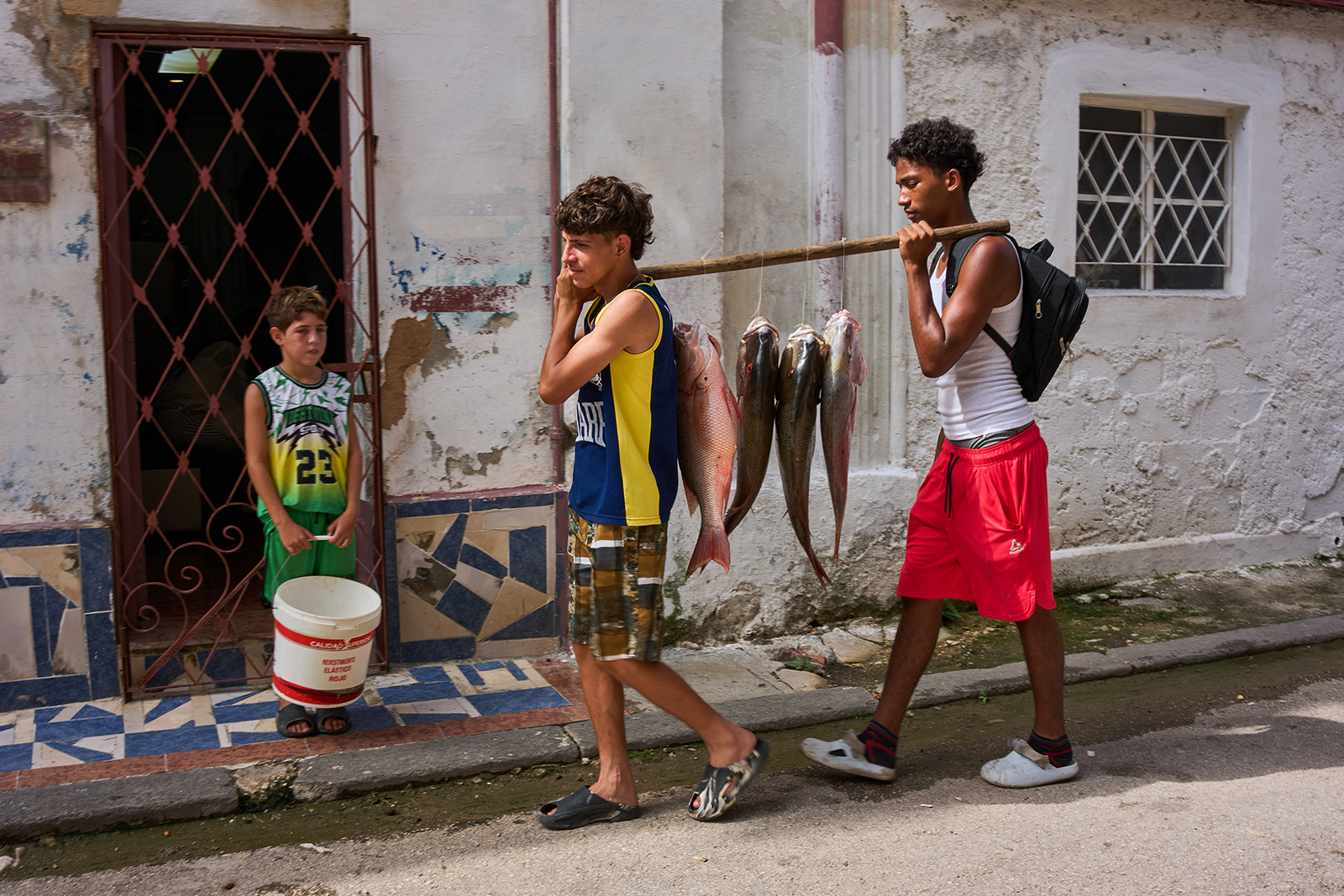
Youths carry freshly caught fish from the sea in Havana, Cuba, Monday, June 1, 2026.
 (AP Photo/Ramon Espinosa)


Aleja Hertzler-McCain
June 19, 2026 
RNS


(RNS) — In the face of an accelerating U.S. pressure campaign, deteriorating public utilities and economic inefficiency, Cuba’s communist government on Thursday (June 18) announced sweeping economic reforms, the largest privatization since before Fidel Castro’s revolution in 1959.

threats of military action, and its sanctions and an oil blockade have been compounding Cuba’s existing fuel shortages, power outages and scarcity of food and medicines.

Amid the mounting internal and external pressure, faith communities have been speaking up and meeting with both the U.S. and Cuban governments.

U.S. Republican administrations have long seen faith groups as a cornerstone for humanitarian aid and community trust as they push for regime change in Cuba. In the last few months, the top U.S. diplomat in Cuba, Mike Hammer, has met with top Catholic bishops, a Catholic priest known for being critical of the Cuban government, a Methodist bishop and members of the Alliance of Evangelical Churches in Cuba, which includes several groups more often critical of the government, including the Assemblies of God.

Despair has become intense, said Rita María García Morris, the executive director of the Centro Cristiano de Reflexión y Diálogo (Christian Center for Reflection and Dialogue) based in the Cuban province of Matanzas, who with her team has helped meet the daily needs of vulnerable people and to advocate for peace, including several meetings with Hammer and U.S.-based pastors.

“Suicide, mental illnesses and hopelessness are extreme, extreme,” said García Morris in Spanish. “Our psychologists cannot keep up. We have a team of psychologists working even at night with phone calls, and they cannot keep up.”


A pile of trash burns in Havana, Cuba, Wednesday, June 17, 2026. (AP Photo/Jorge Luis Banos)

García Morris, a Presbyterian ruling elder, said that suffering due to days-long blackouts and spoiled food is widespread. In December, she had to travel to the Dominican Republic because she had developed diabetic ketoacidosis, a condition that can become life-threatening, because she was not able to keep her insulin refrigerated.

She told RNS she is waiting to see how the economic reforms will affect the population. “Where does that leave the poor people and the humble people?” she asked.

Cuban state media has said the survival rate for children with cancer has fallen from 85% to 65% since the oil blockade began and that more than 75% of essential medications produced on the island can’t be made right now because of unavailable components.

The power outages and lack of flour are also limiting the Catholic church’s ability to produce unconsecrated bread for Communion. Puerto Rican parishes and Dominican religious sisters worked to send nearly 300,000 hosts to Cuba this month.

Outreach Aid to the Americas (OAA) distributes humanitarian aid to Cuba through largely evangelical churches independent from the government.

Teo Babun, OAA’s Cuban-American president and CEO, was quoted on the important role of faith communities in a 2004 Bush administration report issued by the Commission for Assistance to a Free Cuba. The evangelical businessman told RNS that “most of those reports interestingly enough are applicable today.”

He expressed confidence that the U.S. government and evangelical organizations are ready to provide a greater surge of humanitarian aid, even before a regime change.

“ We are aware of a lot of conversation taking place regarding Cuba and the aid that needs to be put together,” he said. “ They are becoming more and more familiar with the fact that the evangelical church has tremendous, broad resources and experience working in Cuba to be able to assist in providing humanitarian assistance at the right time.”

Since the beginning of the year, the U.S. State Department has funneled humanitarian aid to Cuba through the Catholic church, citing concerns about government corruption. The first batch of $3 million was designated after last fall’s Hurricane Melissa and took over four months to distribute.

The State Department announced in February another $6 million in aid to be distributed through the Catholic church, but Secretary of State Marco Rubio said in May that half of that amount was still being held up by Cuban government permitting. The department made a third offer of $100 million in assistance distributed through both the Catholic church and “other reliable independent humanitarian organizations” last month.

The Catholic Church has also been continuing their long history of diplomacy promoting dialogue, rather than military conflict, in the U.S.-Cuba relationship. In February, several high-level meetings at the Vatican involving U.S. and Cuban leaders speaking about the Cuban crisis were publicized.


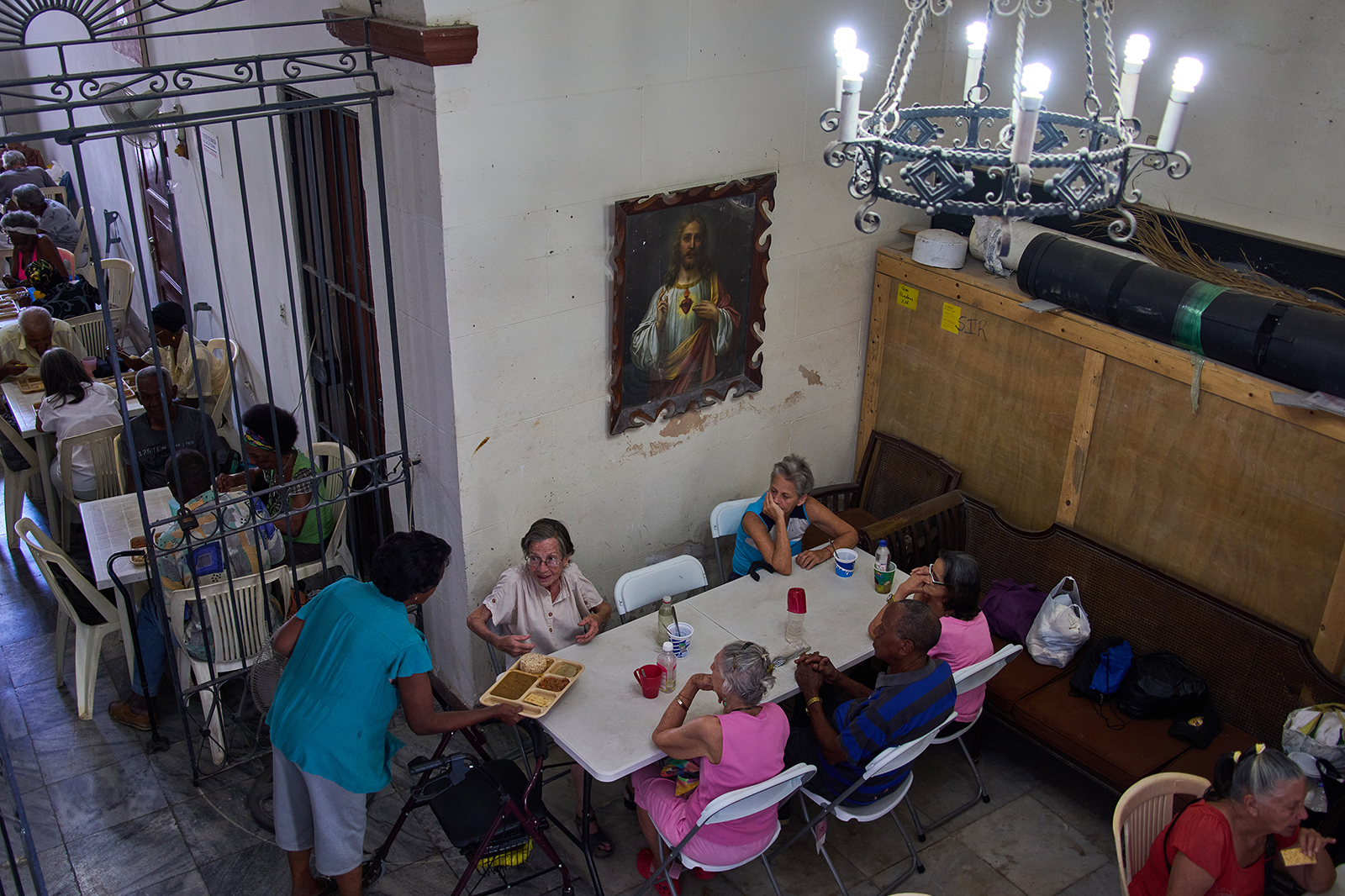
Carmen Casado, 84, is served a free meal of ground meat, rice, red beans and crackers through a program run by the Church of the Holy Spirit at a dining hall adjacent to the Catholic church in Old Havana, Cuba, Thursday, April 21, 2026. (AP Photo/Ramon Espinosa)

“This is the oldest diplomatic corps in the world and is certainly one of the most effective,” said Peter Martin, a former U.S. diplomat to the Holy See who now teaches at Boston College.

Those diplomats have played key roles in Cuba’s recent history. On Pope Francis’ 78th birthday, President Barack Obama announced that he would begin normalizing relations with Cuba, a sharp break in over 50 years of policy — and he personally thanked Francis for his “moral example” and role in brokering key prisoner releases that allowed for the agreement.

That announcement came after decades of work by the Vatican and U.S. bishops. U.S. bishops began to back Cuban bishops’ calls for an end to the U.S. embargo on Cuba in 1972, and Vatican leaders had played a key role in easing government repression of religious groups in the once-atheist country, starting with a 1989 trip by Cardinal Roger Etchegaray.

“Vatican officials always urge leaders to consider the human cost of war, aggression and economic sanctions,” Martin said. “In my experience, when Holy See officials raised these issues, they weren’t asking us to turn a blind eye to the Cuban government’s abuses; they were simply pressing us to engage in dialogue and consider policies that would not harm the most vulnerable.”

Anna Lee Stangl, head of advocacy for CSW, an ecumenical Christian religious freedom organization, told RNS that it was possible to both believe that U.S. sanctions are “unjust” and that the Cuban government is engaging in “the systematic and serious violation of individual people’s basic human rights.”

Her organization’s research with sources on the ground in Cuba informs the U.S. government’s assessment of religious freedom in Cuba, and she said they continue to collect credible reports about religious leaders experiencing harassment, fines, surveillance and unjust incarceration.

Cuba’s Santeros offer gifts and ask deities for peace as tensions rise with US

Catholics weren’t the only religious groups to contribute to the Obama administration policy.

“They wanted to hear from us and valued the expertise because they knew that our partners on the ground had the knowledge of exactly what was happening on the ground unfiltered,” said Catherine Gordon, Presbyterian Church (USA)’s representative for international issues, citing high-level meetings between denominational faith offices and the National Security Council.

Though the Vatican has continued to play a role in U.S.-Cuba diplomacy, faith groups opposing punitive U.S. economic policy on Cuba had not seen much success since the Obama years. In his first term, President Donald Trump reimposed restrictions on the island country, and despite some faith groups expecting the Biden administration would echo Obama’s Cuba policy, he continued Trump administration policies and added new sanctions.


Gordon said her coalition, largely left-leaning Protestant faith groups who had helped shape Obama’s Cuba policies, have been shut out ever since. Under Biden, “ we were seen as another network to promote their agenda with,” said Gordon, but despite assurances the administration was reviewing Cuba’s state sponsor of terrorism designation, “ they were never working on it,” she said, saying the Biden administration’s engagement with those groups was in “bad faith.”

Under Trump, those organizations, which work together under the Interfaith Working Group on Cuba, have tried alternate strategies to keep their ideas in conversation. In February, they delivered a letter to the White House and Congress calling on policymakers to end sanctions, enable humanitarian assistance and engage in diplomacy.

At the end of March, a group including leaders from the World Council of Churches, World Communion of Reformed Churches, the Anglican Communion, the World Methodist Council, Presbyterian Church (USA) and the United Church of Canada made a solidarity visit to Cuba, designed to highlight Cuban suffering and condemn U.S. sanctions, and met with Cuban government leaders.

And in April, Gordon and the working group also organized a webinar with Obama administration alumnus Ben Rhodes, who highlighted the importance and potential power of faith communities in shaping policy on Cuba. “There are faith-based arguments that can be made about the human suffering,” Rhodes said.

But they say they’ve largely been hitting walls in their efforts. Carol Blythe, the advocacy coordinator for the Alliance of Baptists, described feeling unheard in a January Zoom meeting with a State Department staffer when she asserted that their counterparts in Cuba are able to worship freely, counter to the department’s assessment of Cuba as a Country of Particular Concern for religious liberty.

At the end of 2024, Blythe, along with Stan Hastey, a retired denominational leader for the Alliance of Baptists, spearheaded a report about religious liberty based on a survey of pastors in Cuba and the testimonies of U.S. partners, which they delivered to the State Department.

“We contend that there is no systematic, ongoing, egregious violations of religious freedom that specifically include (1) torture; (2) prolonged detention without charges; (3) forced disappearances; or (4) other flagrant denial of life, liberty, or security of persons,” several denominations wrote in a letter introducing the report to then-Secretary of State Antony Blinken.

In the report, which emphasizes the improvements in religious liberty in Cuba, one U.S. pastor who served in Cuba argued that policing seditious political dissidence and controlling religious expression are significantly different.

The State Department and the U.S. embassy in Cuba did not respond to requests for comment.

“I believe that the church, international Christian leaders, can really call for peace and insist that the governments have a dialogue,” García Morris said. “The church in Cuba and the United States has not been indifferent. I believe that it has worked and continues working to prevent a much bigger and worse catastrophe.”


Palantir wants to ‘defend the West,’ but the West is wary

AFP
June 18, 2026
Palantir, founded in 2003 by former founders of PayPal, has grown from a CIA-backed startup into one of the most powerful technology players of the current era – Copyright AFP INA FASSBENDER

France’s move Tuesday to drop Palantir from its intelligence services is the latest sign of European unease with the American data-mining firm — a company that has grown from a CIA-backed startup into one of the most powerful technology players of the Trump era.

– ‘Lord of the Rings’ –

Palantir was born in 2003 from former founders of PayPal — known as the PayPal Mafia — in the wake of the September 11 attacks.

It pitched software that could sift through vast intelligence datasets to flag threats — an idea adapted from PayPal’s fraud-detection systems.

Peter Thiel, the arch-conservative PayPal co-founder, believed better data-sharing between agencies might have prevented 9/11, and built the company around a mission of “defending the West.”

The name came from the “seeing-stones” of J.R.R. Tolkien’s “Lord of the Rings.”

The other co-founders included Alex Karp — a Stanford Law School classmate of Thiel’s who became chief executive despite having no engineering background — as well as Joe Lonsdale, who espouses a hawkish, pro-innovation agenda focused on preserving US national power.

– CIA to ICE –

In 2005, In-Q-Tel, the CIA’s venture arm, began investing in Palantir, cementing its link with the US national security universe. Palantir was quickly put to use by US troops in Iraq and Afghanistan.

For two decades the company worked across the administrations of both US political parties. According to government tracking site usaspending.gov, Palantir has won more than $2.7 billion in defense contracts since 2008.

The company’s fortunes have soared as it has aligned closely with President Donald Trump’s second term.

Palantir’s US government revenue this year reached $687 million in the first quarter, an 84 percent jump year-on-year, according to Karp’s letter to shareholders in May.

Its highest-profile military work is Project Maven — the Pentagon’s AI targeting system, which Palantir took over from Google in 2019 after the search giant abandoned it under pressure from its own staff.

The Maven contract has vastly expanded since then and was used to help identify targets in recent operations including the US-Israel war on Iran.

Palantir’s most contested work involves immigration.

The company has signed more than $81 million in contracts with Immigration and Customs Enforcement (ICE) since January 2025.

Reports say ICE relies on a Palantir tool that mines health agency records to identify people for deportation, prompting an outcry from rights groups.

– Philosopher Karp –


CEO Karp, who holds a philosophy PhD from Germany, is Palantir’s showman — a regular fixture on talk shows and conferences, where he expounds on his vision of business and society, often publishing long letters to shareholders or “manifestos.”

He insists he is bipartisan, though his rhetoric often veers into libertarian, anti-government slogans that can put off a client base which includes governments around the world.

Karp justifies Palantir’s role by arguing that the company helps Western governments reduce terrorism, counter adversaries and strengthen democratic institutions.

Co-founder Lonsdale is far more strident in his defense of conservative values, regularly railing against “woke” culture and defending US supremacy against China and European regulators.

Thiel, the dominant figure in the conservative tech world, has cast those who would slow technology as “legionnaires of the Antichrist,” whom he warns could usher in global totalitarian rule.

– Whose side are you on? –


Palantir’s full-throated support of America and anti-establishment rhetoric may be backfiring, with governments or lawmakers rethinking ties with the firm, notably in France, Germany and Britain.

Foreign clients are left to wonder whether Palantir will side with them or the White House “when they have to make hard decisions,” said Aalok Mehta, director of the Wadhwani AI Center at the Center for Strategic and International Studies.

“Will they accede to a Trump administration demand if it involves something that is sensitive or classified?”

These are questions that government customers outside the United States are starting to take seriously.

Sanders Introduces Bill to ‘Thwart Big Tech Oligarchs’ Via 50% Public Stake in AI Giants

The senator said his legislation aims to ensure “that AI benefits humanity, not just the richest people on the planet.”


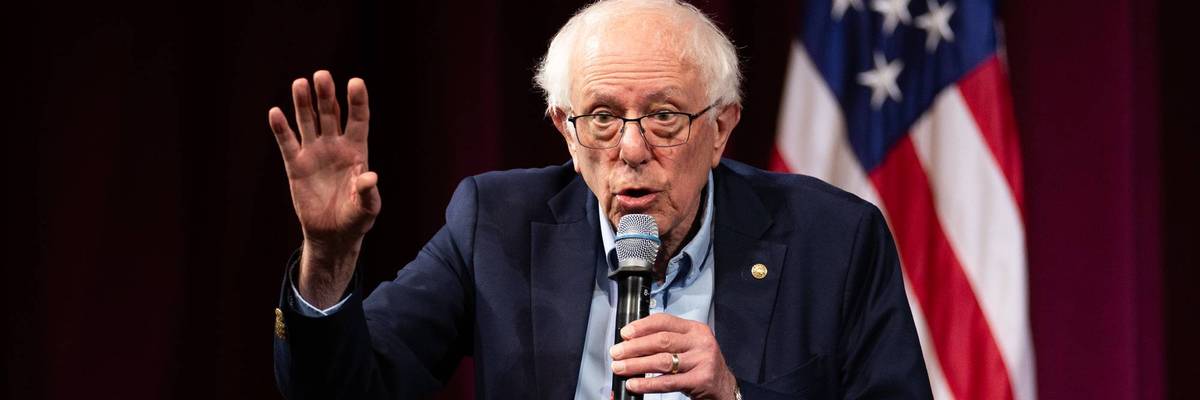
US Sen. Bernie Sanders (I-Vt.) speaks at a town hall event focused on taxing billionaires and the future of artificial intelligence, at Stanford University in Stanford, California on February 20, 2026.
(Photo by Benjamin Fanjoy/Getty Images)


Brett Wilkins
Jun 18, 2026
COMMON DREAMS

US Sen. Bernie Sanders on Thursday introduced legislation that would give the American public a 50% ownership stake in the largest artificial intelligence companies, a move that comes as AI capitalism is rewarding a handful of plutocrats with unprecedented wealth at the eventual expense of many millions of jobs—and possibly humanity’s very existence.

Sanders’ American AI Sovereign Wealth Fund Act would give the public a direct ownership stake in the largest AI companies in America via a one-off 50% tax on the companies’ stock. The taxed shares would be deposited into the sovereign wealth fund, a state-owned investment vehicle similar in purpose to Norway’s Government Pension Fund, which is funded by oil revenue.


Sanders Sovereign Wealth Fund Plan Would Give US Public ‘Direct Ownership Stake’ in AI Giants


Sanders Makes Clear That He and Trump Have Different Ideas When It Comes to AI

The senator estimates that the tax would generate around $7 trillion for the fund.

“The principle is simple: When a public resource generates wealth, the public should share in that wealth,” Sanders said in a statement. “The future of AI and the fate of humanity must not be decided behind closed doors in Silicon Valley by billionaires seeking to maximize their power and profit. It must be decided by workers, parents, teachers, artists, scientists, communities, and the American people.”

Sanders’ proposal comes as AI and related companies have generated trillions of dollars for their shareholders and executives. Meanwhile, AI deployments have resulted in thousands of lost jobs per month in the United States, with that number expected to increase dramatically as the technology improves exponentially.


No paywall. No ads. No billionaire owner. Just you.

Common Dreams is funded exclusively by readers tired of news beholden to corporate interests. Our monthly supporters are the backbone of what makes that possible. Help us reach our Mid-Year Campaign goal of 450 new monthly supporters by July 1.

Eventually, recursive self-improvement—AI that evolves independently of human control—is widely expected to result in Artificial General Intelligence, a tipping point when AI matches or exceeds human capabilities across virtually all cognitive tasks. Experts say that this could lead to wildly varying outcomes, ranging from a “golden age” of AI-driven prosperity to techno-authoritarian government to malicious artificial intelligence wiping out humanity.

In addition to the sovereign wealth fund proposal, Sanders is also calling for a nationwide moratorium on AI data centers, which cause tremendous environmental harm while consuming a staggering amount of energy amidst a worsening climate emergency.

“As a society, we can no longer sit back and allow a handful of Big Tech oligarchs to determine the future of this revolutionary technology with no democratic input,” Sanders said Thursday.

“AI was not created out of thin air. It was not a brilliant idea that just popped into Mark Zuckerberg’s head or Elon Musk’s imagination,” he added. “The foundation of AI is based on the collective knowledge of humanity and the creative work of tens of millions of people. The American people must have the ability to slow it down and make sure that AI benefits humanity, not just the richest people on the planet. That’s precisely what this legislation does.”


Bell, Cohere, and partners announce sovereign AI deal

Digital Journal Staff
June 19, 2026
People working in a server room. – File photo by Digital Journal

Bell Canada, Cohere, Hypertec, and BUZZ High Performance Computing announced a partnership today for a major AI infrastructure deal.

The collaboration will combine Bell AI Fabric’s data centre and connectivity out of its Merritt, British Columbia facility, Cohere’s enterprise-grade AI solutions and LLM, and BUZZ HPC will handle the accelerated computing infrastructure, running on Hypertec’s Canadian-manufactured hardware and NVIDIA’s DSX AI factory platform.

“Canada has the talent and innovation to lead in AI,” said Michel Richer, president of Bell AI Fabric, in a news release. “What’s been missing is the ambition to bring the right ingredients together. This landmark deal helps close that gap.”

With Canadian partners using Canadian infrastructure, R&D on AI models can be refocused, and the country’s digital sovereignty and economic resilience prioritized.

“For enterprises and governments, adopting AI is not just about having access to powerful models,” said Michael Pelosi, country manager (Canada) at Cohere. “It’s about knowing where those models run, how data is protected and whether the technology can be deployed with the security and reliability their work requires.”

The deal builds on the previously announced Canadian Sovereign AI Alliance and the launch of Bell AI Fabric.

Demand for Canadian AI infrastructure is growing as organizations move from experimentation to large-scale deployment, though outcomes will depend on infrastructure performance, and whether enterprise and government customers follow through on that demand.

“AI does not scale on ideas alone, it scales on data centres, specialized GPU compute, sophisticated models and operational execution,” said Craig Tavares, President and COO of BUZZ HPC. “This partnership brings together a combination of capabilities that does not exist anywhere else in Canada today.”
Final ShotsBell AI Fabric’s Merritt, BC facility is purpose-built for advanced AI workloads and serves as the data centre and connectivity foundation for the partnership.
The deal builds on the Canadian Sovereign AI Alliance, positioning the four partners as a combined alternative to US-based hyperscaler infrastructure.


Op-Ed

Corporate Media Covers AI as a Contest of Elites. In That Framing, We All Lose.

Reporting on Elon Musk’s OpenAI lawsuit said it would “shape the future” — but never covered whose futures are at stake.
PublishedJune 17, 2026

Elon Musk is seen through glass at the Ronald V. Dellums Federal Building and U.S. Courthouse in Oakland, California, passing through security as he continues his testimony in the OpenAI trial on April 29, 2026.Karl Mondon / AFP via Getty Images

Corporate news outlets frequently frame stories about artificial intelligence (AI) as contests. The most basic version of this frame — metaphorical “races” between rival tech companies or nations, in which speed of innovation is presumed to determine the victors — is so widely used, it’s easy to take for granted.

As AI systems shift power throughout society, from health care and law enforcement to education and marketing, frames premised on contests or races distort, marginalize, or even erase fateful power dynamics. Reporting that represents AI tech development primarily as a contest among elite rivals typically buries questions about how new technologies are likely to impact the general public. The recommendation of journalism professor Jay Rosen holds true: Informative reporting highlights “not the odds, but the stakes.”

The recent coverage of Elon Musk’s lawsuit against his former business partner Sam Altman and OpenAI exemplifies the problems with framing AI developments primarily as contests among rival elites, in which the majority of the public are bystanders whose only choice is to start using AI or get left behind.

Trial Coverage: “The Landing of the Hindenburg on the Deck of the Titanic”

Established in 2015 by Altman and Musk, OpenAI claimed that its mission was to develop tech that would benefit “all of humanity.” In October 2025, OpenAI announced a new for-profit subsidiary, OpenAI Group, a public benefit corporation. The move, The New York Times reported at the time, “firmly establishes OpenAI as one of the tech industry’s standard-bearers in the AI boom, allowing the San Francisco company to compete on more solid footing with giants like Google, Amazon and Meta.”


Google’s New AI-Fueled Search Bar Threatens to Further Upend Journalism Industry
Independent journalism needs a lifeline to survive as Google urges readers toward AI summaries instead of article links. By Negin Owliaei , Maya Schenwar , Ziggy West Jeffery , Truthout  June 9, 2026


In his lawsuit, Musk contended that Altman and Greg Brockman, OpenAI’s president and co-founder, enriched themselves by betraying OpenAI’s founding mission. For its part, OpenAI characterized Musk’s lawsuit as an attempt to set it back while Musk sought to fortify his own struggling AI startup, xAI.

The nation’s major national news outlets provided day-by-day trial coverage, which regularly characterized Musk and Altman as “titans” and the case as a “blockbuster.” On the eve of the trial, one expert source told The Washington Post, “We are about to witness the landing of the Hindenburg on the deck of the Titanic.” (The examples of news framing cited here are drawn from a sample of 104 news articles about the lawsuit, identified using ProQuest’s U.S. Major Dailies archive.)

Heaps of subsequent coverage focused on the two larger-than-life protagonists’ personalities, the power struggles between them, even the clothes they wore to court — and the market stakes for OpenAI and xAI.

Acknowledging the “billions of dollars and the future of the A.I. industry at stake” in the lawsuit, The New York Times highlighted another reason the trial mattered: “It has given an up-close-and-personal look at how two men worth more than a combined $670 billion function under extreme pressure.”

“What happens in the weeks and months to come will define Altman’s legacy,” one Wall Street Journal article asserted. At the trial’s conclusion, The Washington Post quoted a corporate litigation lawyer: Altman had gone “toe-to-toe with the world’s wealthiest man and won.”

When the jury and judge ultimately rejected Musk’s case — on the technical grounds that he’d waited too long to file — the Times described the judgment as “a major blow to Mr. Musk’s credibility and his effort to become a serious competitor in the artificial intelligence race.”

Overall, the coverage reflected the old (but still apt) insight that, for establishment news media, news is primarily about what powerful elites do and say.

Outside the Frame: Omitted Issues, Missed Opportunities


“This is not a trial on the safety risks of artificial intelligence,” Federal Judge Yvonne Gonzalez Rogers told Musk’s lawyers on the trial’s opening day. “We aren’t going to get into those issues.”

Neither did the establishment press covering the case. Consequently, the coverage missed opportunities to serve the public good in at least two ways.

First, despite an obsessive focus on the power dynamics between Musk and Altman, corporate news coverage of the trial almost never addressed the broader issue of how new AI-powered technologies are shifting power across social, economic, and political spheres.

Establishment coverage of the trial missed opportunities to show how journalists and ordinary people can potentially have a say in AI’s development and application.

Although such coverage frequently asserted that the case would “shape the future of artificial intelligence” — a passing nod to Rosen’s “not the odds, but the stakes” — little to none of it actually examined whose futures hung in the balance. The breadth and speed of AI tech developments are challenging independent researchers to develop new analytic tools to measure the increasing power disparities, which threaten to undermine any democratic, transparent development or use of AI-powered systems.

But existing research has already established that those systems amplify existing inequities and mask injustices, due to prevalent but faulty assumptions about the objectivity of AI systems. A 2023 risk assessment of generative AI and journalism found that concentrated corporate control of AI systems ripples out to other domains of society, potentially undermining public trust in information, devaluing human labor, and degrading the environment. Thus, even as a boom in construction of data centers threatens scarce water sources and drives fossil fuel extraction and pollution, the algorithms they power routinely distort the news, erase marginalized groups, and promote a dangerous sycophancy, in both politics and peoples’ personal lives.

As if the judge’s admonition to Musk also applied to them, the corporate press covering the trial “just weren’t going to get into those issues.” One rare exception was a New York Times report that quoted Max Tegmark of the Future of Life Institute, who quipped that AI is “less regulated in America than sandwiches,” and warned that, absent meaningful regulation, “Trials are all we have right now.”

Second, and perhaps predictably in light of the first omission, establishment coverage of the trial missed opportunities to show how, outside the Oakland courtroom, journalists and ordinary people can potentially have a say in AI’s development and application. This omission reflects a recurrent pitfall in AI journalism: coverage that narrowly reflects industry perspectives and interests. As Sayash Kapoor and Arvind Narayanan, authors of AI Snake Oil, point out, this exclusive perspective often goes hand-in-hand with unjustified optimism about the potential benefits of AI systems.

Three Resources for Better Framing — and Understanding — of Artificial Intelligence

These gaps in establishment news coverage of the Musk-Altman trial were especially glaring given the increasing availability of carefully vetted, practical guidance for better AI journalism.

The FrameWorks Institute has conducted surveys, focus groups, and interviews in an effort to understand not only how AI systems “replicate social systems of power” but also how we can galvanize public support for more just development and use of the technology. In “Framing the Social Implications of AI,” the Institute recommends practical principles of counter-framing that journalists, activists, and news audiences can use to influence public discussion about how AI systems “echo” existing biases and power structures, and to shift debate from a consumerist perspective to one focused on public good.

Likewise, Project Censored’s own Algorithmic Literacy for Journalists is a free, online repository of resources for journalists, including relevant questions to ask when reporting on new AI systems, directions for finding newsworthy sources outside industry, and news frames that serve public, rather than industry, interests.

The high-profile Musk-Altman trial provided news organizations with a clear opening to convey the promises, risks, and ethics of AI as a technology. Instead, the corporate press highlighted the moguls’ personalities and financial interests.

Algorithmic Literacy for Journalists warns about reporters unconsciously adopting “horse race” frames from election campaigns to report on AI developments. A substantial body of research has established that “horse race” coverage of elections increases public distrust in both politicians and news outlets and ultimately leads to an uninformed public, as Shealeigh Voitl and I reviewed in an article for the Reynolds Journalism Institute.

The same is true when reporters use contest or race frames to cover developments in artificial intelligence.

The journalists covering the Musk trial might also have benefited from new research by Trusting News, which reported in May 2026 that news audiences expressed increased trust in news organizations that share AI literacy content. Although the public has mixed feelings about artificial intelligence, Trusting News found that, after viewing just a single example of AI literacy content, even audiences with “low trust in news reported increased willingness to return to the news organization for information.”

The high-profile Musk-Altman trial provided news organizations with a clear opening to convey the promises, risks, and ethics of AI as a technology. Instead, the corporate press highlighted the moguls’ personalities and financial interests, substituting sensational hyperbole (‘the Hindenburg landing on the Titanic’) for informative analysis.

Lost in the pervasive framing of elite rivalry was a rich opportunity to explain the development of artificial intelligence as a matter of social power. Omitted altogether was any explanation of how, developed justly, the frequently touted “future of AI” might be harnessed for public good.


This article is licensed under Creative Commons (CC BY-NC-ND 4.0), and you are free to share and republish under the terms of the license.


Andy Lee Roth
Andy Lee Roth is editor-at-large at Project Censored, a news watch organization that promotes independent journalism and critical media literacy education. He co-edits the Project’s State of the Free Press yearbook series, and is a coauthor of The Media and Me, a guide to media literacy for young people.


AI museum brings sights, sounds and smells of the rainforest

AFP
June 19, 2026
Attendees interact with immersive visualizations from the inaugural exhibition Machine Dreams: Rainforest are projected at DATALAND, the Museum of AI Arts – Copyright AFP Patrick T. Fallon

The squawks of macaws, the smell of wet earth after rain and a swirl of colors will transport visitors from a Los Angeles museum to the heart of the Amazon rainforest — or rather, an AI version of it.

Data collected from those visitors — their movements, their heartbeats and even the temperature of their skin — will feed the computer that is creating the immersive display, using a network of sensors, including those on the wrists of ticket-holders.

“Machine Dreams: Rainforest” is the inaugural exhibition at Dataland, a new museum in the heart of America’s second biggest city that is the brainchild of Refik Anadol and Efsun Erkilic, whose 10 million lines of code power the animations — using 1.5 billion pixels.

Anadol said he was inspired by a visit to the Brazilian Amazon, a place he thinks everyone should experience.

“But I do not believe we should all go to the rainforest,” he told AFP.

“The question was: can the rainforest come to us? Can we still connect, feel special, respect and love nature, learn about it?”

Wall-mounted sensors will track visitors’ movements, and guests will wear a medical-grade, watch-like device to monitor their emotions and heart rate for interacting with the model. They will also carry a portable scent diffuser throughout the experience.

Using billions of images and datapoints, the model will create a constantly evolving experience.

It is as if the system were “dreaming,” Erkilic explained.

“It’s moving all the time, because it’s gathering data. As soon as it builds one structure, it also affects the overall storytelling,” he said.

“It’s coming from a more poetic place instead of a scientific place. The machine itself is trying to recreate the reality based on the data points, it’s like bringing all the little bits and dots and trying to build the reality itself.”

At the end of the experience, visitors can sample chocolates with flavors generated by the model, or print T-shirts and paintings resulting from their interaction.

These are intended to serve as tangible souvenirs of the ephemeral dream in Dataland.

“The system forgets you; that is the beauty of it,” says Anadol.

Dataland opens to the public on June 20.


Robots pour cocktails and run marathons, but still can’t multitask

AFP
June 18, 2026

A humanoid robot that can do a bit of everything is still years off – Copyright AFP JULIEN DE ROSA

They can mix cocktails, run marathons and fold laundry. But humanoid robots are still a long way from doing lots of different jobs on command, whatever the marketing says.

The gap was easy to spot at the Robotics Summit in Boston in late May. The glossy brochures promised one thing. The people who actually build the machines said another.

Elon Musk loves to show off his Optimus prototype, recently filmed jogging in short strides. Figure 03, a third-generation robot developed by Figure AI, can tidy and clean a living room by itself.

China’s AgiBot and Matrix Robotics say their robots can greet visitors, serve coffee and give them a tour, a little like C-3PO from “Star Wars.”

The reality is more modest.

“Most of the humanoids you see are being teleoperated, or they’ve got very specific paths and chores that they do,” said Chris Matthieu of startup RealSense, which makes cameras for robots.

In other words, many are either run by a human with a remote control or stuck doing one narrow task.

Take Neo, the robot that 1X launched with great fanfare last October. It was billed as “the world’s first consumer-ready humanoid robot designed to transform life at home” — but was actually steered by a person off to the side.

Progress is real, though, and artificial intelligence is driving it. “I think AI has extremely accelerated that growth,” said William Okazaki of sensor maker Renesas.

One big hurdle is the hands. Long the holy grail of robotics, they are getting close: robots can now grip with a delicate touch, and some sensors can even tell when they are touching human skin.

Much of this comes from a new kind of AI known as a VLA model, short for vision-language-action. It blends written instructions with what a camera sees in real time, so the robot can link what it is looking at to what it should do.

There is also the “world model” — an AI that learns from vast amounts of images and video until it can predict what will happen next in the real world, such as how an object will shift when it is squeezed.


— Hunt for data —


But an android that can do a bit of everything is still years off.

“For general purpose robots, it will take longer,” said Daniel Fan of Innodisk, which makes parts for robots.

Plenty of humanoids are already out in the world — Boston Dynamics’ Atlas at Hyundai, Hexagon Robotics’ AEON at a BMW site — but these are trials, not final products.

“Until you actually get the robot actually trying to do the thing you think it can do, you don’t really know,” said Charlie Kemp of Hello Robot, which sells robots for people with limited mobility.

Running fully on their own, at scale, is not yet possible, “because there is not enough data,” said Xinrui Bi of AgiBot.

To gather it, companies are setting up cameras everywhere to record human movement — from people cooking at home to workers in a textile workshop in India.

The stakes are higher than for a chatbot like ChatGPT. A robot acts in the physical world, so its mistakes can hurt someone.

“If you want to move into a more social domain, it really has to be safe for the users around the robot,” said Valentino Fagard of Japan’s XELA Robotics, which works on giving robots a sense of touch.

Engineers can set limits — telling the machines not to grip too hard, or not to get too close to a person. But there is a catch. Like chatbots, these AI systems don’t always behave the same way twice, which makes them hard to predict.

“The issue with, call it the world model, or the end-to-end VLA, is they’re non-deterministic, they’re a black box,” said John Black of Brain Corp, whose robots stick to a very specific task, like cleaning floors or checking store shelves.

“They’re nowhere close to reaching the safety levels required,” he said, because even the people who build these systems can not fully see why they do what they do.

‘Alter-Ego’: An Italian hospital’s little robot carer


AFP
June 19, 2026

Humanoid robot Alter-Ego is designed to perform basic tasks to free up healthcare workers – Copyright AFP MARCO BERTORELLO

A robot with expressive eyebrows that is designed to perform basic tasks to free up healthcare workers is being given a trial run by a hospital in Milan.

Named “Alter-Ego”, the 1.2-metre tall robot can stand in for a doctor working remotely, bring a patient a bottle of water or guide them to treatment.

Daniel Senna, a 31-year-old patient at the Maugeri Hospital, transmits his pain level on a screen attached to the robot’s chest.

“Hi Dani. How are you? Do you need anything?” Ego asks wheelchair-bound Senna, as the data collected is sent instantly to the ward’s nurses.

The robot has been undergoing testing since April in a department which treats people with amyotrophic lateral sclerosis (ALS), a neurodegenerative disease.

“At first, we were afraid the patient might have a negative reaction,” Christian Lunetta, director of the hospital’s neuromotor rehabilitation department, told AFP.

But they soon were “very satisfied, because the robot was designed to spark curiosity and its movements, or at least its functions, suggest a wide range of potential uses”.

The project is a collaboration between the Italian Institute of Technology and the University of Pisa in northern Italy and is currently being remotely controlled by an operator.

From July, the robot will work autonomously.

The rise of artificial intelligence (AI) has significantly accelerated progress in robotics but robots still need a great deal of training to operate independently.

The aim with the Milan experiment is to work with patients and caregivers to better understand the limits of what a robot can or should do in a hospital ward, said Manuel Catalano from the Italian Institute of Technology.

“Alter-Ego” could also eventually assist patients and their caregivers at home, he said.

Lunetta pointed out that hospitals “have repetitive tasks” which “could be delegated to a good robot”.

“This would also allow us to better value human beings, giving them the time to focus on the human relationship they must maintain with the patient,” he said.

Nurses monitor patients while handing out medicine, picking up signals about physical or mental health.

“Alter-Ego” may seem capable but “no-one has considered directly delegating the administration of pills” to it, neurologist Rachele Piras said.

It can be helpful in other ways though, “as the (neurodegenerative) disease progresses”, she said.

Patients could find it liberating to be able to directly ask the robot for things, while doing so would also reduce the tasks of a caregiver, allowing him or her to “revert to simply being a companion, mother or daughter”.