Young Americans are happy about the future. They’re also terrified of it.
(RNS) — We are a nation caught between generations, and we don’t have the language to talk about what comes next.

(Photo by Polina Zimmerman/Pexels/Creative Commons)
Liz Bucar
June 15, 2026
RNS
(RNS) — This past week, I lived the reality behind a new Pew Research study without leaving my own family. My in-laws were in town for my father-in-law’s sixtieth college reunion, a celebration of a version of America that delivered on its promises. My daughter was graduating from high school, excited and nervous about what comes next. Same week, same family. Different Americas.
On Friday (June 12), Pew Research Center released its analysis of the national mood timed to the country’s 250th anniversary, and the numbers confirm what I felt all last week: We are a nation caught between generations, and we don’t have the language to talk about what comes next. Most Americans think the country’s best days are behind us. Nearly 7 in 10 say they are dissatisfied with the way things are going.
The finding most concerning to me as a parent and educator is that while young adults (ages 18 to 29) report higher levels of happiness about the future than adults 65 and older, Gen Z is more pessimistic about what that future actually holds. Fewer than 4 in 10 believe the economy will be stronger or that the country will be less politically divided by 2050.
My daughter worries about all the unknown effects climate change will bring. She worries that getting into graduate school will be even harder than the brutal college application process she just went through. And she worries about what the job market will look like for her — whether there will even be the kinds of jobs she’s imagining, given how quickly AI is changing what human work means.
Hers is a generation that feels good, but they expect things to get worse. That makes me deeply sad, because it signals my daughter and her peers have been taught to manage their feelings while abandoning their expectations.
(RNS) — This past week, I lived the reality behind a new Pew Research study without leaving my own family. My in-laws were in town for my father-in-law’s sixtieth college reunion, a celebration of a version of America that delivered on its promises. My daughter was graduating from high school, excited and nervous about what comes next. Same week, same family. Different Americas.
On Friday (June 12), Pew Research Center released its analysis of the national mood timed to the country’s 250th anniversary, and the numbers confirm what I felt all last week: We are a nation caught between generations, and we don’t have the language to talk about what comes next. Most Americans think the country’s best days are behind us. Nearly 7 in 10 say they are dissatisfied with the way things are going.
The finding most concerning to me as a parent and educator is that while young adults (ages 18 to 29) report higher levels of happiness about the future than adults 65 and older, Gen Z is more pessimistic about what that future actually holds. Fewer than 4 in 10 believe the economy will be stronger or that the country will be less politically divided by 2050.
My daughter worries about all the unknown effects climate change will bring. She worries that getting into graduate school will be even harder than the brutal college application process she just went through. And she worries about what the job market will look like for her — whether there will even be the kinds of jobs she’s imagining, given how quickly AI is changing what human work means.
Hers is a generation that feels good, but they expect things to get worse. That makes me deeply sad, because it signals my daughter and her peers have been taught to manage their feelings while abandoning their expectations.
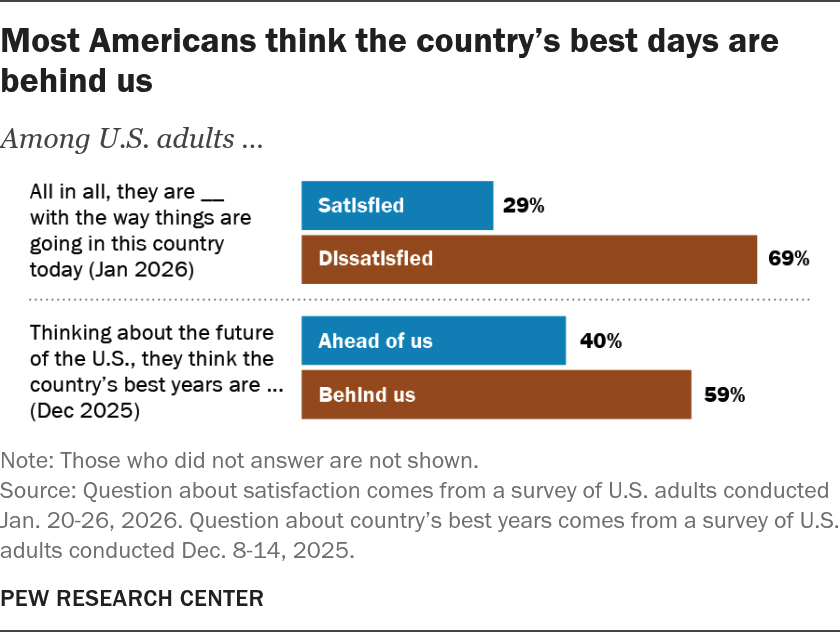
“Most Americans think the country’s best days are behind us”
(Graphic courtesy of Pew Research Center)
Part of the problem is that we have convinced them, and ourselves, to think about happiness in individualized, therapeutic terms. Optimize your morning routine. Manage your anxiety. Cultivate gratitude. Stay present. The promise is that if we tend to our inner life, the chaos outside will feel more bearable.
What that version of happiness can’t do is help us imagine a better future together.
There was a time when Americans located hope not just in personal improvement but in collective projects: the Labor Movement, the Civil Rights Movement, the New Deal. These were endeavors oriented toward something larger than any individual’s mood or even one generation. That orientation has been missing for a while — but it requires a story about why the future matters beyond our own lifetimes.
One place humans have always gone for stories about the future is religion, and this is why I have spent my career studying religious traditions even as someone who is not myself religious. What I have learned is that religious traditions share something the self-optimization industry cannot offer: a vocabulary for collective futures.
Judaism’s concept of ‘tikkun olam’ (repairing the world) assumes the work will never be finished in your lifetime and insists that’s not a reason to stop trying. The Haudenosaunee (Iroquois Confederacy) hold that decisions should be made with seven generations in mind, orienting us toward people who don’t yet exist. Islam understands humans as stewards of the earth on behalf of those who come after. Christianity at its best understands the Kingdom of God not as a postmortem destination but something being built now, collectively, by people who will not see its completion.
You don’t have to be religious to recognize this is something secular culture has never quite figured out how to replace.
Part of the problem is that we have convinced them, and ourselves, to think about happiness in individualized, therapeutic terms. Optimize your morning routine. Manage your anxiety. Cultivate gratitude. Stay present. The promise is that if we tend to our inner life, the chaos outside will feel more bearable.
What that version of happiness can’t do is help us imagine a better future together.
There was a time when Americans located hope not just in personal improvement but in collective projects: the Labor Movement, the Civil Rights Movement, the New Deal. These were endeavors oriented toward something larger than any individual’s mood or even one generation. That orientation has been missing for a while — but it requires a story about why the future matters beyond our own lifetimes.
One place humans have always gone for stories about the future is religion, and this is why I have spent my career studying religious traditions even as someone who is not myself religious. What I have learned is that religious traditions share something the self-optimization industry cannot offer: a vocabulary for collective futures.
Judaism’s concept of ‘tikkun olam’ (repairing the world) assumes the work will never be finished in your lifetime and insists that’s not a reason to stop trying. The Haudenosaunee (Iroquois Confederacy) hold that decisions should be made with seven generations in mind, orienting us toward people who don’t yet exist. Islam understands humans as stewards of the earth on behalf of those who come after. Christianity at its best understands the Kingdom of God not as a postmortem destination but something being built now, collectively, by people who will not see its completion.
You don’t have to be religious to recognize this is something secular culture has never quite figured out how to replace.
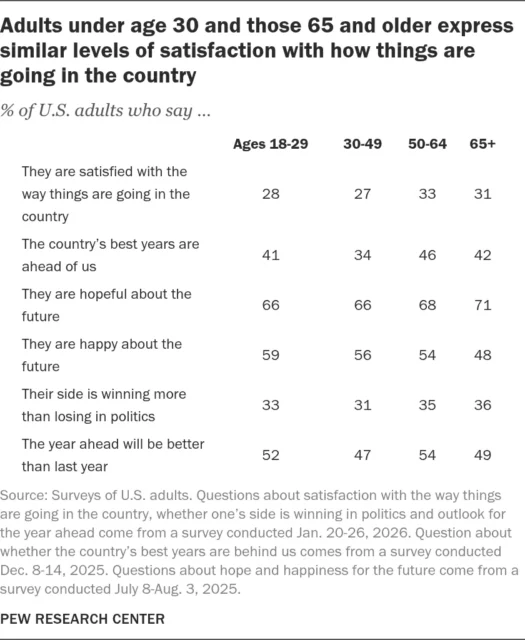
“Adults under age 30 and those 65 and older express similar levels of satisfaction with how things are going in the country” (Graphic courtesy of Pew Research Center)
The Pew data shows a country that feels its feelings without any shared framework for what those feelings are pointing toward. This is a failure happening on multiple fronts simultaneously — in politics, in media, in our institutions and, yes, inside religious communities that have sometimes let their vision shrink down to the size of individual spiritual comfort. We have all forgotten the importance of a collective story.
My father-in-law and his fellow Boomers had a version of the American dream that was structurally possible for them: work hard, build a legacy, pass it on. That story included an economic promise, but it was also a narrative about their place in a timeline and how they could impact the timeline after them. That narrative worked for them. But it won’t work in the same way for my daughter.
She will not become a homeowner at 28 the way her grandparents did. Her college diploma will not carry the same guarantee of employment and social status her grandfather’s did. It will be much harder to raise a family on two incomes, let alone one.
What my daughter’s generation needs is a reason to rebuild. This can’t be an overly optimistic spin on the state of the world nor nostalgia for a version of the American dream that was never available to everyone. What we all need to find again is a collective story about what we owe each other and the future we share.
But how do we do this? The first step is recognizing that going it alone is not the answer, that human flourishing has always been a collective project. The second step is finding new ways to come together across generations to share the stories we love, name the futures we want and reject the ones being written for us by people with too much power and too little accountability. We’ve seen glimpses of what this can look like in the energy that surrounded Zohran Mamdani’s campaign — which felt less like everyday politics and more like a collective imagination exercise.
I think religion is probably how we used to do this, and we haven’t figured out what replaces it. Religious communities were places where people of different generations gathered regularly, told stories about the past and the future and held each other accountable to something larger than their own happiness.
We don’t need to rebuild traditional religion. But we need something that does what religion does at its best.
We have the feelings. My daughter deserves the story.
(Liz Bucar is a professor of religion at Northeastern University and the author of “Beyond Wellness: How Restoring the Religious Roots of Spiritual Practices Can Heal Us” (Tarcher/Penguin Random House, 2026). She writes the Substack bestseller newsletter Religion, Reimagined.)