It’s possible that I shall make an ass of myself. But in that case one can always get out of it with a little dialectic. I have, of course, so worded my proposition as to be right either way (K.Marx, Letter to F.Engels on the Indian Mutiny)
Tuesday, June 23, 2026
U.S. Coast Guard SAR Helicopter Crashes Near Sitka, Alaska
An MH-60 Jayhawk operating near Sitka, 2026 (U.S. Coast Guard file image)
The U.S. Coast Guard reports that a rescue helicopter went down just outside of Sitka, Alaska on Monday morning.
At about 1007 hours on Monday, the command center for Coast Guard Arctic District received report of a crash involving a Jayhawk aircrew operating out of Air Station Sitka. The aircraft had crashed during a training flight near Harbor Mountain, about two miles northeast of Coast Guard Air Station Sitka.
Sitka Fire and Rescue reached the site within about 50 minutes, and its responders retrieved all four aircrew members. All were transported to Edgecumbe Medical Center for evaluation and treatment. Luckily, no fatalities were reported.
"We’re a close Coast Guard family, so it’s great to hear there have been no deaths," said U.S. Coast Guard Lt. Pam Manns, speaking to ADN.
The Coast Guard said that the cause of the crash is under investigation.
The MH-60 Jayhawk is a medium-range SAR helicopter derived from the U.S. Army's Sikorsky UH-60 Black Hawk. It has been in service since 1991, and Monday's casualty is the fifth recorded crash. The Coast Guard has been conducting a service life extension for its existing MH-60s, upgrading all to the new MH-60T specification, and moving to build more MH-60Ts to transition to an all-Jayhawk rotary-wing fleet. That change will phase in gradually through 2040.
The Coast Guard builds and restores its own MH-60 helicopters from used Navy hulls and new hulls from Sikorsky at an assembly hall at Coast Guard Aviation Logistics Center (ALC) in Elizabeth City, North Carolina.
Ukraine Knocks Out Kerch Strait Ferry, Disrupting Russian Fuel Supplies
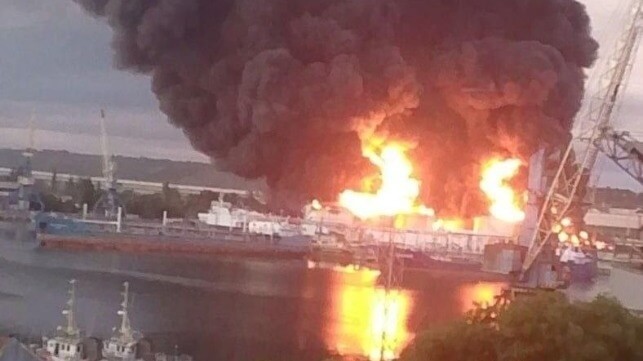
Burning fuel tanks near the ferry landing at Kerch, Crimea (via Russian social media)
Ukraine has launched another attack on the ferry crossing at Kerch Strait, forcing the operator to shut it down and divert military truck traffic onto the Mariupol-Melitopol highway - where it will be within range of constant Ukrainian drone strikes.
Overnight Saturday, Ukraine's drone forces hit the port at Kerch, Crimea, destroying the majority of the fuel tanks at the marine terminal. Fires were also reported at Kavkaz, on the opposte side of the strait.
Drones also struck at least one ferry, the Elena II, a commercial rail-ferry that state enterprise Rosmorport purchased from a Greek operator in 2024. It had been in operation on the Kerch Strait route since mid-2025.
Unverified bystander video footage suggests that at least one other vessel was also hit, and local reports indicate that the ferry service is now out of commission. Fuel trucks are reportedly being diverted from the ferry crossing to the "R-280" road from occupied Mariupol to Crimea, where they will be targeted by Ukraine's medium-strike drone forces.
Russia has another alternative in the form of the Kerch Strait Bridge, a first-rate road and rail crossing adjacent to the ferry route. But the Russian military has been reluctant to use this symbol of Russian presence for the purpose of moving munitions and fuel, as Ukraine has proven adept at leveraging secondary explosions and fires to cause outsize damage. In an attack in 2022, rail tank cars of fuel burst and burned for hours, likely weakening the rail span. The rail bridge's maximum weight capacity was reduced as a precautionary measure. After this hard-earned lesson, the Russian military has made every effort to keep its cargoes of artillery shells and diesel fuel off of the bridge, using the ferries at Kerch as an alternative for hazardous goods (until now).
The R-280 road is itself a poor substitute: in addition to strikes on trucks on the roadway, Ukrainian forces have systematically destroyed road bridges near Crimea, slowing down truck movements. As a consequence of the logistics breakdown, fuel supplies on the peninsula are growing scarce. Russian authorities announced new rationing measures on Sunday, restricting fuel distribution to military and government use only.
Egyptian Seafarer Killed as Russian Drones Hit Three Ships off Ukraine
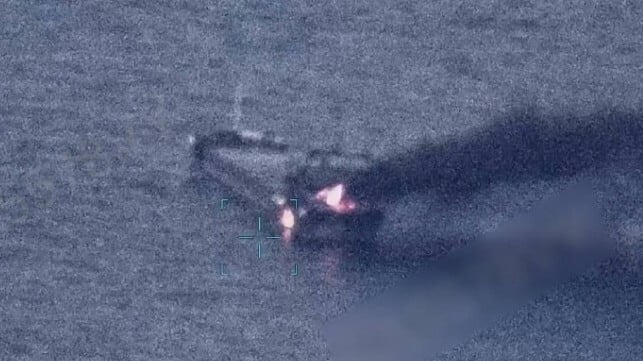
One crewmembers was killed after a Russian drone started a fire on the small cargo ship (Ukrainian Navy)
Ukraine is once again denouncing Russian attacks on commercial shipping in the Black Sea, reporting that one seafarer was killed on Monday, June 22. The strikes came as both sides have intensified their attacks in recent weeks.
Ukrainian officials said a small general cargo ship named Victress (2,386 dwt) was struck on its way to Ukraine. A large fire broke out on the vessel, and as a result, the ship’s Egyptian cook, a 58-year-old, was killed. Eight other crewmembers were able to enter a life raft and were rescued by the Ukrainian Navy.
Built in 1992, the 75-meter (246-foot) long vessel has been operating for Turkish interests since 2018. Reports indicate the ship was making regular trips into the Black Sea.
A video appearing on social media appears to show the bridge and accommodation block of the vessel on fire. Reports said the ship sustained significant damage and is now anchored offshore.
Ukraine’s Minister of Foreign Affairs, Andrii Sybiha, wrote online that the attacks were “a clear demonstration that Russia’s words cannot be trusted. Russia remains the main threat to Black Sea security and prosperity.”
The Ukrainian Navy confirmed that it had conducted a rescue operation. It said, “This case once again demonstrates that the Russian Federation continues to violate the norms of international maritime law and create threats to civilian shipping. The Naval Forces of the Armed Forces of Ukraine will continue to do everything possible to make the seas safe.”
Later, Oleksiy Kuleba, Ukraine’s Vice Prime Minister for Reconstruction, announced that two other vessels had also been struck. He said the ships were flying the flags of Belize and Palau. The report said there were no injuries on these two vessels and that they had continued their journey.
The attacks on the three ships were part of a larger wave of attacks on Ukraine. The port city of Odesa was also hit with reports that two people were killed in a missile strike.
Kuleba, last week, said that 257 civilians have been injured or killed as a result of the attacks on Ukraine’s ports since the start of the war. He reported that Russia has damaged or destroyed 966 port infrastructure facilities and hit more than 200 commercial vessels since it started its invasion of Ukraine in 2022.
Kuleba wrote online that the attacks require a decisive response from the international community.
Japanese Ro-Ro Cargo Ferry Goes Hard Aground on Its Way to Tokyo
Ferry is reported hard aground with efforts to refloat it so far unsuccessful (Video)
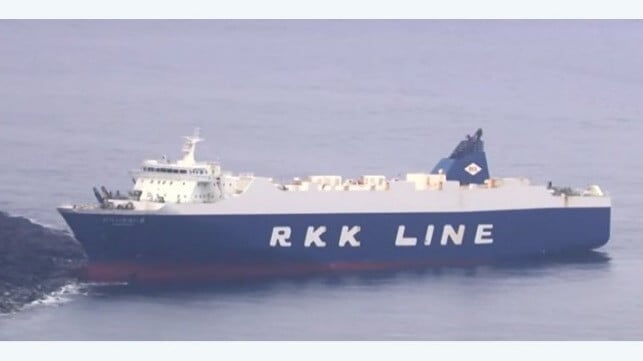
A Japanese cargo ferry making its way from Osaka to Tokyo went hard aground overnight. While there were no immediate reports of damage or environmental issues, the ship remains hard aground after efforts to bring it free during the day on Friday.
The Niraikanai II (7,762 dwt) is a Ro-Ro ferry used to transport cars and cargo between Osaka and Toko. At approximately 0330 local time on Friday, June 19, the vessel’s crew reported it had gone aground off Toshima Island, a small island with just a few hundred inhabitans offshore from Honshu and on the vessel’s route to Tokyo. There were 17 crewmembers aboard.
Built in 2017, the vessel is 181 meters (594 feet) in length. It is 11,687 gross tons. It is unclear from the reports how heavily loaded the vessel was at the time of the grounding. Its operator, Ryukyu Kaiun, says it is one of the largest Ro-Ro vessels on the Okinawa route and that it operates with an electronically controlled main engine that prioritizes environmental friendliness and fuel efficiency.
The Japan Coast Guard only said that the cause of the grounding would be investigated. The Yomiuri Shimbun newspaper was reporting that the seas were calm at the time. It said the winds were under 12 knots and the wave heights under two feet.
Solomon Islands Intercept Shadowy Vessel Suspected of International Crimes
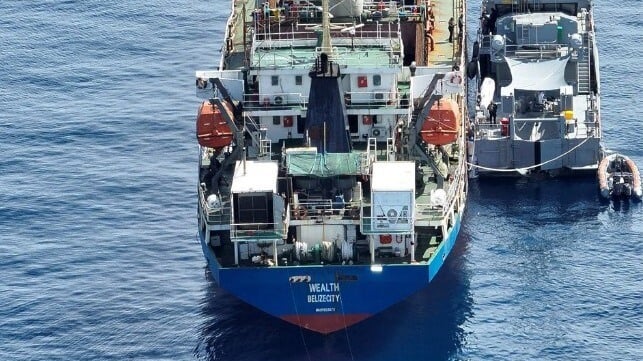
The police in the Solomon Islands intercepted a shadowy vessel believed to be involved in transnational organized crime (RSIPF)
The Royal Solomon Islands Police Force (RSIPF), Solomon Islands Customs, and Immigration conducted a joint operation working with international authorities in the apprehension of a shadowy vessel suspected of involvement in transnational organised criminal activities. The ship has been brought to Honiara, on the island of Guadalcanal, the capital of the Solomon Islands, on the island of Guadalcanal, for further investigation.
The authorities reported they had been tracking the vessel’s movements since April after intelligence reports indicated suspicious movements and activities consistent with organized criminal operations at sea. The Australian Border Force, the Pacific Islands Forum Fisheries Agency (FFA), and other regional law enforcement partners had also become suspicious of the vessel. RSIPF Maritime says the vessel is suspected of drug trafficking, tobacco smuggling, and other forms of maritime transnational crime.
The vessel, identified as MV Wealth (61,00 dwt), is a Belize-flagged general cargo ship measuring approximately 98 metres in length and capable of transporting both containerised and bulk cargo. The vessel was built in 2010 and operated for the Chinese, but according to the databases, it was sold in February 2026, taking on this new identity.
The police report that 19 crewmembers were taken into custody, and they are believed to have come from China, Indonesia, and the Philippines. However, they report they have been unable to verify the identities and nationalities of all crewmembers due to the absence of a complete and legitimate crew manifest, which is part of the ongoing investigation.
Inquiries have revealed that two support tender vessels associated with MV Wealth remain unaccounted for, with the search ongoing. Intelligence assessments indicate a strong possibility that these vessels may have been utilized to transport illicit cargo to other destinations within the Pacific region, including Fiji, Papua New Guinea, Vanuatu, and potentially Australia.
Investigators are also examining the movement of a suspected support vessel and fast craft that reportedly arrived at Noro Marina Wharf on May 8 and departed on May 12, without the knowledge or clearance of Customs, Immigration, or police authorities. There are reports that a Chinese national may have been left behind during this period. These developments have raised further questions regarding the vessel's activities and potential links to illicit cargo transfers.
Investigations into MV Wealth and its associated activities remain ongoing. Authorities are conducting a comprehensive examination of the vessel, its documentation, cargo, crew, and any potential links to broader criminal networks operating across the region.
RSIPF said the interception and detention of MV Wealth underscore the evolving threat posed by organised criminal networks that exploit the vast maritime environment of the Pacific to facilitate illegal activities. Such networks seek to undermine border security, economic stability, and the safety of Pacific communities through sophisticated cross-border criminal operations.
Low on Fuel, Russian Frigate Drifts in the English Channel
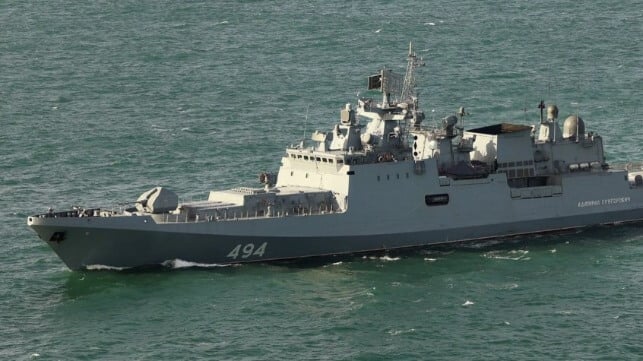
A Russian frigate stationed in the English Channel, which was not on hand to impede the Royal Navy’s seizure on June 14 of the sanctioned Cameroon-flagged Aframax Smyrtos (IMO 9389100), appears to be running very low on fuel.
The frigate RFS Admiral Grigorovich (F494), the lead ship of its namesake class and launched in 2014, has frequently been seen recently in the English Channel and Western Approaches, the more so since Russia has perceived that tankers carrying Russian oil are at risk of seizure. On several occasions she has been refueled, not by one of the numerous oilers equipped for the task and which support far-distant Russian Navy deployments, but by a Project 304 Amur-class floating repair ship, normally used to provide dockside workshop facilities when supporting long-range deployments. Although equipped with five-tonne cranes, the Amur-class vessels are not equipped for conducting replenishments at sea, and have been spotted instead coming alongside the frigate Admiral Grigorovich and conducting makeshift fuel transfer operations at sea. The Admiral Grigorovich does not appear to be equipped with a Ka-27 helicopter, which other ships of the same class often are, and which might help with replenishment tasks.
In an incident in foggy conditions in the English Channel on June 16, the Admiral Grigorovich fired warning shots at a British-flagged yacht, the Bright Future (MMSI 235086766). Although the skipper of the Bright Future claimed he was not on a collision course, the British Ministry of Defence described the firing of warning shots as a normal procedure if closing on a warship. The Admiral Grigorovich was drifting at the time of the incident, presumably to save fuel.
The Admiral Grigorovich was back shadowing Russian tankers through the Channel on June 18, escorting the OFAC and UK sanctioned Russian-flagged Aframax Forwarder (IMO 9419448), which had loaded 730,000 barrels of Urals crude at Ust Luga on June 2 and is bound for Dongying in China. The two Russian ships were shadowed on their way through the Channel by HMS Tyne (P281), without any attempt to repeat the seizure operation carried out earlier in the week against the Aframax Smyrtos (IMO 9389100). The seized Smyrtos is being kept at anchor off Weymouth, in part to ensure that its crew cannot claim asylum in the UK. Three other Aframax tankers which had loaded at Ust-Luga and Primorsk also passed through the Channel on June 18, but were not on any sanctions list, namely the Palau-flagged Visund (IMO 9378864), the Barbados-flagged Aequora Fortune (IMO 9297503) and the Maltese-flagged Hellas Calafia (IMO 9798088).
The Russian Navy is clearly under pressure, and having to prioritize its tasks carefully. Russian tankers are now at risk from the Ukrainian long-range sanctions program not only in the Black Sea, but now also in the Mediterranean. Increasing numbers of European countries are intercepting Russian dark fleet tankers in the Mediterranean, the Baltic and the English Channel. Seizures are not yet taking place when dark fleet tankers are being escorted by Russian warships, which is putting greater pressure on the Russian Navy to find escorts in sufficient numbers, but at a time when Russian warships are themselves also being attacked by Ukrainian drones.
Russian Navy Struggling to Maintain a Mediterranean Presence
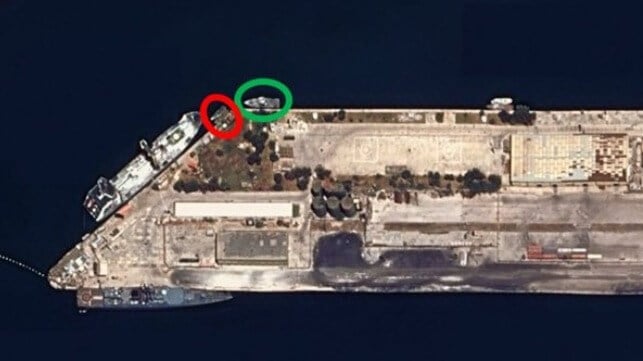
RFS Admiral Kasatonov and the oiler Akademik Pashin docked in Tartus, June 4 (Airbus). Also tentatively identified are 2 x Raptor (red) and a Grachonok Class (green) port security vessels
The Russian Navy seems once again to be heading for a Mediterranean exit, after a presence in May suggested it might be attempting to re-establish its permanent base in the Syrian port of Tartus, once the headquarters of the Mediterranean Flotilla.
On April 29, a convoy passed into the Mediterranean through the Strait of Gibraltar, escorted by the Gorshkov Class frigate RFS Admiral Kasatonov (F461). The convoy consisted of three sanctioned vessels, often involved in arms shipments and resupply activities, the oil products tanker General Skobelev (IMO 9503304), the Ro-Ro cargo vessel Sparta (IMO 9268710), and the Project 23130 oiler Akademik Pashin (IMO 9778193). The convoy had passed through the English Channel on April 18, then through the Strait of Gibraltar, and despite advertising its destination as Port Said, it headed for Tartus. The Admiral Kasatonov then escorted the Sparta and the General Skobelev back towards Gibraltar, handed them over to the frigate RFS Boiky (F532), and then turned backed to Tartus and was imaged with the Akademik Pashin dockside on the old Mediterranean Flotilla wharf on June 4.
In the imagery of June 4, the Admiral Kasatonov and Akademik Pashin are protected by an anti-sea drone barrier – not a precaution which was necessary even a year ago. The maritime open source analyst community have also identified two Raptor and a Project 21980 Grachonok Class Anti-Saboteur Vessel docked close by the Akademik Pashin. It is unclear whether these anti-saboteur craft have arrived recently (perhaps carried by the Sparta on its recent visit), to enhance port security in the face of the Ukrainian long-range sanctions program, or have been kept hidden somewhere in the Tartus area since they were last seen there during the heyday of the Mediterranean Flotilla. Their appearance certainly indicates that the Ukrainian threat is being taken seriously, but also lends weight to reports that the Russian Navy is re-establishing a permanent presence in Tartus. These small port security craft cannot make their way home on their own, so look set to remain in Tartus, presumably to provide security for the Russian presence.
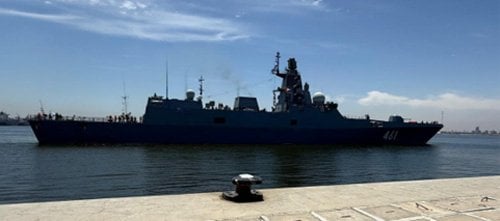
The Admiral Kasatonov alongside in Alexandria (Russian Navy)
The Admiral Kasatonov and the Akademik Pashin subsequently made a port visit to Alexandria on June 12, to celebrate Russia Day. The pair were then spotted south of Sardinia on June 18.
The Admiral Kasatonov was also supported by the oiler Akademik Pashin on a foray into the Mediterranean in March 2021, during which the ships visited Algiers, Piraeus, Alexandria, Tartus, and the Turkish naval base at Aksaz. The Admiral Kasatonov also visited the Mediterranean in 2022 and 2023, suggesting a permanent allocation to the area despite being assigned to the Northern Fleet. But the frigate is probably a less welcome Mediterranean port-caller now than it has been in previous years.
If as expected the two warships head for the Strait of Gibraltar and then for the Admiral Kasatonov’s home port of Severomorsk, the oiler Akademik Pashin will be welcomed in particular by the RFS Admiral Grigorovich (F494). The Admiral Grigorovich is still loitering in the English Channel, harassing the yachting community, seemingly low on fuel and probably looking for a fill-up replenishment at sea.
Teacher feedback linked to stronger social and emotional skills
Teacher feedback is a routine part of classroom interaction, providing students with the opportunity to learn about teachers' opinions of their actions and achievements. Teacher feedback powerfully influences students'learning, achievement, and social development. However, it remains unclear whether teacher feedback in the classroom affects student social and emotional skills and, if so, what types of feedback can are most beneficial. Furthermore, if teacher feedback is positively related to student social and emotional skills, the factors that play vital roles in this relationship should be explored.
To analyze whether student perceptions of teacher feedback differ across student groups, whether teacher feedback affects students' social and emotional skills, as well as the influence mechanism of teacher feedback, a team of researchers comprising Haili Cui from Shanghai Jiao Tong University, Mengmeng Zhang from Shanghai Normal University, and Xingyuan Gao from East China Normal University conducted a quantitative analysis. Their study was published online on June 1, 2026 in the ECNU Review of Education.
This study drew on data from 65,612 students in 15 cities who participated in the SSES 2023, an international survey organized by the Organisation for Economic Co-operation and Development. The sample comprised younger (10-year-olds) and older (15-year-olds) cohorts. Given the hierarchical structure of the dataset, the researchers employed a three-level model to account for its nested characteristics. Hierarchical linear model analysis and a mediating effect test were performed to examine the relationships among the variables. Teacher feedback was divided into three categories, namely feedback about students' strengths, areas needing improvement, and strategies to improve their performance. Social and emotional skills were evaluated using the OECD framework, which includes five dimensions.
The researchers found that gender, age, immigrant status, and reading grades were associated with student perceptions of teacher feedback. However, the effects of immigrant status, socioeconomic status, and math grades on student perceptions of feedback differed between 10- and 15-year-olds. "Our findings suggest that variations in student perceptions of teacher feedback across different student groups. For instance, the 10-year-oldsin our study received more feedback," Cui et al.concluded.
The researchers also found positive associations between teacher feedback and the five domains of student social and emotional skills. Feedback about students' strengths, areas needing improvement, and strategies to improve their performance were each positively related to these skills.
The researchers further reported that teacher feedback affected student social and emotional skills through the teacher–student relationship, after controlling for students' background characteristics. This finding reveals that teacher feedback provides students with opportunities to understand teachers' perceptions of their personal characteristics and school performance, helping them feel respected and understood. In turn, this process improves students' favorable impressions of teachers, which contributes to more positive teacher–student relationships and support the development of students' social and emotional skills.
"Considering the significant value of this feedback in students' promoting academic performance and social and emotional skills, teachers could provide students with feedback that focuses on their personal strengths, areas for improvement, and actionable strategies for improving their academic performance," suggested Cui et al.
The insights gained from this study may provide valuable suggestions for teachers school leaders, and policymakers seeking to strengthen adolescents' social and emotional development through everyday classroom practice.
Teacher Feedback and Student Social and Emotional Skills: An Empirical Study Based on Second Round of SSES 2023 Data
Article Publication Date
21-Jun-2026
COI Statement
The authors declared no potential conflicts of interest with respect to the research, authorship, and/or publication of this article.
Scientists have designed a clay that can prevent fruits and vegetables from rotting too quickly
The gas ethylene causes fruit and vegetables to ripen faster and is responsible for millions of tons of food being lost annually during transport and storage. Now researchers from the University of Copenhagen, among others, have succeeded in getting clay
The research was led by Bordallo’s group at the University of Copenhagen in collaboration with her group members, Karina Kovalchuk and Leander Michels at Lawrence Berkeley National Laboratory (LBNL).
Avocados from Chile, bananas from Costa Rica, tomatoes from southern Spain, mangoes from Brazil. A large part of the fruits and vegetables we eat have travelled across the globe before they reach store shelves here at home. But many millions of tons are lost every year before they reach that far.
One of the main reasons is ethylene – a natural gas that many fruits and vegetables produce and that controls their ripening. When fruits and vegetables are confined in closed packaging or containers during transport and storage, the concentration of ethylene in the air increases, accelerating the ripening process. As a result, a large part of the cargo ends up rotting before it reaches its final destination.
Clay may be the solution
Now, new research led by the University of Copenhagen shows that ordinary clay could probably be part of the solution.
"Clay is an interesting material because it is natural, cheap, non-toxic and found everywhere - and we can absorb it safely into the body. Our thought was: Can we use chemistry and physics to modify clay so that it captures the gas and thus slows down the ripening process? We have succeeded in doing so," says Associate Professor Heloisa Bordallo from the Niels Bohr Institute, who led the new study .
First, the researchers tried to capture the gas with the clay in its natural form. Here, a small amount was captured. By increasing the voids in the clay's structure with a mild chemical treatment, the researchers made room for the clay to capture more gas – but without the gas escaping again – while keeping the material nontoxic.
Researchers have never succeeded in getting clay to absorb such large amounts of ethylene, which is why they believe the concept has potential for use in food packaging.
"Now we know the fundamental physics and chemistry of the process that affects the clay's ability to absorb and retain ethylene. We didn't do that before. So now we can control and optimize the process, which is necessary for it to be used in industry," says Karina Kovalchuk, a a member of Bordallo’s group at Lawrence Berkeley National Laboratory and first author of the study.
Degasser in food packaging
According to the researchers, the research results provide a kind of design manual for how to develop sustainable materials for food packaging that tackle the problem of ethylene.
“We imagine small bags or pads of powdered clay that can be placed with fruit and vegetables during transport and absorb ethylene – in the same way as the moisture-absorbing silica bags that often come in the packaging when you buy, for example, shoes and electronics,” says Karina Kovalchuk.
The research group is currently working on optimizing the chemical process to strike the right balance between effectiveness and environmental friendliness. They are also investigating whether they can make the clay capture even more ethylene and retain it for even longer. Next, the clay material will be tested in food packaging, and hopefully then the concept can be brought to market.
Two good purposes
The new material not only has the potential to reduce food waste. Another consequence of the ethylene problem and the long transport is that fruits often do not develop their full flavour. Much fruit is harvested early precisely to avoid them rotting along the way. But many processes in the fruit are thus not fully developed and cannot be 'caught up' fully later, even if the fruit ripens with ethylene during transport. And this affects the taste and aroma.
"If we manage to solve the problem with ethylene, it serves two good purposes. First, we can reduce the global problem of food waste. At the same time, it can make it possible to harvest fruit later in the ripening process, so that consumers get fruit that tastes as it should," concludes Heloisa Bordallo.
Although the study focuses on ethylene and food, the researchers point out that the research results may also have implications for other technologies where materials need to collect certain gases.
THE STUDY SHOWS
Ethylene is a natural plant gas that many fruits and vegetables secrete and which controls their ripening.
When ethylene gas accumulates during transport and storage, it can significantly shorten the shelf life of fruits and vegetables.
In the study, the researchers used the clay mineral Montmorillonite, which is widespread, nontoxic and naturally occurring.
To investigate how the gas moves in the clay material, the researchers used advanced measurement methods with neutrons and X-rays as well as thermal analyses, where the material is heated and its reaction is measured.
The study shows that chemically modified clay can both increase the uptake and retention of ethylene.
ABOUT THE STUDY
The scientific article about the study has been published in the journal Applied Surface Science Advances.
The following researchers have contributed: Karina Kovalchuk and Leander Michels from Lawrence Berkeley National Laboratory, USA; Will Gates from Deakin University, Australia; Murillo Martins from Oak Ridge National Laboratory, USA, GW Greene from La Trobe University, Australia and Heloisa N. Bordallo from the University of Copenhagen.
The research is supported by the Laboratory Directed Research and Development (LDRD) Program of Lawrence Berkeley National Laboratory and the Carlsberg Foundation.