Showing posts sorted by relevance for query IBLIS. Sort by date Show all posts

Saturday, October 31, 2020

Trump fans tricked into thanking 'Satan' for supporting president


Posted by Greg Evans in news

A string of high-profile American conservatives and Trump supporters have been tricked into thanking Satan for supporting the president.

The likes of Corey Lewandowski, Sebastian Gorka, Tomi Lahren and outspoken Arizona sheriff Joe Arpaio were all duped into thanking someone called 'Iblis' for campaigning for the president.

However, unknowing to them the name 'Iblis' is actually Satan in Arabic. The prank was organised by comedy writer Ali-Asghar Abedi via the Cameo video app where users can pay celebrities to say whatever they want.

Huffington Post reports that Roger Stone, another person with close ties to Trump, had been sent the request but never recorded the video.

Abedi admits that he did spell the name 'Ebliz' when he sent the request. He is quoted as saying:

I left clues for them. I told them that Iblis was Arab American. If they had a sense of the world beyond MAGA, they’d research what Iblis means in an Arab context. I guess they’re true adherents to capitalism, placing money ahead of their own dignity. I spelled it ‘Ebliz’ and laid out the pronunciation as ‘ibb-lease.’ But [I] figured mentioning that Iblis is Arab should have been a cue to vet the request with someone who knows Arabic.

This isn't the first time that Abedi has caught out members of the American right-wing. Earlier this year he pranked Tomi Lahren into calling Trump a 'jackass' in Hindi.

Tuesday, July 03, 2007

Satan Made Him Do It

Maybe Satan made him do it.

NYC man attacks stray peacock, says it's a vampire

A peacock that roamed into the parking lot of a fast-food restaurant was attacked by a man who vilified the bird as a vampire, animal-control authorities said. The peacock, a male several years old, wandered into a Burger King parking lot in the New York borough of Staten Island and perched on a car hood Thursday morning. Charmed employees were feeding him bread when the man appeared.
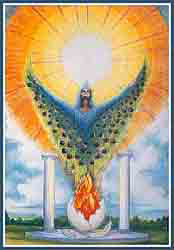
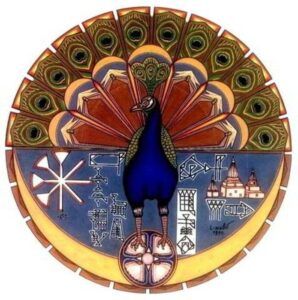
The peacock is sacred to Satan/Lucifer/Iblis according to the Yezedi (aka Yezidi, Yazidi).


Melek Taus, "The Peacock Angel" (in Arabic script ملك طاووس), is the Yazidis' name for the central figure of their faith.


Then said the Mighty Lord, "O Angels, I will create Adam and Eve, and will make them human beings, and from them two shall arise, out of the loins of Adam, Shehr ibn Jebr; and from him shall arise a single people on the earth, the people of 'Azazel, to wit of Ta'us Melek, which is the Yezidi people. Then I shall send Sheikh 'Adi b. Musafir from the land of Syria, and he shall come and dwell in Lalesh".
Meshaf Resh: The Black Book


Azazil (Arabic: عزازل) is often called Shayṭān ( "the Accursed one" الشيطان = "Satan" in the Bible.) When Adam was created in paradise, Allah commanded all the angels to bow down to him. All did as ordered except Azazel, who was too proud to bow down to a mere mortal, protesting: "Why should a son of fire [an angel, or star, formed from that eternal element], fall down before a son of clay?" So God cast Azazel out of Heaven and changed his name to Iblis (إبليس) meaning "despair" or "the despaired".

The Yazidis consider Melek Taus to be a benevolent angel who has redeemed himself from his fall, and has become a demiurge who created the cosmos from the Cosmic Egg. After he repented, he cried for 7000 years, his tears filling seven jars, which then quenched the fires of hell.

Melek Taus is sometimes transliterated Malak Ta'us or Malik Taws. In Semitic languages, malik/melech variably means "king" or "angel". Taus is uncontroversially translated "peacock"; however, it is important to note that peacocks are not, at least currently, native to the lands where Melek Taus is worshipped. This has lead some to speculate that the worship of Melek Taus was imported from India, though it is more likely the peacock iconography is a development from earlier representations depicting the god as a native fowl, such as a bustard. The Yazidi believe that the founder of their religion, Sheikh Adi Ibn Mustafa, was an avatar of Melek Taus. In art and sculpture Melek Taus is depicted as peacock. The Yazidi are thought to be unique in their depiction of their primary god as a bird.


SEE:

Eloi, Eloi, Lama Sabachthani

Black History Month; P.B. Randolph

My Favorite Muslim

Antinominalist Anarchism

Bulgarian Women Abused

New Age Libertarian Manifesto

Heresy

Gnosis

Gnostic

Find blog posts, photos, events and more off-site about:
, , , , , , , , , , , , , , , , , , , , , , , , ,
, , , I
, , , , , , , , , ,


Saturday, December 31, 2022

The Devil went down to Kyiv 

Scholar Eliot Borenstein examines the worrying ‘video game logic’ behind Moscow’s fundamentalist fight


 December 30, 2022
Source: Meduza
By Dr. Eliot Borenstein


Who, exactly, is the enemy Russia has targeted in its unprovoked invasion of Ukraine? Not Ukrainians, who, as the Russian media continually remind us, don’t actually exist. Not NATO and the “collective West,” however much they might fit the bill; Russian television has been demonizing them for more than a decade, but there is little appetite for a direct confrontation. Throughout most of the war, the “Kyiv Junta” has been labeled a band of homosexuals, drug addicts, and, most prominently, Nazis. Yet somehow even Nazis are not quite evil enough. So, who is the true enemy? Could it be … Satan?

Apparently, yes. 

On November 4, Deputy Chairman of Russia’s Security Council Dmitry Medvedev, who just 15 years ago was the gadget-happy, reformist president on whom the country’s liberals pinned their few remaining hopes, gave a speech worthy of a wannabe suicide bomber: 

We listen to the words of the Creator in our hearts and obey them. These words give us our holy goal. The goal of stopping the supreme leader of hell, whatever name he might use — Satan, Lucifer, or Iblis.

As Artem Efimov notes in his excellent contribution to Meduza’s “Signal” Russian-language newsletter (all the Satanic news fit for pixels, if not print), it was Chechen leader Ramzan Kadyrov who, while apparently moonlighting as a demonologist on his Telegram channel, called for the “desatanization” of Ukraine. This is the sort of language we have come to expect from Kadyrov, who rails against “shaitans” so often that they may as well be one of the odd filler words that notoriously pepper most of his sentences. We not only expect Satan from Kadyrov — we’re disappointed if he forgets to mention him.

If both the Muslim Kadyrov and the Russian Orthodox Medvedev are warring against Satan, then this isn’t simply a matter of the ongoing mind meld between the Russian (Orthodox) Church and State. One need not believe in God to worry about Satan (although it certainly helps). 

The U.S. has been beset by waves of demonically-inflected hysteria since the infamous Satanic Panic of the 1980s, when a confluence of concerned parents, “experts,” and media personalities turned a few unhinged accusations of so-called “satanic ritual abuse” into a threat that stalked America’s schools and daycare centers. The officially atheist Soviet Union was spared this particular wave of hysteria, but, as Efimov points out, the moral panic over new religious movements (“cults”) in the 1990s brought satanism into the Russian popular consciousness.

By the 2000s, activists associated with the Russian Orthodox Church (ROC) were ferreting out Satanists left and right. And they involved the government whenever possible. When the Moscow Education Department banned Halloween in the city schools, it claimed that the holiday promoted a “cult of death” and pointed to concerns about “rituals of Satanically oriented religious sects.” The popularity of the Harry Potter franchise put the morality police into overdrive. In December 2002, a woman filed a complaint with Moscow Prosecutor’s Office against Rosmen, the publisher of Harry Potter, for “occult propaganda” (the prosecutors declined to charge Rosmen, due to a lack of evidence).

Something was spreading throughout Russia since the collapse of the USSR, but it was not Satanism: it was the crusade against Satanism. 

This was a movement that crossed church and state boundaries long before the 2022 invasion of Ukraine. The demonization of “cults” in the 1990s was an important step, but it was only in the past decade that both scholars and state actors indulged in a crucial slippage between the religious and the political. The Center for Combating Extremism, founded in 2008, fights both political opposition and unrecognized religious organizations, tacitly making them equivalent “threats.” In 2020, Roman Silantev, one of the leading experts combating new religious movements, published a book called Destructology, which provides the ideological justification for the Center’s work. For Silantev, undesirable political and social movements such as pyramid schemes, “fascist” and “antifascist” groups, and even the pensioners who insist that the USSR still exists, are structurally exactly the same as “totalitarian cults.” From here to Satanism is just a small step.

IBLIS

Since February 24, disaffected Russians have been asking themselves the grimly ironic question: “So, are we North Korea now, or Iran?” If the country is going to be explicitly fighting Satan, then Iran seems like the better bet. But the irony goes even deeper. There’s something about looking for Satan around every corner that is suspiciously …American.

The rise of the Russian anti-cult movement and the fundamentalist fight against secular culture are part of an ideological pipeline that leads back to the Great Satan itself, with American far-right and evangelical organizations taking a strong interest in the post-Soviet space even before Fox News became Russian television’s favorite American channel.

All of which suggests that we should not take the Russian state’s anti-Satanic zeal at face value. And yet something about Russia’s war in Ukraine has repeatedly activated theocratic, reactionary forces. In November 2014, one of the military leaders of the self-proclaimed “Luhansk People’s Republic” announced plans to forbid women from entering bars, when they should be sitting at home practicing their cross-stitching. (“It’s time to remember that you’re Russian! Remember your spirituality!”)

It’s highly unlikely that Medvedev, Putin, or anyone high up in the Russian government believes they are fighting Satan, but their beliefs matter only so much. They are providing a permission structure for fanatics who are only too happy to stamp out the devil’s work wherever they might find it. Just as Putinism has always been a delicately calibrated mix of top-down initiatives and responses to the more belligerent sentiments in Russian society, so too is this Satanic vocabulary both the logical outcome of decades of mild moral panics and the latest (and possibly last) rhetorical ploy on the part of a regime that has backed itself into a corner.

The escalation from gays to Nazis to Satan follows a kind of video game logic: keeping the players engaged means finding ever-bigger bosses for them to fight. But where can you go after Satan? One hopes that the leadership of the Russian Federation is not charting a deliberately apocalyptic course, despite the disturbing chatter about nuclear warfare and Russians “going to heaven, while their enemies just croak.” But when your enemy is Satan, there is little room for negotiation, retreat, or surrender.

All of which scares the hell out of anyone paying attention. Still, there is one cause for hope: If there is any world leader who must have vast experience in making deals with the devil, it’s Vladimir Putin.


Eliot Borenstein is a professor of Russian and Slavic Studies at New York University. He is the author of two forthcoming books — Marvel Comics in the 1970s: The World Inside Your Head (Cornell) and Soviet-Self-Hatred: The Secret Identities of Postsocialism in Contemporary Russia (Cornell) — and the recently released Meanwhile, in Russia…: Russian Internet Memes and Viral Video (Bloomsbury).


THE KUBASONICS

Saturday, May 02, 2020

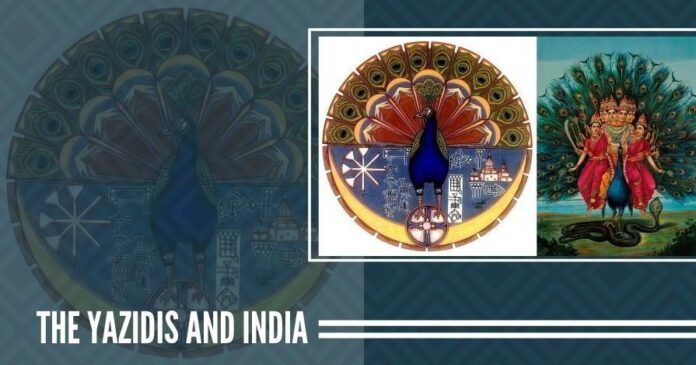
The Yazidis and India

Here I want to speak of the lesser-known connections between the Yazidis and Indians.
By Subhash Kak

-September 2, 2019
Here I want to speak of the lesser-known connections between the Yazidis and Indians.
According to their folklore, the Great Flood compelled Yezidis to disperse to many countries including India, and they returned from these adoptive countries around 2000 BCE.

The Yazidis live far away from India in Iraq, Iran and Turkey. Even though they have legends connecting them to the east, the idea of a link with India appears ridiculous at first sight. But history has wheels within wheels and sometimes reality turns out to be vastly different from common belief.


The Yazidis speak a northern dialect of the Kurdish language, which some call a separate language with the name Ezdiki. Their religion, Yazidism, is also called Sharfadin (the religion of the cultured folks). Reviled as devil worshipers for centuries by their Muslim and Christian neighbours, they have endured over 70 genocides in which millions died and most others were compelled to abandon their culture.

It is not only the kings who had Sanskrit names; a large number of other Sanskrit names have also been unearthed in the records from the area.

The Yazidis were denounced as infidels by al-Qaeda in Iraq who sanctioned their indiscriminate killing. In 2007, a series of coordinated car bombs killed nearly 800 of them.

The Islamic State began a campaign of destroying their cities and villages in 2014. It murdered nearly 3,000 of them, abducted 6,500, and sold 4,500 Yazidi women and girls into sexual slavery. Many of the abducted girls committed suicide. Nadia Murad, the Yazidi human rights activist and 2018 Nobel Peace Prize winner, was kidnapped and used as a sex slave.

Here I want to speak of the lesser-known connections between the Yazidis and Indians. We are not speaking here of the links through the overarching Indo-Iranian language family, but even there it should be noted that in this family the earliest node on the Iranian side is Avestan, which is literally identical to Vedic Sanskrit, and so the family should really be called the Vedic family, of which Indo-Aryan and Iranian are two daughters. These two subfamilies are connected in multiple ways through shared notions and history [1].

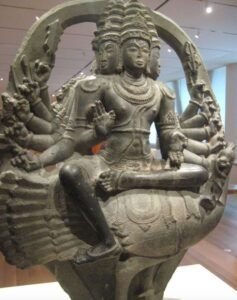
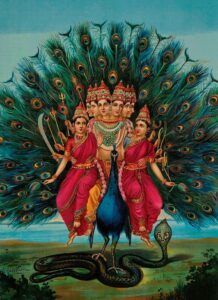
In the second millennium BCE, we have the Mitanni of Syria worshipping Vedic gods. Even prior to that in the third millennium BCE, the figure of Paśupati (Lord of Animals), an epithet of the Hindu deity Śiva, is seen in the famous eponymous seal of the Sarasvati-Sindhu Civilization, a memory of which was retained in the Indic groups who lived across Central Asia. Śiva’s son Skanda (also known as Kumāra, Murugan or Kārttikeya), the general of the gods, has peacock as his amount. The main deity of the Yazidis is the Peacock Angel, Taus Melek.

The peacock is native to the Indian subcontinent and it has long served as a symbol of royalty. We find images of the peacock going all the way back to the 3rd millennium BCE sites of the Sarasvati Civilization. The peacock is worshipped in the Pongal Festival in Tamil Nadu and revered all over India.

The Atharvaveda describes Kumāra as Agnibhuh or born of Agni, the fire god. The Śatapatha Brāhmaṇa refers to him as the son of Rudra and the ninth form of Agni. The Taittirīya Āraṇyaka contains a Gāyatrī mantra for him. The Chāndogya Upaniṣad refers to Skanda as the “way that leads to wisdom.” The Baudhāyana Dharmasūtra provides additional names of Skanda, such as Mahāsena and Subrahmanya. The Skanda Purāṇa is devoted to the narrative of Kārttikeya. 
12th-century image of Skanda from Andhra Pradesh Vedic gods in West Asia

Mitanni ruled northern Mesopotamia (including Syria) for about 300 years, starting 1600 BCE, out of their capital of Vasukhāni[2]. In a treaty between the Hittites and Mitanni, Indic deities Mitra, Varuṇa, Indra, and Nāsatya (Aśvins) are invoked. Their chief festival was the celebration of Viṣuva (solstice) very much like in India. It is not only the kings who had Sanskrit names; a large number of other Sanskrit names have also been unearthed in the records from the area.

The list of the Sanskrit names used in Syria and elsewhere was published by P. E. Dumont of the Johns Hopkins University, in the Journal of American Oriental Society in 1947, and one may see a summary of that in my own book chapter on Akhenaten, Sūrya, and the Ṛgveda[2]. The names of the main kings are (with the standard Sanskrit form or meaning inside brackets): The first Mitanni king was Sutarna I (good Sun). He was followed by Baratarna I (Paratarṇa, great Sun); Paraśukṣatra (ruler with axe); Saustatar (Saukṣatra, son of Sukṣatra, the good ruler); Paratarṇa II; Artadama (Ṛtadhāman, abiding in cosmic law); Sutarṇa II; Tushratta (Daśaratha or Tveṣaratha, having ten or fast chariots); and finally Matiwazza (Mativāja, whose wealth is thought), during whose lifetime the Mitanni state became a vassal to Assyria.

The peacock imagery adorns Yazidi shrines and houses of worship and other places. The attacks on them are a consequence of the Christian and the Muslim belief that the Peacock Angel is Satan or Iblis.

Across India, Iran and West Asia in the ancient world, the worshipers of Veda were called Devayājñi (or Devayasni), or deva-worshiper, of which the terms Sanātana Dharma or Vedic Dharma are synonyms. The name by which the Zoroastrians call their own religion is Mazdayasna (Sanskrit, medhā-yajña), or the religion of Ahura Mazda (Sanskrit Asura Medhā, Lord of Wisdom). Zarathushtra presented his religion as a rival to the religion of the devas (spelt now as daeva in Avestan), that is Devayasna. One can assume that before Zarathushtra, the Indo-Iranian speakers in West Asia were all Devayasni.
Devayasni worship

The Yazidis call themselves Daseni (Dawasen, pl.) which is the same as Devayasni, which confirms what we know from the Mitanni records about the history of that period. The word Yazidi is cognate with Sanskrit Yajata (worthy of worship) which in Old Persian (and Kashmiri) is Yazata [3],[4].

According to their folklore, the Great Flood compelled Yezidis to disperse to many countries including India, and they returned from these adoptive countries around 2000 BCE. From the archaeological record, the most plausible spread of Devayasna from India took place about 1900 BCE, soon after which Vedic gods begin to be mentioned in Mesopotamia and Syria.

Zarathushtra came from Bactria near Afghanistan and his new religion split the Deva-worshipping communities in the West from the ones in India. The 4,000-year estimate of the Yazidis on when they returned from India is consistent with this figure.

After the rise of Zoroastrianism, Devayasna survived for a pretty long time in West Asia. The evidence of the survival comes from the Deva- or Daiva-inscription of Iranian Emperor Xerxes (ruled 486–465 BC) in which the revolt by the deva worshipers in West Iran is directly mentioned. Xerxes announces[15]: “And among these countries, there was a place where previously Daiva [demons] were worshipped. Afterwards, by the grace of Ahuramazda, I destroyed that sanctuary of Daiva, and I proclaimed: The Daiva shall not be worshipped!” This, nearly 2,500 years ago, is an early record of the persecution suffered by the Devayasni, the ancestors of the Yazidis. This accusation of demon or devil worship was repeated later by Christians and Muslims.

The peacock was a sacred symbol to the Jats[6], an Indic group on the Eurasian Steppe, who served as a mediating agency between India, West Asia, and Europe.

Skanda/Murugan, together with the peacock mount, has been a popular deity in South India, which was strongly linked by sea-trade to West Asia and Europe. The story of the spread of the reverence for the peacock from India to Persia and beyond to Europe is well-known.

We see the centrality of Śiva and Skanda in the representation of their coins of the first-century Kushana kings in the deities Οηϸο (Oesho, Īśa = Śiva) and Σκανδo koμαρo (Skando Komaro, Skanda Kumara). The rule of the Kushanas extended to regions that border on today’s Yazidi lands. 
Skanda with his consorts (Painting by Raja Ravi Varma)

The Yazidi religion

The Yazidis have a rich spiritual tradition and their modern culture goes back to the 12th-century leader Shaykh Adi (died in 1162), a descendant of Marwan I, the fourth Umayyad Caliph, whose tomb is in Lalish in Northern Iraq that is now the focal point of Yazidi pilgrimage.

Some believe that Yazidism is a branch of the pre-Islamic, native religion of the Kurds. There are also similarities between the Yazidis and the Yaresan, that extends back in time to the pre-Zoroastrian Devayasnic religion of West Asia.

The Yazidis number approximately 800,000, including about 150,000 who have taken refuge in Europe. They describe themselves as believing in one true God, and they revere Taus Melek, the Peacock Angel who is an embodied form (avatar) of the infinite God. Six other angels assist Taus Melek and they are associated with the seven days of creation with Sunday as the day of Taus Melek. The peacock imagery adorns Yazidi shrines and houses of worship and other places. The attacks on them are a consequence of the Christian and the Muslim belief that the Peacock Angel is Satan or Iblis.

The Yazidi religion is a mystical, oral tradition consisting of hymns (qawls), that are sung by qawwāls. Parts of the tradition have now been transcribed as two holy books called the Kitab al-Jilwa (Book of Revelation) and the Mishefa Reş (Black Book).


The Yazidi calendar goes back to 4750 BCE. It appears that this is connected to the Indian King list that goes back to 6676 BCE, which is mentioned by the Greek historian Arrian in his account of Alexander’s campaign.
Tawûsê Melek, the Peacock Angel

Given that many Yazidis claim to have originated in India, the veneration of the peacock may be a memory of this origin. In India, apart from the peacock as the vehicle of Skanda, it is also associated with Kṛṣṇa, who wears a peacock feather in his hair or in the crown. Of the seven colours produced from the primal rainbow, Tausi Melek is associated with the colour blue, which is also the colour of Kṛṣṇa.

Through his manifestation as a snake, Taus Melek is consistent with the perspective of the yogis of India, for whom the serpent on the tree is a metaphor for the inner serpent (kundalini) that coils around the spine.

Yazidis pray in the direction of the sun, excepting for the noon prayer which is in the direction of Lalish. They believe in reincarnation and they take it that the angels (with the exception of Taus Melek) have been incarnated on earth as holy people or saints. Just like the Hindus, they use the metaphor of a change of garment to describe the process of rebirth.

Like other Indo-European cultures, the Yazidi society is tripartite, with the three classes of Shaykh (priests), Pir (elders), and Murid (commoners) and they marry only within their group. Their society does not allow conversion. The Shaykhs are divided into Faqirs, Qawwals, and Kochaks. The secular leader is a hereditary Mīr or prince, whereas Bābā Shaykh heads the religious hierarchy.

The Yazidi calendar goes back to 4750 BCE. It appears that this is connected to the Indian King list that goes back to 6676 BCE, which is mentioned by the Greek historian Arrian in his account of Alexander’s campaign. (More on this is in my book The Astronomical Code of the Ṛgveda.)

During the New Year celebration, bronze lamps crowned with peacocks, called Sanjaks, which are similar to the bronze peacock ārati-lamps, are taken from the residence of the Mīr in a processional by the qawwals through the Yazidi villages. It is believed that the Sanjaks came from India, and originally there were seven, one for each of the Seven Sacred Angels, but five were taken away by the Turks, and now only two remain.

The Yazidis are a symbol of mankind’s indomitable will. As a persecuted people in world history, they deserve praise and support for their courage and bravery in the face of the greatest odds.

Note:
1. Text in Blue points to additional data on the topic.
2. The views expressed here are those of the author and do not necessarily represent or reflect the views of PGurus.

References
[1] S. Kak, Vedic elements in the ancient Iranian religion of Zarathushtra. Adyar Library Bulletin 67: 47–63 (2003)
[2] S. Kak, Akhenaten, Sūrya, and the Ṛgveda. In G.C. Pande (ed.), A Golden Chain of Civilizations: Indic, Iranic, Semitic, and Hellenic up to C. 600. (2007)
[3] B. Acikyildiz, The Yezidis. I.B. Tauris (2010)
[4] E.S. Drower, Peacock Angel. London (1941)
[5] The Achaemenid Royal Daiva Inscription of Xerxes.
[6] P. Thankappan Nair, The peacock cult in Asia. Asian Folklore Studies 33: 93–170 (1974)

Author
Recent Posts


Subhash Kak

Padma Shri Awardee, Author, scientist. Quantum information, AI, history of science.

Monday, December 29, 2025

Ben-Gvir flees after being pelted with stones in Palestinian village in Negev

ISLAM HAS A TRADITION OF STONING IBLIS 
AT MECCA

December 29, 2025 


Israel’s National Security Minister Itamar Ben-Gvir on 10 September, 2023 [OHAD ZWIGENBERG/POOL/AFP via Getty Images]

Angry Palestinians from the Bedouin village of Tarabin, located in the occupied Negev region of southern Palestine, which has been under Israeli control since 1948, threw stones at Itamar Ben Gvir, the far-right extremist serving as the so-called Minister of National Security in the Israeli occupation government. The incident occurred on Sunday after Israeli occupation forces stormed the village and arrested several residents.

Channel 14 reported that Minister of National Security Itamar Ben-Gvir visited the village of Tarabin in the Negev on Sunday to oversee police operations. During his visit, dozens of villagers clashed with the police and threw stones at him.

Video clips shared on social media showed Ben-Gvir being hit with stones and leaving the area under heavy police protection. Israeli police responded by firing tear gas at the villagers.


Monday, February 13, 2006

My Favorite Muslim


Abou el Moughith al Hussein ibn Mansour al Hallaj

أبو المغيث الحسين إبن منصور الحلاج

ana'l -Haqq - I am the Truth.

(this is the saying which apparently earned al-Hallaj his martyrdom - al Haqq also means God)


The school of Islam that most represents the heresy of Gnosticism, freethinking, the enlightenment values that so offend the fundamentalist Christian, Jew and Muslim alike, is Sufism.

One of the greatest Sufi thinkers a gnostic, a freethinker, an apostate and heretic was Mansur el Hallaj, who when after meditating for a long period was asked what he learned of Allah, and replied; "
I say, I am the Absolute Truth. Inside my cloak is nothing but Allah.". For this he was stoned to death.

Not unlike the mythological stoning and death of Hiram the builder, whom the Freemasons draw on as the source of their initiatory wisdom. The mythos is about the building of Solomon's temple and the betrayl of the architect Hiram Abiff for whom, like Mansur el Halaj, the truth was that he was God. For this heresy he was stoned to death. The modern version of this legend is key to Masonic teachings, showing a link however tenuous to Sufism as well as hermeticism.

The Old Testament of the Bible, on the evolution of the work, says to us:

"Hiram Abiff fused two bronze columns. It had each one eighteen elbows of stop, and a thread of twelve elbows was the one that could surround each one by the columns. They were not massive, but hollow; the thickness of its walls was of four fingers. It fused bronze capitals stops upon the columns; of five elbows of height the one and five elbows of height other... It erected the first column of the right and it gave the name him of Jakin, and soon the column of the left and gave the Boaz name him. As it ends of the columns were a species of iris. Thus the work of the columns was finished ". (I Re 7, 15-22).


Idries Shaw, the Grand Sheik of the Sufi s and historian of their faith, commented on the connection between the Templars and the Sufis:

That the Templars were thinking in terms of the Sufi , and not the Solomonic, Temple in Jerusalem, and its building, is strongly suggested by one important fact. “Temple” churches which they erected, such as one in London, were modeled upon the Temple as found by the Crusaders, not upon any earlier building. This Temple was none other than the octagonal Dome of the Rock, built in the seventh century on a Sufi mathematical design, and restored in 913. The Sufi legend of the building of the Temple accords with the alleged Masonic version. As an example we may note that the “Solomon” of the Sufi Builders is not King Solomon but the Sufi “King” Maaruf Karkhi (died 815), disciple of David (Daud of Tai, died 781) and hence by extension considered the son of David, and referenced cryptically as Solomon — who was the son of David. The Great murder commemorated by the Sufi Builders is not that of the person (Hiram) supposed by the Masonic tradition to have been killed. The martyr of the Sufi Builders is Mansur el-Hallaj (858-922), juridically murdered because of the Sufi secret, which he spoke in a manner which could not be understood, and thus was dismembered as a heretic.’ — Idries Shaw, The Sufis


Mansur el Hallaj remains controversial not only to strict Muslims, but even to
Sufi's.

He was a gnostic, prefering direct knowledge of the universe than faith. He was the model for Michael Valentine Smith in Robert Heinlein's Stranger in A Strange Land. Smith's motto Thou Art God is the grand heresy that all freethinking enlightened heretics have been killed for. He was in fact a deist and a monist.

He was also the original author of the Satanic Verses.

His most well known written work is the Kitab al Tawasin or Ta Sin al Azal, a dialogue of Satan (Iblis) and God, where Satan refuses to bow to Adam, although God asks him to do so. His refusal is due to a misconceived idea of God's uniqueness and because of his refusal to abandon himself to God in love. Hallaj criticizes the staleness of his adoration (Mason, 51-3)


Themes of 'The Erotic' in Sufi Mysticism

by Jonah Winters

Rabi'a seems to have loved a God who was an other, a being who created her and yet was distinct from her. al-Hallaj, though, often has been interpreted as loving a God who was identical with himself. Inspired by Qur'anic verses such as "He who hath given thee the Qur'an for a law will surely bring thee back home again," (28:85), al-Hallaj wrote: "I have become the One I love, and the One I love has become me! We are two spirits infused in a (single) body."[66] This sense of tawhid, of a complete unification of the lover and the beloved, led al-Hallaj to speak of God in very amorous terms. al-Hallaj's biographer Louis Massignon, in describing his ideas of mystical ontology, wrote that, for al-Hallaj, divine union is consummated in "the amorous nuptial in which the Creator ultimately rejoins his creature ...and in which the latter opens his heart to his Beloved in intimate, familiar" discourse.[67]

Al-Hallaj and Hulul:

A Sufi leader by the name Abu Mansoor al-Hallaj went so far in disbelief as to claim he was god himself. He was crucified for his blasphemous claim, and for his defiance of shari'ah, or Islamic jurisprudence, in Baghdad, Iraq, in 309 A.H. (922 A.D.) He said,

"I am He Whom I love; He Whom I love is I; we are two souls co-inhabiting one body. If you see me you see Him and if you see Him you see me."(67)

Abdul-Karim el-Jili, Ibn Arabi's closest disciple, went a step ahead of his master, claiming that he was commanded by Allah to bring to the people his own book, The Perfect Man, the theme of which is pantheism. He claimed that the perfect man could represent all the attributes of God, even though Allah the Exalted is far above the qualities of men.

El-Jili went on to purport to prove that nothing in essence exists in the universe other than Allah, and that all other things, human, animan and non-living are only manifestations of God Almighty Allah. He further asserted in his book that the Prophet Muhammad (s.a.w) is the perfect man and the perfect god. From these blasphemous theories, el-Jili went on to declare himself to be a god also, and exclaimed, "To me belongs sovereignty in both worlds." (68)

This assertion is blatant enough to condemn anyone who utters it of clear kufr, or disbelief. Whenever such zindiqs, or heretics are mentioned, Sufis live up to their beliefs by invoking Allah's mercy on them, unaware of the fact that tolerance of kufr is itself an act of kufr, and that whoever invokes Allah's mercy on an unbeliever commits a grave sin.

The Tawasin

of Mansur Al-Hallaj

Translated by
Aisha Abd Ar-Rahman At-Tarjumana

The Ta-Sin of the Prophetic Lamp

The Ta-Sin of Understanding

The Ta-Sin of Purity

The Ta-Sin of the Circle

The Ta-Sin of the Point

The Ta-Sin of Before Endless-Time and Equivocation

The Ta-Sin of the Divine Will

The Ta-Sin of the Declaration of Unity

The Ta-Sin of the Self-Awarenesses in Tawhid

The Ta-Sin of the Disconnection-From-Forms

The Garden of Gnosis


The Ta-Sin of the Self-Awarenesses in Tawhid

  1. The attribute of the Ta-Sin of the self-awareness in Tawhid is such:

    (Alif - the Unity, Tawhid. Hamza - the self-awarenesses, some on one side some on the other. ‘Ayn at beginning and end - The Essence.)

    The self-awarenesses proceed from Him and return to Him, operate in Him, but they are not logically necessary.
  2. The real subject of the Tawhid moves across the multiplicity of subjects because He is not included in the subject nor in the object nor in the pronouns of the proposition. Its pronominal suffix does not belong to its Object, its possessive ‘h’ is His ‘Ah’ and not the other ‘h’ which does not make us unitarians.
  3. If I say of this ‘h’ ‘wah!’ the others say to me, ‘Alas.’
  4. These are epithets and specifications and a demonstrative allusion pierces this so we could see Allah through the substantive conditional.
  5. All human individualities are ‘like a building well-compacted.’ It is a definition and the Unity of Allah does not make exception to the definition. But every definition is a limitation, and the attributes of a limitation apply to a limited object. However the object of Tawhid does not admit of limitation.
  6. The Truth (Al-Haqq) itself is none other than the abode of Allah not necessarily Allah.
  7. Saying the Tawhid does not realize it because the syntactical role of a term and its proper sense do not mix with each other when it concerns an appended term. So how can they be mixed when it concerns Allah?
  8. If I say ‘the Tawhid emanates from Him’ then I double the Divine Essence, and I make an emanation of itself, co-existent with it, being and not being this Essence at the same time.
  9. If I say that it was hidden in Allah, and He manifests it, how was it hidden where there is no ‘how’ or ‘what’ or ‘this’ and there is no place (‘where’) contained in Him.
  10. Because ‘in this’ is a creation of Allah, as is ‘where.’
  11. That which supports an accident is not without a substance. That which is not separated from a body is not without some part of a body. That which is not separated from spirit, in not without some part of a spirit. The Tawhid is therefore an assimilant.
  12. We return then, beyond this to the center (of our Object) and isolate it from adjunctions, assimilations, qualifications, pulverizations and attributions.
  13. The first circle (in the next diagram) comprises the actions of Allah, the second comprises their traces and these are two circles of the created.
  14. The central point symbolizes the Tawhid, but it is not the Tawhid. If not, how would it be separable from the circle?
Here in is a text worthy of comparison with the Tao Teh King, for it is not just a spiritual and moral text, but a scientific one, that in its monism, compares with the ideas of the Tao; all is one all is nothing, and in the works of Heraclites that all is fire. Mansur el Hallaj thus had developed his own school of dialectics as an enlightened Muslim.

The idea is that like the Tao; the Tawhid is all and not all. The very earliest expression of monism. And as a scientist, el Hallaj's text is about the science of cosmology and mathematics. That of the point in space. Which is the origin not only of the idea of mans relationship to the universe, but it has the same religious and philisophical impact as
Rene Descartes I Think Therefore I Am. It is the recognition of the indivdual in relationship to the whole, of society that they exist in.

XXXVIII. CONCERNETH THE TEH

1. those who possessed perfectly the powers (Teh) did not manifest them, and so they preserved them. those who possessed them imperfectly feared to lose them, and so lost them.
2. the former did nothing, nor had need to do. the latter did, and had need to do.
3. those who possessed benevolence exercised it, and had need of it; so also was it with them who possessed justice.
4. those whom possessed the conventions displayed them; and when men would not agree; they made ready to fight them.
Teh appears as Chokmah - Binah, Benevolence as Chesed, Justice as Geburah, Convention as Tiphereth. thus Kether alone is 'safe'; even Chokmah-Binah risks fall unless it keep Silence.
5. thus when the Tao was lost, the Magick Powers (Teh) appeared; then, by successive degradations, came Benevolence, Justice, Convention.
6. now convention is the shadow of loyalty and good-will, and so the herald of disorder. yea, even understanding (binah) is but a Blossom of the Tao, and promises Stupidity.
this repeats the doctrine of the danger of Binah. the attack on Tipereth is to be regarded as a reference to the 'Fall', death of Hiram at high noon, etc.
7. so then the Tao-Man holds to Mass, and avoids Motion; he is attached to the root, not to the flower. he leaves the one, and cleaves to the other.
that is, if his raod be toward the Tao. in our language, he adores Nuit; but the perfect Man, when he needs to manifest, is on the opposite curve.
Cf. The Book of Lies, 'the Brothers of the A A are Women; the Aspirants to A A are Men'.

The importance of el Hallaj cannot be underestimated. His thoughts influenced French religious thinking as well as its humanistic spiritual philosophy prior to the advent of the materialist philosophers and it would continue later in the development of existentialism.


Fifty years of French philosophy - Cross-pieces/ Philosophy and religion
Cinquante ans de philosophie française - Traverses
- [ Translate this page ]
The heading "Philosophy and religion" was not essential itself: it thus calls some explanations. In this respect, it would not be bad to return to some sometimes forgotten basic obviousnesses. Since the Fathers of the Church until the Rebirth at least, it is clear that philosophy and theology were consubstantielles, no philosophical development not being a long time possible out of the Christian dogma which governed at the same time the ways of thinking and the modes of organization of the concrete existence of the men. It is with Descartes in a sense, Kant especially, one knows it, that philosophy as such will take its take-off while separating from the theological supervision, separation which the French philosophy of the Lights will greet like the triumph (late) of the finally adult reason and of the released thought of the dreams metaphysics. The things, however, are not so simple. The philosophy of Kant congédie not purely and simply the religion, but reinterprets it "within the limits of the simple reason" by integrating into its equations the metaphysical enigma of the radical evil. Philosophy hégélienne in its turn is thought like completion, in the form of the absolute knowledge, of this "phenomenology of the Spirit" in work of oneself whose religion is one of the ultimate figures, and it will be necessary forces it proclamation of "dead of God" in the lyricism of Nietzsche so that one comes from there to think that a systematically atheistic philosophy is possible which opens with the unknown of a new era.

The late arrival in France of Nietzsche, Hegel, Marx as well, undoubtedly explains the long insistence of a spiritualistic philosophy which will have known to resist the power of the rationalist currents (neo-kantian in particular), even frankly scientistic. This tendency could be expressed brillamment in a whole side of the philosophy of Bergson, but also in the analyses metaphysics of Maurice Blondel ( the Action , 1893; The Thought , 2 vol., 1934; The Being and Beings , 1935), of Jacques Maritain ( integral Humanism , 1936; Short Treaty of the existence and existing , 1947) or of Gabriel Marcel ( To be and To have , 1935; Metaphysical newspaper , 1927). This philosophy then appeared able to oppose a Christian humanism to a humanism existentialist which was in a direction its interlocutor privileged, able also to maintain the anchoring of the thought in an ontology inherited the thomism (in a form it is true often scholastic and dogmatic). It is in fact that this "Christian philosophy" mainly moved away from us with the language which she spoke, and which the historical bond between philosophy and theology then strongly distended. However, it is not impossible to suppose that this situation is changing, not certainly in the direction of a return behind, but in that of a revival of the interrogation and dialogue. The collapse of the insurrectionary movements of the années70, the collapse of the communist universe belong to this news gives: handing-over with foreground of the ethical question caused for example by recent progress of the life sciences, the collapse of the Utopias émancipatrices, the new forms of destructuration of the personality which psychoanalysis and psychotherapies approach according to their respective protocols, all that resulted reopening a field of interrogation and in again questioning this long memory of Occident in the heart of which the message of the three monotheisms insists - to contemplate the powerful consistency of a report/ratio of the subject to the law and the history which is formulated there.


ABDELWAHAB MEDDEB - [ Translate this page ]

Massignon, L.,
The Passion of al-Hallaj, Mystic and Martyr of Islam. Translated by Mason, H. 4 Vols, Princeton, NJ, Princeton, 1982.

Christianity and Islam in Historical Perspective: A Christian’s View by Sidney Griffith, Catholic University of America

Like others of his faith, when Louis Massignon learned the Arabic language and became immersed in the lives of Muslims in Cairo and Baghdad in the early twentieth century he was deeply impressed by the rigor and regularity of their religious observances. He was struck by the power of Islamic mystical poetry, and especially by the life and passion of the Muslim Sufi saint and martyr, Husayn ibn Mansur al-Hallaj (d. 922).54 He began an intensive study of the life and work of al-Hallaj, culminating in the publication in 1922 of two major books on the biography of al-Hallaj and on Islamic, mystical vocabulary, works that would revolutionize the study of Islamic mysticism in Europe.55 But personally the most important experience for Massignon was his religious conversion in 1908 in Iraq, from a life of profligacy. as he saw it, back to the intense practice of the Roman Catholic faith he had earlier abandoned. It was precipitated by a dramatic moment in his life, fraught with sickness and physical danger. He always believed that al-Hallaj, the Muslim mystic and martyr, interceded for him with God on this occasion. The experience gave Massignon a deeper, religious appreciation of Islam, and he thereafter and throughout his life sought ways to bring about a rapprochement between Islam and Christianity.56 Eventually he became associated with Charles de Foucauld (1858-1916), the Christian hermit in Muslim North Africa,57 whose spirituality was to inspire many in the twentieth century. In later life Massignon, together with a ‘Melkite’ woman of Cairo named Mary Kahil (1889-1979), founded an ecclesiastically approved sodality of prayer, called in Arabic al-Badaliyya. The purpose of the sodality was for its members mystically to offer their prayer and fasting in behalf of Muslims. A notable, early member of the sodality was Giovanni Batista Montini, the future Pope Paul VI.

Massignon’s experience, while it was dramatically more striking than that of most people, was nevertheless in many ways fairly typical of that of many Christians from the west who lived with Muslims in the nineteenth and twentieth centuries. Kenneth Cragg, who had a long experience as an Anglican priest in Jerusalem and Cairo, eventually being ordained an assistant bishop of the Anglican see in Jerusalem, was similarly inspired by Islamic religious life. He has written numerous books explaining Islam and Muslims to Christians, becoming in the process the most prominent voice in the English-speaking world to commend a religious respect for Muhammad, the Qur’an, and Islam.58


The Sufi tradition of openess and questioning has led them and other Shia sects to be considered blashphemous and irreligious to those who like their counterparts in the West believe in the literalness of the Koran or the Bible.

This Gnosis that infuses Sufism was later embraced by the great British explorer, linguist, and author Sir Captain Richard Burton. He wrote his famous paen to Sufism and Arabic Gnosticism; the Kasidah, I am sure not without passing knowledge of the work of Mansur el Hallaj.

"All Faith is false, all Faith is true" says Burton in the Kasidah.

M
any of el Hallaj's ideas are within Burtons clever text. I say clever because he claims it is an original work in Arabic that he merely translated, when in reality he wrote in Arabic and then translated. In order to get the poetic scanning correct.

NOTE: "Kasidah" is an Arabic or Persian panegyric. A panegyric is a public speech or writing in praise of some person, thing, or achievement; a laudatory discourse, a formal or elaborate encomium or eulogy. According to the ancient rules the author of a "qasîda" must begin by a reference to the forsaken camping-grounds. Next he must lament, and pray his comrades to halt, while he calls up the memory of the dwellers who had departed. The Kasidah is a very artificial composition; the same rhyme has to run through the whole of the verses, however long the poem may be. (OED.)
Burton takes the last name of el-Yezdi. Which in Farsi is Devil or Satan. The Yezedi are a Gnostic sect of believers who exist in modern day Iraq, Armenia, Turkey and Iran. They are Kurds whose religion predates all others in the region.

The Encyclopaedia Britannica 1986' explains : "The Yazidi religion is a syncretic combination of Zoroastrian, Manichaean, Jewish, Nestorian Christian and Islamic elements. The Yazidi themselves are thought to be descended from supporters of the Umayyad Caliph Yazid 1. They themselves believe that they are created quite separately from the rest of mankind, not even being descended from Adam, and they have kept themselves strictly segregated from the people among whom they live. Although scattered and probably numbering fewer than 1,00,000, they have a well-organized society, with a chief shaykh as the supreme religious head and an amir, or prince, as the secular head.

As early as 2000 BC, the vanguards of the Indo-European speaking tribal immigrants, such as the Hittites and Mittanis, had arrived in southwestern Asia. While the Hittites only marginally affected the mountain communities in Kurdistan, the Mittanis settled in Kurdistan and influenced the natives in several fields worthy of note, in particular the introduction of knotted rug weaving. Even rug designs introduced by the Mittanis and recognizable in Assyrian floor carvings remain the hallmark of Kurdish rugs and kelims. The modern minakhani and chwarsuch styles are basically the same as those the Assyrians depicted nearly 3000 years ago.

The Mittanis seem to have been an Indic, and not an Iranic group of people. Their pantheon, which includes names like Indra, Varuna, Suriya, Nasatya, is typically Indic. The Mittanis could have introduced during this early period some of the Indic tradition that appears to be manifest in the Kurdish religion of Yazdanism.


Burtons Kasidah can be seen as a tribute to el-Hallaj and his original Satanic Verses. Because of his dark features, wicked sense of humour and irrelgious views Burton was referred to as "that Devil" by his friends and enemies.


Sir Richard Burton's Kasidah, written in 1880 after his return from Mecca, has been called one of the greatest poems of the Earth, and the essence of the explorer's life and work. In exquisite verse and extensive author's notes, Burton adapts the style, techniques and ideas of the classical Sufi masters such as Hafiz and Omar Khayyam, exploring the limitation of man's undeveloped reason, egoism and self-made religions in fulfilling real human destiny.

Idries Shah devotes almost an entire chapter of The Sufis to The Kasidah, calling it, "One of the most interesting productions of Western Sufic literature... Burton provided a bridge whereby the thinking Westerner could accept essential Sufi concepts."


The Kasîdah of Hâjî Abdû El-Yezdî

or

“Lay of the Higher Law”

“Translated and annotated by his friend and pupil, F.B.”

by

Richard F. Burton


TO THE READER

The Translator has ventured to entitle a “Lay of the Higher Law” the following composition, which aims at being in advance of its time; and he has not feared the danger of collision with such unpleasant forms as the “Higher Culture.” The principles which justify the name are as follows:—

The Author asserts that Happiness and Misery are equally divided and distributed in the world.

He makes Self-cultivation, with due regard to others, the sole and sufficient object of human life.

He suggests that the affections, the sympathies, and the “divine gift of Pity” are man’s highest enjoyments.

He advocates suspension of judgment, with a proper suspicion of “Facts, the idlest of superstitions.”

Finally, although destructive to appearance, he is essentially reconstructive.

For other details concerning the Poem and the Poet, the curious reader is referred to the end of the volume.

F. B.

Vienna, Nov., 1880.


The Sufi's originating in Persia, Iran, are a school of Shi'ism that Dr. Ali Shariati calls Red Shi'ism

Shi'ism is the Islam which differentiates itself and selects its direction in the history of Islam with the "No" of the great Ali, the heir of Mohammad and the manifestation of the Islam of Justice and Truth, a "No" which he gives to the Council for the Election of the Caliph, in answer to Abdul Rahman, who was the manifestation of Islamic aristocracy and compromise. This "No", up until pre-Safavid times, is recognized as part of the Shi'ite movement in the history of Islam, an indication of the social and political role of a group who are the followers of Ali, known for their association with the kindness of the family of the Prophet. It is a movement based upon the Qoran and the Traditions; not the Qoran and the traditions as proclaimed by the dynasties of the Omayyids, Abbasids, Ghaznavids, Seljuks, Mongols and Timurids, but the ones proclaimed by the family of Mohammad.

That "NO" is the libertarian expression we find in the poetic morality of Omar Khayyam, the politics of the Old Man of the Mountain, and in the economic libertarianism of Ibn Khaldun. Like Mansur el Hallaj they were Shia, Persian and Sufi's. Which is why he is one of my favorite Muslim's.


See:The Need for Arab Anarchism

Tags
politics
history
sociology
Arab
Islam
Libertarian


Find blog posts, photos, events and more off-site about:

, , , , , , , , , ,

Thursday, June 16, 2022

How Islam Settled Roe v. Wade Centuries Ago

Equating its repeal to ‘Shariah’ drags Muslims into a culture war they do not deserve
Anti-abortion advocates kneel and pray outside of the Supreme Court during the March for Life / Drew Angerer / Getty Images


As soon as the news broke that Supreme Court Justice Samuel Alito is trying to overturn Roe v. Wade, familiar — and troubling — Islamophobic tropes began to emerge in the discourse.

“America’s Taliban really hates women and minorities,” wrote Daily Beast editor Naveed Jamali on Twitter, harkening back to late September when dozens of commentators, including MSNBC’s Rachel Maddow, started referring to Texas lawmakers as the “American Taliban” — a trope that Muslim leaders are still trying to come back from.

Meanwhile, The Daily Show’s Trevor Noah gave it his own comedic twist: “All across the country, women in places like Missouri or even Texas will have the same abortion rights as women under the Taliban in Afghanistan. Think about it. We just evacuated people out of Afghanistan, and now we are going to evacuate them out of Tennessee?” he quipped — up until this point walking the fine line between humor and accidental Islamophobia. “After all these years of the right screaming about Shariah law, it turns out they were just jealous.”

Never mind the fact that this comparison is insulting to Muslims — it is also blatantly false. Rather than point out the hypocrisy of the way that the far right has spent the past 20 years criticizing the Taliban for its record on women’s rights only to turn around and enact its own brand of religious fundamentalism, this commentary misses the mark and lands as a lazy insult, akin to “you crazies are even crazier than those brown crazies!” It unwittingly drags Muslims into the so-called “culture wars,” hurling them into the fray of the right wing’s crackdown on LGBTQ and women’s rights, their faith no more than an argument to prove a point.

It wouldn’t be the first time that Muslims have had their faith exploited as a political pawn in bipartisan politics. Sometimes it is left-leaning Democrats who uphold them as an underrepresented minority in a sea of white supremacy, all the while refusing to take account of their faith and values that might not as cleanly line up with their agenda. Other times, it is the Christian far right that superimposes its conservative viewpoints onto them as fellow people of faith, assuming their faith-based politics will align.

Some conservatives are taking the bait. Jordan Peterson, who is openly suspicious of modern science, also conveniently believes that the truth and wisdom found in religion are the guidance that lost young men need in the world. He believes this so much that he has even defended anti-democratic, Salafi preachers. Other Muslims — even some scholars — have adopted the extreme far right stance that abortion is the equivalent of murder.

Ironically, these views could not be further than the actual Islamic views on abortion—which are extremely diverse, and historically a subject of constant debate and consideration across schools of thought, from fringe Islamic jurists to the mainstays of Sunni and Shia scholarship. Often it is considered from both a religious and practical standpoint — guided by the hadith (the Prophet Muhammad’s sayings and acts) but also informed by someone’s ability to give birth, and any complications that a pregnant woman might face. It is hotly debated — but it is the presence of this debate — and the breadth of nuance among different schools of thought — that makes it so different from the polarizing forces of the U.S. culture wars that is driving the debate to the brink of absolutism.

If Muslims are going to get dragged into this particular front of America’s culture wars, it is time to set the record straight. There is no debate today in Muslim-majority countries about the permissibility of abortion when the mother’s health is in jeopardy, which means that abortion remains an integral and noncontroversial part of women’s health. Modern states may grapple with social and moral dilemmas when the abortion is elective, but there is a rich tradition of Islamic law to draw on that has addressed many of the questions with which the U.S. Supreme Court is grappling.

According to Islamic tradition — and the view of the majority of Sunni Muslim scholarship — life begins not at the moment of conception nor even in the first stage of development (known as the “nutfa,” or drop) nor with the presence of the “alaqa” (that which hangs) or the “mudgha,” which literally translates to a clump of flesh that looks like chewed skin. Rather, it is the “khalqan” that describes the moment that it becomes a separate creation. This is the moment that the Archangel Gabriel breathes a soul into the embryo, creating a connection with God and the universe that gives it life. According to the hadith, this moment happens at 120 days — or approximately four months — into the pregnancy. While Islamic scholars are known for debating scripture at length, the idea that a cluster of cells does not become a person until the soul meets the body is widely agreed upon, a rare moment of almost absolute consensus.

Based on this idea, Muslim scholars largely agree that abortion should be illegal after 120 days into the pregnancy. However, it is the debate surrounding abortion before the 120-day mark where it becomes interesting. According to the Hanafi School of thought — one of the four major Sunni schools of Islamic rite and religious law — abortion should be permissible so long as there is a sound reason for the abortion. In contrast to today’s conservative positions, some Hanafi scholars permitted abortion without any restrictions at any point. Traditionally, reasons have often been a fear of being unable to provide for the child, such as the case with a lack of wet nurses or the presence of other children that depend on the mother’s milk. “Zina” or sex outside of marriage also falls into this category — and on the Indian subcontinent, there is a fatwa from the prominent scholar Ahmad Raza Khan that states that abortion is fine for a single mother and maybe even better given social stigma. It is also permissible in cases of rape. Meanwhile, the Shafi school didn’t need a reason at all.

Others are more restrictive, such as some scholars within the Shafi and Hanbali schools popular in the Kingdom of Saudi Arabia and the Gulf states, as well as prominent Shia schools, which typically limit abortion to up to 40 days after conception. Other schools, like the Maliki, forbid it entirely. But it has never been compared to murder — and, even in most conservative views, it is permitted if it is needed to save a woman’s life. This is theologically justified as being a “lesser of two evils,” according to scholars such as the late chief cleric of Egypt’s Al Azhar institution Mahmud Shaultut, Syrian cleric Mustafa al-Zarqa and Egyptian cleric Yusuf al-Qaradawi.

Meanwhile in the United States, the pro-life movement has a long history of referring to abortion as murder, even in instances where it could save a woman’s life. Roe v. Wade pushed back against this narrative by establishing that foetuses are not people under the U.S. Constitution. Now that it could be repealed, politicians like Louisiana state Rep. Danny McCormick are jumping on the opportunity to push forward legislation that would establish that fetuses are unborn children whose right to life is protected by law, making abortion — no matter how soon after conception — a homicide. It follows a troubling trend that has seen a woman in Texas handed over to the police after needing to go to the hospital following a self-induced abortion, though charges have since been dropped.

It doesn’t stop at abortion, either. Last year, a woman in Oklahoma was convicted of manslaughter after she suffered a miscarriage and was sentenced to four years in jail. Prosecutors said her methamphetamine use caused the miscarriage; the defense argued that other factors could have been at play. Now that the right to life is being reconsidered in the Supreme Court, pro-life groups are starting to push the narrative that emergency contraception — or as it is commonly known, Plan B — is akin to an abortion pill. Recently, U.S. Rep. Marjorie Taylor Greene told the House floor that Plan B kills a baby in the womb once a woman is pregnant, a statement that reproductive health advocates have long demonstrated to be a lie. Meanwhile, Idaho state Rep. Brent Crane recently gave an interview in which he announced that he is considering a state law to ban both emergency contraception and intrauterine devices (IUDs). These moves arise from the worst nightmares of an assault on reproductive freedoms, and no comparison to the Taliban is needed to make this point.

Needless to say, miscarriage and birth control are treated much differently in Islamic jurisprudence. One of the most famous stories involves the seventh-century second caliph, Umar ibn al-Khattab, summoning a woman to his court and then learning that, upon his summons, she suffered a miscarriage. Consumed with guilt, he consulted the Prophet Muhammad’s son-in-law and the would-be fourth caliph, Ali ibn Abi Talib, who had high stature and reverence in the court and whose opinion he respected. As the caliph expected, Ali told him that he needed to recognize that he held a position of power, which inevitably colored his summons, even when that was not his intention. Ali argued that Umar should pay the woman an indemnity to compensate for her miscarriage. It is a legal decision that went on to form the basis for determining that should a woman miscarry due to circumstance, it is her right to be compensated for being harmed. Islamic jurists also considered that the father should also have the right to compensation. However, the famous conservative jurists from the 14th-century Ibn Taymiyya and 19th-century Deobandis, the scholars of the Indian subcontinent that allegedly gave rise to the Taliban, ruled that as long as both the man and woman agreed with each other, it would not be necessary.

As for birth control, most attitudes were relatively liberal. While bearing children was often seen as the preferable outcome of sex, contraception was largely seen as normal as was the idea that it is God’s decree to give people control over when they start a family. Still, some treated it as “makruh” (undesirable), as it interfered with building a family, which was seen as the preferable path, the one more conducive to building the Muslim community or umma.

One of the most entertaining examples of this particular attitude comes from 12th-century historian Ibn ul-Jawzi’s book “Talbis Iblis” (The Trappings of the Devil), in which a man sleeps with a woman outside of marriage, then discovers that she has fallen pregnant. When he confesses his sin to a compatriot, the compatriot asks why he did not practice coitus interruptus. “But isn’t coitus interruptus undesirable?” he asks. His compatriot laughs. “Didn’t it reach you that adultery was forbidden altogether?”

In Islam, discussions about abortion or miscarriage have traditionally been legal — not moral — debates. While opinions varied, most conversations were grounded in an intellectual effort to consider the practicalities of a pregnancy in addition to the Quranic narrative and hadith. While “ensoulment” is the moment life begins, a mother’s life is just as important as that of the unborn child, allowing for most an abortion even after 120 days if the mother’s life was in danger, a view that values the woman’s life in ways alarmingly missing among some parts of the “pro-life” movement in the U.S.

Americans themselves often have mixed views about abortion. A recent Pew Research study found that the majority of Americans believe that abortion should be legal in some cases and illegal in others, yet the far right evangelical movement, along with those making the nation’s laws, has plundered this debate of any common sense or nuance. Instead, they are paving the way forward for an absolutist view by which people are arrested for homicide for undergoing or providing abortion or suffering a miscarriage.

So again, rather than smear the Christian far right as “no better than the Taliban,” pro-choice advocates in the United States could turn to the Islamic tradition — and for that matter, the Bible itself — for an example of how religiosity doesn’t always have to be diametrically opposed to a person’s right to choose. While a terminated pregnancy — whether an abortion or miscarriage — was given value in Islam, either legally or financially, it was never treated as “munkar” (an absolute religious evil), and those seeking them were never seen as morally repugnant. As the well-known Islamic scholar Imam al-Izz bin Abdul-Salam explained in his two-volume work, moral goodness or even awareness of something that is beneficial is rarely an absolute or without its negative consequences, and not every religious injunction is rational or moral.

What might it look like if we applied this kind of flexibility to the abortion debate in the United States? While we are discussing religious edicts that were devised before the nation-state, many of these edicts have been revised to inform Islamic law today, meaning that many people across the Middle East are able to access legal and safe abortion, as long as it is early in the pregnancy. With this in mind, it is useful to think about how this holistic approach to the intersections of faith and an unwanted — or unsafe — pregnancy could be applied to the abortion debate in the United States. A wet nurse might not be as much of a concern in the age of baby formula and breast pumping, but a person’s finances, or whether or not they will have to raise the child as a single parent, are just as important to a child’s future and a parent’s ability to provide for them. An unplanned pregnancy can get in the way of a young person’s plans to pursue an education, putting dreams on hold, often forever. Enjoying the right to choose can make the difference between raising a child in poverty or in comfort, between a person being satisfied with their choices or living with regret. When it comes to abortion, traditional Islamic authorities have much to teach us about being both “pro-choice” and “pro-life.”

Rashad Ali is resident senior fellow at the Institute for Strategic Dialogue
Anna Lekas Miller is a London-based journalist, covering borders and migration

May 20, 2022