Showing posts sorted by relevance for query SPACE COSMOS. Sort by date Show all posts

Thursday, August 19, 2021

A Cosmic Web Connects Everything in the Universe
Aug 18, 2021
Motherboard

From the surface of Earth it seems the stars and galaxies are randomly placed throughout the universe. But step back to a galactic scale, and a mysterious network of roads and hubs emerges. This is the Cosmic Web, and we are just beginning to learn how it underlies the nature of the cosmos. Mordecai-Mark Mac Low and Carter Emmart from the American Museum of Natural History take us on a tour of the Cosmic Web.


Mapping the universe's earliest structures with COSMOS-webb
Mapping the universe's earliest structures with COSMOS-webb
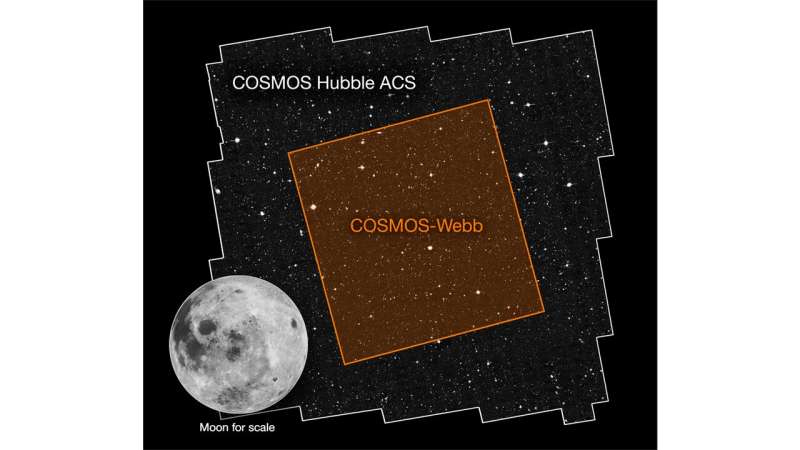
The COSMOS-Webb survey will map 0.6 square degrees of the sky—about the area of three full Moons—using the James Webb Space Telescope’s Near Infrared Camera (NIRCam) instrument, while simultaneously mapping a smaller 0.2 square degrees with the Mid Infrared Instrument (MIRI). The jagged edges of the Hubble field’s outline are due to the separate images that make up the survey field. Credit: Space Telescope Science Institute

When NASA's James Webb Space Telescope begins science operations in 2022, one of its first tasks will be an ambitious program to map the earliest structures in the universe. Called COSMOS-Webb, this wide and deep survey of half a million galaxies is the largest project Webb will undertake during its first year.

With more than 200 hours of observing time, COSMOS-Webb will survey a large patch of the sky—0.6 square degrees—with the Near-Infrared Camera (NIRCam). That's the size of three full moons. It will simultaneously map a smaller area with the Mid-Infrared Instrument (MIRI).

"It's a large chunk of sky, which is pretty unique to the COSMOS-Webb program. Most Webb programs are drilling very deep, like pencil-beam surveys that are studying tiny patches of sky," explained Caitlin Casey, an assistant professor at the University of Texas at Austin and co-leader of the COSMOS-Webb program. "Because we're covering such a large area, we can look at large-scale structures at the dawn of galaxy formation. We will also look for some of the rarest  that existed early on, as well as map the large-scale dark matter distribution of galaxies out to very early times."

(Dark matter does not absorb, reflect, or emit light, so it cannot be seen directly. We know that dark matter exists because of the effect it has on objects that we can observe.)

COSMOS-Webb will study half a million galaxies with multi-band, high-resolution, near-infrared imaging, and an unprecedented 32,000 galaxies in the mid infrared. With its rapid public release of the data, this survey will be a primary legacy dataset from Webb for scientists worldwide studying galaxies beyond the Milky Way.

Building on Hubble's achievements

The COSMOS survey began in 2002 as a Hubble program to image a much larger patch of sky, about the area of 10 full moons. From there, the collaboration snowballed to include most of the world's major telescopes on Earth and in space. Now COSMOS is a multi-wavelength survey that covers the entire spectrum from the X-ray through the radio.

Because of its location on the sky, the COSMOS field is accessible to observatories around the world. Located on the celestial equator, it can be studied from both the northern and southern hemispheres, resulting in a rich and diverse treasury of data.

"COSMOS has become the survey that a lot of extragalactic scientists go to in order to conduct their analyses because the data products are so widely available, and because it covers such a wide area of the sky," said Rochester Institute of Technology's Jeyhan Kartaltepe, assistant professor of physics and co-leader of the COSMOS-Webb program. "COSMOS-Webb is the next installment of that, where we're using Webb to extend our coverage in the near- and mid-infrared part of the spectrum, and therefore pushing out our horizon, how far away we're able to see."

The ambitious COSMOS-Webb will build upon previous discoveries to make advances in three particular areas of study, including: revolutionizing our understanding of the Reionization Era; looking for early, fully evolved galaxies; and learning how dark matter evolved with galaxies' stellar content.

Goal 1: Revolutionizing our understanding of the reionization era

Soon after the big bang, the universe was completely dark. Stars and galaxies, which bathe the cosmos in light, had not yet formed. Instead, the universe consisted of a primordial soup of neutral hydrogen and helium atoms and invisible dark matter. This is called the cosmic dark ages.

After several hundred million years, the first stars and galaxies emerged and provided energy to reionize the early universe. This energy ripped apart the hydrogen atoms that filled the universe, giving them an electric charge and ending the cosmic dark ages. This new era where the universe was flooded with light is called the Reionization Era.

The first goal of COSMOS-Webb focuses on this epoch of reionization, which took place from 400,000 to 1 billion years after the big bang. Reionization likely happened in little pockets, not all at once. COSMOS-Webb will look for bubbles showing where the first pockets of the early universe were reionized. The team aims to map the scale of these reionization bubbles.

"Hubble has done a great job of finding handfuls of these galaxies out to early times, but we need thousands more galaxies to understand the reionization process," explained Casey.

Scientists don't even know what kind of galaxies ushered in the Reionization Era, whether they're very massive or relatively low-mass systems. COSMOS-Webb will have a unique ability to find very massive, rare galaxies and see what their distribution is like in large-scale structures. So, are the galaxies responsible for reionization living in the equivalent of a cosmic metropolis, or are they mostly evenly distributed across space? Only a survey the size of COSMOS-Webb can help scientists to answer this.

Goal 2: Looking for early, fully evolved galaxies

COSMOS-Webb will search for very early, fully evolved galaxies that shut down star birth in the first 2 billion years after the big bang. Hubble has found a handful of these galaxies, which challenge existing models about how the universe formed. Scientists struggle to explain how these galaxies could have old stars and not be forming any new stars so early in the history of the universe.

With a large survey like COSMOS-Webb, the team will find many of these rare galaxies. They plan detailed studies of these galaxies to understand how they could have evolved so rapidly and turned off star formation so early.

Goal 3: Learning how dark matter evolved with galaxies' stellar content

COSMOS-Webb will give scientists insight into how dark matter in galaxies has evolved with the galaxies' stellar content over the universe's lifetime.

Galaxies are made of two types of matter: normal, luminous matter that we see in stars and other objects, and invisible dark matter, which is often more massive than the galaxy and can surround it in an extended halo. Those two kinds of matter are intertwined in galaxy formation and evolution. However, presently there's not much knowledge about how the dark matter mass in the halos of galaxies formed, and how that dark matter impacts the formation of the galaxies.

COSMOS-Webb will shed light on this process by allowing scientists to directly measure these dark matter halos through "weak lensing." The gravity from any type of mass—whether it's dark or luminous—can serve as a lens to "bend" the light we see from more distant galaxies. Weak lensing distorts the apparent shape of background galaxies, so when a halo is located in front of other galaxies, scientists can directly measure the mass of the halo's dark matter.

"For the first time, we'll be able to measure the relationship between the dark matter mass and the luminous mass of galaxies back to the first 2 billion years of cosmic time," said team member Anton Koekemoer, a research astronomer at the Space Telescope Science Institute in Baltimore, who helped design the program's observing strategy and is in charge of constructing all the images from the program. "That's a crucial epoch for us to try to understand how the galaxies' mass was first put in place, and how that's driven by the  halos. And that can then feed indirectly into our understanding of galaxy formation."

Quickly sharing data with the community

COSMOS-Webb is a Treasury program, which by definition is designed to create datasets of lasting scientific value. Treasury Programs strive to solve multiple scientific problems with a single, coherent dataset. Data taken under a Treasury Program usually has no exclusive access period, enabling immediate analysis by other researchers.

"As a Treasury Program, you are committing to quickly releasing your data and your data products to the community," explained Kartaltepe. "We're going to produce this community resource and make it publicly available so that the rest of the community can use it in their scientific analyses."

Koekemoer added, "A Treasury Program commits to making publicly available all these science products so that anyone in the community, even at very small institutions, can have the same, equal access to the data products and then just do the science."

COSMOS-Webb is a Cycle 1 General Observers program. General Observers programs were competitively selected using a dual-anonymous review system, the same system that is used to allocate time on Hubble.

The James Webb Space Telescope will be the world's premier space science observatory when it launches in 2021. Webb will solve mysteries in our solar system, look beyond to distant worlds around other stars, and probe the mysterious structures and origins of our universe and our place in it. Webb is an international program led by NASA with its partners, ESA (European Space Agency) and the Canadian Space Agency.

Image: Hubble's treasure chest of galaxie

Provided by Space Telescope Science Institute


Sunday, December 28, 2025

SPACE/COSMOS

Gemini And Banco Telescopes Unlock Clues To Origin Of Longest Gamma-Ray Burst Ever Observed


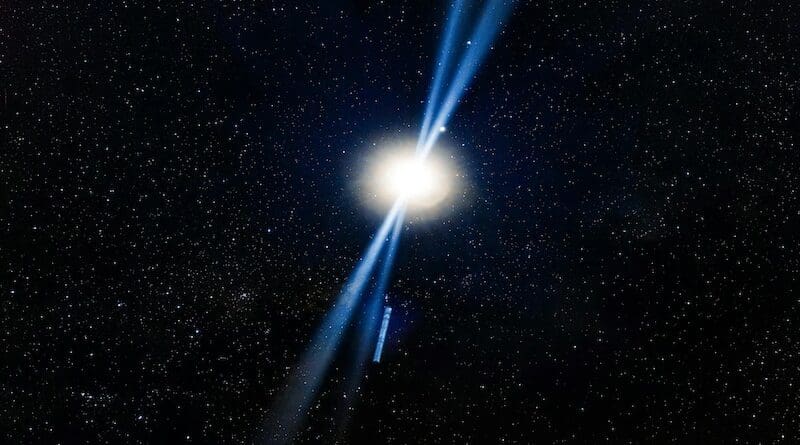
This artist’s illustration, which shows a high-speed jet of material being launched from a source that is embedded in a very dusty galaxy, depicts GRB 250702B — the longest gamma-ray burst that astronomers have ever observed. This powerful, extragalactic explosion was first detected on 2 July 2025. It exhibited repeated bursts that lasted over seven hours. Astronomers conducted rapid follow-up observations with multiple telescopes around the world and found that GRB 250702B resides in a large, extremely dusty galaxy. Their data support a range of progenitor scenarios, including interactions between a star and a black hole, or possibly a neutron star.
 CREDIT: NOIRLab/NSF/AURA/M. Garlick


December 28, 2025 
By rasia Review

Gamma-ray bursts (GRBs) are among the most powerful explosions in the Universe, second only to the Big Bang. The majority of these bursts are observed to flash and fade within a few seconds to minutes. But on 2 July 2025, astronomers were alerted to a GRB source that was exhibiting repeating bursts and would end up lasting over seven hours. This event, dubbed GRB 250702B, is the longest gamma-ray burst humans have ever witnessed.

GRB 250702B was first identified by NASA’s Fermi Gamma-ray Space Telescope (Fermi). Shortly after space-based telescopes detected the initial bursts in gamma-rays and pinpointed its on-sky location in X-rays, astronomers around the world launched campaigns to observe the event in additional wavelengths of light.

One of the first revelations about this event came when infrared observations acquired by ESO’s Very Large Telescope (VLT) established that the source of GRB 250702B is located in a galaxy outside of ours, which until then had remained a question.

Following this, a team of astronomers led by Jonathan Carney, graduate student at the University of North Carolina at Chapel Hill, set out to capture the event’s evolving afterglow, or the fading light emissions that follow the initial, extremely bright flash of gamma-rays. The properties of these emissions can provide clues about the type of event that caused the GRB.

To better understand the nature of this record-breaking event, the team used three of the world’s most powerful ground-based telescopes: the NSF Víctor M. Blanco 4-meter Telescope and the twin 8.1-meter International Gemini Observatory telescopes. This trio observed GRB 250702B starting roughly 15 hours after the first detection until about 18 days later. The team presents their findings in a paper published in The Astrophysical Journal Letters.

The Blanco telescope is located in Chile at NSF Cerro Tololo Inter-American Observatory (CTIO), a Program of NSF NOIRLab. The International Gemini Observatory consists of the Gemini North telescope in Hawai‘i and the Gemini South telescope in Chile. It is partly funded by the NSF and operated by NSF NOIRLab.

“The ability to rapidly point the Blanco and Gemini telescopes on short notice is crucial to capturing transient events such as gamma-ray bursts,” says Carney. “Without this ability, we would be limited in our understanding of distant events in the dynamic night sky.”

The team used a suite of instruments for their investigation: the NEWFIRM wide-field infrared imager and the 570-megapixel DOE-fabricated Dark Energy Camera (DECam), both mounted on the Blanco telescope, and the Gemini Multi-Object Spectrographs (GMOS) mounted on Gemini North and Gemini South.

Analysis of the observations revealed that GRB 250702B could not be seen in visible light, partly due to interstellar dust in our own Milky Way Galaxy, but more so due to dust in the GRB’s host galaxy. In fact, Gemini North, which provided the only close-to-visible-wavelength detection of the host galaxy, required nearly two hours of observations to capture the faint signal from beneath the swaths of dust.

Carney and his team then combined these data with new observations taken with the Keck I Telescope at the W. M. Keck Observatory, as well as publicly available data from VLT, NASA’s Hubble Space Telescope (HST), and X-ray and radio observatories. They then compared this robust dataset with theoretical models, which are frameworks that explain the behavior of astronomical phenomena. Models can be used to make predictions that can then be tested against observational data to refine scientists’ understanding.

The team’s analysis established that the initial gamma-ray signal likely came from a narrow, high-speed jet of material crashing into the surrounding material, known as a relativistic jet. The analysis also helped characterize the environment around the GRB and the host galaxy overall. They found that there is a large amount of dust surrounding the location of the burst, and that the host galaxy is extremely massive compared to most GRB hosts. The data support a picture in which the GRB source resides in a dense, dusty environment, possibly a thick lane of dust present in the host galaxy along the line-of-sight between Earth and the GRB source. These details about the environment of GRB 250702B provide important constraints on the system that produced the initial outburst of gamma-rays.

Of the roughly 15,000 GRBs observed since the phenomenon was first recognized in 1973, only a half dozen come close to the length of GRB 250702B. Their proposed origins range from the collapse of a blue supergiant star, a tidal disruption event, or a newborn magnetar. GRB 250702B, however, doesn’t fit neatly into any known category.

From the data obtained so far, scientists have a few ideas of possible origin scenarios: (1) a black hole falling into a star that’s been stripped of its hydrogen and is now almost purely helium, (2) a star (or sub-stellar object such as a planet or brown dwarf) being disrupted during a close encounter with a stellar compact object, such as a stellar black hole or a neutron star, in what is known as a micro-tidal disruption event, (3) a star being torn apart as it falls into an intermediate-mass black hole — a type of black hole with a mass ranging from one hundred to one hundred thousand times the mass of our Sun that is believed to exist in abundance, but has so far been very difficult to find. If it is the latter scenario, this would be the first time in history that humans have witnessed a relativistic jet from an intermediate mass black hole in the act of consuming a star.

While more observations are needed to conclusively determine the cause of GRB 250702B, the data acquired so far remain consistent with these novel explanations.

“This work presents a fascinating cosmic archaeology problem in which we’re reconstructing the details of an event that occurred billions of light-years away,” says Carney. “The uncovering of these cosmic mysteries demonstrates how much we are still learning about the Universe’s most extreme events and reminds us to keep imagining what might be happening out there.”

Iran launches 3 new satellites aboard Russia’s Soyuz carrier

It marks latest launch in growing Iran-Russia space cooperation amid Western criticism

Syed Zafar Mehdi |28.12.2025 - TRT/AA


TEHRAN, Iran

Iran on Sunday successfully launched three new satellites into space aboard a Russian Soyuz rocket in Russia’s Far East.

The satellites – Kowsar 1.5, Paya, and Zafar-2 – represent the latest chapter in a series of Iranian satellite launches in recent years, many of which have been carried out with Russian cooperation.

The Soyuz carrier also carried payloads from other countries, including Kuwait and Belarus.

The Kowsar 1.5 satellite is an upgraded version of Iran’s previous remote-sensing platform, designed for high-resolution imaging with a focus on agricultural applications, according to Iranian officials.

It was developed by a local knowledge-based company in collaboration with the Iranian Space Agency, highlighting growing cooperation between the public and private sectors.

Zafar, another upgraded satellite, is an advanced Earth-observation platform designed and built by Iran University of Science and Technology.

Weighing approximately 100 to 135 kilograms, it is intended to transmit high-resolution images for monitoring and managing natural resources, according to reports.

Paya, the heaviest of the three satellites, was produced by Iran Electronics Industries in collaboration with the Iranian Space Agency. Weighing about 150 kilograms, it is a remote sensing satellite and considered one of the most advanced domestically built imaging satellites.

The launch was widely followed in Iran with a live telecast by the state broadcaster.

There has been no reaction so far from the US or its European allies on the latest launch. They have often expressed concerns over Iran’s space launches, claiming they violate UN Security Council resolutions. Iran has, however, rejected these claims.

In a statement released ahead of Sunday’s launch, Foreign Minister Abbas Araghchi emphasized that Iran’s satellite program is civilian and scientific in nature and expressed the ministry’s full support for the Iranian Space Agency.

“Iran’s activities in nuclear science, defense industries, nanotechnology, and satellite development are entirely peaceful and intended for peaceful purposes,” he said.

While many of Iran’s satellite launches in recent years have faced technical difficulties, this latest launch further strengthens cooperation between Iran and Russia in space technology.

Kazem Jalali, Iran’s ambassador to Russia, speaking ahead of the launch on Sunday, said that Tehran-Moscow collaboration in the space sector is extensive.

He noted Russia’s leading role in space affairs, including satellite technology, launch vehicles, and satellite deployment, saying the latest launch marks the seventh Iranian satellite to be carried into space by Russia.

New race to the moon: could a German be first this time?


Copyright Copyright 2025 The Associated Press. All rights reserved

By Sonja Issel
Published on 28/12/2025 - EURONEWS

Man is returning to the moon - and with him old rivalries and new ambitions. Europe wants to have its say; Germany wants to be at the forefront. A historic opportunity beckons for Berlin.

Humans are due to land on the moon again in 2027—a return that comes at a time of growing geopolitical tensions reminiscent of the Cold War in many respects: rearmament, new power blocs, and increasing tensions between East and West.

As in the past, space has once again become a stage for strategic competition. A new landing on the moon stands for far more than scientific progress: it is seen as an expression of technological leadership and geopolitical power in the new space race. A permanent presence on the moon promises influence on future space standards, questions of resource utilisation and international cooperation.

The ambitions are correspondingly high. In addition to the USA and Europe, Russia and China in particular are currently pushing ahead with their own programmes. In this context, the European Union is increasingly coming into focus. Not only as a partner of the USA, but increasingly as an independent player in space.

This raises a new question: could this race end with a German on the moon for the first time?

US lunar programme with a European signature


The return of humans to the moon is part of the NASA-led Artemis programme. The United States is leading the way, while international partners—above all the European Space Agency (ESA)—are playing a central role.

A manned orbit of the moon is planned for the first half of 2026 with Artemis 2. One year later, Artemis 3 will see astronauts land on the lunar surface for the first time since 1972. In the long term, the programme also envisages the construction of the Gateway lunar station.

Europe is involved not only politically but also technologically. A key component of the missions is the European service module of the Orion spacecraft, which is being developed by ESA on behalf of NASA and largely built in Germany.

This role could now even be honoured with a priority on the moon: The head of the ESA, Josef Aschbacher, explained that he had decided that the first Europeans on a future moon mission should be astronauts of German, French, and Italian nationality. Germany should make the start.

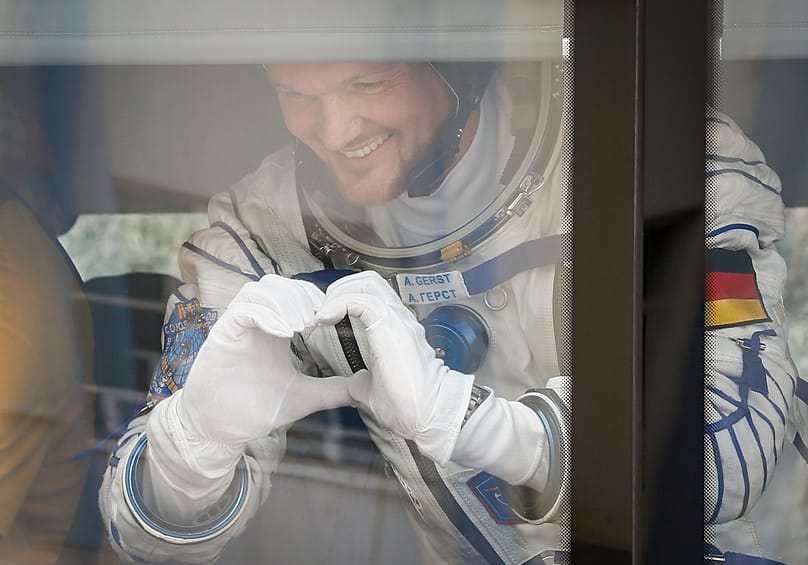
Gerst as the Gagarin of the 21st century?


Four Germans are currently hoping for a ticket to the moon. As things stand today, Alexander Gerst and Matthias Maurer are considered the most promising candidates.

Gerst, a geophysicist and volcanologist, and Maurer, a materials researcher, have already been on the International Space Station (ISS) and are members of the European Space Agency's (ESA) active astronaut team.

Experience is particularly crucial for the selection process: according to current criteria, only astronauts who have already been in space can be considered for a mission to the moon. The two German reserve astronauts, Amelie Schoenenwald, a biochemist, and Nicola Winter, do not yet fulfil this requirement.

However, as it could still be a few years before an actual moon mission is scheduled, it cannot be ruled out that they will also have space experience by then, and therefore also have a chance.

Alexander Gerst on his last space mission in 2018. AP

Gerst is already open to a mission to the moon. When asked whether he could imagine a flight to the moon, he replied, "Of course."

For him, these missions have numerous benefits. Those who play an active role in the lunar programme will also remain at the forefront of key future technologies in space travel—for example, in earth observation, climate research, and Europe's technological autonomy.

Whether a German astronaut will actually be among those who set foot on the Moon cannot be determined at this stage, Gerst said. In his view, this would in any case require a significantly stronger involvement of the European Space Agency in providing key components for the missions.
Europe's striving for independence

However, a European on the moon also has great symbolic significance for Europe. Despite its close co-operation with NASA, Europe remains dependent on the USA in many areas of space travel. At the same time, the European Union is pursuing the goal of becoming more technologically independent.

This strategy is receiving a boost from a record budget for the European Space Agency (ESA). The member states are providing almost 22.1 billion euros for the years 2026 to 2028. One focus is on Europe's independent access to space.

Germany wants to define its role within this framework—as Europe's strongest economic power, preferably at the forefront. Research Minister Dorothee Bär (CSU) speaks of space travel "Made in Germany."

It seems to be no coincidence that her department has officially included the term "space" in its name since the start of the new legislative period.

With 5.1 billion euros, Germany is the largest contributor to the ESA. According to Bär, investment in space travel is necessary despite tight budgets—not only as an investment in the future, but also as a contribution to European sovereignty and security.
Competition in space

Other major powers also have ambitions beyond Earth. In Russia, for example, the state space agency Roskosmos is planning to spend billions and wants to involve private investors to a much greater extent than before.

Among other things, it plans to set up its own satellite internet service modelled on Starlink, which, according to Roskosmos CEO Dmitry Bakanov, is due to launch in 2027.

However, Russia's prospects in the new race to the moon are currently considered limited. Experts are expecting delays due to logistical and financial problems. The Luna-26 moon mission has already been postponed to 2028.

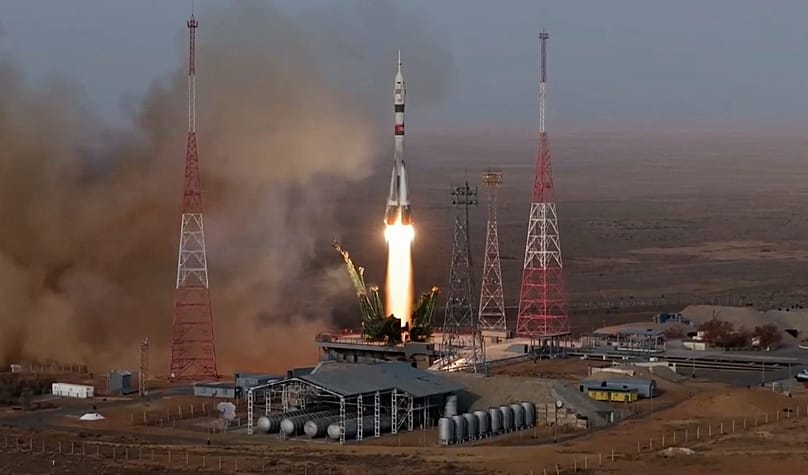
Launch of a Russian Soyuz rocket with a new ISS crew in Kazakhstan, November 2025. AP/Roscosmos space corporation

China, on the other hand, is much more dynamic. The People's Republic is pushing ahead with its space programme at a rapid pace and is increasingly positioning itself as a strategic competitor to the USA. The official goal is to launch a manned mission to the moon by 2030, even if Beijing has so far revealed little about specific timetables.
A symbolic first step towards the moon

As far as Germany is concerned, the journey to the moon could begin as early as 2026—but not directly with a German astronaut for the time being. The Italian designer Giulia Bona, who lives in Berlin, has created a mascot that could fly into space on NASA's Artemis 2 mission.


The design shows a small astronaut on the shoulder of a giant called Orion, named after the mission's space capsule and also an allusion to the mythology in which Orion is associated with the goddess Artemis. Such so-called zero-G indicators have a long tradition: Yuri Gagarin is said to have taken a small lucky charm with him into space in 1961.

Bona said she took part in the competition spontaneously. The fact that her design made it to the final round was an "unexpected joy" for her.

She now hopes to see her mascot floating between the astronauts in the live stream when Artemis 2 is launched, which would at least be a symbolic first step for Germany towards the moon.

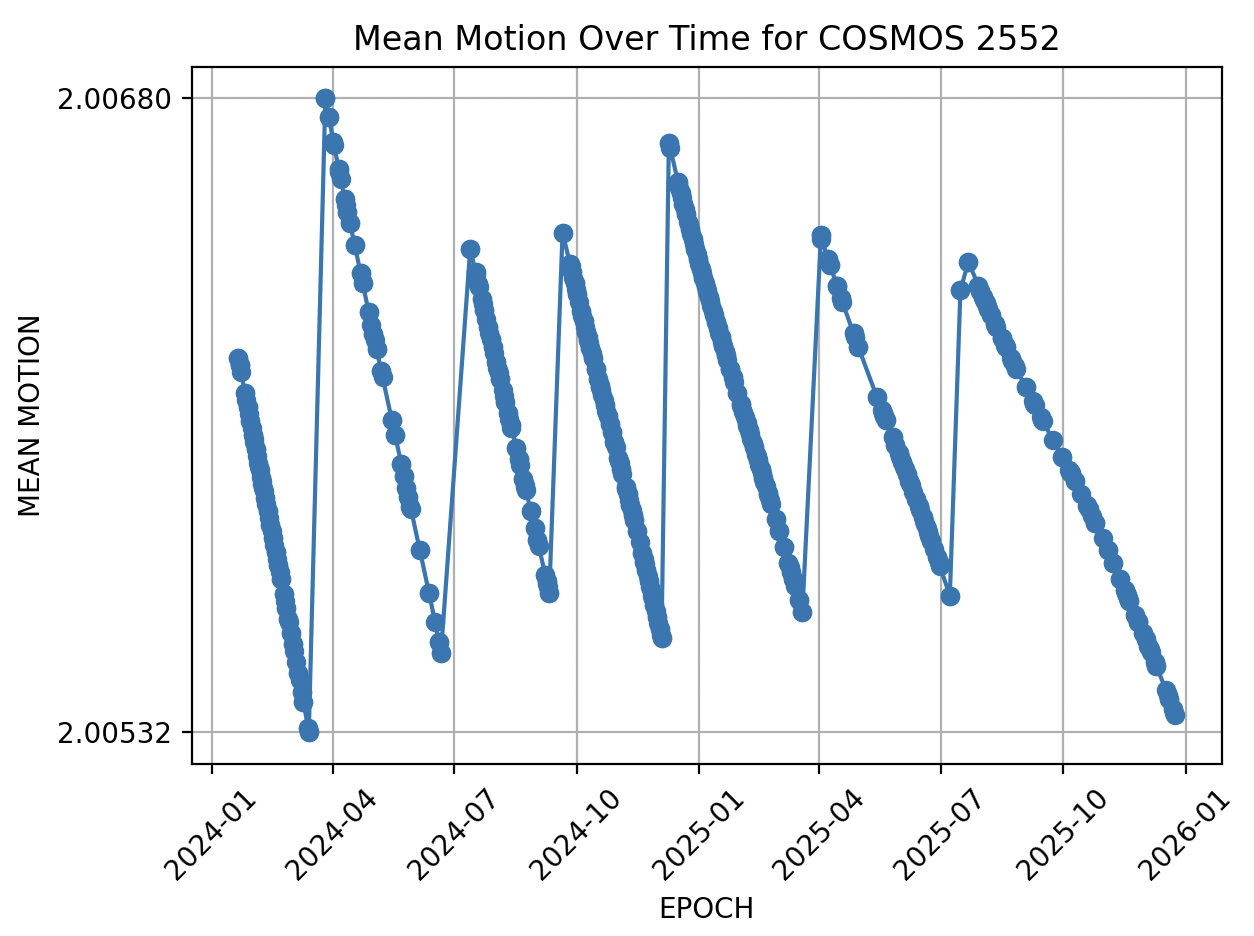
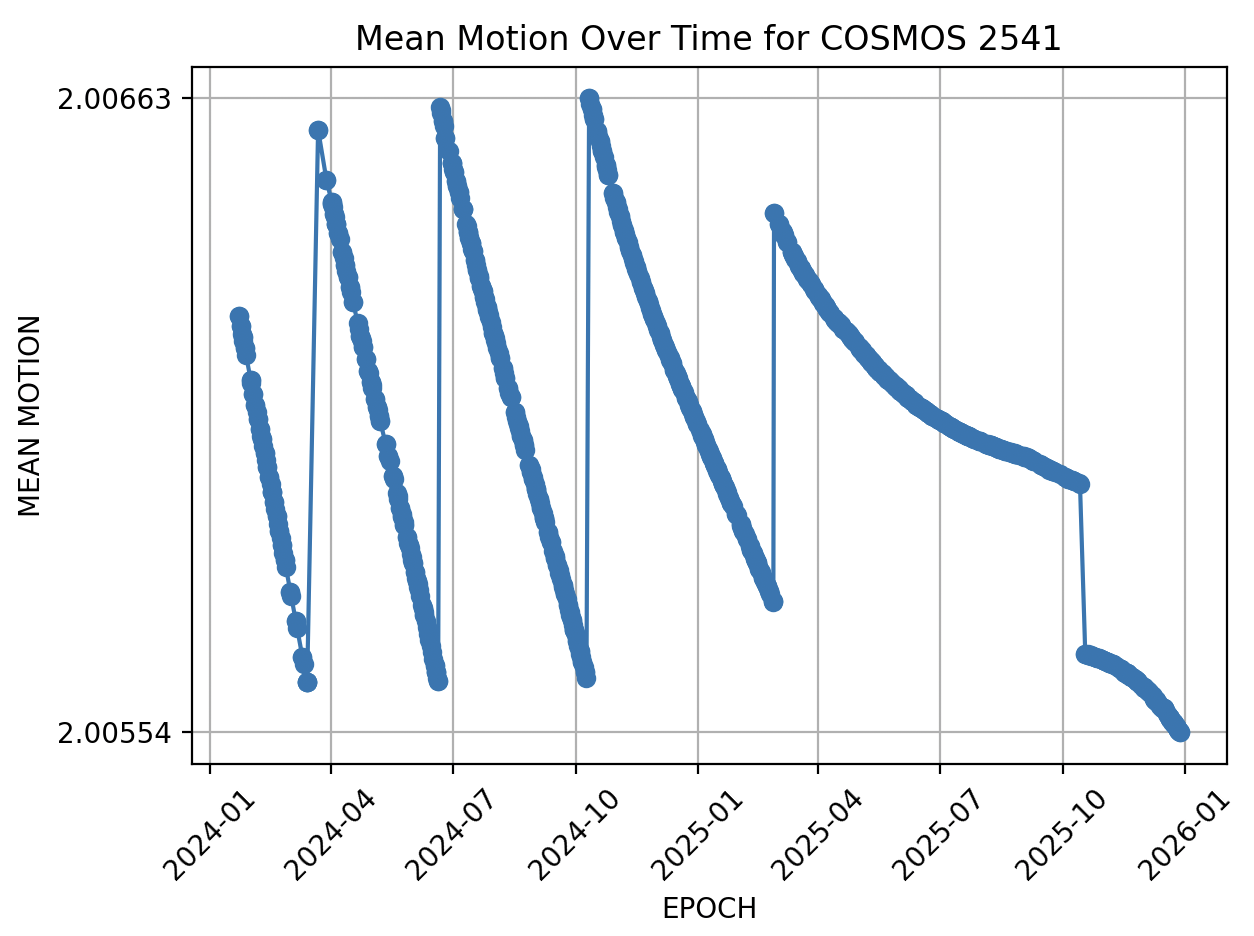
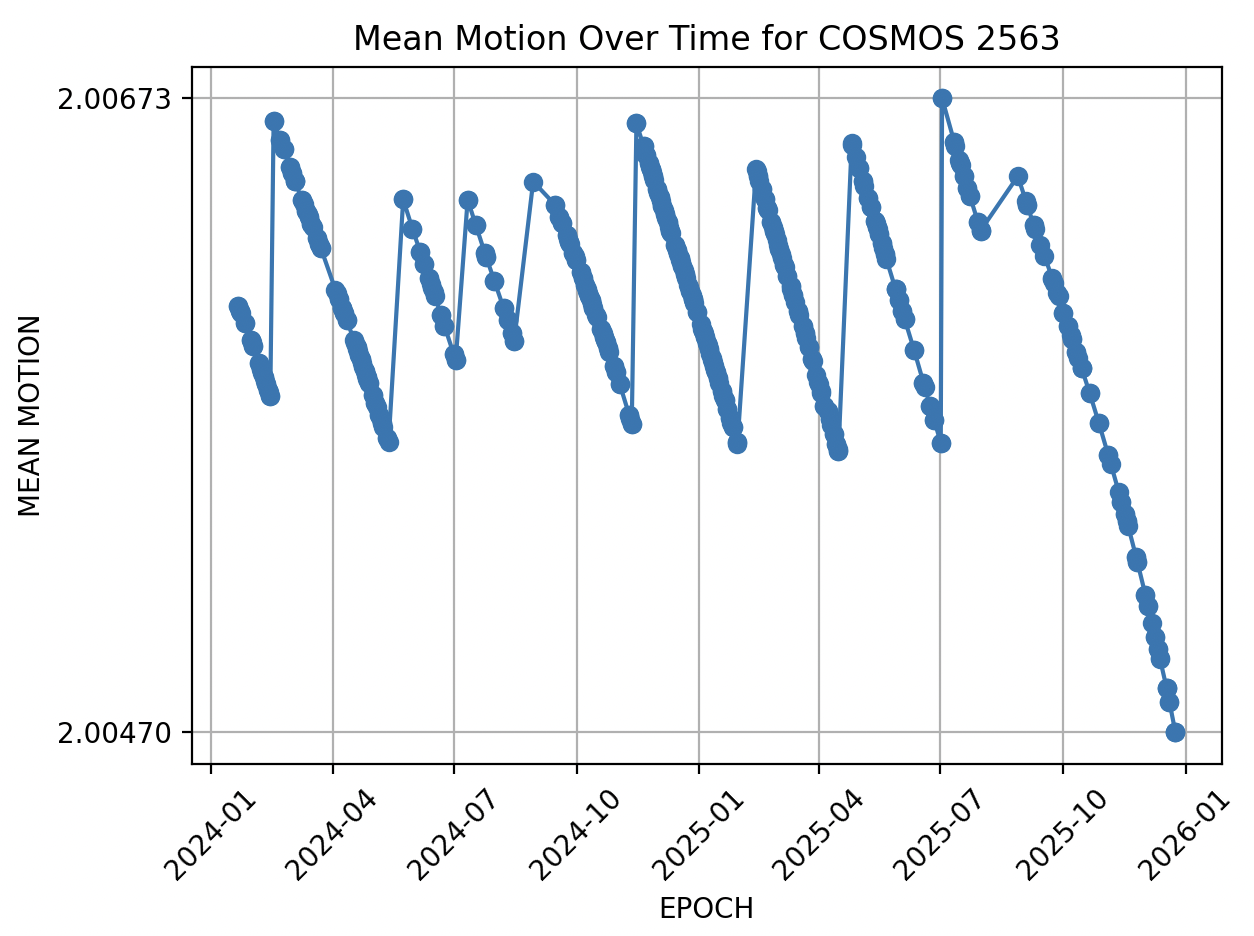
20251218-Cosmos-2552.pngOrbital data suggest that as of the end of 2025 Russia may have only one functioning early-warning satellite of the Tundra type. This is a significant decline from the situation in March 2025, when three satellites of the constellation - Cosmos-2541 (launched in September 2019), Cosmos-2552 (November 2021), and Cosmos-2563 (November 2022) - appeared to be operational.

Now it appears that for Cosmos-2541, the orbit correction maneuver successfully conducted in March 2025 was the last one. Another satellite of those three, Cosmos-2563, appears to have failed at some point after the last successful maneuver in July 2025. Images below show the changes in mean motion that testify to the failures.

20251218-Cosmos-2541.png20251218-Cosmos-2563.png

The only satellite that doesn't show clear signs of failure is Cosmos-2552, launched in November 2021. However, based on recent patterns, it should have performed an orbit correction sometime in November 2025 (see the main image in the post). But it is too early to say that Cosmos-2552 has ended its operations.

I should note again that the apparent loss of early-warning satellites is not necessarily a cause for alarm. Russia does not rely on the space-based segment of its early-warning system to the extent the United States does. For a discussion, see this 2015 post or my Science & Global Security article.

Sunday, August 10, 2025


Seeds of the cosmos: How a Pakistani engineer sent wheat into space

The test tube carrying the Pakistan-origin wheat seeds was aboard the SpaceX Dragon Capsule, which was launched from Nasa's Kennedy Space Centre on August 1.

 August 8, 2025
PRISM/DAWN
Muzhira Amin is a member of staff. She tweets @NMuzhira


Space, as all Trekkies agree, is the final frontier. It is mysterious, magnificent, mighty, and draws in earthlings who have long dreamed of exploring other worlds. In recent years, these dreams have crossed over from the realm of ambition to the reality of necessity. As billion-dollar companies and superpowers race toward the stars, a Pakistani engineer has crossed the Kármán line with nothing more than a handful of wheat seeds and a vision.

“As we speak, Pakistan-origin wheat seeds are on their way to space,” Mahhad Nayyar told Dawn.com. He and his colleague, Muhammad Haroon, successfully sent the first Pakistani payload to the International Space Station through the Kármán-Jaguar Earth Seeds for Space partnership.

The initiative brought together researchers and space leaders from four countries to explore how native crops respond to microgravity. Pakistan’s contribution, wheat seeds, was spearheaded by Mahhad.


Mahhad Nayyar works on the payload at Nasa’s Kennedy Space Centre before the launch. — courtesy Jaguar Space/Ivan Castro Guatemala

The seeds took up one-quarter of the space in the test tube, equal to the Nigerian melon seeds, Armenian pomegranate seeds, and Egyptian cotton seeds. The test tube was aboard the SpaceX Dragon Capsule — mounted on a Falcon 9 rocket — which launched from Nasa’s Kennedy Space Centre in Florida, on August 1.

“I was quite literally living a dream,” Mahhad gleamed. “Watching the rocket fire up and blaze into the sky, leaving behind a trail of smoke … all of it happened just within a few minutes. For me, though, it was the experience of a lifetime.”

But the flight from land to space, one that the 34-year-old had dreamt of for years, was long and riddled with challenges.


How it started

As a young boy, Mahhad was obsessed with the boundless horizon above him. At the time, the only way he knew to explore the skies was through flying, and, in what he describes as “quintessential fashion”, the engineer joined PAF College Sargodha, where he underwent five years of training and subsequently joined the Pakistan Air Force.

“My aim was to become a fighter pilot, but I fell short due to my short-sightedness and was hence sent towards engineering by the PAF,” he recalled to Dawn.com. In 2009, Mahhad enrolled in the aeronautical engineering programme at the PAF College, Risalpur, during which he secured a scholarship at the US Air Force Academy.

This is where his life took a turn. Mahhad went to the States with the intention of studying aeronautical engineering, but came back as an astronautical engineer. “It was here that I found my love for space; when I controlled, monitored and designed satellites.” But he couldn’t explain it to the people around him when he came back home, who thought it was a subject far-fetched, one that “didn’t even have an office here”.

For the next few years, he served as a flight engineer for search and rescue helicopters during the day and volunteered for astronomical societies in the evenings. Meanwhile, Mahhad immersed himself in the world of astrodynamics — his nights were occupied by documentaries such as ‘Cosmos: A Personal Voyage’ and ‘Cosmos: A Spacetime Odyssey’.

“I fell in love with how vast the space is. I could see all the possibilities of what could be done there,” he reminisced. As years passed by, however, he couldn’t help but wonder how Pakistan was losing out on the vast potential of the cosmos.

His disappointment further grew when, in 2020, Mahhad came across a research paper featuring a world map of countries that had participated in initiatives with the ISS. One conspicuous gap was hard to ignore: Pakistan was the only one of the world’s 10 most populous countries to not have taken part.

The image stayed with him, almost as if it were imprinted in his mind. “I realised that in two and a half decades, we were unable to send an experiment into space, let alone an astronaut. This was a matter of shame to me.” He resolved to change this and bring to life the idea that space should be accessible and meaningful for everyone, not just a select few nations or industries.

So when in 2024 he came across the Kármán Project, he knew exactly what he needed to do.


A journey into space

Mahhad applied to become a pioneer for the project, named after the line 100km above the ground from where space begins. By this time, he had retired from the PAF and was pursuing a PhD from Purdue University in the US.

“I got an email from the Kármán Project one day, wherein they were seeking proposals for sending a free-of-cost experiment to space, so I drafted a proposal with the help of my colleague Haroon, who is currently studying botany at the same varsity as mine,” he said.

Their proposal, for sending wheat seeds to space, was among the four that were accepted from across the world. These seeds, once back on Earth, will be examined at length to see the changes they underwent while in space.


Mahhad Nayyar poses with colleagues at Nasa’s Kennedy Space Centre. — courtesy Jaguar Space/Ivan Castro Guatemala


“For me, just the fact that a Pakistani experiment is going to space matters the most, and the fact that we are finally on the ISS map,” Mahhad remarked. For him, it is a matter of national pride and a call to future Pakistani scientists, astronauts and aerospace engineers that nothing is beyond their reach, not even space.

The pride Mahhad talks about, he felt it the most when he visited the Kennedy Space Centre last week for the launch, making sure to keep a neatly folded Pakistani flag with him.


Mahhad holds Pakistan’s flag at the Kennedy Space Centre. — photo by Mahhad Nayyar


But Mahhad kept his excitement at bay because he knew entering the centre could be a lengthy process. It involved a lot of paperwork, and more so in his case, because Pakistan fell under the strictest criteria. A Nasa escort accompanied him throughout the visit. “Once inside, I worked with my Armenian, Nigerian and Egyptian colleagues on the final work required for the payload,” he recalled.

After a day’s delay that triggered Mahhad’s anxiety, the SpaceX Dragon Capsule finally took off from the Kennedy Space Centre’s Space Systems Processing Facility at 11:43am Eastern Time (around 8:43pm in Pakistan) on Friday and docked at the International Space Station just 15 hours after the launch.

There were many thoughts racing in his mind at the time, those of childlike wonder and pure fascination. “A rocket is essentially a controlled explosion and to put human beings on top of that and launch them to another realm of existence is not only thrilling but also leaves you in awe of how far science and technology has come for the betterment of humans.”


The science

As grand and groundbreaking as the project was, at first glance, it may seem too simple. Why wheat seeds? Isn’t that too ordinary for a space mission?

“For us, wheat seeds were a strong candidate because they’re a staple food in Pakistan and other countries,” said Haroon, the collaborator on the payload. Elaborating on the same, Mahhad told Dawn.com that the cultural and dietary significance of wheat made it a powerful symbol of sustenance, resilience and everyday life.

“Scientifically, wheat is also a strong candidate for space agriculture due to its relatively short growth cycle, high nutritional value, and adaptability to controlled environments. As space agencies explore long-duration missions and potential off-world settlements, crops like wheat will be essential to support human life sustainably,” he explained.


The test tube that carried wheat seeds into space. — courtesy Jaguar Space/Ivan Castro Guatemala

But most importantly, the crop serves as a bridge between nations, and while it has been studied in space before, this experiment focuses on a variety native to South Asia, cultivated in different climatic and soil conditions. Hence, both Mahhad and Haroon agreed that this could open the door to valuable comparative insights into genetic resilience and environmental adaptation under extreme conditions.

The scientific objective of the payload is to observe the effects of microgravity on the seeds. “One key focus will be on studying stomatal traits — the microscopic pores on the surface of leaves that regulate gas exchange and water loss. Stomata play a vital role in photosynthesis, respiration, and overall plant-water relations.

“By observing how these traits develop in a microgravity environment, we can better understand how space conditions may affect plant physiology at a structural and functional level. This could reveal critical insights into drought tolerance, water use efficiency, and stress adaptation,” Mahhad said.

Once the seeds come back to Earth, which is expected by the end of the month, they will be germinated under controlled conditions, and their physiological and anatomical traits will be studied.


The SpaceX Dragon Capsule after launch. — photo by Mahhad Nayyar

“We will identify beneficial traits related to drought tolerance concerning stomata so these seeds won’t require extra water and will be good for both space and land. For sure they will have effect from space which will help us understand how this physiology is different from when they were sent to space,” Haroon added.

Moreover, if these traits prove to be beneficial, they could inform future breeding programmes to develop cultivars that require less water and are ideal for regions like Pakistan that are facing water scarcity or extreme climate stress. “The insights from this space-based study may help design crops that are not space-resilient but also more sustainable for vulnerable ecosystems on Earth.”
Beyond the science

But for Mahhad, the true impact of the payload goes far beyond the science behind it. Working with wheat — a staple food for millions across the globe — creates an opportunity for Pakistan and gives it a chance to connect space exploration with daily life in a way that feels intimate and real.

“It will open doors for young Pakistanis to understand, discover and fall in love with space,” he said, expressing the hope that the mission is remembered as a gentle but lasting turning point — a moment when space became a little more accessible, a little more culturally grounded, and a lot more inclusive. This also comes at a time when Pakistan, in collaboration with China, plans to send its first manned space mission to the latter’s space station

Personally, though, for Mahhad, this is just the beginning for him. A PhD student at Purdue University, Mahhad’s research revolves around space situational awareness, and his study has brought him face to face with some hard realisations.

“Emerging space economies such as Pakistan have a maximum of five objects in space; we have been unable to use the space medium adequately. Now this is not just a question of scientific exploration but also that of fundamental human equity. With developed countries now exponentially populating space with their objects, the space for countries like ours is shrinking every day.”

Mahhad wants to change this, for which Pakistan’s strategic geographical location is his biggest asset. “It is one of the best sites for looking into space traffic, and this data can be sold globally,” he said.

The benefits are not just monetary. A person going about their usual day may not even realise but space plays a huge part in their lives — from enabling smooth communication to navigating through traffic (basically Google Maps) and monitoring the climate. The benefits are endless.

“But all of this can only come through with situational awareness of the space environment,” the engineer stressed. He believes that this can only happen when Pakistan starts investing in a space programme, where students in universities, schools and colleges are encouraged to develop, launch and monitor satellites.

And to play his part, the 34-year-old plans to build a virtual mentorship lab to turn his story into a conversation starter, ultimately encouraging more experiments from Pakistan in space.

To prove his point, the engineer quotes his favourite astrophysicist and writer, Neil deGrasse Tyson: “Recognise that the very molecules that make up your body, the atoms that construct the molecules, are traceable to the crucibles that were once the centres of high mass stars that exploded their chemically rich guts into the galaxy, enriching pristine gas clouds with the chemistry of life.

“So that we are all connected to each other biologically, to the earth chemically and to the rest of the universe atomically. That’s kinda cool! That makes me smile and I actually feel quite large at the end of that. It’s not that we are better than the universe, we are part of the universe. We are in the universe and the universe is in us.”

Header image: The payload of seeds sent to space. — courtesy Jaguar Space/Ivan Castro Guatemala

Wednesday, September 22, 2021

Let's talk about sex — in space

It's naturally part of every human space exploration but remains taboo. Here's what we do and don’t know about cosmic sex.


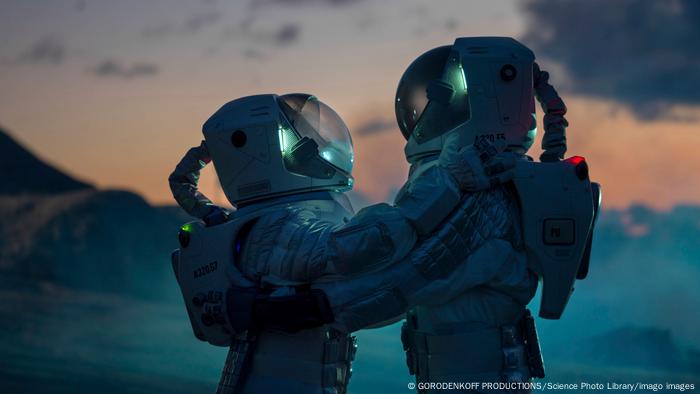
Better hold on to each other: Sex in space will be more difficult than on Earth because of microgravity.

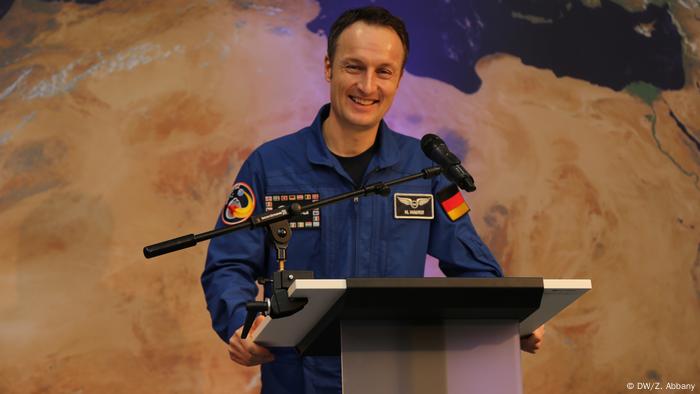
German astronaut Matthias Maurer breezes through interviews, rarely missing a beat when he answers journalists' questions around his upcoming six-month trip to the International Space Station (ISS). But one topic throws even Maurer off momentarily: sex drive in space.

"We haven't talked about this, because it's a professional environment," he replied to DW's question on whether astronauts exchange insights on how to handle their desires.

Thanks to commercial space flights, more people are entering the cosmos than ever before. Just this past week,SpaceX launched four tourists through the Earth's orbit. Ten years from now, the first crew of astronauts will likely set off on a mission to Mars that could last multiple years.

Sexuality is intrinsic to human nature and inevitably factors into space missions. But while space science is progressing, our understanding of sex in space is still basic.

NASA, the US's National Aeronautics and Space Administration, insists that no humans have had sex in space, and American astronauts famously avoid the topic. The few experiments that have been conducted on space sex focused on animals, not humans.

"We need to know more about sexuality in space if we are serious about long-duration space flights. Sexuality is very possibly going to be a part of that," Paul Root Wolpe, who spent 15 years as a senior bioethicist at NASA, tells DW.


German astronaut Matthias Maurer told DW that there is no official training on sexuality in space

Sex in space matters


Addressing sexuality in space isn't just important because it's what's on everyone's mind. Asked by DW whether sexuality is part of an astronaut's training, Matthias Maurer replied: "No, but maybe it should be.”

"If we look at sexual health as a core component of health, it's important to understand the conditions we are putting individuals in," Saralyn Mark, former senior medical adviser to NASA, tells DW.

Sex and masturbation are linked to physical and mental health — that doesn't change in space.


Ejaculation is essential for men to avoid the risk of bacteria building up in their prostate, and orgasms have been shown to relieve stress and anxiety as well as improve sleep quality, which likely helps during a high-pressure space mission.

Has it already happened?


We can only speculate, but it seems likely that sex in space has already happened. There are two space missions that jump out as candidates for the first cosmic coitus.

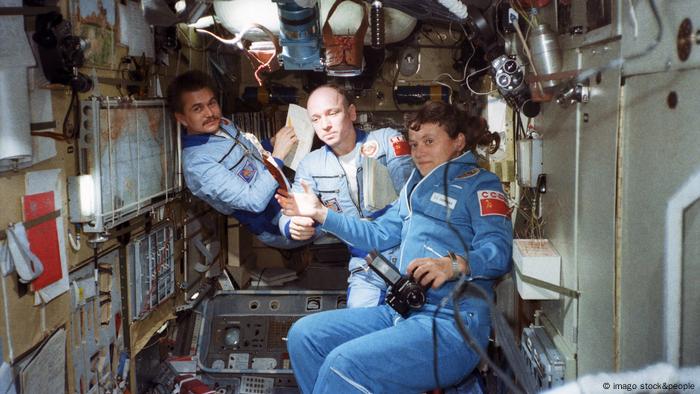
In 1982, Russian cosmonaut Svetlana Savitskaya, only the second-ever woman in space, joined the Soyuz T-7 space mission for eight days. Two male colleagues were already on board when she arrived, making it the first co-ed space mission.

In his book, Höllenritt durch Raum und Zeit (A hellride through time and space), German astronaut Ulrich Walter notes that, according to the team's doctor, Oleg Georgievich Gazenko, the flight was planned with a sexual encounter in mind.

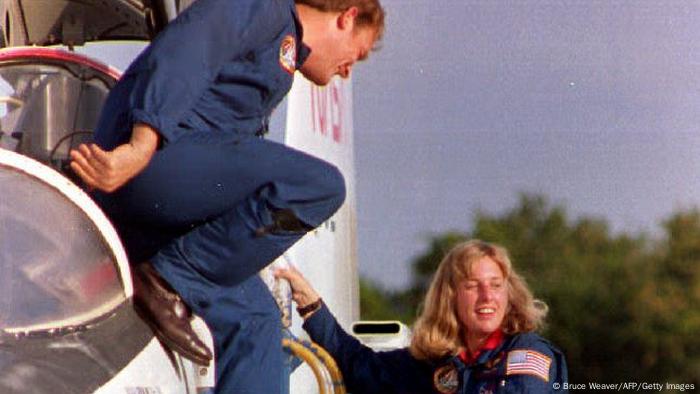
The second mission in question took place in 1992, when NASA's Space Shuttle Endeavor was launched with a married couple on board. Mark Lee and Jan Davis, both astronauts, met at NASA. They married in secret a year before lift-off. Their joint flight to space was practically their honeymoon.


Svetlana Savitskaya and her colleagues Anatoly Berezovoi and Valentin Lebedev made up the world's first mixed-sex space crew

How is it different from here on Earth?


So, we can assume that sex in space is a reality. But how is it different to ours on Earth? Let's start with the basics: sex drive.

The little publicly available information that we have indicates that being in space leads to reduced libido, at least at first.

That's because microgravity, the weightlessness astronauts experience in space, causes hormonal changes, like decreases in estrogen. Low estrogen levels have been linked to a drop in sex drive.

Unfortunately, most of what we know about hormones in space comes only from tests on men. That's because only 11.5% of astronauts are female, and the relatively few women who have been to space opted to go on birth control beforehand to avoid menstruation. This makes it tricky to disentangle artificial hormonal changes from those caused by space flight.

Another factor in cosmic sex drive is a change in astronauts' internal clock.

"When you're going around the planet right now, every 90 minutes, your circadian rhythms are altered and that alters everything, including your sex hormones and probably your libido," Mark says.

The science also matches astronaut Walter's on-site experience. In his book, he writes that, during his short 10-day stay in space, he had no libido.

But there's hope: According to Walter, astronauts' sex drive does readjust after a few weeks in space.

Astronauts and arousal


While our knowledge of sex drive is still fuzzy, we have a much clearer picture on whether humans can get physically aroused in space.

Microgravity causes blood flow to reverse its course and move upwards, towards the head and chest, instead of circulating in the lower half of the body. The internet abounds with speculation on whether this prevents men from getting erections in space.

When asked whether space boners are viable, Mark gave a clear answer: "Yes, microgravity does not affect that path."

Root Wolpe agrees: "There is no reason why it should be biologically impossible."

Ron Garan, an American astronaut who went to space twice, was asked whether erections are possible in space on an Ask Me Anything Reddit thread.

"I know of nothing that happens to the human body on Earth that can't happen in space," he answered.

For women, arousal in space is possible as well but getting wet feels physically different than on planet Earth. In zero gravity, liquids collect at their point of origin, meaning they form a blob at the spot where they are secreted, instead of flowing freely.


Astronauts Mark Lee and Jan Davis spent their honeymoon aboard a space shuttle

Velcro and dolphin sex


So much for the biological basics. Now we are left with speculating about the act itself. One thing is certain: Sex in space is a far more exhausting endeavor than here on Earth.

In zero gravity, Newton's third law, which states that for every action there is an equal and opposite reaction, makes thrusting against each other a real challenge.

"We don't realize how much gravity assists us in the act of intercourse," Wolpe says. "Sex involves pressure. In space, without any counterforce, you end up constantly trying to push your partner away from you."

But where there's a will, there's a way.

In an interview with German public broadcaster NDR, Walter suggested that astronauts could adopt a method employed by dolphins in the ocean, where a third party holds the other two together to prevent them from drifting.

Wolpe has another idea: "Everything on the walls of the space station is covered in Velcro, so you could take advantage of that by velcroing one partner to the wall. You have to get creative in this space."

SPACE TOURISM: OUT OF REACH FOR MOST EARTHLINGS
An unbeatable record
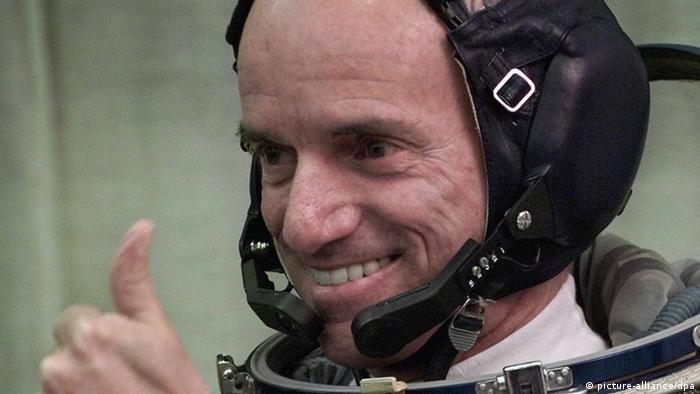
Dennis Tito was and always will be the first civilian to travel to space. Tito had been a NASA engineer before turning to finance. He had always dreamed of a trip to space and is said to have paid $20 million to have his dream come true. It was hard convincing the big space agencies, but on April 28, 2001, Tito took a ride on a Soyuz rocket and spent six days at the International Space Station.

Sunday, May 09, 2021

SUNDAY SERMON II


The Space Adventures of Russian Orthodox Saints

By Elodie Phillips Posted May 7, 2021
In Analysis, Culture, Russia

Russian cosmonaut and practising Orthodox Christian Sergey Ryzhikov may have been born on Earth but currently, he resides among the stars, firmly in God’s territory, on the International Space Station (ISS). Earthly parishioners of St Vladimir’s Orthodox Church in Houston, Texas were treated to a glimpse at the cosmos when Rhzhikov teleconferenced worshippers from the ISS, answering questions about Russia’s scientific discovery of the heavens. This technological link between terrestrial and sky-dwelling Orthodox Christians speaks to a greater connection growing between the earthbound church hierarchy and those Russians exploring the realms above.

Since the shattering of Soviet state atheism, icons and relics have frequently passed between Earth and the cosmos as patterns of religious engagement changed in the new Russian Federation. As an extension of this, the expressed personal religious beliefs of the cosmonauts themselves have become entangled with earthly political agendas.

Noting how Russians in space have created a culture of religious observance on the ISS allows us to recognise patterns of interaction between the crew, the Russian Federal Space Agency (Roscosmos) and the Russian Orthodox Church (ROC). In the post-Soviet era, the display of religious icons and relics is an increasingly common societal performance, which has become interwoven with meanings related to Russian identity and patriotism. These rediscovered religious practices on earth take on new significance when transported to outer space.


As the Cold War ended and a tentative, cooperative relationship began between the USA and the new Russian Federation, both states agreed to form the International Space Station. The ISS was initially created from a merger of the USA’s Freedom Station and the Russian Mir-2 designs. Russian cosmonauts living aboard the ISS have resided in the Zvezda space module since Expedition 1 arrived there in November 2000. The Zvezda living quarters comprise two sleeping areas, exercise equipment, a toilet and a galley which are used not only by Russians but all astronauts living on the ISS. Zvezda is therefore a hub for multiple forms of international activity on the ISS.

Orthodox practices in the Zvezda module create a distinct Russian culture in space and reflect changes in church-state relations on earth. It is especially significant that US-controlled modules ban the display of religious imagery. Although, since retiring the Space Shuttle in 2011, NASA has relied on Russia’s Soyuz rockets and Baikonur cosmodrome in Kazakhstan to launch transportation shuttles and as a result has willingly turned a blind eye to Russian religious displays onboard the ISS. The International Space Station Archeological Project notes that religious items have yet to be displayed in the US, European or Japanese modules (aside from those related to Christmas), meaning the practices on Zvezda are a uniquely Russian phenomenon.
Iconography in the cosmos

The importance of the display of icons in Russian public spaces did not disappear during the Soviet Union as images of Soviet leaders were replete in public life. Even in Soviet space stations, Salyut and Mir, images of Lenin and other important Communist figures were displayed on the aft wall of the module. Yet God was absent from the public Russian discovery of the cosmos. As Khrushchev once said: “I sent cosmonauts to space, but they didn’t see God”.
NO GOD

God entered the Russian experience of space by joining other national icons on the aft wall. This is a flat space in Zvezda’s living quarters often used as the backdrop of broadcasts back to earth. This area continues to be used for the display of images and symbols with special importance for the cosmonauts residing there such as on Mir. This personal practice reflects changes in post-Soviet religious engagement where private Russian domestic spaces are more likely to contain religious displays.

The aft wall is prominent in broadcasts to earth by all ISS crew members, not only the Russians. Moreover, there is an additional political significance to the icons chosen by both the cosmonauts and terrestrial organisations such as Roscosmos and the ROC. On the ISS, therefore, personal expressions of Orthodox Christianity coincide and interact with institutional and even state-sponsored ways of conveying faith.
The wall of the Zvezda module. Since the disintegration of the USSR, Orthodox saints have begun replacing old Soviet heroes / NASA

NASA posts publicly accessible photos of Zvezda’s interiors on Flickr and a close examination of 48 photos taken between 2000 and 2014, revealed variations in the icons adorning the aft wall mirrored developments in Russian religious and political life on earth. It can be concluded that alterations in the icons on display reflect the changing religious practices of Russians in the post-Soviet era as well as events occurring in Russian foreign and domestic politics.

Trends can be noted in how the display of icons is used to benefit the changing policies of the ROC and the Russian Federation. Through its closer relationship with the cosmos, the ROC connects itself to national institutions constituting part of “Greater Russia”, such as the space programme. In terms of the Russian Federation, changes in the conspicuousness of icons can be observed at times when the regime requires the consolidation of Russian patriotism at home.


Co-operation earthside

Prior to Zvezda, the ROC began collaborating with Roscosmos in ways that reversed the
atheist rhetoric typically used by the state to describe Russian adventures in the cosmos. The patriarchate of Alexiy II (1990-2008), which began as the Soviet Union was collapsing, represents a key period in this varying relationship. At this time, the Orthodox Church resumed its central position in Russian society accompanied by a revival in Russian religious life. The institutional efforts of the ROC to establish a presence in space evoke a sense of missionary zeal.

The frequent transportation of icons and relics into space began under Alexiy II. In July 1995, the Patriarch blessed two print icons of Saint Anastasia (one Orthodox and one Roman Catholic), which were then sent on a “peace mission” to the Mir Station. Saint Anastasia was chosen as a symbol of peace as she is a saint common in both Eastern and Western Christianity as well as a protector against international warfare. Hence the project’s name: “Project Anastasia- The Hope of Peace”.


Seven months later, the icons returned to earth and embarked on a pilgrimage across Europe to all places associated with Saint Anastasia. The impact of this move by the Church hierarchy was significant to the Russian cosmonauts living on Mir. It empowered them to adorn their own personal space with icons. Consequently, photos between 1996 and 1998 demonstrate that icons were informally stuck to the walls of the Russian quarters.


Cosmonauts in Zvezda, 2014, with icons of Saint Sergius of Radonezh / NASA


The missionary enthusiasm of the Church also found a pathway to the cosmos through the thoughtful cultivation of personal relationships with key personnel in Russia’s space programme. For example, Head of Roscosmos Anatoliy Perminov enjoys a close, personal relationship with the ROC, established during the patriarchate of Alexiy II. Perminov met repeatedly with Patriarch Alexiy and continually expressed a desire for mutual cooperation with the Church. Indeed in 2008, Perminov gifted him with a GLONASS System Satellite navigator as a Christmas gift. The evidence of deeply personal relationships between ROC and Roscosmos is also noticeable in the friendships between Russian cosmonauts and Father Yov Talats, rector of the Cathedral of the Transfiguration. This church is located in Star City where the Russian cosmonaut training facilities are located.

Father Yov is present when Russian cosmonaut teams are sent off from Baikonur, and meets them upon their return. In his public engagements, the clergyman often recounts his childhood dream of becoming a cosmonaut and, even after becoming a priest, took part in aspects of cosmonaut training. Yov works from the Trinity Laura of St. Sergius, an extremely significant centre for the ROC, where departing Russian ISS crew members are blessed before they leave for Baikonur. Recently, Father Yov has acted as a religious mentor for members of the Russian ISS crew and has arranged for holy relics to be sent into space in the care of his flock.
Heavenly journeys, earthly implications

The ROC under Alexiy II forged close ties with Roscosmos and oversaw the initial transportation of icons and relics into space. After “Project Anastasia”, a cult began to form around these icons that had travelled to space upon their return to earth. These icons took on a new power for Orthodox believers due to their exposure to space. Head of Roscosmos Perminov himself announced, “already the icons of Kazan Mother of God and the Archangel Michael, after many times orbiting our planet … will come to reflect the combination of traditional spiritual symbols and contemporary achievements in the field of space exploration”.

An example of this is the icon from the Valaam monastery, which orbited the earth over 1000 times in the company of Russian cosmonaut and ISS crew-member Sergey Krikalev in 2005. On its return to earth in 2006, Valaam monks and the cosmonauts who accompanied it home claimed that the icon was capable of miracles and had ensured a difficult landing was carried out safely.


Icon of Christ Pantocrator and gold cross floating in front of the front hatch of Zvezda / NASA

In this way, the transportation of religious icons and relics to the ISS is seen as a new form of the Orthodox krestnyy khod [Crucession or Cross Procession] The Crucession is a religious event that takes place on important dates in the liturgical calendar and involves large processions for the veneration and public conveying of icons or relics. As the abbot of the Valaam monastery himself stated, “the tradition of the religious procession is ancient,” yet also “these days, this tradition takes new forms and we encounter an icon that has completed an even more unusual religious procession”. Like the cosmonauts themselves, the icons take on a certain significance having endured the tribulations of space.


ROC Church officials deliberately referred to the transportation of relics of St. Serafim of Sarov to the ISS in 2016 as a krestnyy khod. The box containing the relics was strapped to the chest of the aforementioned Sergey Ryzhikov, parishioner of St Vladimir Orthodox Church and at that time the commander of the Soyuz rocket travelling to the ISS. Upon returning to Earth, the relics were given a place of honour at Father Yov’s church, the Cathedral of the Transfiguration. Crucessions have historically been seen as displays of a national communal faith and therefore new manifestations of the practice have very real implications for creating a sense of national patriotism.

The krestnyy khod has appeared in contemporary Russian legend during times of national insecurity. In 2013, gossip circulated that Vladimir Putin had carried an icon in a helicopter over Volgograd after the suicide bombings in the city. This reflects similar rumours that spread as the Nazis were about to capture Moscow during the Second World War that Josef Stalin himself had flown over the city accompanied by an icon.
To infinity… and beyond?

It follows that displays of religiosity on the ISS differed from the peace-building sentiment behind “Project Anastasia”. Rather, icon displays were more connected with political life and religious revival on earth. Icons and relics from Russian Orthodox saints continue to travel to the celestial domain but their journeys speak more to terrestrial dynamics of power as Russia and its national church extend their influence into the cosmos.

Parishioners watching Sergey Ryzhikov from their pews in Houston must have felt him very far away as he floated among the stars, an awe-inspiring personification of Russia’s expansion into all realms of human activity. Yet the relationship between Russian cosmonauts and the earthly politics of religious engagement remains much closer than the yawning void of space between them would make it seem.

Featured image: Saints in Space / Amanda Sonesson