Showing posts sorted by relevance for query STATE CAPITALI$M IS STILL CAPITALI$M. Sort by date Show all posts

Monday, September 11, 2023

U$A 

IRA Subsidies Spark Green Energy Gold Rush In Conservative Regions

ALL CAPITALI$M IS STATE CAPITALI$M

  • Massive federal funding available for wind, solar, and EV initiatives are prompting conservative states to re-evaluate low-carbon energy projects.

  • West Virginia, traditionally coal-dependent, approved three renewable projects worth $400 million, driven by the prospect of job creation.

  • Most of the Inflation Reduction Act funding for renewable energy is being directed to conservative states, with 27 out of 30 projects located in these areas, valued at over $35 billion.

Massive federal subsidies for wind and solar energy are prompting conservative state governments to reconsider their opinions on low-carbon generation capacity or, indeed, consider having some.

With several hundred billion available in the form of subsidies for solar and wind farms, EV manufacturing, and batteries, among others, the Inflation Reduction Act passed by Congress last year has prompted a race among states for a piece of the subsidy pie.

It’s not just the money, either. West Virginia recently approved a titanium manufacturing project led by Berkshire Hathaway that will be powered by a solar+battery installation. It is one of three low-carbon energy projects the state has approved over the past year, the Wall Street Journal reported this week, worth $400 million in total.

This is a major breakthrough for a state so heavily dependent on coal it generates 90% of its electricity from it. The heart of coal country also, unsurprisingly, has a strong pro-coal lobby influencing energy decisions on the state government level. What did the trick, it appears, was the promise of new job creation.

The Berkshire factory, for instance, will employ some 200 people in its titanium production plant and another hundred in a facility for the production of utility-scale battery storage. That facility is being developed by a Berkshire partner in the West Virginia project, Michigan-based Our Next Energy.

Jobs are changing minds in conservative states, which also just so happen to have plenty of low-carbon resources, meaning a lot of sun and a lot of wind. Indeed, early this year, the Wall Street Journal reported that most of the IRA money for low-carbon energy was going into red states. Driven by the promise of generous subsidies, companies have also made pledges worth tens of billions for these states.

As of January, the report said, out of 30 low-carbon and other transition-related projects that had a location included in the description, 27 were in red states. Together, these 27 projects were worth over $35 billion.

Of course, investment pledges are not actual investments, and yet the abundant federal government support will likely motivate a lot of companies to really spend the promised sums. As for job creation, there seems to be a widespread misconception that everyone involved in every wind or solar project gets a job for life. This is not the case.

The number of people directly involved on a permanent basis in transition activities, that is, wind and solar power, battery and EV production, and green hydrogen, tends to be smaller than politicians like to boast. Scotland is a case in point: its government promised a few years ago offshore wind would create as many as 28,000 new jobs. The number of full-time jobs that industry actually created, as of 2021, was 3,100.

This has sparked an effort to define what a green job actually means. Perhaps this effort will spread to the United States as well as job creation as approving low-carbon generation and other transition-related projects gains popularity in the states with the most abundant wind, solar, and land resources.

While it becomes clear which of the prospective transition investors was indeed serious about it, the race between states will continue—there is still a lot of money to be distributed—and it will cost them money.

The FT wrote about that in May, saying states were competing to offer the best incentives to prospective transition investors looking for a place to set up shop and benefit from the IRA subsidy package. Some have questioned the outcome of such an approach to attracting investment, noting there is no certainty such incentives are necessary at all and what they would realistically achieve in terms of returns.

One executive at an accountability research company described the situation graphically: “The states are free to overspend and rip each other’s guts out and compete, race to the bottom, and waste gazillions of dollars,” Greg LeRoy from Good Jobs First told the FT.

By Irina Slav for Oilprice.com 

Thursday, June 22, 2023


China's state planner signs letter of intent to cooperate with European corporate giants

STATE CAPITALI$M IS STILL CAPITALI$M

Reuters
Wed, June 21, 2023 at 9:15 AM MDT·1 min read


BEIJING, June 21 (Reuters) - China's state planner this week signed letters of intent in Berlin on cooperation with European corporate heavyweights in areas ranging from aviation and chemicals to automobiles, as the world's second-largest economy seek to lobby for stronger ties with Europe.

European companies including Airbus, BASF , Siemens, Mercedez-Benz, BMW and Volkswagen were among those that signed agreements with China, according to statements from China's National Development and Reform Commission on Wednesday.

The Chinese state planner said it will work with the relevant companies to advance cooperation in areas including sustainable aviation fuel, low-carbon product production, and new-energy vehicles.

The signing came as a Chinese delegation led by Premier Li Qiang was in Berlin for intergovernmental talks with Germany, their first face-to-face summit since the COVID-19 pandemic.

The talks had came under fire as critics say the symbolism is not appropriate anymore given rising tensions between the West and China, and as the European Union is seeking to reduce its dependence on the Asian powerhouse.

On Tuesday, the European Union executive presented an economic security plan seeking consensus among the bloc's 27 states for stronger controls on exports and outflows of technologies that could be put to military use by rivals like China.

Li, who was on his first overseas visit since becoming premier in March, had warned against any economic decoupling from Beijing.

"We should not artificially exaggerate 'dependence', or even simply equate interdependence with insecurity," he told Germany's top CEOs in a meeting on Monday.

"Lack of cooperation is the biggest risk, and lack of development is the biggest insecurity," he said. (Reporting by Ethan Wang and Ryan Woo in Beijing, Twinnie Siu in Hong Kong; Editing by Jonathan Oatis)

Sunday, October 24, 2021

STATE CAPITALI$M IS STILL CAPITALI$M
China to pilot property tax scheme in some regions -Xinhua


A man rides a scooter past apartment highrises that are under construction near the new stadium in Zhengzhou


Sat, October 23, 2021

SHANGHAI (Reuters) -The top decision-making body of the Chinese parliament said on Saturday it will roll out a pilot real estate tax in some regions, the official Xinhua news agency reported.

The State Council, or Cabinet, will determine which regions will be involved and other details, Xinhua added.

The long-mooted and long-resisted property tax has gained new momentum since President Xi Jinping threw his support behind what experts describe as one of the most profound changes to China's real estate policies in a generation.

A tax could help red-hot home prices that have soared more than more than 2,000% since the privatisation of the housing market in the 1990s and created an affordability crisis in recent years.

But talk of the plan is coming at a sensitive time, as the property market is showing significant signs of stress and home prices have started falling in tens of cities.

The tax will apply to residential and non-residential property as well as land and property owners, but does not apply to legally owned rural land or where residences are built on it, Xinhua said.

The pilot schemes will last five years from the issue of the details from the State Council.

The idea of a levy on home owners first surfaced in 2003 but has failed to take off due to concerns that it would damage property demand, home prices, household wealth and future real estate projects.

It has faced resistance from stakeholders including local governments, who fear it would erode property values or trigger a market sell-off.

Over 90% of households own at least one home, the central bank said last year.

But analysts say the tax will bring in much needed revenue.

"Land sales are not a sustainable source of government revenue any more," Capital Economics said in a note on Friday. "Gradual implementation should also mitigate fears that a tax could cause prices to crash."

In pilot programmes rolled out in 2011, the megacities of Shanghai and Chongqing taxed homeowners, albeit just those possessing higher-end housing and second homes, at rates from 0.4% to 1.2%.

But until now the pilot programmes have not been widened to more cities.

Analysts expect a wider pilot to first include wealthier and economically more diversified regions in eastern and southern China such as the provinces of Zhejiang and Guangdong.

"It is expected that Zhejiang is likely to be included in the reform, especially Hangzhou," said Yan Yuejin, director of Shanghai-based E-house China Research and Development Institution.

Hangzhou, the base of e-commerce giant Alibaba, is China's eighth-richest city, with economic output reaching 1.61 trillion yuan ($252 billion) last year, about 70% of Hong Kong's gross domestic product.

($1 = 6.3839 Chinese yuan renminbi)

<^^^^^^^^^^^^^^^^^^^^^^^^^^^^^^^^^^^^^^^^^^^^^^^^^^^^^^^^^^^

Mainland China's Reliance on Land Sales (by province) https://tmsnrt.rs/3lyvluJ


^^^^^^^^^^^^^^^^^^^^^^^^^^^^^^^^^^^^^^^^^^^^^^^^^^^^^^^^^^^>

(Reporting by Steven Bian and Engen Tham in Shanghai; Additional reporting by Ryan Woo and Liangping Gao in Beijing; editing by Kim Coghill and Jason Neely)

Saturday, October 16, 2021

STATE CAPITALI$M IS STILL CAPITALI$M

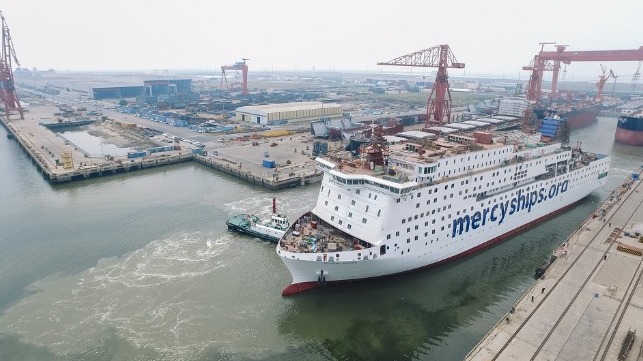
Chinese Shipyard Closes Due to Lack of Profitability 

Chinese shipyard ceases operations due to debts and lack of profits
Hospital ship Global Mercy in 2020 at the Tianjin shipyard (Mercy Ships)

PUBLISHED OCT 13, 2021 3:09 PM BY THE MARITIME EXECUTIVE


One of China’s mid-sized shipbuilders, Tianjin Xingang Ship Heavy Industry, announced that it will stop all operations as of the end of October. The disbanding of the company comes despite the recent resurgence in shipbuilding orders and China’s overall leadership in the industry.

The Shanghai International Maritime Information Research Center reported that the shipyard is shutting down for the second time in its history due to heavy financial debts. They reported that insufficient profits from shipyard operations in recent years led to the decision to cease operations. The shipyard announced that it has discharged its labor contracts with employees and will stop all of its operations and production by the end of the month. 

Tianjin Xinjiang had relocated its operations in 2017 focusing both on new ship construction up to 500,000 tons and ship repair for ships up to 300,000 tons. It had a capacity to build ships up to about 1,000 feet in length.

In operation since 1940, the shipyard had previously been reorganized about twenty years ago. It filed for bankruptcy in 2000 but completed a restructuring of the operations the following year.

Tianjin completed construction to the 39,000 gross ton Global Mercy for Stena RoRo in June 2021. The vessel, which is the world’s largest civilian hospital ship, will begin operations in 2022 for Mercy Ships. First steel for the vessel was cut in 2015 with the floating out taking place at the beginning of 2020. Especially design for Mercy Ships, it is being billed as the most technologically advanced ship of its kind. It has six operating rooms, 200 beds, a laboratory, general outpatient clinics, and eye and dental clinics. The total area of the hospital department is more than 75,000 square feet.

The shipyard also completed the construction of two 210,000 dwt bulk carriers built for COSCO Shipping Bulk Transportation Co. The vessels, each of which measures 984 feet in length, were delivered in May and June 2021, promoted as a new generation of a large bulk carrier. The shipyard said the vessels’ design incorporated “intelligence, green, environmental protection, energy-saving, and reliable” technology.

The reports indicate that Tiajin’s operations will likely be divided up going to other parts of the Chinese state-owned China State Shipbuilding Corporation, which has also been undergoing a reorganization to improve results. Tianjin's shipbuilding business is expected to be taken over by Dalian Shipbuilding Industry while the ship repair business will become part of Shanhaiguan Shipbuilding. The reports did not include any details on the size of the shipyard’s orderbook.

Thursday, March 12, 2026

Aluminum price surge propels Chinese tycoon to $48 billion fortune


When Zhang Bo took over his father’s industrial empire in 2019, it was already a sprawling industrial giant and one of the world’s biggest producers of aluminum.

Since then, the stock of his China Hongqiao Group has risen 585%, quietly turning Zhang into Asia’s richest metals tycoon with a fortune of about $48 billion.

Zhang, the world’s largest private producer of the metal, has a grip on low-cost output at a critical moment for global demand. He’s a supplier to China’s biggest tech firms like Huawei Technologies Co., Xiaomi Corp., and BYD Co. Aluminum has spiked more than 25% in the past year, fueled by demand from new energy vehicles to solar panels and wind turbines, while geopolitical shocks like the war in Iran have added to volatility. The metal rose to the highest in almost four years on Monday.

The widening Middle East conflict has disrupted local smelters, which account for 9% of global primary aluminum supply. An effective halt on shipments via the Strait of Hormuz, off Iran’s coast, has also choked shipments of the metal. That positions Chinese aluminum producers like Zhang’s to plug emerging supply gaps if global output slows.

“Their influence and personal wealth expanded because the industrial platform they built reached a scale where the market could no longer ignore it,” Harry Yu, senior partner at family office advisory Fung, Yu & Co said of the Zhang clan. “Families like this tend to stay low-profile because their power sits in production systems and supply chains, not in branding.”

Chinese aluminum smelters in the past years have grappled with access to bauxite, the ore used to produce aluminum, as political instability in Guinea and export restrictions in Indonesia disrupted shipments. Jakarta’s drive to keep more processing at home further tightened global supply. Zhang and his father, however, had moved ahead of peers to lock in upstream resources.

Hongqiao began developing bauxite mines in Guinea, the largest mining country for the raw material, around 2014. That’s given better access to bauxite than rivals, Bloomberg Intelligence analyst Michelle Leung said. Securing upstream resources in the early days has contributed to earnings growth, she said.

The company is now one of the lowest-cost producers globally through power plants in China, bauxite mines in Guinea and alumina plants in Indonesia.

Since he controls a significant share of primary aluminum output – which totaled nearly 73 million tons globally in 2024 – Zhang Bo’s decisions affect global supply and price expectations. Hongqiao’s share placements and refinancing are also closely watched by investors, affecting sentiment for aluminum equities across the region.

In the last year alone, his family’s wealth has gained 110%, according to the Bloomberg Billionaires Index, placing the clan among the wealthiest in Asia as of 2025. Zhang declined to comment.

Zhang Xuexin, the patriarch of rival firm Xinfa Group, is worth more than $35 billion.

Since taking over the helm from his father, Zhang Bo has helmed a major pivot by relocating a chunk of aluminum capacity to China’s mountainous Yunnan province to tap cheap green hydropower and align himself with China’s broader energy transition. He later expanded into high-end aluminum products used in electric vehicles as demand from traditional sectors such as property, construction waned.

Still the company is highly exposed to aluminum price volatility, while weaker-than-expected economic growth in major economies amid escalated trade and geopolitical tensions poses major downside risk to demand for the most widely used industrial metal.

Early days

The family’s history in aluminum goes back to 1994, when his father, Zhang Shiping, founded Weiqiao Textile Co. By the early 2000s, the elder Zhang began using excess energy from his textile plants to fuel a venture in aluminum.

The Chinese aluminum industry expanded rapidly in the late 1990s as the country moved toward a more market-oriented economy. While state-owned giants remained dominant, as they did in strategically important sectors such as oil and steel, aluminum’s economics hinged less on political control and more on access to cheap electricity. Hongqiao capitalized on that dynamic by building its own captive power plants, allowing it to scale rapidly and maintain some of the industry’s lowest production costs.

By 2017, the company had overtaken global titans like Russia’s Rusal and China’s state-owned Chalco to become the world’s largest producer. Chalco has since grown bigger in terms of aluminum production, closely followed by its privately-owned rival.

Wednesday, March 16, 2022

STATE CAPITALI$M IS STILL CAPITALI$M
Buttressing Greenland - a bailout in China's distressed property sector

By Engen Tham and Xie Yu 
© Reuters/TINGSHU WANG People walk past a building of Greenland Holdings Corp. Ltd. in Beijing

SHANGHAI/HONG KONG (Reuters) - Greenland Holdings Corp Ltd, a major Shanghai-based Chinese state-backed property developer responsible for marquee projects at home and abroad, was scrambling for funds late last year, people with direct knowledge of the matter said
.
© Reuters/TINGSHU WANG Sign of Greenland Holdings Corp. Ltd. is seen on its building in Beijing

In danger of defaulting on a $500 million offshore bond in December, it was rescued after Shanghai authorities told local state-owned enterprises (SOEs) to step in and buy new Greenland debt, sources told Reuters.

Greenland's financial straits and subsequent bailout, details of which are previously unreported, mark the first known example where Chinese SOEs have been directly ordered to participate in a property sector bond offering - highlighting more active and targeted action being taken by authorities as they seek to limit risks posed by the industry.
© Reuters/TINGSHU WANG People walk past a building of Greenland Holdings Corp. Ltd. in Beijing

Here is what happened.

Greenland, China's No. 7 property developer and highly leveraged, became swept up in a sector-wide debt crisis that roiled international markets last year amid fears that a large-scale developer collapse could derail the world's second-largest economy.

Like many of its peers, it was reeling from tighter caps on debt ratios introduced in January 2021 that resulted in a liquidity squeeze across the sector.

By October, some long-term lenders such as CITIC Bank were reducing their lending, two people with direct knowledge of Greenland's financial situation said, adding the state of affairs was not helped by downgrades to its debt ratings from credit rating agencies.

It had sought fresh financing from trust firms and leasing companies but a sharp rise in interest rates was proving to be a stumbling block, they said.

In the fourth quarter, Greenland embarked on more drastic steps - slashing real estate-related headcount by 30% and placing more strategic emphasis on infrastructure construction projects that accounted for half of its revenues, they added.

Even so, it did not have sufficient funds to cover the likely event that many holders of the $500 million puttable bond would seek to exercise their right to redeem it roughly a year early on Dec. 16, they said.

Sources for this article were not authorised to speak to media and spoke on condition of anonymity.

Greenland said in a statement to Reuters it has always repaid its domestic and overseas debts in full and kept financing costs low, adding that its liabilities reduction plan was progressing smoothly. CITIC Bank did not respond to requests for comment.

WHITE KNIGHTS

Concerned about Greenland's financial situation, Shanghai municipal authorities had sometime during the fourth quarter asked its lenders to be flexible with repayment extensions and to maintain rather than drop existing relationships, said one person with knowledge of the matter.

Then in early December, the Shanghai government's state asset administrator held a meeting with representatives of seven SOEs, ordering them to buy new dollar bonds issued by Greenland, according to four people briefed about the gathering.

Shanghai Municipal Investment Group, Bank of Shanghai, Shanghai Land (Group) Co and Lujiazui International Trust Co were among the SOEs, said two of the four sources.

On Dec. 14, Greenland announced it had raised $350 million in a dollar bond issue. Due August 2022 and carrying a 7.974% coupon, it was a rare developer bond deal at a time when concerns about the sector had dried up new note issuance. The only purchasers were the seven SOES, two sources said.

Three days later, Greenland said it had redeemed 85.9% of the $500 million bond after put options were exercised.

The Shanghai government's state asset administrator, the Shanghai municipal government and the four SOEs named above did not respond to requests for comment.

China's property sector crisis has posed a high-stakes quandary for President Xi Jinping, who is seeking to secure an unprecedented third term this year.

On one hand, the government wants to impose financial discipline on an industry known for unbridled borrowing and which by some metrics accounts for a quarter of China's economy. But it also can't afford to derail growth or fuel social unrest.

Bond defaults by China Evergrande Group, the world's most indebted developer with some $300 billion in liabilities, as well as by other developers, have seen authorities soften their initial stance that market forces would hold sway.

Rules relating to M&A and capital raising in the sector have been relaxed and developers have been given easier access to pre-sale funds held in escrow accounts. At last week's annual meeting of parliament, Premier Li Keqiang signalled more easing was in the works.

Local authorities have also encouraged SOEs to purchase developer assets, sources have previously said, although it is unclear if any SOEs have been ordered per se into an acquisition.

SHIMAO TOO

Shimao Group Holdings, a developer which has put all its property up for sale to repay debt, has also had a helping hand from Shanghai municipal authorities.

Twenty-seven of Shimao's creditors were asked to maintain lending positions and to not publicly undermine Shimao's creditworthiness, said a separate person who attended a creditor meeting. "Everyone was stony-faced, no one had any reaction," said the person.

Shimao did not respond to requests for comment.

Greenland, however, appears to have had more government intervention than most other developers. The sources who spoke with Reuters were not sure why but noted Greenland is state-backed and has high-profile projects.

It recently built Sydney's tallest residential tower and has billions of dollars worth of projects in London, New York, Los Angeles and Paris. At home, its projects include construction of the tallest building in northwest China and it is heavily involved in building subways, highways and bridges.

The use of government-backed credit support rather than the purchase of fire-sale assets is becoming the preferred policy option for reducing risk in the sector, one government policy advisor told Reuters.

There is also a growing consensus that when deciding which firms will gain government support, it will be size rather than whether a firm is government-backed or private that will be the key factor, the person said, adding the bottom line is to prevent a financial crisis.

Just how far the government will support Greenland remains to be seen. Its financial difficulties are not over. It has $190 billion in total liabilities, and according to Refinitiv data, outstanding bonds worth $7.1 billion, of which $3.7 billion is due to mature this year.

The order to SOEs to support Greenland only pertained to the $350 million purchase of new debt, the sources said.

At one SOE at least, there is fear that Greenland might fall further into financial strife and of the potential fallout if that happens.

The written instructions with a Shanghai SASAC letterhead that ordered the purchase of Greenland's bonds are being kept in a safe place in case Greenland defaults and SOE officials are called to account for their actions, said one person with knowledge of the matter.

(Reporting by Engen Tham, Xie Yu, Zhang Yan, Julie Zhu and Clare Jim; Additional reporting by Andrew Galbraith; Editing by Sumeet Chatterjee and Edwina Gibbs)

Friday, September 10, 2021

STATE CAPITALI$M IS STILL CAPITALI$M*
Evergrande’s collapse would have ‘profound consequences’ for China’s economy

Issued on: 10/09/2021 - 
China Evergrande Centre is seen in the Wan Chai district of Hong Kong on August 6, 2021. 
© Isaac Lawrence, AFP
Text by: Sébastian SEIBT

Investors are bracing for the increasing risk that Chinese real estate colossus Evergrande will collapse under the weight of more than $300 billion of debt. But experts say the Chinese Communist Party will have no choice but to save a company that is so emblematic of its economic growth model – and whose collapse would send shockwaves across the global economy.

Western financial institutions think Evergrande has a bleak future, if it has one at all.

JP Morgan made a whopping cut to its stock price target for the business on Friday, to 2.80 Hong Kong dollars from $HK7.20.

This came after ratings agency Fitch downgraded the firm's foreign currency credit rating from triple C plus to double C on Wednesday, saying that a form of default “looks probable”. Ratings agency Moody’s lowered Evergrande’s credit rating in the third time in three months – on the grounds that its creditors faced “weak recovery prospects” if the company defaulted.

Evergrande is the world’s most indebted real estate developer; $300 billion is roughly equivalent to the entire public debt of Portugal. Unsurprisingly, senior executives admitted in August that they might be unable to meet all of their financial obligations.

‘Debt-dependent growth model’


This poses a serious problem for the Chinese Communist Party, as Evergrande is a longstanding symbol of the country’s very economically productive urbanisation.

Also, Evergrande’s business model is representative of “China’s highly debt-dependent growth model”, Jean-François Dufour, head of French, China-focused consulting firm DCA Chine-Analyse, told FRANCE 24.

The company was founded in 1996, in the midst of the Communist Party’s Herculean endeavour of moving hundreds of millions of Chinese people from the countryside to the cities, creating a "very strong growth of the Chinese real estate sector", Frédéric Rollin, an investment strategy adviser at the multinational firm Pictet Asset Management, told FRANCE 24.

Evergrande was the main beneficiary of this boom. It pursued a very aggressive growth strategy and was dependent on banks’ goodwill as it accumulated a proliferating portfolio of real estate projects at a rapid clip.

This expansion continued over the decades, as shown by Evergrande raising $722 million in its IPO on the Hong Kong Stock Exchange in 2009. The firm now controls 778 real estate projects in 223 Chinese cities, directly employing nearly 200,000 people. Evergrande has claimed that it has indirectly created more than three million jobs.

Huge debt pile

But at the beginning of the 2010s, in the wake of that blockbuster IPO, Evergrande stretched its tentacles into an array of other sectors. The company was in a “race against time to diversify its activities, much more so than other Chinese real estate groups”, Dufour said. The Communist Party had “made other sectors national priorities”, he continued.

Consequently, Evergrande acquired stakes in video streaming companies, health insurers, milk farmers and pig-breeding co-operatives. It also bought Guangzhou FC, a football club in the Guangdong region where it is based, and built amusement parks. Evergrande’s latest diversification project was an attempt in 2019 to start manufacturing electric cars – despite a lack of any experience in this field.

Evergrande got its fingers into so many pies because it wanted a presence in “a sufficient number of priority sectors so that the state would be more inclined to support it financially when the weight of its debt became too heavy to bear”, Dufour explained.

The debt is very heavy indeed. Evergrande is due to pay $15 billion to creditors by the end of 2021; but, as of late June, it had only $13 billion to its name. At the same time, the banks have become much more reluctant to lend it money. “It’s become more complicated because of the restrictive monetary policy the government is currently pursuing,” Rollin said.

Economic contagion risk


Evergrande has entered a downward spiral in which the banks no longer want to give it the funds to finish its real estate projects, depriving the company of new properties to sell and therefore of fresh funds to repay creditors and reassure the banks.

“In a normal market economy, Evergrande would have gone bankrupt a long time ago,” Dufour said. But the Chinese model of capitalism has long encouraged the model of private debt.

“The rule was that as long as a company looked like it was moving forward – with plenty of projects in the pipeline – the banks gave it credit on the understanding that the strength of Chinese economic growth would always deliver profits,” he continued.

This way of thinking meant that “in 2020, Chinese companies’ debt represented 160 percent of GDP, compared to just 85 percent in the US and 115 percent in the eurozone”, Rollin pointed out.

Companies like Evergrande find themselves in a tricky situation now that Beijing has pushed heavily indebted countries to deleverage over the past year.

But the Communist Party also faces a dilemma, as it needs to prevent Evergrande from going under, to avoid the “profound consequences it would have for the Chinese economy”, Dufour said.

If Evergrande went bankrupt, “at least one bank would go under”, Dufour continued. “That may well push other banks to be more reluctant to end to highly leveraged countries – and that would herald the end of China’s debt-fuelled growth model.”

The real estate behemoth’s collapse would sent shockwaves far beyond China. As the Financial Times noted: “Evergrande counts big international companies among its investors, including Allianz, Ashmore and BlackRock. A default is likely to have spillover effects on global markets, where many investors have historically anticipated Chinese government support at times of distress.”

Given Evergrande’s importance to the Chinese economy, “it’s highly probable that the state will sort out a debt restructuring programme for it”, Rollin said. In other words, Beijing will force creditors’ hands while organising the sale of Evergrande’s non-core assets.

“This will likely mean putting the company under the state’s control while it finds a buyer; an approach the Chinese government has adopted before,” Dufour said.

But cleaning up a mess as big as a $300 billion debt pile will not happen overnight.

This article was translated from the original in French.


* WHAT GOES UP MUST COME DOWN, IS BOTH A WALL ST. TRUISM AND A LAW OF PHYSICS

Monday, February 06, 2023

STATE CAPITALI$M IS STILL JUST CAPITALI$M
China keeps insisting its real estate market is not in a crisis — even as just about every sign points to the opposite


Huileng Tan
Mon, February 6, 2023 

China's real-estate sector is mired in debt woes.Xu Jinbai/VCG/Getty Images

The IMF said in a report on China's economy that the country's property crisis remains "unresolved."

But China's hit back at that, saying its property market "has been operating smoothly in general, and is not in a 'crisis' situation."

China's real estate market has been mired in debt woes for the past few years.

China's property market woes may be well-documented — but Beijing insists there's no crisis.


And that's clashing with the International Monetary Fund's, or IMF's read of things. The IMF released its annual review of China's economy on Friday, in which it said that the real estate crisis "remains unresolved" and that the country's growth remains "under pressure."

But China's taking a contrarian view, saying in a January 12 response to the IMF, included in the Fund's report, that the country's property market "has been operating smoothly in general, and is not in a 'crisis' situation."

"The authorities are aware of the risks and are working to address them," said Zhengxin Zhang, China's representative to the IMF's executive board, and Xuefei Bai, a policy adviser at the IMF. "It is inappropriate to overstate the difficulties in the market and potential impacts to the financial sector."
The IMF says China's property crisis "intensified" in 2022

The IMF said in its Friday report China's property crisis "intensified" in 2022.

"Accumulating pressures from the unresolved property crisis could trigger a sharp retrenchment in aggregate demand, with adverse macro-financial feedback loops and potentially large external spillovers," the IMF said while calling for "further action" at the national level by increasing funding for the completion of stalled projects.

This might help lead the way to market-based restructuring, and contain financial risks, it added.

Despite China's efforts to reassure investors about the health of its property sector, more than half of 60 mainland China-listed developers are likely to post losses for 2022, per Bloomberg calculations which used public data. And on top of that, investment into China's property fell 10% in 2022 from a year ago, according to official data released on January 17.

The average net-debt-to-equity ratio at the country's top 80 real estate companies rose to 152% by the second quarter of 2022 — twice what it was in mid-2020 before debt restrictions on property developers were introduced, Reuters reported, citing analysts from the state-owned Chinese Academy of Social Sciences.

China's Zhang and Bai acknowledged in their January 12 response China's real-estate market entered "a new environment" in 2022 due to various factors, such as shrinking demand, weaker market expectations, the pandemic, and liquidity issues at some developers. But the balance sheets of listed developers showed improved liabilities to assets ratio in the first half of 2022, they wrote.

Chinese authorities are also supporting "reasonable market financing," they said, adding: "the current development of the real estate market is a natural evolution of 'deleveraging and destocking' in the past few years."

"The related risks are local and only concern individual firms, and their impact on the rest of the world has been relatively small," they added.
Beijing started clamping down on excessive borrowing in 2020

The sharp exchange comes amid an ongoing debt crisis in China's property sector after Beijing started clamping down on excessive borrowing in 2020, which contributed to the debt troubles at major property developer Evergrande.

The cash crunch led to stalled construction, spurring worries that buyers may never see the apartment they have been paying for.

Banks also tightened lending to the entire property sector amid Evergrande's liquidity crunch, leading to concerns of a domino effect on China's financial sector — and the rest of the world.

The debt crisis also had a deep social impact. Chinese millennials, for instance, are grappling with an existential crisis over home ownership due to concerns over whether developers will be able to deliver apartments buyers have paid for, wrote Insider's Cheryl Teh in October 2021.

"The real problem is that many developers simply do not generate positive cash flow and that the funding model of unfettered pre-sale receipts is broken," Andrew Lawrence, TS Lombard's Asia property analyst, wrote in a January 12 note seen by Insider.

Thursday, August 17, 2023


China's Xi calls for patience as Communist Party tries to reverse economic slump
STATE CAPITALI$M IS STILL CAPITALI$M

JOE McDONALD
Updated Thu, August 17, 2023 

BEIJING (AP) — Chinese leader Xi Jinping has called for patience in a speech released as the ruling Communist Party tries to reverse a deepening economic slump and said Western countries are “increasingly in trouble” because of their materialism and “spiritual poverty.”

Xi’s speech was published by Qiushi, the party’s top theoretical journal, hours after data Tuesday showed consumer and factory activity weakened further in July despite official promises to support struggling entrepreneurs. The government skipped giving an update on a politically sensitive spike in unemployment among young people.

Xi, the country’s most powerful leader in decades, called for China to “build a socialist ideology with strong cohesion” and to focus on long-term goals of improving education, health care and food supplies for China’s 1.4 billion people instead of only pursuing short-term material wealth.

Since taking power in 2012, Xi has called for restoring the ruling party's role as an economic and social leader and has tightened control over business and society since taking power in 2012. Some changes come at a rising cost as successful Chinese companies are pressured to divert money into political initiatives including processor chip development. The party tightened control over tech industries by launching data security and anti-monopoly crackdowns that wiped out billions of dollars of their stock market value.

“We must maintain historic patience and insist on making steady, step-by-step progress,” Xi said in the speech. Qiushi said it was delivered in February in the southwestern city of Chongqing. It is common for Qiushi journal to publish speeches months after they are delivered.

Economic growth slid to 0.8% in the three months ending in June compared with the previous month, down from 2.2% in January-March. That is equivalent to a 3.2% annual rate, which would be among China’s weakest in decades.

A survey in June found unemployment among urban workers aged 16 to 24 spiked to a record 21.3%. The statistics bureau said this week it would withhold updates while it refined its measurement.

The government is trying to reassure uneasy homebuyers and investors about the deeply indebted real estate industry after one of China's biggest developers, Country Garden, failed to make a payment to bondholders and suspended trading of its bonds. A government spokesperson said Tuesday regulators are getting debt under control and risks are “expected to be gradually resolved.”

Beijing also has expanded anti-spying rules and tightened controls on information, leaving foreign and private companies uncertain about what activities might be allowed.

Xi stressed “common prosperity,” a 1950s party slogan he has revived. He called for narrowing China’s yawning wealth gap between a tiny elite and the poor majority and to “regulate the healthy development of capital” but announced no new initiatives.

“Common prosperity for all people” is an “essential feature of Chinese-style modernization and distinguishes it from Western modernization,” Xi said.

Western-style modernization “pursues the maximization of capital interests instead of serving the interests of the vast majority of people,” Xi said.

“Today, Western countries are increasingly in trouble,” Xi said. “They cannot curb the greedy nature of capital and cannot solve chronic diseases such as materialism and spiritual poverty."


People wait outside a restaurant in Beijing, Tuesday, Aug. 15, 2023. Chinese leader Xi Jinping has called for patience in a speech released as the ruling Communist Party tries to reverse a deepening economic slump and said Western countries are "increasingly in trouble" because of their materialism and "spiritual poverty." (AP Photo/Ng Han Guan)

Analysis-China's crackdowns rewrite investors' private sector playbook


 An electronic board shows stock indexes at the Lujiazui financial district in Shanghai

By Samuel Shen and Summer Zhen
Thu, August 17, 2023

SHANGHAI/HONGKONG (Reuters) - Buy the state, sell the capitalist - that's how global investors are trying to play China's latest anti-graft crackdowns as they see private enterprise increasingly sidelined in Beijing's quest for "common prosperity".

China's recent sweep of the medical sector came as a shock to many investors who had thought the end of Beijing's three-year regulatory purge of the property and tech sectors meant there would be no more industry-wide crackdowns as policymakers prioritised economic recovery.

Several government bodies in July launched a year-long anti-corruption campaign into the medical system, making clear that China's drive to deliver affordable housing, education and healthcare to its masses was more important.

That forced many investors to quickly draw parallels with last year's crusade against private tutoring and a long-running one against tycoon Jack Ma's consumer finance firm Ant Group.

The one unanimous conclusion they came to was that Beijing wants a greater state presence in these sectors.

"The underlying principle is that healthcare is kind of like a social service that should principally be in state hands," said Arthur Kroeber, partner and head of research at Gavekal in New York. Kroeber says the crackdowns are about "defining what the state does, what the private sector does, and creating a more limited sandbox for the private sector to play in."

"This links to the idea of common prosperity because it's the state's job to guarantee a level of provision of basic services, whether it's education or healthcare, so it's important for the state to have a role," he said.

That has left investors now picking the state over the private sector.

While the CSI Medical Services Index is down 4.4% this month and 20% so far this year, investors have snapped up shares of state-owned medicine producers such as Beijing Tongrentang Co, which is up 14% this month.

Similarly, the expectation that state-backed property firms will gain better access to funding and bigger market share has seen investors dump private developers' stocks and rush into state-owned developers such as Yuexiu Property and Poly Developments.

Zhang Kexing, general manager of Beijing Gelei Asset Management, expects healthcare companies with strong branding will benefit, as will firms in traditional Chinese medicine, which has political support, such as Beijing Tongrentang.

NATIONAL SERVICE

While President Xi Jinping has made graft busting a priority since 2012, the Chinese Communist Party's (CCP) two-year-old "common prosperity" campaign that targets financial services, private education and healthcare has accelerated that push.

The CCP's July Politburo meeting reinforced the message, with the top policymaking body pledging to put a floor under the property sector, help indebted local governments heal and boost consumer demand.

Investors now believe Xi will be relentless in his social and economic agenda, much of which draws on Mao Zedong's Marxist and socialist thinking.

Thomas Masi, a partner and equity portfolio manager at Boston-based GW&K Investment Management, spoke to heads of several Chinese firms that he reckoned were at the fore of innovation in healthcare.

"Basically the message they were getting from the government was that they should be doing some of this innovation for national service, as opposed to for profitability only. That was a lightbulb for us," said Masi, who was once bullish on healthcare.

"We basically understood...we were not necessarily going to be paid as shareholders."

Xi himself has often said that private companies should be "rich and loving," be "patriotic" and share the fruits of their growth with employees more equitably.

Nuno Fernandes, also a partner and portfolio manager at GW&K, says it is important for investors in China to recognise the power of the state to override private interests, which means companies will need to "make a profit out of whatever circumstances and situation they are given."

That is why Fernandes has slashed his portfolio holdings in Chinese drugmakers.

Huang Yan, general manager of private fund manager Shanghai QiuYang Capital Co, said Beijing will crack down on any sector seen as increasing people's economic burden.

"Whether it's healthcare or tutoring, a crackdown will befall any sector as long as the campaign benefits the majority of people at the cost of the minority," Huang said.

Huang points to inflated liquor prices as an example.

"Using pricey spirit to lubricate business at the banquet increases companies' cost which could be used in better ways. It's possible for this sector to be targeted," he says.

But Beijing may ignore other sectors such as infrastructure, where such excess is less visible, he said.

Kumar Pandit, portfolio manager at Somerset Capital Management's Emerging Markets Dividend Growth Fund in London, is not cutting his China exposure but has an "added layer of scrutiny" around sectors Beijing deems important to common prosperity.

While the probability of wider crackdowns is low, he said making decisions remains challenging.

"It is difficult to say with certainty whether the crackdown will spill into other sectors," Pandit said.

(Additional reporting by Jason Xue in Shanghai and Ankur Banerjee in Singapore; Writing by Vidya Ranganathan; Editing by Sam Holmes)

Sunday, August 24, 2025

Analysis-China faces pivotal welfare reform test as court ruling hits jobs, small firms

STATE CAPITALI$M IS STILL CAPITALI$M

View of financial district of Pudong is reflected on a bus passing by, in Shanghai 

Reuters
Wed, August 20, 2025 

BEIJING (Reuters) -China's top court ruling that makes it illegal for businesses and employees to avoid social insurance payments is stoking fears about jobs and the survival of small firms, forcing Beijing to confront the risks of long-promised welfare reform
.

The ruling, analysts and one government adviser say, aims to replenish depleted pension coffers in ageing regions and lay the groundwork for more generous welfare, helping China transition to a growth model that relies more on consumer demand and less on debt-driven infrastructure and industrial investment.

The Supreme People's Court said this month the levies have always been mandatory, but acknowledged patchy enforcement. In practice, millions of workers informally agree with factories, construction firms, delivery services, restaurants and other small businesses not to pay into the scheme so they can keep the money.

Hit by higher U.S. trade tariffs this year, some factories have fired full-time staff and rehired them as day labour to save on pension, unemployment, medical and other insurance payments.

Analysts say the court ruling, which is effective September 1, could bring Beijing closer to meeting its long-standing pledge to bolster the safety net in the world's second-largest economy, but it also poses a difficult test to the government's broader reform ambitions as it creates immediate risks to economic growth if businesses and workers have less to spend.


Jia Kang, founding president of the China Academy of New Supply-Side Economics, told Reuters the decision could be "a matter of life or death for many small firms."

Societe Generale estimates the costs to firms and consumers at about 1% of GDP if the ruling is enforced.

"China is confronting the core question of who pays for reform," said Joe Peissel, an analyst at research firm Trivium.

As things stand, workers and businesses bear the burden, which undermines employment and consumption and may not be sustainable, he said. This calls for new policies to make more state resources available to the welfare system.

"The long-term success of these reforms will hinge on whether the government is willing to shoulder more of the cost," said Peissel.

The human resources ministry, and the State Council Information Office, which answers media queries for the government, did not immediately respond to a comment request.

INSTANT IMPACT

Social insurance contributions differ by city but typically equal about a tenth of gross income for employees and roughly a quarter for employers.

That's high by global standards and incentivises informal workarounds, economists say.

A complex system of paybands also makes social insurance payments highly regressive, with low-income workers bearing a heavier burden than top earners, discouraging them from paying, a 2024 report by China's top legislature found.

A survey of more than 6,000 firms by human resources firm Zhonghe Group last year found only 28.4% of them were fully compliant with social insurance rules. Official data shows 387 million employees contribute to China's urban pension scheme, roughly half of the workforce.

Mary Dai, 23, a waitress in the eastern city of Jinhua, said her boss asked her to accept a salary cut to 2,500 yuan from 4,000 yuan per month if they both had to pay contributions.

"It's like one sweeping blow killing everyone" said Dai, adding such income would not cover her basic needs and she would return to her village to live with her parents.

Qin Sinian, a restaurant owner in the southwestern city of Mianyang, said he fired six of his 12 workers to be able to afford paying social insurance from next month.

His restaurant makes 700,000 yuan annually, of which 500,000 goes on rent, labour and ingredients. Social insurance will add 120,000 yuan, leaving just 80,000 yuan ($11,140) before taxes.

"It feels like being crushed beneath a mountain," Qin said.

Social media users have also expressed a lack of trust in how their contributions are managed. A 2024 cabinet report found 13 provinces had diverted 40.6 billion yuan from pension funds to other expenditures.

Xiao Qiang, founder of U.S.-based censorship tracker China Digital Times, said some posts on this topic have been taken down, including views that the ruling disproportionately hurts the most vulnerable.

A construction worker from the central Hubei province, giving only her surname Li for privacy, said neither she nor her employer can afford social insurance on her 3,500 yuan wage.

"When they roll out these policies, do they even consider the struggles of people at the bottom?" Li said.

LABOUR 'SUPPRESSION'


Waiving social insurance payments has fed China's economic imbalances at home and abroad.

It lowers factory labour costs and improves China's export competitiveness. It makes public infrastructure works cheaper, which in turn lowers logistics costs for manufacturers and brings supply chains closer together.

But as China ages, missed payments pose risks to the pension system - predicted to run out of money by 2035.

It also worsens industrial overcapacity by freeing resources for factory expansion. And it forces workers to save for rainy days on their own, a key drag on consumer spending.

"A core flaw in China's overall economic development has been relying on suppressed labour costs to compete, generating large trade surpluses, especially with the United States and Europe," said a policy adviser, requesting anonymity due to the topic's sensitivity.

"This is not a viable long-term path," the adviser said, citing trade tensions. "If you can't afford to pay wages, what kind of business are you running?"

The adviser suggested Beijing should increase unemployment benefits before tightening enforcement to cushion the blow of business closures.

Societe Generale analysts expect the government will either delay implementation or roll out more stimulus to offset the impact.

"Another shock to the labour market is the last thing policymakers would like to see," they wrote in a note.

($1 = 7.1813 Chinese yuan)

(Reporting by Liangping Gao, Ellen Zhang, Kevin Yao in Beijing and Claire Fu in Singapore; Writing by Marius Zaharia; Editing by Kim Coghill)

Sunday, November 17, 2024


Deconstructing State Capitalism


 November 15, 2024
Facebook

The term state capitalism does not have a single definition that is used with consistency and uniformity. The definitions that have been used depend on the context of the discussion, both historically and in terms of discipline or field, and the ideological commitments of the speaker or author. To understand state capitalism, it is necessary to survey the ways the state has shaped and participated in economic life within capitalist frameworks. Today, state actors around the world are adopting an aggressive economic strategy, investing heavily across sectors to position themselves optimally within the global capitalist system. State-owned enterprises (SOEs) have proliferated dramatically in recent years, growing in number and increasingly occupying positions as some of the top companies in the world. In the twenty-first century, SOEs have “evolved from national monopolist[s] to global players,” expanding their reach and increasingly “operating in strategic sectors – such as energy, transport, infrastructure and logistics, banking and high-tech.” As just one example, sovereign wealth funds (SWFs) have grown significantly in recent years and are now some of the largest and most important investment funds in the world. “As of February 2023, assets under management of sovereign wealth funds globally stood at $11.3 trillion, up more than tenfold in the last decade.” Governments can generally mobilize much larger sums of capital than private companies—and more quickly and easily. Governments have a range of powers that make them unique among institutional investors; they can do things like tax people, control natural resources (like oil, gas, and minerals), print and disseminate money, adjust interest rates for the entire national financial system, and apply foreign exchange reserves. With their incredible masses of capital, states exert enormous and unmatched power as investors in the global market. Their actions can impact whole industry sectors and national economies. Within the current context, the term state capitalism has been deployed as a kind of smear against China and others, to differentiate their supposedly exotic, statist-authoritarian practice of capitalism from a purer and truer Western version. It is undoubtedly true that for cultural and political reasons, China does not feel the same need to obscure or euphemize its participation in the economy. But it has become necessary to mount a critical challenge to the reproduction of “extremely problematic Eurocentric imaginaries” that present a misleading picture of a supposed contest between the “vile, authoritarian state capitalism” of the East and “a more virtuous liberal-democratic form of free-market allegedly prevailing in the West.”

The idea of state capitalism has long been associated with Marxist discourse. Notably, for Vladimir Lenin, state capitalism was promoted as an intermediate phase in which the state would participate in the capitalist system under the supervision and control of the working class. Lenin believed that the consolidation associated with monopoly capitalism would prepare the way for the socialization of production through the state. Indeed, he goes so far as to argue that under “[t]he objective process of development” it is “impossible to advance from monopolies (and the war has magnified their number, role and importance tenfold) without advancing towards socialism.” To Lenin, socialism must proceed directly from state-capitalist monopoly as the inevitable “next step forward.” “Or, in other words, socialism is merely state-capitalist monopoly which is made to serve the interests of the whole people and has to that extent ceased to be capitalist monopoly.” Ironically, then, were he alive today, Lenin could be expected to see current concentrations of wealth under global state capitalism as an auspicious indicator, the condition precedent to the advent of socialism under state administration. Many of Lenin’s socialist and communist contemporaries shared his conviction that capitalist monopolies were the path to state ownership and thus to an eventual full socialist state. At this point, some will ask: what are we to make of the fact that so many influential socialists saw socialism as monopoly capitalism perfected? At the very least, it shows that there were and are many visions of socialism—and of the paths thereto. During Lenin’s lifetime, several social, technological, and ideological developments contributed to his understanding of state monopoly capitalism as the immediate precursor to socialism. Whether or not they were actually implemented in the early Soviet Union, Lenin was influenced by ideas associated with Frederick Winslow Taylor and his Principles of Scientific Management. Taylorism emphasized the centralization and standardization of production processes, which Lenin believed would rationalize and optimize the allocation of labor resources. Lenin thought that under the control and direction of the state, these new methods and practices could be implemented to overcome the chaos and inefficiency of capitalism, creating a streamlined planned economy that would work for all. In line with the economic thinking of the time, Lenin saw gigantic scale as necessary for both attaining economies and making it possible for qualified experts in the state to manage the economy from the top down. It is important to understand Lenin’s point of view because it helps to explain the trajectory of twentieth century communism and to highlight, by contrast, some of the libertarian socialist and anarchist criticisms of state capitalism. Both the state capitalism of the West and the communism of the Soviet Union and China during the 20th century created morphologically similar structural and organizational patterns—centralized, hierarchical, bureaucratic, and ruled from the top down. Lenin’s phased framework notwithstanding, the mere fact of its ownership by the state does not make a corporate entity less hierarchical or exploitative per se. Nor does state ownership, on its own, mean management and control resides in the hands of the workers. Conditions for the workers seem to depend much less on institutional names and formalities than they do on the embodied material facts of centralized power and rigid hierarchical control.

It is ahistorical to present the state as merely a neutral rule-giver and enforcer, refereeing fair play in the free market. The twenty-first century state is not passingly interested in the economy. Indeed, the state regards itself as responsible for fundamental measures of economic health such as the GDP, employment levels, inflation, and the balance of trade. The GDP is its GDP, etc. Sovereign states participate directly in the capitalist market in a wide variety of ways. They are much more active players in the capitalist “free market” than many suppose. States often compete in the market directly, with governments owning and operating firms in sectors ranging from airlines and oil and gas to telecommunications, investing, mining, agribusiness, pharmaceuticals, and infrastructure construction. Perhaps least surprisingly, some of the largest energy companies in the world belong to governments, including the largest in Saudi Aramco, one of the most valuable companies in the world, with a market cap of $1.9 trillion (just 6 companies have a market cap over $1 trillion). Russia owns the world’s largest natural gas company by production volume, Gazprom, “with a 10% worldwide share of the market in 2023, followed, just as in the previous year, by PetroChina.” Any real understanding of the way corporate power operates in the world today requires us to “understand the inextricable interrelation between the state and the corporation.” It is common for the mainstream conversation to treat corporate influence on policy making and the political process as a kind of breakdown of the system, a glitch or deviation. But as a historical and empirical matter, this is not at all accurate. The state is itself a corporation in the sense that it is a discrete legal entity, an artificial person separate from the group of people it represents. The first modern companies were created explicitly as the conduits of anti-competitive monopoly privileges and imperialism. The charters that created them were readily acknowledged as favors from sovereigns, granting special rights to particular spheres defined geographically and commercially. Abstract or philosophical notions about economic freedom and fair competition were of course not driving the creation of the proto-corporate economy.

Scholarly interest in the institutions, phenomena, and ideological systems often associated with state capitalism has increased over the past decade in response to aggressive government strategies to play an active and direct role within the global market. In their book The Spectre of State Capitalism, published earlier this year (the full book is available for free here), Ilias Alami and Adam D. Dixon provide a comprehensive and interdisciplinary picture of the “material, discursive, and ideological dimensions” of present-day state capitalism, with they discuss as “the new state capitalism.” Alami and Dixon hope to correct the record in part by pointing out that vigorous state intervention has been anything but an aberration in the history of capitalism:

First, we submit that state capitalism must not be seen as an anomaly or a deviance from liberal, market-based capitalism, but as a particular modality of expression of the capitalist state, including in its liberal form. State capitalism is an immanent potentiality, an impulse which is contained in the form of the capitalist state and built into its DNA.

Alami and Dixon stress that the modern state and capitalism arise together and evolve in a sophisticated and highly intertwined relationship with each other. And as they note, historically, there is no capitalism without deliberate and sustained state intervention to create it. Relatedly, in their analysis of the private sector, Alami and Dixon want to remove it from a privileged position whereby it is simply assumed a priori that private companies are necessarily more efficient, innovative, and driven. Their work encourages us to look behind a state-market, public-private dichotomy that does not accurately describe the real-world relationship between the state and the economy. The authors also want to understand the relationship between the rise of state capitalism and “secular capitalist trends of economic stagnation and the centralization and concentration of capital.” Today, global capital is extremely concentrated and centralized, with inequality soaring in recent years and a relatively small number of companies controlling each major sector. Among the major economic trends of the past several decades is “the unprecedented centralization and concentration of capital on a planetary scale.” In the United States, there are about 40 percent fewer companies today than there were 30 years ago. “In the mid-1990s, there were nearly 8,000 public companies listed in the U.S. Today, there are half as many, and at the current rate, we’ll see that number halved again by 2044.” This has led and will continue to lead to major crises. Among the fundamental contradictions of capitalism is that it expects growth in revenues and profits even as it concentrates the benefits of that growth—and all wealth—in fewer and fewer hands. Unsurprisingly, in capitalism, this phenomenon of wealth and power concentration also appears within the firm, as the size of the firm increases. Quite contrary to popular belief, the growth of state power and a modern state more willing to participate directly in economic competition have not translated to weaker corporations or a more diverse and competitive economy. Indeed, a more active and powerful state seems to lead almost ineluctably to a more centralized and oligopolistic political and economic system. Perhaps surprisingly, then, in a recent interview with Geoffrey Gordon for the New Books Network, Dixon notes that libertarian and classical liberal types could find themselves agreeing with many of the book’s core claims. The book shows that as a political and economic system, state capitalism depends on the active interventions of governments in market economies, the kinds of interventions libertarians frequently criticize. This is another of many areas of fruitful dialogue between libertarian and leftist modes of criticism.

Alami and Dixon note that quantifying state capitalism presents many practical difficulties, but using the example of the United States, we find enormous levels of government intervention and participation in the economy. Whether they admit it or not, the political establishment across both major parties in the U.S. has long been comfortable with strong and sustained federal government intervention in the economy. A certain level of positive intervention is taken for granted at the political level, and that level is extremely high under any plausible empirical approach. The United States is home to the top two state-owned enterprises by total assets, Fannie Mae and Freddie Mac, which are both currently under government conservatorship; though they are not technically owned by the U.S. government, they highlight one of the fundamental characteristics of the state capitalist paradigm: they were included in the list presumably because, formal ownership notwithstanding, the state holds the incidents of ownership, as is often the case in partnerships between the state and normally private corporations. The state is shrewd and sophisticated as a commercial actor and does not invest without holding the strings. Whatever its rhetorical pretensions, the United States has not adopted a light-touch approach to the economy. Over the past several years, the United States government’s interventions in the economy have totaled in the multiple trillions of dollars, far beyond the level of state involvement we would expect in a hypothetical free and competitive economic system (importantly, this is even without including spending associated with responses to the pandemic). Most such interventions were undertaken to benefit and prop up giant multinational companies, with, for example, several trillions going directly to defense contractors (read: war profiteers) over the past 5 years alone. As an insurance provider, the United States government manages millions of policies to the tune of trillions of dollars. The U.S. government provides grants and subsidies for domestic companies and industries, bails out banks and other financially troubled domestic industries, offers credit lines, and purchases billions of dollars worth of securities. Today, it is considered impolite to point out that the United States is an empire; it wants its vassals—particularly its first-tier ones—to feel that they are masters of their own destiny. But the United States has the power to dictate the parameters of their economic policy, and it is not at all shy about exercising this power. The United States also increasingly tries its best to police and control who can participate in the global market, through an ever-increasing list of sanctions. The idea that the United States should assume this role is asinine and would be hilarious were it not so costly in human terms: to show how serious it is about punishing its enemies and controlling the world economy, Washington will sentence millions of innocent people to entirely unnecessary death.

As observers have long acknowledged, the U.S. incarnation of state capitalism is a version of fascist political economy. In a fascist system, the economy is not centrally planned, but it is monitored, controlled, and directed toward the aims of the state, with any liberal notion of economic rights subordinated to the demands of national greatness and unity. Private ownership is permitted, but corporate power collaborates with the state as junior partner; corporations may operate and compete freely within limited commercial spheres, but they must operate as extensions of the state when called upon and must align their efforts with the goals of the state. Americans of many political stripes have begun to see such features in the visage of our government (if you’ll forgive our here). Though we are led to believe bigger is always better, large scale is integral to the systems of domination and human suffering we see around us. Capitalism has been able to absorb and overcome its critics— “it has become much more immune to social movements, much more immune to critique and judgment. A hundred years ago, it would’ve been probably a lot easier to overturn and topple the system than it is today; it’s so much more rooted in our everyday life, and the values are so taken for granted and a priori …” And speaking of absorbing its critics, just as there is no real free market in the United States, there isn’t much communism going on in China these days. From Mao’s 1938 call for the “Sinification of Marxism” to Deng’s Socialism with Chinese Characteristics to today, China has become comfortable with state capitalism. The Chinese Communist Party has long emphasized the distinctiveness of their socialist vision. And it is no doubt a distinctive form of socialism that unites the full state embrace of capitalism with promises of a return to national greatness, and that preserves the unquestioned political dominance of a single party.

As a social system, state capitalism is a dramatic failure, engendering a crisis of hopelessness, isolation, and dissociation, “because the society seems inalterable, unchangeable, unresponsive to our needs, and it’s crushingly—let’s be honest—meaningless.” If we were to caricature an oligarchical empire ruled by global finance capital, that system might look similar to the one we actually have in 2024. The existing system is a social illness. We have left behind our skepticism of the gargantuan and forgotten that what is giant must be dangerous—and hard to move from an ill course. We may not like the task and we may not be up to the task, but the task is clear: we must dramatically relocalize our political and economic institutions, cultivating active and direct resistance to the dominance of capital and the state over human life. We can only meaningfully counter their dominance by understanding their interrelatedness and history. The dominant system—choose your preferred name: state capitalism, monopoly capitalism, state monopoly capitalism, fascism—seems to us inevitable, but it is far from being so. Other ways of life exist, even now alongside our supposedly inevitable system, all around the world, at the still unreached boundaries of the state capitalist order. Even as the state and capital grow in power together, they have not dominated everything yet.

David S. D’Amato is an attorney, businessman, and independent researcher. He is a Policy Advisor to the Future of Freedom Foundation and a regular opinion contributor to The Hill. His writing has appeared in Forbes, Newsweek, Investor’s Business Daily, RealClearPolitics, The Washington Examiner, and many other publications, both popular and scholarly. His work has been cited by the ACLU and Human Rights Watch, among others.


LA REVUE GAUCHE - Left Comment: Search results for STATE CAPITALI$M

LA REVUE GAUCHE - Left Comment: Search results for STATE MONOPOLY CAPITALISM