Pope Leo XIV Says God ‘Does Not Listen’ To Prayers Of Those Who Wage War

Pope Leo XIV takes part in the traditional Palm Sunday procession in St. Peter's Square at the Vatican on March 29, 2026. | Credit: Daniel Ibáñez/EWTN
March 30, 2026
EWTN News
By Victoria Cardiel
Pope Leo XIV on Palm Sunday sharply condemned war and the use of religion to justify violence, saying during Mass in St. Peter’s Square that God “does not listen to the prayers of those who wage war.”
At the start of Holy Week, the pope tied the Church’s contemplation of Christ’s Passion to the suffering of people caught in today’s conflicts, especially Christians in the Middle East.
In his Palm Sunday homily, Leo repeatedly presented Christ as the “King of Peace,” contrasting Jesus’ meekness with the violence surrounding him as he entered into his Passion.
“We turn our gaze to Jesus, who reveals himself as King of Peace, even as war looms abounds him,” the pope said. “He remains steadfast in meekness, while others are stirring up violence.”
Leo said Christ “did not arm himself, or defend himself, or fight any war” but instead “revealed the gentle face of God, who always rejects violence.”
“Rather than saving himself, he allowed himself to be nailed to the cross, embracing every cross borne in every time and place throughout human history,” the pope said.
The pope then issued one of the strongest lines of his homily, rejecting any attempt to invoke God in support of armed conflict.
“Brothers and sisters, this is our God: Jesus, King of Peace, who rejects war, whom no one can use to justify war,” Leo said. “He does not listen to the prayers of those who wage war, but rejects them, saying: ‘Even though you make many prayers, I will not listen: your hands are full of blood.’”
The Palm Sunday liturgy, which opened Holy Week, began with the traditional procession in St. Peter’s Square with cardinals, bishops, priests, religious, and thousands of faithful carrying palms and olive branches.
In his homily, Leo reflected on Jesus’ entry into Jerusalem on a donkey rather than a war horse, saying the moment fulfilled the prophecy of a king who would “command peace to the nations.”
Recalling the Gospel account of Peter drawing a sword to defend Jesus, Leo cited Christ’s rebuke: “Put your sword back into its place, for all who take the sword will perish by the sword.”
The pope said that in the crucified Christ “we can see a crucified humanity.”
“In his wounds, we see the hurts of so many women and men today,” he said. “Above all, we hear the painful groans of all those who are oppressed by violence and are victims of war.”
“Christ, King of Peace, cries out again from his cross: God is love! Have mercy! Lay down your weapons! Remember that you are brothers and sisters!”
Following the Mass, Leo returned to the theme of war during the Angelus, praying in particular for Christians in the Middle East who have been prevented in some places from fully taking part in Holy Week rites.
“At the beginning of Holy Week, our prayers are more than ever with the Christians of the Middle East, who are suffering the consequences of a brutal conflict and, in many cases, are unable to observe fully the liturgies of these holy days,” he said.
“Just as the Church contemplates the mystery of the Lord’s Passion, we cannot forget those who today are truly sharing in his suffering. Their ordeal challenges all our consciences.”
The pope added: “Let us raise our prayer to the Prince of Peace that he may sustain the peoples wounded by war and open concrete paths to reconciliation and peace.”
Leo also remembered “the maritime workers who have fallen victim to the conflict,” adding: “I pray for the deceased, the wounded and their families. Land, sky and sea were all created for life and peace!”
He further called attention to migrants who died in the Mediterranean, saying: “Let us also pray for all the migrants who have died at sea, especially those who lost their lives in recent days off the coast of Crete.”
Near the end of his homily, the pope entrusted his plea for peace to the intercession of Mary, quoting the Servant of God Bishop Tonino Bello and praying that “the tears of all the victims of violence and pain will soon be dried up.”
He concluded the Angelus by asking the Virgin Mary to accompany the faithful through the days ahead.
“May she guide us during these holy days, so that we may follow Jesus, our Savior, with faith and love,” he said.
This story was first published in two parts by ACI Prensa, EWTN News’ Spanish-language news partner. It has been translated and adapted by EWTN News English.
EWTN News is the rebranding of the Catholic News Agency (CNA), following the decision by EWTN — which was launched as a Catholic television network in 1981 by Mother Angelica, PCPA — that brings CNA and its affiliated ACI international outlets under a single, unified identity. Previous CNA articles may be found by clicking here.
EWTN News is the rebranding of the Catholic News Agency (CNA), following the decision by EWTN — which was launched as a Catholic television network in 1981 by Mother Angelica, PCPA — that brings CNA and its affiliated ACI international outlets under a single, unified identity. Previous CNA articles may be found by clicking here.
Ewan Gleadow
March 29, 2026
RAW STORY
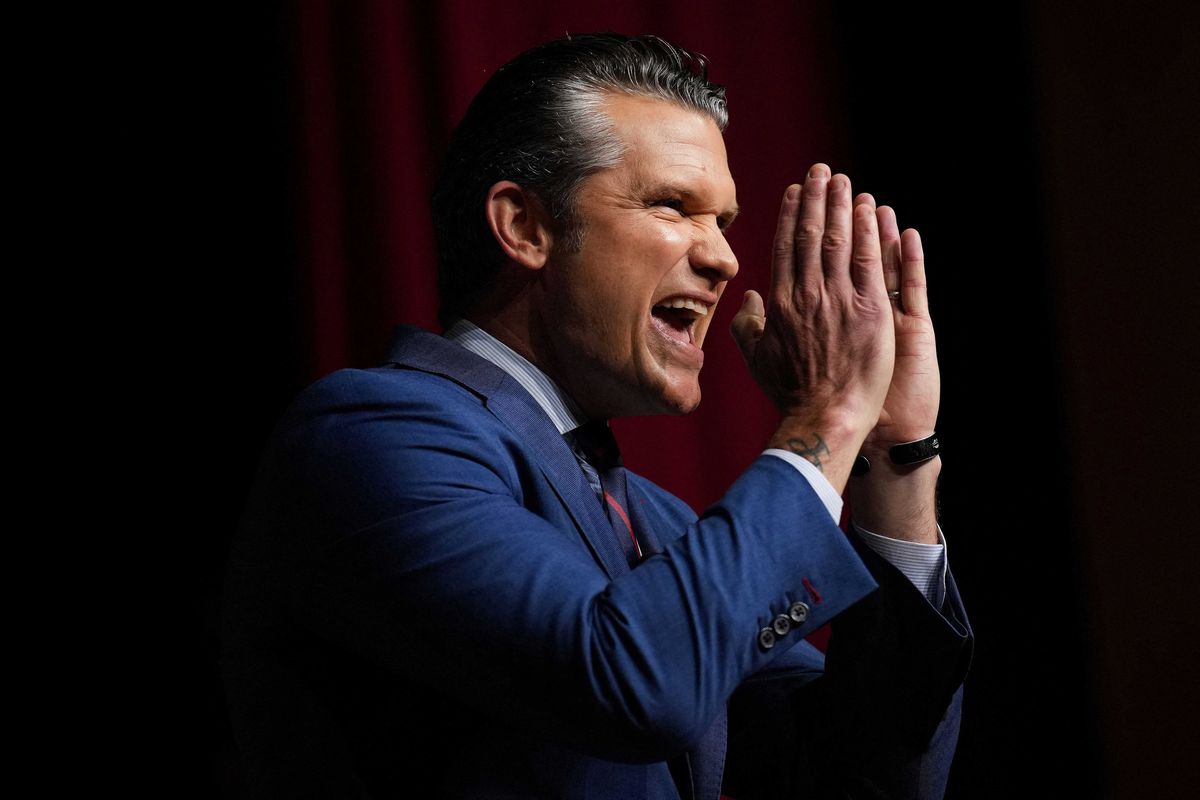
Pete Hegseth speaks to senior military leaders at Marine Corps Base Quantico, Virginia. Andrew Harnik/REUTERS
Defense Secretary Pete Hegseth has alienated a critical group within the military establishment — religious leaders and chaplains — by weaponizing Christianity to justify the Iran war and creating an atmosphere of fear for those who refuse to comply with his ideological demands.
According to Washington Post analyst Michelle Boorstein, Hegseth's inflammatory rhetoric at a recent Pentagon prayer service has triggered serious alarm among military chaplains and senior officials who view his approach as a dangerous departure from Pentagon norms.
At the prayer service, Hegseth invoked religious language to justify military violence, saying: "Let every round find its mark against the enemies of righteousness and our great nation. Give them wisdom in every decision … and overwhelming violence of action against those who deserve no mercy."
The language represents a troubling shift in how the Pentagon frames military operations, according to military leadership.
"The Pentagon's shift from previous historical norms is dangerous, according to multiple former high-ranking military officials, heads of chaplain corps, some veterans groups, current Pentagon staff and current officers," Boorstein wrote.
Retired Army Maj. Gen. Randy Manner, who trained hundreds of interfaith military chaplains and served as second-in-command at the National Guard from 2011 to 2012, has been hearing from active-duty chaplains about systematic retaliation.
"Manner said he has talked with 'dozens and dozens' of active-duty chaplains in recent weeks who say those who don't identify with Hegseth 'are being marginalized.' They feel they can't voice their concerns to their own superiors, and feel their work as the primary advocate for troops' spiritual, mental, and moral health is being threatened."
The situation has become dystopian. "I've had people tell me they're not included in staff meetings," Manner added.
Pentagon insiders describe the atmosphere as chilling. An anonymous Department of Defense source characterized the environment as "terrifying," noting that personnel working under Hegseth fear being punished or fired for failing to embrace his Christian nationalist worldview.
An unnamed member of a recent Joint Chiefs chairman's leadership team articulated the constitutional threat directly: "I don't approve of cramming your religious faith down people's throats, and when the top of the chain couches these operations in this hyper-Christian tone, it flies in the face of the freedom of religion that the Constitution enshrines and that our men and women in uniform sign up to defend."
March 29, 2026
RAW STORY
Pete Hegseth speaks to senior military leaders at Marine Corps Base Quantico, Virginia. Andrew Harnik/REUTERS
Defense Secretary Pete Hegseth has alienated a critical group within the military establishment — religious leaders and chaplains — by weaponizing Christianity to justify the Iran war and creating an atmosphere of fear for those who refuse to comply with his ideological demands.
According to Washington Post analyst Michelle Boorstein, Hegseth's inflammatory rhetoric at a recent Pentagon prayer service has triggered serious alarm among military chaplains and senior officials who view his approach as a dangerous departure from Pentagon norms.
At the prayer service, Hegseth invoked religious language to justify military violence, saying: "Let every round find its mark against the enemies of righteousness and our great nation. Give them wisdom in every decision … and overwhelming violence of action against those who deserve no mercy."
The language represents a troubling shift in how the Pentagon frames military operations, according to military leadership.
"The Pentagon's shift from previous historical norms is dangerous, according to multiple former high-ranking military officials, heads of chaplain corps, some veterans groups, current Pentagon staff and current officers," Boorstein wrote.
Retired Army Maj. Gen. Randy Manner, who trained hundreds of interfaith military chaplains and served as second-in-command at the National Guard from 2011 to 2012, has been hearing from active-duty chaplains about systematic retaliation.
"Manner said he has talked with 'dozens and dozens' of active-duty chaplains in recent weeks who say those who don't identify with Hegseth 'are being marginalized.' They feel they can't voice their concerns to their own superiors, and feel their work as the primary advocate for troops' spiritual, mental, and moral health is being threatened."
The situation has become dystopian. "I've had people tell me they're not included in staff meetings," Manner added.
Pentagon insiders describe the atmosphere as chilling. An anonymous Department of Defense source characterized the environment as "terrifying," noting that personnel working under Hegseth fear being punished or fired for failing to embrace his Christian nationalist worldview.
An unnamed member of a recent Joint Chiefs chairman's leadership team articulated the constitutional threat directly: "I don't approve of cramming your religious faith down people's throats, and when the top of the chain couches these operations in this hyper-Christian tone, it flies in the face of the freedom of religion that the Constitution enshrines and that our men and women in uniform sign up to defend."

No comments:
Post a Comment