Nickel price rises to two-year high as supplies from Indonesia tighten
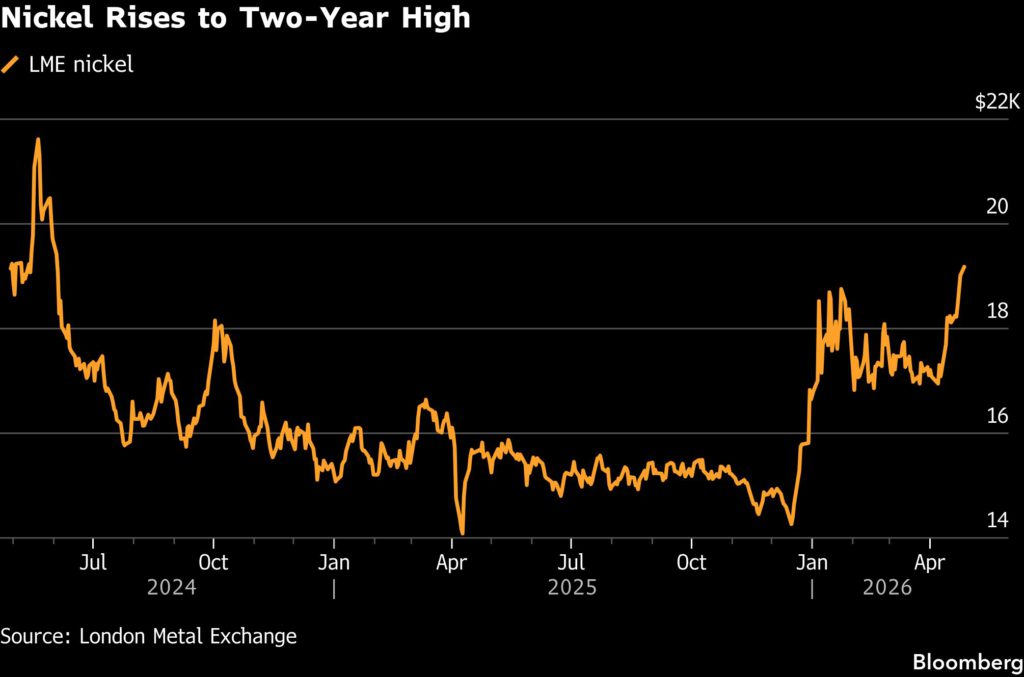
Nickel rose to the highest in almost two years, as reduced mining quotas in major producer Indonesia and a global sulfur shortage tighten the supply outlook for the battery metal.

Futures in London have risen about about 7% since the start of the Iran war, which is driving a surge in prices of sulfur — a key reagent used in processing — and fueling concerns over disruptions to global mining, including mixed-hydroxide precipitate production in Indonesia and copper leaching in Africa.
Nickel climbed as much as 2.8% on Monday, before giving up most of its gains. Other base metals were mixed, as efforts to resume peace talks between the US and Iran remained at an impasse, two months into a conflict that’s dented the outlook for global economic growth.
Nickel mining in Indonesia is already under pressure after the country slashed its production quota to revive prices for the metal. The Asian country accounts for well over half of global production, thanks to a wave of Chinese investment in smelters.
“Market sentiment on nickel remains positive as traders await further upside catalysts pointing to a substantial production cut in MHP,” Jinrui Futures Co. said in a note, referring to the mixed-hydroxide precipitate, an intermediate product containing nickel.
Nickel was up 0.7% at $19,155 a ton by 4:56 p.m. local time on the London Metal Exchange, after touching its highest level since June 2024. Copper fell 0.8%, while tin was down 2%.
Huayou cuts output at Indonesian nickel plant as sulphur costs surge
Zhejiang Huayou Cobalt said on Tuesday that its Indonesian unit will temporarily halt some production lines from May 1, slashing about half of the plant’s output, after rising sulphur prices lifted costs at one of its key battery-nickel projects.
The Chinese nickel and cobalt maker said in a statement that the Huafei Nickel Cobalt plant would cut production because of the higher sulphur costs as well as maintenance required after a long period of producing at high capacity.
It did not state how long the outage would last.
Spot prices for sulphur delivered to Indonesia have risen above $800 a metric ton as the Iran war disrupted production and shipping of the key raw material from the Gulf. The region produces about a quarter of global sulphur supply and about 75% of Indonesia’s supply.
Reuters reported on April 14 that several Indonesian HPAL producers operated by Huayou, Lygend Resources and Tsingshan Group had trimmed output by at least 10% due to rising sulphur prices since March.
The outage at the Huafei plant is one of the clearest company-level signs yet that a global sulphur squeeze is hitting Indonesia’s high-pressure acid leach, or HPAL, nickel sector.
HPAL plants use sulphuric acid to process laterite ore into mixed hydroxide precipitate, an intermediate product used in electric vehicle batteries.
Huayou said it would speed up process upgrades to reduce sulphuric acid consumption and expand sulphur supply channels. It also said it would accelerate development of nickel, cobalt and lithium mining resources obtained through investment and equity stakes.
Huafei generated 14.50 billion yuan ($2.12 billion) in revenue in 2025, accounting for 17.89% of Huayou’s total revenue. It made 1.25 billion yuan in net profit, while Huayou’s share of attributable profit from the unit was 569 million yuan, or 9.32% of the company’s parent net profit.
($1 = 6.8372 Chinese yuan renminbi)
(By Dylan Duan and Lewis Jackson; Editing by Emelia Sithole-Matarise)

No comments:
Post a Comment