Nuclear News
Triton Uranium fast-tracks Saskatchewan project in possible bid to secure US listing
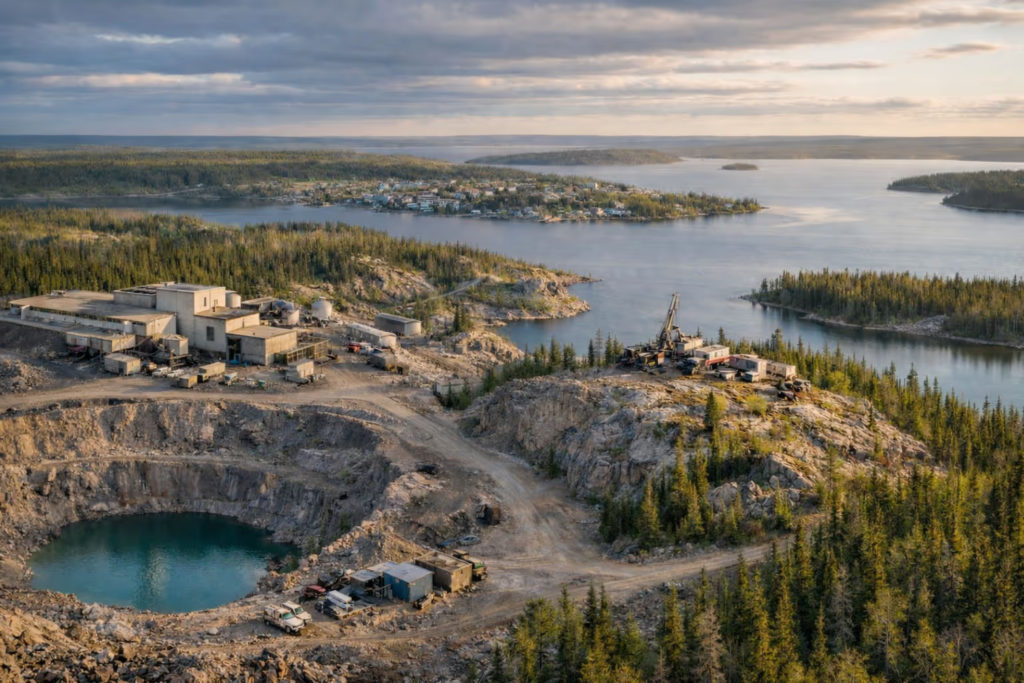
Private Canadian developer Triton Uranium has begun development activities at its Atlas project in Uranium City, Saskatchewan, marking a pivotal step toward establishing new domestic uranium supply as nuclear power is experiences the early stages of a nuclear resurgence across the United States.

“Speed is the missing piece in North America’s uranium supply,” Triton Uranium CEO Todd Montgomery said. “AI data centers and a renewed U.S. nuclear buildout are accelerating demand right now, but most uranium developments won’t come online for years. The Atlas project is built to change that, with our near-surface, infrastructure-ready model that we believe can be developed significantly faster than conventional uranium mines.”
According to a recent Reuters new report, Triton is considering pursuing a U.S. stock exchange listing through a special purpose acquisition company merger during 2026, President Scott Evans said. The company has secured nearly $16 million through private funding rounds, directing these resources toward exploration activities that will precede any potential public market debut.
Evans indicated the company remains open to future equity partnerships with either U.S. or Canadian government entities, acknowledging the increasing policy emphasis on securing critical mineral supply chains across North America. These policy shifts create opportunities for domestic uranium developers to attract strategic investment from public sector partners.
The timing of Triton’s potential public listing aligns with broader uranium market dynamics driven by artificial intelligence data centres and renewed nuclear power plant construction across the United States. These demand drivers have prompted utilities to secure long-term supply agreements, creating favourable conditions for uranium development companies seeking growth capital.
Advancing toward production
Evans outlined the significance of transitioning from planning to active development phases.
“With today’s announcement, the Atlas project takes a major step forward,” Evans said. “Beginning on-site work moves the project closer to advancing a future open-pit ore body and reinforces our commitment to creating value for the company, the community, and North America’s uranium supply.”
Market analysts are saying North America currently faces constrained uranium supply conditions, with limited domestic production forcing continued reliance on foreign-controlled sources and strategic inventories outside Western utility markets.
Development timeline
The upcoming drill program represents the next phase in advancing the Atlas project toward potential production. The company’s focus on near-surface mineralization and existing infrastructure aims to compress typical development timelines that often extend beyond a decade for conventional uranium projects.
Triton’s approach leverages historical mining activity in the region while applying modern extraction and processing technologies. The company anticipates that its infrastructure-ready model will enable faster permitting processes and reduced construction phases compared to remote greenfield developments.
The June 2026 drilling commencement will target four priority zones identified through historical data analysis and recent geological assessments. Results from this 10,000-metre program will inform resource estimation and preliminary economic assessments scheduled for later in 2026.
Mining operations start at Wyoming project
The start of uranium mining operations at Ur-Energy's second in-situ recovery uranium project marks the transition from development to initial operations.
_46522.jpg)
Ur-Energy made the decision to "build out" the fully permitted and licensed project in Carbon County, Wyoming, in March 2024: the company estimated it would take about 24 months to finalise designs, order materials and construct the satellite plant and initial wellfield. On 23 April, the company announced that uranium-bearing solution is now being captured from Mine Unit 1 at Shirley Basin after the successful completion of significant construction, wellfield installation, and permitting.
In-situ recovery - or ISR - is a method of mining uranium by dissolving and recovering it via wells. It is also known as in-situ leaching. At Shirley Basin, uranium is captured on ion exchange resin which Ur-Energy will then ship to its Lost Creek facility - also in Wyoming - for final processing, drying, and packaging. It expects to begin transporting uranium-loaded resin from Shirley Basin to Lost Creek this summer, subject to an additional regulatory inspection and approval.
Ur-Energy CEO and President Matt Gili said the launch of initial operations at Shirley Basin marks a pivotal achievement in the company's growth strategy and plan to expand US uranium production capacity. "Two years ago, we committed to building out this project. Today, we have successfully brought a historically significant uranium district back to life, demonstrating disciplined execution of our strategy. This accomplishment reflects the dedication and expertise of our teams, who have advanced Shirley Basin from development to operations. It is particularly meaningful as it supports the growing need for secure, domestic uranium supply and underscores our ability to move permitted projects toward production while strengthening our role in the US nuclear fuel cycle," he said.
Shirley Basin has a resource base of about 9.1 million pounds U3O8 (3500 tU) in the measured and indicated categories) at an average grade of 0.22%. With a licensed annual wellfield and toll processing capacity of up to 2.0 million pounds equivalent of U3O8, it has an anticipated mine life of about nine years across three shallow mining units. The combined total annual licensed production and toll processing capacity of Lost Creek and Shirley Basin is 4.2 million pounds U3O8.
Uranium was mined at Shirley Basin using conventional methods from the 1960s until low uranium prices prompted its closure in 1992. Ur Energy acquired the project as part of its acquisition of the Pathfinder Mines Corporation from an Areva affiliate in 2013.
Fuel loading begins for Bangladesh’s first nuclear power plant
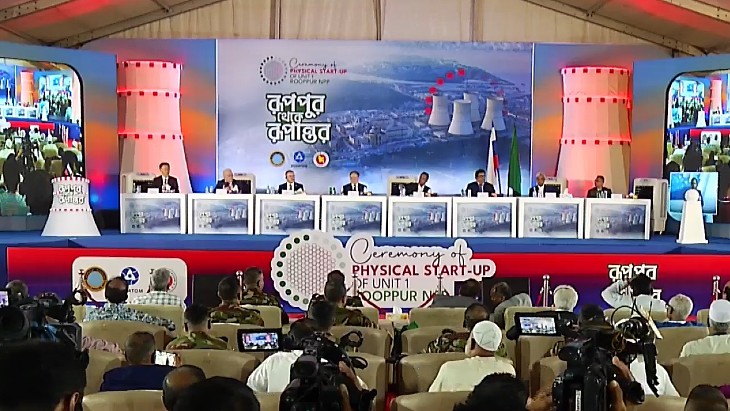
Loading of nuclear fuel in a new reactor is a key moment in the construction of any new nuclear power reactor. It is the first stage of the unit's key startup phase and, according to reports in the Bangladesh press, will take about 45 days to complete.
The next step will see the reactor being brought to a minimum controllable power level, with checks and tests before the level is increased in stages.
Fakir Mahbub Anam, Minister of Science and Technology, said: "The peaceful use of nuclear energy will play a key role in ensuring national energy security, accelerating industrialisation, and promoting the development of a technology-based economy. The Rooppur Nuclear Power Plant project serves as a symbol of Bangladesh's scientific progress and demonstrates the country's willingness and ability to responsibly and effectively harness advanced technologies."
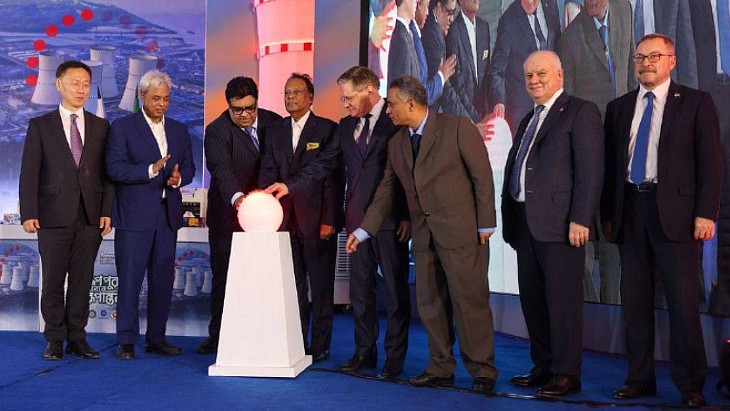
Initiating fuel loading at the event (Image: Rosatom)
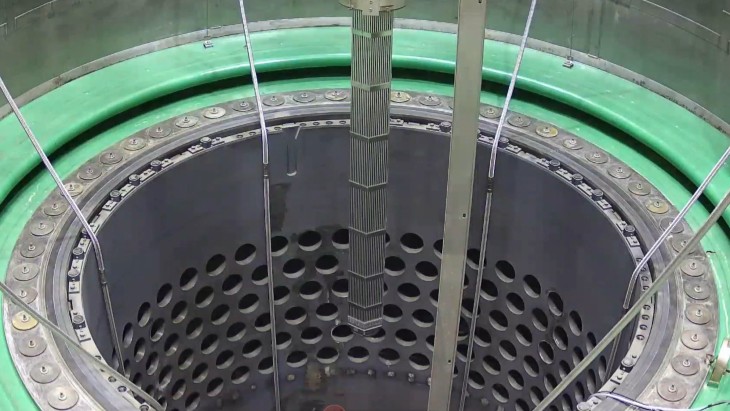
The first fuel being loaded (Image: Screenshot from Bangladesh Atomic Energy Commission live stream)
Rosatom Director General Alexei Likhachev, said: "Today, Bangladesh joined the club of countries using peaceful nuclear energy as a reliable source of sustainable development. The Rooppur Nuclear Power Plant will undoubtedly become a vital element of the country's energy system. For Rosatom, this project is another important step in the development of global nuclear energy and in strengthening friendly relations with our international partners."
Background
In February 2011 Russia's Rosatom signed an agreement for two reactors to be built at Rooppur, about 160 kilometres from the capital Dhaka, for the Bangladesh Atomic Energy Commission. The initial contract for the project, worth USD12.65 billion, was signed in December 2015. The Bangladesh Atomic Regulatory Authority issued the first site licence for the Rooppur plant in June 2016, allowing preliminary site works, including geological surveys, to begin.
Construction of the first unit began in November 2017. Construction of the second unit began in July 2018. They have an initial life-cycle of 60 years, with a further 20-year extension possible.
The first batch of nuclear fuel was delivered to the site in October 2023 - the moment that the site got its status as a nuclear facility. In March last year, Rooppur unit 1's turbine installation was completed, as were hydraulic tests to check the primary circuit systems and equipment, followed by hot functional tests. An operating licence was issued by the Bangladesh Nuclear Regulatory Authority on 16 April.
Hot tests completed at second San'ao unit
_80481.jpg)
Hot functional tests involve increasing the temperature of the reactor coolant system and carrying out comprehensive tests to ensure that coolant circuits and safety systems are operating as they should. Carried out before the loading of nuclear fuel, such testing simulates the thermal working conditions of the power plant and verifies that nuclear island and conventional equipment and systems meet design requirements.
China General Nuclear (CGN) announced that hot tests at San'ao unit 2 were successfully completed at 08:28 (local time) on Tuesday.
"The team fully drew on the experience feedback and best practices of unit 1 and previous projects, and worked together efficiently and with high quality to complete transient tests such as safety injection test, power switching test, and non-nuclear start-up test, as well as all tests required by the commissioning outline for this stage, achieving the goal of completing the hot commissioning in 51.9 months [since the pouring of first concrete for the nuclear island]," CGN noted.
Cold functional tests - which are carried out to confirm whether components and systems important to safety are properly installed and ready to operate in a cold condition - were completed at San'ao 2 in October. The main purpose of those tests - which marked the first time the reactor systems were operated together with the auxiliary systems - was to verify the leak-tightness of the primary circuit.
_835f5de5.jpg)
The San'ao site (Image: CGN)
First concrete for unit 1 was poured in December 2020, with that for unit 2 following a year later. Unit 1 achieved first criticality in February this year and was connected to the grid in March. San'ao 2 is scheduled to begin supplying electricity in 2027.
The San'ao plant is the first nuclear power project in China's Yangtze River Delta region to adopt the Hualong One reactor design. A total of six Hualong One units are planned for the site.
The construction of two Hualong Ones as units 3 and 4 of the San'ao plant was among plans for 11 reactors approved by China's State Council in August 2024. The first concrete was poured for the nuclear island of unit 3 on 19 December last year. A further two Hualong One units are planned as units 5 and 6.
Upon completion, the project will provide more than 54 TWh of electricity annually to Zhejiang Province and the Yangtze River Delta region, reducing standard coal consumption by more than 16 million tonnes and carbon dioxide emissions by more than 51 million tonnes annually, CGN noted.
The San'ao project marks the first Chinese nuclear power project involving private capital, with Geely Technology Group taking a 2% stake in the plant. CGN holds 46% of the shares of the project company Cangnan Nuclear Power, with other state-owned enterprises holding the remainder.
Flushing of safety systems begins for Kudankulam unit 3
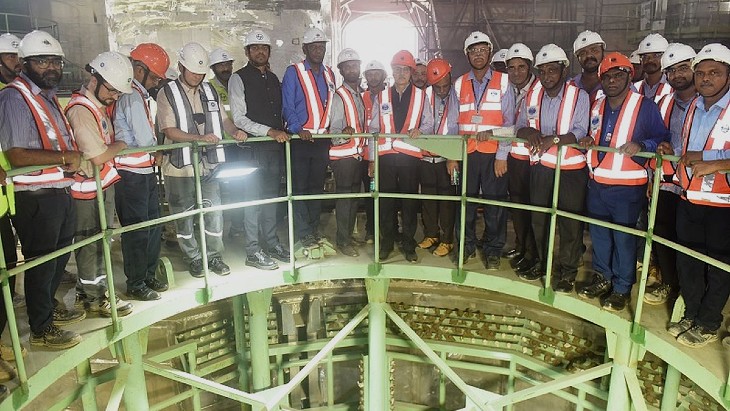
Nuclear Power Corporation of India Limited (NPCIL) called it "a significant stride in India's journey towards energy security and sustainability".
The flushing process, using demineralised water, is designed to check everything has been installed correctly and remove impurities from pipelines, check pump sets, process safety systems and normal operation systems. Samples of flush water have been collected and sent to a chemical laboratory for analysis.
"During the second stage, the active part, the safety system pumps are filled with water from the used fuel pool and then activated, pumping water into the open reactor. During the flushing operations, foreign objects that could enter the reactor vessel and damage its internal components during startup are removed from the pipelines connected to the primary circuit," Rosatom said.
Andrey Petrov, President of JSC Atomstroyexport, said: "The safety system testing phase is the final stage before reactor assembly. After this, testing of the primary circuit systems and equipment, as well as cold and hot runs, will begin. Our joint project with our Indian partners is proceeding according to plan and confirms the reliability and leadership of Russian nuclear technology. The commissioning of the second and third phases of the Kudankulam NPP will be a significant contribution to India's energy supply and will further strengthen the long-standing ties between our countries."
Background
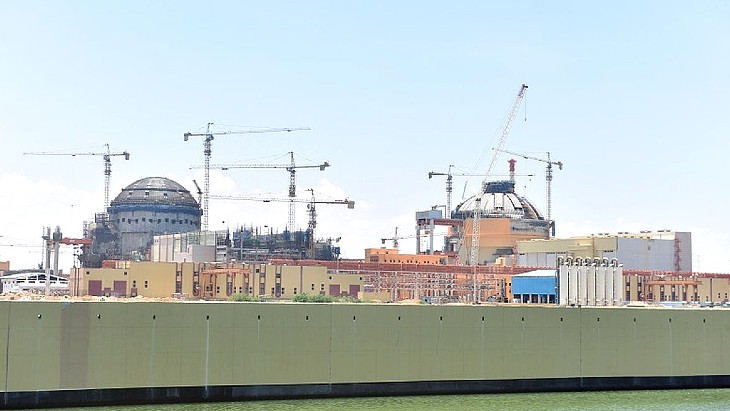
The Kudankulam site, about 100 kilometres from the port city of Tuticorin (Image: Rosatom)
The Kudankulam site, near the southern tip of India, is already home to two operating Russian VVER-1000 pressurised water reactors which have been in commercial operation since 2014 (Kudankulam unit 1) and 2017 (unit 2). Four more are currently under construction, in two phases: construction of units 3 and 4 began in 2017, with work on units 5 and 6 beginning in 2021. Two further units - Kudankulam 7 and 8, larger AES-2006 units with VVER-1200 reactors - have been proposed as a fourth phase of the plant.
The first nuclear fuel was delivered for unit 3 in December under a contract signed in 2024 which covers the fuel supply for units 3 and 4 for the entire operating life of the units.
French nuclear supply chain boosting capacity
_58396.jpg)
Orano Projects, a subsidiary of Orano, inaugurated its new building on Friday. The ceremony took place in the presence of state representatives, local elected officials, institutional and economic stakeholders from the region, industrial partners, and employees.
"This event marks a key milestone in a major modernisation programme for the Pierrelatte site, launched in September 2024," Orano said. "This programme includes the construction of a new building, the complete renovation of a second building, and, by 2027, the renovation of a third building, ultimately providing a fully modernised engineering platform. Its capacity has been doubled, increasing from 300 to 600 employees."
Established in Pierrelatte since 1986, Orano's engineering department now benefits from a modernised site. Covering an area of more than 5,600 square metres, it offers a functional working environment, organised into open-plan areas promoting collaboration between teams, quality of working life and fully meeting accessibility requirements.
Orano said the 'Le Gardon' building - named after its location - exemplifies the group's strong local ties. The EUR7 million (USD8.2 million) project, carried out between 2024 and early 2026, was awarded to local companies, contributing to the region's economic vitality.
"Safety was a top priority throughout the entire construction process, which was completed without incident," said Denis Lyonnet, Director of Orano's Southeast Engineering division. "We opted for a sustainable building, incorporating concrete solutions to reduce our environmental footprint: photovoltaic electricity generation panels, eco-mobility solutions, optimised energy consumption management, a permeable parking lot, and a rainwater harvesting system. It was designed by an architect from Pierrelatte and built with local companies. This project, developed collaboratively with our employees, is deeply rooted in its local community and supports a rapidly growing engineering division."
Guillaume Dureau, Director of Engineering, Innovation, R&D and New Business Activities at the Orano Group, added: "I am proud to inaugurate this new building in Pierrelatte today. It brings together teams that are currently working at the heart of the Group's major projects. To meet our challenges and support the growth of our activities, we are aiming for 600 new engineering hires in France by 2026."
The Pierrelatte site is part of a broader real estate investment programme undertaken by Orano to support the significant expansion of its engineering activities, linked to the revitalisation of the nuclear sector. This momentum supports the implementation of strategic projects such as the expansion of the Georges Besse II enrichment plant, the extension of the lifespan of the back-end fuel cycle plants, and their modernisation as part of the 'Future Back-Cycle' programme. This programme entails an unprecedented increase in skills: 500 engineers and technicians will be recruited each year, enabling the group to double its engineering workforce by 2030.
New heat exchanger factory
EDF has announced an investment of nearly EUR100 million by its subsidiary Arabelle Solutions to build a new 20,000-square-metre factory in Chalon-sur-Saône. The factory will manufacture heat exchangers for the future construction programme of six EPR2 reactors - and eight additional potential EPR2 reactors - in France, as well as for new build programmes abroad. This investment will result in the creation of about 160 local jobs by 2030.
The factory will manufacture key equipment designed to optimise heat exchange in the turbine hall of a nuclear power plant, where electricity is generated. This includes moisture separator reheaters, as well as high- and low-pressure heaters. The first equipment manufacturing is scheduled to begin in 2030. Arabelle Solutions in Chalon-sur-Saône will have the production capacity to supply, each year, all this equipment for a nuclear power plant.
This project forms part of the investment plan of Arabelle Solutions and builds on the investments announced in January for the site at Belfort, in eastern France. These investments will help ensure the equipment of future EPR2 nuclear power plants through a French production chain. Arabelle Solutions will be able to supply and integrate the full set of equipment for the turbine hall of a nuclear power plant.
"This investment marks a major milestone for the EDF Group and for the revival of nuclear power," said EDF CEO Bernard Fontana. "It strengthens the Group's industrial capabilities for the deployment of six EPR2 reactors and eight additional potential EPR2 reactors in France, as well as new reactors internationally. In Chalon-sur-Saône, Arabelle Solutions is developing key skills and production capacities for essential equipment in the turbine hall. This new factory helps structure an integrated value chain, serving competitive, sovereign and low‑carbon electricity - vital to the energy security of France and Europe."
In February 2022, French President Emmanuel Macron announced that the time was right for a nuclear renaissance in France, saying the operation of all existing reactors should be extended without compromising safety and unveiling a proposed programme for six new EPR2 reactors, with an option for a further eight EPR2 reactors to follow. The first three pairs of EPR2 reactors are proposed to be built, in order, at the Penly, Gravelines and Bugey sites. Construction is expected to start in 2027.
Stellaria, CEA to consider experimental MSR at Cadarache
_35731_20301.jpg)
The letter of intent concerns the establishment of an 'Alpha' Basic Nuclear Installation (INB) - an installation involved in the handling, processing, or storage of alpha-emitting radioactive materials - at the Alternative Energies & Atomic Energy Commission's (CEA's) Cadarache site. This installation will house a model, a fast-spectrum liquid-fueled (molten salt) demonstration reactor, and a salt production facility to supply the model and demonstration reactor. To this end, an area has been identified to study the feasibility of establishing the Alpha INB at the CEA Cadarache centre.
The Alpha nuclear facility will include not only the Alvin experimental reactor but also MegAlvin, Stellaria's 10 MWe prototype reactor.
The 100 kW Alvin experimental reactor, scheduled to start up in 2030, will carry out a test programme that will definitively validate the company's modelling and calculations of neutron-thermo-hydraulic coupling.
By 2032, after the end of Alvin's experimental programme, Stellaria plans to modify the facility to operate MegAlvin. The prototype reactor will be installed in the building that was used for the critical Alvin experiment, the main modification of which will consist of replacing some systems and the tank with another of a larger size (about 40-100cm).
MegAlvin's objectives are: to conduct endurance and qualification tests on the fuel; testing structural materials and systems specific to molten salt reactors; and to obtain sufficient and available feedback several years before the commissioning of Stellaria's first commercial reactor, the Stellarium, for 2035.
Stellaria - a start-up spun out of the CEA and Schneider Electric - submitted its application for the creation authorisation decree (DAC) for its Alpha INB to the French minister in charge of nuclear safety in December last year.
The CEA - a public research institution - says it plays a key role in nuclear innovation, notably by supporting the French industrial sector, major research programmes, and more recently, by assisting the winning projects of France 2030 in their development and industrialisation. The CEA Cadarache centre, located in Saint-Paul-Lez-Durance in the Bouches-du-Rhône region, is dedicated to research platforms and technological development in low-carbon energy (nuclear fission, nuclear fusion, solar, bioenergy, biotechnology and hydrogen). Contruction of the International Thermonuclear Experimental Reactor (ITER) is under way at Cadarache.
The Stellarium reactor proposed by Stellaria will be very compact (measuring 4 cubic metres) and will be able to use a diversified range of nuclear fuels (uranium, plutonium, mixed-oxide, minor actinides, even thorium). Stellaria says the reactor is "the world's first reactor to operate with a liquid fuel capable of destroying more waste than it produces".
In November 2025, Stellaria signed a pre-order agreement with California-headquartered data centre developer and operator Equinix. Under the agreement, Equinix has secured the first power capacity reservation on the Stellarium, the reactor that Stellaria plans to deploy starting in 2035.
Molten salt reactors (MSRs) use molten fluoride salts as primary coolant, at low pressure. They may operate with epithermal or fast neutron spectrums, and with a variety of fuels. Much of the interest today in reviving the MSR concept relates to using thorium (to breed fissile uranium-233), where an initial source of fissile material such as plutonium-239 needs to be provided. There are a number of different MSR design concepts, and a number of interesting challenges in the commercialisation of many, especially with thorium.

No comments:
Post a Comment