One Step Forward, One Step Back for U.S. Navy's Next Carrier-Based Drone
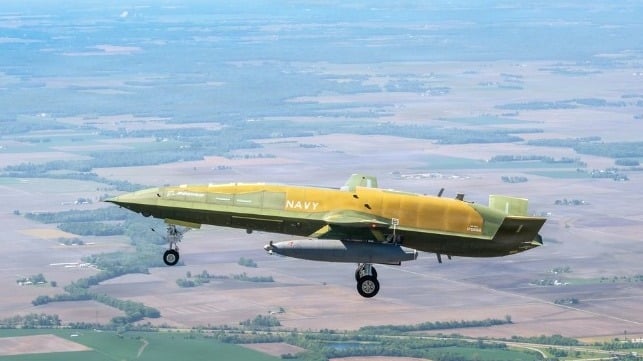
The U.S. Navy's next attempt at an unmanned carrier-borne aircraft took its maiden flight on Saturday, soaring over the skies of southern Illinois. Boeing's first MQ-25A Stingray drone aircraft is now airborne, but it will not be arriving soon: initial operational capability has now been pushed back by three years, from 2026 to 2029, according to USNI.
The Navy has been working towards adding drones to the carrier air wing for decades. Conceptual planning began in 2000, and a Northrop Grumman X-47A demonstrator took flight for the first time in 2003. A navalized and evolved version, the Northrop X-47B, had its first test flight in 2011. It progressed swiftly to sea trials, and came aboard a carrier for a trial integration in 2014; while declared successful, the test program ended in 2015 without progressing to procurement, and the two demonstrator airframes are in storage.
The MQ-25A was developed for non-lethal requirements, initially for surveillance and then later for tanking. The tanker mission takes up about a third of a carrier's F/A-18 fighter force, just for aerial refueling; offloading that task onto an unmanned aircraft would free up fighter airframe hours and pilot hours for higher-value tasking.
The first flight of Boeing's MQ-25 test airframe happened in 2021, and five years later, the Navy and Boeing are celebrating the launch of the first test airframe intended for Navy ownership. Under Navy remote pilotage, the first engineering and development model variant of the MQ-25A took off on Saturday. Three more are planned.
"Watching our first Navy aircraft complete an autonomous flight underscores what disciplined teamwork and rigorous testing deliver," said Troy Rutherford, VP of the Boeing MQ-25 program, in a company statement. "Together, we are redefining the future of naval aviation and pushing the boundaries of what's possible with autonomy."
The objective is to progress the aircraft's development towards carrier qualifications, which will require relocating the team to Naval Air Station Patuxent River in Maryland.
There is still much work to be done, according to USNI. The MQ-25A has been slowed down by production issues, the outlet reports, and by scheduling. It was supposed to achieve IOC this year, but will now be pushed back until 2026.
The U.S. Air Force's foray into manned-unmanned teaming is moving more quickly, and contemplates designs for direct combat roles. There are three contenders for the USAF's first collaborative combat aircraft: the Anduril Fury "loyal wingman" drone, which had its first fight with weapons attached in February; General Atomics' YFQ-42; and Northrop Grumman's Project Talon collaborative combat aircraft.
US Navy Wants to Spend $2B on Foreign Shipbuilding "Study and Procurement"
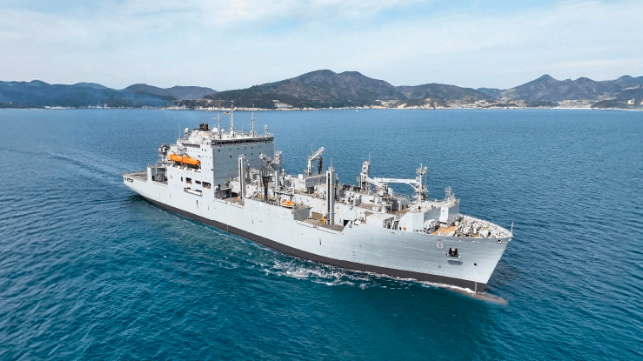
The U.S. Navy's next annual budget is going to contain an unheard-of line item: a pair of multibillion-dollar studies of foreign shipbuilding options, USNI reports. The budgets for these "study and procurement efforts" are priced so high that they could easily pay for design, long-lead-time materials and initial construction contract awards, if the Navy were to progress them into a "procurement" effort. The department's detailed plans for the program have not yet been disclosed.
According to USNI, the FY2027 budget includes $1.85 billion for a pair of R&D studies on the future construction of frigates or destroyers in foreign shipyards, as well as joint foreign-domestic ventures. The general model is that of the Coast Guard's Finnish/Canadian/American icebreaker procurement program, which is buying two different classes of medium icebreakers from two different Finnish shipyards. The first vessels of each design will be built overseas, then the remainder will be built in the U.S. with assistance and technology transfer from foreign partners. The model is intended to attract investment and expertise from overseas, boosting U.S. shipbuilders' ability to produce complex designs with higher efficiency.
The dismissal of former Navy Secretary John Phelan last week is said to have hinged on the service's perceived lack of progress on getting its shipbuilding programs back on track. All newbuild classes are behind schedule; the next-generation frigate, the Constellation-class, has been canceled; and future orders in the new Ford-class carrier series are reportedly under review. Defense Secretary Pete Hegseth was reportedly frustrated with Phelan's rate of progress in turning the ship around on procurement, and the president is said to have shared his views.
Just last week, shortly before his ouster, Phelan alluded to the Navy's willingness to look overseas for construction options. At Sea-Air-Space, he told reporters that "everything's on the table," and that the skilled labor shortage in the U.S. required the service to look abroad for help. In Japan and Korea - the two allied nations most qualified to secure contract awards - the same labor shortage problem exists, but the issue is solved by the importation of immigrant labor with guest-worker visas.
Both Korea and Japan have successfully completed maintenance periods for Military Sealift Command, and both hope to leverage that experience into larger contracts for newbuilds. Korea has experience in delivering Aegis-equipped destroyers, similar if not identical to the U.S. Navy's Arleigh Burke class, and wants to attract orders for high-margin hulls like surface combatants.

No comments:
Post a Comment