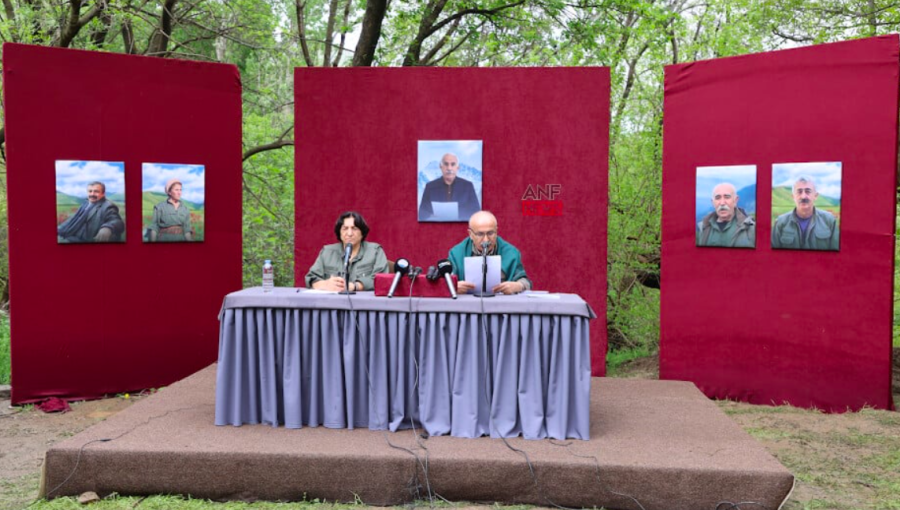
The one-year anniversary of the latest self-dissolution declaration by the Kurdistan Workers’ Party (PKK) arrived earlier this month. And at a press conference held in northern Iraq’s Qandil mountains, a new name was put into circulation. The PKK that does-not-but-does exist referred to itself as “Apocu Hareket Yonetimi” (Apoist Movement Management).
Throughout last year, countless headlines declared that the PKK had indeed disbanded and laid down arms. The ‘analysis’ and commentaries on this supposed fact kept on coming.
Nowadays of course, journalists are rarely heard talking about keeping the public informed as to what is really going on, instead they are fixated on attracting clicks. The fresh name, nevertheless, is recorded as a new development in the centuries-long Kurdish question.
Back to factory settings
The political movement of Turkey’s Kurds is loosely referred to in general as “the PKK”. It has established itself as the dominant political organisation of the Kurds in Turkey and Syria by order of the gun since the 1980s.
Between 1973 and 1978, the initial antecedents of the movement that would later become the PKK amounted to a loose ideological circle in Turkey, referred to by themselves as the Revolutionaries of Kurdistan (Kurdistan Devrimcileri).
Others, meanwhile, called them the Apoists (Apocular) after Abdullah Ocalan, also known as Apo, who would go on to become the indisputable leader of the PKK.
Now half a century later, the political organisation is calling itself the Apoist Movement Management, which provides an interesting nuance.
In the last five decades or so, the PKK has also called itself the Kurdish Freedom Movement (Kurt Ozgurluk Hareketi) and the Kurdistan Freedom Movement (Kurdistan Ozgurluk Hareketi). These names are also still in use today.
2002, first self-dissolution announcement
Since it was launched in 1978, the PKK has utilised a sophisticated “umbrella” strategy, frequently changing names to adapt to shifting legal and geopolitical dynamics.
Between 1978 and 2002, the “umbrella” organisation called itself the PKK and declared that it was waging an armed insurgency in Turkey for an independent state.
In 2002, the PKK declared its first self-dissolution, three years after Ocalan was in 1999 handed over to Turkey’s intelligence service, MIT, by the CIA in Kenya.
During 2002 and 2003, the name of the umbrella organisation became the KADEK (Kurdish Freedom and Democracy Congress) as part of an attempt to pivot toward legal diplomacy.
During 2003 and 2005, KONGRA-GEL (Kurdistan People’s Congress) was employed as the name to describe the umbrella organisation.
Since 2005, the KCK (Kurdistan Communities Union) has been in use. There are dozens of combinations of three letters that operate under the KCK, a name that is also still in use.
And, with a May 5 press release, the organisation returned to its factory settings by calling itself the Apoist Movement Management. They also underlined their demand that Ocalan be given official status.
The names keep coming
In addition to the many names used for the “umbrella” organisation, the PKK uses many other names for dozens of sub-groups that operate under the umbrella.
The PKK’s most significant achievement across its history has been the expansion of the movement into northern Syria. PYD (Democratic Union Party), YPG/YPJ (People’s/Women’s Protection Units), SDF (Syrian Democratic Forces), TEV-DEM (Movement for a Democratic Society) are just a few of the names still in use in Syria.
Lately, it was said that the SDF is over and done with now since it made a recent deal with the Hayat Tahrir Al-Sham (HTS) government in Damascus. It is hard to keep track of the fate of all the names used by the PKK.
The mainstream media loves to rabbit on about how the PKK’s military presence has faded in recent years. That is only because the organisation built an army of a few dozen thousand fighters in Syria. It is erroneous to think they are covered by a separate organisation.
The fighters have been adapted to roles in Syria’s newly-established army in battalions. Turkey and the HTS had pushed for the inclusion of fighters as individuals, but the Kurds managed to keep their military force together.
Other names in use are PJAK (Free Life Party of Kurdistan in Iran) and PCDK (Kurdistan Democratic Solution Party in Iraq).
HPG (People’s Defense Forces) is a name used by the armed groups in the Qandil Mountains on the Iraq-Iran border. YPS (Civil Protection Units) and YDG-H (Patriotic Revolutionary Youth Movement) are other examples of names used to describe the armed groups that carried out attacks in Turkey.
And there are still other names used by the PKK not mentioned in this article. In addition to armed groups and umbrella organisations, there are also legal entities active in Turkey and many countries across Europe.
Cycles upon cycles
Since the 1980s, governments in Turkey and the political movement of the country’s Kurds have entered into cycles where, in coordination, concepts of war and peace are addressed.
Currently, a ceasefire prevails. It was initiated in October 2024. Donald Trump, who does not like US proxies jostling among each other, was on the road to the White House. A widescope operation against the Istanbul mayor Ekrem Imamoglu-led main opposition party (Republican People’s Party, or CHP) was picking up pace.
In July, IntelliNews wrote: “Make no mistake. What we have here is an Erdogan, PKK coalition.” Why so? You can read about it here.
The coalition process that holds sway in Turkey is conducted by the powers that be. Erdogan pulls the strings. When the time comes to sell a sharp U-turn in rhetoric, the masses are always, step by step, subject to thorough preparation.
As regards the selling of the ceasefire, we saw the PKK step forward to announce that the PKK – which strictly speaking was actually abolished in 2002 – was disbanding and soon after stage a ceremony for invited media during which they set some old school Kalashnikov rifles on fire. No other decommissioning of weapons seems to have taken place since.

The Kurdish affair has a complex structure and long history. Coupled with it is always heavy manipulation from multiple sides (foreign players in addition to different power groups within the various parties involved in the conflict) as well as the courage of ignorance that dominates media coverage. In fact, relying on media reports for the sake of understanding developments is not advisable.
In March, this publication reported that Turkey’s government has built a house for Ocalan on Imrali prison island, where he remains an inmate.

No comments:
Post a Comment