Ukraine has tested a balloon-assisted launch system designed to greatly extend the operational range of its intermediate range attack drones and improve its strike capabilities against Russian targets.
The potentially low-cost adaptation is the latest innovation in the rapidly developing arms race between Russia and Ukraine as the war goes into its fifth year and both sides are under increasing economic pressure.
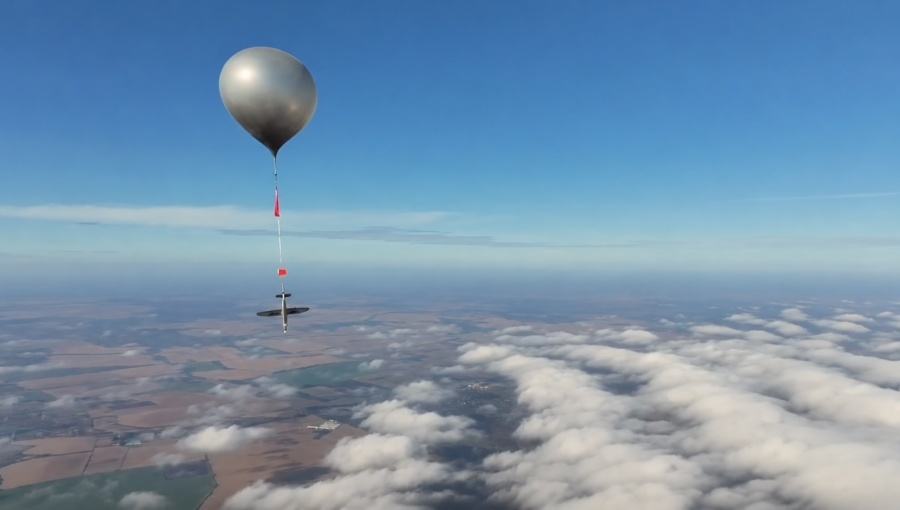
Ukrainian troops reportedly launched the Ukrainian-American Hornet one-way attack drone from an aerostat balloon during a recent trial. According to military blogger reports circulating online, the balloon carried the drone approximately 42km before releasing it from an altitude of 8km.
The approach allowed the drone to preserve almost all of its onboard battery power before beginning its independent flight on the final leg to the target. Reports said the Hornet used only about 5% of its battery during the ascent phase attached to the aerostat. The balloon-drop effectively doubled the range of the drone which is usually limited to around 150km.
The concept is intended to combine the endurance advantages of lighter-than-air platforms with the manoeuvrability of small attack drones. By outsourcing the energy-intensive climb and part of the transit distance to a balloon, operators can reserve battery capacity for the strike phase of the mission.
Ukraine has increasingly relied on domestically developed unmanned systems during the war with Russia, particularly as drone warfare has become central to both reconnaissance and long-range attacks on military and energy infrastructure. Since last year, the Armed Forces of Ukraine (AFU) has been increasingly targeting Russian refineries and between 10-15% of Russia’s oil production capacity is reportedly offline, which will increase the pressure on the Russian budget.
Kyiv has accelerated efforts to produce cheaper and longer-range platforms capable of operating beyond front-line positions while reducing dependence on costly missile systems. Ukrainian President Volodymyr Zelenskiy recently said that Ukraine plans to produce 7mn drones this year and in April it fired more drones at Russia than Russia fired at Ukraine for the first time.
Aerostat-assisted launches are relatively uncommon in modern battlefield operations but offer potential advantages including lower fuel consumption, reduced launch infrastructure and greater operational flexibility. Military analysts caution, however, that large balloons may themselves become vulnerable to air defence systems and adverse weather conditions.
The Hornet programme reflects growing co-operation between Ukrainian and US-linked defence technology developers as Ukraine seeks unconventional methods to offset Russia’s larger industrial and missile production capacity.

No comments:
Post a Comment