Showing posts sorted by date for query HARSH MISTRESS. Sort by relevance Show all posts

Thursday, June 18, 2026


Salesforce France CEO: Both leaders and employees need to adapt to AI


Copyright Euronews
By Roselyne Min
Published on

Speaking at Vivatech in Paris, Emilie Sidiqian, Salesforce France’s CEO, told Euronews Next how companies should embrace AI and why leaders must drive its adoption from the top.

Once best known for its software that helps businesses track customers, sales leads and service requests, Salesforce says it is now moving deeper into artificial intelligence (AI).

The US company has been promoting what it calls the “agentic enterprise,” a model where AI agents work alongside human employees across business functions.

In 2024, Salesforce launched Agentforce, its AI-agent platform, and this month announced a $3.6 billion (€3.14bn) deal to acquire Fin, a customer-service AI company whose agent can answer customer questions and resolve support cases.

“We moved from a standard Customer Relationship Management (CRM) to data, data to AI, AI to the agentic enterprise,” Emilie Sidiqian, Salesforce France CEO, told Euronews Next at the tech conference Vivatech in Paris, France.

“Our positioning is to reinvent the way all enterprises need to embrace the AI revolution,” Sidiqian added.

Salesforce says Agentforce can deliver “real conversational AI” across service, sales and marketing workflows, citing 66% autonomous case resolution, 15% more marketing pipeline and 1.8 times higher lead conversion.

Its AI agents are already being used by clients, the CEO says, such as SharkNinja, a US home appliance company that uses them for 24/7 customer support across 30 countries.

She also says Swiss staffing company Adecco has used AI-powered candidate conversations to reach 1.2 million conversations and help accelerate 50,000 job placements.

The Salesforce executive said enterprise AI is “for everyone,” from small companies to mid-sized businesses and global corporations.

“This is not a tool,” Sidiqian said. “This is a small wave of a new kind of innovation. The pace is massive. You can see that it impacts all types of jobs, all types of activities.”

Job transformation in the AI era

Sidiqian underlined the goal is not to replace humans, but to build a form of “hybrid” work where people remain “at the centre” while agents take on more routine or repetitive tasks.

She believes the shift should be treated as a leadership question, with CEOs and executive teams deciding how AI reshapes jobs across the company.

“AI is AI, it is a technology. When you really reinvent your business model, it is the leaders who need to understand how they will transform every single job in the company,” she said.

“This is a leadership question and it should be carried by the CEO and by every single executive committee,” she added.

Sidiqian said she uses AI tools every day, including a Salesforce-owned Slack, where Slackbot acts as a “concierge” to summarise overnight activity across teams from the US to Japan and flag what needs approval.

She said the aim is to avoid moving between several different tools and instead use AI as a “cockpit” to organise work with the right permissions and data. She also encourages her teams to use AI, arguing that adoption has to be led from the top.

“When you have like the right leadership, when you had the right adoption, when you carry this revolution at the heart of your business model, there is a huge opportunity to have growth for your company”.


From Foxconn to Nvidia: Why France is so attractive for Europe’s AI infrastructure
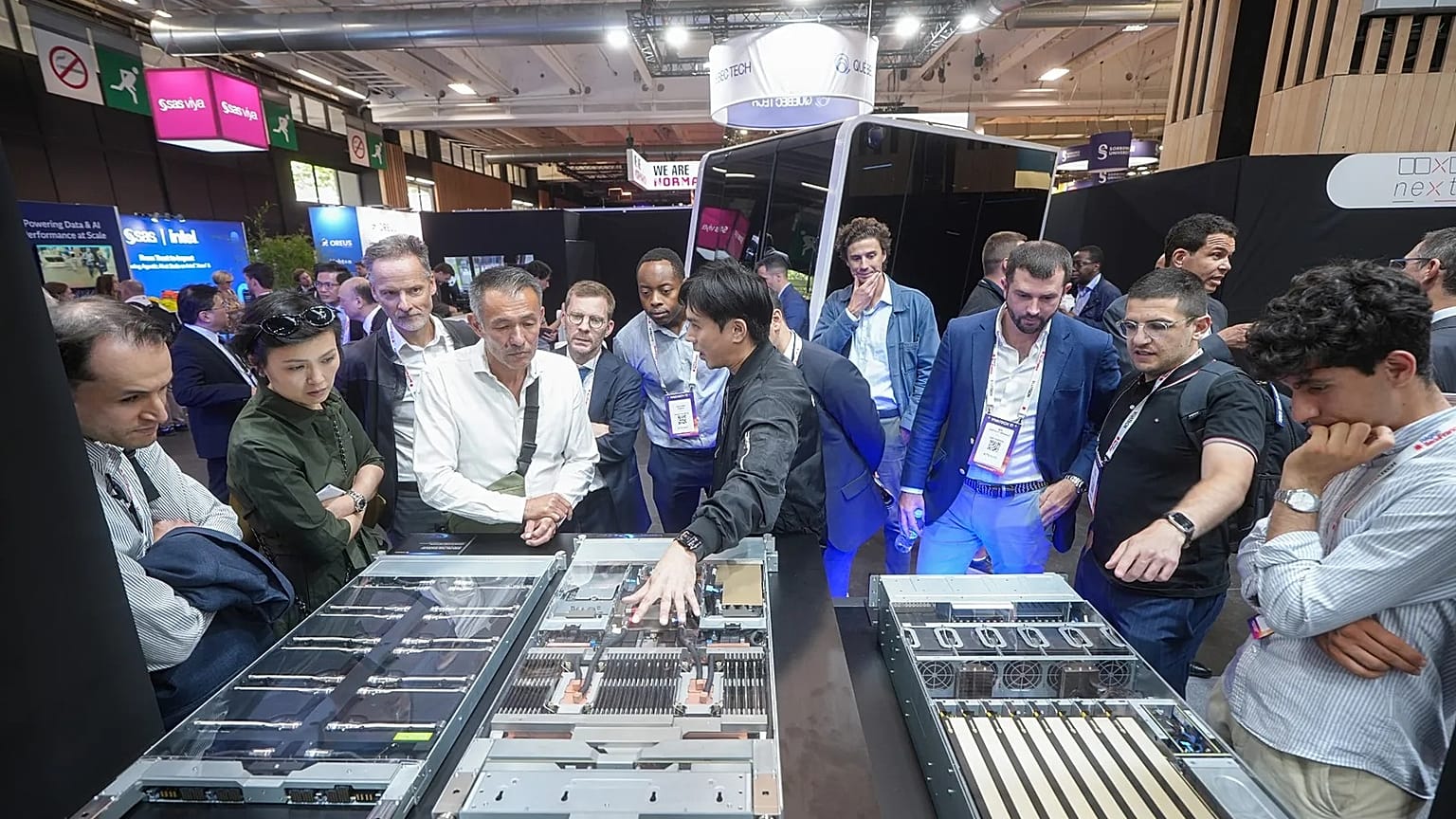
Presentation of the various Foxconn and Nvidia innovations.
Copyright Courtesy of Foxconn at VivaTech 2026, all rights reserved.

By Pascale Davies
Published on

Foxconn, Nvidia and Mistral AI announce major AI infrastructure deals at Europe's VivaTech conference, with France's cheap nuclear energy and homegrown talent drawing global investment.

The race to build Europe's artificial intelligence future sets up a home in Paris this week, as the city's flagship tech conference VivaTech becomes a magnet for global technology giants who see France as a key to building AI on the continent

The event has grown from a 45,000-person gathering into Europe's largest startup and tech conference, drawing over 200,000 attendees from 170 countries. This year, it carries more geopolitical weight than ever, with AI sovereignty and infrastructure dominating the agenda.

Taiwanese manufacturing giant Foxconn and French computing firm Bull announced a partnership on Thursday to build powerful AI computers in Europe to power the continent's fast-growing network of AI factories, the large-scale computing centres that form the backbone of artificial intelligence infrastructure.

“France is one of the biggest countries in Europe with quite a lot of talent… We also know that France is very good at high-tech and especially in the space industry,” Foxconn’s vice president and spokesperson James Wu told Euronews Next.

“France has very great ambitions in solving AI projects and we believe we can create a very important role to help France achieve that goal,” he added.

Components will be manufactured and tested at Foxconn's facilities in the Czech Republic before final assembly and validation at Bull's factory in Angers, France. The servers are targeted at cloud providers and the growing market of AI factories across Europe.

The announcement was made at VivaTech in Paris, marking Foxconn's first appearance at the show.

Alongside the Nvidia-powered AI server news, the company displayed two electric vehicles, one of which had a massage chair, and a wheeled humanoid robot capable of performing precision assembly tasks.

The Foxconn-Bull deal is part of a wider surge of AI infrastructure investment in Europe anchored by Nvidia.

At last year's VivaTech, Nvidia CEO Jensen Huang committed to building more than 20 AI factories across Europe and named Mistral AI as the continent's sovereign-compute champion.

This year, Nvidia and Mistral AI announced the creation of Mistral Compute, a sovereign AI infrastructure and GPU cloud platform project designed specifically for Europe.

Foxconn presentation at VivaTech 2026.
Foxconn presentation at VivaTech 2026. Photograph courtesy of Foxconn, all rights reserved.

Why France is attractive to AI giants

Under French President Emmanuel Macron, the country has positioned itself as startup nation and a serious contender in AI.

France is at a unique advantage over other European countries in that its energy source is much cheaper, as it relies on nuclear, which was attractive to Foxconn.

“Today we talk about AI computing capacity as a power, but utility actually is fundamental for computing power. So I think France has a very good advantage in the power structures… especially with a lot coming from nuclear, which is very stable as a supply,” Wu said.

“I believe for those advanced countries to generate new energy to fulfil the demand for the AI era, France definitely has a very, very good advantage here,” he said, adding that France was also at an advantage as it has a “determination to develop the AI industry”.

Wu said that it was not just the AI server rack that powers AI factories that the company is bringing to France, but also the potential to boost the country’s entire AI ecosystem from electric vehicles to smartphones and PC’s, all of which require AI-embedded technology.

Foxconn will provide the AI factory infrastructure while the US giant Nvidia provides the latest AI chips.

Nvidia CEO Jensen Huang this month described AI as a five-layer cake that includes energy, chips, infrastructure, data centre servers and the AI models and applications.

“Nvidia is trying to help everyone across that cake, all the layers, work together and progress together,” Nat Ives, Nvidia’s director of enterprise for Benelux, France & Nordics, told Euronews Next.

He said that “comes home to roost in France in particular,” as France has the French multinational electric utility company EDF, which is owned by the government of France, nuclear power and renewable power.

“When I look at the work that goes into deciding where data centres should be and when people are contracting with data centres, the sustainability and the carbon impact or lack of is a really massive part of the process,” Ives said.
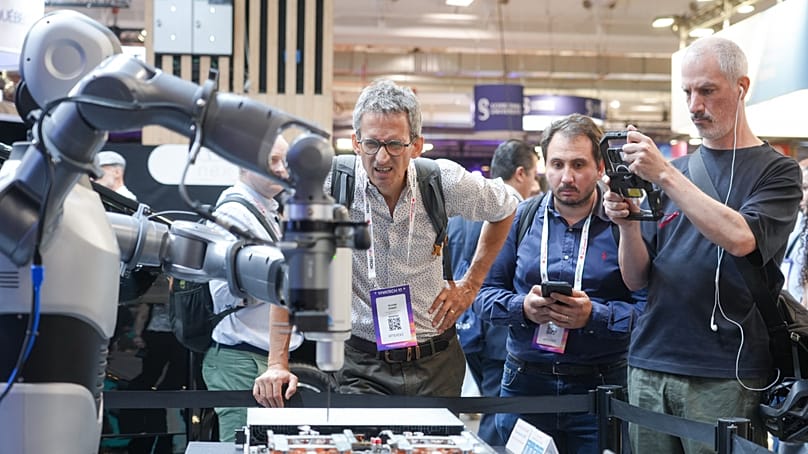
Foxconn presentation at VivaTech 2026.
Foxconn presentation at VivaTech 2026. Courtesy of Foxconn at VivaTech 2026, all rights reserved.

The planning is increasingly shaped by Nvidia's own environmental commitments. The company powered all of its global offices and data centres with renewable electricity.

Its latest Blackwell chip architecture also delivers up to 25 times lower energy consumption for AI tasks compared to the previous generation.

France is at another advantage with its AI champions, including Mistral AI, AMI, H Company, as well as software providers and builders, and has a strong history of talent that rises through the universities, he added.

“Those model builders in Europe have a massive role to play and I'm pleased to say that I've known Mistral guys since they were like three guys in a coffee shop and even before they were Mistral, and we've worked with them all the way through,” Ives said.

These open-source and open-science companies that allow access to AI for organisations or developers that lack the means to pay for other closed-source companies, such as OpenAI, help promote a more equal playing field.

“So we've worked with and collaborated with and helped and invested in those things since the very beginning because we believe that open source and open science, which most of them are doing, is super important to generate that choice,” he added.


Jeff Bezos at VivaTech: We need to colonise the Moon to save Earth
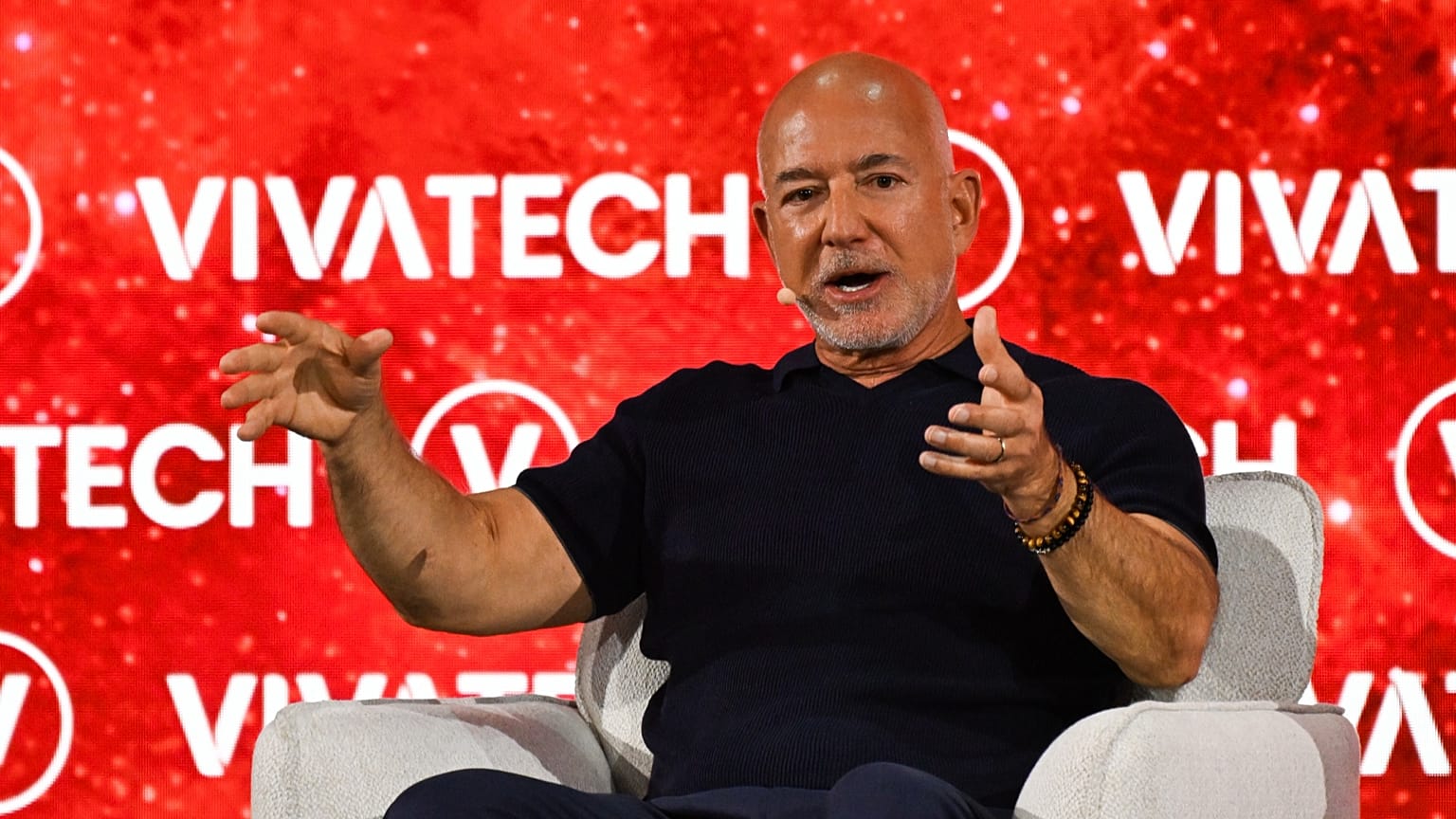
Amazon founder Jeff Bezos speaks at the Vivatech fair in Paris, Wednesday, June 17, 2026. (AP Photo/Emma Da Silva)
Copyright Copyright 2026 The Associated Press. All rights reserverd


By Pascale Davies & Una Hajdari
Published on

The Amazon founder told VivaTech in Paris that moving heavy industry off Earth is the only way to reconcile economic growth with a liveable planet — and the moon is where it starts.

Jeff Bezos took the stage at VivaTech in Paris on Wednesday to make the case that humanity must move to the moon and eventually beyond, not just for the sake of exploration but to save the planet from the effects of technology and industry.

Speaking alongside Blue Origin chief executive Dave Limp in a session moderated by former NASA astronaut Mike Massimino, the Amazon founder and Blue Origin executive chairman argued that shifting heavy industry off Earth is the only scenario in which economic growth and environmental preservation can coexist.

"[Our] garden planet can be returned to its pre-industrial revolution state," Bezos said.

"This is the only way in which the world is worse today than it was 500 years ago ... We can actually have both," he continued, emphasising that the quality of life has improved for the entirety of humanity but that the planet suffered as a result.

His message was unambiguous on sequencing, namely that the moon comes before Mars, and skipping that step would be a mistake.

The moon's proximity, which is reachable in three and a half days, makes it accessible at any time rather than once every two years like Mars, and its shallow gravity makes it an essential staging post, he argued.

"When you skip steps, it actually doesn't make you faster," Bezos said. "It's a kind of a gift. It's so near Earth."

Materials lifted from the lunar surface require 28 times less energy per kilogram than those launched from Earth, he noted. That figure makes the moon not just a destination but a potential supplier for deeper space missions.

He was pointed about the Apollo programme too: the original moon landings were pulled forward in time by geopolitics and the race with the Soviet Union, achieved by spending up to 4.5% of the US federal budget and ultimately unsustainable.

What Blue Origin is attempting now, he argued, is categorically different — not a sprint driven by rivalry but a permanent settlement driven by necessity.

"The idea that we've been to the moon before — it's the permanence of it, of staying there," he said. "Now is the right time. To really get into it and go to stay."

The economic logic of the moon, in Bezos's telling, is as compelling as the environmental one.
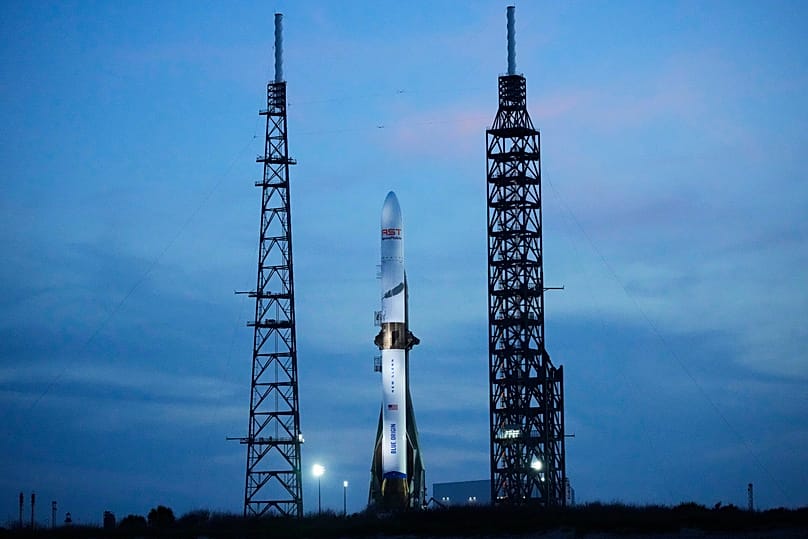
FILE - A Blue Origin New Glenn rocket stands ready for launch at the Cape Canaveral Space Force station in Cape Canaveral, Fla., 18 April 2026. (AP Photo/John Raoux, File) Copyright 2026 The Associated Press. All rights reserved

Lunar water ice, detectable from orbit and soon to be examined up close, could be converted into liquid oxygen — one of the key propellants for deep space travel — and launched into orbit at a fraction of the cost of lifting it from Earth.

The moon's surface, bombarded for four and a half billion years by meteorites, holds virtually every mineral needed to build infrastructure in space.

The longer vision he sketched was sweeping: large space habitats of the kind first proposed by physicist Gerard O'Neill in the 1970s, in which thousands or even millions of people live and work in orbit, compute infrastructure built in space, solar energy generated beyond the atmosphere, and chips manufactured off-world with answers beamed back to Earth.

Mars and further destinations would follow but only once the lunar foundation is in place.

"We will build colonies on Mars and so on," he said. "The moon is an important first step."

Bezos also used the appearance to address Prometheus, his artificial intelligence venture co-founded last year, which he described as a tool to compress the engineering cycle — potentially cutting a ten-year development programme to five years, then two, then one.

Unlike large language models trained on text, he said, Prometheus is built on engineering-specific data suited to designing physical objects, with the goal of dramatically accelerating the pace of invention.

He closed on characteristic optimism. Civilisational wealth, he argued, has always been driven by invention, from the plough 6,000 years ago to the steam engine, and the current moment is the most target-rich environment in human history.

"Every young person right now should be so excited," he said. "It's never been a better time to be an entrepreneur."


LA REVUE GAUCHE - Left Comment: Search results for THE MOON IS A HARSH ,MISTRESS


Wednesday, May 20, 2026


Cuba between the great powers


Khrushchev and Fidel

First published in Polish in Gazeta Wyborcza. Translation and footnotes by Adam Novak from Europe Solidaire Sans Frontières.

What can a state do when faced with an overwhelmingly stronger power seeking to subjugate it or maintain its dominance over it? Often it must turn for help to another power — hostile to or competing with the first — or even seek refuge under its umbrella. In doing so it often risks going from the frying pan into the fire. After the Second World War, until around 1990, the risk was all the greater because the world was perceived as bipolar, even as more and more countries broke loose from the orbits of both superpowers.

Such a risk became Cuba’s when, as a result of the Castroist revolution, it broke out of the American sphere of influence. Facing a siege by a hostile superpower, the revolution desperately sought, and found, an ally in the Soviet Union. It quickly became apparent that the alliance threatened the loss of independence. Fidel Castro would fight to preserve it for more than ten years, repeatedly balancing on the brink of breaking the alliance.

A colony in the republic

The revolution was a real one — like the Yugoslav, Chinese or Vietnamese. Moreover, unlike those, in Cuba it was not “made” by communists, and so by its very nature it offered strong resistance to Sovietisation. Even when its leaders decided to ally with the local communists, and even themselves to become communists — but “new” ones. The catch was that the “old” communists, with whom the alliance of the “new” was as inevitable as the alliance of the revolution itself with the USSR, sided with the Soviets, which undermined from within the intention to preserve independence from the international ally. The struggle for that independence therefore had to be fought on two interconnected fronts — external and internal.

The revolution, victorious in January 1959, took place in a country which half a century earlier had won independence from Spain — through a war of liberation, true — but had fallen into deep dependence on the United States. The American army had intervened in that war in order to take over, worldwide, almost the entire colonial inheritance from this old and declining power, Cuba included. Even after the abrogation in 1934 of the so-called Platt Amendment,1 which had bound Cuba hand and foot, the country remained — as the nineteenth-century Cuban poet and independence leader José Martí said of such states — a “colony within a republic”. A colony to a degree matched by few other Latin American republics.

The revolution, which began as a struggle against the Batista dictatorship, quickly turned into a confrontation with United States interests — economic and political alike. After two years of guerrilla war, Fidel Castro’s Rebel Army forced the government troops to capitulate and seized power, and the revolution very quickly collided with the “colony within the republic” and swept it away. And because the “colony within the republic” was above all American capital in the economy, in uprooting the colony it overthrew capitalism itself through sweeping nationalisations. The revolution did so just a few months before the second anniversary of its victory.

Those putschists need to be dealt with!

Who were those who at the turn of 1956 and 1957 launched the guerrilla war? Ernesto Che Guevara, asked about this in a guerrilla camp by the Argentine journalist Jorge Masetti,2 explained: “Politically, Fidel and his movement could be called ’revolutionary-nationalist’.” Rightly so — except that it was not a narrow nationalism, but Cuban and also Latin American, similar to the panarabism of the time. “The fatherland is America” — that “Our America” as Martí called it, Latin America — and they were martianos: they regarded themselves as the ideological heirs of that hero of the war of independence.

Did they have anything in common with the communists of the Popular Socialist Party (PSP)3 at that point? At first nothing. When on 26 July 1953 Castro first attempted to ignite an uprising against the recently installed Batista dictatorship, attacking the Moncada barracks in Santiago with his men, the communist party sharply denounced this as a “putschist adventure”. This was the major bone of contention — greater than any other ideological-political divergence. The slogan from Moscow addressed to the communist parties was clear: the peaceful road to socialism… which, the Castroists ironised, one would follow ad calendas Graecas.4

The following fact illustrates how great a bone of contention the insurrectionary ethos of the revolutionary nationalists was with the communists, and what consequences it sometimes had. On 13 March 1957, when guerrilla war was already underway in the Sierra Maestra, 46 fighters of the Revolutionary Directorate, founded by the student union leader José Antonio Echeverría, stormed the presidential palace with him at their head to kill Batista. Almost all died on the spot. Four survived and went into hiding, but, on the basis of an informer’s tip, the police tracked them down and murdered them.

Seven years later it would turn out that they had been betrayed by a university classmate, a communist who, on instructions from his party, had infiltrated the Directorate. He would confess in court that he had done so on ideological grounds — specifically because of his party’s hostility to such putschist methods of struggle, as they appeared in its eyes.

Plains and mountain revolutionaries

The “plains” — that is, the underground urban wing — of the 26th of July Movement related to the communists with great mistrust. Many activists of this movement proclaimed that the USSR was an imperialist power, like the United States. Others — for example Armando Hart and the son of Polish-Jewish immigrants Enrique Oltuski5 — moreover read with approval Trotsky’s writings on the “degeneration” of the Soviet state and on Stalinism in the communist movement in general. At the same time the head of the National Workers’ Front of the 26th of July Movement was a Trotskyist activist, the railwayman Ñico Torres. Former Trotskyists who had once joined the revolutionary nationalists, while retaining their previous political views, were also active in the 26th of July Movement.

In the last months of 1958, when the Rebel Army went on the offensive, the communists began to cooperate with it. They were a potentially important ally, since the 26th of July Movement lacked their kind of social base in the labour movement. In the “mountain” — that is, the guerrilla — wing of the 26th of July Movement, in Castro’s closest entourage, two of the other three main commanders — Raúl Castro, Fidel’s younger brother, and Guevara — represented pro-communist and pro-Soviet views. Raúl had earlier belonged to the communist youth, and in Mexico, when Fidel was organising the insurgent landing on Cuba, it was Raúl who recruited the Argentine, when it turned out that the latter shared his pro-Soviet orientation. Striving to ensure that the revolution would become socialist, they considered that without the communists it could not be done, and so, in order to draw them in, both — still in the guerrilla period — even joined the PSP, concealing this from Fidel.

Because of his views, Guevara had political clashes at that time with the leaders of the “plains” wing of the movement. After a year of armed struggle in the Sierra Maestra he wrote to René Ramos Latour,6 national chief of Action and Sabotage of the 26th of July Movement: 

Owing to my ideological background I belong to those who believe that the solution to the world’s problems lies behind the so-called Iron Curtain, while I treat this movement as one of the many provoked by the bourgeoisie’s desire to break the economic chains of imperialism. I have always regarded Fidel as an authentic leader of the bourgeoisie’s left wing, although his extraordinary personal qualities raise him very far above his own class. With this disposition I entered the struggle — honestly speaking, without hope of going beyond the framework of national liberation, and prepared to leave when at a later stage the conditions of the struggle would cause the movement as a whole to turn to the right.

Ramos Latour replied: 

We want a strong [Latin] America that would be mistress of her own fate, an America that would stand up proudly to the United States, Russia, China or any power seeking to encroach on her economic and political independence. By contrast, those with your ideological preparation believe that the answer to our ills is to free ourselves from the harmful domination of the ’Yankees’ by establishing the no less harmful domination of the ’Soviets’.

Behind Fidel’s back

Soon the leadership of the 26th of July Movement passed from the urban underground — towards which Guevara was mistrustful, convinced that it represented the right, bourgeois wing of the movement — into the hands of the Rebel Army command. And the latter, he assured, “is already ideologically proletarian” — though he never explained how it had become so, operating in the Sierra Maestra, beyond a vague statement that this was the result of “a process of proletarianisation of our thinking, a revolution taking place in our habits and minds”.

After the victory Fidel, realising that Guevara was working with Raúl behind his back and that the two of them were placing communists in many positions in the apparatus of power, in fact pushed Guevara aside for some time, sending him — as a representative of the new Cuban authorities — on a long journey to Third World states and to Yugoslavia.

At the end of October 1960, when the overthrow of capitalism in Cuba had reached a point of no return not only with the full support but actually under the leadership of Castro himself, it seemed that he, Guevara and Raúl were now walking the same path together. This was an illusion, as is known today after the opening of the post-Soviet archives. Guevara, then president of the central bank, arrived on a trade and economic mission to Moscow, where, accompanied by the secretaries of the PSP Executive Bureau, Aníbal Escalante and Manuel Luzardo, he met with CPSU dignitaries — Suslov, Kosygin, Mikoyan and Ponomarev. In the official Soviet record of these talks one reads something hitherto unimaginable to historians of the Cuban revolution and to Guevara’s biographers:

Comrade Escalante asks the Soviet side to take into account that he can negotiate with Comrade E. Guevara beyond the prerogatives of the trade and economic mission, because recently Comrade Guevara, together with Comrade Raúl Castro, has been promoted to the leadership of the PSP, although a very small circle of persons know about this and it is being kept secret from Fidel Castro.” And further: “Although the latter does not know that his brother Raúl and Guevara are communists, he knows very well that they work in close contact with the party, and even jokes sometimes that they are the PSP’s representatives in the revolutionary government.

At the same time the Soviet ambassador in Havana reported with alarm to the Kremlin that there was considerable friction with Guevara, as he was violently criticising the Latin American communist parties — arguing that they “do not exploit the revolutionary situation, behave like cowards, do not go to the mountains and do not begin open struggle”, armed struggle, naturally, on the Cuban model.

Moscow looks askance

In April 1961 Castro formally consecrated the overthrow of capitalism by proclaiming the socialist character of the revolution. He did so literally on the eve of the landing at Playa Girón of an armed brigade of Cuban exiles supported by the United States, which was to march on Havana. Once it landed, the brigade was unable to get off the beach: first it was held there by workers’, students’ and peasants’ militias, and then crushed by the still small Rebel Army. Before this happened, the besieged and desperate revolution had turned to the only ally it could realistically find — the Soviet Union. The world’s second superpower lay very far away, in another hemisphere, so Castro presumed that he would manage to conclude the alliance while preserving independence — without becoming a satellite, without succumbing to structural assimilation, in other words: Sovietisation.

In the Moscow press it was on the one hand suggested that Cuba owed its victory at Playa Girón partly to the Soviets, and on the other the declaration of the socialist character of the revolution was passed over, because in the Kremlin it had met with a clearly negative reaction. Cuba dared to consider itself the Soviets’ equal! According to the Soviet canon, there could be not only no socialist revolution but not even a “people’s-democratic” one where the leadership was not undivided in the hands of a communist party recognised as “theirs” by Moscow. Like the Nasserist revolution in Egypt, the Castroist revolution deserved in Soviet eyes only the lowest title in the hierarchy — “national-democratic revolution”. But the Cuban revolution had overthrown capitalism, Castro reasoned. In Moscow that was not what counted. It is significant that when the former guerrilla commander Faure Chomón, serving as Cuban ambassador in the USSR, said publicly “we, communists”, it caused outrage there.

Castro brings order

In the summer of 1961, from the 26th of July Movement, the Revolutionary Directorate of 13 March and the Popular Socialist Party, Castro formed the Integrated Revolutionary Organisations (ORI7) with a view to building a single party. And at the end of the year, attempting to bring some order to this “disorder” in accordance with the standards prevailing in the communist world, he announced that he was a Marxist-Leninist. Organisational integration and ideological standardisation rapidly produced a powerful crisis. Under the leadership of the aforementioned Aníbal Escalante8 the communists immediately used their experience in building party apparatuses to take over the apparatuses of the ORI, through them to place their own people in state institutions, to uproot those who had made the revolution, and to prepare themselves to take power. If the revolution was socialist — and Castro himself had proclaimed this — then power now belonged to the communists, while he should be left to play the role of Kerensky.

Oltuski would recall: 

In Che’s presence a certain extremist attacked the 26th of July Movement. After some hesitation I ventured to reply: it is true that we did not know Marxism at all and did not belong to the party, but perhaps it is precisely for that reason that we overthrew Batista. Che agreed with me.

Now sparks flew not only between Guevara and the communist parties of Latin America, but also between him and the Cuban communists.

The ORI lasted less than eight months. In March 1962 Castro, without attacking the communists as such, declared that the ORI had been taken over by “sectarianism” under the leadership of Escalante. He dismantled the apparatuses he had just built, forced the recall of the Soviet ambassador — whom he regarded as an accomplice or instigator of the “sectarianism” — and ordered the construction of a new United Party of the Socialist Revolution (PURSC9). He filled its leadership with his own people from the guerrilla and the underground, and with selected, reliably loyal communists. Escalante he exiled to Moscow.

That same year the conflict between Castro and the former guerrillas with their own communists extended sharply into relations with the strategic ally itself. This happened during what is variously called the October, missile or Caribbean crisis.

Missiles in Cuba

The 1962 crisis had its origins eighteen months earlier, after the defeat of the counter-revolutionary brigade at Playa Girón. Paradoxically, the victory there had increased the Cuban sense of threat, this time from direct US military intervention. The Kennedy administration was regarded in Havana as openly hostile to the revolution. The alliance with the Soviet Union was deemed the only real security guarantee, which Moscow exploited for an extraordinary move: Cuba was offered the deployment of Soviet nuclear weapons on the island.

Today it is known that this was not a Cuban initiative but the result of Moscow’s geopolitical strategic calculations in the arena of superpower rivalry. The Cubans agreed, but pressed for the move to be made openly, since they considered this would be safer. Nikita Khrushchev, however, pushed through the operation in strict secrecy. The Cuban side was right — when it came to light, the world stood on the brink of nuclear war.

Kennedy received irrefutable proof of the deployment of Soviet missiles in Cuba — contrary to Moscow’s earlier repeated denials. Now therefore Khrushchev maintained that they were purely defensive, appealing at the same time to the Americans for restraint. American intelligence, however, had a poor grasp of the situation, as the then secretary of defence Robert McNamara would learn only thirty years later in Havana, at a conference on the crisis organised by Castro.10 The Americans thought that nuclear warheads were only on their way to Cuba, whereas 162 of them were already in place along with 42,000 Soviet troops. Having no idea of this, they intended to attack Cuba.

At the peak of the crisis Khrushchev proposed a solution: withdrawal of the missiles in exchange for a guarantee of non-aggression against Cuba and the withdrawal of American missiles from Turkey. Negotiations were conducted without Castro’s participation: not only was he left outside the decision-making process, with the crisis reduced to a bilateral conflict between the superpowers, but he was not even informed that negotiations were taking place. Castro’s demands that the crisis be resolved by obtaining American guarantees of the lifting of the blockade of Cuba, the cessation of sabotage and military actions against it, and the liquidation of the American military base at Guantánamo were ignored. What is more, having reached agreement with Kennedy, Khrushchev ordered the withdrawal of the missiles and troops from Cuba, again without coordinating this with Castro or notifying him of it. The Cubans suddenly saw the Soviets dismantling the launchers and leaving the island, which came as a shock to them.

Commenting on the October events of 1962 some years later, Castro stated that “the possibility of the Soviet Union withdrawing the missiles did not even occur to us”, and that after the crisis the Cuban revolution “stood before an ally in a state of complete retreat and almost beyond retreat — in a state of complete flight”, so that its security seemed even more uncertain than before the crisis erupted. Although he did not say so publicly, it is known today that he irreversibly lost trust in the Soviet Union as an ally.

A warning to the old communists

In Czechoslovakia the Cuban special services arrested Marcos Rodríguez, who was studying there and who in 1957 had handed over to Batista’s police four fighters — participants in the attack on the presidential palace. Chomón, former leader of the Revolutionary Directorate of 13 March, revealed that after the handover Rodríguez, who had left for Mexico, had been sheltered by a couple of high-placed old-party communist activists who were now even more highly placed as dignitaries. He accused this couple of having known that it was Rodríguez who had pointed out the fighters’ hideout.

This married couple were the de facto minister of culture Edith García Buchaca and the first deputy minister of the armed forces Joaquín Ordoqui. Castro intervened at Rodríguez’s trial in an effort to confront the threat of a wave of public hostility towards the old communists arising from this case.

At the same time he used the affair to remove García and Ordoqui from their posts and to stem the inflow of communists into the apparatuses of power, bringing their presence in those apparatuses down to safe proportions.

On the basis of denunciations well fabricated by the American special services and addressed to the Cuban services, Ordoqui was suspected of cooperating with the CIA, but Castro also held it against him that during the missile crisis he had stood politically not with Castro but with Khrushchev. He regarded him — probably rightly — as Moscow’s most important and most dangerous man in Havana. He wanted to put him on trial on the charge that he was, or had once been, a CIA agent, but under strong Soviet pressure he abandoned this. He nevertheless ordered him placed under house arrest together with his wife, where Ordoqui would die nine years after Rodríguez’s trial. The settling of accounts with Ordoqui — and incidentally with García — was a very serious warning to all those among the old communists who had not abandoned the thought that sooner or later Castro would yet share Kerensky’s fate, and that they would play the role of the Bolsheviks.

Comrade Che criticises the Soviets

Guevara had already broken with his earlier pro-Soviet orientation — and not only because the USSR was failing to meet many of the economic commitments it had taken on, or because it was delivering industrial goods of strikingly low quality. In 1964, then minister of industry, he travelled to the USSR for the celebrations of the anniversary of the October Revolution. His Mexican biographer Paco Ignacio Taibo II11 recounts: “Che cannot abandon his criticism, which is becoming sharper and sharper. He visits a Soviet factory presented to him as a model and, according to the account of one member of the delegation, says that it resembles a capitalist factory of the kind that existed in Cuba before they were nationalised” — that is, under conditions of capitalist underdevelopment. “He observes the aberrations in the field of planning, the traps of socialist competition, since he sees that planning is done so as to exceed the plan. He tells his comrades on the delegation that under the rule of bureaucratism the Soviets are heading into a dead end in the economic sphere.”

On his return he declared to the staff of his ministry: “Contrary to what is said, the countries of the Western European bloc are developing significantly faster than the countries of the people’s-democracies bloc. Why?” He recounted that in the USSR the bible was the (Stalinist) handbook Political Economy, not Marx’s Capital, and that he, Guevara, was regarded there as a Trotskyist. Although he was not a Trotskyist, to the economic debate he had initiated — which was a thinly veiled polemic between proponents of the Soviet economic model and its critics — he invited the Belgian Marxist economist and leading activist of the Fourth International, Ernest Mandel.12 Mandel was known for his devastating critique of Soviet economic planning and management.

Guevara had broken completely with the thought that “the solution to the world’s problems lies behind the Iron Curtain”, and decided that it lay in revolutions in the Third World. He himself, with more than a hundred Cuban military personnel, set off to assist the Lumumbist uprising in the Congo. After this failure, during his clandestine stay in Czechoslovakia, in his now well-known “Prague notebooks”13 he criticised the Soviet system, predicting its collapse. At the same time Cuba’s support for guerrilla movements in Latin America led to a prolonged — more than three years — strain in relations with Moscow. Perhaps even greater than during the missile crisis.

Castro versus the microfraction

It began in 1966 with an article published in the central Cuban party daily on the occasion of the anniversary of the October Revolution. In it “real” Latin American communists were called upon to follow the example of the Venezuelan guerrilla commander Douglas Bravo and his comrades. They had earlier been expelled from their communist party for refusing to cease armed struggle, but Castro promptly sent them over a dozen of his experienced officers to assist them.

In July 1967 the prime minister Kosygin, returning from Washington, came to Cuba where he told Castro that the Americans had proof that Cuba was supporting guerrillas in at least seven countries of the subcontinent, and demanded the cessation of this support under threat of breaking the alliance. Castro’s answer was his speech — the second on the subject — in which he subjected the Communist Party of Venezuela to a violent critique for having abandoned the guerrilla movement that the party itself had created and in support of which it had engaged Cuba.

In the Latin American communist movement linked to Moscow, and in Moscow itself, these speeches were taken as proof that Castro was breaking with communism. In Cuba, with the support of the Soviet bloc and under the leadership of Escalante, who had returned from exile, a section of the old communists — the so-called microfraction — entered the fight. It accused the Castroist regime of being petty-bourgeois, nationalist, non-Marxist, anti-Soviet and indeed anti-communist; of failing to recognise the leadership and hegemony of the USSR; of trying to replace the alliance with the USSR by an alliance with France; of seeking to bind itself to the Western economies instead of integrating economically with the Soviet bloc; and of pushing in Latin America — contrary to the policy of the communist parties and in accordance with what was alleged to be a “Trotskyist line of exporting the revolution” — the line of armed struggle.

At the end of the year Castro ordered the arrest of many activists involved in the “microfraction”, and in January 1968 their trial. The full detailed report of Raúl Castro on the investigation was made public, including the names of very high East German and Czechoslovak party dignitaries involved in support for the “microfraction”, as well as of Soviet functionaries present in Cuba itself who had assured the “microfraction” of support in Moscow. At a session of the Cuban Central Committee, Castro delivered a secret — today partly declassified — ten-hour speech in which he set out and documented the history of Cuban-Soviet relations, particularly the inside story of the missile crisis and its consequences for those relations.

Defeated by sugar cane

It seemed that relations with the allied superpower were hanging by a thread when, half a year later — to the surprise even of those closest to him — Castro supported the Warsaw Pact military intervention in Czechoslovakia. He did so, however, so ambiguously that in the Kremlin it was not taken as support. That this did nothing to improve relations was evidenced by the fact that almost a year later Cuba refused to take part in an international conference of pro-Soviet communist parties in Moscow.

Only in 1970 did the traumatic failure — for the regime and for society — of the record sugar cane harvest, voluntaristically planned to pave the way for Cuba’s independent economic development, force Castro to reconcile with Moscow. The latter put the matter clearly: either Cuba would accept the Soviet model of economic management, or the USSR — in fact the entire bloc — would cease to provide it with extensive aid.

This time Castro yielded — in 1971 Cuba joined the Council for Mutual Economic Assistance (Comecon). With the participation of 10,000 Soviet specialists and advisers, the Cuban economy began to be vigorously integrated into the bloc. This economic Sovietisation entailed cultural as well as ideological and political Sovietisation. The first victim of Sovietisation on this front was the writer Heberto Padilla,14 compelled to make a public self-criticism, against which many intellectuals worldwide who had previously sympathised with the Cuban revolution protested.

The next victim was the monthly Pensamiento Crítico15 — a journal published by young philosophers proposing an alternative to Soviet “Marxism-Leninism”: an open Marxism — widely open to Western Marxism and to revolutionary thought from the Third World — as well as critical and creative. Raúl Castro accused the journal’s editorial board of ideological diversion. The notorious “grey five years” (1971—1975)16 cast a grim shadow over literary and artistic life for a long time. The Cuban intelligentsia took its revenge for this five-year period only in 2007, when it spontaneously conducted a mass, public and radically critical debate about it, and about cultural Sovietisation in general. It did not spare even Castro himself from harsh criticism.

Concessions to the processes of Sovietisation, however — contrary to all appearances — were incomplete, and Cuba continued to pursue a fundamentally independent international policy. It demonstrated this above all in 1975, when the fate of newly independent Angola was being decided. Troops of the racist Republic of South Africa were then advancing on the capital of this former Portuguese colony. Cuba came to the aid of the liberation movement. It carried out — unexpectedly for the great powers — an intercontinental military operation unprecedented for a small country. It did so on its own initiative, presenting a surprised Soviet Union with a fait accompli.

Zbigniew Marcin Kowalewski studies revolutionary movements. In 1975—79 he worked in Cuba. In 1981 he was a member of the presidium of the NSZZ “Solidarność” for the Łódź region and worked for workers’ self-management. His first book was Guerrilla latynoamerykańska (Latin American guerrilla, 1978); his most recent are Rap. Między Malcolmem X a subkulturą gangową. Naród Islamu w czarnej Ameryce (“Rap: between Malcolm X and gang subculture. The Nation of Islam in Black America”, 2020), Ukraińskie rewolucje (“Ukrainian revolutions”, 2022; French edition 2025), and To nie jest kraj dla wolnych ludzi. Sprawa polska w rewolucji haitańskiej (“This is no country for free men. The Polish question in the Haitian revolution”, 2025).

Adrianna Nowak graduated in philosophy from the University of Warsaw. She is preparing the defence of her MA thesis in history at the Jagiellonian University on the roles of women in pre- and post-revolutionary Cuba from a decolonial feminist perspective. She intends to research the history of the interaction of political and feminist ideas in Cuban revolutionary processes, as well as the history of Cuban-Soviet and Cuban-American relations. She has written on Cuba for the Polish edition of Le Monde diplomatique and for Gromady.

  • 1

    The Platt Amendment, attached to Cuba’s 1901 constitution at US insistence, granted Washington the right to intervene militarily in Cuban affairs and to lease territory for naval stations --- including the Guantánamo Bay base, which remains under US control today. Most of its provisions were abrogated in 1934 under the Roosevelt administration’s “Good Neighbor” policy, but the Guantánamo lease was maintained.

  • 2

    Founder of Prensa Latina, the Cuban press agency established after the revolution; killed in 1964 leading a guerrilla group in Argentina inspired by the Cuban model.

  • 3

    The Partido Socialista Popular was the official Cuban communist party, founded in 1925, which had collaborated tactically with Batista in the early 1940s when he was constitutional president, accepting two cabinet posts. By the time of the 26th of July Movement’s emergence the PSP was committed to a “peaceful road to socialism” line.

  • 4

    A Latin idiom: literally “until the Greek Kalends” --- meaning never, since the Romans had Kalends in their calendar and the Greeks did not.

  • 5

    Led the 26th of July Movement underground in Las Villas province; served in various ministerial posts after the revolution.

  • 6

    Took up the role following Frank País’s assassination in July 1957; killed in combat with Batista’s forces in mid-1958.

  • 7

    ORI: Organizaciones Revolucionarias Integradas, the transitional structure created in 1961 from the three revolutionary organisations as the precursor to a unified party.

  • 8

    Aníbal Escalante: pre-revolutionary leader of the PSP and one of its principal organisers. After the “sectarianism” affair of 1962 he was sent into exile in Czechoslovakia; he returned to Cuba but was again arrested in 1968 over the “microfraction” affair.

  • 9

    PURSC: Partido Unido de la Revolución Socialista de Cuba. In 1965 it would be renamed the Communist Party of Cuba (PCC), the name it retains today.

  • 10

    The Havana conference of January 1992 brought together former Soviet, US and Cuban participants in the missile crisis, including McNamara and several senior Cuban and Soviet officials. The Soviet disclosures concerning the number of warheads already in Cuba at the time of the crisis and the size of the Soviet troop contingent were among its most significant revelations.

  • 11

    Author of Ernesto Guevara, también conocido como el Che (1996), one of the principal Guevara biographies.

  • 12

    His contributions to the 1963—64 Cuban economic debate appeared in Nuestra Industria Económica alongside texts by Guevara, Charles Bettelheim and Alberto Mora.

  • 13

    The “Prague notebooks”: critical notes Guevara made during his clandestine stay in Prague in 1966 between his Congo and Bolivia missions, in which he developed an extended critique of the Soviet handbook of political economy. Published posthumously as Apuntes críticos a la Economía Política (2006).

  • 14

    Heberto Padilla: Cuban poet whose 1968 collection Fuera del juego (“Out of the Game”) was awarded a prize by the Cuban Writers’ Union despite the regime’s hostility to the work. He was arrested in 1971 and forced to deliver a public self-criticism --- the so-called “Padilla affair” --- which prompted a break with the Cuban revolution by many of its previously sympathetic international intellectuals.

  • 15

    Published 1967—1971 by a group of young philosophers based at the University of Havana; its closure marked the consolidation of the orthodox Soviet line in Cuban intellectual life.

  • 16

    In Spanish, quinquenio gris: characterised by the institutional persecution of writers and artists deemed insufficiently orthodox and by the imposition of socialist-realist canons.