Showing posts sorted by date for query PETRO-CANADA. Sort by relevance Show all posts

Sunday, April 26, 2026

Rights Groups Warn Countries to End Complicity in Trump’s High Seas Murder Spree

As the death toll rises, governments “cannot plausibly claim ignorance of the risks” of supporting the US military in the Caribbean and Pacific, said a coalition.


Wayuu fishermen in the coastal community of Cano Sagua, Venezuela on December 20, 2025 continue their daily work amid growing anxiety over the Trump administration’s deadly attacks on boats in the region.
(Photo by Oumala Epieyuu/Anadolu via Getty Images)


Julia Conley
Apr 24, 2026
COMMON DREAMS


With the death toll in the Trump administration’s bombings of boats in the Caribbean Sea and eastern Pacific Ocean hitting at least 180, a global coalition of rights and policy organizations is warning governments that they “cannot plausibly claim ignorance of the risks” of continuing to support the United States’ deadly policy in the region, and demanding that countries “stop facilitating extrajudicial killings” carried out by the US military.

The Center for Civilians in Conflict (CIVIC) spearheaded the statement now co-signed by at least 125 human rights groups, drug policy organizations, and veterans’ groups, warning that just as US military officials and personnel have risked potential criminal liability by taking part in at least 52 boat bombings since September, third countries that are aiding the US in the attacks may be taking similar risks.

“Third states can incur legal responsibility for aiding or assisting another state in their commission of internationally wrongful acts, including extrajudicial killings and crimes against humanity,” reads the statement, whose signatories include Amnesty International, Oxfam America, and the Friends Committee on National Legislation. “Forms of cooperation such as intelligence sharing, access to military bases, and the provision of logistical support may meet the threshold for aiding and assisting where they facilitate the identification, tracking, and targeting of vessels.”

As El País reported Thursday, a number of countries have confirmed they are cooperating with President Donald Trump’s targeting of boats in the Caribbean and Pacific, which the administration has claimed is aimed at stopping drug trafficking in the region.

The US military has not publicly released evidence that the people it’s killed were actually “narco-terrorists” as it’s repeatedly claimed; the family members of some of the victims have filed legal complaints, saying their loved ones were not involved in the drug trade.


A small number of victims were identified last year by The Associated Press, which found some were struggling fishermen or other workers who took low-level jobs helping drug traffickers to navigate the Caribbean. Adam Isacson of the Washington Office on Latin America has compared the killings, if they have targeted the drug trade at all, to “straight-up massacring 16-year-old drug dealers on US street corners.”

Despite the lack of evidence to back up the administration’s claims about the operation, the Dominican Republic has allowed the US to refuel military planes and transport equipment at one of its air bases and its Las Américas International Airport, and the prime minister of Trinidad and Tobago expressed support for the boat bombings when they began in September. The island nation has reportedly allowed the transit of military aircraft and the installation of a US radar system for surveillance.

Colombian President Gustavo Petro said in November that his government would no longer share intelligence on drug trafficking with the US, but he later walked back the threat, saying intelligence would be shared provided it “will be used for seizures without undermining human rights.”

Trump also convened a “Shield of the Americas” summit last month to announce the creation of a coalition of 17 countries in the region, including Argentina, Costa Rica, and Paraguay, which will focus on “bilateral and multilateral operations against cartels and terrorist organizations.”

Legal experts have warned that although Trump informed the US Congress last October that the administration views the US as being in an “armed conflict” with Latin American drug cartels, the military has clearly violated international law by targeting defenseless survivors of its boat bombings.

“The United States is not in an armed conflict with anyone in Latin America. That means the people on these boats are civilians. Civilians, including those suspected of smuggling drugs, are not lawful targets,” said the ACLU last month.

Experts have said the bombings meet the definition of extrajudicial killings—or simply murder—and one top US military lawyer warned before the operation began that US service members could face legal repercussions for carrying out the attacks at the direction of Trump and Defense Secretary Pete Hegseth.

Despite the alarm raised by legal experts, “we are witnessing a continuation and a truly worrying normalization of these attacks against vessels,” Annie Shiel, US director of CIVIC, told El País on Thursday. “The United States is committing extrajudicial killings or murders, plain and simple.”

The group and its fellow signatories warned states like the Dominican Republic and Trinidad and Tobago could also be held legally responsible if they provide aid or assistance to the US when it is committing acts that violate international law.

“All states must immediately cease or refrain from providing any assistance that could contribute to these unlawful killings,” reads the statement. “Failure to do so facilitates the continuation of this lawless campaign, undermines the rule of law, and risks incurring legal responsibility under international law.”

The groups emphasized that in addition to putting countries at risk for legal liability, governments that facilitate the boat killings are exacerbating harm to their own communities.

“Families awaiting the return of their loved ones may never know what happened to them and have no access to recourse,” they said. “Coastal communities have witnessed human remains washing up on shore and fear for their lives when they trade and fish, sowing psychological trauma and undermining livelihoods.”


From Boat Murders to Kidnapping Maduro, Trump Spending Billions on ‘Donroe Doctrine’ Militarism

“Across the country people are going bankrupt and dying prematurely because of lack of healthcare, but the US government has billions to spend on imperialist violence to enrich corporations,” said one researcher.


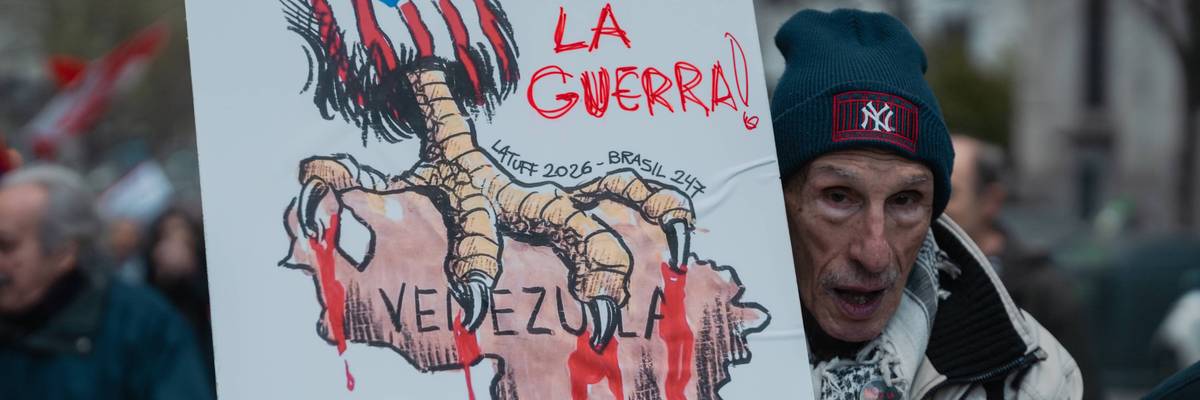
A protester holds a sign decrying US militarism against Venezuela, with the message “No to War,” during a March 14, 2026 demonstration in Madrid.
(Photo by Olmo Blanco/Getty Images)

Brett Wilkins
Apr 23, 2026
COMMON DREAMS

As the basic needs of millions of Americans are sacrificed upon the altar of waning US global domination, an analysis unveiled Thursday revealss that the Trump administration has spent billions of dollars on illegal military aggression against Venezuela and civilian boats alleged without evidence to be smuggling drugs off the coast of Latin America.

The Costs of War Project at Brown University’s Watson School of International and Public Affairs published an analysis by a pair of researchers who “found that spending on Operation Southern Spear and Operation Absolute Resolve in Venezuela, the Caribbean, and the Eastern Pacific cost at least $4.7 billion from August 1, 2025 to March 31, 2026.”

The researchers—Hanna Homestead of the Institute for Policy Studies’ National Priorities Project and Jennifer Kavanagh of the think tank Defense Priorities—also found that “costs will continue to mount as some naval assets and aircraft remain in the region and strikes continue.”

“This estimate is only partial due to lack of information, and does not include long-term budgetary costs such as veterans benefits,” an introduction to the analysis states.


In addition to the financial burden, the analysis notes the human costs of enforcing the so-called “Donroe Doctrine.

“While not the topic of this paper, they are essential to note at the outset,” the publication states. “The raid and capture of Venezuelan President Nicolás Maduro during Operation Absolute Resolve resulted in approximately 75 known fatalities. These include 32 Cuban personnel killed, at least 23 Venezuelan security officers killed, and at least two civilian deaths.”

US strikes “against unarmed vessels in the Caribbean and Eastern Pacific between September 2, 2025 and March 31, 2026 have killed at least 163 people,” the authors added. “In addition, at least one American service member died while deployed to the Caribbean in February 2026 when two US ships collided.”

The toll from Trump’s boat-bombing spree has since risen to more than 180 following additional reported strikes. Survivors of somemi bombings allege they were tortured by their US captors. The US military and Trump administration have provided no solid evidence to support their claims that the boats were transporting illicit narcotics.

Homestead and Kavanagh noted in their analysis that “to date, Congress has not authorized the use of force in the Caribbean or Eastern Pacific and the Pentagon has not provided information about costs of Venezuela-related operations, even as they continue to mount.”

There have been more than 50 boat bombings since Trump launched his campaign last September. Relatives of people killed in or missing after the strikes insist their loved ones were fishers with no links to the drug trade, an assertion echoed by leaders in VenezuelaColombia, and some Caribbean island nations.

Multiple war powers resolutions aimed at reining in Trump’s ability to wage war on Venezuela or bomb boats on the high seas without congressional authorization have been rejected by the Republican-controlled Congress.

In addition to the bombing and invasion of Venezuela and the boat strikes, the Trump administration has deployed troops to Ecuador as part of a joint campaign against alleged drug gangs dubbed Operation Total Extermination. Trump has also ordered the military to plan an invasion to seize the Panama Canal, threatened to “take” Cuba, possibly attack Mexico and Colombiainvade and annex Greenland, and somehow make Canada the “51st state.”

That’s just in the Western Hemisphere. Overall, Trump has bombed seven countries around the world since returning to the White House and 10 nations over the course of his two terms—including Iran, where he launched an illegal war with Israel.

The Costs of War Project rose to prominence by tracking the human and financial price of the so-called US War on Terror, which since September 2001 has resulted in over 940,000 direct deaths, including at least 432,000 civilians, in five studied countries, at a monetary cost of around $8 trillion.

Homestead and Kavanagh wrote in their analysis that the $4.7 billion figure “is a conservative estimate, and the greatest costs may yet be to come,” as “operations do not have a clear end date and are actively expanding.”

“They carry significant human, financial, and strategic costs and risk,” the researchers contended. “American taxpayers, who are increasingly unable to afford basic needs, have a right to know how their tax dollars are spent.”

Homestead told The Intercept on Thursday that “across the country people are going bankrupt and dying prematurely because of lack of healthcare, but the US government has billions to spend on imperialist violence to enrich corporations—from Venezuela to Iran—without any regard for human rights, life, or rule of law.”

“This situation illustrates why greater restraint on Pentagon spending—which primarily benefits private contractors—is so necessary,” she added.

This, as Trump seeks a record $1.5 trillion allocation for military spending in the next federal budget—despite the national debt approaching a staggering $40 trillion—while proposing billions of dollars in cuts to vital social programs.


‘Leaving the US Behind,’ 50+ Nations Gather in Colombia to ‘Phase Out Fossil Fuels’

“Word on the street is NO fossil fuel lobbyists at the Santa Marta, Colombia ‘Transition Away’ conference,” said one climate journalist.


Colombian Environmental Minister Irene Vélez Torres speaks during the First Conference on Transitioning Away from Fossil Fuels, in Santa Marta, Colombia on April 24, 2026.
(Photo by Colombian Ministry of Environment and Sustainable Development/X)


Brett Wilkins
Apr 24, 2026
COMMON DREAMS

Representatives of more than 50 countries on Friday kicked off the First Conference on Transitioning Away from Fossil Fuels in Colombia, a hopeful summit that comes amid a worsening global climate crisis and fossil fuel-producing nations’ efforts to block a clean energy transition.

Organizers of the conference—which is taking place in the Caribbean city of Santa Marta and is co-hosted by the Netherlands—said participants aim to “initiate a concrete process through which a coalition of committed countries, subnational governments, and relevant stakeholders can identify and advance enabling pathways to implement a progressive transition away from fossil fuels, creating sustainable societies and economies.”


‘No Oil, No War’: Trump’s Attack on Iran Condemned Ahead of Global Climate Summit

“This process will be informed by the experience and perspectives of national and subnational governments, academia, Indigenous peoples, peoples of African descent, peasants, civil society, workers, the private sector, and other key actors at different stages of the transition,” the organizers added.


The conference comes amid widespread disappointment and frustration over what climate defenders called a “shamefully weak” draft text—called the Multirão Decision—produced at last November’s United Nations Climate Change Conference, or COP30, in Brazil. The final document removed all mentions of fossil fuels amid pressure from oil and gas-producing nations like the United States, Russia, and Saudi Arabia, and the presence of a record number of industry lobbyists.

“When multilateral processes move slowly, concrete alliances of the willing can take us a long way,” German Chancellor Friedrich Merz said this week at the 17th Petersberg Climate Dialogue in Hesse state, where high-level representatives from around 40 countries discussed “concrete steps towards overcoming the climate crisis.”


The Santa Marta conference, which will run through April 29, will focus on three main areas:Overcoming economic dependence on fossil fuels;
Transforming energy supply and demand; and 
Advancing international cooperation and climate diplomacy.

Major fossil fuel producers including Angola, Australia, Brazil, Canada, Mexico, Nigeria, Norway, and the United Kingdom are among the 54 nations represented in Santa Marta.

Notably absent from the conference are some of the world’s biggest greenhouse gas polluters, including the United States, China, Russia, India, and Japan. Their absence is fine with Colombian Environmental Minister Irene Vélez Torres, who told The Guardian that “this is not the space for them.”

“We are not going to have boycotters or climate denialists at the table,” Vélez said.

Also missing by design are the legions of lobbyists who increasingly swarm COP conferences.


Former Peruvian Environment Minister Manuel Pulgar-Vidal, who heads the World Wildlife Fund’s global climate division, said in a statement that “changing the world’s dependence on fossil fuels isn’t a slow problem with a slow solution: We need a rapid, global shift to renewable power, smarter grids, and efficiency, so emissions fall fast and stay down.”

“And we need a ‘coalition of the willing’ to show us the way,” he added. “Santa Marta is an inflection point and an opportunity that we should not miss.”

The absence of the United States surprised no one, given the Trump administration and Republicans’ promotion of oil, gas, and coal. Big Oil invested $445 million during the 2024 election cycle in efforts to elect Trump and other Republicans and promote fossil fuel-friendly policies.

Trump, who ran on a “drill, baby, drill” energy policy, has signed a series of executive orders aimed at boosting fossil fuel production, including by declaring a fake “energy emergency” in a push to fast-track permit approvals. He also tapped former fossil fuel executives to head the Department of Energy and Interior Department, which have pursued a policy of opening up more public lands and waters for fossil fuel development.

At the same time, the Trump administration dropped out of the Paris climate agreement for the second time and moved to roll back the modest climate progress achieved under former President Joe Biden.

Melinda Lewis—who directs the Global Trade Watch program at the consumer advocacy group Public Citizen—is attending the Santa Marta conference, where she is working to dismantle the investor-state dispute settlement (ISDS) system. The enforced mechanism empowers multinational corporations to sue governments before panels of corporate attorneys and has been denounced by opponents—especially those in the Global South—as a novel form of colonialism.

“While it is tragic that the United States government is failing to meet this critical moment for climate action, we are encouraged that the rest of the world has recognized that it’s high time to take bold action to remove the arcane ISDS extra-legal instrument buried in trade and investment treaties that has been used as a cudgel by fossil fuel and extractive industries to stymie government actions that might reduce their profits,” Lewis said on Friday.

As Canadian researcher Joseph Bouchard recently wrote in a Common Dreams opinion piece, “Colombia is especially exposed” to ISDS harm, as “the country has 129 oil and gas projects covered by ISDS provisions, leaving it vulnerable to a wave of potential claims as it pursues its energy transition.”


Lewis noted that Colombia’s government, led by leftist President Gustavo Petro, “recently announced its intention to renounce its treaties that include ISDS as part of the full package of needed action to usher in a clean energy transition.”


Indigenous leaders said more must be done to ensure a just transition.

“We are very concerned. We talk about a just transition, but in practice it is not true,” Oswaldo Muca, General Coordinator of the Organization of Indigenous Peoples of the Colombian Amazon, told Inter Press Service. “Mining continues. Extraction continues. Deforestation continues. The territories and Indigenous peoples continue suffering this problem, and it is becoming more serious every day.”

Muca added that benefits from resource extraction “do not reach Indigenous territories, but they destroy the territory and leave the damage.”

On Friday, more than 250 legal experts from around the world asserted that “phasing out fossil fuels is not a political choice—it is a legal obligation.”

The jurists noted in an open letter that “the International Court of Justice (ICJ) unanimously confirmed that every state must use all means at its disposal to prevent significant harm to the climate system, including by avoiding the principal activities driving it: fossil fuel production and use.”

The letter’s signers include former Irish President Mary Robinson and Julian Aguon, an Indigenous human rights lawyer from Guam who played a key role in winning the ICJ climate case.

“The phaseout of fossil fuels is not just scientifically necessary to prevent catastrophic and irreversible harm to the climate system, all peoples, and ecosystems; it is legally required,” they wrote. “It is also socially, economically, and environmentally beneficial for present and future generations.”

Ultimately, countries participating in the Santa Marta conference will draw their own individual roadmaps with the help of scientists and other experts.

“If we think about it,” said Vélez, “the conference is that turning point where, collectively, we decide to be on the right side of history.”

Friday, April 24, 2026

Amid fuel crisis, a bold move to leave oil and gas behind

DW
 24/04/2026 


At an unprecedented meeting in Colombia, delegates from more than 50 countries want to chart a practical path to wean the world off fossil fuels. Can they succeed where the UN climate talks have failed?

Representatives from more than 50 countries are meeting in Colombia to make a plan on transitioning away from fossil fuels
Image: Roberto Pfeil/dpa/picture alliance

Cristian Retamal, Chile's former negotiator at the annual UN climate talks, hopes this week's conference in Colombia will lead to the start of a new global political movement.

Retamal is in Colombia's northern coastal city of Santa Marta, where representatives from more than 50 countries are meeting for the first-ever conference on transitioning away from the fossil fuels that are heating the planet.

They aim to come up with a practical, equitable plan to help the world reduce its dependence on coal, oil and natural gas, and identify which legal, economic and social measures are needed to do so.

The conference, taking place from April 24 to 29, was created amid frustration at last year’s UN climate conference. Despite support from a broad coalition of more than 80 countries, the talks failed to nail a binding mandate to phase out fossil fuels, due to a veto led by petrostates like Russia and Saudi Arabia.

COP30 deal sealed without fossil fuel plan 04:35

Retamal said broad international interest from all levels showed that the world recognized the need to end the fossil fuel era, despite the impasse at COP.

"In the '90s, climate became an issue at the UN level because a few countries decided to start working on that and pushing for the UN system to address the issue," Retamal told DW. He believes the Colombia talks could be a similar catalyst.

Major fossil fuel nations taking part


Colombian Environment Minister Irene Velez Torres, whose country is co-hosting with the Netherlands, has said participants at the unprecedented meeting are not just countries on the front lines of climate change, like Pacific Island developing states.

Major fossil fuel producing nations like Canada, Australia, the United Kingdom and Norway are also taking part. Germany, France and a few other EU member nations are also sending delegates, along with the European Commission.

The effects of climate change include more extreme weather around the world, including a major flood in Indonesia in December 2025
Image: Chaideer Mahyuddin/AFP

The world's biggest coal, oil and gas producers, such as the US, China, Saudi Arabia and Russia, won't be there. But that hasn't stopped major environmental organizations like Greenpeace and the WWF from calling it a "historic" meeting of a new "coalition of the willing."

An end to fossil fuel subsidies?


"It is implementation time, no more discussions on ambitions," a spokesperson for Stientje van Veldhoven-van der Meer, the Dutch minister of climate and green growth, told DW.

"We will start concrete work with a group of countries with shared views on what a transition away from fossil fuels looks like and what is required: decrease supply and demand," he added. Part of that shift would include a plan to "phase out fossil fuel subsidies."

Renewable energy has seen record growth in recent years. Led by solar power, especially in China and India, clean energy sources exceeded global demand for electricity in 2025, according to the latest analysis from energy think tank Ember.

The share of renewables, including solar, wind, hydropower and other clean energies, made up more than one-third of the world's electricity mix for the first time last year.

But a worldwide phaseout of fossil fuel power, and associated greenhouse gas emissions, is still some years off. Fossil fuels are being subsidized to the tune of around $920 billion (€782 billion) every year, making oil, gas and coal appear better value than they actually are.

Iran war exposes overreliance on fossil fuels


The burning of fossil fuels is a major contributor to global warming, which is causing longer heat waves and droughts, stronger storms and flooding worldwide. These consequences are becoming more extreme and costly, with lasting consequences for people and economies.

The surge in oil and gas prices and supply shortages triggered by the Iran war has highlighted the vulnerability of countries that are reliant on fossil fuels, or the revenue generated by their sale.

"Transitioning away from fossil fuels reduces exposure to both external dependencies and to toxic pollution, enables more stable development and strengthens self-determination and democracy," said Lili Fuhr, director of the Fossil Economy Program at the Center for International Environmental Law.

For years, energy experts have warned of relying too heavily on coal, oil and gas to power the global economy. Retamal said while the conference in Santa Marta wasn't organized in the context of the current energy crisis, it did give delegates a good reason to "seriously discuss […] how to transition away from fossil fuels."

No 'magic wand' to end fossil fuels reliance

Despite the optimism, the talks won't act as "a magic wand" to clear away all the problems and obstacles that have built up over the decades, said Madeleine Wörner, a climate and energy expert at the German aid organization Misereor.

Retamal agreed, saying it will likely take several years before countries can agree to a binding road map or treaty. Delegates won't just be discussing how to phase out fossil fuels, but also the many legal and trade issues that go along with such a monumental transition.

Wörner pointed out that major corporations, for example, could decide to claim compensation for lost profits under investor-state dispute settlement clauses, if their fossil fuel facilities are shut down earlier than planned. Such a far-reaching decision wouldn't just mean potential costs, she added, but could also lead to bilateral disputes.

Millions of people around the world also depend on the fossil fuel industry for their livelihoods. An eventual phaseout would also have to ensure that these people aren't left behind.

Germany not sending top-level politician

Co-hosts Colombia and the Netherlands are both sending their climate ministers to the talks, and Colombian President Gustavo Petro is also expected. Jochen Flasbarth, the secretary of state for the environment, will make the trip for Germany.

"It's a shame that the German government isn't represented at the highest level," said Wörner. Germany's coalition government hasn't presented a united front on climate policy, she said, meaning Germany likely won't play a major role in shaping the discussion in Santa Marta.

The conference is being framed as a dialogue, not a negotiation. Starting Friday, a wide spectrum of civil society groups, academics and representatives from the private sector will talk about potential solutions. Political representatives will join the talks for the final two days.

By then, it should be clearer what this new movement will actually be able to achieve.

This article was originally written in German.


Tim Schauenberg One of DW's climate reporters, Tim Schauenberg is based in Brussels and Münster.

Thursday, April 23, 2026

Correlating US Aggression On Cuba, Venezuela And Iran: The Oil Factor – Analysis


April 22, 2026
Manohar Parrikar Institute for Defence Studies and Analyses (MP-IDSA)
By Dr. Saurabh Mishra

Venezuela and Iran, the two countries that President Trump has targeted for military operations to date, along with the US, account for about one-third of global oil reserves. The endgames of the US aggression against Venezuela, Iran, and possibly Cuba in the near future may focus on long-term deals that include oil benefits. The Trumpian economic strategy hinges on access to cheap oil.

At the beginning of 2026, United States (US) forces abducted President Nicolás Maduro of Venezuela with the intention of regime change, although the stated goals were different. We also witness the US facing extreme difficulty in breaking Iran’s will to fight, and Tehran is resisting regime change despite immense losses to its top leadership, military and civilian infrastructure. Cuba, too, has a standing threat issued by President Trump, who had been projecting himself as the ‘President of Peace’ until a few months ago.

Trump threatened Cuba with a “friendly takeover”[1] in “some form”,[2] along with choking the country by blockading its oil imports and threatening its suppliers. The country has been under duress with chronic blackouts due to a fuel shortage. Cuban authorities confirmed that there was no oil shipment from January 2026 until the end of March, when a Russian oil tanker arrived with a consignment of 730,000 barrels.[3] President Trump has repeatedly indicated that he would be focusing on his next target, Cuba, once the conflict with Iran is over.[4]

Venezuela and Iran are very different in terms of their political composition, power and identity, and neither of them is/was an imminent military threat to the US. Although Trump’s military actions have been framed as preemptive responses to the threat to US citizens, its core security interests and safety of assets, one factor that Trump has downplayed or not mentioned while stating his objectives is the presence and potential of oil reserves in the two countries.


President Trump’s actions against Cuba are perplexing as to why he would threaten a tiny island nation that cannot pose any real military or economic threat in the context of contemporary global geopolitics. The return of Cuba, which has gradually been phased out of high-level geopolitical discussions since the end of the Cold War, into US grand-strategic calculations, needs explanation. This brief examines President Trump’s desire to “take over” Cuba and highlights the oil variable correlating his rhetoric and actions on Cuba with operations in Venezuela and Iran.

The Façade and the Truth in Venezuela Operation

On 3 January 2026, US forces abducted President Nicolás Maduro of Venezuela, along with his wife, in Operation Absolute Resolve. The couple was accused of heading a drug network impacting the youth and families in the US. President Trump, who previously had reduced US foreign military commitments, expressing a desire for peace and economic prosperity of the US, has ironically been successful in putting military pressure on Venezuela to open up for ‘reforms’ and make structural changes to its economy, especially in the oil sector, so that it could facilitate foreign (US) investments. Venezuela has the largest proven oil reserves, constituting approximately 17 per cent of the global total.[5] The stated objective of eliminating the drug and refugee problems emanating from Venezuela was soon overshadowed by the real calculations and strategies of developing oil fields in the country by US companies with a planned investment of US$ 100 billion over time.[6] The military threat over Venezuela, however, lingers to the degree of the Venezuelan regime’s non-cooperation with the US.[7]

The Bogeyman of Imminent Threat in Iran


Within a couple of months of the Venezuela action, the US, along with Israel, attacked Iran on 28 February 2026 and decapitated its leadership by killing Ayatollah Ali Khamenei, along with other high-ranking politicians and military officers, in Operation Epic Fury. The stated objectives were “eliminating imminent threats from the Iranian regime” and to “ensure that Iran does not obtain a nuclear weapon”.[8] Obliterating the Iranian missile industry, annihilating their navy and disabling their regional proxies were a few other stated objectives.[9]

It must be noted that the claims of both the US and Israel after the 12-day war in June 2025 had ranged between “obliteration” of Iran’s nuclear bomb building capability and a “setback” in “Iran’s ability to develop nuclear weapons by many years”. The assessments claimed that it might take Iran many years to reconstitute the lost capability of enriching Uranium and build a weapon out of it.[10] The Israeli Prime Minister’s Office had also claimed, “The achievement can continue indefinitely if Iran does not get access to nuclear material”.[11] Moreover, Joe Kent, Director, National Counterterrorism Centre in the US, resigned, saying, “Iran posed no imminent threat to our nation, and it is clear that we started this war due to pressure from Israel and its powerful American lobby”.[12]


Therefore, a surprise attack on Iran only within a year, against assessments of the country not posing an immediate threat to the US, along with the targeted assassination of its highest leadership and administrators, reveals a calculated intention for regime change with strikes for which no immediate provocation by Iran was visible. President Trump called on the people of Iran to take over the regime, as this might be their chance that they have had in generations.

The range and nature of the targets selected at the beginning of the US–Israeli joint strikes were beyond what was required to eliminate Iran’s nuclear capability, which was allegedly achieved in June 2025 itself. Therefore, the US’s emphasis on the nuclear dimension as justification for the attacks seemed more like a bogeyman. At the same time, the real objectives were different and linked to the long-term Trumpian grand strategy to be achieved through regime change in Iran. President Trump, known for his transactionalism, is spending billions of dollars on military adventures in Iran. Hence, the question is what motivated him to go to this war.

Did Israel Pull Trump into the War?

It is speculated that President Trump was led into the war by Israel. Israel’s objectives and motivations for the strikes can be understood in light of its antagonistic relationship with the country. Israel had been looking for an opportunity to bring the US on board with its designs to eliminate the Iranian regime, and Prime Minister Netanyahu of Israel succeeded with President Trump this time. But the question again is why Israel could convince Trump.

Given his inclinations and transactional temperament, President Trump should not join a war without concrete business incentives. His real motivations in this war, however, are less understood and quite obfuscated. Differences of opinion have also appeared within the Make America Great Again (MAGA) leadership about the ways of the movement that thrusted him to power. There is a divide within, and Trump, with his adventures in Venezuela and Iran, stands for his own faction. His war on Iran has received credible backing by the Republican Party supporters,[13] anointing his actions as the legitimate MAGA approach. Therefore, to understand his motivations and adventures, we must look into his policy and strategic outlook.

President Trump, in his address after the strikes, mentioned every long-term threat posed by Iran to the US interests in the region, but left out one aspect, i.e. oil. The US has historically had an interest in Iranian oil, but the aspirations to get hold of the source were jeopardised by the Iranian Islamist Revolution in 1979.[14] The Israeli objective of regime change or weakening Iran to a point of no return was deemed as a chance that converged with President Trump’s long-term strategic goals, hinged on an oil vision.

Trump’s approach, discernible in the National Security Strategy 2025, introduces oil as a correlating variable to be discussed in relation to his global strategic adventures, leading to military actions that began in Venezuela.[15] In 2023, Iran accounted for 12 per cent of the global oil reserves and 24 per cent of the Middle East.[16] The two countries that President Trump has targeted for military operations to date, along with the US, account for about one-third of global oil reserves. President Trump’s eagerness to end the war and expression of desire to control Kharg Island and the Iranian oil amidst the conflict alludes towards the original motive of controlling the Iranian oil with a brief blitzkrieg of air power, eliminating its leadership. No other economic factor explains President Trump’s allowing himself to be led into this expensive war.


As there was no immediate provocation by Iran, the US stated objectives appeared to align with Israeli objectives at the outset. However, as the conflict unfolded and the US (especially Trump) considered ending it even without the Strait of Hormuz reopening to normal operations, this revealed the US’s eagerness to get out of the expensive quagmire it had fallen into.[17] This also exposed the difference in goals between the two partners, despite their shared means of regime change. Israel’s motivation for the attack was a shift in the regional strategic balance and long-term security through regime change and weakening of Iran, and this could provide President Trump access to Iranian oil. A Venezuela-like cooperation from the Iranian leadership post the initial strikes appears to have been expected, but the dynamics of the conflict have set back US expectations.
The Centrality of Crude Oil in Trump’s Domestic and Global Strategy

President Trump started his second term with the slogan “drill baby drill”.[18] He concluded that producing more oil would help grow the US economy faster and secure its future hegemony.[19] His pursuit of foreign oil resources is also important to study, as President Trump himself has highlighted that the US is a net energy exporter and does not need foreign oil as it did in the past.[20] It is noteworthy that within a month of the inauguration of his second stint, President Trump signed an executive order stating his administration’s policy of “making America energy dominant”.[21] To this end, the order established the National Energy Dominance Council (NEDC) under the Executive Office of the President.[22]

Now, the question is: why does the US need this Council to dominate energy if the country has a surplus, and who is supposed to be dominated? The executive order, however, did not explicitly mention any other country or region to be dominated; and instead focused on planning from a “long-term” energy perspective towards increasing production of “reliable energy”. For this, the Trump administration prioritises oil drilling over green policies favouring renewables as he has reversed policies that supported and promoted electric vehicles.[23] The Endangered Species Committee in the US has also recently cleared oil and gas drilling in the Gulf of Mexico, exempting it from environmental rules, a move that could threaten a rare whale species and other marine life.[24] The Trumpian economic strategy clearly hinges on access to cheap oil.

Why the Threat to ‘Take Over’ Cuba?


After Venezuela and Iran, which are oil-rich countries, Cuba is a curious case that has not been in global news for its oil reserves. The island, home to around 10.9 million people, located only 90 miles off the southern US state of Florida, is associated with President Fidel Castro, its communist revolution, and its very close relationship with the Soviet Union (USSR) despite being a ‘non-aligned’ country during the Cold War. Cuba was governed by the Castro family under the banner of the Communist Party of Cuba, with single-party rule from 1959 to 2018. And, since then, it has been ruled by President Miguel Díaz-Canel under the same system.


Cuba is known for its famous cigars, sugar production (once among the highest globally but currently at record-low levels and negligible on a global scale), world-class rum, and pristine beaches, but not for oil. It is also recorded in modern history and international relations for the infamous Cuban Missile Crisis, which took the world to the brink of nuclear war in October 1962. The US had blockaded the country during the Crisis, and it has been under a strict US sanctions regime since then. The end of the Cold War, with the disintegration of the Soviet Union and the weakening and reinvention of Russia as a successor state and polity, reduced Cuba’s strategic importance in global geopolitics. The state, however, remains a communist-run system with currently declining industrial and well-being indicators. It has ideological opposition to US policies, but cannot pose any military or political threat in the post-Cold War scenario.

Due to the historical baggage, Cuba keeps good relations with countries that oppose US hegemonic policies and its ambitions of unipolarity. Therefore, in the executive order signed on 29 January 2026, President Trump found Cuba’s “policies, practices and actions” as constituting “an unusual and extraordinary threat” to the “national security and foreign policy of the United States”. The allegations are that Cuba has relations with “numerous hostile countries”, “terrorist groups”, and “malign actors hostile to the United States” that include Russia, China, Iran, Hamas and Hezbollah. Citing Cuba’s relations with these actors and blaming it for having “Russia’s largest overseas signals intelligence facility” and “deep intelligence and defence cooperation” with the People’s Republic of China (PRC), the executive order links it with the US’s notion of Western Hemisphere security and dominance.[25] The country, in fact, has been doing this for decades, but still cannot pose any real threat to the US.

A situation that was considered non-threatening and manageable with sanctions has now been categorised as a “national emergency”. The reasons for this shift are President Trump’s ideological perspective and the resulting threat perception, which makes him sensitive to anything linked to China in the American neighbourhood. Trump has concluded that he needs to push back against the increasing Chinese reach and penetration into the economic and strategic sectors in Latin America, especially in countries ruled by left-leaning leaders. Venezuela and Cuba, from the US perspective, are seen as classic autocratic ideological opponents in the region. Brazil, Mexico and Colombia, too, have left-leaning leadership. Still, they are viewed as functional democracies and may be more difficult to handle due to their size, resources, political culture and international relations. Colombia is a case in which there is a left-leaning government for the first time in modern history, and the upcoming presidential elections may alter the current government. Power in these countries may change hands between the right and left, but Cuba is different. President Trump’s military threat to the country is not justified by any explicit economic reason. The reasons cited are strategic, and Cuba has also been designated as a “state sponsor of terrorism” for sheltering members of US-designated terror organisations.[26] It may be noted that Trump had similar allegations against Venezuela and Iran, which also have the common mineral resource factor of substantial oil reserves that could be turned into long-term energy and economic benefits for the US. Given the absence of a large oil industry, Cuba, at the surface, seems to be a different case altogether. But, with a further inquiry into the country’s crude oil potential, the perception changes.

Cuba as a Potential Petro Power in the Western Hemisphere


Cuba currently has only 124 billion barrels of proven oil reserves, ranking it the 67th largest reserve holder.[27] The US and Cuban geological surveys estimate recoverable oil reserves between 4.6 and 20 billion barrels, respectively.[28] Various geological assessments of Cuba, especially its northern offshore Exclusive Economic Zone (EEZ) blocks, identify and acknowledge its potential to catapult itself among the top 20 largest proven oil reservoirs in the world and become a significant player in the oil economy of the Latin American Region. Even if the mean potential of the reserves is realised, only Venezuela and Canada would be able to surpass Cuba in terms of per capita oil reserves in the Western Hemisphere.[29] The estimates for the Cuban offshore fields are at least half the size of the US’s Alaskan oil reserves.[30]

Since the discovery of Cuba’s oil potential in the early 21st century, the country has sought to reduce its energy dependence on Venezuela and Mexico amid the post-Cold War geopolitical landscape. Oil companies from Canada, China, Russia, Spain, Norway and India had shown interest and invested in Cuba’s offshore exploration blocks, but nothing productive has come of it. Almost 80 per cent of the exploration area lies in deep or ultra-deep waters, and oil cannot be easily extracted with old technology.[31] The state-of-the-art exploration technology is owned and controlled by the US, which has imposed sanctions and a blockade against Cuba, making it difficult to drill due to technology and investment denial, and practically choking the country from becoming energy self-reliant.[32] The development of offshore oilfields over time could boost the Cuban economy and national prosperity, making Cuba a significant player in the region’s petroindustry, although possibly at the cost of economic diversification.[33]

US companies in the agricultural and pharmaceutical sectors have been pressing, sometimes successfully, for relaxations or normalisation of relations with Cuba to gain better access to its lucrative business opportunities.[34] Similarly, US oil companies have also been, though unsuccessfully, lobbying the US Congress to permit them to bid for oil and gas exploration in Cuban Waters. With only a small fraction of the world’s proven oil reserves open to foreign involvement,[35] they do not want to be left out of the race.[36] Former US President Barack Obama took steps to ease sanctions and build a normal relationship with the country. But, his efforts were thwarted by President Trump’s reversal of his policy towards Cuba. President Trump not only reinstated stringent sanctions on Cuba but also choked its essential crude supplies responsible for more than 80 per cent of its electricity generation.[37]

Amidst the downplayed oil dimension in Venezuela and Iran adventures, President Trump’s attention on Cuba as well as the US companies’ interest in exploration of its oilfields converge at a point where the country needs to be opened up for exploration. President Obama took a few steps towards engagement, but President Trump has a different way of achieving his goals. The oil potential of Cuba fits into his long-term scheme of Making America Great Again (MAGA), for which dominating the global energy market, along with the geopolitics of the Western Hemisphere, is an important condition.

The Political Dimensions of a Cuban Energy Self-Reliance


Industry experts do not expect any global disruption due to the availability of Cuban oil in future, and the realisation of the estimated potential may not impact the global prices in general. But, Cuba shall be energy self-reliant with the realisation of even the lower end of the estimates.[38] Further, the country’s transition to being a net oil exporter will have a positive impact on its economy, leading to the failure of the long-term US sanctions policy against Cuba.[39] Hence, it is imperative from the US perspective to keep Cuba energy-starved until the geopolitical and economic positions of the two countries are aligned. The alignment is possible either with regime change in Cuba or a paradigm shift in the US policy to engage the country with its political system intact. President Obama’s efforts to engage and relax sanctions on Cuba faced tough resistance, especially by migrant Cubans who have a grudge against the Communist regime.

President Trump, however, in the new geopolitical context of increasing influence of China and Russia in the Latin American Region, wants to decisively change the long-maintained status quo to benefit the US through regime change. His rhetoric on Cuba is explained by the convergence of his strategic visions of securing the Western Hemisphere for the US by driving China and Russia out, and of dominating the global energy market. As President Trump’s actions in Cuba are being analysed more from strategic and high-level geopolitical perspectives rather than economic ones, the correlation with oil has received little attention from analysts, who focus only on the country’s current proven reserves and production capacity.[40]

Trumpian Actions Have a Long-Term Economic Perspective on Oil

The US military actions and objectives on Venezuela and Iran are being shaped from a long-term Trumpian economic and strategic perspective, and Cuba is no exception. The exploration and development of oil fields in these countries may take around a decade or more and require heavy investment. Cuba, with its oil potential, is also among the top global producers of Cobalt and Nickel (critical metals for electric vehicle battery production) that may be important to a futuristic US foreign policy. But, President Trump has already ‘debunked’ US policy supporting and promoting electric vehicles by prioritising oil and gas over green and renewable energy sources.[41] Hence, oil has emerged as a clear priority in his calculations for engaging or targeting countries to achieve his strategic and foreign policy goals. In the context of Cuba, too, potential oil fields have to be given greater weight than renewables and critical minerals to understand the Trumpian economic and strategic calculus.

Conclusion


The oil potential of Cuba would be an unsaid benefit for the US if the stated strategic objectives are achieved through regime change. US involvement in oil exploration and production in Cuba could be a viable option for the communist Cuban government as well, but it cannot happen without the US securing guarantees to protect its stated strategic interests in the country. President Trump had already indicated the possibility of a deal between the two countries without an invasion, referring to a takeover in “some form”. Any deal, however, would depend on the Cuban government’s willingness to shed its ideological opposition to the US government. Apart from the US desire to detach Cuba from China, Russia and other unfriendly states in the region, oil exploration could be another lucrative potential benefit for the Trump Administration.

President Trump’s conflict with countries that posed no immediate or imminent military threat to the US should at least be explained by economic logic and motivation. Any conflict initiated for any reason ultimately has its economic endgame. And, as we examine here, oil fits in as the variable correlating to Trump’s aggression and military threat against Venezuela, Iran and Cuba. The presence of the correlation is further highlighted by President Trump’s statements and executive order regarding his energy policy. The US–Israel–Iran war has not yet concluded, and the outcomes may not be as the US expected, but oil could be a benefit in all the three. The endgames of the US aggression against Venezuela, Iran and Cuba may focus on long-term deals that include oil benefits.

The focus on the nuclear material issue might be more useful for legitimising the catastrophe unleashed. But, from the perspective of Trumpian MAGA priorities, the success, rationale, wisdom and the economics of these military adventures would remain highly questionable in the absence of any energy/oil deals.


Endnotes:

Will Grant, “Russian Oil Tanker Docks in Cuba Ending Near-Total Blockade”, BBC News, 31 March 2026.

Cuba War Next? Trump Drops ‘Wait for Two Weeks’ Bombshell as Iran Conflict Explodes”, The Times of India Channel on YouTube, YouTube, 6 March 2026.

Country Analysis Brief: Venezuela”, Energy Information Administration, United States of America, p. 5.

Michael Scherer, “Trump Threatens Venezuela’s New Leader with A Fate Worse than Maduro’s”, The Atlantic, 4 January 2026.

Statement of Policy by the National Security Council (NSC 5402)”, Office of the Historian, Washington, USA, 2 January 1954.

National Security Strategy 2025, pp. 5, 14, and 28.

Alexander Ward and Meridith McGraw, “Trump Tells Aides He’s Willing to End War without Reopening Hormuz”, The Wall Street Journal, 31 March 2026.

President Donald Trump’s Inaugural Address”, The White House, 25 January 2026.
National Security Strategy 2025, p. 14.

Establishing the National Energy Dominance Council”, The White House, 14 February 2025.
Ibid.

State Sponsors of Terrorism”, U.S. Department of State.

Cuba Oil Summary Table”, Worldometer, 15 April 2025
.
H. Michael Erisman, “Cuba as a Hemispheric Petropower: Prospects and Consequences”, International Journal of Cuban Studies, Vol. 11, No. 1, 2019, pp. 43–44.
Ibid.

Jonathan Benjamin-Alvarado, “The Current Status and Future Prospects for Oil Exploration in Cuba: A Special Report for the Cuban Research Institute”, Florida International University, November 2006, p. 6.

H. Michael Erisman, “Cuba as a Hemispheric Petropower: Prospects and Consequences”, no. 28, p. 48.

Jonathan Benjamin-Alvarado, “The Current Status and Future Prospects for Oil Exploration in Cuba: A Special Report for the Cuban Research Institute”, no. 30, p. 4.
H. Michael Erisman, “Cuba as a Hemispheric Petropower: Prospects and Consequences”, no. 28, p. 50.
Ibid., pp. 54–55.

Jonathan Benjamin-Alvarado, “The Current Status and Future Prospects for Oil Exploration in Cuba: A Special Report for the Cuban Research Institute”, no. 30, p. 2.
H. Michael Erisman, “Cuba as a Hemispheric Petropower: Prospects and Consequences”, no. 28, p. 55.

Where Does Cuba Get Its Electricity?”, International Energy Agency, 7 April 2026.
Robert Sandels, “An Oil-Rich Cuba?”, Monthly Review, Vol. 63, No. 4, 2011, pp. 40–45.
Ibid.

Arnab Chakrabarty, “Cuba – Cracks in the Red Citadel, and the US’ Unfinished Geostrategic Dream”, Indian Council of World Affairs, 7 April 2026.

Jeremy M. Michalek, “Trump Reversed Policies Supporting Electric Vehicles − It Will Affect The Road To Clean Electricity, Too”, no. 23.


Views expressed are of the author and do not necessarily reflect the views of the Manohar Parrikar IDSA or of the Government of India.

About the author: Dr. Saurabh Mishra is a Research Fellow at the Manohar Parrikar Institute for Defence Studies and Analyses (MP-IDSA), New Delhi. Prior to MP-IDSA he was an Associate Professor at the Amity Institute for Defence & Strategic Studies (AIDSS), Noida, preceded by his assignments as Research Fellow at the Indian Council of World Affairs (ICWA), an autonomous think-tank of the Ministry of External Affairs, India and Research Assistant at the Institute for Defence Studies and Analyses.

The Manohar Parrikar Institute for Defence Studies and Analyses (MP-IDSA), is a non-partisan, autonomous body dedicated to objective research and policy relevant studies on all aspects of defence and security. Its mission is to promote national and international security through the generation and dissemination of knowledge on defence and security-related issues. The Manohar Parrikar Institute for Defence Studies and Analyses (MP-IDSA) was formerly named The Institute for Defence Studies and Analyses (IDSA).

Saturday, April 18, 2026


Spain's Sánchez builds anti-Trump coalition looking for political lifeline at home

Leaders gather in Barcelona for conference of global progressives
Copyright Copyright 2026 The Associated Press. All rights reserved.

By Maria Tadeo from Barcelona
Published on 

Spanish PM led a progressive conference in Barcelona bringing together world leaders opposing MAGA politics, as Brazil's Lula lashed out at warlords and tech billionaires. "They're destroying democracy, workers and nature."

Pedro Sánchez rallied global leaders in Barcelona this weekend at a two-day convention billed as the “progressive CPAC”, crowning himself leader of the international left while grappling with mounting challenges at home.

The Spanish leader warned of an international “reactionary wave” fuelling hate speech, sexism, war and division, without explicitly naming US President Donald Trump.

"It doesn't matter how much they scream, or how many lies they spread," Sánchez said in a speech on Saturday. "The time for the reactionary, ultra-right has come to an end."

Brazilian President Luiz Inácio Lula da Silva echoed the remarks, criticising those “who call themselves patriots but put their sovereignty up for sale and call for sanctions”.

Chants of “No to war” could be heard at the Fira auditorium in Barcelona.

The guest list included South African President Cyril Ramaphosa, Colombian President Gustavo Petro and Mexican President Claudia Sheinbaum. All three have clashed with US President Donald Trump over tariffs and migration, while South Africa has also faced allegations of “anti-white” racism — claims echoed by tech billionaire Elon Musk.

A European delegation included German Vice-Chancellor Lars Klingbeil, UK Foreign Secretary David Lammy, Italy’s opposition leader Elly Schlein, and Belgian politician Paul Magnette. Tax-the-rich economist Gabriel Zucman was also in attendance.

European Council President António Costa cancelled at the last minute, citing personal reasons, and skipped a gathering perhaps considered too political for his role.

Mexico's Sheinbaum participated in an event about protecting democracies but did not join the more political rally on Saturday. A US-Mexico-Canada trade agreement is under review by the Trump administration and delicate talks about terms are ongoing.

Progressive CPAC to counter global MAGA

Sánchez said the Barcelona conference — unofficially billed as a left-wing answer to the conservative gathering CPAC — would serve to unite “progressive forces” under a single banner. A source involved in the preparations told Euronews that Brazil had asked Spain to move the event earlier to spring, with April ultimately chosen as the date.

While none of the leaders mentioned US President Donald Trump by name, references to the American leader surfaced repeatedly, alongside criticism of his policies. From tariffs to the war in Iran, officials called for a progressive response to "a reactionary wave."

Minnesota Governor Tim Walz, who ran alongside Hillary Clinton in her failed presidential bid against Donald Trump, addressed a large crowd on Saturday during the inaugural Global Progressive Mobilisation, describing Trump as “trigger-happy” with no actual plan.

Walz denounced a seemingly authoritative drift under the Trump, suggesting "we need to call that what it is. That's fascism. Or at least it's fascist curious as they would be."

Brazil's president Lula joined in the criticism of the war in Iran, and greeted Spain's decision to deny access to US forces to use Spanish military bases to strike Iran.

"I want to salute friend, Pedro Sánchez, for having the courage (to say no)," Lula added.

A difficult week for Sánchez at home

By often taking an independent stance - from Gaza to the war in Iran - the Spanish prime minister has captured a global audience, leading a bloc of left-wing leaders.

Euronews first reported about plans to organise a convention for socialist parties and the international left in March.

Euronews also reported that Sánchez sought to capitalise on public discontent over the war in Iran and the unpopularity of Trump to boost his international profile.

His stance has earned him applause, but also criticism from the White House.

Trump has repeatedly said he “wants nothing to do with Spain” and has criticised Sánchez as a bad leader who is “not paying” his fair share for NATO protection. He also threatened to impose a full trade blockade, although no measures have been announced.

The convention wraps a difficult week for the Spanish prime minister after his wife, Begoña Gómez, was charged with corruption and is set to face trial following a two-year investigation. The couple have denied any wrongdoing.

Sources close to Sánchez speaking to Euronews describe the case as politically motivated and expect Gómez to be acquitted.


Sánchez, Lula Lead ‘Work for Peace’ and Equality at Gathering of Global Progressive Leaders in Spain


“While others open wounds, we want to mend them and cure them,” said Spanish Prime Minister Pedro Sánchez.


Brazilian President Luiz Inacio Lula da Silva and Spain’s Prime Minister Pedro Sánchez (R) review the troops during a welcoming ceremony upon the Brazilian president’s visit at the Palacio de Pedralbes in Barcelona on April 17, 2026.
(Photo by Oscar Del Pozo/AFP via Getty Images)


Julia Conley
Apr 17, 2026
COMMON DREAMS

Arriving in Spain on Friday for a two-day visit that will center on a gathering of progressive leaders from more than 100 political parties across five continents, Brazilian President Luiz Inácio Lula da Silva emphasized that the summit was not “an anti-Trump meeting.”

But the contrast between US President Donald Trump’s violent foreign and domestic policies and the international meeting, which will focus on wage inequality and electoral strategy for progressives, was unmistakable as Spanish President Pedro Sánchez opened the gathering at a press conference in Barcelona on Friday.


Spanish PM Says Ceasefires ‘Always Good News,’ But Trump Deserves No Praise


“We want to double our efforts to work for peace and for a reinforced multilateral order. While others open wounds, we want to mend them and cure them,” said Sánchez.

Da Silva—who is commonly called Lula—and Sánchez, as well as other leaders who will be attending the weekend event, have spoken out forcefully against Trump’s policies and the rise of the far right in the US, Germany, Italy, and other European countries.

Sánchez has refused to allow US fighter planes to use Spanish military bases for missions in the US-Israeli war on Iran and closed the country’s airspace to American military aircraft—plus doubled down on his condemnation of Trump and Israeli Prime Minister Benjamin Netanyahu’s war even after the US president threatened Spain with a trade embargo.

Lula expressed solidarity with Pope Leo this week after the pontiff denounced the Iran war, and Mexican President Claudia Sheinbaum, who will also attend the meeting, took aim last month at Trump’s claim that her country is the “epicenter of cartel violence”—blaming the US for the flow of illegal weapons into Mexico.

Lula emphasized that the 3,000 attendees of the summit, which will include the IV Meeting in Defense of Democracy as well as a gathering called the Global Progressive Mobilization on Saturday, will “discuss the state of democracy, to see what went wrong and what we have to do to repair it.”

The Brazilian president added that “Brazil and Spain are side by side in the trenches together.”

“We are an example that it is possible to find solutions to problems without giving into the empty promises of extremism,” said Lula. “Democracy must go beyond just voting and bring real benefits to people’s lives.”

Sánchez added that “in a world that doubts and fragments, Spain and Brazil open a new chapter convinced that our countries have something the world needs: the strength to build bridges where others raise walls.”


The Global Progressive Mobilization meeting will include roundtables dedicated to discussing economic inequality and other issues at a time when, as one report showed earlier this month, the richest 0.1% of people on the planet are stashing more than $2.8 trillion in tax havens—more than the wealth owned by the entire bottom 50% of humanity.

The economic hardships of working people have only been exacerbated by the war on Iran, which has sent global energy prices soaring.

US Sen. Chris Murphy (D-Conn.) is the only federal US official planning to attend the gathering, while New York City Mayor Zohran Mamdani—who has swiftly taken steps toward enacting a universal childcare program and announced a plan to tax second homes valued at over $5 million since taking office in January, is scheduled to participate virtually.

Also on Saturday, Lula and Sánchez will host the IV Meeting in Defense of Democracy, a summit first held in 2024 with the aim of combating “extremism, polarization, and misinformation.”

European Council President António Costa, South African President Cyril Ramaphosa, Colombian President Gustavo Petro, and leaders from Albania, Ghana, and Lithuania are among those attending the meeting on democracy.

Lula said the large number of attendees is evidence that progressive governments are winning more influence around the world despite the rise of authoritarian political parties.

“Our flock is growing. We must give hope to the world,” said Lula. “Otherwise, what happened with [Nazi leader Adolf] Hitler is going to happen.”

Economist Gabriel Zucman, who joined Mamdani this week in publishing an op-ed calling for an end to regressive tax systems and highlighting a proposal for a 2% tax on the wealth of those with more than €100 million, or $117 million, expressed hope that the global left is amassing power by building a cooperative international movement.

“The good news is that, from Zohran Mamdani and [Congresswoman] Alexandria Ocasio-Cortez in New York to Pedro Sánchez in Spain, from Lula in Brazil to [Green Party Leader] Zack Polanski in the UK, we may be seeing the early signs of a new cross-border alliance taking shape against global oligarchy,” said Zucman. “And I have no doubt that in this fight—the defining battle of the 21st century—democracy will prevail. See you in Barcelona this weekend to press ahead!”


President Ramaphosa Champions Trade, Democracy And Fair Multilateralism At Spain–South Africa Business Forum


President Cyril Ramaphosa at the Spain–South Africa Business Forum. 
Photo Credit: SA News


April 18, 2026 
By SA News


President Cyril Ramaphosa has called for deeper trade ties, strengthened democratic partnerships and a more equitable multilateral system at the Spain–South Africa Business Forum during his working visit to the Kingdom of Spain.

Addressing delegates at the Business Forum on Friday, President Ramaphosa said the visit underscores the shared commitment between the two nations to build a modern, dynamic and mutually beneficial economic relationship.

“This visit reflects the strength of our longstanding partnership and our shared commitment to building a modern, dynamic and mutually beneficial economic relationship,” he said.

Framing his address around trade expansion, democratic values and the importance of multilateral cooperation, the President highlighted the steady growth in economic ties between the two countries.

“In 2025, total trade between South Africa and Spain reached approximately 2.8 billion Euros. South Africa’s exports to Spain reached 1.3 billion Euros, a 10 percent increase over the previous year.


“This makes Spain our fastest-growing major trading partner within the European Union,” the President said.

He emphasised that the relationship between the two economies is complementary rather than competitive.

“Our countries do not compete. We complement each other, demonstrating how strategic partnerships can strengthen global value chains,” he said.

President Ramaphosa noted that more than 150 Spanish companies operate in South Africa, supporting over 20 000 jobs across sectors including renewable energy, infrastructure, technology and tourism.

He further pointed to Spain’s investment of over 2.1 billion Euros in South Africa’s just energy transition as a strong signal of confidence.

“It is a statement of confidence not merely in our economy, but in our future,” he said.
Diversifying trade and strengthening value chains

While acknowledging the strength of bilateral trade, the President cautioned that the relationship remains concentrated in a narrow range of exports.

“Even though our trade relationship is strong, it remains structurally imbalanced. It is concentrated in a narrow range of products,” the President said.

He said diversification is critical to building resilience, particularly as motor vehicles for the transport of goods account for nearly half of South Africa’s exports to Spain.

President Ramaphosa identified critical minerals, green industrialisation and advanced manufacturing as key areas for future cooperation, especially as the global economy transitions to cleaner energy.

“South Africa holds the world’s largest reserves of platinum group metals. These critical minerals sit at the heart of hydrogen fuel cell technology, clean energy systems and the future of electric mobility,” President Ramaphosa said.

He said Spain’s growing leadership in the hydrogen economy presents an opportunity for alignment.

“South Africa brings the resource base. Spain brings technological capability, investment and market access. Together, this creates the foundation for a new kind of partnership, a collaboration across the value chains of the future,” he said.
Call for fair global rules and inclusive multilateralism

Placing the discussion within a broader global context, the President stressed the importance of fair and inclusive rules in international trade and climate governance.

“As we expand trade, we must ensure that the rules governing global commerce are fair and support development,” President Ramaphosa said.

He cautioned that emerging regulatory measures, such as the European Union’s carbon border policies, should not disadvantage developing economies.


“But new regulatory frameworks, including the EU Carbon Border Adjustment Mechanism, must not become instruments that inadvertently punish developing economies for emissions they did not historically cause,” he said.

While reaffirming South Africa’s commitment to climate action, he called for stronger support mechanisms within global frameworks.

“We are not opposed to the principle of carbon accountability. What we ask is that climate measures be accompanied by the necessary climate finance, technology transfer and transitional arrangements that the Paris Agreement and successive COP commitments have promised,” the President said.
Investment, industrial cooperation and shared prosperity

The President used the platform to position South Africa as an attractive investment destination, highlighting a pipeline of 85 projects valued at over 62 billion Euros across key sectors such as energy, infrastructure, digital connectivity and pharmaceuticals.

“Our message to every Spanish company in this room is that South Africa is open for business,” he said.

He encouraged Spanish firms to partner with South Africa as long-term collaborators in building industries that support inclusive growth.

“We invite you to partner with us not only as investors, but as long-term industrial partners, as co-builders of industries that will serve our people and yours for generations,” President Ramaphosa said.

Concluding his address, President Ramaphosa underscored the broader significance of the partnership between the two nations.

“We have an opportunity to connect European technological strength with African growth. We have an opportunity to build supply chains that are resilient, sustainable and inclusive,” he said.


He added that such cooperation can drive shared prosperity across both regions.

“Most importantly, we have an opportunity to create prosperity that is genuinely shared in Madrid and in Johannesburg, in Seville and in Durban,” the President said.

The President arrived in Spain on Thursday for a Working Visit that runs until 18 April, where he is participating in the In Defence of Democracy Initiative and engaging with political and business leaders to reinforce bilateral relations between South Africa and Spain.

The President is also scheduled to have an audience with King Felipe VI at the Zarzuela Royal Palace today.

On Saturday, he will be in Barcelona where he is scheduled to hold a bilateral meeting with President Pedro Sánchez at the Fira de Barcelona, before delivering remarks at the plenary session on Extremism and Inequality.

The President is accompanied by the Minister of International Relations and Cooperation, Ronald Lamola, and the Minister of Trade, Industry and Competition, Parks Tau.


SA News

Government Communication and Information System (GCIS) established the SA Government News Agency to enable all media locally and abroad to have easy and fast access to fresh government information, news and current affairs at no cost.


Trump turmoil sees Spain’s Sanchez emerge as progressive star


By AFP
April 15, 2026


Spain's Prime Minister Pedro Sanchez speaks during a press conference in Beijing on April 14, 2026 - Copyright AFP Delil SOULEIMAN


Imran Marashli

Spain’s Pedro Sanchez hosts a summit of world progressives this week with greater global clout as turbulent relations with US President Donald Trump bolster his image as a left-wing hero.

Clashes with Trump, virulent criticism of Israel and a championing of immigration have set the Socialist prime minister apart in Europe, which has in the last years tilted to the right.

The latest episode was his staunch opposition to the US-Israeli war on Iran, with Trump threatening trade retaliation after Spain denied the use of its bases.

Sanchez broke with NATO allies last year by refusing to agree to Trump’s demand that alliance members hike defence spending to five percent of GDP.

He is also the highest-profile Western leader to call Israel’s devastating two-year war against Hamas in Gaza a “genocide”.

For Ignacio Molina, a senior fellow at Madrid’s Elcano Royal Institute, Sanchez has earned Spain recognition for a “coherent” stance in the Global South, particularly in the Arab world and Latin America.

“It works out well for the government, because it has gained a lot of leadership, influence and presence in many countries,” Molina told AFP.

Of the countries adopting a similar stance, Spain is the “most relevant” because others are not in NATO, such as Ireland, or outside the European Union, for example Norway, he added, citing nations who also recognised a Palestinian state in 2024.

“Spain has achieved a weight among the European Union’s big countries that it did not have before,” agreed Joan Botella, a political science professor at the Autonomous University of Barcelona.


– ‘Trump’s nemesis’ –


Sanchez has gained attention in international media, penning articles for The New York Times and Le Monde diplomatique.

“Pedro Sanchez has become the standard-bearer for Western political opposition to the US president,” The Wall Street Journal wrote in March, while the Financial Times called the Socialist “Trump’s nemesis in Europe”.

Bathing in the new-found limelight, the current president of the Socialist International will host leading leftist figures at the two-day Global Progressive Mobilisation beginning in Barcelona on Friday.

Brazil’s Luiz Inacio Lula da Silva, South African President Cyril Ramaphosa and Mexico’s Claudia Sheinbaum are due to attend alongside 400 mayors and more than 100 parties.

Sanchez and Lula will deliver the keynote address on Saturday at the gathering, which organisers say aims to rally progressives in times of turmoil marked by the rise of the far right.

Progressives must “unite, tell citizens that we belong to something that goes beyond domestic politics, our borders — and that is having a positive, humanist outlook,” Sanchez said on Tuesday during his fourth visit to China in as many years.

The rise of Sanchez’s stock abroad contrasts with his polarising image at home.

He has never commanded a parliamentary majority since taking office in 2018 and is under pressure from corruption investigations into relatives and former close political allies.


– ‘Absorb left-wing vote’ –


Botella said Sanchez was “playing the foreign policy card hard, because it’s an area he’s comfortable in, and in which a majority of Spanish public opinion is favourable to him”.

More than 68 percent of Spaniards opposed the war on Iran, including voters of the conservative main opposition Popular Party (PP), according to a March poll published in El Pais newspaper.

“Spaniards have a certain inferiority complex when they go out into the wider world. In that sense, the profile that Sanchez’s figure has acquired satisfies many people beyond his electoral base,” Botella told AFP.

On the other hand, the PP says he has used foreign policy exclusively for domestic purposes, to rally fractious left-wing forces and distract attention from the negative headlines.

Other Western leaders have preferred to handle Trump with tact on trade, defence and foreign policy.

Sanchez “is trying to use this image of a progressive leader, opposed to Trump” to “strengthen his political position” and “absorb the left-wing vote”, said Juan Tovar Ruiz, a professor of international relations at the University of Burgos.

“That has consequences at European level. Right now, I think Spain is in a clearly minority position,” he warned.

For Molina, Sanchez’s stance risked alienating some traditional allies governed by the right, such as Germany and Italy, but “in the end, what is gained is rather more than what may be lost.”