Even if the Democrats secure a victory in the midterm elections, would-be king Donald’s ultra-rich supporters will continue to find ways to protect their privileged status in society.
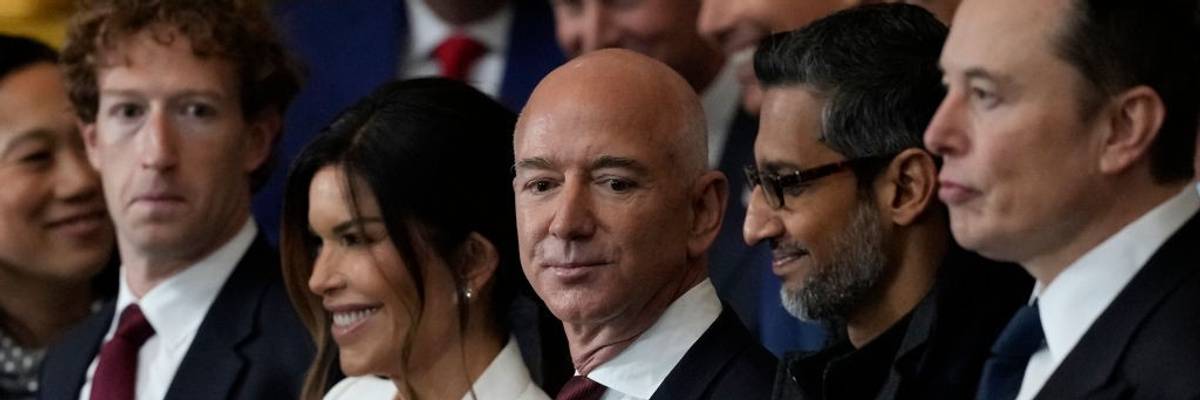
Guests including Mark Zuckerberg, Lauren Sanchez, Jeff Bezos, Sundar Pichai, and Elon Musk attend the Inauguration of Donald J. Trump in the US Capitol Rotunda on January 20, 2025 in Washington, DC.
(Photo by Julia Demaree Nikhinson - Pool/Getty Images)
Jeff Peck
Oct 17, 2026
Oct 17, 2026
Common Dreams
Two opposing views from America’s Founding Fathers are particularly relevant to the upcoming No Kings rallies:
Two opposing views from America’s Founding Fathers are particularly relevant to the upcoming No Kings rallies:
“Of more worth is one honest man to society and in the sight of God, than all the crowned ruffians that ever lived.”—Thomas Paine
“There never was, nor ever will be a civilized Society without an Aristocracy.”—Gouverneur Morris
I once played the historic figure of Gouverneur Morris in Paul Foster’s stage play, Tom Paine, about the life of Thomas Paine who, in 1776, wrote a pamphlet called “Common Sense,” which guided and gave form to the American Revolution. Much has been written about how that work has direct relevance to today’s No Kings rallies, making a compelling case for the preservation of a republic and representative democracy over authoritarianism. However, thinking back to Foster’s play, I’m reminded that it’s important to also remember Morris because, as a bitter critic of Paine, he represents a viewpoint diametrically opposed to Paine’s egalitarianism, as represented in the role of oligarchs in society, or the “gentry,” as he called them. Their loyalty and support underpins the power of a king. And 250 years later, this is just as true for today’s oligarchs and their would-be king, Donald J. Trump.
Simply have a look at any image of the 2025 presidential inauguration. The platform behind Trump is crowded with the richest people in the country, among them, Elon Musk, Mark Zuckerberg, Jeff Bezos, Tim Cook, Sam Altman, Sundar Pichai, and Rupert Murdoch.
Attending the No Kings rallies to express loudly and clearly the views of the 99% is a step in the right direction.
These people are enablers of Donald Trump, but at the same time, as Paine points out, the relationship between oligarchs and an authoritarian ruler is an uneasy one: “The rich are in general slaves to fear, and submit to courtly power with the trembling duplicity of a spaniel.” How else to describe the obsequious fawning over Donald Trump by those same people on the platform?
A wealthy landholder and capitalist, Gouverneur Morris was a member the “1%” of his day. And when resentment against King George III was brewing in the colonies in the 1770s, he and his fellow landowners worried that any change to the status quo could threaten their power and privilege. Suppressing discontent, however, he realized, would not be easy. Referring to popular leaders in the colonies, in a 1774 letter to John Penn, Morris wrote: “These sheep, simple as they are, cannot be gulled as heretofore. In short, there is no ruling them; and now, to leave the metaphor, the heads of the mobility [mob] grow dangerous to the gentry, and how to keep them down is the question.”
Today’s oligarchs have a simple answer: Spend a billion dollars to elect right-wing candidates in this year’s midterm elections. The degree to which that will work any better than Morris’ efforts in the 1770s remains to be seen.
After armed conflict broke out between colonists and British troops in Lexington and Concord in April 1775, most wealthy landholders did not openly side with the king. However, many argued for negotiations to end the hostilities and reconciliation with the Crown. Thomas Paine thought this was madness. Once blood has been shed, he said, reconciliation was impossible: “As well can the lover forgive the ravisher of his mistress, as the continent forgive the murders of Britain.” Indeed, in the end, a peaceful settlement between king and colonists was not to be.
Today, with two years of increasing violence, both rhetorical and physical, on the part of the second Trump administration, that same line has undeniably been crossed.
If in the elections on November 3, Democrats win control of Congress, there will no doubt be calls for toning down the rhetoric, more cooperation across the aisle, and a working relationship between Trump and a Democratic Congress. But, as with Paine’s argument, that may very well not be possible.
At the end of the War of Independence, when the new country’s constitution was being considered, America’s wealthy managed to guarantee their continued privileged position in society. Paine had argued: “The true and only true basis of representative government is equality of rights. Every man has a right to one vote… The rich have no more right to exclude the poor from the right of voting, or of electing and being elected, than the poor have to exclude the rich.” However, at the Constitutional Convention of 1787, Morris made the case that only those who owned property should have the right to vote. “Children do not vote,” he said, “Why? Because they want prudence; because they have no will of their own. The ignorant and the dependent can be as little trusted with the public interest.” James Madison, Alexander Hamilton, and John Adams agreed, and although the Constitution left the right to vote in the hands of the individual states, in most cases that meant that only white male voters with property could vote.
Although they will still seek to benefit from their proximity to power in the wake of a Democratic victory in the midterms, like Morris and his fellow gentry, Trump’s ultra-rich supporters will continue to find ways to protect their privileged status in society. With virtually unlimited resources, both financial and technical (including advanced AI models), along with increasing control of the media, the oligarchs will do their best to influence policy, legislation, regulation, and public opinion. This will make them difficult to keep in check. But attending the No Kings rallies to express loudly and clearly the views of the 99% is a step in the right direction.
Before the war, judges in the colonies were appointed and paid by the Crown. This made them natural allies of the king and the wealthy in society. Morris believed that “the principle purpose of the state was protecting private property” and a strong executive and the courts were the instruments to ensure that. In today’s America, this alliance is again in force on the Supreme Court. Trump has nominated 3 of its 9 judges, and 3 others were nominated by Republican presidents, giving the conservatives a supermajority. For this reason, the court has ruled in Trump’s favor in many cases, notably rolling back voting rights and loosening campaign financing laws, both of which entrench the power of the wealthy over the poor. But the court has also afforded Trump king-like immunity from prosecution for all “official acts.”
Thomas Paine had a response to that: “When it is laid down as a maxim, that a King can do no wrong, it places him in a state of similar security with that of idiots and persons insane, and responsibility is out of the question with respect to himself.” I leave it to you to decide if that description applies to our would-be king.
Our work is licensed under Creative Commons (CC BY-NC-ND 3.0). Feel free to republish and share widely.
Jeff Peck
Dr. Jeff Peck is a film and television writer and producer and has taught film history at universities in America and Australia.
Full Bio >
Follow the Money: How Billionaire Wealth Became Political Power
Wealth creates political power; political power produces tax and economic policies favorable to wealth; those policies concentrate still more wealth; and some of that wealth is reinvested in politics to keep the cycle going.
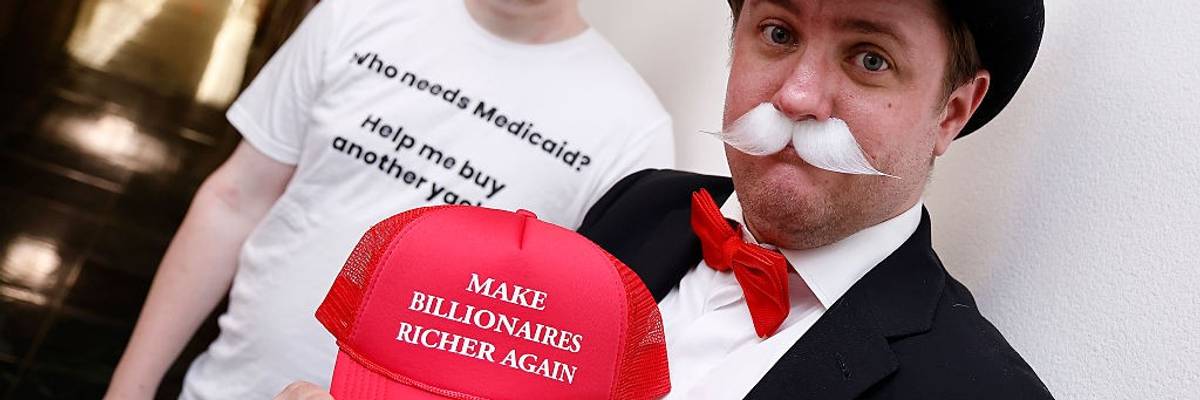
Advocates pose as Monopoly men and wealthy DOGE supporters while protesting tax breaks for billionaires and the Republican tax plan, inside and outside the Ways & Means Full Committee Markup to advance the legislation in the Longworth House Office Building on May 13, 2025 in Washington, DC.
(Photo by Paul Morigi/Getty Images for Stop Billionaires Tax Cuts Campaign)
Zack Kaldveer
Oct 16, 2026
Wealth creates political power; political power produces tax and economic policies favorable to wealth; those policies concentrate still more wealth; and some of that wealth is reinvested in politics to keep the cycle going.
Advocates pose as Monopoly men and wealthy DOGE supporters while protesting tax breaks for billionaires and the Republican tax plan, inside and outside the Ways & Means Full Committee Markup to advance the legislation in the Longworth House Office Building on May 13, 2025 in Washington, DC.
(Photo by Paul Morigi/Getty Images for Stop Billionaires Tax Cuts Campaign)
Zack Kaldveer
Oct 16, 2026
Common Dreams
In 1971, corporate lawyer Lewis Powell wrote a confidential memo to the US Chamber of Commerce warning that American business was under attack. Among his complaints were politicians and activists who portrayed tax breaks as benefiting “only the rich” and who dared to set the “rich” against the “poor,” and “business against the people.”
Powell’s solution was not subtle. Corporate America needed political power, and that power “must be assiduously cultivated” and, when necessary, “used aggressively and with determination.” Business should organize, influence the media and universities, build political power, and exploit what Powell called the “vast opportunity” presented by the courts.
Heist: Who Stole the American Dream? traces much of what happened next. Powell joined the Supreme Court and later wrote the majority opinion in First National Bank of Boston v. Bellotti, expanding constitutional protection for corporate spending on ballot measures. Decades later, Citizens United would further expand corporate political spending rights. Meanwhile, Ronald Reagan ushered in enormous tax cuts, deregulation, attacks on organized labor, and an economic philosophy that promised prosperity would trickle down (it never did!).
That brings us to a question I think every politician promising a better future should have to answer: Tell me what you want to do—and tell me who you’re willing to tax to pay for it.
More than half a century after the Powell Memo, we’ve got the receipts.
According to a new Americans for Tax Fairness analysis, America’s 977 billionaires now control a record $9.24 trillion. In just one year, their wealth increased by $2.2 trillion, or 32%, while the overall economy grew by about 6%. The richest 16 Americans alone possess nearly $4 trillion, more wealth than all US billionaires combined had less than six years ago.
But those gains look even more extraordinary when we look at what is happening to everyone else. The bottom half of American households collectively owns just over 2% of the nation’s wealth. Nearly 48 million Americans live in households struggling with food insecurity. And the divide between workers and those at the top of corporate America has exploded: CEOs at the country’s 350 largest firms made 325 times as much as the typical worker in 2025, up from 21 times as much in 1965. Since 1978, CEO compensation has risen 1,316%, while typical worker compensation increased just 28%.
Yet as wealth becomes increasingly concentrated at the top, Washington is moving in precisely the opposite direction for millions of working families: massive tax cuts disproportionately benefiting the wealthy alongside deep cuts to Medicaid, food assistance, and other programs people depend on.
That brings us to a question I think every politician promising a better future should have to answer: Tell me what you want to do—and tell me who you’re willing to tax to pay for it. Want universal healthcare? Affordable housing? Better schools? Modern infrastructure? A serious response to climate change? A stronger safety net? Great. How are you going to pay for it?
After decades in which an extraordinary share of America’s wealth has accumulated at the very top, pretending we can adequately fund those priorities without asking substantially more from those who have accumulated that wealth is not a serious answer.
California’s Proposition 40 puts that question directly before voters.
The measure would impose a one-time 5% tax on billionaire wealth, primarily to help protect healthcare from massive federal cuts. In a letter endorsing the measure, six Nobel Prize-winning economists note that California’s roughly 250 billionaires now possess $2.3 trillion, up from about $700 billion a decade ago. From 2019 through 2025 alone, those billionaires gained $1.4 trillion in wealth, while the state income taxes they paid during that period amounted to just 1.6% of those gains.
The good news is that none of this is inevitable. These rules were created through political choices, and they can be changed through political choices and organized action.
How have some of California’s wealthiest people responded to being asked for a small portion of those enormous gains? By spending an extraordinary amount of money to stop it.
As of October 10, billionaire-backed opposition efforts have reportedly raised approximately $300 million to fight Prop 40, vastly outspending its supporters. The opposition includes Building a Better California, which is also backing Props 41 and 42, competing measures that could potentially block the billionaire tax even if voters approve it.
Think about that for a moment. A small number of extraordinarily wealthy people can spend a quarter-billion dollars influencing an election over whether extraordinarily wealthy people should pay more in taxes.
And California is only one battlefield. American billionaires had already contributed more than $433 million to the 2026 midterms by early this year. Nearly 80% went to Republican candidates and conservative organizations.
This is the feedback loop Powell envisioned, taken to an extreme he might not have imagined: Wealth creates political power; political power produces tax and economic policies favorable to wealth; those policies concentrate still more wealth; and some of that wealth is reinvested in politics to keep the cycle going.
That is why this debate is about more than tax rates. It is about democracy.
It is also why Prop 40 matters beyond California. As the six Nobel economists wrote, passage could help “kickstart a movement” to tax extreme wealth elsewhere. They concluded that this vote could ultimately be remembered as a turning point in the struggle between democracy and oligarchy.
The good news is that none of this is inevitable. These rules were created through political choices, and they can be changed through political choices and organized action.
Vote. Demand that candidates tell us not only what they want to accomplish, but who they are willing to tax to pay for it. Join the No Kings mobilization on October 17. And watch and share Heist: Who Stole the American Dream? to understand how we got here.
Then let’s stop the heist.
Our work is licensed under Creative Commons (CC BY-NC-ND 3.0). Feel free to republish and share widely.
Zack Kaldveer
Zack Kaldveer is a communications strategist and public policy advocate with nearly three decades of experience advancing evidence-based solutions in pursuit of justice. His work has spanned labor, environmental, economic, health, consumer rights, and corporate accountability. He leads communications for the Healthy Work Campaign and Prevention Policy Group at the Public Health Institute and serves as a Pacifica National Board director.
Full Bio >
In 1971, corporate lawyer Lewis Powell wrote a confidential memo to the US Chamber of Commerce warning that American business was under attack. Among his complaints were politicians and activists who portrayed tax breaks as benefiting “only the rich” and who dared to set the “rich” against the “poor,” and “business against the people.”
Powell’s solution was not subtle. Corporate America needed political power, and that power “must be assiduously cultivated” and, when necessary, “used aggressively and with determination.” Business should organize, influence the media and universities, build political power, and exploit what Powell called the “vast opportunity” presented by the courts.
Heist: Who Stole the American Dream? traces much of what happened next. Powell joined the Supreme Court and later wrote the majority opinion in First National Bank of Boston v. Bellotti, expanding constitutional protection for corporate spending on ballot measures. Decades later, Citizens United would further expand corporate political spending rights. Meanwhile, Ronald Reagan ushered in enormous tax cuts, deregulation, attacks on organized labor, and an economic philosophy that promised prosperity would trickle down (it never did!).
That brings us to a question I think every politician promising a better future should have to answer: Tell me what you want to do—and tell me who you’re willing to tax to pay for it.
More than half a century after the Powell Memo, we’ve got the receipts.
According to a new Americans for Tax Fairness analysis, America’s 977 billionaires now control a record $9.24 trillion. In just one year, their wealth increased by $2.2 trillion, or 32%, while the overall economy grew by about 6%. The richest 16 Americans alone possess nearly $4 trillion, more wealth than all US billionaires combined had less than six years ago.
But those gains look even more extraordinary when we look at what is happening to everyone else. The bottom half of American households collectively owns just over 2% of the nation’s wealth. Nearly 48 million Americans live in households struggling with food insecurity. And the divide between workers and those at the top of corporate America has exploded: CEOs at the country’s 350 largest firms made 325 times as much as the typical worker in 2025, up from 21 times as much in 1965. Since 1978, CEO compensation has risen 1,316%, while typical worker compensation increased just 28%.
Yet as wealth becomes increasingly concentrated at the top, Washington is moving in precisely the opposite direction for millions of working families: massive tax cuts disproportionately benefiting the wealthy alongside deep cuts to Medicaid, food assistance, and other programs people depend on.
That brings us to a question I think every politician promising a better future should have to answer: Tell me what you want to do—and tell me who you’re willing to tax to pay for it. Want universal healthcare? Affordable housing? Better schools? Modern infrastructure? A serious response to climate change? A stronger safety net? Great. How are you going to pay for it?
After decades in which an extraordinary share of America’s wealth has accumulated at the very top, pretending we can adequately fund those priorities without asking substantially more from those who have accumulated that wealth is not a serious answer.
California’s Proposition 40 puts that question directly before voters.
The measure would impose a one-time 5% tax on billionaire wealth, primarily to help protect healthcare from massive federal cuts. In a letter endorsing the measure, six Nobel Prize-winning economists note that California’s roughly 250 billionaires now possess $2.3 trillion, up from about $700 billion a decade ago. From 2019 through 2025 alone, those billionaires gained $1.4 trillion in wealth, while the state income taxes they paid during that period amounted to just 1.6% of those gains.
The good news is that none of this is inevitable. These rules were created through political choices, and they can be changed through political choices and organized action.
How have some of California’s wealthiest people responded to being asked for a small portion of those enormous gains? By spending an extraordinary amount of money to stop it.
As of October 10, billionaire-backed opposition efforts have reportedly raised approximately $300 million to fight Prop 40, vastly outspending its supporters. The opposition includes Building a Better California, which is also backing Props 41 and 42, competing measures that could potentially block the billionaire tax even if voters approve it.
Think about that for a moment. A small number of extraordinarily wealthy people can spend a quarter-billion dollars influencing an election over whether extraordinarily wealthy people should pay more in taxes.
And California is only one battlefield. American billionaires had already contributed more than $433 million to the 2026 midterms by early this year. Nearly 80% went to Republican candidates and conservative organizations.
This is the feedback loop Powell envisioned, taken to an extreme he might not have imagined: Wealth creates political power; political power produces tax and economic policies favorable to wealth; those policies concentrate still more wealth; and some of that wealth is reinvested in politics to keep the cycle going.
That is why this debate is about more than tax rates. It is about democracy.
It is also why Prop 40 matters beyond California. As the six Nobel economists wrote, passage could help “kickstart a movement” to tax extreme wealth elsewhere. They concluded that this vote could ultimately be remembered as a turning point in the struggle between democracy and oligarchy.
The good news is that none of this is inevitable. These rules were created through political choices, and they can be changed through political choices and organized action.
Vote. Demand that candidates tell us not only what they want to accomplish, but who they are willing to tax to pay for it. Join the No Kings mobilization on October 17. And watch and share Heist: Who Stole the American Dream? to understand how we got here.
Then let’s stop the heist.
Our work is licensed under Creative Commons (CC BY-NC-ND 3.0). Feel free to republish and share widely.
Zack Kaldveer
Zack Kaldveer is a communications strategist and public policy advocate with nearly three decades of experience advancing evidence-based solutions in pursuit of justice. His work has spanned labor, environmental, economic, health, consumer rights, and corporate accountability. He leads communications for the Healthy Work Campaign and Prevention Policy Group at the Public Health Institute and serves as a Pacifica National Board director.
Full Bio >


