Showing posts sorted by relevance for query THOMAS PAINE. Sort by date Show all posts

Friday, January 21, 2022

INTERNATIONALIST HUMANIST

Celebrate Thomas Paine’s Birthday on January 29th


13 JANUARY 2022


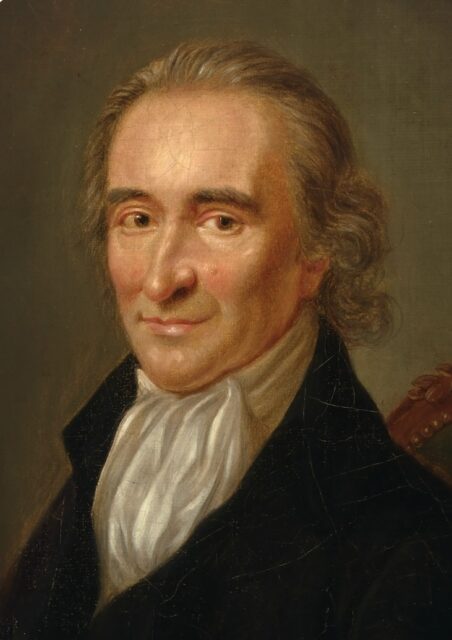
Thomas Paine portrait via New York Public Library


On Saturday, January 29th the newly-formed Thomas Paine Memorial Association will hold a virtual celebration of Thomas Paine, founding father and humanist.

Congressman Jamie Raskin (MD-8) opened last year’s Thomas Paine Day celebration by saying, in part, “There’s so much to celebrate with regard to Thomas Paine, whose memory and message have only become more urgently relevant as every day goes by. Thomas Paine put democracy itself in government by the people and the sovereignty of the people at the very center of our political philosophy. Paine has a lot to teach us about civil rights and about social justice and reconciliation of the country. His legacy is endlessly rich and fertile for us who continue to fight for strong democracy against all of the fascist undertones of our day.”

On January 29, 2022, at 1:00 PM (PST)/4:00 PM (EST), hundreds of people will gather on Zoom to celebrate the birthdate of an often-forgotten Founding Father, Thomas Paine. Paine is hailed as a “Freethought Hero,” and great patriot and the event will be, as far as we know, the very first Zoom celebration of his birth, creating connections from all over the world. All are invited to share a toast in celebration of the life and work of this champion of reason, independent thought, and revolutionary ideas.

The Thomas Paine Memorial Association (TPMA), is a new non-profit organization, with the mission of educating the public and installing statues of Thomas Paine in Washington, DC and other places of significance to his life.

Event cosponsors include American Humanist Association, Center for Inquiry, Freedom From Religion Foundation, Freethought Society, the Stiefel Freethought Foundation, and the Thomas Paine National Historical Association.

During the Thomas Paine Birthdate Celebration, the Stiefel Freethought Foundation (SFF) is pleased to offer an opportunity to TRIPLE any donation to TPMA that is received. A $17.76 donation will be matched to become $53.28 and a $1,776 donation becomes $5,328. Don’t miss this opportunity to support an important endeavor. Todd Stiefel, founder and president of SFF stated, “Thomas Paine was a patriot, revolutionary, Founding Father, and a victim of colonial America cancel culture. His advocacy for freedom from authoritarian organizations made him both lionized and ostracized. It is past time for his legacy to be restored and for him to be honored for his critical role in driving and sustaining the American Revolution. Without Paine, there likely would not be an America.”

Closing remarks at the event will be delivered by Congressman Jamie Raskin.

Educator, songwriter and recording artist James Klueh will perform two Thomas Paine-themed songs prior to the interactive social hour. He said, “My primary experience of all things Thomas Paine has been through the endeavor of setting his verse and poems to music. This minor contribution constitutes my addition to the continuing celebration of one of history’s most important actors.”

Please register here for this international event: https://bit.ly/ThomasPaineBirthdayCelebration

The following statements are from some of the TPMA board members who will be speaking at the event.

Gary Berton, Thomas Paine researcher and expert:
The age of democratic revolutions was sparked by Paine—the modern concept of democracy was placed before humanity by him – with the possibility of liberty from tyranny, from poverty, from the chains of superstition, and from helplessness. That is his legacy. 1776 began with Common Sense and closed with the first Crisis. If this country should honor him, a statue in its capital is necessary.

Robyn Blumner, CEO, Center For Inquiry:
Thomas Paine said, ‘To argue with a person who has renounced the use of reason is like administering medicine to the dead.’ How relevant for today’s epidemic of COVID misinformation and anti-vax hysteria. If only more people read and understood the writings of Thomas Paine, perhaps rabbit holes would just be where rabbits lived.

Christopher Cameron, history professor:
In addition to inspiring the Declaration of Independence with his pamphlet Common Sense and stirring the hearts of weary troops with his Crisis essays, Thomas Paine was a pioneering abolitionist who published anti-slavery essays as early as 1776 and helped make Pennsylvania the first state to adopt a gradual emancipation law. Throughout his life, Paine was a stalwart champion of the downtrodden and the oppressed and should be remembered as one of the leading humanitarian thinkers of his age. This statue will go a long way toward preserving that memory.

John de Lancie, actor, director, producer, writer, and educator:
The more I read Thomas Paine, the more I feel we’ve let him down. We have a lot of work to do.

Marnie Mosiman de Lancie, actor and singer:
In these perilous times for democracy, no doubt Thomas Paine would once again say, ‘These are the times that try men’s souls.’ I think he would be astonished that, so long after he fought against the notion that voting rights extended only to those of wealth and property, we would once again be fighting for all citizens to have the simple right to vote.

Ann Druyan, author, producer, and director:

Thomas Paine is that rarity, a Founding Father, for whom we need not make any excuses. More than two hundred years after his death, the writings of this least celebrated, yet possibly most influential architect of the dream of America, requires no special pleading. They are the blueprint for equality, diversity, and freedom. For too many of his contemporaries it is time to come to grips with their crimes and tear down their statues. For Thomas Paine it is long overdue to raise one up.

Annie Laurie Gaylor, Co-President, Freedom From Religion Foundation:

My favorite Thomas Paine quotation is, ‘The mind once enlightened cannot again become dark.’ The Freedom From Religion Foundation invites everyone to celebrate Thomas Paine’s enlightening wisdom on the date of his birth, January 29, 2022.

Julia Sweeney, actor, comedian, and writer:

Thomas Paine said, ‘He who dares not offend, cannot be honest.’ I think of this all the time. Paine’s words challenge me to be more honest. He didn’t retreat. He explained and encouraged this country to strive to be more honest, more equitable, more reasonable, and more democratic. I want to help promote his ideas, so that they become a part of our common understanding of what it means to be a citizen.

Actor Ian Ruskin will speak about his experiences portraying Thomas Paine. He will share photos of appearances and will include an overview of his “Walk in the Footsteps of Thomas Paine” tour that took place in England. Ruskin said, “A statue helps us to remember someone’s life and work, and who could be more deserving than Thomas Paine, who had such an impact on the birth and soul of America? Yet I know of only three in all of the world. Performing my play To Begin the World Over Again: The Life of Thomas Paine in England, I found them in country towns large and small, in Thetford, Lewes, and London. There are great monuments to a number of men in Washington, DC, and it’s time to add a statue of Thomas Paine. It’s time to remember, thank, and celebrate this truly visionary man.”

Freethought Society president Margaret Downey will be talking about the many Thomas Paine-themed activities she has sponsored, including her “Walk in the Footsteps of Thomas Paine” that took place in Paris, France. In regard to the January 29th celebration, Downey said, “The first formal gathering to celebrate the birth of Thomas Paine took place on January 29, 1825. One hundred and ninety-seven years later, I’m looking forward to conveying how Thomas Paine became my freethought hero and what I’ve done for 30 years to honor his life and work.”

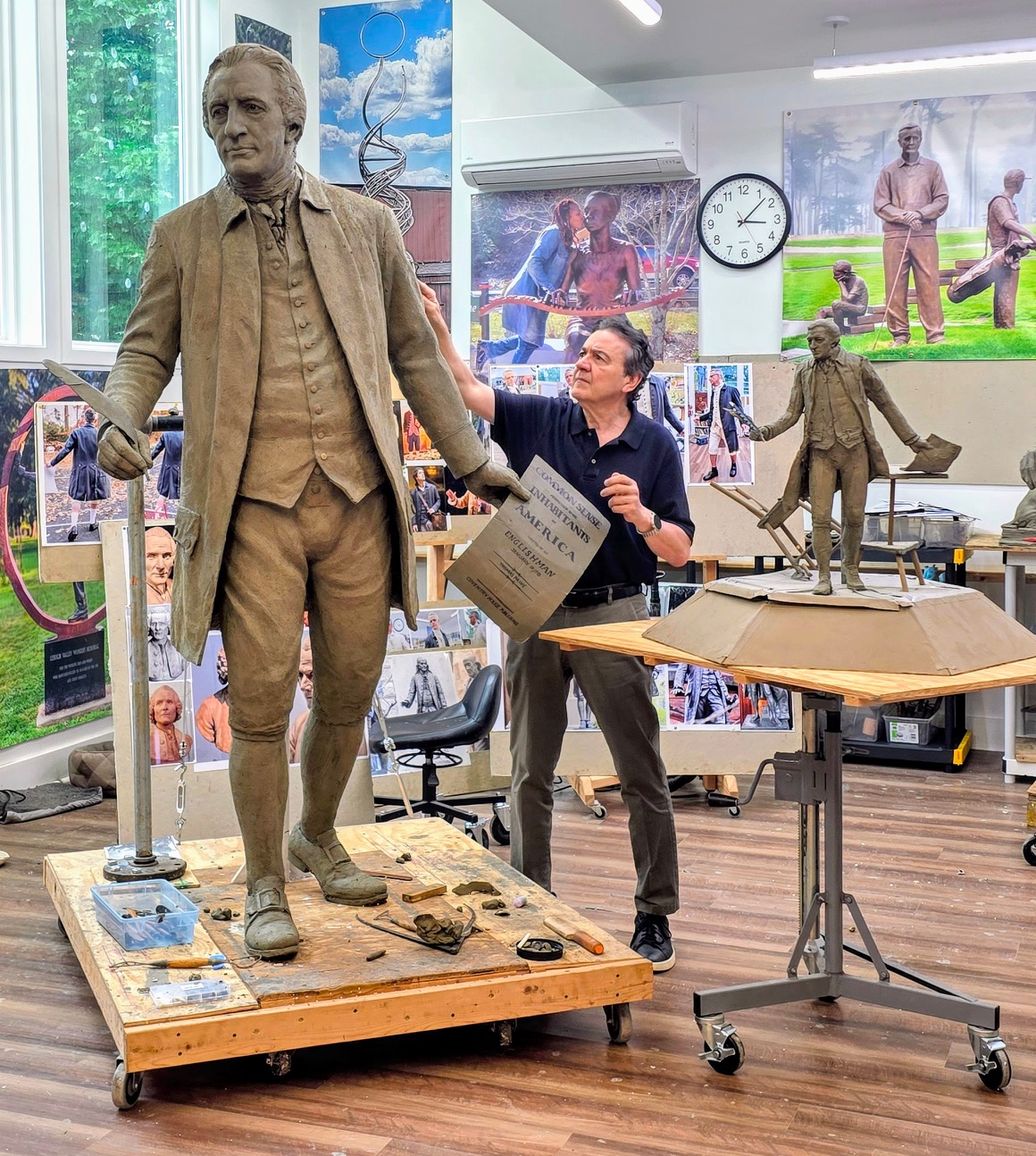
Sculptor Zenos Frudakis will join the festivities from his studio in Glenside, Pennsylvania. He recently stated, “To me, Thomas Paine represents common sense and reason in politics. As such, a statue of Paine would embody those ideals and inspire others by his words and example. Paine was a critical voice in the Enlightenment of the last quarter of the 18th century. His continued relevance in presence of form and substance of thought is dearly needed now. I’m pleased to be the sculptor selected for this important project.”

Margaret Downey is the founder and president of the Freethought Society in Philadelphia, Pennsylvania.

THE WRITINGS OF THOMAS PAINE
EDITED BY DR. PHIL S. FONER

TWO VOLUMES

Publication date 1945

The writings of Thomas Paine helped shape the American nation and left their imprint on democratic thought all over the world. This two-volume set represents an attempt to make these writings available to both the general reader and the student. Every effort has been made to include all of Paine's writings available at present, and to present them in a manner that would make clear their historical background. Emphasis has been placed throughout on presenting Paine's writings in their essential clarity, and for this purpose efforts have been made, without in any sense distorting Paine's meaning, to modernize the spelling, capitalization and punctuation wherever it was necessary to make the meaning clear to a present day reader.

Volume One contains Paine's major works: Common Sense, The American Crisis, Rights of Man, The Age of Reason, and Agrarian Justice.

Volume Two contains Paine's political and economic essays, theological dissertations, scientific papers and political and personal correspondence. Much of the material found in the second volume has never been included in any previous collection of Paine's writings.


Saturday, January 10, 2026

REVOLUTIONARY HUMANIST & INTERNATIONALIST
National organizations unite to celebrate Thomas Paine’s Revolutionary War service at annual birthdate event: A Tribute to Thomas Paine’s Legacy
Thomas Paine Memorial Association


The Times That Tried Men’s Souls: Thomas Paine’s Service During The Revolutionary War

January 29, 2026 — Online Event | 4:00 PM PST / 7:00 PM EST
Registration Required:  us02web.zoom.us/meeting/register

The Thomas Paine Memorial Association (TPMA) and a coalition of leading secular, historical, and humanist organizations invite the public to the annual celebration of the birth of one of America’s most influential Founders — Thomas Paine. This year’s online commemorative program, The Times That Tried Men’s Souls: Thomas Paine’s Service During The Revolutionary War,” will take place on Thursday, January 29, 2026.

TPMA, which educates about Paine’s legacy, has been authorized by Congress to erect a memorial to Paine in Washington, D.C. The group has since received preliminary approval to pursue a memorial in Area 1 (close to the United States Capitol Building). The approval bill is awaiting congressional action.

Thomas Paine, author of Common Sense and The American Crisis, played an indispensable role in igniting the call for independence and sustaining morale through the darkest moments of the Revolution. His writing, service, and vision for a democratic society continue to inspire generations. Paine’s contributions recently have been highlighted in Ken Burns’ documentary “The American Revolution.”

Event Highlights

Distinguished Opening Remarks
The program will commence with words from Members of Congress Jamie Raskin and Victoria Spartz, with a special appearance from Benjamin Franklin (portrayed by actor Brian Patrick Mulligan).

Keynote Presentation
Acclaimed historian and author Jack Kelly — whose book Tom Paine’s War explores Paine’s firsthand experiences during the Revolution — will deliver a keynote address examining Paine’s military service and enduring relevance. Kelly will cover:

  • Paine’s background and rise to prominence
  • His Common Sense pamphlet and his influence on the Declaration of Independence
  • His service with the Pennsylvania militia and involvement with the Continental Army
  • The fall of Fort Washington and Fort Lee
  • The march across New Jersey
  • The writing of The American Crisisand its impact on the battles of Trenton and Princeton
  • Paine’s legacy in modern times

Readings from Paine’s Writings
Award-winning actor Ian Ruskin, known for his one-man show portraying Paine, will perform a dramatic reading from The American Crisis synchronized with a photo slide show of various images of the Paine memorial sculpted by Georg Lober, dedicated in 1950 in Morristown, New Jersey. The statue portrays Paine in the midst of writing The American Crisis during the Revolutionary War — capturing both his intellectual and patriotic courage.

A Veteran’s Perspective
Gene Jones of Florida Veterans for Common Sense will speak about Paine’s heroism, the challenges he faced after the war, and why Paine remains a powerful symbol of principled military service today.

Showcase: The Thomas Paine Cottage
A video created by Suzanne Tanswell and Gary Bush, trustees of the Huguenot New Rochelle Historical Association which owns the Thomas Paine Cottage in New Rochelle, New York, will highlight one of the most important historical sites connected to Paine’s life.

Additional Program Features

  • Musical selection from the celebrated play ‘The Crossing’
  • Live Q&A with Jack Kelly, Gary Berton, Christopher Cameron, Ian Ruskin, Margaret Downey, Gene Jones, Frances Chiu, Joy Masoff, Suzanne Tanswell, and Gary Bush
  • Cosponsor messages from national organizations
  • Credits slideshow
  • A post-event Social Hour and Toasts, including a special opening toast by renowned sculptor Zenos Frudakis, who will show his progress in creating a statue of Thomas Paine that will be placed in a prestigious pre-approved location in Washington, D.C.

Event Hosts and Sponsors

The event will be co-hosted by TPMA President Margaret Downey and TPMA Board Member Christopher Cameron.

Sponsors include:

  • Thomas Paine Memorial Association
  • Black Nonbelievers
  • Thomas Paine Historical Association
  • Freethought Society
  • Freedom From Religion Foundation
  • Thomas Paine Society
  • Military Association of Atheists and Freethinkers
  • American Atheists
  • Secular Coalition for America
  • American Humanist Association
  • Center for Inquiry/Richard Dawkins Foundation

Join Us

This event offers an extraordinary opportunity to rediscover Thomas Paine’s contributions through scholarship, performance, and reflection.

Attendance is free, but pre-registration is required.

Register here: https://us02web.zoom.us/meeting/register/ga-dvEPuR0iLzT5LA45BOw

###

Contact:
Margaret Downey, President
Thomas Paine Memorial Association
info@thomaspainememorial.org


THOMAS PAINE. COMMON SENSE (1776). Perhaps the sentiments contained in the following pages, are not yet sufficiently fashionable to procure them general ...


"Common Sense" by Thomas Paine is a pamphlet published in January 1776 advocating independence from Great Britain for the Thirteen Colonies. Written in clear, persuasive prose, Paine presents moral and political arguments to encourage common people to fight for egalitarian government. Published anonymously at the American Revolution's beginning, it became an immediate sensation—the best-selling American title of all time. Paine connected independence with Protestant beliefs and structured his work like a sermon, making the first serious case for full independence when reconciliation still dominated colonial thinking. (This is an automatically generated summary.) 


The Writings of Thomas Paine,
Complete by Thomas Paine

"The Writings of Thomas Paine, Complete" by Thomas Paine is a historical collection of political writings compiled in the late 18th century. The volume includes influential pamphlets that played a pivotal role in shaping American revolutionary sentiment, particularly focusing on issues of independence and the fight against tyranny. The collected works provide profound insights into the social and political climate of the time, highlighting the struggle for freedom and democratic ideals. The opening of this work lays the groundwork for Paine's monumental series, "The American Crisis," which begins with a stirring call to action amidst the Revolutionary War. He reflects on the challenges facing American patriots, emphasizing the importance of perseverance and unity against oppression. The famous opening lines address the trials of these tumultuous times and encourage individuals to stand firm in their commitment to liberty, while also critiquing those who waver in their loyalty. Through vivid imagery and passionate prose, the initial segments set a tone of urgency and resolve, making it clear that the fight for independence is both a personal and collective responsibility. (This is an automatically generated summary.) 

Sunday, May 17, 2026

INTERNATIONALIST FREETHINKER 

Thomas Paine helped start America. In the Trump era, he's under fire.

In some ways, the debate over Paine's legacy today is a proxy for a much larger debate over whose vision gets to govern.


Jack Jenkins
May 13, 2026
RNS

(RNS) — Rep. Jamie Raskin, D-Md., was revving up a crowd of tens of thousands gathered in Philadelphia for the first major No Kings protest last June. His speech, like the demonstration itself, was focused primarily on pushback against President Donald Trump, whom critics such as Raskin likened to a would-be monarch.

But after railing against the president, Raskin paused to focus on one of his favorite Founding Fathers: Thomas Paine, an English-born political writer who supercharged the American Revolution with his wildly popular pamphlet “Common Sense” 250 years ago.

Noting that he named his own late son after Paine, Raskin recalled the corset-maker-turned-revolutionary’s dream of an America that would operate as “an asylum to humanity.” Paine, he told the crowd, envisioned “a place of refuge for people seeking freedom from religious and political and intellectual and economic repression from around the world” — and then helped spur a revolution to make it a reality.

Less than a month later, at the inaugural service of Christ Church DC — a congregation organized by self-described Christian nationalist Doug Wilson and attended by influential conservatives, including Defense Secretary Pete Hegseth — Pastor Jared Longshore delivered a sermon that held up Paine not as a hero, but a cautionary tale. Longshore dismissed Paine as someone who “exalted human reason to the place of a golden calf,” an apparent reference to Paine’s deism and his criticism of organized religion’s entanglements with political power.


Portrait of Thomas Paine by Laurent Dabos, circa 1791.
 (Image courtesy of National Portrait Gallery/Wikimedia/Creative Commons)

“Thomas Paine actually lost all of his old friends,” Longshore said, standing at a pulpit underneath an American flag. He then implied Paine’s fall from grace could be the ultimate fate of modern progressives, saying: “Only a few mourners came to his funeral, and even the Quakers wouldn’t let him be buried in their cemetery. That’s tough. Shows you how people used to think and how people are thinking now.”

The contrast captures not only Paine’s contested place in American memory, but the larger political and religious debate in the US over whose founding vision should govern.

Scholars say Paine’s historical importance is undeniable. A seminal and celebrated voice in the American Revolution, Paine was so influential that John Adams once referred to the late 1700s as “the age of Paine.” What’s more, in addition to his role in America’s founding, Paine, an Englishman, championed democratic values so fervently that he later became a leader in the French Revolution despite not speaking French.

But Paine ultimately proved polarizing in his own lifetime, largely because of his blistering critique of organized religion, historians say. Among other things, he helped initiate debates over the separation of church and state that continue to this day, resulting in a bifurcated legacy: Paine as a champion of freedom or Paine as the “Forgotten Founding Father” — embraced or dismissed, depending on who is doing the remembering.

That fissure appears to be growing amid ongoing celebrations of the 250th anniversary of the U.S., with left-leaning leaders who support the separation of church and state championing Paine even as he is derided by prominent Christian nationalist figures aligned with Trump. And as the Trump administration and its allies prepare a faith-themed event on the National Mall to “rededicate” America “as One Nation to God,” debate over Paine’s ideas — such as his passionate opposition to “mingling religion with politics” — is unlikely to abate.

Paine once enjoyed vocal bipartisan support in Washington. In 1992, bipartisan legislation, signed by President George H.W. Bush, authorized construction of a memorial, but the project stalled. A 2022 bill renewed the push for a Paine memorial that could be erected on the National Mall by 2030, but it is still awaiting approval from the U.S. Department of the Interior and, ultimately, Congress.


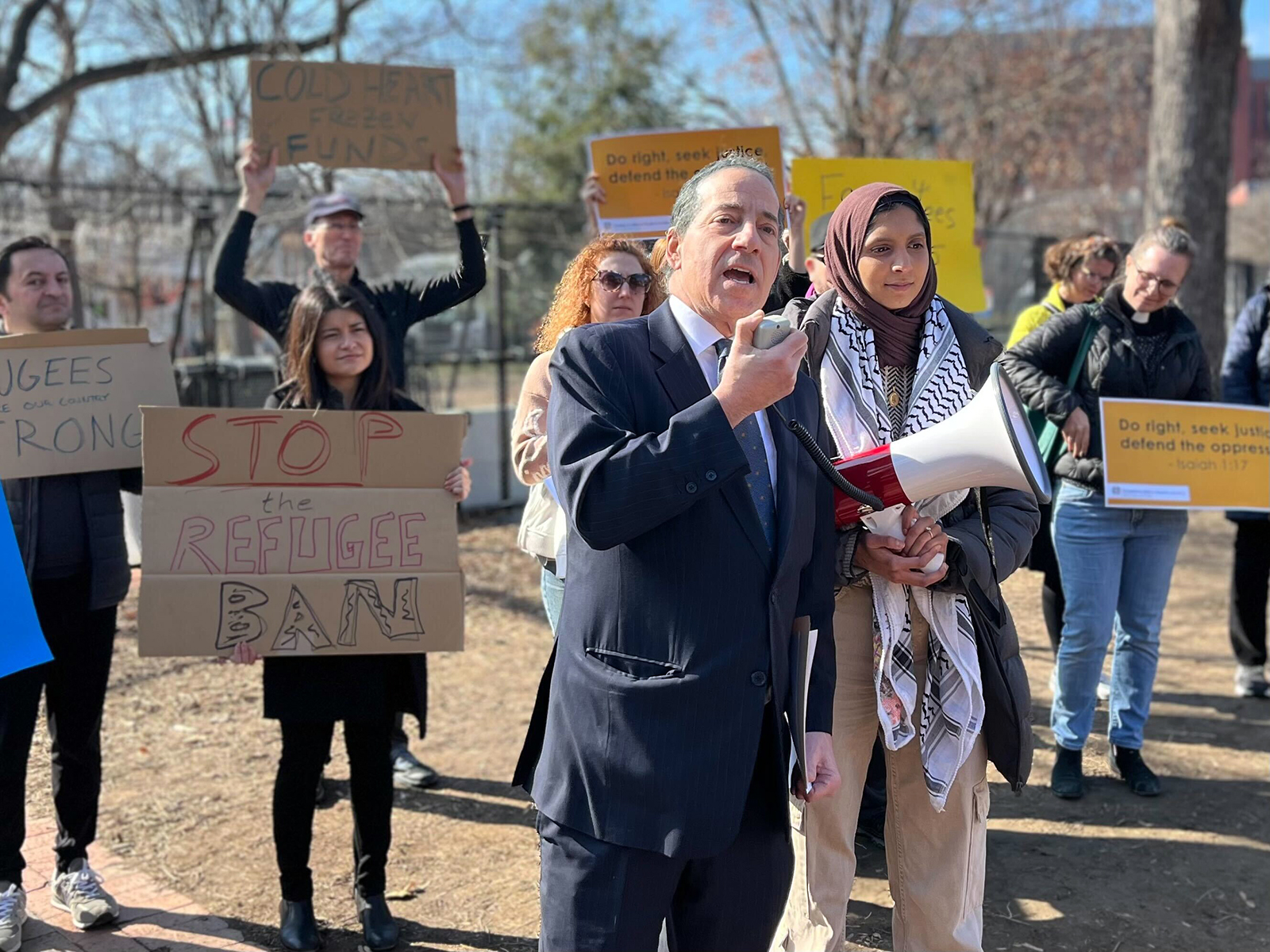
Rep. Jamie Raskin, D-Md., speaks during a protest against the shuttering of the United States Refugee Admissions Program, Feb. 4, 2025, in Washington. 
(RNS photo/Aleja Hertzler-McCain)

As the sponsor of the 2022 bill, Raskin is perhaps Paine’s most visible modern-day champion in Washington. The Maryland congressman told Religion News Service he first encountered Paine in high school by reading the revolutionary’s best-known works: “Common Sense,” “The American Crisis” and “The Rights of Man.” “I read Paine and I just felt like a light bulb went off,” Raskin said, noting that President Abraham Lincoln was also a fan of Paine. “(Paine) had this passionate and unwavering commitment to democracy as the system that will both protect people’s freedom and allow for mutual progress in society.”

Raskin often cites Paine in speeches and even pushed to name a congressional caucus he co-founded with Rep. Jared Huffman the “Thomas Paine Caucus.” The group, which boasts 36 members and is dedicated to both religious freedom and church-state separation, ended up being called the Congressional Freethought Caucus instead, although a portrait of Thomas Paine graces the group’s website.

“Tom Paine is still too radical a figure even in the 21st century, apparently,” Raskin joked.

Liberals, progressives and radicals across the globe have long claimed Paine as one of their own, often pointing to his progressive policy views for his day, such as opposition to slavery as well as support for public education and state-sponsored prenatal and postnatal care.

However, it is Paine’s views on religion — as well as how religion should interact with government — that have likely complicated his legacy. Raised in a Quaker home, Paine made several lengthy theological arguments in “Common Sense,” but ultimately declared himself a passionate deist.

“I believe in one God, and no more; and I hope for happiness beyond this life,” Paine wrote. “I believe in the equality of man, and I believe that religious duties consist in doing justice, loving mercy, and endeavouring to make our fellow-creatures happy.”

"The Age of Reason" by Thomas Paine was controversial, in part because of his blistering critique of organized religion. (Public domain image)

"Common Sense" by Thomas Paine is credited with helping to inspire the American Revolution. (Public domain image)

In 1793, Paine published “The Age of Reason,” a lengthy critique of organized religion — especially what he called “the adulterous connection of church and state.” Among other claims, he wrote that he believed the American Revolution would be followed by revolutions in the religious world.

Seth Perry, who teaches American religious history at Princeton University, told RNS the book was hardly met with the rapturous praise enjoyed by “Common Sense.” Part of the issue, Perry said, was timing: “The Age of Reason” was published just as religious revivals associated with the Second Great Awakening had already swept across the U.S., and Paine’s involvement in the chaotic French Revolution — during which Paine himself was imprisoned — gave his ideological opponents in the U.S. cause to condemn him.

“There’s good scholarship showing how the anti-religious vibe of the French Revolution was used by those at the time who wanted more religion in the government as a cudgel to push back on people like Thomas Paine, who were pushing against religion in the government,” Perry said.

In the 20th century, some prominent conservatives embraced Paine, particularly President Ronald Reagan, who often referenced Paine in public remarks. But these days, Paine has become a target among far-right intellectuals, particularly those aligned with Christian nationalism or Catholic integralism, an ideology similar to Christian nationalism that advocates for a less overt approach to exerting Christian influence over society.

“We can find in Paine antecedents for almost every political ideology we find today,” Ben Wright, a professor of American history at the University of Texas at Dallas, said in an interview. “It’s curious to see who decides to claim him and who doesn’t — and that changes over time.”

It's curious to see who decides to claim him and who doesn't — and that changes over time.Ben Wright, professor of American History at the University of Texas at Dallas

At last year’s National Conservatism Conference in Washington, Patrick Deneen — a professor at the University of Notre Dame who is associated with Catholic integralism — urged conservatives to distance themselves from Paine. After acknowledging Paine’s influence, Deneen argued far-right thinkers have overlooked Paine’s involvement in the French Revolution and his longstanding debate with Edmund Burke, a seminal conservative intellectual figure.

“Paine was no conservative, and nor, really, was his political theology,” declared Deneen, who went on to voice support for more public religious expression in government. “I would submit that by adopting this Painian, Rousseauan, French Revolutionary … political theology that conservatism has been equally the cause of woe and destruction to the values and the institutions that conservatives all along claimed to hold dear.”


Patrick Deneen addresses the National Conservatism conference, Thursday, Sept. 4, 2025, in Washington. (RNS photo/Jack Jenkins)

Gary Berton, president of the Thomas Paine Historical Association, acknowledges that Paine has long made some conservatives uncomfortable. But he insisted Paine’s criticisms of religion continue to inspire young people, many of whom are religiously unaffiliated: Berton said that, in recent years, young people often walk into the association’s building wanting to know more about Paine after reading “Age of Reason.”

Raskin, meanwhile, sees the hostility from conservatives in the Trump era as predictable.

“Monarchists and reactionary conservatives have always hated Tom Paine,” Raskin said, noting that Paine famously railed against the divine right of kings, the theology that monarchs answer only to God.

In the meantime, Raskin said, he is looking forward to a Paine memorial eventually being erected in Washington, and will continue to draw inspiration from a man he insists is unfairly maligned by those on the right.

“Democracy is always a controversial idea,” Raskin said. “Monarchy is obviously a betrayal of that idea. Aristocracy is a radical betrayal of that idea. Theocracy is just somebody dressing up their pretensions to power and dictatorship in religious garb.”


Tuesday, January 09, 2024

Anti-slavery efforts of Thomas Paine is theme for January 29, 2024 online event

AMERIKA'S FORGOTTEN INTERNATIONALIST FOUNDING FATHER

Thomas Paine Memorial Association

The Thomas Paine Memorial Association (TPMA) is celebrating both the January 29th birthdate of Thomas Paine and Black History Month, with an international event focusing on Paine’s significant anti-slavery efforts. 

Black leaders, educators, celebrities, politicians, social influencers, and others duly impressed with Paine’s foresight and warnings of civil unrest to end slavery are scheduled to appear throughout this greatly anticipated event. Guests include comedian Ty Barnett; Representative Jamaal Bowman (D-NY 16th District); Representative Shontel M. Brown (D-OH 11th District); poet Victor Harris; feminist/activist Dom Jones; emergency room doctor and nontheist activist Wil Jeudy; educator, author and historian Richard Newman; Professor Anthony Pinn; Representative Jamie Raskin (D-MD 8th District); Smithsonian Museum Curator Teddy Reeves; and Representative Victoria Spartz (R-IN 5th District).

Also participating will be event planners TPMA president Margaret Downey, and History Professor Christopher Cameron, author of Black Freethinkers: A History of African American Secularism.

Musical performances by Cynthia McDonald, a member of Godless Gospel and leader of Chicago’s Black Nonbelievers chapter, will open and close the event.

Actor Ian Ruskin will recite a letter that Paine wrote to Thomas Jefferson, using the persona of an enslaved person to emphasize the urgency of ending slavery. The 1808 letter, written seven months before Paine’s death, reveals a frustrated and angry abolitionist who had lost patience with those who participated in the debauchery. 

Thomas Paine expert Gary Berton, president of the Thomas Paine National Historical Association, will be in attendance to introduce the letter from “A Slave” and answer questions.

“Thomas Paine stood for equality like no other Founder and more people should know his legacy,” says Downey.

“This event will prove that Thomas Paine’s legacy should be honored and recognized. A Thomas Paine monument in Washington, DC is needed to complete the story of the founding of the United States of America,” she continued.

A post-event social hour will allow audience participation. Sculptor Zenos Frudakis will Zoom from his studio in Glenside, Pennsylvania to show his clay statue of Thomas Paine.

Sponsors of the Monday, January 29, 2024 event are the Thomas Paine Memorial Association, Black Nonbelievers, the Secular Coalition for America, the Freedom From Religion Foundation, the Center for Inquiry, and the Freethought Society. 

Pre-registration for the event, which begins at 4:00 PM PST/7:00 PM EST, is required. You can find the pre-registration link here.

TPMA has been charged by Congress with creating a long-overdue monument to this “forgotten founder” in Washington, DC. A bill sponsored by Representatives Raskin and Spartz was signed into law by President Biden in December 2022. TPMA is in the midst of finding a location and getting final approval for the monument. Raskin and Spartz now serve as the nonprofit group’s honorary co-chairs. Learn more about TPMA here.


For more information, please contact the event coordinators:

Margaret Downey, President
Thomas Paine Memorial Association (A nonprofit educational 501(c)3 organization)
Email: Margaret@ThomasPaineMemorial.org

Christopher Cameron, Board Member
Thomas Paine Memorial Association
Email: Christopher@ThomasPaineMemorial.org

###

Disclaimer: The views and opinions expressed in this article are those of the authors and do not necessarily reflect the official policy or position of Religion News Service or Religion News Foundation.

Monday, May 25, 2020

Trumpsters Are Already Revolting Against COVID Contact Tracing

The latest villain is the one that health officials say is integral to stopping the reemergence of the disease.


Will Sommer May. 25, 2020 


Mark Makela/Getty
Donald Trump’s allies in conservative media have a new villain in the coronavirus fight: contact tracing, the rigorous efforts to track the virus’s spread that public health experts say is essential to safely restarting society. 

Fox News host Laura Ingraham devoted much of her show Thursday night to raising questions about contact tracing, the process where interviewers try to figure out who has been exposed to the virus by literally figuring out whom the infected had contact with. As a Fox News chyron warned that contact tracing should “concern all Americans,” Ingraham claimed that calls for more contact tracers were just an “excuse” to keep businesses closed, and compared being interviewed by a contact tracer to being groped by a Transportation Security Administration agent.

“Instead of rummaging through your luggage, these contact tracers will be prying through the most intimate details of your life,” Ingraham said. 

A wide range of public health officials and experts have insisted that the country needs to vastly expand contact tracing, with one Johns Hopkins study calling for the hiring of at least 100,000 additional contact tracers. Dr. Anthony Fauci, the head of the National Institute of Allergy and Infectious Diseases, said earlier this month that coronavirus deaths will “of course” increase without additional tracing and testing. Workplace contact tracing is included in the White House’s own reopening plan. 

“Contact tracing” sounds sensible —and a federal jobs program for 300,000 Americans! Yet concerns about our privacy rights are real—who protects your data? Here’s my take: https://t.co/RLJuzI7i9b #TheAngle

— Laura Ingraham (@IngrahamAngle) May 22, 2020
But Ingraham isn’t alone on the right in sowing doubts about contact tracing. Conservative columnists Andy and John Schlafly—best known as the sons of late right-wing activist Phyllis Schlafly—co-authored a column at Townhall.com criticizing Gov. Greg Abbott (R-TX) for budgeting nearly $300 million for contact tracing. The Schlaflys laid out a dystopian vision of contact tracing, comparing it to a “dark episode in the history of the communist Soviet Union” and claiming that contact tracing could be used to separate children from infected parents. 
They even imagined contact tracing details being used to embarrass Republican candidates. 

“The real goal of the contact tracing is to use COVID-19 as a pretext to monitor the whereabouts of every American, perhaps through our smartphones, and take away our liberties,” the Schlaflys wrote. “Republican political candidates will be tracked and leaks of their private information to the media would be inevitable under this scheme, while Democrats such as Joe Biden are given a pass on their far greater misconduct.” 

Instead, the Schlaflys called for Abbott to flood the state with hydroxychloroquine, the anti-malarial drug that’s become a darling of Trump supporters as a potential coronavirus treatment—even as clinical studies suggest it has no effect on the virus and actually increases mortality.

“The $295 million that Abbott is spending on contact tracing could have purchased HCQ treatments for half of the entire State of Texas, to reopen the state without the need for oppressive monitoring,” the Schlaflys wrote. 

Emerald Robinson, the White House correspondent for conservative Newsmax TV, which is run by a close Trump confidant, compared contact tracing to “mandatory vaccination” and 5G towers, which conspiracy theorists have claimed spread coronavirus. 

Contact tracing. 5G. Drones. AI. Mandatory vaccination. Digital ID.

Nobody in America voted for any of this stuff.

So why are these projects moving ahead anyway?

Big Tech is out of control. It must be regulated before it's too late.

— Emerald Robinson ✝️ (@EmeraldRobinson) May 22, 2020
Pro-Trump activist Tom Fitton, the head of conservative activist group Judicial Watch, put contact tracing on a list of his coronavirus grievances, declaring: “I’m done with it.”

I'm done with it. No masks, then masks, unprecedented shutdowns,the "models" collapse, the curve, hospital capacity, then its "testing", then "contact tracing" and now the VACCINE. And now CDC tells us it does NOT easily spread from surfaces! #ConstitutionOverCoronavirus https://t.co/4GSRn4DB3G

— Tom Fitton (@TomFitton) May 22, 2020
Other concerns on the fringe right about contact tracing have been driven by outright hoaxes about H.R. 6666, legislation from Rep. Bobby Rush (D-IL) that would put $100 billion into coronavirus testing and contact tracing. 

RELATED IN POLITICS

It’s Official: Laura Ingraham Wants Your Grandmother to Die
https://www.thedailybeast.com/its-official-laura-ingraham-wants-your-grandmother-to-die

Trump World Turns in the True COVID Villain: Surgical Masks
https://www.thedailybeast.com/trump-world-turns-on-the-true-covid-villain-surgical-masks

These ‘Reckless’ Docs Are the New COVID-19 Stars of Fox News
https://www.thedailybeast.com/the-newest-fox-news-doctor-duo-have-been-emphatically-condemned-by-physician-groups

The bill’s number alone puts it perilously close to the supposedly Satanic number “666,” right as conspiracy theorists have become convinced that any coronavirus vaccine would be the “Mark of the Beast.” Prominent conspiracy theory outlet InfoWars declared that the bill was the “Bill of the Beast,” while rumors spread on social media claiming that the bill would authorize contact tracers to abduct children.

Privacy watchdogs have raised legitimate concerns about how contact tracing data could be used, especially when the data is collected through apps. On Monday, the ACLU called for additional safeguards to protect contact tracing data. A report on a North Dakota contact tracing app found several privacy flaws. 

QAnon conspiracy theorist DeAnna Lorraine tells her viewers/followers not to get tested for COVID-19 because *SHE* doesn't want to be contacted by contact tracers if they test positive. pic.twitter.com/I2V2sVQeDU
— Right Wing Watch (@RightWingWatch) May 20, 2020

But much of the fearmongering about contact tracing seems to be driven by ignorance of what it actually is. Failed Republican congressional candidate and QAnon conspiracy theorist DeAnna Lorraine Tesoriero, whose call to “#FireFauci” Trump retweeted in April, has urged her fans to not get tested for COVID-19. She also appears to misunderstand contact tracing, claiming that contact tracers go through phone “contact” lists, rather than in-person contacts. 

“I don’t want people to get tested, because I don’t want to be in their phone, in their contact list, and if you guys are all following me on Twitter and following me on YouTube, then I’m probably going to be in your contact list,” Tesoriero told her fans in a video. “So I would prefer not to be there. They specifically said if they find one person, then they’re going to make sure they call all of that person’s contacts, whether they have 5,000 contacts or 5 contacts. And I really don’t feel like being called, I want to get off the grid of this system.”


On her Thursday night show, Ingraham positioned herself as perhaps conservative media’s leading contact tracing skeptic. But her guests went even further than her, with Claremont Institute senior fellow John Eastman adopting what was meant to be a German or Russian accent to imitate a contact tracing interviewer. 

Ingraham guest Wesley J. Smith, a senior fellow at the DiscoveryInstitute's Center on Human Exceptionalism, claimed that contact tracing meant that the “French revolution is attacking the American revolution.” Ingraham agreed, comparing contact tracers to radical French revolutionaries. 

“The Jacobins, they’re back,” she said 

YEP 
JACOBINMAG.COM


BOTH THE AMERICAN AND THE FRENCH REVOLUTION INCLUDING THE JACOBINS WERE INFLUENCED BY THE INTERNATIONALIST, GLOBALIST, HUMANIST, REVOLUTIONARY THOMAS PAINE


Thomas Paine and the French Revolution. Tom Paine was the most pro-French Revolution propagandist. He had helped the Americans in their conflict against Britain with his pamphlet Common Sense and possibly had also had a hand in writing the Declaration of Independence. He had tried to encourage democracy in England.

SENIOR FELLOW MY ASS WHAT ACADEMIC STANDING DOES HE HAVE 
SENIOR FELLOW IS NOT AN ACADEMIC STANDING 
I GUESS AMERICAN HISTORY LET ALONE EUROPEAN HISTORY WAS
 NOT PART OF INGRAHAM'S CHRISTIAN PSYCHOLOGIST DEGREE EITHER 

NEITHER OF THESE KNOW WHAT THEY SPEAK OF.

EUGENE PLAWIUK BA
SENIOR FELLOW, HISTORY
FREE UNIVERSITY OF BRUDERHEIM 


Citizen Thomas Paine, whose pamphlet Common Sense helped ignite the American Revolution, was an enthusiastic early supporter of the French Revolution. He ...
Oct 23, 2019 - Thomas Paine was an England-born political philosopher and writer who supported revolutionary causes in America and Europe. ... to Europe and offered a stirring defense of the French Revolution with “Rights of Man.
Jump to Funding the Revolution - Paine has a claim to the title The Father of the American Revolution, which rests on his pamphlets, especially Common ...
by M Philp - ‎2013 - ‎Cited by 3 - ‎Related articles
Jul 18, 2013 - Thomas Paine was a pamphleteer, controversialist and international revolutionary. ... was the most widely read pamphlet of the American Revolution. ... Paine contemplated writing a history of the French Revolution but he ...
Sep 11, 2019 - During the American RevolutionPaine served as a volunteer personal assistant to General Nathanael Greene, traveling with the Continental ...
Thomas Paine, political propagandist whose Common Sense pamphlet and Crisis papers influenced the American Revolution.
Apr 12, 2019 - Thomas Paine, the most widely read political thinker in the late 18th century, played a notable role in the American Revolution, in the ...
This simple quotation from Founding Father Thomas Paine's The American Crisis not only describes the beginnings of the American Revolution, but also the life ...