Showing posts sorted by relevance for query ATHEISM. Sort by date Show all posts

Sunday, April 03, 2022

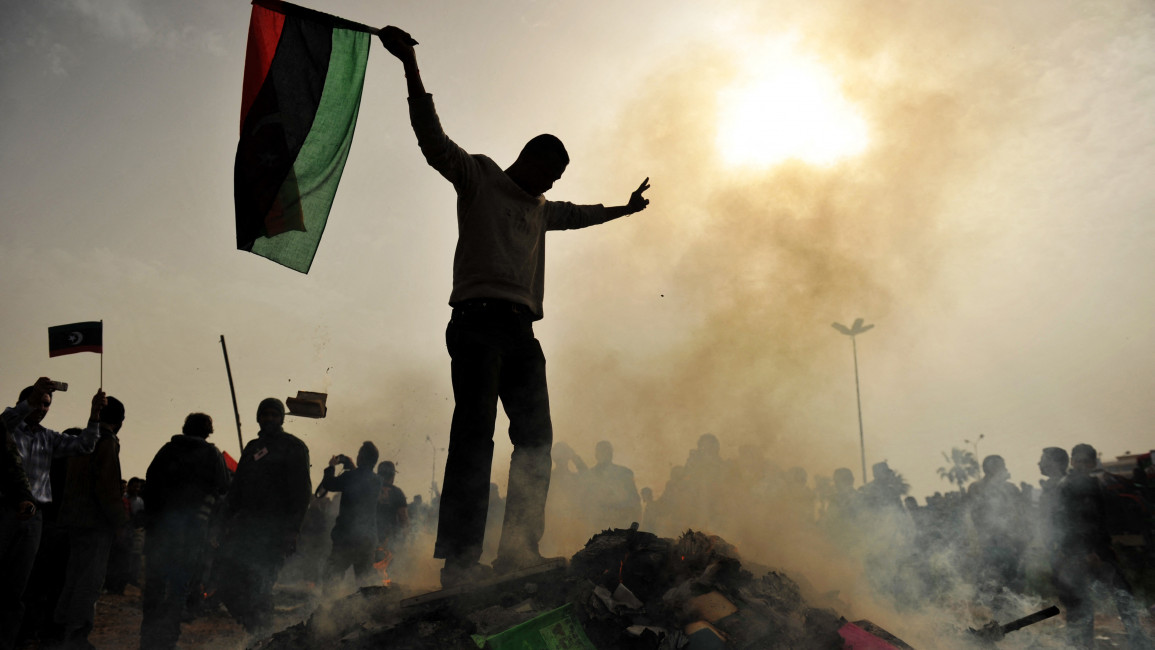
With inquisition-like tactics, Libya is jailing progressive youths on charges of 'atheism'

In-depth: Progressive activists in Libya have been detained by security forces on accusations of promoting atheism and forced to sign 'confessions', triggering fears of a return to Gaddafi's repressive era.


Analysis

The authorities in post-Gaddafi Libya often make a lot of promises about a new era for democracy and freedom. Instead, human rights groups and activists are warning the country is steadily returning to 'total tyranny' with a sustained security crackdown on independent journalism, and now, even expressions of secular thinking.

The New Arab has learned that seven activists - aged between 19 and 29 - have been detained in Tripoli as Libyan security forces and authorities use accusations of atheism to jail journalists and muzzle civil society.

Five of the detainees have been accused by Libya's public prosecution of belonging to the Tanweer Movement, a civil society group best-known for organising book fairs and calling for liberal social reforms.

The charges against the accused of 'promoting atheism' and 'abandoning religion' have alarmed human rights groups who believe that Tripoli authorities are working with the security forces to crush dissent in Libya - Libya warlord Khalifa Haftar and the rival eastern authority have faced similar accusations.

"It is a shameful display, the public prosecution should be investigating the internal security agency for their crimes, not to mention the rampant crimes and abuses committed by militias and armed groups across Libya," Hussein Baoumi, Amnesty International's Libya researcher told The New Arab.

Security forces


At least one of the activists was detained for alleged 'blasphemous' conversations on social media app Clubhouse, while another was snatched as he attempted to fly out of Libya.

Border guards at Tripoli Airport, where the incident took place, have been linked to the Internal Security Agency (ISA) headed by former militia commander Lofti al-Harari.

The agency has been accused of a harrowing campaign of repression against activists, often on spurious charges of 'promoting atheism' or 'insulting Islam', which could potentially carry the death penalty.

Libya's political authorities appear unwilling to rein in the security forces, which is largely made up of members of Harari's previous armed group. Critics say these men lack the training or background to work in a credible security service.

Abdul Hamid Dbeibeh, the prime minister of Libya's provisional government and one of two rival prime ministers currently claiming the post, on Friday publicly condemned atheism and urged the country to do more to stamp it out in an apparent show of support for the detentions.

"After Harari took over the security agency you began to see more abuses committed against activists and videotaped confessions. The Internal Security Apparatus now de-facto operates under Harari, which is nominally under the supervision of the prime minister," said Amnesty's Baoumi.

"We see the ISA using religion and Libyan 'morals' to silence any criticism or free expression in the country. We are very concerned about the effect this is having on others, both inside and outside Libya, who want to exercise the right to freedom of expression."

In a statement posted on social media and later taken down, the ISA denied claims raised by Amnesty International about the mistreatment of the accused. The New Arab has approached the Libyan embassy for comment but was unable to get a response.
"Chillingly, some of the detained activists have been dragged in front of cameras and forced to 'confess' to 'promoting atheism, blasphemy, and feminist ideas'"

Filmed confessions


Chillingly, some of the detained activists have been dragged in front of cameras and forced to 'confess' to 'promoting atheism, blasphemy, and feminist ideas'.

The videos were posted on ISA-affiliated social media pages, a tactic regularly employed by the agency against alleged atheists, along with common criminals.

Muammar Gaddafi's thuggish security forces had regularly broadcast 'confessions' from activists during the 2011 revolution about being in the pay of foreign agencies or other deviancies. Such claims were widely rejected by human rights groups, who saw the confessions as extracted under torture.

Hanan Salah, senior Libya researcher at Human Rights Watch, said the recent public humiliations and arbitrary detentions have largely muzzled activism and independent journalism in all parts of Libya.

"It is very hard to believe that anyone would go in front of a camera and out themselves in this way. My assumption is that the vast majority, if not all of them, are under duress," Salah said.

"This is a very problematic tactic because there are obviously no due process rights when doing this and I think it is very worrying that the Libyan government is not trying to end this completely."

RELATED
Analysis
Abdulkader Assad

The silence of the Libyan government on these cases has been a concern for human rights groups who say it allows Tripoli to distance itself from the ISA's repressive methods and absolve itself of responsibility for the men's fate.

It also highlights the huge power armed groups - some now part of security agencies - wield in the east and west of the country.

"There is an interdependency between these armed groups and the authorities, who rely on armed groups for their survival," said Salah.

"There's a very violent landscape across Libya with armed groups that have different agendas and ideologies taking over areas that the state used to provide. They're the ones who provide - quote, unquote - law and order and run the security agencies."


"Both the eastern and western authorities are guilty of retaining or enacting draconian legislation - some legacies of the Gaddafi era - that can and have been used to target perceived opponents"

Draconian laws


Both the eastern and western authorities are guilty of retaining or enacting draconian legislation - some legacies of the Gaddafi era - that can and have been used to target perceived opponents.

The former Government of National Accord (GNA) in Tripoli introduced a law in 2019 widely perceived as restricting civil society's ability to operate and hindering access to international NGOs and donors.

"If civil society groups were to 100 percent comply with the law, then they would basically not be able to speak at a webinar organised by an international organisation without getting preapproval from authorities," said Salah.

"Any form of activism - really grassroots and basic issues that are far away from any talk of secularism - could already make you a target if you oppose what these armed groups stand for. I think it's very worrying that journalists and activists are being arrested on loose allegations invoking insult to religion."

The OHCHR has also voiced concern about the detention of the seven men and said that the allegations of atheism will have a 'chilling effect' on human rights defenders, civil society, and humanitarian workers in Libya.

RELATED
Analysis
Giorgio Cafiero

This includes the Tanweer (Enlightenment) Movement. Formed in 2013 amid the optimistic spirit of the Arab Spring, the group has rejected recent claims by Libyan authorities that it operated secretly or promoted atheism.

It also insists that its activities are visible on official social media pages and it has always acted according to Libyan law by registering with the Civil Society Commission and given official approval to operate.

"The Tanweer Movement knows full well these restrictions and baseless accusations… are nothing more than a fierce war led by political parties," said the movement in a statement.

"The Libyan government with its security services is trying to create and fabricate any issue… [to] gain popular support in front of their opponents. What is happening is nothing but a political rivalry par excellent."

"Even these modest demands have resulted in harassment and intimidation against its members culminating in the assassination of the group's founder, Intisar al-Hasari, in 2015"

Tanweer Movement


Its activists had attracted some controversy for campaigns for women's and LGBTQ rights and calls for liberal reforms such as abolishing Article 424 of the Libyan law code, which allows charges against rapists to be dropped if the accused marries the victim.

Even these modest demands have resulted in harassment and intimidation against its members culminating in the assassination of the group's founder, Intisar al-Hasari, in 2015.

In February 2022, after accusations of supporting 'atheism' and 'infidel feminism', Tanweer closed for a third time due to the threats posed to its members in Tripoli and abroad. The group strongly denies claims of atheism and immorality.

"Our goal was to encourage critical thinking in society and promote individual freedoms," Ahmed Elbukhari, a former member of the group who now lives in Europe due to the dangers at home, told The New Arab.

"We were subject to harassment and threats over the years and our movement was frozen due to the persecution of its members."

RELATED
Analysis
Ufuk Necat Tasci

Elbukhari said former Tanweer activists, both inside Libya and abroad, fear for their safety and their futures.

"Many activists are now on the run and afraid. I do not think that they will recover because of this prosecution. Freedom in Libya, and Tripoli in particular, has been reduced to almost zero," he said.

"We feel we have been abandoned, and we ask the international community to stand with us in our battle [for freedom] because it is not only our battle but one for the whole free world."

Kacem El Ghazzali, Moroccan-Swiss secular activist and Humanists International’s MENA Advocacy & Casework Consultant, told The New Arab that the detention of the activists is turning the clock back to before the Arab Spring when there was virtually no room for criticism of authorities in Libya.

"The recent arrest campaign in Libya represents an attack on the very last space of freedom, and thereby the country's ascent into an atmosphere of total tyranny," El Ghazzali added.

"Libyan authorities should address the security and economic problems afflicting the country, rather than using peaceful young secular and feminist activists as scapegoats to cover up political failures."

Paul McLoughlin is a senior news editor at The New Arab.
Follow him on Twitter: @PaullMcLoughlin

Monday, August 30, 2021


New book explores the different—and surprising—types of atheism in science

New book explores the different — and surprising — types of atheism in science

A newly published book argues that a significant part of the public wrongly sees scientists who are atheists as immoral elitists who don't care about the common good.

Misconceptions and distrust of science and scientists—including those who are atheists—have been amplified during the COVID-19 pandemic, according to the book's authors, Elaine Howard Ecklund, the Herbert S. Autrey Chair in Social Sciences, professor of sociology and director of the Religion and Public Life Program at Rice University, and David Johnson, an associate professor of higher education at Georgia State University.

In "Varieties of Atheism in Science," Ecklund and Johnson draw from the most comprehensive study of atheist scientists ever completed. They surveyed 1,293 atheist scientists in the U.S. and U.K. over a five-year period and conducted in-depth interviews with 81 of these individuals. They conclude that the perception of atheist scientists as dishonest, arrogant and selfish is inaccurate.

As it turns out, the "New Atheism" embraced by the likes of Richard Dawkins, Sam Harris and other notable scientists is at odds with the beliefs of most scientists who are atheists.

"Atheist scientists and religious communities, for example, certainly disagree about many things, but we found that they have so much more in common than they might think they share," Ecklund said. "Both groups often have a sense of fascination about the world, a sense of meaning and purpose and a desire to explain something larger than themselves."

For example, some atheist scientists identify as "culturally religious," which Ecklund and Johnson define as being meaningfully involved in  even though they are committed atheists. Often, these scientists have a religious partner or spouse and their children attend religious services.

"These individuals expressed that the moral frameworks from religion are important for living life well, and even for application of scientific work," Ecklund said. "I think it's really interesting and important to learn that some of these atheist scientists might be active participants in ."

The authors said many scientists they interviewed were raised religious, and that bad experiences—including parents who dismissed their curiosity about science—led them to abandon their beliefs.

Other types of  the authors encountered in their study were modernist atheism (in which people have no religious views and don't engage with faith traditions, but they're not hostile to religion or religious people) and spiritual atheism (in which spirituality is important, often as it relates to research).

Ecklund and Johnson argue that improving the public's perception of scientists requires uncovering the real story of who  scientists are.

"As the pandemic continues to ravage the global population, never before has it been more important to improve the relationship between the public and the  community," Ecklund said.

Of the New Atheists, the book concludes, "It is now our responsibility to replace their rhetoric with reality."

Provided by Rice University 

Saturday, July 28, 2007

The War Against Secular Society


The right wing is expanding it's identity politics campaign claiming that Christianity is being oppressed and abused; with politically correct attacks on outspoken atheists of late.

As Barbara Kay in the National Post writes;
"atheists in democratic countries can't conjure up grim tales of the truncheon's midnight thud on the door,"

Once again proving that right wing political correctness is based on historical revisionism.

Indeed Ms. Kay atheism was considered a legal offense in Merry Olde England for the longest time.

Free Thinkers, as they were called, did have the police truncheon and worse put upon them. Indeed their publications were banned and their printing presses destroyed. Free Thought, indeed secularism, with its libertarian origins in Godwin, Bakunin, Carlisle, Tucker, Proudhon, Woodhull, etc. was began in the late 18th Century and was a 19th Century phenomena.

Richard Carlisle, a "freethinker," opened a lecturing, conversation, and discussion establishment, preached the "only true gospel," hung effigies of bishops outside his shop, and was eventually quieted by nine years' imprisonment, a punishment by no means undeserved.


Despite its origins in Greek Philosophies such as those of Heraclitus and Epicurus, atheism is a modern movement coincidental with the Enlightenment and the development of modern industrial/capitalist society.

And it was the philosopher Spinoza, a Jew, who began the attack on Christianity, Judaism, Islam and all the Abrahamic religions with his philosophical defense of atheism.

It is well known that Marx was familiar with Spinoza; indeed, he hand-copied whole passages of Spinoza's Tractatus Theologico-Politicus into his notebooks. Less clear is the significance of this fact, and the extent of Spinoza's influence on Marx's thought.


And it would be Marx who would proclaim that atheists needed to take one more step to truly be revolutionaries.

In the "Economic and Philosophical Manuscripts" (1844), Marx said:

Once the essence of man and of nature, man as a natural being and nature as a human reality, has become evident in practical life, in sense experience, the quest for an ALIEN being, a being above man and nature (a quest which is an avowal of the unreality of man and nature) becomes impossible in practice. ATHEISM, as a denial of this unreality, is no longer meaningful, for atheism is a NEGATION OF GOD and seeks to assert by this negation the EXISTENCE OF MAN. Socialism no longer requires such a roundabout method; it begins from the THEORETICAL and PRACTICAL SENSE PERCEPTION of man and nature as essential beings. It is positive human SELF-CONSCIOUSNESS, no longer a self-consciousness attained through the negation of religion. (Marx 1964A: 166-67)


In the famous Introduction to the Critique of the Hegelian philosophy of public law, Marx gives an even more explicit and elaborate formulation of this outlook. "Religious misery", he writes, "is at once the expression of real misery and a protest against it. Religion is the groan of the oppressed, the sentiment of a heartless world, and at the same time the spirit of a condition deprived of spirituality. It is the opium of the people. The suppression of religion as the illusory happiness of the people is the premise of its real happiness. It is first and foremost the task of philosophy, operating in the service of history, to unmask self-alienation in its profane forms, after the sacred form of human self alienation has been discovered. Thus criticism of heaven is transformed into criticism of the earth, criticism of religion into criticism of law, criticism of theology into criticism of politics". And just before: "Religion is the consciousness and awareness of man who has not yet acquired or who has again lost himself. But man is not an abstract being, isolated from the world. Man is the world of man, the State, society. This State and this society produce religion, an upside-down consciousness of the world, just because they are an upside-down world. Religion is the general theory of this world, its encyclopedic epitome, its logic in popular form, its spiritualistic point d'honneur, its enthusiasm, its moral sanction, its solemn completion, its fundamental reason of consolation and justification. It is the fantastic realization of human essence, since human essence does not possess a true reality. The struggle against religion is therefore indirectly the struggle against that world of which religion is the spiritual aroma" (K. Marx, Per la critica della filosofia del diritto di Hegel, Introduzione, Rome 1966, pp. 57-58).


Ironically in her attack on atheists Kay attacks Christopher Hitchens, the right wings favorite former Trotskyist turned pro war contrarian. She of course claims that atheists only want to ban Christianity and Judaism.

Aggressively marketed grievance has worked for women and gays. The same strategy for brights will doubtless end in a government-funded Status of Atheists Council to undo the iniquities of 10,000 years of theocratic hegemony and repression. After that, we may yet see -- don't laugh until you're sure it can't happen -- demands for reparations payout by churches and synagogues to redress the ignominy and shame now-atheist, former (involuntarily-designated) Christians and Jews suffered as children when force-fed the Ten Commandments in Sunday and Hebrew School. (Somehow, I do not envisage a similar campaign by Muslim atheists directed against the madrassas, not sure why ?)


While Christopher Hitchens has made it clear for many years that he opposes all theocracies and theocrats, Christian, Jewish or Muslim, heck he doesn't even like the Dali Lama. He has been outspoken against Islamism in fact his support for the war on terror is based upon his atheist opposition to Muslim Fascism.

So like her counterpart at the Sun; Michael Coren, she smears atheists with the Anti-Christian PC label, while failing to accurately point out that atheists oppose all religions and all belief systems that put faith in a supreme being.

Like Coren, Kay and other social conservatives, especially those of the evangelical Protestant faith, believe in the coming Rapture, the end times, and the Israel plays a role in this as predicted in the Book of Revelations in the New Testament.

They of course overlook the persecution and pogroms of the Jews by the Catholic, Orthodox, and Protestant Empires in Europe. They are not defending Jews or Jewish culture, which has had a major cultural impact on the West in developing secularism, socialism, and yes atheism as well as anarchism and libertarianism. Rather they are defending Israel and Zionism.

The phony war on Christianity is just so much bunkum. According to Stats Canada the dominant religion in Canada remains Christianity and its sects and cults.

For Kay, Coren and the Byfields, the supposed war on Christianity is being engaged in by the secularist elites and heathen pagans, whoever they are. Oh yeah the old 'Powers That Be'. Except that the PTB in North America are Christians. Once again the right embraces historical revisionism; the screed of conspiracy theorists.


h/t to Another Point of View


SEE:

Lou Dobbs New Enemy: The Church

Pauline Origins of Social Conservatism

Marxism and Religion

Secular Democracy

GoldilocksEnigma

American Polytheism

1666 The Creation Of The World

Snakes Alive


Find blog posts, photos, events and more off-site about:
, , , , , , , , , , , , , , , , ,
, , , , , ,
, , , , , , , , ,, , , , ,
, , , , , , , ,
, , , , , , , ,,

Saturday, July 24, 2021


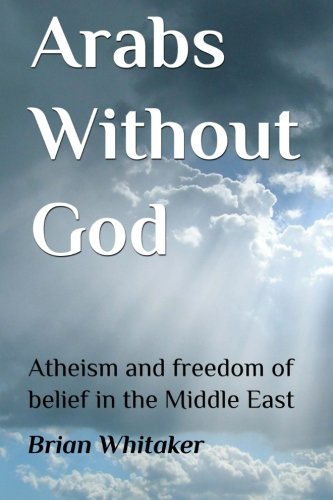
Arabs Without God: Introduction

Introduction

ARABS, in popular imagination, are assumed to be Muslims and potential religious fanatics. The reality is a lot more complex. Islam is far from monolithic and has many strands: Sunni, Shia, Salafi, Wahhabi, Zaidi, Sufi, Alawi, Ibadi, Isma’ili and others. Nor are Arabs necessarily Muslims. There are millions of Arab Christians, plus smaller numbers of Druze, Yazidis, Mandaeans and Jews.

Added to this mix is a growing number of Arabs – mainly young – who openly declare themselves to be atheists, agnostics or sceptics. Non-believers have probably always existed in the Middle East, mostly out of sight, but now they have begun to find a voice. Social media have provided them with the tools to express themselves and the “Arab Spring” uprisings that began in 2010 emboldened some of them to speak out.

In countries where religion permeates most aspects of daily life, publicly challenging belief shocks families, society and governments. Many have been imprisoned merely for expressing their thoughts, others have been forced into exile and some threatened with execution. Many more keep their thoughts to themselves, for fear of the reaction from family, friends and employers.

For an established order that favours orthodoxy and conformity and is unaccustomed to questioning, these dissenting voices are a problem – especially for autocratic governments that base their claims to legitimacy on religious credentials. Regardless of attempts at suppression, though, what some see as the “problem” of disbelief is unlikely to go away; more likely, it will grow.

Thanks to the internet, along with satellite television and foreign travel, young Arabs today are far more aware of the outside world than previous generations and, when they hold up their own countries to the mirror, many dislike what they see. Rejecting religion is one response to that but it is also part of broader demands for political and social change. The inclusion of religion in this wave of disaffection was almost inevitable, since religion in the Arab countries – far from being a personal, private matter – has become heavily politicised and is responsible for many of the social restrictions that cause so much frustration, especially among the youth.

It is not the purpose of this book to make a case for atheism or to single out Islam among religions for particular criticism, though Islam happens to be the dominant faith in the region. Rather, the purpose is to look at non-belief as a social phenomenon – its causes and its consequences – and to argue for the right of non-believers to be treated as normal human beings.

Public discourse in the Arab countries has opened up considerably since the 1990s. Many of the old taboos have been broken and things can be said in public now that would have been unimaginable only a decade or two ago. Despite that, religion is still generally treated as sacrosanct: challenging it is the biggest and most untouchable of the remaining taboos.

This, in turn, raises important questions about how best to press for change. Some of the non-believers interviewed for this book could be described as activists who openly question and confront religion in all its forms (as is their right). Others simply want a quiet life; they see no need to advertise their disbelief but resent being forced to comply with rules imposed by believers. Both of these approaches are fraught with difficulties, however, and may also bring their adherents into conflict with the law.

The result is that Arab non-believers face two separate but related struggles. One is their dispute with religion itself; the other is with societies and governments that refuse to  recognise their disbelief. This broader struggle for personal rights – freedom of thought, freedom of expression, freedom of conscience, and so on – is one that they share with millions of religious Arabs too, especially religious minorities. Anyone who does not conform to whatever happens to be the local religious orthodoxy is liable to fall victim to blasphemy and apostasy laws or sectarian prejudices. The irony of this is that while believers and non-believers are on opposite sides where religious ideas are concerned they may also find themselves on the same side in the struggle for freedom of belief. A substantial part of the discussion in this book is therefore concerned with broader questions of religious liberty which affect believers and non-believers alike.

Nevertheless, minority religious beliefs tend to be more accepted than atheism. There is some recognition of religious diversity, at least among the monotheistic faiths, even if prejudice and discrimination persist. Outright disbelief in God, on the other hand, tends to be greeted with general abhorrence. In lands where religion holds sway, the treatment of non-believers thus becomes the ultimate test: when an atheist can be accepted and respected as a normal human being, liberty will truly have arrived.

Continue reading >>>

Arabs Without God is available in paperback from Amazon (US) or Amazon (UK). It is also available in Arabic (online, free of charge) and in Italian under the title Arabi Senza Dio.

Friday, October 12, 2007

The War On Atheism


Here is a biased survey on Atheism and Morality conducted by Reginald Bibby of the University of Lethbridge.

A new Canadian survey has found that believers are more likely than atheists to place a higher value on love, patience and friendship, in findings the researcher says could be a warning that Canadians need a religious basis to retain civility in society.

About the only claim that holds any 'value' is this one;


In the survey findings, there was only a five percentage-point difference between how theists and atheists valued honesty. But of all the categories, honesty is the value that is least connected to broad emotions such as love and compassion. In other words, someone can be honest and brutal.
I stand by that, being a Saggitarian and an ENTJ, I am often brutally honest.

The assertion made by the article that 'atheists' are less compassionate and moral than Christians misses the point. Those Canadians he interviewed are not necessarily atheists, per se, rather they are Canadians who do not profess a belief in God or organized religion. That is an unbelief, while atheism, and its derivatives; Marxism and Anarchism are counter beliefs, and in all cases rely upon classical liberalism as the basis of morality.


But in the realm of forgiveness, which is a core value of many major religions, particularly Christianity, the difference - 32 percentage points - is stark.

"That's a pretty explicit value within a large number of religious communities," said Prof. Bibby.

"Look at the culture as a whole and ask yourself: to what extent do we value forgiveness against themes like zero-tolerance? We don't talk very much about what we're going to do for people who fall through the cracks. So I think forgiveness is pretty foreign to a lot of people if they're not involved in religious groups."

Heck even Satanism has a moral code. Though it is not one of forgiveness. It is modeled on Ayn Rands morality.

In a consumer capitalist culture based on the values of ; I'm Ok Your Ok, the Me Generation and I Got Mine Jack 'unbelief' in God reflects a consumer choice. And the morality of the individual is then shaped by the society they exist in. In the era of Enron, Chainsaw Jack Welch, and other criminal capitalist enterprises, where Business Schools are having to 'teach' morality to budding business types, it is no surprise to find that Bibby's findings are what they are. Which is actually what Bibby is saying , despite the National Posts spin on the survey, that 'godless' capitalism has no values.

After all seeing that the culture is one of consumer capitalism, then this is more a condemnation of that then atheism or its political and philosophical offshoots.

But there is a war on Atheism currently in vogue amongst the Christian Right, and this just gives ammunition to the side which has conducted wars, pogroms and mass genocide, and continues with oppression, exploitation and mindless discrimination to excuse themselves as being 'good' people, with 'values'.


He said people who are believers are encouraged ­- whether by a desire to please God, or because of a fear of God - to adopt these values

To please or to fear the ultimate cosmic boss, to accept 'his' values, is not as humanistic as it appears. It is the morality of the slave. And thus is reflected in the social schizophrenia that creates the need for God, Priests, Bosses, Cops, Social Workers, etc, the whole kit and caboodle of authority ( a hold over of aristocracy within capitalism).

While Christians on the right claim that we need less human rights and more folks taking responsibility for their actions, they always seem to lovingly accept them folks who break the social or moral code, if they accept Jesus into their hearts.

The enlightened individual sees morality as a social construction; one of mutual agreement and sees no difference between human rights and responsibilities. Thus with the rise of Freemasonry and its child The Rights Of Man a new 'godless'
revolutionary morality evolved and created secular society; Liberty, Equality,Fraternity.

Immoral Capitalism has truncated Liberty from Equality and Fraternity. That is the ultimate truth in Bibby's survey.

http://spmedia.canada.com/gallery/00posted/1011religion.jpg

Only one word more concerning the desire to teach the world what it ought to be. For such a purpose philosophy at least always comes too late. Philosophy, as the thought of the world, does not appear until reality has completed its formative process, and made itself ready.

History thus corroborates the teaching of the conception that only in the maturity of reality does the ideal appear as counterpart to the real, apprehends the real world in its substance, and shapes it into an intellectual kingdom.


When philosophy paints its grey in grey, one form of life has become old, and by means of grey it cannot be rejuvenated, but only known. The owl of Minerva, takes its flight only when the shades of night are gathering.

Hegel, Philosophy of Right (1820), "Preface"

SEE:

Islamicists and Evangelical Christians


Find blog posts, photos, events and more off-site about:
, , , , , , , , , , , , , , , , ,
, , , , , ,
, , , , , ,, ,
, , , , ,
, , , ,

Saturday, May 18, 2024

AMERIKA

The number of religious ‘nones’ has soared — but not the number of atheists
Image via Shutterstock.


The Conversation
May 07, 2024

The number of individuals in the United States who do not identify as being part of any religion has grown dramatically in recent years, and “the nones” are now larger than any single religious group. According to the General Social Survey, religiously unaffiliated people represented only about 5% of the U.S. population in the 1970s. This percentage began to increase in the 1990s and is around 30% today.

At first glance, some might assume this means nearly 1 in 3 Americans are atheists, but that’s far from true. Indeed, only about 4% of U.S. adults identify as an atheist.

As sociologists who study religion in the U.S., we wanted to find out more about the gap between these percentages and why some individuals identify as an atheist while other unaffiliated individuals do not.
Many shades of ‘none’

The religiously unaffiliated are a diverse group. Some still attend services, say that they are at least somewhat religious, and express some level of belief in God – although they tend to do these things at a lower rate than individuals who do identify with a religion.

There is even diversity in how religiously unaffiliated individuals identify themselves. When asked their religion on surveys, unaffiliated responses include “agnostic,” “no religion,” “nothing in particular,” “none” and so on.

Only about 17% of religiously unaffiliated people explicitly identify as “atheist” on surveys. For the most part, atheists more actively reject religion and religious concepts than other religiously unaffiliated individuals.

Our recent research examines two questions related to atheism. First, what makes an individual more or less likely to identify as an atheist? Second, what makes someone more or less likely to adopt an atheistic worldview over time?
Beyond belief – and disbelief

Consider the first question: Who’s likely to identify as an atheist. To answer that, we also need to think about what atheism means in the first place.

Not all religious traditions emphasize belief in a deity. In the U.S. context, however, particularly within traditions such as Christianity, atheism is often equated with saying that someone does not believe in God. Yet in one of our surveys we found that among U.S. adults who say “I do not believe in God,” only about half will select “atheist” when asked their religious identity.

In other words, rejecting a belief in God is by no means a sufficient condition for identifying as an atheist. So why do some individuals who do not believe in God identify as an atheist while others do not?

Our study found that there are a number of other social forces associated with the likelihood of an individual identifying as an atheist, above and beyond their disbelief in God – particularly stigma.

Many Americans eye atheists with suspicion and distaste. Notably, some social science surveys in the U.S. include questions asking about how much tolerance people have for atheists alongside questions about tolerance of racists and communists.

This stigma means that being an atheist comes with potential social costs, especially in certain communities. We see this dynamic play out in our data.

Political conservatives, for instance, are less likely to identify as an atheist even if they do not believe in God. Just under 39% of individuals identifying as “extremely conservative” who say they do not believe in God identify as an atheist. This compares with 72% of individuals identifying as “extremely liberal” who say they do not believe in God.

We argue that this likely is a function of greater negative views of atheists in politically conservative circles.
Adopting atheism

Stating that one does not believe in God, however, is the strongest predictor of identifying as an atheist. This leads to our second research question: What factors make someone more or less likely to lose their belief over time?

In a second survey-based study, from a different representative sample of nearly 10,000 U.S. adults, we found that about 6% of individuals who stated that they had some level of belief in God at age 16 moved to saying “I do not believe in God” as an adult.

Who falls into this group is not random.

Our analysis finds, perhaps unsurprisingly, that the stronger an individual’s belief in God was at age 16, the less likely they are to have adopted an atheistic worldview as an adult. For instance, fewer than 2% of individuals who said that “I knew God really existed and I had no doubts about it” as a teenager adopted an atheistic worldview later on. This compares with over 20% of those who said that “I didn’t know whether there was a God and I didn’t believe there was any way to find out” when they were 16.

However, our analysis reveals that several other factors make one more or less likely to adopt an atheistic worldview.

Regardless of how strong their teenage belief was, for instance, Black, Asian and Hispanic Americans were less likely to later identify as an atheist than white individuals. All else being equal, the odds of individuals in these groups adopting an atheistic worldview was about 50% to 75% less than the odds for white individuals. In part, this could be a product of groups that already face stigma related to their race or ethnicity being less able or willing to take on the additional social costs of being an atheist.

On the other hand, we find that adults with more income – regardless of how strong their belief was at 16 – are more likely to adopt the stance that they do not believe in God. Each increase from one income level to another on an 11-point scale increases the odds of adopting an atheistic worldview by about 5%.

This could be a function of income providing a buffer against any stigma associated with holding an atheistic worldview. Having a higher income, for instance, may give an individual the resources needed to avoid social circles and situations where being an atheist might be treated negatively.

However, there may be another explanation. Some social scientists have suggested that both wealth and faith can provide existential security – the confidence that you are not going to face tragedy at any moment – and therefore a higher income reduces the need to believe in supernatural forces in the first place.

Such findings are a powerful reminder that our beliefs, behaviors and identities are not entirely our own, but often shaped by situations and cultures in which we find ourselves.

Christopher P. Scheitle, Associate Professor of Sociology, West Virginia University and Katie Corcoran, Associate Professor of Sociology, West Virginia University

This article is republished from The Conversation under a Creative Commons license. Read the original article.

Thursday, October 05, 2023

An atheist in northern Nigeria was arrested. Then the attacks against the others worsened


KANO, Nigeria (AP) — When the megaphone called out for the daily Islamic prayers, the nonbeliever grabbed his prayer beads and ambled through the streets to join others at the mosque in Kano, northern Nigeria’s largest city. Formerly a Muslim, he now identifies as an atheist but remains closeted, performing religious obligations only as a cover.

“To survive as an atheist, you cannot act like one,” said the man, who spoke to The Associated Press on condition of anonymity over fears for his safety. He said he narrowly escaped being killed by a mob in 2015 after some people found out he had forsaken Islam.

“If I ever come out in northern Nigeria to say I am an atheist, it will be an automatic death sentence,” said the man, a business owner in his 30s.

In parts of the world, the religiously unaffiliated are on the rise, and can safely and publicly be a “none” — someone who identifies as an atheist, agnostic or nothing in particular. In countries like Nigeria, the situation is starkly different.

Nonbelievers in Nigeria said they perennially have been treated as second-class citizens in the deeply religious country whose 210 million population is almost evenly divided between Christians dominant in the south and Muslims who are the majority in the north. While the south is relatively safe for nonbelievers, some say threats and attacks have worsened in the north since the leader of the Humanist Association of Nigeria, Mubarak Bala, was arrested and later jailed for blasphemy.

The Associated Press spoke to seven nonbelievers to document their experiences. Most spoke anonymously and in secret locations over concerns for their safety.

“Bala’s imprisonment rolled our movement underground,” Leo Igwe, a founder of the humanist association, said of the group’s leader, who in 2022 was jailed for 24 years. A court convicted him on an 18-count charge of blaspheming Islam and breach of public peace through his posts on Facebook.

Since Bala was prosecuted by the Kano state government, the humanist association — which has several hundred members — has gone underground, struggling with threats to members who no longer hold meetings, Leo said.

Nigeria’s constitution provides for freedom of religion and expression, but activists say threats to religious freedom are common, especially in the north.

Almost half of the countries in Africa, including Nigeria, have statutes outlawing blasphemy. In most secular courts in Nigeria, the stiffest penalty for a blasphemy charge is two years in prison, while it carries a death penalty in the Islamic courts active in the north.

There are no records of any such executions in recent years. The most recent instance of a death sentence, issued in December against an Islamic cleric, has not been carried out.

The Shariah law operating in Islamic courts defines blasphemous acts as those committed by anyone who “intentionally abuses, insults, derogates, humiliates or seeks to incite contempt of the holy Prophet Muhammad.”

But what exactly constitutes an insult to Islam is often open to interpretation by accusers; some alleged offenders have been attacked and killed before any trial.

At least three people have been killed for alleged blasphemy in northern Nigeria in the past year. The latest victim was a Muslim stoned to death in June after being accused of blaspheming Islam during an argument at a market. Those who stoned him included children, according to a video reviewed by the AP.

Authorities in Nigeria have failed to act to prevent such attacks, and prosecutions have been rare, said Isa Sanusi, director of Amnesty International in Nigeria.

“The alarming uptick in blasphemy killings and accusations underscores the urgency with which the authorities must wake up to Nigeria’s international legal obligations to respect and protect human rights, including freedom of religion,” Sanusi said.

Perpetrators of such attacks are ignorant of Islamic teachings, which discourage violence and do not compel anyone to become an adherent unwillingly, said Professor Usman Dutsinma, deputy director of the Center for Islamic Civilization and Interfaith Dialogue at Kano’s Bayero University.

“The best thing you can do is to subject him to reasoning,” Dutsinma said of nonbelievers. “But if somebody denounces Islam … some punitive measures must be taken against him. That is what Islam provides.”

Threats against the nonreligious in Nigeria are common on social media. On a Facebook group named Anti-Atheist, users frequently posted messages that trolled or threatened atheists, using the Hausa language of northern Nigeria.

The atheist in Kano, in a dimly lit room, spoke with a mix of grit and fear about his experiences as a nonbeliever in a nation where about 98% of the population are Christians or Muslims, according to the Pew Research Center. A Facebook post from Bala in 2015, critiquing some Islamic teachings, influenced the man's shift to atheism.

The man said he created a Facebook account of his own with a fake profile, regularly posting comments that questioned religion.

“My biggest fear is for people I live with to know that I am an atheist,” he said.

Even his relatives are unaware he is an atheist, though his wife, a Muslim, accepts him as he is. “Her type is very rare,” he said.

Bala, once a Muslim, was seen as an influential member of the humanist community; most of the nonbelievers who spoke to the AP credited him as an inspiration. Until his conviction, he made several posts on Facebook that questioned religion, often attracting threats.

In April 2020, he shared a post noting that he and other humanists in northern Nigeria “claim that there is no God.” One user called for Bala to face the death penalty.

Life as a nonbeliever in Nigeria is also difficult for women, who already are severely underrepresented in government and other key sectors.

“Your achievements are reduced to nothing if you are irreligious,” said Abosuahi Nimatu, who dropped out of university in Katsina state in 2020 to escape violence after her peers learned she was no longer a Muslim.

Nimatu was so close to Bala that his prolonged detention depressed her for a year, she said. She used her Facebook account to campaign for his release, prompting threats that reached her cellphone and email inbox. Her home address was shared among people threatening to attack her and her family.

Even at home, there is scant comfort. She is often reminded that — as a female nonbeliever — no man would marry her.

“You are seen as a rebel and as a wayward person," she said.

In 2020, Nigeria became the first secular democracy designated by the U.S. State Department as a “Country of Particular Concern” for engaging in or tolerating “systematic, ongoing, egregious violations of religious freedom.” It later was dropped from that list of countries, prompting criticism from the U.S. Commission on International Religious Freedom, which says Nigeria should be re-added.

“Religious freedom conditions in Nigeria remained poor as both state and non-state actors continued to commit widespread and egregious religious freedom violations,” the commission said in its 2022 annual report.

Sometimes, such intolerance comes from one’s family.

A man from Yobe state said he was forced to leave home in 2019 when his uncle found out he belonged to an atheist group on WhatsApp, prompting death threats. He returned home only after pretending to be a practicing Muslim even though he remained a closeted atheist, with Bala a strong supporter.

“Before Mubarak was arrested, you had the feeling of someone who could be responsible for you even if your life was in danger. … But now, you are overwhelmed by a sense of fear and looming danger that you cannot have any way of being supported by anybody,” said the man, now a university student.

It is a different reality for the openly faithless in southern Nigeria; they even hold public meetings occasionally. The two atheists who spoke to AP in the commercial hub of Lagos said they had never been attacked or threatened because they are not religious.

Busayo Cole, who was once a Christian and had a foster father who was an Anglican bishop, said his family is indifferent about his religious status. Beyond his family, the worst consequences he faces are occasional snide remarks.

“People are more liberal about things like that down here,” said Cole.

At the Kuje prison in Abuja, Bala continues to serve his jail term, receiving visitors from time to time including his wife Amina Ahmed, also a humanist. She went to see him most recently with their 3-year-old son who was only six weeks old when Bala was taken into custody.

He is in good spirits, Ahmed said of her husband. But it has been difficult for her, beginning when she was healing from childbirth while her husband remained behind bars.

“I am trying to be strong (but) my strength sometimes fails me," she said.

In prison, Bala remains resolute as a humanist despite his experiences since April 2020 when he was arrested, though he worries about the safety of his family and the humanists he leads in Nigeria.

Such concerns were what prompted him to plead guilty, his wife said, recalling how worried he had been that a non-guilty plea could cause more anger in northern Nigeria and endanger him more. He also hoped a guilty plea would help him regain access to health care and his young family, which he had been denied for most of the nearly two years he was in solitary confinement before being convicted.

Like Ahmed, the Nigerian humanist community hopes that an appeal of Bala’s conviction would bring him freedom.

“For now, I just have to keep pretending (to be religious),” said the atheist in Kano. “Even if I run to somewhere and come out, my family will not be safe.”

___

Associated Press religion coverage receives support through the AP’s collaboration with The Conversation US, with funding from Lilly Endowment Inc. The AP is solely responsible for this content.

Chinedu Asadu, The Associated Press


Fearing ostracism or worse, many nonbelievers hide their views in the Middle East and North Africa


There’s the Tunisian woman who fasts during the Islamic holy month of Ramadan, though not for God. The Iraqi woman who, until recently, wore a hijab. And a man whose Egyptian identity card still identifies him as “Muslim.”

Such are the ways that some of the religiously unaffiliated, or “nones” — people who are agnostics, atheists or nothing in particular — negotiate their existence in the Middle East and North Africa, or MENA, where religion is often ingrained in life’s very fabric.

Aware that rejecting religion can have repercussions, many conceal that part of themselves. Declaring disbelief may spur social stigma, ostracism by loved ones or even unleash the wrath of authorities, especially if going public is coupled with real or perceived attacks on religion or God.

“I have a double life all the time,” said the 27-year-old Tunisian woman. “It’s better than having conflict every day.”

Many nonbelievers seek community, ideas or pockets of digital defiance on the internet even though online spaces can come with risks.


Most of those interviewed by The Associated Press spoke on condition of anonymity for fear of repercussions and because some of their families don’t know how they religiously identify.

“The Middle East is the birthplace of the three heavenly religions and there’s no doubt that the region’s culture has long been intertwined with religion,” said Mustapha Kamel al-Sayyid, a political science professor at Cairo University. “Religion has also been a source of legitimacy for rulers, a source for knowledge and behavioral norms.”

Many in Arab countries, he said, associate lack of religion with immorality. “To them, you cannot talk about the rights of someone who is a danger to society.”

Bans on blasphemy appear in different parts of the world. But, according to a Pew Research Center analysis, they have been most common in the MENA region as of 2019.

The Tunisian woman said she fasts to avoid being found out by her family. She pretends to sleep to skip gatherings, where relatives may take aim at her suspected disbelief.

From an early age, she rejected how Islam was practiced in her home. She said her father would sometimes force her to pray. Resisting traditional interpretations of such things as gender roles, she turned to progressive Muslim readings.

She now sees herself as nothing in particular and open to different spiritual paths.

“You’re socially perceived like you are public enemy,” she said. “People hate you without knowing you.”

Hany Elmihy hoped conditions could change. The 57-year-old Egyptian agnostic and some other nonbelievers saw a window for visibility following the “Arab Spring" uprisings.

Elmihy said he founded a Facebook group for Egyptians without religion in 2011, while similar ones formed in other Arab countries. Mass protests demanding political change had just unseated an Egyptian president then, highlighting the power of social media for dissent.

“It’s not the revolution that turned some into atheists or irreligious; the revolution gave them the freedom and courage to speak up,” Elmihy said.

Elmihy said he was insulted, threatened, and attacked by unknown assailants.


Seeking recognition, he tried to change the “Muslim” designation listed on his identity card to state he adheres to no religion. He failed.

After the post-revolt euphoria fizzled out, he left Egypt in 2015 and now lives in Norway.

“Society scared me the most,” Elmihy said. “I felt isolated."

He views his earlier advocacy with mixed feelings, but says “it was important to let the society know that the religiously unaffiliated exist.”

Some took note.

Ishak Ibrahim, a researcher with the Egyptian Initiative for Personal Rights, said Egypt’s youth ministry announced plans in 2014 to combat atheism in collaboration with religious bodies.

Local press also reported on anti-atheism efforts by some Islamic and Christian institutions.

“We believe that those who don’t belong to religion are committing a sin but it’s not our responsibility to hold them accountable,” said Abbas Shouman, an official with Al-Azhar, the Cairo-based seat of Sunni Muslim learning. The role of religious authorities, he said “is only to explain, clarify, spread the right education and respond to suspicions.”

Shouman rejects attacks on religion, saying nonbelievers "have the right to defend their beliefs as they wish but not to go after others’ beliefs and affiliations.”

Atheism is not criminalized in Egypt, Ibrahim said. Last year, Ibrahim’s EIPR said an Egyptian court upheld a three-year-prison sentence and a fine against a blogger charged with contempt of religion and misusing social media. The organization, whose lawyer appealed the earlier verdict, has said the man was accused of managing a Facebook page for Egyptian atheists that allegedly criticizes religions.

In May, Iran hanged two men convicted of blasphemy, carrying out rare death sentences for the crime. The men were accused of involvement in a Telegram channel called “Critique of Superstition and Religion,” according to the U.S. Commission on International Religious Freedom. The Mizan news agency of Iran’s judiciary described the two as having insulted Prophet Muhammad and promoted atheism.

In Saudi Arabia, a court has sentenced a man to 10 years in prison and 2,000 lashes on accusations of expressing atheism online; a media report said in 2016 that religious police found tweets denying the existence of God and ridiculing Quranic verses.

For some, like Ahmad, religious disbelief hasn’t caused tensions. But the 33-year-old Lebanese, who comes from a Shiite Muslim family and now lives in Qatar, wanted his last name withheld because of the sensitivity of the subject.

“We have an unspoken agreement: I don’t criticize religion and you don’t criticize my lack of religion,” he said. He’s religiously unaffiliated, and says he cannot believe “in something that I cannot touch or cannot see.”

The role of sectarian divisions in fueling conflicts in Lebanon is one reason Talar Demirdjian distanced herself from religion.

“People either go very into their religion or their sects, or the other side.” A Lebanese Armenian of Christian heritage, Demirdjian said about religion, “I don’t even think about it enough to tick a label.”

For one Iraqi woman, questions started when a childhood dream to one day become an imam like her grandfather was quashed because she is a girl. Iraq’s turmoil fueled her disbelief.

The 24-year-old's generation witnessed the U.S.-led invasion, militancy, sectarian violence, the brutal reign of the Islamic State and increasing clout of militias.

She’s worn the Islamic headscarf before and, for a while, after she became agnostic. When militants proliferated where she lived, she donned it to stay out of danger; at other times, it was to socially fit in. She removed it around 2020.

“I don’t tell people that I am agnostic,” she said. “It’d be an act of stupidity to do so in such a society.”

___

AP writers Youcef Bounab in Paris and Abdulrahman Zeyad in Baghdad contributed.

___

Associated Press religion coverage receives support through the AP’s collaboration with The Conversation US, with funding from Lilly Endowment Inc. The AP is solely responsible for this content.

Mariam Fam, The Associated Press

Nonreligious struggle to find their voice and place in Indian society and politics


CHENNAI, India (AP) — Despite India’s millennia-old history of nonreligious movements, most atheists and rationalists choose to keep quiet about their skepticism of faith — it’s easier and far less risky than going public in one of the world's most religious countries.

The space that does exist for debating religious authority and belief is shrinking, said Avinash Patil, a religious skeptic who was born Hindu and is now a leader of an anti-superstition group working in one of the country’s western states. He blames the growth of nationwide religious and communal tensions over the last decade as well as rising Hindu nationalism under Prime Minister Narendra Modi’s leadership.

“When you are open about it and engage in activism, it can get challenging, and even dangerous,” said Patil, chairperson of Maharashtra Andhashradha Nirmulan Samiti.

In fact, Patil and his organization are still seeking justice for its founder and renowned rationalist, Narendra Dabholkar, who was gunned down during a morning walk in Pune 10 years ago. Patil helped organize vigils and rallies Aug. 19-20 for Dabholkar in Mumbai and Pune. The murder trial is ongoing.

Indians not affiliated with any religion — known as the "nones” — are a very small minority among the nation’s 1.4 billion people, according to government statistics and independent surveys. They include atheists, agnostics, the culturally religious but not observant, rationalists and the spiritual but not religious.

It is possible that nones in India are underrepresented in such surveys due to societal taboos and shortcuts taken by interviewers, said Stephanie Kramer, a senior researcher at Pew Research Center who led a 2020 survey about the nation’s religious makeup.

Only 13 out of the 30,000 Indians surveyed by Pew said they were unaffiliated with any religion, while many more responded that there was no such thing as having no religion, Kramer said.

“Such a tiny percentage of people with no religion is unusual,” Kramer said.

Hindus are the largest religious group in India by far. They comprise about 80% of the population while Muslims account for 14%, the largest of the minority religions. The country also is home to Buddhists, Christians, Jains, Sikhs and numerous Indigenous faith traditions.


Renouncing one’s religion is allowed in India, and the Special Marriage Act of 1954 permits people with no religious beliefs to marry, as well as nonreligious and non-ritualistic weddings. But the country doesn’t officially recognize atheism or the nonreligious. To avoid a hassle, some feel forced to list a religion on government forms such as birth certificates, or on school admissions paperwork.

“There are delays with documents when you don’t state your religion,” said Jaswant Mohali, a coordinator for the rationalist group Tarksheel Society Punjab. “Sometimes we take this issue to court, but most of the time we just state our religion at birth to avoid problems with official documents.”

Mohali’s and Patil’s organizations are among those pushing for the government to add a “no religion” checkbox to the country’s new census form. But irreligious activists don’t just advocate for their specific causes; they have long pushed for other social justice issues like caste and gender equality.

Although small in numbers, atheists in India have been able to exert influence and advance their agenda “with a human approach and empathy,” said K. Veeramani, president of the Chennai-based Dravidar Kazhagam, a social justice organization advocating for equality. It was launched in the 1940s by E.V. Ramaswamy Naicker, popularly known as Periyar, in the southern state of Tamil Nadu.

“It’s not about a show of hands,” Veeramani said. “It’s about clarity of thinking. The rationalist way of life is about equality and equity.”

The group, along with its coalition of political parties, has resisted Modi’s central government policies. Their biting rhetoric has sometimes proved controversial.

On Sept. 2, speaking at an event in Chennai, Udayanidhi Stalin, Tamil Nadu’s sports minister and son of Chief Minister M.K. Stalin, called to eradicate Hinduism, comparing it to coronavirus, malaria and dengue. After a firestorm of criticism from opponents, allies and Hindus both within India and in the diaspora who called his statements anti-Hindu, Stalin, who identifies as atheist, doubled down on his comments, clarifying that his fight is against a system that perpetrated caste discrimination.

Sharp rhetoric about Hinduism often stems from deep-seated hurt and the trauma of caste, and not from hatred of Hindus or upper-caste Brahmins, said Annamalai Arulmozhi, a Chennai-based lawyer born to parents who were followers of Periyar and raised their children as atheists. Arulmozhi, who is still an atheist and a feminist, says feminism and fighting inequities perpetrated by the caste system have been central to Periyar’s movement, which continues today.

Fighting for justice means facing opposition from religion, culture, caste and everything else the system throws at you, Arulmozhi said.

“Atheism has given me the strength to stand against all of this,” she said. “To get justice, you have to oppose all these structures, branches and corollary institutions. You need to reject all that and only view your path and your goal as a humanist. That feeling, to me, is atheism.”

Arulmozhi said her family would not have had the opportunity to get an education without the push for equality that Periyar led. She has found living as an atheist “freeing.”

The nones in India come from an array of belief backgrounds, including Hindu, Muslim and Sikh. Atheism is still largely invisible and ignored in India, said Mohali, who was born into a Sikh family. Rational thought, he said, is without a platform.

“There are a lot of television channels for religion, but not for science or rational thought,″ he said.

Sultan Shahin, founder of a progressive Muslim website called New Age Islam, said he is seeing more Muslims in India questioning their religion and some even calling themselves “ex-Muslims.” Shahin shuns such labels but said most would view him as a “cultural Muslim.”

“I question how the Quran is compiled and I ask these questions openly,” he said. “We need to have room for these discussions without fearing for our safety.”

Historically, doubt has been an integral part of India's spiritual DNA. The gurus or spiritual masters, including the Buddha, encouraged followers to ask questions. Ancient Indian scriptures, such as verses in the Rig Veda, address skepticism around the fundamental question of a creator god, and the creation of the universe, said Signe Cohen, associate professor of religion at the University of Missouri who focuses on Hinduism and Buddhism.

“Buddhism is a functionally atheist religion because there is no belief in a god who is the creator of the universe or a savior of humans,” Cohen said.

Other religions that took root in India pose similar questions, she said. Jain texts raise the question most atheists ask: If there is a creator god who is the ruler of the universe, why is there so much suffering?

Materialist schools of thought dating back to the fifth and sixth centuries include declarations that human beings are nothing more than their physical bodies, and denied the existence of god, the soul and life after death. Others that denied the existence of gods still believed in rebirth and the soul.

India has also seen several movements in the last century that emphasize spirituality over religion and ritual, like the one started by philosopher Jiddu Krishnamurti. His foundation is headquartered in Chennai and emphasizes living in the present.

“He (the philosopher) said we don’t need to go the previous or next life because how we live now dictates the quality of the next moment or the next day,” said Harshad Parekh, a longtime follower and educator in Krishnamurti schools who was born Hindu and now is agnostic.

Krishnamurti died in 1986, but his view on the search for truth lives on in followers like Parekh.

“Man cannot come to it through any organization, through any creed, through any dogma, priest or ritual, not through any philosophical knowledge or psychological technique,” according to the late philosopher.

Krishnamurti also repeatedly stated that he held no nationality or belief and belonged to no particular group or culture. Parekh strongly aligns with that belief.

He does, however, support the Modi government.

“I'm not for or against any religion or faith group,” he said. “But I do like what this government has done for the economy.”

___

Associated Press religion coverage receives support through the AP’s collaboration with The Conversation US, with funding from Lilly Endowment Inc. The AP is solely responsible for this content.

Deepa Bharath, The Associated Press


GOD IS NOT