Matthew Chapman
October 1, 2026
RAW STORY

Defense Secretary Pete Hegseth attends a House Armed Services Committee hearing on the Department of Defense's FY27 budget request on Capitol Hill in Washington, D.C., on April 29, 2026. REUTERS/Elizabeth Frantz
The conservative Wall Street Journal editorial board had scorn for Secretary of Defense Pete Hegseth's bizarre speech boasting about how his military only had "warriors," rather than "beardos," "weirdos," or slurs for transgender people.
Hegseth, wrote the board, "rolled out several good U.S. military initiatives on Wednesday, and usually the purpose of big speeches is to persuade the public of worthy ideas. Yet Mr. Hegseth seems determined to shrink his support with gratuitous potshots, and that bears on whether the Administration can boost recruitment or confront new technology in warfare."
Many of the things Hegseth talked about are decent, the board wrote, like a program for recruiting officers out of schools — even if the focus is intensely on right-wing schools like Liberty University and Hillsdale College — as well as plans to establish a four-star command for autonomous weaponry.
However, the board said, Hegseth "couldn’t resist his usual polarizing attack routine against all and sundry, and he even accused the press of 'treason' for publishing what’s leaking out of the secretary’s shop. The most remembered line of the speech will be Mr. Hegseth’s declaration that the U.S. military no longer abides 'beardos' or 'weirdos.' As a practical matter, has he met anyone in defense technology lately?"
The fact is, said the board, "voters wanted the Trump Administration to restore and protect the military’s meritocracy, after race and identity excesses in the Biden Administration," something Hegseth promises to do, but now "his shoot-first firings of general officers have exasperated even some Republican Members of Congress, and the public is losing confidence in the project as it descends into debates about testosterone levels."
Ultimately, the board concluded, "Mr. Hegseth relishes attacking opponents, and even sometimes allies, as if he’s running a political campaign. But he’s a cabinet officer who needs allies to achieve his military goals."
Hegseth mocked for 'not achieving full extension' after speech about troop fitness
Erik De La Garza
September 30, 2026

Kasie Hunt and retired Army Lt. Gen. Karen Gibson on "The Arena." (Screengrab via CNN)
Defense Secretary Pete Hegseth’s fixation on military fitness became a punchline when a retired lieutenant general was asked to evaluate his own workout form.
CNN’s Kasie Hunt noted Wednesday that Hegseth has repeatedly stressed physical fitness standards and cited an assessment in The Atlantic that described his push-ups as more like “half-ups.”
Hunt then played several clips of Hegseth working out on camera and asked retired Army Lt. Gen. Karen Gibson whether he was performing the exercises correctly.
“The kettlebell, not so much,” Hunt joked as laughter broke out on the CNN set of her show, “The Arena.”
“The pull-up is like this, not like this. Yes? No?” Hunt asked while mimicking the movement.
Gibson agreed that Hegseth’s form appeared incomplete.
“Well, he’s not achieving full extension of his arms or the joint there,” she said.
But Gibson quickly shifted to a broader point about Hegseth’s emphasis on physical fitness.
“I think every soldier should be fit. That’s really important,” she said. “But his fixation on some specific exercises is not the quality that makes the U.S. military so incredibly lethal and powerful.”
“There are lots of other things that make a good soldier,” Gibson added.
Erik De La Garza
September 30, 2026
RAW STORY
Kasie Hunt and retired Army Lt. Gen. Karen Gibson on "The Arena." (Screengrab via CNN)
Defense Secretary Pete Hegseth’s fixation on military fitness became a punchline when a retired lieutenant general was asked to evaluate his own workout form.
CNN’s Kasie Hunt noted Wednesday that Hegseth has repeatedly stressed physical fitness standards and cited an assessment in The Atlantic that described his push-ups as more like “half-ups.”
Hunt then played several clips of Hegseth working out on camera and asked retired Army Lt. Gen. Karen Gibson whether he was performing the exercises correctly.
“The kettlebell, not so much,” Hunt joked as laughter broke out on the CNN set of her show, “The Arena.”
“The pull-up is like this, not like this. Yes? No?” Hunt asked while mimicking the movement.
Gibson agreed that Hegseth’s form appeared incomplete.
“Well, he’s not achieving full extension of his arms or the joint there,” she said.
But Gibson quickly shifted to a broader point about Hegseth’s emphasis on physical fitness.
“I think every soldier should be fit. That’s really important,” she said. “But his fixation on some specific exercises is not the quality that makes the U.S. military so incredibly lethal and powerful.”
“There are lots of other things that make a good soldier,” Gibson added.
Alarm as Hegseth gives mega MAGA donors a say in future of warfare: 'Feels different now'
Robert Davis
October 1, 2026
RAW STORY
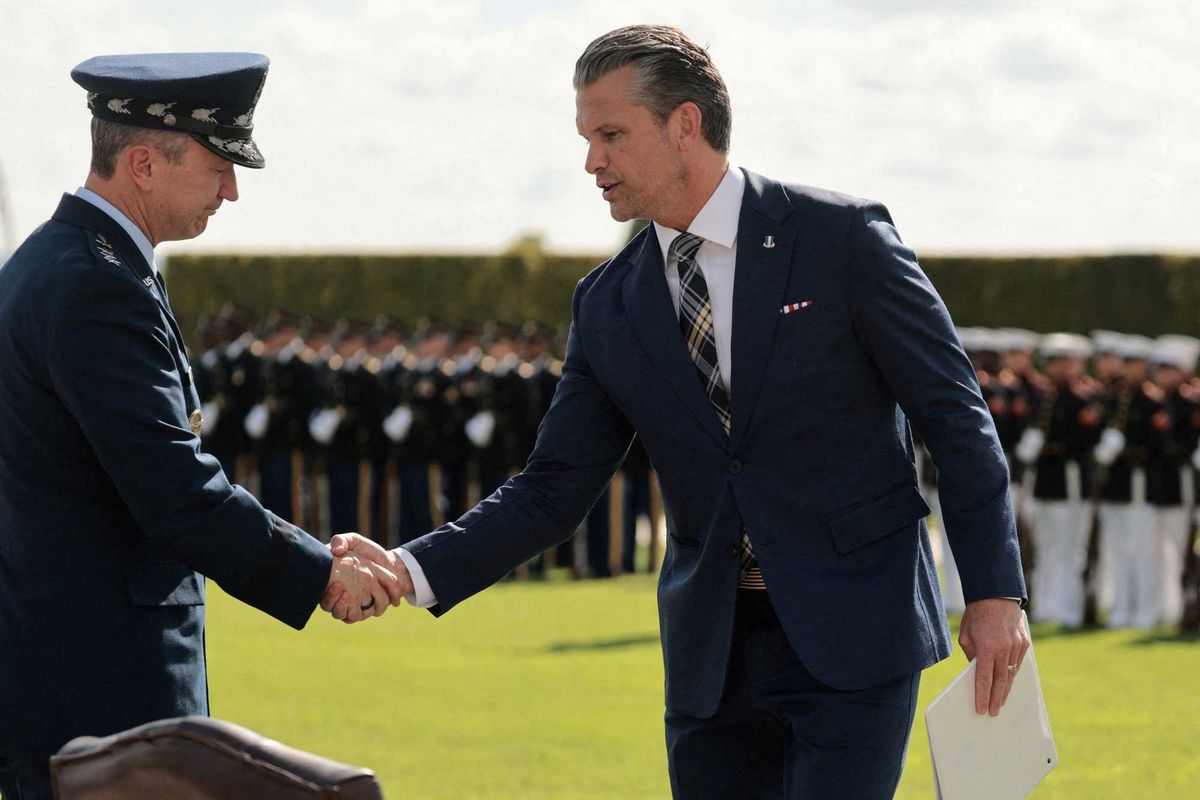
FILE PHOTO: US Defense Secretary Pete Hegseth shakes hands with Chairman of the Joint Chiefs of Staff US Air Force General Dan Caine as he returns to his seat after his remarks at a ceremony in remembrance of US military prisoners of war and those missing in action (POW/MIA) at the Pentagon in Washington, D.C., US, September 18, 2026. REUTERS/Jonathan Ernst/File Photo
Defense Secretary Pete Hegseth alarmed some analysts Thursday after he announced he was inviting a few private citizens to collaborate with the Defense Department on the future of warfare.
Elon Musk, founder of SpaceX, and Palmer Luckey, founder of drone company Anduril, have been given advisory roles in a Pentagon project about the future of war, The Guardian reported. The project, known as “Project Meridian," seeks to develop new weapons of war for different terrain ranging from outer space to subterranean.
The inclusion of private citizens in defense contracting is nothing new, but Brendan Glavin at Open Secrets noted in the report that the motley crew Hegseth has gathered raises some important questions.
“Bringing major industry players into these types of positions at the Pentagon is not something new, but what feels different now is the substantial financial support these two have, and continue to, deliver for the Republican Party,” Glavin told The Guardian.
Musk was one of the largest donors to President Donald Trump's 2024 campaign, spending an estimated $250 million to help elect the president. Musk's companies have also been deeply wedded to some of the Trump administration's pet projects, such as the Department of Government Efficiency and the so-called "golden dome" missile defense project.
Luckey's company is also supported by the venture capital firm run by Trump's son-in-law, Jared Kushner, according to the report.
Luckey has also been dubbed the "godfather of Republican fundraising on the West Coast," according to the report.
"Invitations to political fundraisers obtained by the Guardian show Luckey hosted and co-hosted events for candidates from Trump himself to Ken Calvert, Rick Scott, Mehmet Oz, Ted Cruz and others. The most recent event was on 22 August, where he and his wife co-hosted a $50,000-a-head effort to 'Keep the Senate,' and listing guests John Thune of South Dakota, Mike Rogers of Michigan, Dan Sullivan of Alaska and Jon Husted of Ohio," the report reads in part.
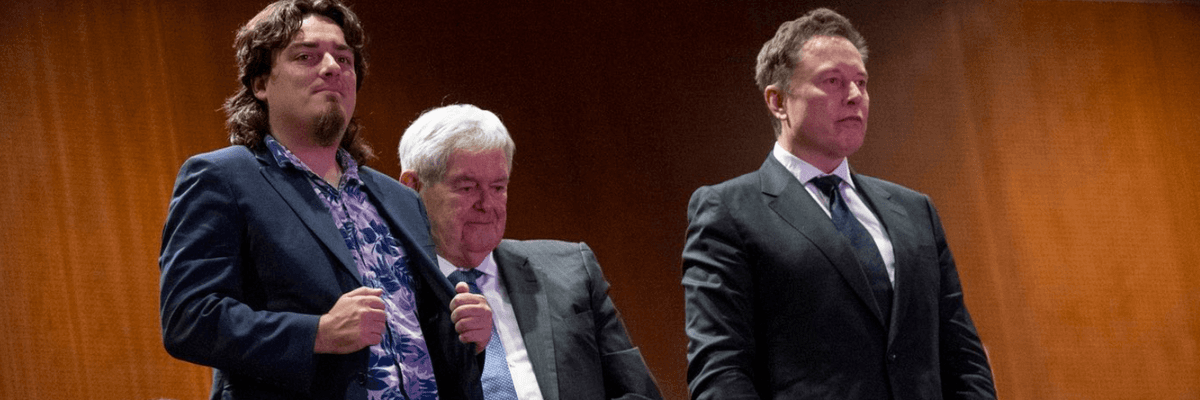
Palmer Luckey (left), Newt Gingrich (center), and Elon Musk (right) look on during US Secretary of Defense Pete Hegseth’s “State of the Force” speech—in which the trio was announced as leaders of the “future of warfare” initiative—at Marine Corps Base Quantico in Virginia on September 30, 2026.
(Photo by Sean Parnell/X)
Brett Wilkins
Sep 30, 2026
COMMON DREAMS
US Defense Secretary Pete Hegseth announced Wednesday that three men—none of whom have served in the military and two who make billions of dollars from it—will help lead a new Pentagon project on the “future of warfare,” even as he moves to eliminate hundreds of senior armed service leadership position, including many generals and admirals.
Hegseth unveiled Project Meridian during his “State of the Force” address at Marine Corps Base Quantico in Virginia. The 120-day initiative will examine emerging technologies that the Department of Defense believes will be critical in future warfare.
“America’s best minds” will be brought together to “reimagine what warfare will look like in the future,” Hegseth said.
To that end, the defense secretary said that “Project Meridian will be co-led by three of our nation’s best minds, Elon Musk, Palmer Luckey, and Newt Gingrich.”
Musk, the world’s wealthiest human, is already deeply involved in US national security infrastructure through SpaceX—the recipient of billions of dollars in Pentagon contracts—and other businesses. He was previously part of the administration as the de facto leader of the Department of Government Efficiency.
Luckey, who like Musk is a major Trump donor, is the co-founder of defense technology company Anduril Industries. Last year, he said that Anduril planned to produce “large numbers” of cruise missiles, fighter jets, and other artificial intelligence-powered weapons systems.
“If we have to fight Iran, and China, and Russia all at the same time, we are screwed,” Luckey said in pushing for more arms production.
Gingrich is a former Republican speaker of the House of Representatives who had been pushing for war with Iran since at least 2005. Like President Donald Trump, he has been accused of dodging the draft during the Vietnam War by receiving numerous deferments; in Trump’s case for bone spurs, and for Gingrich because he was a student and a father.
“Those three great Americans are going to be joined by a team of senior leaders, hand-picked private sector leaders, and subject matter experts from across our nation’s unmatched innovation, academic, and policy ecosystems,” said Hegseth—whose Senate confirmation last year was so contentious due to concerns about him being unfit for office that it required a tie-breaking vote by Vice President JD Vance.
The defense secretary also announced the creation of an Autonomous Warfare Command—or Autowarcom—“a new four-star combatant command with service-like authorities built to scale autonomous and robotic capabilities across the joint force.”
The appointments come as Hegseth simultaneously pursues a major reduction in the military’s senior leadership. He announced Wednesday that the Pentagon would eliminate 20% of its roughly 800 general and admiral positions by January—doubling a previously announced 10% reduction. Hegseth described the cuts as necessary to eliminate “redundant force structure” and “unnecessary bureaucratic layers.”
The reductions follow the removal or early departure of more than two dozen senior military and civilian defense officials since Hegseth became defense secretary.
The contrast has drawn criticism from lawmakers and military observers, who expressed alarm at the prospect of removing experienced officers while handing an influential role in planning future war to warfare technology executives and a hawkish former lawmaker who is no longer accountable to the public.
“Interesting. A board loaded with defense contractors and one draft-dodging war hawk will decide the future of the US military,” NewBlue USA executive Marty Taylor said on social media. “What could possibly go wrong?”
Robert Davis
October 1, 2026
RAW STORY
FILE PHOTO: US Defense Secretary Pete Hegseth shakes hands with Chairman of the Joint Chiefs of Staff US Air Force General Dan Caine as he returns to his seat after his remarks at a ceremony in remembrance of US military prisoners of war and those missing in action (POW/MIA) at the Pentagon in Washington, D.C., US, September 18, 2026. REUTERS/Jonathan Ernst/File Photo
Defense Secretary Pete Hegseth alarmed some analysts Thursday after he announced he was inviting a few private citizens to collaborate with the Defense Department on the future of warfare.
Elon Musk, founder of SpaceX, and Palmer Luckey, founder of drone company Anduril, have been given advisory roles in a Pentagon project about the future of war, The Guardian reported. The project, known as “Project Meridian," seeks to develop new weapons of war for different terrain ranging from outer space to subterranean.
The inclusion of private citizens in defense contracting is nothing new, but Brendan Glavin at Open Secrets noted in the report that the motley crew Hegseth has gathered raises some important questions.
“Bringing major industry players into these types of positions at the Pentagon is not something new, but what feels different now is the substantial financial support these two have, and continue to, deliver for the Republican Party,” Glavin told The Guardian.
Musk was one of the largest donors to President Donald Trump's 2024 campaign, spending an estimated $250 million to help elect the president. Musk's companies have also been deeply wedded to some of the Trump administration's pet projects, such as the Department of Government Efficiency and the so-called "golden dome" missile defense project.
Luckey's company is also supported by the venture capital firm run by Trump's son-in-law, Jared Kushner, according to the report.
Luckey has also been dubbed the "godfather of Republican fundraising on the West Coast," according to the report.
"Invitations to political fundraisers obtained by the Guardian show Luckey hosted and co-hosted events for candidates from Trump himself to Ken Calvert, Rick Scott, Mehmet Oz, Ted Cruz and others. The most recent event was on 22 August, where he and his wife co-hosted a $50,000-a-head effort to 'Keep the Senate,' and listing guests John Thune of South Dakota, Mike Rogers of Michigan, Dan Sullivan of Alaska and Jon Husted of Ohio," the report reads in part.
‘Best Minds’? Hegseth Taps Elon Musk, Palmer Luckey, and Newt Gingrich to Lead ‘Future of Warfare’ Project
“A board loaded with defense contractors and one draft-dodging war hawk will decide the future of the US military,” said one observer. “What could possibly go wrong?”
“A board loaded with defense contractors and one draft-dodging war hawk will decide the future of the US military,” said one observer. “What could possibly go wrong?”
Palmer Luckey (left), Newt Gingrich (center), and Elon Musk (right) look on during US Secretary of Defense Pete Hegseth’s “State of the Force” speech—in which the trio was announced as leaders of the “future of warfare” initiative—at Marine Corps Base Quantico in Virginia on September 30, 2026.
(Photo by Sean Parnell/X)
Brett Wilkins
Sep 30, 2026
COMMON DREAMS
US Defense Secretary Pete Hegseth announced Wednesday that three men—none of whom have served in the military and two who make billions of dollars from it—will help lead a new Pentagon project on the “future of warfare,” even as he moves to eliminate hundreds of senior armed service leadership position, including many generals and admirals.
Hegseth unveiled Project Meridian during his “State of the Force” address at Marine Corps Base Quantico in Virginia. The 120-day initiative will examine emerging technologies that the Department of Defense believes will be critical in future warfare.
“America’s best minds” will be brought together to “reimagine what warfare will look like in the future,” Hegseth said.
To that end, the defense secretary said that “Project Meridian will be co-led by three of our nation’s best minds, Elon Musk, Palmer Luckey, and Newt Gingrich.”
Musk, the world’s wealthiest human, is already deeply involved in US national security infrastructure through SpaceX—the recipient of billions of dollars in Pentagon contracts—and other businesses. He was previously part of the administration as the de facto leader of the Department of Government Efficiency.
Luckey, who like Musk is a major Trump donor, is the co-founder of defense technology company Anduril Industries. Last year, he said that Anduril planned to produce “large numbers” of cruise missiles, fighter jets, and other artificial intelligence-powered weapons systems.
“If we have to fight Iran, and China, and Russia all at the same time, we are screwed,” Luckey said in pushing for more arms production.
Gingrich is a former Republican speaker of the House of Representatives who had been pushing for war with Iran since at least 2005. Like President Donald Trump, he has been accused of dodging the draft during the Vietnam War by receiving numerous deferments; in Trump’s case for bone spurs, and for Gingrich because he was a student and a father.
“Those three great Americans are going to be joined by a team of senior leaders, hand-picked private sector leaders, and subject matter experts from across our nation’s unmatched innovation, academic, and policy ecosystems,” said Hegseth—whose Senate confirmation last year was so contentious due to concerns about him being unfit for office that it required a tie-breaking vote by Vice President JD Vance.
The defense secretary also announced the creation of an Autonomous Warfare Command—or Autowarcom—“a new four-star combatant command with service-like authorities built to scale autonomous and robotic capabilities across the joint force.”
The appointments come as Hegseth simultaneously pursues a major reduction in the military’s senior leadership. He announced Wednesday that the Pentagon would eliminate 20% of its roughly 800 general and admiral positions by January—doubling a previously announced 10% reduction. Hegseth described the cuts as necessary to eliminate “redundant force structure” and “unnecessary bureaucratic layers.”
The reductions follow the removal or early departure of more than two dozen senior military and civilian defense officials since Hegseth became defense secretary.
The contrast has drawn criticism from lawmakers and military observers, who expressed alarm at the prospect of removing experienced officers while handing an influential role in planning future war to warfare technology executives and a hawkish former lawmaker who is no longer accountable to the public.
“Interesting. A board loaded with defense contractors and one draft-dodging war hawk will decide the future of the US military,” NewBlue USA executive Marty Taylor said on social media. “What could possibly go wrong?”
Patriotic Cowboys ‘R Us
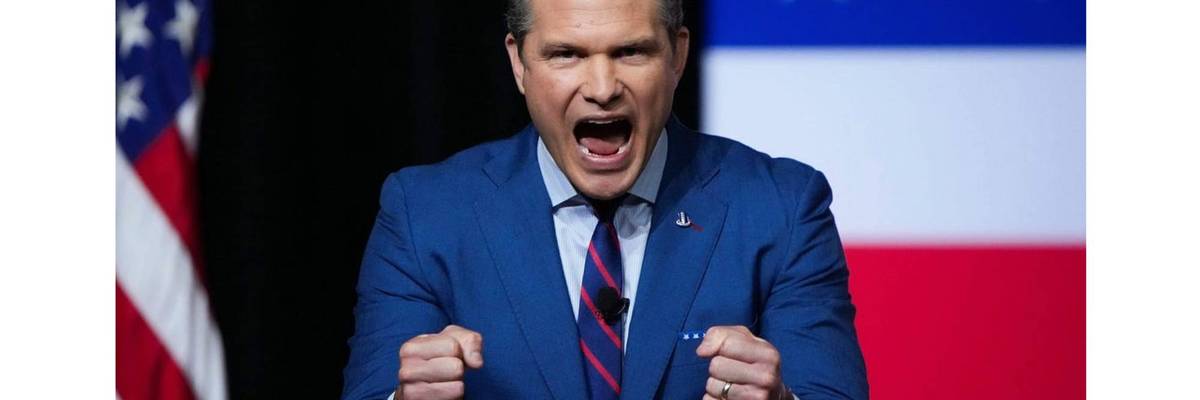
Warfighter-obsessed Pete Kegsbreath
Photo by Andrew Harnik/Getty Images
Abby Zimet
Oct 02, 2026
FURTHER
Warfighter-obsessed Pete Kegsbreath
Photo by Andrew Harnik/Getty Images
Abby Zimet
Oct 02, 2026
FURTHER
COMMON DREAMS
Sidestepping his debacle of a war, “smug pathetic little man,” warfighter fetishist and Gen.-Patton-cosplaying clown Pete Hegseth just gave a blustering speech before troops In a “hyper-macho freak show” to announce he’s cutting forces, starting several senseless new programs, and proclaiming, “We are no longer the woke (or) weak department...No fatties, trannies, beardos, weirdos, wimps, radicals. Just warriors.” Appalled consensus on the yahoo “turning the military into a frat house”: “What a dick.”
Perhaps due to his low-rent credentials as a weekend TV host at Fox - and a history of drunkenness, adultery, sexual assault and on-the-job incompetence so sordid he needed JD’s tie-breaking vote to get his job - Hegseth has built a sloppy, fragile “Department of Defensiveness” focused on shaping a narrative and persona to his liking - one based on paranoia, distrust, dysfunction, lies and frequent purges of those deemed disloyal. From his make-up studio to his press strictures to his blunders - Signalgate, the war, its first day’s war crimes - Pete’s spent an inordinate amount of time covering his ass and overcompensating for his failures. “He’s just a true believer in way over his head, the living embodiment of the Dunning-Kruger effect,” said one DOD employee. “Generally, we consider him a joke, a deeply unqualified clown.”
Still, with men reportedly fleeing MAGA, their need to “pump up that masculine animus” is well-served by Pete’s juvenile, chest-pounding, lethality-obsessed focus on testosterone in the name of a “High-T Department of War” that has “nothing to do with science and everything to do with regressive ideas of what masculinity is.” The same idiocy fuels all the culture war malevolence: Banning books, gutting DEI initiatives - “Diversity is not our strength” - blocking promotions for women and Blacks, a “no more dudes and dresses” transphobia, and ending tenure for civilian professors at military academies ‘cause who needs to protect independent thinkers, scholars, leaders, experts from “the tyranny of a government that actively hates its critics,” the “mindset of someone who has learned nothing (from) American military failures.”
And so to another cringey, Strangelovian “State of the Force Address,” which was not a thing until a TV bobblehead took over the military and turned it into bumbling amateur-hour theater. Last year, he summoned nearly 800 generals, admirals, advisors from around the world, all smarter and higher-ranking than him, to rant about beards and “fat troops,” tell them they “kill people and break things for a living,” and prattle about a 10% cut in their numbers by “removing redundant force structure to optimize and streamline leadership.” When he paused for applause, there was only deep silence. Maybe because a Joint Chiefs chairman, two service chiefs, two intelligence directors, several generals and the better part of the Army’s senior leadership “were told to run faster by a weekend television host.”
On Wednesday, he gathered about 600 officers and enlisted members, again at the Quantico Marine Corps Base in Virginia, for another speech. In the weeks leading up to his latest dash of show business, The Wall Street Journal reported, he emailed commanders asking them to nominate troops to attend. They had to “fit certain physical standards,” he wrote, to have the proper height/weight ratio, with “impeccable grooming: ”I want central casting.“ If they were hot enough, he added, as a bonus some would have ”the opportunity“ to join him in a hot and sweaty dawn work-out at the Pentagon. Totally normal! And luckily, a camera crew was there to follow them on a chanting, banner-bearing run through D.C. To make them look even cooler, he gave them all t-shirts that read, ”This Is War.“ Or at least off-off Broadway.
Later, before a giant American flag, he dropped the hammer in a campy speech many compared to SNL’s Colin Jost doing Pete Hegseth, or Tom Cruise’s braying misogynist in Magnolia, or George C. Scott’s Gen. Patton “minus the inspiration.” Under his “less generals, more GIs” mandate - though it’s “fewer” not less - he said he was doubling the previous cut of 10% of high-ranking personnel to 20% with, wrote Tom Wellborn, “the confidence of a man who has looked at the most powerful armed force in the world and concluded its central weakness was the number of people in it who outrank a major,” what he was. Months into a disastrous war, “That is the force Pete Hegseth has built by subtraction. What it has lost is (what) a general is for, which is to be the person in the room who says no, and (he) has made sure, one firing at a time, there is nobody left in the room to say it.”
“The media calls that a purge,” blustered Hegseth, evidently expecting criticism. “I call it accountability. As usual, what the media levels as an accusation, I wear as an accomplishment.” He haughtily went on to “lay it out simply for the anti-American losers in our media...We are no longer the woke department, or the weak department. Simple translation? No fatties, no trannies, no beardos, no weirdos, no wimps, no radicals. Just warriors.” On coverage of the war and eight attempted suicides on the USS Lincoln, he slammed “disingenuous headlines about deployment lengths, false claims of low troop morale or flat-out propaganda as if it’s written by our adversaries.” “The information space is a battle space,” he said. “The ideological clowns are out. The patriotic cowboys are in.” Smirking, he added,.“With testosterone testing on top.” Jesus, dude.
He also announced several new programs with fancy warlike names like Fortress America and Autonomous War Command or AutoWarCom, a “four-star combatant command with service-like authorities built to scale autonomous and robotic capabilities,” and “The Next Great American Base,” the first new military base in 40 years, with all 50 states “invited to bid for it like an Amazon headquarters,” and “America’s Corps of Cadets, creating new college partnerships with right-wing Liberty University and Hillsdale College, plus Louisiana State, Mississippi, Tuskegee Universities, to increase the number of ”patriotic leaders of character“ and counter ”anti-American, DEI-worshiping woke factories,“ aka the Ivy League schools Hegseth attended.
There’s the bonkers Project Meridian to study “the future of warfare,” headed by “three of our nation’s best minds” - two tech fat cats and one 83-year-old MAGA hawk - none of whom have served in the military, two of whom have made fortunes from it. Cue Elon Musk, a gonzo rocket salesman with billions in Pentagon contracts, GOP pol Newt Gingrich, who got almost as many deferments as Trump during the Vietnam War, and Palmer Luckey, MAGA donor, self-proclaimed “radical Zionist” and founder of tech company Anduril - “three great Americans to help plan the next war with three people who have never been in one,” what could possibly go wrong?“ From a military Reddit: ”Is this real?“, ”Yes master code-monkey, infosec ninja, and tech infrastructure guru Newt Gingrich age 83. Our enemies are so fuct bro!“ and ”Oh fuck this fucking Nazi-loving fuck outta here.“
There’s a new Office of Religious Affairs for a DOD “putting on the full armor of God” to “strengthen the moral, ethical and spiritual readiness of our warfighters,” aka “do the Lord’s work to improve smiting capacity,” because, “while we wage physical war, the real battle is spiritual.” (Maybe why the Pentagon’s covering up not-real casualties?) It’s “voluntary,” which skeptics say is akin to being “voluntold” to do things. Finally, as a party favor, troops were given a new 144-page “field manual” of transcripts of Hegseth speeches. Its forward is by Trump, in classic Trumpese. “As your Commander-in-Chief, I will not ask you to fight dumb Wars,” it reads. “I will unleash you to be violent, lethal and unstoppable - and I will always have your back. Godspeed, Great Warriors. Thank you for your attention to this matter!”
YouTubewww.youtube.com
Along with other regime Nazis, crackpots and fools, theories abound as to what the fuck is wrong with Pete Hegseth. Many argue he’s afflicted with the common sickness of countless, soulless, mediocre white men who know, deep inside, they have risen further than they deserve to. Hence, the bottomless need to be subservient to a monster like Trump (who is too mad to know that) to maintain their place and value in a white guy patriarchy, to always understand “who they get to abuse, and who they are supposed to take abuse from,” and to remain within that vaunted structure, the only one where they have power and respect, by continuing to rule over those they’ve been taught are beneath them. It’s also why, conversely, they freak out when their vital slot is threatened: See Hegseth’s frantic lie detectors at any sign of leaking, mocking, saying no.
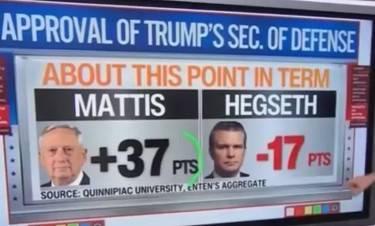
Hegseth seems particularly despised by Americans, many of whom eagerly await his war crimes trial, his impeachment,, his rapturing - hopefully first in line, though maybe behind Goebbels/Miller. The concrete damage done by his legacy - the calamitous war, hollowing of the military’s promotion chain, lethality-tinged dumbing down of its intellectual infrastructure and exploitation of those serving - will presumably take years to repair. But people hate him just as much for his personal failings: his gross unfitness and incompetence, his swaggering “Jr High Machismo,” the Nazi-adjacent arrogance of “this nose-powdering drunk,” the lying, preening chutzpah of the military’s worst-ever leader consistently “acting like a 19-year-old edgelord loser,” like “a dipshit,” “an asshole,” “an absolute tinydick in every goddamn way.”
Several truly obnoxious moments of his state-of-the-empire speech ignited that animus. His attack on media who do their job and tell the truth about him began with a lame nod to the First Amendment - “A free press is of course important” - that veered to a diatribe: “But partisan activism that intentionally smears the troops and the historic mission they are undertaking (is) anti-American. It’s sick. It’s a national betrayal. It’s treason, actually...It has to be said.” Umm, not, said America: “Secretary of Dewar’s doesn’t get he’s the only one getting smeared, not the troops,” “I love the free press until they say words I don’t like in which case I call them traitors and want them killed,” “Bro, they’re not shitting on the troops, just you,” “It’s called free speech, fucknut. The thing your troops are supposed to defend,” “The mission of our military has become historic only in the degree of its absurdity.”
Then there was a pitiful, fitness-instructor-like defense of his bullying of troops: “Telling someone to get in shape or shave or fix their uniform or start busting their ass - that’s not discrimination. That’s leadership.” Fact: Actually, it’s neither. It’s stupid, shallow, beside-the-point bullying. Many argued it’s just “being a dick” and “an asshole.” That he should “tell his boss to get in shape and start busting his ass.” That it’s weird how he “doesn’t get to the part where he actually discriminates.” That leadership is “inspiring, being an example, not getting your nation into an illegal war, losing it in days and committing war crimes.” That he’s “a drunk, vain, adulterous rapist with ridiculous sideburns.” That it’s “stunning in an awful way a man his age is so immature.” That “this motherfucker is waaay out over his skis.” And damn, more fucking patriotic cowboys is the last thing we need thanks.
Along with other regime Nazis, crackpots and fools, theories abound as to what the fuck is wrong with Pete Hegseth. Many argue he’s afflicted with the common sickness of countless, soulless, mediocre white men who know, deep inside, they have risen further than they deserve to. Hence, the bottomless need to be subservient to a monster like Trump (who is too mad to know that) to maintain their place and value in a white guy patriarchy, to always understand “who they get to abuse, and who they are supposed to take abuse from,” and to remain within that vaunted structure, the only one where they have power and respect, by continuing to rule over those they’ve been taught are beneath them. It’s also why, conversely, they freak out when their vital slot is threatened: See Hegseth’s frantic lie detectors at any sign of leaking, mocking, saying no.
Hegseth seems particularly despised by Americans, many of whom eagerly await his war crimes trial, his impeachment,, his rapturing - hopefully first in line, though maybe behind Goebbels/Miller. The concrete damage done by his legacy - the calamitous war, hollowing of the military’s promotion chain, lethality-tinged dumbing down of its intellectual infrastructure and exploitation of those serving - will presumably take years to repair. But people hate him just as much for his personal failings: his gross unfitness and incompetence, his swaggering “Jr High Machismo,” the Nazi-adjacent arrogance of “this nose-powdering drunk,” the lying, preening chutzpah of the military’s worst-ever leader consistently “acting like a 19-year-old edgelord loser,” like “a dipshit,” “an asshole,” “an absolute tinydick in every goddamn way.”
Several truly obnoxious moments of his state-of-the-empire speech ignited that animus. His attack on media who do their job and tell the truth about him began with a lame nod to the First Amendment - “A free press is of course important” - that veered to a diatribe: “But partisan activism that intentionally smears the troops and the historic mission they are undertaking (is) anti-American. It’s sick. It’s a national betrayal. It’s treason, actually...It has to be said.” Umm, not, said America: “Secretary of Dewar’s doesn’t get he’s the only one getting smeared, not the troops,” “I love the free press until they say words I don’t like in which case I call them traitors and want them killed,” “Bro, they’re not shitting on the troops, just you,” “It’s called free speech, fucknut. The thing your troops are supposed to defend,” “The mission of our military has become historic only in the degree of its absurdity.”
Then there was a pitiful, fitness-instructor-like defense of his bullying of troops: “Telling someone to get in shape or shave or fix their uniform or start busting their ass - that’s not discrimination. That’s leadership.” Fact: Actually, it’s neither. It’s stupid, shallow, beside-the-point bullying. Many argued it’s just “being a dick” and “an asshole.” That he should “tell his boss to get in shape and start busting his ass.” That it’s weird how he “doesn’t get to the part where he actually discriminates.” That leadership is “inspiring, being an example, not getting your nation into an illegal war, losing it in days and committing war crimes.” That he’s “a drunk, vain, adulterous rapist with ridiculous sideburns.” That it’s “stunning in an awful way a man his age is so immature.” That “this motherfucker is waaay out over his skis.” And damn, more fucking patriotic cowboys is the last thing we need thanks.
How Pete's (deservedly) doingScreengrab from CNN

