First published in Spanish at Viento Sur. Translation by International Viewpoint.
Perhaps paraphrasing Marx and Engels in the Communist Manifesto, when they described the revolutionary process that swept through Europe at the end of the 1940s as a spectre, we could describe the counter-revolutionary cycle that is sweeping through Our America in these 2020s as a spectre, albeit of the opposite kind.
This is a cycle that began tentatively with the electoral victories of Jair Bolsonaro and Nayib Bukele in Brazil and El Salvador in 2019, continued with the governments of Santiago Peña, Javier Milei, and Daniel Noboa in Paraguay, Argentina, and Ecuador in 2023, and then began to accelerate with the victories of Rodrigo Paz in Bolivia in 2025, José Antonio Kast, Nasry Asfurade (elected in 2025 but taking office in 2026), and Laura Fernández Delgado in Chile, Honduras, and Costa Rica. Meanwhile, Abelardo de la Espriella and Keiko Fujimori in Colombia and Peru won their respective elections in 2026 and were awaiting the inauguration of their respective countries at the time of writing.
If we consider the period from 2023 to 2026, far-right victories were seen in 13 of the 16 presidential elections held during that time. But it is since Donald Trump assumed the presidency of the United States 18 months ago that this political shift has intensified, with far-right candidates winning the last seven presidential elections in the region.
Simultaneity of processes
It is a politically novel phenomenon, both because of its simultaneity and coincidence, and because of the depth of the regressive reforms and structural changes it proposes. Furthermore, it does not appear to be a random or merely episodic event. In any case, its effects will be long-lasting.
A political shift has occurred. The “orange wave,” as The Economist dubbed it (referring to the US president’s skin tone), is dominant, embodied by a group of leaders who have attained political power in their countries through liberal democracy, capitalizing on popular frustrations with previous periods and governments. In a way, they are a product of the social decay imposed by decades of neoliberalism (concentration of wealth, expansion of poverty, uncertainty, and a lack of future prospects), which have instilled in the world the idea that there is no way out. However, the capitalist crisis that has been unfolding since 2008, which remains unresolved, cannot be ignored. In Latin America, this crisis has taken the form of an organic crisis characterized by high social and environmental vulnerability.
These governments, despite their differences and heterogeneity, have adopted the style, rhetoric, and agenda of Trumpism (authoritarianism, racism, sexism, homophobia, anti-environmentalism, the reconstruction of patriarchy, and the use of hate as a political tool). They have found that simple and direct messages on social media are a very effective way to connect with voters.
With Venezuela transformed by imperialist military aggression into a kind of US protectorate, and with Cuba blockaded and threatened with invasion, for now only Brazil, led by Lula, who is seeking reelection, and Mexico — the region’s two largest economies, together representing almost 70% of the regional GDP — are resisting this wave. Uruguay is also resisting to the extent possible.
In this context, the upcoming presidential elections in Brazil take on a decisive character. If the far right and Bolsonaro’s movement were to triumph, the consequences would be significant. Should the PT regain political power, the region will present an unprecedented and difficult-to-predict political landscape. Conversely, if the PT manages to win the elections, the country’s size could put a powerful brake on the current wave sweeping the region.
A turning point
It would be a mistake to interpret this rightward shift in the governments of Our America as a new phase in the alternation between right-wing and progressive governments, as a new turn resulting from frustrations, adaptations of progressive movements, and a return to traditional conservatism, or as an electoral wave in which all the opposition parties win. This surge of the extreme right can be seen as a response to the so-called leftward turn of the progressive- neo-developmentalist governments of the first 15 years of this century; however, it is a true turning point.
Those experiences altered the balance of social power but failed to change the pattern of accumulation and the subordinate integration into the global market, nor did they distribute wealth. Thus, predatory extractivism and the primary sector grew, while manufacturing declined.
US destabilization maneuvers, attempts at re-election, corruption, or demobilizing practices, the multi-class consensus that allowed them to achieve a degree of hegemony broke down, and governments ended up relying on clientelism and electoralism to guarantee governability. They have ultimately made it clear that progressivism, by failing to envision a horizon of overcoming capitalism and remaining solely focused on reforms — with varying degrees of intensity — and adopting a conservative stance regarding the autonomy of the masses, found its own limitations there.
The following period saw a return of traditional conservative right-wing politics (the Macri, Bolsonaro, Piñera, and Añez governments in Argentina, Brazil, Chile, and Bolivia) and then a tepid attempt at low-intensity progressivism (the Boric, Fernández, and Arce governments in Chile, Argentina, and Bolivia), to name just the Southern Cone of Latin America. These attempts were short-lived and resulted in significant frustrations. Building on these frustrations, whether neoliberal or neo-developmentalist, the extreme right has been gaining ideological and electoral ground, a process in which the crisis of political representation, attacks on journalism, disinformation, and the half-truths or outright lies circulating on social media have played a decisive role.
These new right-wing movements are far more radical, far more profound in the structural changes they promise, and far more aggressive in dismantling the democratic consensus achieved in the previous period. They promote the broadest deregulation of capital flows, the curtailment, if not the elimination, of social and political rights, the lack of protection for workers, women, peasants, Indigenous peoples, common goods, and nature, the dismantling of education and healthcare policies, the expropriation of Indigenous peoples and their identities, and the use of public debt to justify permanent austerity policies. It is a full-scale attack against the working class and in favor of capital, seeking to establish a long-lasting, regressive balance of power.
Much more market-intensive. An extreme neoliberalism that defines the market as the best allocator of resources and as the measure of all values, that emphasizes modernizing repressive forces and increasing military spending in each country. They are thus a turning point, a watershed moment with respect to the entire preceding period.
In Argentina, the Milei government, completely subservient to the US, is at the forefront of this process, with an ultraliberal experiment in the regressive reconfiguration of the productive matrix and society. It aspires to lead a group of countries identified with Trumpist policies in the context of the China- US dispute. The current diplomatic crisis with Brazil is an expression of this global conflict. Within this framework, the Argentine government is preparing a meeting of leaders from these far-right groups for the end of the year, dubbed the Blue Summit, seeking to consolidate ties and position President Milei as the regional leader. Of course, much depends on the results of the upcoming elections in Brazil and the US, which could influence the region and particularly the presidential elections next year in Argentina.
Associated with Trumpism
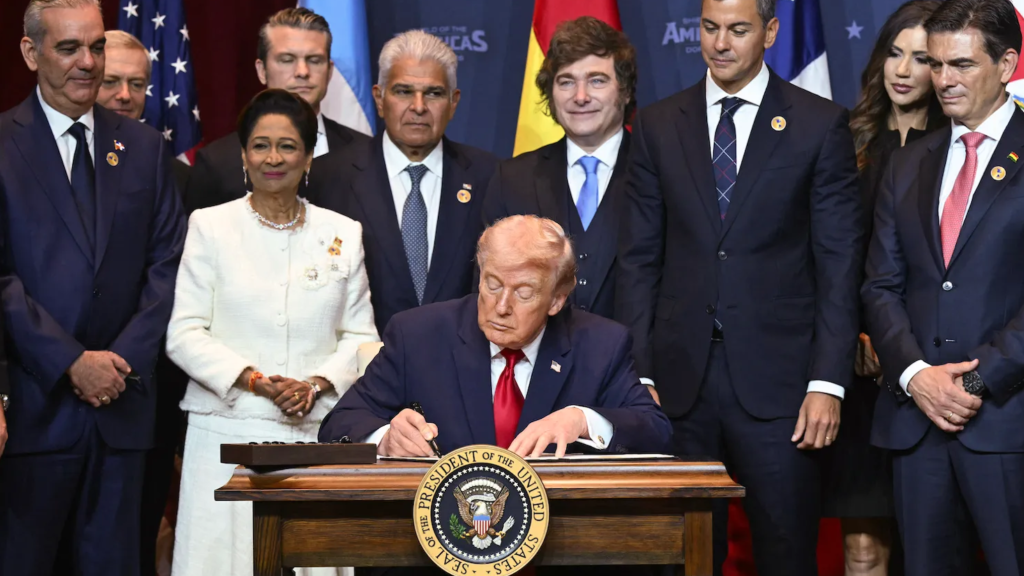
The region is entering a new period of militarization with the integration of the Shield of the Americas. This multinational political-military coalition, proposed by the US, comprises 12 countries that have pledged to combat drug cartels and terrorism militarily within their respective nations. It serves as a smokescreen to justify US troop intervention in the region. In mid-July, US Secretary of State Marco Rubio convened numerous representatives from various countries to present an international strategy aimed at combating what he defined as "far-left political terrorism," seeking to coordinate security agencies and intelligence sharing.
US’s New National Security Strategy (November 2025), which has been deploying a much more aggressive imperial policy, inaugurated under the pretext of combating drug trafficking and the indiscriminate bombing, without evidence and in violation of international agreements, of small vessels in the Caribbean. An executive order from the Trump administration, "Establishing an America First Arms Transfer Strategy," promotes arms sales abroad. Latin America is considered a good market, and investments in the arms industry will further constrain public policies that could be implemented to address growing social inequalities. With the increased involvement of militaries in internal affairs, the dangers to the future of liberal democracies in the region grow, as national defense and internal control become intertwined.
The military invasion of Venezuela and the kidnapping of its president and his wife (a national deputy) on January 3 of this year were a continuation of that offensive. Simultaneously, the US threatened to annex Greenland until it had established three military bases on the island and to rename the Gulf of Mexico the Gulf of the Americas. It succeeded in getting Panama to expel Asian companies from the canal, which it declared a priority for US national security, even knowing that, due to its shallow draft, only commercial vessels can pass through. It forced Chile to suspend the project for a submarine fiber optic cable from Concón to Hong Kong, while Argentina suspended the agreement to build a radio telescope in the province of San Juan. Recently, the US ambassador to Argentina threatened members of an electric cooperative over an agreement with Huawei and warned about the continuation of US investments in Vaca Muerta. This is a pressure strategy aimed at achieving a highly ambitious objective: control of more than 30,000 km of fiber optics, an essential infrastructure for the deployment of 5G.
Trump has understood that unilateralism in the world is over, and with it, the role of US hegemonic power. He is therefore seeking to redesign the global landscape, reorganizing it into areas of influence and security dominated by the major powers (US, China, Russia) while withdrawing into the Western Hemisphere (from the Arctic to Antarctica). With this withdrawal, he aims to address what he considers strategic objectives: blocking China’s access (with $600 billion in annual trade, it is the region’s largest trading partner, in addition to financing substantial investments) and guaranteeing political control for his subordinate and unconditional allies.
They also need access to the natural resources necessary for their value chains and the energy transition. Latin America takes on particular importance in this regard, with the enormous biodiversity of the Amazon, the Andean ecosystems, and the vast wetlands. According to ECLAC, the region holds almost 20% of the world’s hydrocarbon reserves, more than 40% of global biodiversity, and 30% of primary forests, along with large river basins and the Guarani Aquifer, one of the world’s largest underground freshwater reservoirs.
In this era of accumulation by dispossession, major powers are vying for abundant resources in our region: metallic minerals (gold, silver) and so-called critical minerals (lithium, copper, nickel, cobalt, among others), as well as rare earth elements (17 little-known elements that play a central role in the manufacture of lithium batteries, magnets for electric vehicles, electronic circuits, catalysts for the chemical industry, and turbines for wind turbines and the arms industry). Various international organizations have estimated that the demand for these minerals will quadruple in the coming decades.
Almost all the far-right governments in Latin America are followers of Trumpism’s environmental denialism. They deny climate change and encourage the indiscriminate exploitation of our societies’ common resources, since most of our countries’ economies depend on the export of primary products and are heavily reliant on extractive industries. This exacerbates the climate crisis already affecting the subcontinent (loss of biodiversity, air and soil pollution, and contribution to global warming). According to National According to the United Nations, since 2000 a total of 152 million people in the region have been affected by 1,205 natural disasters, including droughts, floods, landslides, fires, hurricanes, and earthquakes. The United Nations considers Latin America and the Caribbean the second most disaster-prone region in the world.
According to the Pentagon’s National Defense Strategy (January 2026), the Atlantic Ocean is of paramount importance due to its interoceanic passages. In this context, the southern part of our subcontinent plays a crucial role, thanks to the Strait of Magellan, the Beagle Channel, and the Drake Passage. Together, these constitute one of the six strategic waterways worldwide and the natural replacement for the Panama Canal in case of emergency or traffic congestion.
However, it would be a mistake to characterize this US withdrawal as implying a disengagement from its interests in other regions of the world. In reality, using a football analogy (permissible amid the World Cup atmosphere), "the team is built from the back." That is precisely what Trump has been doing since assuming his second presidential term: guaranteeing political, economic, and military control of what the US has always considered (as the Monroe Doctrine dictates ) its "backyard." To this end, he has not hesitated to interfere politically and financially in the elections of sovereign nations (the paradigmatic case of Argentina) and to militarize the region under the pretext of drug trafficking, national security, and migration. It is from this position that he seeks to recover hegemonic ground within the context of his relative decline, which, given the results of the war in the Middle East, casts doubt on his capacity for global leadership due to his undeniable defeat.
The disputed future
Most of the electoral victories that allowed the rise of far-right governments were decided in second rounds and by very few points of difference, in some cases by tenths, so the governments take over in totally polarized societies, which calls into question governability.
So far, these governments have focused more on dismantling the achievements of the previous period and modifying the role of the State (which ceases to arbitrate between social classes and reverts to being the general manager of capital’s interests) than on projecting any future. The extreme neoliberalism they profess faces serious difficulties in relaunching the process of capital accumulation and reproduction. They depend increasingly on foreign investment, generally directed toward agribusiness or extractive industries, which, to materialize, demands ever more tax breaks, legal guarantees, and capital flow restrictions that ultimately undermine the sovereignty of peoples and nations.
Thus, projects become trapped by the contradictions of the current situation, with the particularity that the long progressive decade left a foundation of social and democratic rights that workers and popular sectors do not seem willing to relinquish without a fight. Bolivia, with its months of highway blockades by thousands of workers, Indigenous people, and peasants demanding the resignation of President Paz just months after he took office; the precipitous drop in President Kast’s popularity in Chile; and the ongoing mobilizations of various sectors in Argentina are just a few examples of this resistance. In the immediate term, however, if we look beyond the immediate, what weighs heavily and determines the situation is the organic nature of the crisis of capital in the region. This crisis manifests itself in the marked inability to relaunch the accumulation process and in the disaffection of citizens with traditional parties and leaders, which is already a structural problem. These political processes are not irreversible, but their effects will be long-lasting. Nothing guarantees that far-right governments will consolidate their power, only that they will govern in a state of permanent instability, while extreme polarization foreshadows new resistance and opens up a space for the anti-capitalist left.
However, in this historical period, capital centralizes, concentrates, and homogenizes from above, while simultaneously fracturing, dividing, and creating heterogeneity from below. Thus, workers’ and popular struggles against the fascist-like nature of the extreme right and imperialist domination are fragmented and dispersed, not only at the national level but also internationally. This underscores the importance of solidarity and the integration of antifascist and anti-imperialist resistance with the defense of national and popular sovereignty.
Earlier this year, 1,800 prominent figures from around the world signed the “Call for an Antifascist International,” calling on all forces fighting against the rise of the far right, fascism, and imperialist aggression to “coordinate these struggles against increasingly threatening enemies.” The call states: “This convergence can and must include all forces willing to defend the working class, the peasantry, migrants, women, LGBTQ+ people, racialized people, oppressed national or religious minorities, and Indigenous peoples; to defend nature against ecocidal capitalism; to combat imperialist and colonial aggression, regardless of its origin, and to support the struggles of peoples resisting it.”
This call materialized at the end of last March when thousands of people from more than 30 countries gathered in the city of Porto Alegre, Brazil, giving rise to the 1st International Antifascist, Anti-imperialist and for the Sovereignty of Peoples Conference, to share analyses, strengthen ties and agree on concrete actions.
The task will be continued by the Latin American Anti-Imperialist and Anti-Fascist Regional Conference, to be held in Buenos Aires on December 17, 18 and 19 of this year, and then another one in Mexico possibly in March 2027.
The path is laid out; it will be difficult to achieve, but not impossible.
Eduardo Lucita is a Director of the Marxist review Cuadernos del Sur, and member of the Argentinian group Economists of the Left (EDI) and of the Fourth International. He has been active on the revolutionary left since the 1960s.
.png)