Tuesday, June 15, 2021

WHACKADOODLE
Trump cited conspiracy theories to pressure DOJ to overturn 2020 election results, emails show

MICHAEL MCAULIFF AND DAVE GOLDINER NEW YORK DAILY NEWS
JUNE 15, 2021 

Former President Donald Trump repeatedly pressured the Justice Department to overturn Joe Biden’s victory, at one point urging prosecutors to file a Supreme Court lawsuit to nullify the election, according to new emails released Tuesday by the House Oversight Committee.

The emails from Trump and his aides during the last weeks of his presidency revealed bogus claims of fraud and conspiracy theories to win then-Acting Attorney General Jeffrey Rosen’s support, prompting outrage from Rosen’s deputy.

“Pure insanity,” wrote then-Deputy AG Richard Donoghue, after receiving a YouTube link from Trump chief of staff Mark Meadows about a theory involving Italian spies.

Committee Chair Carolyn Maloney, D-N.Y., called the 232-page report a smoking gun that proves Trump wanted to block certification of Biden’s win — a campaign that eventually led to the Jan. 6 storming of the Capitol.

“Trump tried to corrupt our nation’s chief law enforcement agency in a brazen attempt to overturn an election that he lost,” said Maloney.

The emails cited debunked claims of voter fraud in various swing states and outlandish claims spouted by far right-wing conspiracy theorists that Italy used military satellites to switch votes to Biden.

Maloney said the new documents prove the necessity of forcing officials like Meadows, Rosen and former Attorney General Bill Barr to testify under oath about Trump’s and their own actions.

“Those who aided or witnessed President Trump’s unlawful actions must answer the committee’s questions about this attempted subversion of democracy,” the New York Democrat said.

The emails date back to Dec. 14, right as Barr resigned from his post after declaring there was no evidence of widespread fraud or any other substantial issues with the presidential election.

Trump and his acolytes clearly hoped to take advantage of Rosen’s tenuous position to obtain ammunition for their campaign to block Congress from certifying the election.

Meadows demanded in one email that Rosen order prosecutors to look into possible issues with signature matching on absentee ballots in the county that includes Atlanta after Biden narrowly won Georgia.

“Engage on this issue immediately to determine if there is any truth to this allegation,” Meadows wrote.

Rosen resisted the efforts. He wrote to Donoghue deriding the request, according to the documents.

“Can you believe this?” Rosen asked. “I am not going to respond to the message.”

Rosen also said he “flatly refused” Meadows’ demand that he meet with Rudy Giuliani, Trump’s personal lawyer, to discuss the Italian spy claims.

“(I) said I would not be giving any special treatment to Giuliani or any of his ‘witnesses,’” Rosen wrote.

GOP Rep. Jim Jordan, a ranking member of the House Judiciary Committee, argued Tuesday that it’s the Justice Department that should be probed for ignoring Trump and Meadows’ demands.

“When the president, when the chief of staff to the president of the United States asked someone in the Executive Branch to do something, and they basically give him the finger, I think that’s the problem we should be looking into. But that’s not what the Democrats are going to look into,” said Jordan, R-Ohio.



CASINO CAPITALI$M
Hindenburg Research reveals DraftKings short position, says company is hiding black market operations

Will Daniel Jun. 15, 2021, 10:39 AM

DraftKings CEO Jason Robins.
Angela Rowlings/MediaNews Group/Boston Herald via Getty Images

Hindenburg Research revealed its latest short position in a report on Tuesday, setting sights on online betting company DraftKings.

The short seller claimed DraftKings is hiding "black market operations."

Hindenburg says 50% of DraftKings' SPAC partner SBTech's revenue comes from markets where gambling is banned.

Short seller Hindenburg Research revealed its latest short position against DraftKings in a report on Tuesday.

Hindenburg said that one of DraftKings' SPAC merger partners, Bulgaria-based gaming technology company SBTech, "brings exposure to extensive dealings in black-market gaming, money laundering, and organized crime."

The short seller claimed that, according to their estimates based on SEC filings, "supporting documents," and conversations with former employees, roughly 50% of SBTech's revenue comes from markets where gambling is banned.

DraftKings did not immediately respond to Insider's request for comment about the report.

Hindenburg said the company's illicit customer relationships were shuffled into a newly formed "distributor" entity called BTi/CoreTech when DraftKings went public via a SPAC merger with Diamond Eagle Acquisition Corp. in April 2020.

The short seller has been a frequent critic of popular startups, many of which have gone public via SPAC. Previous targets include electric vehicle makers Nikola and Lordstown Motors, as well as Chamath Palihapitiya-backed Clover Health.

Hindenburg also noted that DraftKings insiders have dumped over $1.4 billion in stock since the company went public, and SBTech's founder personally sold around $568 million in shares.

Finally, the short seller argued DraftKings' business model of aggressively spending cash to acquire customers that may or may not be loyal to the platform could be a risk moving forward.

DraftKings stock traded down 4.24% as of 1:14 p.m. ET after news of the short-seller report broke.

Queer Video Game Life Is Strange Coming to Nintendo Switch


Both Life Is Strange: Remastered and Life Is Strange: True Colors are coming to the platform.

BY MEY RUDE
JUNE 15 2021 

Today was Nintendo's presentation at this year's virtual Electronic Entertainment Expo (more commonly known as E3), and apart from announcing a new Metroid game and a classic Tekken character coming to Super Smash, the gaming giant also gave some good news to the queer gamers this morning!

Nintendo just announced that the groundbreaking series of LGBTQ-inclusive video games, Life Is Strange, will be coming to the Switch later this year.

In a preview shown during the Nintendo Direct, we saw cute, cartoon-styled versions of Chloe and Max, as well as Life Is Strange: True Colors' main character Alex Chen. The trio is riding in a train boxcar together through the Pacific Northwest.

Life Is Strange: True Colors launches on Nintendo Switch on September 10, and no release date for the Life Is Strange: Remastered Collection has been announced just yet.

The Remastered Collection stars Max and Chloe in their adventures from both the original game and Before the Storm. There’s no announcement on whether or not Life Is Strange 2 will come to the platform.

The original Life Is Strange featured Max, a queer teen who learns that she can rewind time and must embark on a journey to save her friends and her hometown. In the game, she sparks up a romance with her childhood friend Chloe. The prequel, Life Is Strange: Before the Storm shows Chloe having romantic feelings for another female character, Rachel.

The protagonist of Life Is Strange 2, Sean Diaz, is a bisexual teen with latent telekinetic abilities. Now, in the newest installation of the game, you play as Alex Chen, a young, Asian-American queer woman with the power to read and manipulate other people’s emotions. In the game, you have two potential love interests, one named Ryan, and one named Steph.

It’s going to be queer autumn for gamers everywhere, and we can’t wait to play as tragic, psychic queer teens once again!
MacKenzie Scott, the billionaire philanthropist and Jeff Bezos’s ex-wife, has given $2.7 billion to a variety of charities

Scott, who is worth almost $60bn, has donated to 286 organisations from the Alvin Ailey American Dance Theatre to racial equity funds in philanthropy and journalism 
[File: Jorg Carstensen/AFP/Getty Images]

By Sophie Alexander
Bloomberg
15 Jun 2021

MacKenzie Scott, the billionaire philanthropist and Jeff Bezos’s ex-wife, has given $2.7 billion to a variety of charities, she wrote in a blog post Tuesday, bringing her total donations since her first giving spree in July 2020 to $8.5 billion.

Scott, 51, shook up the philanthropy world last year with the pace and magnitude of her giving. This time she donated to 286 organizations from the Alvin Ailey American Dance Theatre to racial equity funds in philanthropy and journalism. This is her first time announcing donations since she remarried to Dan Jewett, a Seattle science teacher.

“Me, Dan, a constellation of researchers and administrators and advisors — we are all attempting to give away a fortune that was enabled by systems in need of change,” Scott, who is worth almost $60 billion, wrote in the post. “We are governed by a humbling belief that it would be better if disproportionate wealth were not concentrated in a small number of hands, and that the solutions are best designed and implemented by others.”

Scott, who ended up with a 4% stake in Amazon.com Inc. following her divorce with Bezos, has quickly become one of the most consequential philanthropists in the world.

Last year she likely set a record for the largest annual distribution by a living person. Scott has been lauded by experts and philanthropy critics alike not only for the speed and scope of her gifts, but also for what organizations she’s giving to — smaller ones typically overlooked by big donors — and for the no-strings-attached that come with her gifts.

“Because we believe that teams with experience on the front lines of challenges will know best how to put the money to good use, we encouraged them to spend it however they choose,” she wrote in her post Tuesday. “Many reported that this trust significantly increased the impact of the gift
.”
Study: Many cosmetics contain unlisted, toxic 'forever chemicals'

HEALTH NEWS
JUNE 15, 2021 / 11:00\
 
Cosmetics contain high levels of potentially dangerous "forever chemicals," according to a new analysis. File Photo by Stephen Shaver/UPI | License Photo

June 15 (UPI) -- Commonly used cosmetics, including certain types of mascara and lipstick, contain high levels of potentially toxic chemicals that are not listed on labels, according to an analysis published Tuesday by the journal Environmental Science and Technology Letters.

As a result, some makeup wearers may be absorbing and ingesting these chemicals, called per- and polyfluoroalkyl substances, or PFAS, the researchers said.

Several of the products tested, including multiple brands of waterproof mascara, liquid lipstick and foundations, had high fluorine levels -- a sign of the "probable presence of PFAS," which are also known as "forever chemicals."

Products with the highest fluorine levels that underwent further analysis were found to contain at least four PFAS of concern, with the majority not listed on the label.

RELATED DoD expects to wrap investigation of PFAS pollution by 2024

"Lipstick wearers may inadvertently eat several pounds of lipstick in their lifetimes," study co-author Graham Peaslee said in a press release.

"But unlike food, chemicals in lipstick and other makeup and personal care products are almost entirely unregulated," said Peaslee, a professor of physics at the University of Notre Dame in South Bend, Ind.

In addition to potentially ingesting PFAS from lip products, cosmetic wearers may be absorbing the chemicals through their skin and tear ducts so that they enter the bloodstream, the researchers said.

RELATED Legislation calls for 'forever chemicals' to be regulated as hazardous substances

PFAS, which have also been found in drinking water, soil and in food packaging, can accumulate in the human body and persist in the environment -- hence their nickname "forever chemicals."

Some studies have linked them with fertility problems, birth defects, obesity, diabetes and cancer, according to the Washington, D.C.-based Environmental Working Group.

RELATED PFAS should be classified as carcinogens, researchers say

The chemicals are often intentionally added to personal care products such as dental floss, lotion, cleanser, foundation, lipstick, eyeliner, eyeshadow, water-proof mascara, nail polish and shaving cream to improve their durability, texture and water resistance.

The Environmental Working Group has been pushing federal lawmakers to more strongly regulate PFAS, including labeling some of these chemicals as carcinogens, designating them as hazardous to human health.

"The public shouldn't have to worry that they're putting their own health at risk by doing something as routine and mundane as applying personal care products," Scott Faber, the group's senior vice president for government affairs, said in a press release.

"The only way to adequately protect the public from toxic chemicals like PFAS being used as ingredients in cosmetics is for Congress to step up and change the law," he said.

Sen. Susan Collins, R-Maine, and Rep. Debbie Dingell, D-Mich., are expected to introduce legislation this week that would ban toxic PFAS in cosmetics.

For the new study, Peaslee and his colleagues screened 231 cosmetic products purchased in the United States and Canada for fluorine, a sign of the presence of PFAS, using particle-induced gamma-ray emission spectroscopy.

More than three-quarters of waterproof mascara, nearly two-thirds of foundations and liquid lipsticks and more than half of eye and lip products had high fluorine concentrations, they said.

All 29 products selected for targeted analysis contained detectable levels of at least four specific PFAS, including those known to break down into other forever chemicals that are highly toxic and environmentally harmful.

Nearly all of the 29 products in the separate analysis did not have any PFAS listed on their ingredient labels.

Many of the products containing PFAS were advertised as "wear-resistant" or "long-lasting." In many cases, PFAS listed on product labels often include "fluoro" in the ingredient name, the researchers said.

"PFAS are not necessary for makeup," study co-author Arlene Blum said in a press release.

"Given their large potential for harm, I believe they should not be used in any personal care products," said Blum, executive director of the Green Science Policy Institute in Berkeley, Calif.
TORY AUSTERITY


UK
New data shows ministers knew early years was underfunded


MATT TRINDER
MORNING STAR
TUESDAY, JUNE 15, 2021
Parliamentary reporter @TrinderMatt

MINISTERS have “shamelessly, knowingly” underfunded the early years sector for a decade, driving childcare costs up and quality down, the Early Years Alliance (EYA) has charged.

Government briefing documents uncovered in a two-year investigation by the industry body reveal that the level of funding to support 30 hours of free pre-school childcare a week in England is less than two-thirds what ministers believed was needed.

They also show the government was aware that insufficient investment would result in higher prices for parents and that nurseries would be forced to lower quality by maximising child-adult ratios just to stay open, the EYA said.

The findings, blasted as “shocking” by Labour, follow a lengthy freedom of information dispute between the government and the EYA and come as a petition calling for an independent review of childcare costs has topped 100,000 signatures.

One government document appears to show that, in 2015, officials estimated that the cost of providing an early-years place would be £7.49 an hour by 2020-21; the average funding rate actually given to local authorities was £4.89, a shortfall of £2,964 a year according to research agency Ceeda.

Ahead of the EYA’s annual conference today, chief executive Neil Leitch called on ministers to launch a full review of early years policy and make more cash available.

“Only with fair and adequate funding will we ensure nurseries, pre-schools and childminders can continue delivering the quality, affordable care and education that children and families need,” he said.

A Department for Education spokesperson claimed the government had made an “unprecedented investment” of £3.5 billion in each of the past three years on free childcare offers.

FASCIST PROVACOTUERS 
Israelis march in east Jerusalem in test for new government


BY ILAN BEN ZION ASSOCIATED PRESS
JUNE 15, 2021


Israeli border police block a main road ahead of a planned march by Jewish ultranationalists through east Jerusalem, outside Jerusalem's Old City, Tuesday, June 15, 2021. (AP Photo/Ariel Schalit) ARIEL SCHALIT AP

JERUSALEM

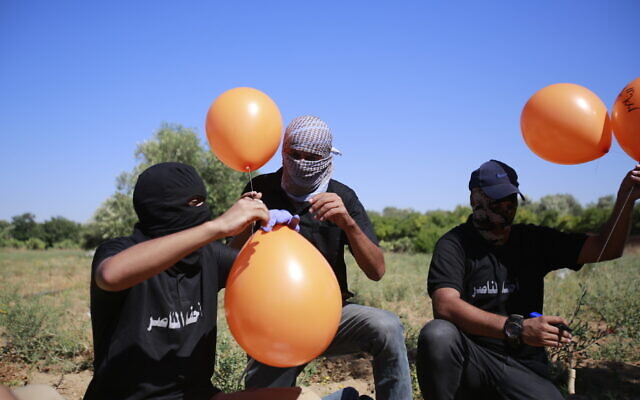
Hundreds of Israeli ultranationalists, some chanting “Death to Arabs,” paraded through east Jerusalem on Tuesday in a show of force that threatened to spark renewed violence just weeks after a war with Hamas militants in the Gaza Strip. Palestinians in Gaza responded by launching incendiary balloons that set at least 10 fires in southern Israel.

The march posed a test for Israel's fragile new government as well as the tenuous truce that ended last month's 11-day war between Israel and Hamas.

Palestinians consider the march, meant to celebrate Israel's capture of east Jerusalem in 1967, to be a provocation. Hamas called on Palestinians to “resist” the parade, a version of which helped ignite last month's 11-day Gaza war.


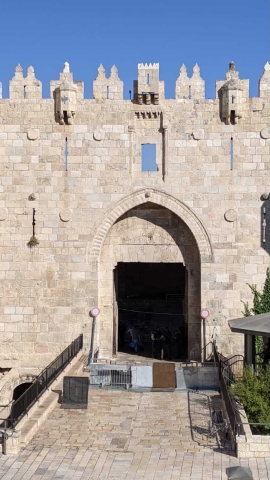
With music blaring, hundreds of Jewish nationalists gathered and moved in front of Damascus Gate. Most appeared to be young men, and many held blue-and-white Israeli flags as they danced and sang religious songs.

At one point, several dozen youths, jumping and waving their hands in their air, chanted: “Death to Arabs!” In another anti-Arab chant, they yelled: "May your village burn.”

The crowd, while boisterous, appeared to be much smaller than during last month's parade.

Ahead of the march, Israeli police cleared the area in front of Damascus Gate, shut down roads to traffic, ordered shops to close and sent away young Palestinian protesters. Palestinians said six people were arrested, and at five people were hurt in clashes with police.

The parade provided an early challenge for Israel's new prime minister, Naftali Bennett, a hardline Israeli nationalist who has promised a pragmatic approach as he presides over a delicate, diverse coalition government.

Though there were concerns the march would raise tensions, canceling it would have opened Bennett and other right-wing members of the coalition to intense criticism from those who would view it as a capitulation to Hamas. The coalition was sworn in on Sunday and includes parties from across the political spectrum, including a small Arab party.

Mansour Abbas, whose Raam party is the first Arab faction to join an Israeli coalition, said the march was “an attempt to set the region on fire for political aims,” with the intention of undermining the new government.

Abbas said the police and public security minister should have canceled the event. “I call on all sides not to be dragged into an escalation and maintain maximum restraint,” he said.

In past years, the march passed through Damascus Gate and into the heart of the Muslim Quarter, a crowded Palestinian neighborhood with narrow streets and alleys. But police changed the route Tuesday to avoid the Muslim Quarter.

Instead, marchers were to walk around the ancient walls of the Old City and enter through Jaffa Gate, a main thoroughfare for tourists, and head toward the Jewish Quarter and Western Wall, the holiest site where Jews can pray.

Damascus Gate is a focal point of Palestinian life in east Jerusalem. Palestinian protesters repeatedly clashed with Israeli police over restrictions on public gatherings during the Muslim holy month of Ramadan in April and May.

Those clashes eventually spread to the Al-Aqsa Mosque compound, a flashpoint site sacred to Jews and Muslims. Tensions at the time were further fueled by protests over the threatened eviction of dozens of Palestinian families by Jewish settlers, also in Jerusalem.

At the height of those tensions, on May 10, Israeli ultranationalists held their annual flag parade. While it was diverted from the Damascus Gate at the last minute, it was seen by Palestinians as an unwelcome celebration of Israeli control over what they view as their capital.

In the name of defending the holy city, Hamas fired long-range rockets at Jerusalem, disrupting the march and sparking the Gaza war, which claimed more than 250 Palestinian lives and killed 13 people in Israel.

After capturing east Jerusalem in 1967, Israel annexed the in a move not recognized by most of the international community. It considers the entire city its capital, while the Palestinians want east Jerusalem to be the capital of their future state. The competing claims over east Jerusalem, home to sensitive Jewish, Christian and Muslim holy sites, lie at the heart of the conflict and have sparked many rounds of violence.

Ahead of the march, Hamas called on Palestinians to show “valiant resistance” to the march. It urged people to gather in the Old City and at the Al-Aqsa Mosque to “rise up in the face of the occupier and resist it by all means to stop its crimes and arrogance.”


On Tuesday afternoon, Hamas-linked Palestinians launched a number of incendiary balloons from Gaza, setting off at least 10 blazes in southern Israel, according to Israel's national fire department.

Abu Malek, one of the young men launching the balloons, said called the move “an initial response” to the march.

Prime Minister Mohammad Shtayyeh, of the internationally backed Palestinian Authority in the West Bank, called the march an “aggression against our people.”

Israeli media reported the military was on heightened alert in the occupied West Bank and along the Gaza frontier in case of violence. Batteries of Israel's Iron Dome rocket-defense system were seen deployed near the southern town of Netivot, near the Gaza border, as a precaution. Hundreds of police will also be deployed.

Defense Minister Benny Gantz met with the military chief of staff, the police commissioner and other senior security officials on Tuesday. He “underscored the need to avoid friction and protect the personal safety of ... Jews and Arabs alike.”

U.N. deputy spokesman Farhan Haq said U.N. officials have urged all sides to avoid “provocations” in order to solidify the informal cease-fire that halted the Gaza war.


Israeli police officers detain a Palestinian man during clashes that erupted ahead of a planned march by Jewish ultranationalists through east Jerusalem, outside Jerusalem's Old City, Tuesday, June 15, 2021. (AP Photo/Mahmoud Illean) MAHMOUD ILLEAN AP


Israel-Palestine: Beatings, arrests and chants of 'Death to Arabs' at far-right march in Jerusalem's Old City

Israeli police shut symbolic Damascus Gate and beat and arrest Palestinians as twice-postponed parade goes ahead, with far-right Israelis chanting 'Death to Arabs' and Palestinians calling for 'day of rage'

Israeli security forces disperse Palestinians near Damascus Gate in East Jerusalem on 15 June 2021 (AFP)

By Shady Giorgio in Jerusalem
Published date: 15 June 2021 

Israeli police beat and arrested Palestinians on Tuesday, after closing Damascus Gate to make way for at least a thousand Israelis gathering for the start of a provocative nationalist march through occupied East Jerusalem's Old City, in the first major test for Israel's new government.

A police barricade set up in front of Jerusalem's Damascus Gate on 15 June 2021 (MEE/Shady Giorgio)


Set to begin at 5.30pm, the so-called Flag March was rescheduled to Tuesday after being cancelled during a period when repeated Israeli crackdowns in al-Aqsa Mosque and the threatened expulsion of Palestinian families was causing uproar in Jerusalem. That tension led to last month's 11-day war between Israel and Hamas.

Having closed off certain roads and Damascus Gate, Israeli police arrested Palestinians in Jerusalem ahead of the march. A video posted on Twitter showed Israeli police officers beating a Palestinian on the steps by Damascus Gate.

The Red Crescent said that 27 people were wounded during confrontations with Israeli authorities around the Old City of Jerusalem, including three from rubber-coated steel bullets, one from being beaten and one who had been hit by part of a sound grenade. Two people were hospitalised.

Authorities beat vendors working in shops near Damascus Gate, and pushed them away from the Old City. The whole area around the gate was sealed off by early afternoon on Tuesday, except for members of the press, with several barricades set up to clear the way for the settlers' march.

AFP reported that more than a thousand Israelis waving national flags gathered at the basin of Damascus Gate at the start of the march, singing anthems of the Jewish state's settler movement.

Videos on social media showed Israelis waving flags chanting "Death to Arabs".

Some hoisted far-right lawmaker and Benjamin Netanyahu ally Itamar Ben-Gvir, and Bezalel Smotrich, leader of the far-right Religious Zionism faction, on their shoulders, AFP reported.
Right-wing politicians Itamar Ben-Gvir and Bezalel Smotrich at Tuesday's march (MEE/Supplied)

Israeli authorities raised the alert level in the country ahead of the march, with additional police and military forces set to be deployed near the besieged Gaza Strip and in towns in Israel with mixed populations of Jewish and Palestinian citizens.

By Tuesday afternoon, a small number of incendiary balloons had been sent from Gaza into Israel, with 20 fires reported along the Gaza border.

Israeli authorities also diverted flights towards the "Northern Route" in and out of Israel, in anticipation of a possible escalation in Gaza.

The march is set to run along the Old City's wall from Damascus Gate to Jaffa Gate, before heading towards the Western Wall.

Palestinian counter-protesters are also expected in Jerusalem and in towns in Israel with significant numbers of Palestinians, with some Palestinian groups calling for a “day of rage” denouncing the far-right march.

New government’s first test

The Flag March is usually held on the occasion of Jerusalem Day, which marks Israel’s capture and subsequent occupation of East Jerusalem in the 1967 Middle East war.

The march typically brings together thousands of young, far-right religious Israelis, who chant anti-Palestinian slogans and wave Israeli flags as they pass through the small streets of East Jerusalem's Old City.

Initially scheduled for 10 May, the route of the Flag March had been diverted away from the flashpoint of Damascus Gate amid Palestinian protests against the planned forcible removal of Palestinians from the Sheikh Jarrah neighbourhood, and Israeli forces' violent raids at al-Aqsa Mosque.


The Israeli ‘Flag March’ explained   Read More »


The march was called off that day, as sirens went off after Hamas fired four rockets from Gaza towards Jerusalem when Israel ignored its ultimatum calling on Israeli forces to withdraw from al-Aqsa.

Over the following 11 days, Israeli forces and Hamas engaged in a war that would leave 248 people in Gaza dead and 13 in Israel.

The procession was later rescheduled for 10 June, but once again postponed after Hamas warned of renewed hostilities should it proceed.

The new date for the march was set on 8 June by the cabinet of then-Prime Minister Benjamin Netanyahu, who was voted out by Israel’s parliament on Sunday after 12 years as premier.

Netanyahu has been replaced by his former protege turned rival, the far-right, pro-settlement Jewish nationalist and tech millionaire Naftali Bennett, 49.

The Flag March will be the first test for Bennett’s fragile coalition government, cobbled together by the secular centrist Yair Lapid, a former TV presenter, and including eight parties, ranging from Bennett's far-right Yamina Party to left-wing Labor and an Islamist party representing Palestinian citizens of Israel.

While Bennett is a prominent member of Israel’s far-right, Netanyahu has labelled the new cabinet as a "dangerous" “left-wing” government, and accused it of being "the greatest election fraud in the history" of Israel.
'A provocation against our people'

Jewish supremacists, including Israeli MP Itamar Ben-Gvir, have meanwhile vowed to participate in the march regardless of what the new government - or Palestinians - might say.

Israel's incoming government is so unnatural only Netanyahu can keep it 
More »

“I will arrive today to participate in the flag parade and I will fly the Israeli flag,” he wrote on Twitter on Tuesday morning. “We do not need permission from Hamas or the Islamic Jihad to march in the capital of Israel.”

Palestinian Authority Prime Minister Mohammad Shtayyeh has condemned the march as "a provocation and aggression against our people, Jerusalem and its sanctities that must end".

"We warn of the dangerous repercussions that may result from the occupying power's intention to allow extremist Israeli settlers to carry out the Flag March in occupied Jerusalem tomorrow," Shtayyeh  tweeted on Monday.

In April, Israeli settlers had already marched in the streets of Jerusalem’s Old City chanting “Death to Arabs”, sparking riots.

Tensions Raised Ahead of Jerusalem Flag March

by Reuters and Algemeiner Staff


Israeli police detain a Palestinian man during clashes that erupted ahead of a flag-waving procession by far-right youth, at Jerusalem’s Old City, June 15, 2021. REUTERS/Ammar Awad

Right-wing Israeli groups plan to march in eastern Jerusalem on Tuesday in a flag-waving procession that risks reigniting tensions with Palestinians and poses an early test for Israel’s new government.

Several hours before the event was due to start, incendiary balloons launched from Gaza caused several fires in fields in Israeli communities near the border with the Palestinian enclave, witnesses and the Israeli fire brigade said.

Such incidents had stopped with a ceasefire that ended 11 days of cross-border fighting last month between Palestinian militants in Hamas-ruled Gaza and the Israeli military.

The marchers hope to pass through Jerusalem’s walled Old City, which is home to shrines sacred to Judaism, Islam and Christianity and is the most sensitive site in the Israeli-Palestinian conflict.

But a route of blocked-off streets published by police showed that marchers would not go through Damascus Gate, the main entry to the Muslim quarter, in an apparent attempt by Israeli authorities to avoid friction with Palestinians.

Assailing the march as a “provocation,” Palestinians called for “Day of Rage” protests in Gaza and the West Bank, with memories still fresh of confrontations between Israeli police and Palestinians during the Muslim holy month of Ramadan.

“We warn of the dangerous repercussions that may result from the occupying power’s intention to allow extremist Israeli settlers to carry out the Flag March in occupied Jerusalem,” Palestinian Prime Minister Mohammad Shtayyeh said.

The march was originally scheduled for May 10 as part of “Jerusalem Day” festivities that celebrate Israel’s capture of eastern Jerusalem in the 1967 Middle East war.

At the last minute it was diverted away from Damascus Gate and the Muslim Quarter but even after the re-routing it helped trigger last month’s fighting.

The march is being held by Israeli rightists who were angered that the procession in May was diverted from its traditional route and accused former Prime Minister Benjamin Netanyahu’s government of caving in to Hamas.

Hamas warned of renewed hostilities over the march, which Israel’s internal security minister approved on Monday. It is scheduled for 6 p.m.

“We will march, thousands of us, with flags where we’re told. Anywhere we’re told not to march — we won’t march,” Matan Peleg, one of the march organizers, told Israel’s Army Radio.

Diplomats urged restraint by all sides.

“Tensions (are) rising again in Jerusalem at a very fragile & sensitive security & political time, when UN & Egypt are actively engaged in solidifying the ceasefire,” UN Middle East envoy Tor Wennesland said on Twitter.

He urged all sides to “act responsibly & avoid any provocations that could lead to another round of confrontation.”

TEST FOR BENNETT

The march poses a challenge for new Prime Minister Naftali Bennett and his alliance of right-wing, centrist, left-wing and Arab parties, who took office on Sunday and ended Netanyahu’s long rule.

Bennett heads a right-wing party and diverting the procession could anger members of his religious base and expose him to accusations he was giving Hamas veto power over events in Jerusalem.

Palestinian protests were planned for 6 p.m. across Gaza. Hamas and Palestinian President Mahmoud Abbas’s Fatah faction have called on Palestinians to flock to the Old City to counter the march.

Israeli Defense Minister Benny Gantz met police, military and intelligence chiefs on Tuesday and “underscored the need to avoid friction and protect the personal safety of Israel’s citizens, Jews and Arabs alike,” his office said.


THE ZIONIST PRESS REPORT

‘Death to Arabs’: Nationalist Jerusalem flag march held under ramped up security

Lapid slams ‘disgrace’ of racist chant; 33 Palestinians said hurt in police clashes; signs say ‘Bennett the liar’; flights rerouted amid Gaza threats; arson balloons spark 20 fires

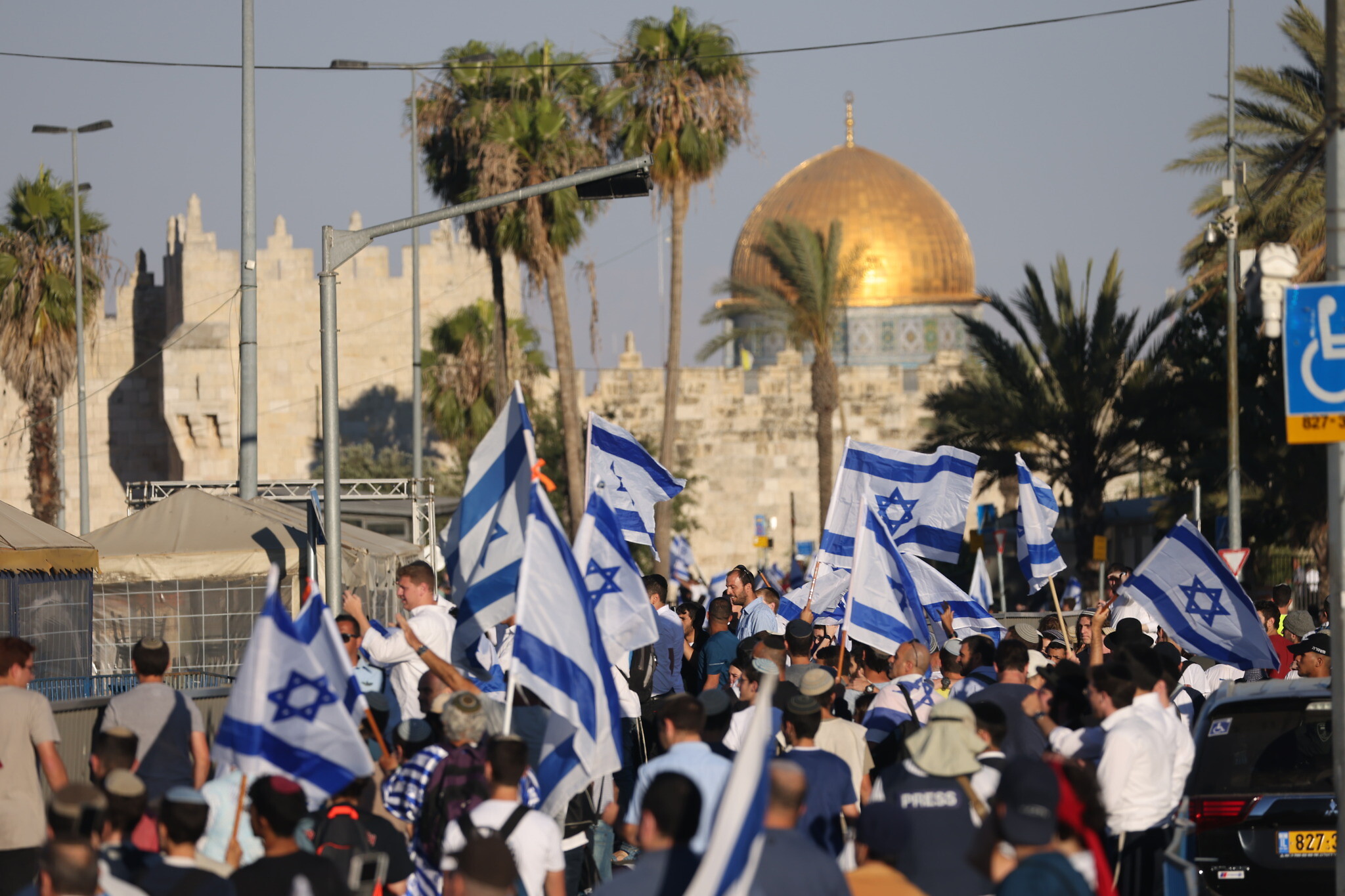
Jewish men dance with Israeli flags during the March of Flags near Jerusalem's Old City, June 15, 2021. (Yonatan Sindel/Flash90)

Thousands of right-wing nationalists marched through parts of Jerusalem’s Old City on Tuesday under a heavy police presence, as Israeli security forces braced for possible fresh violence from Gaza amid threats from terror groups in the coastal enclave.

Police estimated turnout at 5,000 participants and some 2,000 officers were deployed across the city for the event.

Footage posted to social media showed the right-wing marchers chanting “Death to Arabs” as well as “Shuafat is on fire,” referring to the East Jerusalem neighborhood, and “Jerusalem is ours.”

While voicing support for the decision to approve the march, Foreign Minister Yair Lapid denounced the chants of “Death to Arabs.”

“The fact that there are extremist elements for whom the flag of Israel represents hate and racism is revolting and unforgivable,” Lapid tweeted. “It is incomprehensible that people can hold the Israeli flag in one hand and shout ‘Death to Arabs’ at the same time. This isn’t Judaism or Israeliness, and it is definitely not what our flag symbolizes. These people are a disgrace to the nation of Israel.

The parade, the first major test of the new government sworn in Sunday, was rescheduled after the original Flag March was halted on Jerusalem Day, May 10, when the Gaza Strip’s Hamas rulers fired rockets at Jerusalem.

As the march began just before 6 p.m., clashes broke out near the Old City between police and Palestinians, 33 of whom the Palestinian Red Crescent said it treated. Six of the injured were hospitalized for wounds from rubber or sponge-tipped bullets, according to the medical service, which also said another Palestinian was injured by live fire, but that police were preventing them from evacuating him for treatment.

Video showed Palestinians throwing rocks at mounted police officers and one fell off his horse.

Police arrested 17 people on suspicion of disturbing the peace, throwing rocks and assaulting officers. Two cops were injured and taken for medical treatment, according to police.

The clashes came as marchers gathered on Jerusalem’s Hanevi’im Street, from where they headed toward the Damascus Gate, a flashpoint in the Old City. As part of the route agreed upon with police, the marchers weren’t permitted to pass through the gate but could go past it, with some participants allowed to go down to the plaza just outside the gate.

The marchers then entered the Old City via the Jaffa Gate and marched toward the Western Wall.

A number of participants accosted Arab journalists, with a reporter sharing video showing marchers shouting curses at them, and one man spitting in their direction.

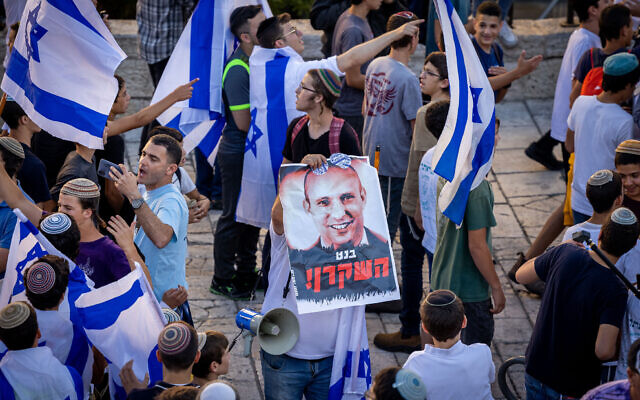
Some of the marchers chanted against Prime Minister Naftali Bennett and posters were seen depicting the new premier alongside the text “Bennett the liar.”

The posters apparently referred to Bennett’s breaking of his pre-election pledge not to form a government in which he switched off the premiership with Yair Lapid and not to rely on the Islamist Ra’am party’s support.

A poster reading ‘Bennett the liar’ is seen at the nationalist flag march, outside the Damascus Gate in Jerusalem’s Old City, June 15, 2021. (Nati Shohat/Flash90)

Several far-right lawmakers opposed to the government took part in the march, among them Religious Zionism leader Bezalel Smotrich and his faction’s lawmakers Itamar Ben Gvir and Orit Struck.

MKs May Golan and Shlomo Karhi of former prime minister Benjamin Netanyahu’s Likud party were also taking part, with video showing the latter dancing with Smotrich outside the Damascus Gate.

Lawmakers from the Joint List rallied outside the Old City to denounce the march, with the predominantly Arab political alliance’s leader Ayman Odeh saying that the Israeli capital will one day be the capital of a Palestinian state.

“On these walls the flag of Palestine will be hoisted and Jerusalem will be the capital of recaptured Palestine,” he told the Kan public broadcaster.

“Our people will cause them to be ashamed and withdraw from these places,” he said, referring to the Jewish marchers in the parade.

Nationalist Israel Jews wave Israeli flags as they march outside the Damascus Gate to Jerusalem’s Old City, on June 15, 2021. (Ahmad Gharabli/AFP)

Ra’am chief Mansour Abbas, whose Islamist party is part of the diverse ruling coalition, earlier called the march an “unbridled provocation” and said it should have been canceled.

Meanwhile, the Israel Defense Forces deployed Iron Dome missile defense batteries outside Jerusalem ahead of the march, according to Palestinian media reports. The IDF also deployed Iron Dome batteries elsewhere in the country and sent reinforcements to the West Bank.

Flight trackers showed air traffic to and from Ben Gurion Airport was being rerouted northward further away from Gaza to avoid any potential rocket fire.

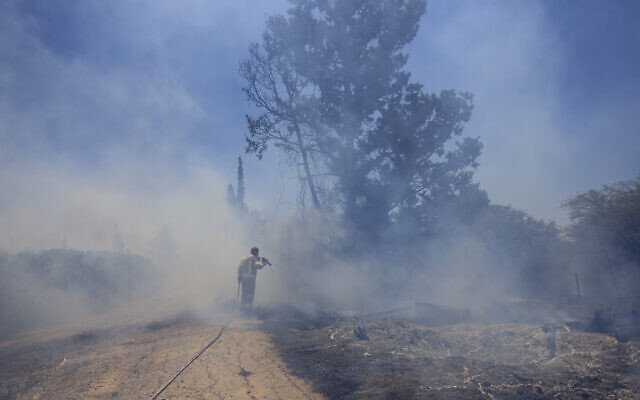
The apparent precautions came as numerous blazes were sparked in southern Israel near Gaza, with fire services reporting at least 20 were sparked by balloon-borne incendiary devices launched from the Strip.

An explosive device attached to one balloon exploded over a kibbutz in the Sha’ar Hanegev Regional Council, startling children in a playground, according to Hebrew media reports. The children were said to have run to a bomb shelter after hearing the blast and there were no reports of injuries.

An Israeli firefighter attempts to extinguish a fire caused by an incendiary balloon launched by Palestinians from the Gaza Strip, on the Israel-Gaza border, Israel, June 15, 2021. (AP Photo/Tsafrir Abayov)

Clashes also broke out between dozens of Palestinian protesters and IDF troops on the Gaza border. One Palestinian was reportedly shot in the leg, suffering light injuries.

The IDF has been bracing for a resurgence in Gaza fighting and a flare-up of clashes across the West Bank following Palestinian threats of violence if the march went ahead.

Amid Tuesday’s violent incidents around Gaza, Channel 13 news cited unnamed Palestinian sources saying Egypt had asked Hamas not to cause an escalation, warning that such a move would “embarrass” Cairo and that Bennett’s government — which approved the parade on Monday — would respond forcefully.

According to the sources, Hamas responded that “all options are on the table” but escalation could be avoided “if the event doesn’t get out of control.”

Later in the evening, Channel 12 news said Israel warned Hamas via Egypt that it would there would be a tough and immediate response to any rocket fire from Gaza. The network quoted a diplomatic source vowing Israel would respond to the arson balloon attacks, but would pick the timing.

The report said Israel warned Hamas that any escalation in violence would jeopardize understandings on allowing goods into Gaza and improving conditions there that the Egyptians are trying to broker, while signaling it made efforts to ensure the march would not go through the Old City’s Muslim Quarter.

The network also asked the diplomatic source what Bennett would now do as prime minister in light of hawkish comments he has previously made.

“On the one hand there are doubts, we want to show that there really is a new equation here like we promised after Operation Guardian of the Walls,” the source said. “On the other hand, we don’t want to create the connection that Hamas wants us to create between Gaza and Jerusalem. There will be a response and it will be expressed in a variety of forms.”

Supporters of the Palestinian Islamic Jihad terror group prepare balloon-borne incendiary devices to launch toward Israel, east of Gaza City, on June 15, 2021. (Atia Mohammed/Flash90)

The May 10 — Jerusalem Day — rocket attack during the original parade, which came amid already rising tensions over planned East Jerusalem home evictions and police actions against Muslim rioters on the Temple Mount, touched off 11 days of intense fighting between Israel and Hamas-led terrorists in the Gaza Strip, as well as a rash of lower-level clashes in the West Bank and mob violence between Arabs and Jews inside Israel.

Since the fighting ended, Hamas has repeatedly warned that it could reopen hostilities over developments in Jerusalem, and has responded with increased belligerence to plans for the march, an annual event — held to mark Israel’s 1967 capture of East Jerusalem — during which thousands of nationalist youths parade through the Muslim Quarter of the Old City toward the Western Wall.

The rescheduled event was initially planned for last Thursday, but was postponed to this Tuesday when police refused to authorize its planned route through the Old City’s Damascus Gate entrance and Muslim Quarter.


Slovakia court tosses acquittals in reporter's slaying

BRATISLAVA, Slovakia (AP) — An appeals court in Slovakia has dismissed a lower court's acquittal of a businessman accused of masterminding the 2018 slayings of an investigative journalist and his fiancée.
© Provided by The Canadian Press

The Slovakian Supreme Court said the lower court did not properly assess available evidence when it cleared businessman Marian Kocner and one co-defendant of murder in the killings of Journalist Jan Kuciak and his fiancée, Martina Kusnirova, both 27.

The ruling issued Tuesday means the case will return to the Specialized Criminal Court in Pezinok, which handed down the acquittals in September.

A Specialized Criminal Court judge said at the time that there was not enough evidence for the convictions. A third defendant was convicted and sentenced to 25 years in prison. Within hours, prosecutors appealed the verdicts to the country’s Supreme Court.

Kuciak was shot in the chest and Kusnirova was shot in the head at their home in the town of Velka Maca, east of Bratislava, on Feb. 21, 2018. Kocner had allegedly threatened the journalist following publication of a story about his business dealings. In total, Kuciak published nine stories about the businessman.

Kuciak filed a complaint over the alleged threats in 2017 and had claimed that police failed to act on it. He had been investigating possible government corruption when he was killed.

Two other defendants previously were convicted and sentenced. Former soldier Miroslav Marcek pleaded guilty to shooting Kuciak and Kusnirova and was sentenced to 23 years in prison in April 2020. Prosecutors alleged Kocner paid Marcek to carry out the killings.

The couple's deaths prompted major street protests unseen since the 1989 anti-Communist Velvet Revolution and a political crisis that led to the collapse of Slovakia's government.

The Associated Press


Exclusive - Indian scientists: We didn't back doubling of vaccine dosing gap

By Krishna N. Das and Devjyot Ghoshal
By Krishna N. Das and Devjyot Ghoshal© Reuters/Dinuka Liyanawatte FILE PHOTO: A health official draws a dose of the AstraZeneca's COVID-19 vaccine manufactured by the Serum Institute of India, at Infectious Diseases Hospital in Colombo

NEW DELHI (Reuters) - The Indian government doubled the gap between the two doses of the AstraZeneca COVID-19 vaccine without the agreement of the scientific group that it said recommended the increase, three members of the advisory body told Reuters.

The ministry of health announced the decision to change the gap from 6-8 weeks to 12-16 weeks on May 13, at a time when supplies of the shot were falling short of demand and infections were surging across the country.

It said the extended gap was recommended by the National Technical Advisory Group on Immunisation (NTAGI), based on real-life evidence mainly from the United Kingdom. Yet the NTAGI scientists, classified by the government as three of the 14 "core members", said the body did not have enough data to make such a recommendation.
© Reuters/FRANCIS MASCARENHAS FILE PHOTO: COVID-19 vaccination in Mumbai

M.D. Gupte, a former director of the state-run National Institute of Epidemiology, said the NTAGI had backed increasing the dosing interval to 8-12 weeks - the gap advised by the World Health Organization. But he added that the group had no data concerning the effects of a gap beyond 12 weeks.

"Eight to 12 weeks is something we all accepted, 12 to 16 weeks is something the government has come out with," he added. "This may be alright, may not be. We have no information on that."

This was echoed by his NTAGI colleague Mathew Varghese, who said the group's recommendation was only for 8-12 weeks.

The health ministry did not respond to requests for comment.

The ministry's statement https://pib.gov.in/PressReleasePage.aspx?PRID=1718308 on May 13 said that it had accepted the 12-16 weeks recommendation from NTAGI's COVID working group, as had a group of mainly government officials tasked with vaccine administration, known as NEGVAC.

Government health officials told a news conference on May 15 the gap was not increased to address a vaccine shortage but was a "scientific decision".

J.P. Muliyil, a member of the seven-strong COVID working group, said there had been discussions within the NTAGI on increasing the vaccine dosage interval but that the body had not recommended 12-16 weeks.

"That specific number was not quoted," he said, without elaborating.

N.K. Arora, head of the COVID working group, declined to comment on its recommendations but said all its decisions were taken collectively by the NTAGI at large.

A NEGVAC representative said it "respects the decisions of the NTAGI and use them for our work", declining to elaborate.

Real-world data released early last month by South Korea showed https://www.reuters.com/world/asia-pacific/skorea-says-astrazeneca-pfizer-covid-19-vaccines-87-effective-after-first-shot-2021-05-05 that one dose of the vaccines from AstraZeneca and Pfizer was 86.6% effective in preventing infections among people aged 60 and older.

Muliyil said this increased confidence within the advisory body that delaying a second shot would not be harmful.

The AstraZeneca vaccine accounts for nearly 90% of the 257.5 million vaccine doses administered in India.

The dispute over doses comes amid criticism from some scientists that the government had been slow to respond to a new virus variant that led to a spike in infections in April and May.

The government has denied being slow to react, saying state-run laboratories had studied variants in real time and shared data with local authorities to allow them to take the necessary action.

Shahid Jameel, a top Indian virologist who recently quit a government panel on virus variants after criticising New Delhi over its response to the pandemic, said the authorities should clarify their position on the reasons for the decision to double the gap between doses.

"In a situation where we have a variant of concern spreading, we should really be vaccinating people at scale and making sure that they are protected," he added.

(Reporting by Krishna N. Das and Devjyot Ghoshal; Editing by Sanjeev Miglani and Pravin Char)


FRENCH REACTOR FRENCH CO-OWNERS
Hong Kong watching Chinese nuclear plant after leak reported

HONG KONG (AP) — China's government said Tuesday no abnormal radiation was detected outside a nuclear power plant near Hong Kong following a news report of a leak, while Hong Kong's leader said her administration was closely watching the facility.

© Provided by The Canadian Press

The operators released few details, but nuclear experts said that based on their brief statement, gas might be leaking from fuel rods inside the reactor in Taishan, 135 kilometers (85 miles) west of Hong Kong.

In Beijing, Foreign Ministry spokesperson Zhao Lijian gave no confirmation of a leak or other details. He responded to reporters' questions by saying, “there is nothing abnormal detected in the radiation level surrounding the plant.”

In Hong Kong, radiation levels Tuesday were normal, according to the Hong Kong Observatory.

Framatome, a French company that helps manage the Taishan Nuclear Power Plant in Guangdong province, said Monday it was dealing with a “performance issue.” It said the facility was operating within safe limits.

That followed a report by CNN that Framatome told U.S. authorities about a possible leak.

“With regards to foreign media reports about a nuclear plant in Taishan, Guangzhou, the Hong Kong government attaches a high degree of importance to this,” said Hong Kong Chief Executive Carrie Lam.

She said her government would ask authorities in Guangdong for information and tell the public about any developments.

China is one of the biggest users of nuclear power and is building more reactors at a time when few other governments have plans for new facilities because the cost of solar, wind and other alternatives is plunging.

Chinese leaders see nuclear power as a way to reduce air pollution and demand for imports of oil and gas, which they deem a security risk. Government plans call for Hong Kong to use more mainland nuclear power to allow the closure of coal-fired power plants.

The Taishan plant, which began commercial operation in December 2018, is owned by China Guangdong Nuclear Power Group and Electricite de France, the majority owner of Framatome. A second reactor began operating in September 2019.

They are the first of a new type called European Pressurized Reactors. Two more are being built in Finland and France.

CNN reported Framatome wrote to the U.S. Department of Energy warning of an “imminent radiological threat” and accusing Chinese authorities of raising acceptable limits for radiation outside the plant to avoid having to shut it down.

U.S. officials believed there was no severe safety threat, CNN said.

The Department of Energy declined to comment. The International Atomic Energy Agency, a U.N. body, told The Associated Press it was aware of the issue and was awaiting information from China.

Video: U.S. assessing ‘leak’ at Chinese nuclear plant: CNN (Reuters)

“There is nothing we can do about it," said Li Tak, a Hong Kong retiree. Justin Santini, a teacher, noted that government officials have said it isn't a problem as of yet. “Until more alarm bells are raised, it’s probably premature to be concerned about it," he said.

Electricite de France said Monday it was informed of the increase in concentration of “certain noble gases” in Taishan reactor No. 1.

That suggests fuel rods are leaking gases produced during nuclear fission, according to Luk Bing-lam, an expert on nuclear engineering at the City University of Hong Kong.

Noble gases such as xenon and krypton are byproducts of fission along with particles of cesium, strontium and other radioactive elements.

“If the leakage is more severe, then you will start seeing more radioactive material like cesium, rather than gas,” said Luk, who is chairman of the Hong Kong Nuclear Society.

Such leaks “happen every so often” in China and plants “usually can handle it themselves,” Luk said. But he said this incident might be complicated if the Taishan plant uses U.S. technology that is covered by export restrictions.

China’s state-owned nuclear power companies are on Washington’s “entity list” that bars them from obtaining U.S. technology without government approval.

The French partner might ask for permission because Framatome previously licensed technology from Westinghouse, Luk said.

“With the situation now, that becomes difficult,” he said. “For even a small problem, they need U.S. government approval.”

China has 50 operable reactors and is building 18 more, according to the World Nuclear Association, an industry group. It is largely self-sufficient in reactor design and construction but is “making full use of Western technology while adapting and improving it,” the association says on its website.

China has constructed reactors based on French, U.S., Russian and Canadian technology and has developed its own Hualong One reactor, based on Westinghouse technology, marketing it abroad since 2015.

Hong Kong gets as much as one-third of its power from the Daya Bay nuclear power plant east of the territory in Guangdong.

Luk, who has worked with Chinese nuclear power plant operators, said he asked the company for information about the leak but managers won’t talk about it.

“I suspect the leakage is far more widespread than just a single assembly,” he said. “Because of that, they probably need some special technology to resolve this leakage problem.”

Previously, the Taishan facility leaked a “small amount” of radioactive gas on April 9, the National Nuclear Safety Administration said on its website. It said the event was “Level 0,” or “without safety significance.”

Zhao, the Foreign Ministry spokesperson, defended China's nuclear safety record and said the nuclear agency works with regulators in other countries and the IAEA.

“China’s nuclear power plants have maintained a good record in operation and no incidents affecting the environment or public health have occurred,” Zhao said.

___

This story corrects the spelling of Framatome and fixes the second reference to the nuclear expert to Luk throughout. Also, the translation of the quote by Chief Executive Carrie Lam has been revised to clarify that she said the Hong Kong government “attaches a high degree of importance” to the reports about the nuclear plant, not that it is “highly concerned” about them.

___

AP Business Writer McDonald reported from Beijing. AP video journalist Alice Fung in Hong Kong contributed to this report.

Zen Soo And Joe Mcdonald, The Associated Press