US Adds Sanctions on Tankers and Iranian Oil Awaiting Trump’s Decision
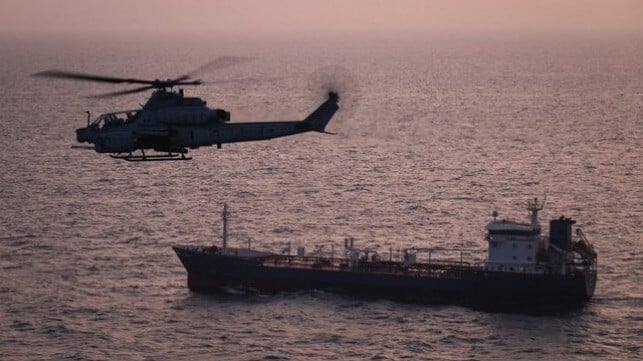
The United States Treasury and Department of State continued with their efforts of “maximum pressure” with sanctions on Iran as the decision on the new ceasefire to end the war was reportedly near. The United States has been increasing the financial pressure through sanctions and the blockade in an effort to bring Iran to the negotiations and win favorable terms.
Donald Trump said he would be meeting with his advisers on Friday to review the status of the agreement. They said he would be making a “final determination,” although the Iranian said terms have not yet been reached.
U.S. forces continue to enforce the blockade against Iran. CENTCOM said as of May 29, a total of 115 commercial vessels have been redirected to “ensure no commerce enters or leaves Iranian ports.” TankerTrackers.com said on Wednesday that it calculated that “There are close to 60 million barrels of Iranian crude oil trapped by the U.S. Navy blockade. That is nearly $6 billion in oil revenue that currently is not reaching Tehran.”
The Department of State on Thursday reported it was increasing the sanctions to reduce the revenue that the Iranian regime receives. It said it was adding eight tankers and the companies involved in their operations, as well as three energy traders. Concurrently, Treasury reported it was sanctioning an oil sales network that facilitated the movement of tens of millions of barrels of Iranian oil. They asserted the funds were being funneled to the IRGC, Iran’s Armed Forces General Staff, and its military apparatus.
The sanctions were extended to ship managers based in Hong Kong and the United Arab Emirates, and a shipping company registered in the Marshall Islands. The tankers included both product and crude oil vessels, and they ranged from registries in Palau to the Marshall Islands, Panama, Comoros, Cameroon, and San Marino.
The NGO UANI (United Against Nuclear Iran) tracks around 200 tankers that have been sanctioned since 2020. It says that about one-in-three of the nearly 600 vessels it has tracked over the past six years involved in the Iranian oil trade.
The U.S. State Department also imposed sanctions on three traders of Iranian-origin petrochemical products. It included a trader based in Qatar, a Singapore-based company that it says was involved in the export of over $900 thousand worth of Iranian petrochemical products, and an India-based trader that it says imported approximately $54.6 million of Iranian petrochemical products.
Iran is believed to be pushing not only for the end of the U.S. blockade but also for an end to these sanction programs.
Trump, on social media on Friday, listed three conditions, Iran’s nuclear program, the opening of the Strait of Hormuz, and all sea mines destroyed. Reports indicate the ceasefire would be for 60 days, during which time negotiations would proceed on the enriched uranium and to finalize the terms of the agreement.
Trump Says U.S. Will End Naval Blockade of Iran
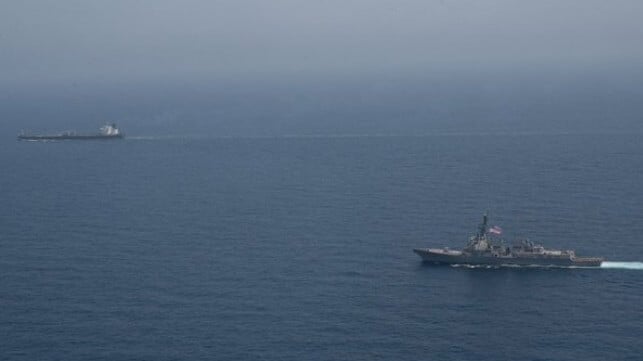
Listing out his conditions for the ceasefire agreement on social media on Friday, Donald Trump said the U.S. would lift its naval blockade. He did not give a timeline, but said ships caught in the region may start the process of “heading home.”
Roughly a quarter of the large oil tankers trapped inside the Persian Gulf at the outbreak of the Iran war have managed to slip out, reports Bloomberg. Based on AIS signals and other data, it believes 29 of the 109 supertankers stuck in the Persian Gulf have either slipped out or gained permission from the Iranians for the transit.
However, traffic through the Strait has continued at a trickle, with even fewer vessels willing to chance a return trip back into the Persian Gulf due to the fears they could become caught. On Friday, the International Energy Agency, International Monetary Fund, World Bank Group, and World Trade Organization issued a statement warning of the lasting impact. In addition to a rapid drawdown of the world’s oil reserves, they warned that the continued disruption was having broad impacts on food and other critical supply chains.
Shortly before Trump’s statement, CENTCOM provided its daily update, reporting that a total of 115 commercial vessels have been redirected to ensure no commerce enters or leaves Iranian ports. While it no longer cites the four vessels that were disabled, it said the enforcement was ongoing. The number of vessels rose by a few each day.
“Ships caught in the Strait due to our amazing and unprecedented naval blockade, which will now be lifted, may start the process of ‘heading home!’ Say HELLO to your wives, husbands, parents, and families…” wrote Trump.
The lifting of the blockade, Trump said, was part of the efforts to fully reopen the Strait of Hormuz. He asserted that Iran had to immediately open the Strait with no tolls, for unrestricted shipping traffic in both directions. He also said the U.S. had already detonated most of the mines, but made another condition that Iran would complete the immediate removal and/or detonation of any mines that are left, while asserting, “which will not be many.”
The key conditions are that Iran will never have a nuclear weapon or bomb, and he asserted the U.S. would “unearth” the enriched uranium, which is buried deep underground in the collapsed structures bombed last year by the United States. He said only the U.S. and China have the mechanical capability to unearth the uranium. He said the International Atomic Energy Agency would also be involved, and the uranium destroyed. He made no mention of Iran’s enrichment capabilities.
No timeline was provided, but he said that he was heading into the Situation Room to meet with advisers. He said he would be making a “final determination.” Trump has not commented, but reports said he left the meeting after two hours and had not reached a decision.
Iran has yet to make a public statement on the terms or if it has agreed to the terms. Hours earlier, a military adviser to Iran’s Supreme Leader Mojtaba Khamenei warned Iran would launch attacks if the U.S. naval blockade “continues beyond a certain timeframe.
Experts agree that Iran’s exports of oil have largely been brought to a halt. TankerTrackers.com on Wednesday estimated that “There are close to 60 million barrels of Iranian crude oil trapped by the U.S. Navy blockade. That is nearly $6 billion in oil revenue that currently is not reaching Tehran.”
Iran has repeatedly said that any agreement would have to include a pullback of U.S. forces. The U.S. currently has approximately 20 warships in the region to maintain the line east of the Strait of Hormuz to enforce the blockade that Trump announced in mid-April.

No comments:
Post a Comment