Carney pitches US on closer ties in autos, aluminum and minerals
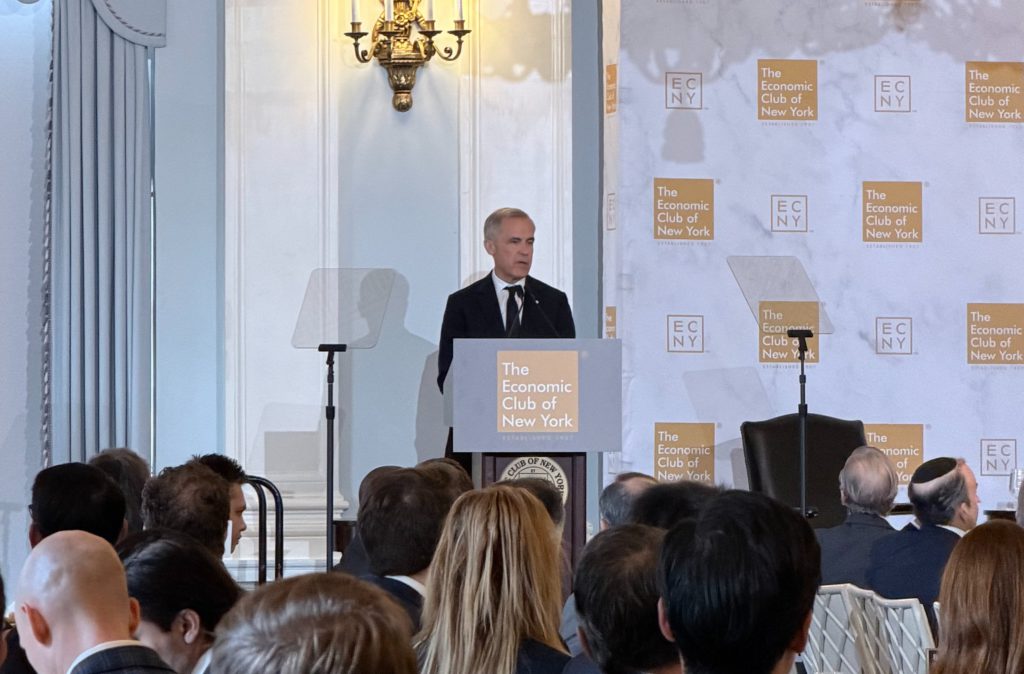
Canadian Prime Minister Mark Carney used a speech in New York to make the case to the Trump administration for closer cooperation on aluminum, auto manufacturing and critical minerals.

The trip comes as pressure builds on Carney to show Canada is still engaged with the US on trade. American and Mexican negotiators began formal talks this week on potential changes to the continental trade pact known as the US-Mexico-Canada Agreement, but Canada is not at that table and there is no schedule yet for its own bilateral discussions.
Carney has lately begun pushing a “Fortress North America” message in his public remarks, including in another recent speech which he said Canada is “open to deeper integration” with the US.
“Let’s be absolutely clear, Canada Strong will help make America great again,” Carney told the Economic Club of New York on Thursday, combining slogans both leaders use for their own countries.
“Examples of where that’s true are legion, where we should work together and compete with the world together. And to those ends, we have made specific practical proposals to the US administration.”
It’s a more conciliatory tone compared to earlier this year, when he declared that Canada’s close integration with American supply chains was once a strength but has become a weakness.
On Thursday, Carney said aluminum is one clear example where it makes sense for the longstanding allies to cooperate, given the huge amount of production in Quebec using relatively cheap hydro electricity.
Canadian exports of aluminum to the US “are the energy equivalent of 10 Hoover Dams,” Carney said. “With America’s growing energy needs because of the incredible transformation here, does it make sense to build the gigawatts here needed to replace Canada?”
On autos, he noted that Canada is the biggest customer of American-built cars, and said an integrated North American market is still the best way to compete with the automotive sectors in other regions.
The auto sector is expected to be a difficult element of trade discussions with the US, as Trump imposed tariffs of 25% on Canadian-built cars, with an exemption for the percentage of US-made parts inside the car.
Carney has sought to alleviate this with counter-tariffs on US cars and a remission scheme for companies that build cars in Canada.
More controversially, he’s also slashed tariffs on a limited number of Chinese-made electric vehicles, a change from Canada’s previous policy of fully matching the 100% tariff on Chinese EVs that the US has in place.
Carney defended that move, noting the tariff break for Chinese EVs is initially capped at 49,000 annually, a small portion of the 1.8 million cars sold in Canada each year. He told the New York crowd that over time a broad range of cheaper Chinese cars are expected to come in under that system, “but in a controlled way.”
Meanwhile, Canada’s reserves of potash, nickel, copper and uranium can also be a major economic advantage for the US, Carney said. “Canada can be the most reliable supplier that America needs to put affordable food on the table, strengthen its national defense and meet the exploding demand to power AI.”
Much of Carney’s speech was spent outlining his government’s efforts to grow Canada’s energy exports and rapidly expand its military capabilities.
He ended by urging the US to forge a closer partnership with what he described as “a different Canada, a stronger Canada, a more confident Canada.”
(By Brian Platt)
Aluminum facts - Natural Resources Canada


No comments:
Post a Comment