Friday, April 15, 2022

It’s not over: COVID-19 cases are on the rise again in the U.S.


A sign advises visitors to don face coverings at a hospital in Aurora, Colo. COVID-19 cases are rising again in the United States, with numbers up in most states and up steeply in several.
(David Zalubowski / Associated Press)

BY LAURA UNGAR
ASSOCIATED PRESSAPRIL 15, 2022 

Yet again, the U.S. is trudging into what could be another COVID-19 surge, with coronavirus infections rising in most states and nationally after a two-month decline.

One big unknown? “We don’t know how high that mountain’s going to grow,” said Dr. Stuart Campbell Ray, an infectious disease expert at Johns Hopkins University.

No one expects a peak nearly as high as the last one, when the highly contagious Omicron variant ripped through the population.

But experts warn that the coming wave — caused by an Omicron subvariant called BA.2 that’s thought to be about 30% more contagious than the original Omicron — will wash across the nation. They worry that hospitalizations, which are already ticking up in some parts of the Northeast, will rise in more states in the coming weeks. And the case wave will be bigger than it looks, they add, because reported numbers are vast undercounts as more people test at home without reporting their infections or skip testing altogether.

At the height of the previous Omicron surge, daily tallies of new reported cases reached into the hundreds of thousands. As of Thursday, the seven-day rolling average for new cases rose to 39,521, up from 30,724 two weeks earlier, according to data from Johns Hopkins collected by the Associated Press.

Dr. Eric Topol, head of Scripps Research Translational Institute, said the numbers are likely to keep growing until the surge reaches about a quarter the height of the last “monstrous” one. BA.2 may well have the same effect in the U.S. as it did in Israel, where it created a “bump” in cases, he said.

Keeping the surge somewhat in check, experts said, is a higher level of immunity in the U.S. from vaccination or past infection now compared with the early winter.

(BPT) - The weather is warming and now is the best time to plan your spring and summer vacation in the beautiful outdoors of The Natural State — Arkansas. While Arkansas offers an abundance of outdoor recreational opportunities on dry land and in...

But Ray said the U.S. could wind up looking like Europe, where the BA.2 surge was “substantial” in some places that had comparable levels of immunity. “We could have a substantial surge here,” he said.


CALIFORNIA
Infectious Omicron BA.2 now dominant in U.S., with coronavirus spring rise likely
March 29, 2022


Both experts said BA.2 will move through the country gradually. The Northeast has been hit hardest so far, with more than 90% of new infections caused by BA.2 last week, compared with 86% nationally. As of Thursday, the highest rates of new COVID cases per capita over the past 14 days were in Vermont, Rhode Island, Alaska, New York and Massachusetts.

In Washington, D.C., which also ranks in the top 10 for rates of new cases, Howard University announced it was moving most undergraduate classes online for the rest of the semester because of “a significant increase in COVID-19 positivity” in the district and on campus.

Some states, such as Rhode Island and New Hampshire, saw the average of daily new cases more than double in two weeks, according to Johns Hopkins data.

Joseph Wendelken, a spokesperson for the Rhode Island Department of Health, said that despite rising cases, hospitalizations remain relatively low, and that’s the metric they are most focused on right now. About 55 COVID-19 patients are hospitalized, compared with more than 600 at one point in the pandemic.

Officials credit high vaccination rates. State statistics show 99% of Rhode Island adults are at least partially vaccinated and 48% have gotten the booster dose that scientists say is key in protecting against severe illness with Omicron.


COVID-19 is fading. But ending the health emergency could leave us vulnerable
March 14, 2022

Vermont also has relatively high levels of vaccination and fewer patients in the hospital than during the height of the first Omicron wave. But Dr. Mark Levine, the health commissioner there, said hospitalizations and the numbers of patients in intensive care units are both up slightly, although deaths have not risen.

Data from the U.S. Centers for Disease Control and Prevention shows that new hospital admissions of patients with confirmed coronavirus infections were up slightly in New England and the New York region.

On the West Coast, modelers from Oregon Health & Science University are projecting a slight increase in hospitalizations over the next two months in that state, where cases have also risen steeply.

As the wave moves across the country, experts said states with low vaccination rates may face substantially more infections and severe cases that wind up in the hospital.

Ray said government leaders must be careful to strike the right tone when talking to people about protecting themselves and others after COVID restrictions have largely been lifted. Philadelphia recently became the first major U.S. city to reinstate its indoor mask mandate after a sharp increase in infections. But Vermont’s Levine said there were no plans to bring back any of the restrictions that were imposed earlier during the pandemic.

“It’s going to be hard to institute restrictive, draconian measures,” Ray said. “Fortunately, we have some tools that we can use to mitigate risk. And so I hope that leaders will emphasize the importance for people to watch the numbers,” be aware of risks and consider taking precautions such as wearing masks and getting vaccinated and boosted if they’re not already.


CALIFORNIA
It’s a big mistake to think pandemic is over, despite recent good news, experts say
Feb. 23, 2022

Lynne Richmond, a 59-year-old breast cancer survivor who lives in Silver Spring, Md., said she plans to get her second COVID-19 booster shot and keep wearing her mask in public as cases rise in her state and in nearby Washington, D.C.

“I never really stopped wearing my mask. ... I’ve stayed ultra-vigilant,” she said. “I feel like I’ve come this far; I don’t want to get COVID.”

Vigilance is a good strategy, experts said, because the coronavirus is constantly throwing curveballs. One of the latest: even more contagious subvariants of BA.2 found in New York state, known as BA.2.12 and BA.2.12.1. And scientists warn that potentially dangerous new variants could arise at any time.

“We shouldn’t be thinking the pandemic is over,” Topol said. “We should still keep our guard up.”

Associated Press writer Wilson Ring in Stowe, Vt., contributed to this report.

Starbucks CEO Schultz Blasts ‘False Promises’ by Past Management

Howard Schultz

(Bloomberg) -- Starbucks Corp. Chief Executive Officer Howard Schultz, moving to further put his stamp on the coffee giant in his third stint at the helm, criticized “false promises” and poor short-term decisions by prior management in a message to employees.

In a seven-minute video set to be sent to Starbucks employees Friday and viewed by Bloomberg News, Schultz discussed the feedback he received from employees around the country in recent meetings he dubbed “co-creation sessions.”

“I think there’s been a lot of false promises over the last few years -- those days are over,” Schultz said, without elaborating. “We’re going to make promises that we can keep, we’re going to make promises that are real.”

Schultz said he realized through the employee sessions that “there’s been many short-term decisions that have had an adverse long-term effect on the company. We’re going to reverse that. We’re going to make much better long-term decisions that are going to have a short-term benefit for you.”

Employees expressed desires for better training and guaranteed hours, Schultz said, as well as detailing problems such as ice and espresso machines breaking and taking a long time to get repaired.

“We are going to fix the near-term problems like maintenance people not showing up on time ... and we’re going to fix the bigger issues of training, wages and the other issues facing the company,” he said.

The 68-year-old Schultz earlier this month succeeded Kevin Johnson, 61, who had been CEO since 2017. He has moved swiftly in the role, suspending share buybacks to spend more on stores and staff, and dismissing former General Counsel Rachel Gonzalez as the company contends with a fast-spreading unionization effort.

Starbucks shares have been under pressure for months and have continued to fall during Schultz’s renewed tenure as investors worry his plans will squeeze profit margins. The stock was down 32% this year through Thursday, worse than the 7.8% fall of the S&P 500 index.

Schultz didn’t refer directly to the union fight in his video message but pledged to execute against the “fantastic ideas” employees had shared with him.

“We have to reimagine the customer experience, the partner experience, the third-place experience; we have to reimagine mobile order and pay, the drive-thru,” he said. “We have a lot of work to do.”

©2022 Bloomberg L.P.

China’s Zhengzhou Locks Down Areas Near Major IPhone Plant

(Bloomberg) -- China’s Zhengzhou city has locked down some areas near Foxconn Technology Group’s main iPhone manufacturing base in a move that could spell further trouble for Apple Inc.’s supply chain. 

Local authorities announced late Friday they are placing some areas in the Zhengzhou Airport Economy Zone under quarantine effective immediately, according to a statement on its official WeChat account. People in the area will not be permitted to leave, according to the statement.  

The Zhengzhou Airport Economy Zone is home to the world’s largest iPhone assembly plant, where staff have been ordered to undergo mandatory Covid-testing in recent days. Foxconn and Apple didn’t immediately reply to emailed queries about whether the lockdown will affect operations.  

Read more: IPhone City Staff in China to Undergo Mandatory Virus Tests

The fresh controls mark a widening of curbs in China, which is battling its worst Covid-19 outbreak in the past two years. Major cities from Shanghai to Guangzhou have already imposed restrictions on their citizens, fueling burgeoning anger against the government. 

Fellow Apple suppliers Pegatron Corp. and Quanta Computer Inc. have halted production in eastern China to comply with local Covid-related restrictions. 

©2022 Bloomberg L.P.

Twitter Brings on JPMorgan as Adviser Alongside Goldman


<p>    </p>

(Bloomberg) -- Twitter Inc. has brought on a second investment bank, JPMorgan Chase & Co., to help it respond to Elon Musk’s hostile bid, according to people familiar with the matter.

The largest U.S. bank started work recently to assist Twitter in talks with potential buyers, the people said, asking not to be identified because the matter is private. 

Representatives for Twitter and JPMorgan declined to comment. 

Besides Musk’s offer, Twitter has been fielding takeover interest from other parties, including technology-focused private equity firm Thoma Bravo, according to one of the people familiar. The New York Post reported Thoma Bravo’s interest on Thursday. 

A representative for Thoma Bravo declined to comment.

In bringing on JPMorgan, Twitter is working with a bank that hasn’t been afraid to wrangle with Musk. JPMorgan and Musk’s electric vehicle company Tesla Inc. have been embroiled in lawsuits. They are suing each other over stock transactions, some that are linked to Musk’s tweet in 2018 that he had secured the funding to take Tesla private, an effort that was given up weeks later.

JPMorgan is the latest Wall Street heavyweight to become involved with Musk’s quest to buy Twitter, and joins Goldman Sachs in helping deal with the 50-year-old billionaire. Morgan Stanley is working with Musk.

Missing Out

JPMorgan’s involvement is also a blow to the boutique investment banks, who have been increasingly competing for market share against the bulge brackets. 

Twitter was advised by boutique advisory firm Allen & Co. in 2020 when the company was tussling with activist investor Elliott Investment Management, according to data compiled by Bloomberg.

This time around, no boutique investment bank appears to be involved although companies tend to add on more advisers as transactions drag on.

Goldman, which has been historically close to Musk, including being the lead bank in 2018’s failed attempt to take Tesla private, was conflicted from advising the billionaire due to its longstanding relationship with Twitter. 

Twitter adopted a so-called poison pill on Friday, a measure to help shield it from Musk acquiring more of the company. The move could buy the board more time to decide how to proceed.

©2022 Bloomberg L.P.

Citadel’s Ken Griffin is GOP’s top donor – with $40M put toward midterms
By
Lydia Moynihan
April 15, 2022 
Ken Griffin is ramping up political donations, with an eye on fighting crime.
Bloomberg via Getty Images

Billionaire hedge fund manager Ken Griffin isn’t just investing in stocks, he’s also investing in politics — to the tune of $40 million in the upcoming midterm election cycle, according to a report.

Griffin, who made more money than any other hedge fund manager last year — raking in $2 billion in 2021 alone — has also become the No. 1 donor to Republican causes, according to the Wall Street Journal’s tabulations.

And Griffin, 53, is particularly focused on reining in crime and improving education.

“I’ve had multiple colleagues mugged at gunpoint. I’ve had a colleague stabbed on the way to work,” Griffin, who is based in Chicago, said in an interview with the Wall Street Journal. “That’s a really difficult backdrop with which to draw talent to your city.”

While it takes safety for a nation to flourish in the short term, it also takes a substantive education system to maintain a thriving country, Griffin argues.
Ken Griffin made more money than any other hedge fund manager last year.
Bloomberg via Getty Images

“Nothing is more important to the future of America than a robust nursery through high school, and then a system of higher education,” Griffin adds. “A huge part of my shift towards being more involved in politics has been watching federal and state policies undermine access to the American Dream.”

Griffin is quick to acknowledge not everyone shares his political viewpoints.

But he still encourages those who disagree with him to get involved and donate to causes they care about as well.

“Too many of America’s business leaders stay out of politics today,” Griffin said “They have to be engaged because they understand the ramification of policy decisions: I’m building a business; I’m running a factory; I’m creating jobs. They just can’t continue to be silent.”
Ken Griffin is worth $30.5 billion.
Getty Images

Griffin, who’s worth an estimated $30.5 billion, according to Bloomberg Billionaires Index, has slowly ramped up his involvement — and his election spending — over the last decade.

In 2010, he gave under $1 million to political causes. In 2020, he gave more than $67 million to political causes.

While he’s donated broadly to issues, he is also interested in supporting individual candidates.


He has given $5 million to a political action committee associated with Florida Gov. Ron DeSantis. He’s also donated $7.5 million to a PAC associated with Pennsylvania Republican gubernatorial candidate David McCormick. McCormick left his CEO perch at posh hedge fund Bridgewater Associates to run against Dr. Mehmet Oz.

Ken Griffin is alarmed about crime in Chicago — and says he’s had multiple colleagues mugged and even stabbed.
ZUMAPRESS.com

Griffin is less enthusiastic about one politician in particular: Donald Trump. Griffin has criticized Trump’s unsubstantiated claims that the 2020 election was rigged and adds it’s time to look to “the next generation” of candidates for the 2024 election cycle.

And it’s not just politics Griffin is spending big money on. Last year Griffin decided to shell out $43.2 million last month for a rare copy of the US Constitution at the urging of his son.

The document, which is one of 13 original copies from 1787, was initially valued by Sotheby’s at $15 million to $20 million.

But Griffin said he decided he’d spend whatever it took to get it.

“I told myself, ‘I am going to own this,’” Griffin said. “I don’t do that very often.”

Journalists Despair Over Toll of Disinformation on Jobs

April 15, 2022 
Associated Press
Author Margaret Atwood speaks at the PEN America Literary Gala in New York, May 22, 2018.

Journalists are sounding an alarm about the spread of disinformation in society and how it affects their jobs on a daily basis, along with skepticism on whether traditional methods to combat it really work.

The free speech advocates PEN America found in a survey of journalists released Thursday that 90% said their jobs have been affected by false content created with the intent to deceive.

Disinformation takes many forms: former President Donald Trump's false claims that he won the 2020 presidential election, unproven COVID-19 treatments spreading online and wild QAnon theories about pedophilia. It could be as simple as a local politician lying about an opponent's record or this week's debate over whether video showed bird poop landing on President Joe Biden's jacket during a speech.

When more than 1,000 journalists returned the survey, PEN America was struck at how images in written responses "kept coming up with people being flooded with disinformation," said Dru Menaker, the organization's chief operating officer.

"Clearly, we have touched a nerve," she said.

Four in five respondents labeled it a serious problem and most say they deal with it regularly, either through sources passing along false information or the need to debunk something spreading online.

False information can be spread through bots, or in doctored photos and video that needs to be verified, Menaker said. It has spread in large part because its purveyors find it effective.

Luke O'Brien, a journalist and fellow at Harvard's Shorenstein Center on Media, Politics and Public Policy, is now an expert on a beat that hardly existed a decade ago. He said he's been stunned at how fast misinformation spreads into the media.

"It just gets worse and worse," he said.

While most journalists work to combat it, 11% of those surveyed admitted that they had unwittingly passed along false information, and 17% said they avoided doing a story because they feared being subject to a "fake news" backlash that would seek to discredit their reporting.

Asked by PEN America about sources of the most egregious misinformation they've encountered, 76% of the journalists cited right-wing conspiracy theorists (35% said left-wing conspiracy theorists). Seventy percent said government officials or politicians, 65% said advocacy groups and 54% mentioned organizations specifically designed to create disinformation.

Public hostility toward journalists and a business climate that has reduced ranks in the field, particularly outside of big cities and among those who cover minority communities, has amplified the issue.

One Los Angeles Times reporter who returned the survey told about reporting on a militia-backed group that was using disinformation to gain power in local government. The group's leader went on a podcast to call the reporter and a colleague Nazis who needed to be "taken care of," and she now keeps a bulletproof vest in her closet.

O'Brien said he first became aware of bad actors operating online in the mid-2010s when covering the harassment of women in the video game industry.

Several news organizations have strengthened their efforts to root out disinformation in recent years. The Associated Press, for example, has a 12-person verification unit that investigates claims spread online, along with a separate fact-check operation and reporters that cover disinformation as a news beat.

AP has a weekly column, "Not Real News," that dissects the most popular but completely untrue stories circulating online.

Many don't have the capacity, though. "We need more journalists," one survey respondent said. "The ones who are left are overwhelmed and do not have the time to take on the entire world of disinformation."

Many of the journalists don't think enough is being done to train people on how to deal with these issues. Yet there's also little unanimity in how to do this.

While some believe it's important to report on false claims, others believe that only gives them greater circulation. O'Brien said there are ways to report them without amplification, by not including links, for example.

It's important to report on what is going on for the historical record, he said. Journalists should also devote resources to reporting on who is behind disinformation, both bankrolling and executing it.

Fact-checkers are often met with resentment, and have to guard against readers who feel they are being talked down to, Menaker said. Some of those surveyed concede that journalists have to do a better job showing to readers or viewers that they're not remote, that they are part of the community.

Frighteningly, there may be no way to combat this effectively. And some people simply won't accept it if presented with facts contrary to what they believe.

"Some people are despairing that people have just become unmoored from facts, that there is a substantial part of the audience that may be unreachable," she said.
USA
More pets, fewer vets. Experts say veterinarian shortage could affect animal health


Madeleine List, The Charlotte Observer - 

This time last year, Stand For Animals, a low-cost veterinary clinic in North Carolina, had 10 veterinarians.

“We currently have four,” Cary Bernstein, founder and executive director of the clinic, told McClatchy News. “So the numbers kind of speak for themselves.”

Animal advocates across the country say they are worried about a shortage of veterinarians, especially as many COVID-19 restrictions are lifted and clinics start to reopen for in-person services.

On average, veterinary practices had two more clients per day in 2020 than 2019, and one more client per day in 2021 than 2020, according to a spokesman for the American Veterinary Medical Association. Visits are up 2.4% this month compared with April 2021.

The average number of veterinary appointment bookings grew by 4.5% from 2019 to 2020, according to a report from the American Veterinary Medical Association. They had increased 6.5% from January to June of 2021, compared with the same period in 2020.

Some of this was due to pent-up demand from when clinics were closed or offering limited services during the pandemic, the report says.

Demand for veterinary care increased “well beyond expectations” during the COVID-19 pandemic in 2020, according to Mars Veterinary Health, an international network of 2,500 veterinary clinics. But experts say the country was already experiencing a veterinary shortage in 2018.

If current trends continue, there could be a shortage of 15,000 veterinarians needed to meet the expected animal healthcare burden by 2030, according to Mars Veterinary Health.

“If you ask me what keeps me up at night, it’s this,” Julie Castle, CEO of Best Friends Animal Society, a national nonprofit providing adoption, spay/neuter and educational programs, told McClatchy News. “There aren’t enough veterinarians in this country to service the animals that are part of families.”

According to Mars Veterinary Health, experts predict spending on pet healthcare will increase by 33% over the next 10 years.

“Meanwhile, more and more veterinary professionals are leaving the field due to anxiety, stress and compassion fatigue,” Pam Runquist, executive director of the Humane Society Veterinary Medical Association, wrote in an email.

Some areas are “veterinarian deserts” where only one or two vets service an entire population of pets, Castle said.

The American Veterinary Medical Association said in a statement that some clinics are doing well — while at others, veterinarians report feeling overworked and some practices have had to change the way they operate altogether.

“Like many industries, veterinary medicine currently is in a tight labor market,” the statement says. “While most pet owners report being able to see a veterinarian within a week (emergencies, of course, are handled as just that), we know that at some clinics there are still long delays for an appointment, or pet owners who have had to wait for unusually long times in waiting rooms.”

The Humane Society Veterinary Medical Association is working to help address the veterinarian shortage by providing resources for vets to care for their mental health, giving student loan assistance for veterinary medical students, promoting veterinary telemedicine as a potential alternative to in-person visits, and advocating for more diversity and inclusion in the profession, Runquist wrote.

Bernstein said her organization is doing everything it can to recruit vets.

“We have engaged with a headhunter, which is something we thought we’d never do in the past,” she said. “We’ve started to use social media as a way to try to recruit veterinarians.”

In the meantime, Stand For Animals has had to close one of its practice locations because of the staffing shortage, she said.

“Also, we’re not accepting any new clients right now which is something that we never thought we would do because we’re a low-cost provider and we’re one of the only options in the community,” she said. “It was a really hard decision to make - that we really had to focus on the people that we currently are trying to help.”

Castle said the issue is a complex one that affects not only families and their pets, but the entire shelter system.

The veterinarian shortage can delay the adoption process or halt it altogether if animals aren’t able to get the care they need before going home to a family.

“Where I’m seeing our ecosystem disrupted the most is shelters that once didn’t have an issue sourcing veterinarian talent,” Castle said said. “They just can’t find them, so the animals are really the ones that are getting the short end of that stick.”

Missing dog named for AL woman’s late husband found 500 miles away on her anniversary

Animal Trafficker Busted Smuggling Over 2,000 Turtles Destined to Be Eaten

BY JOSEPH GOLDER, ZENGER NEWS ON 4/15/22

A suspected animal trafficker has been arrested while allegedly attempting to smuggle more than 2,000 turtles on a long-haul coach across Colombia.

Colombian authorities have said that this type of turtle is considered a delicacy at Easter in the devout, primarily Catholic country, and they often catch smugglers this time of year moving them across the country to meet demand after they have been poached in the wild.

For Catholics, Easter means abstaining from eating meat on Ash Wednesday, Good Friday, and the other Fridays leading up to Easter.

But when beef, pork, and poultry are not allowed, fish is not the only alternative protein source, and in Colombia, the faithful has their own tradition of eating turtles.

Police seized 2,047 turtles from a citizen transporting them on a public bus on April 14, 2022, in Quindio, Colombia.
@CORPOQUINDIOCRQ/ZENGER

The consumption of turtle meat during Lent is so deeply rooted in the culture of northwestern Colombia that inhabitants have a popular saying: "If you didn't eat turtle meat, you didn't celebrate Holy Week."

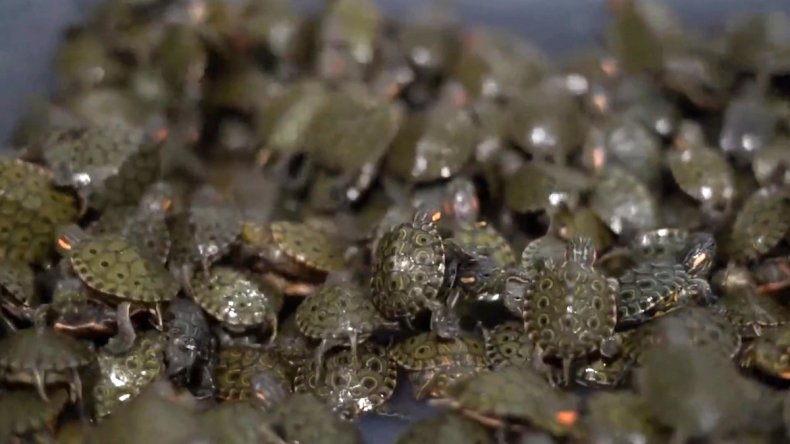
The footage first shows at least six large plastic containers with a multitude of tiny turtles seen moving around inside them after the authorities seized them from the bus during the bust.

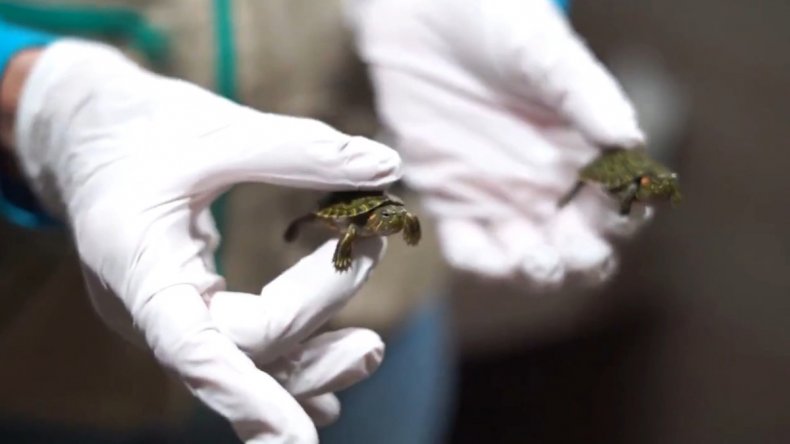
The images then show the authorities piling up the large plastic containers of turtles on the pavement after having seized them. And close-up images of the turtles also show that they are so small that they can fit in the palm of a person's hand.

Zenger News obtained the images and a statement from the Regional Autonomous Corporation of Quindio (CRQ), saying on Thursday, April 14, they had "detained a citizen with a shipment of 2,047 turtles that he was transporting on a public service bus."

The CRQ is a Colombian, governmental organization that is in charge of the management and protection of environmental resources in the District of Quindio, which is a department in western-central Colombia.

The Colombian regional environmental authorities report directly to the Colombian Ministry of the Environment.

The man had reportedly left the northern Colombian region of Cesar, which is near the Caribbean Sea, aboard the coach, and was headed to the southwestern region of Valle del Cauca.

The authorities reportedly stopped the suspected animal trafficker, who has not been named, while the coach was transiting through the Quindio region.

The CRQ said that the arrest "was the result of one of the checkpoints that our Highway Police has and that thanks to cooperation between the Environmental Police the Regional Autonomous Corporation of Quindio, we managed to seize these individuals of wildlife."
Police seized 2,047 turtles from a citizen transporting them on a public bus on April 14, 2022, in Quindio, Colombia.
@CORPOQUINDIOCRQ/ZENGER

The turtles were Colombian sliders (Trachemys callirostris), according to Jose Manuel Cortes Orozco, the director of the CRQ.


They are known in Colombia as "tortugas hicoteas" and are found in Colombia and Venezuela. They have green shells with bright splashes of color. The species typically reaches sizes ranging from about 10 inches up to a maximum of 13.7 inches.

The authorities are reportedly giving the 2,047 turtles a health checkup before they are "released back into their natural habitat in the wild," in the Colombian Caribbean, on the Atlantic coast.

The authorities said that this type of turtle is one of the most trafficked species in Colombia, along with the red-footed tortoise (Chelonoidis carbonarius), known locally as the morrocoy tortoise, and the green iguana (Iguana iguana).

This story was provided to Newsweek by Zenger News.

From “Drill, Baby, Drill” to “Mine, Baby, Mine”

President Biden and the Bi-Partisan Effort to Destroy Planet Earth

In 2015, former President Barack Obama said “If we’re going to prevent large parts of this Earth from becoming not only inhospitable but uninhabitable in our lifetimes, we’re going to have to keep some fossil fuels in the ground rather than burn them.” Despite this, Obama’s energy policy was called “All of the Above,” and his administration supported and subsidized drilling for oil, fracking for gas, coal mining, damming rivers, building nuclear power plants, erecting wind turbines on mountaintops, capping hot springs for geothermal energy, and covering sunny regions with solar panels.

President Trump followed a similar policy; despite publicly joking about wind and solar, his administration fast-tracked infrastructure permits for energy projects of all kinds as well as for mining to extract materials for electric vehicles (such as the Thacker Pass lithium mine).

Clearly, politicians lie.

President Biden is following in their footsteps. Even before the war in Ukraine broke out and Biden began taking action to increase domestic oil drilling, the U.S. was on track to break an all-time record for oil production in 2023.

On March 31st, President Biden invoked the Defense Production Act (DPA)—a cold-war era bill giving broad powers the Executive Branch—and directed the Department of Defense to provide up to $750 million in subsidies to the mining industry for five “critical materials”: lithium, graphite, nickel, cobalt, and manganese. The Administration’s stated goal is to develop the domestic supply chain for critical minerals used by the military, in industry, and in the energy system, including batteries for electric vehicles and energy storage.

The DPA allows the military to do pretty much whatever it feels is necessary, without much oversight from the people of the United States, to extract resources for domestic supplies of these “critical” materials, in the name of national security and national defense.

This subsidy will mean more mining, more land bulldozed, more mountains blown up, more water polluted. It will mean more biodiverse, sacred places like Thacker Pass on the chopping block. It will further mute the voices of people and communities already drowned out by the howling of corporate power, lobbyists, and campaign contributions. And we believe it is very unlikely to substantially reduce carbon emissions.

Since the founding of the United States, political parties have battled over slavery, poverty, and military intervention. But the need to destroy wild lands to “develop natural resources” has never really been up for debate. And now this problem is global, since the U.S. way of life has been pushed on the world via economic and military colonization, structural adjustment policies, “free” trade, and the Millennium Challenge Corporation for the better part of 100 years.

This is the “good-cop bad-cop” routine that the Democrats and Republicans play with our society, and our planet. While the partisan gridlock continues and political battles shift one way, then another, we find ourselves in an environmental crisis, with 200 species being driven extinct every day, dead zones in the ocean, toxic chemicals inside every person’s body, 40% of all deaths being attributable to pollution, the erosion of soil fertility, and with climate destabilization promising a future of mass refugee crises, resource wars, and social chaos.

There is irony in President Biden invoking the “Defense Production Act” and putting funds to subsidize the mining industry in the hands of the U.S. Military. Here in Nevada, where we have been fighting to protect Thacker Pass from a proposed lithium mine permitted by the Trump administration and touted by the Biden administration, there is a history of linkages between mining and warfare.

In 1865, U.S. Cavalry soldiers slaughtered a group of Paiute men, women, and children camped at Thacker Pass. The soldiers attacked at dawn, riding down from the east on the unsuspecting Paiutes, who fled west into what could soon become an open-pit mine. One contemporary, Sarah Winnemucca, writes of the Snake War that “the only way the cattlemen and farmers get to make money is to start an Indian war, so that the troops may come and buy their beef, cattle, horses, and grain.” In the slaughter, between 31 and 70 Paiutes were killed, or as a newspaper article stated, made “permanently friendly,” and “a troubled peace” settled over “ranches, mines, and prospect camps” in Northern Nevada.

Within empires, there is a symbiotic relationship between military and economic spheres. War is good for business, and business is good for war. If war is a continuation of politics by other means, as the Prussian strategist Clausewitz said, then economics is the engine that powers both peacetime and wartime politics. Armies have always marched on their stomachs, but in the last century they have also been whisked along on jet fuel and diesel. Biden’s strategy is clear: the five minerals he has subsidized will not only be used directly in military hardware including nuclear weapons, their mining and consumption will also provide the tax base to fuel increasing military spending, and their domestic production will defuse economic weapons that could be leveraged by China and Russia.

To critique U.S. economic and military hegemony is to make yourself a pariah, especially when one utters such blasphemy during a “just war”—or, as is happening in Ukraine now, a proxy war. In superpower conflicts, economic dominance and military power are twin raised fists. The neoliberal New York Times columnist Thomas Friedman wrote, in one of his more lucid moments, that “The hidden hand of the market will never work without a hidden fist — McDonald’s cannot flourish without McDonnell Douglas, the builder of the F-15. And the hidden fist that keeps the world safe for Silicon Valley’s technologies is called the United States Army, Air Force, Navy and Marine Corps.”

Unlike Mr. Friedman, we do not see this as positive. Our world is crumbling under the incessant assaults of McDonalds, McDonnell Douglas (now part of Boeing), and Silicon Valley. These companies and industries are ecoterrorists and are raping our planet. Their shareholder wealth grows proportion to the number of bombs dropped, the gallons of jet fuel burned, the pounds of toxic waste emitted from factories around the world, and the number of animals cruelly sacrificed in industrial slaughterhouses. Their products are made of shattered mountains and shattered soils. They are Faustian devils, providing short-lived benefits to a few, while damming us and our grandchildren to a hellish future.

But perhaps we are being unfair. The benefits packages must be nice. Perhaps destroying the natural world, driving entire species to extinction, dooming future generations to starvation and war, trampling local communities opposition, and burying native sacred sites is less important than seeing your stock portfolio rise.

Here in Nevada, Governor Sisolak is already using the White House announcement to promote Nevada as a key source of these critical materials, to make sure his state gets some of the funding that will be handed out by the Biden administration to extract even more resources and develop more industry. Nevada is consistently the state with the highest release of toxic pollution in the country each year, thanks to the mining and military activities in the state. It’s also a state being devastated right now with thousands of acres of desert ecosystems being razed for new industrial solar farms and the grids that accompany them. Nevada has a long history of extraction and destruction for mining and the military, at the expense of the fragile arid high desert ecosystems which make up the state, and the communities of people and wild beings who live there. Governor Sisolak’s plans to cash in on the federal government’s plans to develop domestic mining and industry for “national defense” will ensure that this doesn’t change.

In times of war, and in times of peace, the poor, women and children, elderly people, and the living planet all pay the price.Facebook

Max Wilbert is an organizer, writer, photographer, and wilderness guide. He is the co-author of Bright Green Lies: How The Environmental Movement Lost Its Way and What We Can Do About It, which was released in 2021, and the co-founder of Protect Thacker Pass. Elisabeth Robson is an activist and author. She is campaigning with Protect Thacker Pass to stop the Thacker Pass lithium mine. Read other articles by Max Wilbert and Elisabeth Robson.

Noam Chomsky and Jeremy Scahill on the Russia-Ukraine War, the Media, Propaganda, and Accountability

Renowned dissident and linguist Noam Chomsky joins The Intercept's Jeremy Scahill for a wide-ranging discussion on Russia’s invasion of Ukraine, holding the powerful accountable, the role of media and propaganda in war, and what Chomsky believes is necessary to end the bloodshed in Ukraine.


Vijay Prashad on the War in Ukraine & the West’s “Open, Rank Hypocrisy” in Condemning

 War Crimes


As the Russian invasion in Ukraine enters its 50th day, we look at the war’s impact around the world with Vijay Prashad, author and director of the Tricontinental: Institute for Social Research. “When food prices go up, the political crisis is almost immediate,” says Prashad, who calls the U.S. pressure on Global South countries to cut off essential imports from Russia after a 30-year globalization campaign a double standard. He says if the U.S. encourages greater global division in order to isolate Russia and China, they will implicitly plunge developing countries “into even greater catastrophe.” He also says the West — led by the Biden administration — is pursuing a “casual weaponization of human rights and the word genocide.” #DemocracyNow Democracy Now! is an independent global news hour that airs on nearly 1,400 TV and radio stations Monday through Friday. Watch our livestream 8-9AM ET: https://democracynow.org


How Russia’s Disinformation Spreads Beyond Its Borders  Russia-Ukraine War

We traveled inside Transnistria, a Moscow-backed breakaway state in Moldova, to find out how Russia’s disinformation campaign stretches beyond its borders.