The Unions We Need Will Be Built by Workers, Not Labor Officials
Organizer Daniel Gross explains how to make sure that union building actually works and is sustained over time.
By Ella Fassler ,
PublishedMay 1, 2026
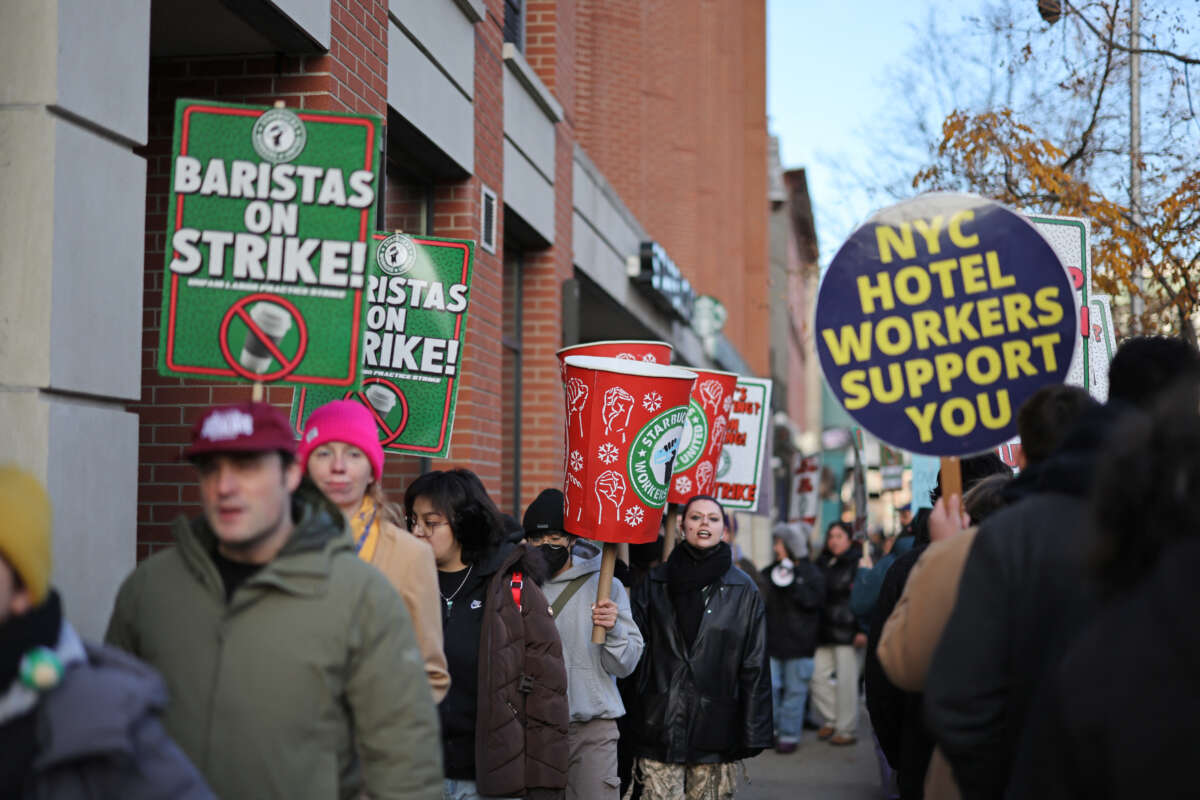
Striking Starbucks workers walk the picket line in New York on December 1, 2025.ANGELA WEISS / AFP via Getty Images
Despite a hostile labor environment, the number of workers under a union contract in the U.S. reached a 16-year high in 2025, and public support for unions hit as high as 71 percent. The labor movement secured a number of impressive victories, including a new contract for dockworkers that raised wages by 60 percent following a brief strike, and unionized journalists at Politico and E&E News (PEN Guild) won an arbitration case against the company’s management over its adoption of artificial intelligence tools. Yet, the far greater union growth and coordinated working-class power that can systemically challenge the agenda of the ruling class remains elusive. In his “State of the U.S. Unions 2026” report, labor movement researcher Eric Dirnbach noted half of all union members live in just seven states, which he referred to as alarming numbers that represent a long-term existential crisis for the labor movement. “The decline of the labor movement,” he writes, “is no doubt one of the factors that have enabled Trumpism to capture the nation.”
In Unions of Our Own, longtime labor organizer Daniel Gross suggests the type of power that can challenge the ruling class may emerge when workers themselves — not union officials — design and refine unions that meet their needs. The new book introduces an accessible step-by-step union model framework to help workers take on the task of building unions that actually work for them, informed by decades of Gross’s own organizing experience — including as a founding member of the Industrial Workers of the World Starbucks Workers Union in 2004 — and countless conversations with other worker-organizers. Bringing together insights that have achieved victories going back over a century, the union model framework is being used by a growing community of workers in diverse industries.
In the conversation that follows, Gross discusses the eight building blocks of unions outlined in Unions of Our Own, the difference between union organizing and union building, solidarity unionism versus traditional unionism, and lessons learned from the era when capitalists and the state repressed solidarity unionism.
This interview has been lightly edited for length and clarity.
Ella Fassler: So, to start, why did you decide to write Unions of Our Own? Was there a gap in the literature about unions you were trying to fill?
The State Is Escalating Charges Against Protesters. Labor Must Defend Them.
John Caravello is facing decades in prison for an anti-ICE protest. He needs labor to build a national defense campaign. By Blanca Missé , Truthout March 11, 2026
Daniel Gross: Yeah, I think two things came together. One, I am just really blessed from the work I’ve gotten to do in my life to connect with a lot of visionary workers that want to do unionism where they work and in their industries. They want to do unionism grounded in racial and gender justice. They’re concerned, in many cases, about capitalism, and they, of course, want to win. And the thing that just comes up again and again are the questions: Can unionism be done in a different way? Can we have our own union? Can our values be deeply embedded in the union, with respect to how we want to be at work, but also regarding how our companies show up in the world?

I’ve been doing this work for a minute and I have learned a bunch. First of all, by failures. My first foray into the labor movement was definitely a swing and a miss at Borders bookstore around 2000. That experience started a journey where I became obsessed with questions like, “What does it take to maximize the chance of victory?” Through my own experience accompanying others, and then really nerding out on a large number of historic and contemporary campaigns, I found that there are these eight building blocks to building and sustaining unions that really deliver needs to workers.
You joke that the book isn’t a beach read meant for entertainment — it’s clearly one that’s geared toward taking action, and the book’s structure, along the lines of those eight building blocks, makes that clear. Can you talk a little bit more about what they are?
Yeah, absolutely. It gets to the second part in the prior question, you know, what’s out there? Of course, you don’t want to duplicate good work already being done. I had many questions during many conversations with workers: “Hey, what resources are you finding out there? What are you not finding out there?” And then, of course, my own observation of what’s going on. There are many really good resource books out there. What I found, though, is that these books are largely about union organizing. They answer the questions: How do we get a structure of co-workers together, carry out a plan, and win our demands?
To kind of put it in simple terms, organizing is the heart of those books.
But really to safeguard and make sure that organizing actually works and is sustained over time — that requires something bigger. In the book, I call that bigger piece union building. That piece is not out there. Union building, for example, involves assessing various mechanisms for holding worker gains. Traditional collective bargaining agreements are considered one mechanism, but there are many others. I think the implicit idea with the union organizing framework has been that considering these types of things are above the pay grade of co-workers on the job. The assumption has been that there are professionals who will worry about that and who make those decisions for them. Unions of Our Own is trying to wrest open those fundamental questions and decision-making spaces for workers.
The other piece: A lot of what’s out there, as good as it is, has the implication that there is one method of organizing, it’s tried and true, and the problem is that we’re just not doing it well enough. We have to train more. We have to be more disciplined. We have to run the recipe all the way. There are good people that promote this. It’s not bad or shady, but I just fundamentally have not seen it to be true that there is a certain method and you can just carry it out like a checklist and then you’ll have your needs met, your vision is going to be expressed in the world, and you’re going to have a sustainable union.
Even with all the great training, initiatives, and ideas and strategies and money being expended, there’s been a 70- to 80-year decline in labor unionism in the United States. Once a certain traditional model of unionism consolidated — we’re talking around 1950 — as the hegemon, to use that big word, unionism has been on decline. If there’s one really, really central belief in the book, it’s actually that co-workers are best positioned to figure out their own successful union models, and they actually have a really unique power to be able to do that well by virtue of being workers.
On the other hand, we’ve seen that starting with a blank slate is not a good idea. It doesn’t work. It doesn’t work because it’s really hard, and if we do it that way, we’re cut off from working-class wisdom that exists today that has come before.
Co-workers are best positioned to figure out their own successful union models, and they actually have a really unique power to be able to do that well by virtue of being workers.
So what the book offers up is neither the cookie-cutter nor the blank-slate approach. It’s saying here’s a framework. The eight blocks of the framework are: constituency, problem, solution, strategy, mechanism, structure, funding, and metrics. The framework is about having the context to know where there’s big decisions you have to make, and helps you test those decisions out.
Yeah, it seems to offer a Middle Way approach, to use a Buddhist analogy, which I think you referenced in the book.
At least I know one reader will appreciate that!
So, as long as I’ve known you, you’ve been an advocate of rank-and-file unionism as opposed to traditional unionism. How do you relate to, or introduce, these different union models in your book? Do you encourage rank-and-file unionism?
Yes, absolutely. So yes, I’m definitely a rank-and-file unionist. That’s been the through line. I got lucky in a way. That’s the tradition I connected in right away from the beginning. The book doesn’t hide the type of unionism I believe in, but I don’t dismiss any union form in the book. Really, what it does is tee up for workers to be able to have that debate, to be able to have that discussion and test out a particular model. What I’m really against is this idea that there are forces not on the shop floor who have taken away that decision-making space.
I say this explicitly in the book: Whatever vision a group of co-workers wants to pursue, they’re going to have my full support and my full respect, but at least they’ll have the ability to weigh their options.
There are many types of unionisms out there. Social movement unionism, community unionism, open-source unionism, class struggle unionism. Every day someone invents a new unionism. What the book is saying is that, yes, there are all those types, but the first decision tree is really between two types: traditional unionism and solidarity unionism.
Traditional unionism will have the hard structural elements of representational type of unionism. It’s the kind of unionism where the goal is around an exclusive collective bargaining agreement with a certain type of provisions that have to do with how the union is funded.
And then solidarity unionism is directly led and operated by workers. It’s not a representational model, and that has really major ramifications. It has a preference for direct action. They both have pros and cons. I get into both in the book.
I think this is going to be one of the more (hopefully) important parts of the book — to really open up that question to workers. Because typically you connect with some resource, or some union connects with you, and all of that decision-making, all that thinking, it’s already been done for them. No one’s like, “Hey, what type of union do you want to form?” They mostly say, “We’re going to organize you into our union.”
Imagine solidarity unionism really does expand in the U.S. What do you think are the most important lessons we could take from the era when it was more prominent in the early 1900s, but was ultimately repressed and co-opted, to ensure we don’t make the same mistakes today?
Solidarity unions need to make these types of unions more sustainable. That’s been the knot on solidarity unionism. The critique is often overplayed, or overstated, and there is a lot of straw-manning of solidarity unionism, but it is also the most important critique of solidarity unionism.
The book is obsessed with sustainability. My argument is that it really takes these eight building blocks working together and working in their own right so we have a union that renews itself. That’s really what sustainability is. It has to renew itself over time. We need unions where we’re creating value by solving yesterday’s injustices, but also where we can expect value for each other in the future. How we hold our gains, and how we tie those things to membership experience is a key part.
The other part, which I get into the book as well, is the question of repression. The reality is that solidarity unionism was taken down partially from outright murder, kidnapping, imprisonment, deportation, and destruction of materials, records, and literature. I try to use the most concrete language possible to just wake us up. It is very, very, very devastating. What I found, sadly, while looking at labor trends in many countries around the world, is that there’s still assassination, kidnapping, and violence and threats against families today. Colombia is a standout.
So I think we need to try to preempt these forms of repression. One of the ways to preempt it is really to think about the first element of the model I get into called constituency. How do we think about the different segments of society, the different groups, different individuals that we bring together into our models, our unions? That connectedness to other groups can make a union harder to repress. It is important to have explicit preemptive strategies against repression.
And then, of course, you need strategies for active defense and responsiveness to repression because you’re not going to be able to preempt it all.
It can be hard to feel hopeful about labor organizing with that horrifying history, and grim ongoing reality for many workers, in mind. I saw you were described as a very “optimistic” organizer in a blurb about Unions of Our Own. So, I’m wondering, what are the most hopeful labor movement trends that you’re seeing right now?
Yeah, I laugh at that “optimistic” part because a lot of people say that to me. I am a pretty optimistic person. I guess that’s a compliment. I don’t know about that. I think what I’m endlessly hopeful about is the quest for freedom and the desire for freedom and dignity.
But to get to your question more specifically, I am optimistic about the labor movement. Definitely in recent years, the turn to unionism, as I mentioned in the book, has been absolutely undeniable. There is motion in the working class in the U.S. Every month there’s a new group of workers that have always been exploited getting organized. Just in my personal trajectory, I can tell you, it’s like living on a different planet. I’m from the generation when there was one labor reporter at a large national publication. There was one dude! Now, thankfully, I can’t get through the amount of excellent labor reporting that takes place in any given week.
Every month there’s a new group of workers that have always been exploited getting organized.
Then there’s the big but, right? The big but is that the vast, vast majority of us are still screwed at work and are mostly unorganized as a working class. And that means we are screwed in society. We have the oligarch theft of a pretty unfathomable proportion of resources and power and water and land. So, with all this motion, this commendable, undeniable motion, we still have not seen that growth in unionism and working-class power that one would want to see.
It is a great honor to try to bring something into the mix that actually says the wisdom, the answers and the journey to test and refine those answers, comes from folks employed together on the shop floor. The more we can be clear about that, the more we could take down the myth that a lawyer or professionals are going to be the ones that can get you out of the predicament. The more we can challenge that notion, the better.
Beautifully said. Thank you so much for your time, and for your commitment to struggle. As we wrap up, where can people find you and Unions of Our Own?
From the book’s website, folks can purchase the book, access ready-to-use tools for free, register for companion trainings, and even get confidential one-on-one support to deal with problems at work. They can also follow me on Bluesky.
This article is licensed under Creative Commons (CC BY-NC-ND 4.0), and you are free to share and republish under the terms of the license.

Ella Fassler
Ella Fassler is an independent journalist based in Providence, Rhode Island. Their work on social movements, labor, technology and the carceral system has been featured in Teen Vogue, The Boston Globe, The Nation, Vice, The Appeal, Slate, Mic, In These Times, and elsewhere. Follow them on Twitter or Bluesky.

No comments:
Post a Comment